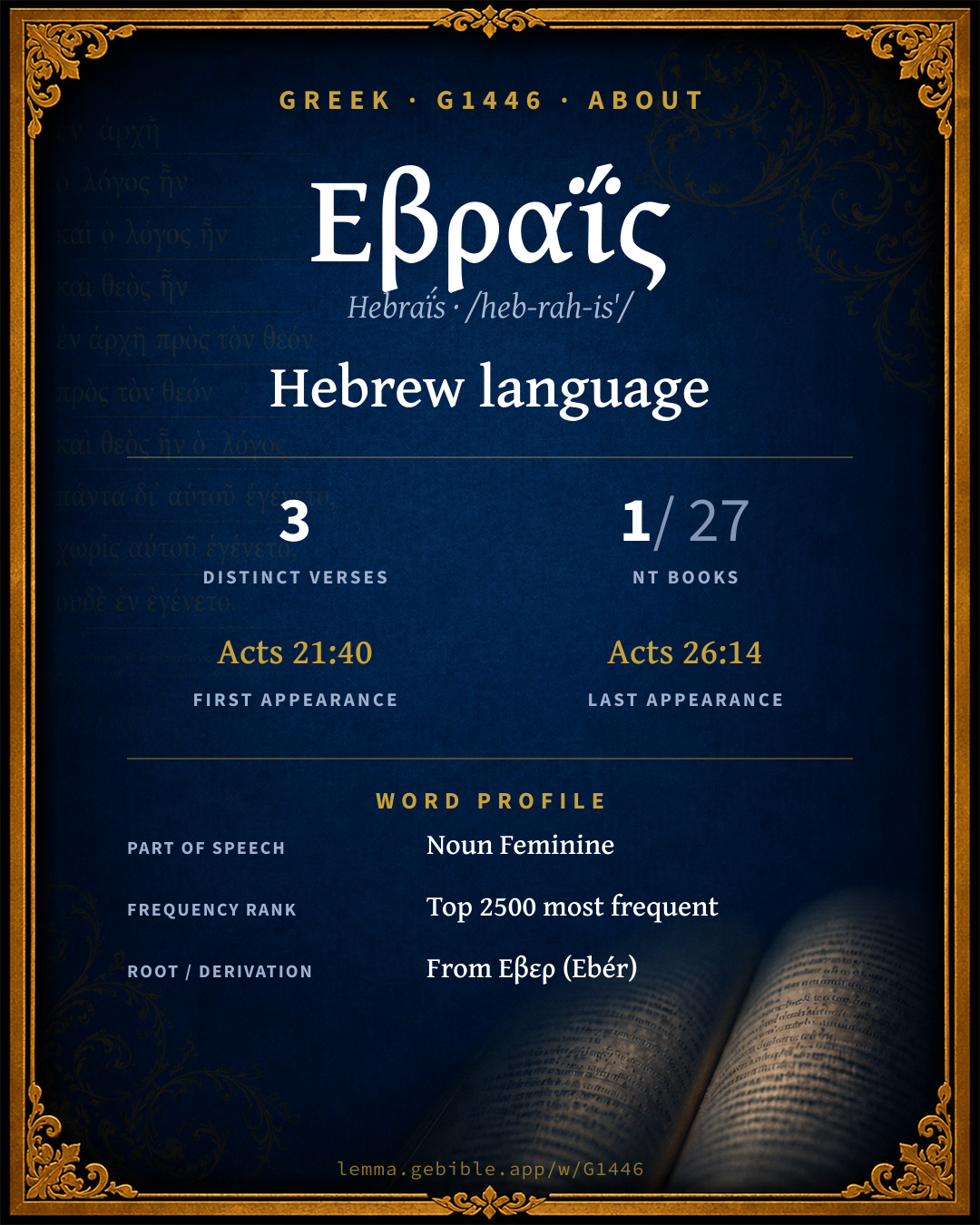
Ἑβραΐ́ς
Hebrew language
Full lexicon entry — Thayer's Greek Lexicon
From Thayer's Greek Lexicon
Where this word appears
Grammar key — what these labels mean
Part of speech
- Noun
- A naming word — a person, place, thing, or idea.
Case
- Dative
- The case of the indirect object, means, or location — “to / for / with / in.”
Gender
- Feminine
- Grammatically feminine.
Number
- Singular
- One.
Every verse where G1446 appears — 3 distinct verses across 1 book. Click any verse to open its interlinear word-by-word view. Verse text shown in the World English Bible for context — . Each verse’s Greek form is shown with its reference; the English is not keyword-highlighted, since the data carries no word-level English alignment. Use “Compare translations” on any verse to read it across multiple English versions. This concordance covers the Greek New Testament; Septuagint (Greek Old Testament) occurrences of this word are not indexed here.
Acts 3 verses
- Acts 21:40 Ἑβραΐδι n dat sg fem When he had given him permission, Paul, standing on the stairs, beckoned with his hand to the people. When there was a great silence, he spoke to them in the Hebrew language, saying,
- Acts 22:2 Ἑβραΐδι n dat sg fem When they heard that he spoke to them in the Hebrew language, they were even more quiet. He said,
- Acts 26:14 Ἑβραΐδι n dat sg fem When we had all fallen to the earth, I heard a voice saying to me in the Hebrew language, 'Saul, Saul, why are you persecuting me? It is hard for you to kick against the goads.'
About this entry
At a glance — auto-summarized from this page’s data, not written by a person. Every figure links to its source below. This summary describes the numbers; it doesn’t interpret them.
At its core, Εβραΐς (Hebraḯs) means “Hebrew language.” The Greek New Testament uses it only 3 verses. Its uses cluster heavily in Acts (100% of all occurrences). Scripture first uses it in Acts 21:40. Each statement above links to its evidence; the full detail follows below.
Gloss history
Strong's 1890 vs modern scholarship
About this word
Strong's G1446 catalogs a Greek word from the Greek New Testament.
These counts are not copied from any lexicon or concordance. They are computed here, from the morphology-tagged Greek New Testament. What Lemma adds →
- 3
- distinct verses
- The word appears in 3 distinct verses.
- 1 / 27
- NT books
- The word appears in 1 of 27 New Testament books.
- #2,203
- by frequency
- Top 2500 most frequent Greek words (rank 2,203 of 5,347 Greek words by occurrence).
View all 3 occurrences in the concordance →
Most concentrated in
- Acts 3 verses 100%
By section of the New Testament
By traditional corpus
Conventional, traditional groupings — biblical authorship is debated, so this is a traditional corpus grouping, not an authorship claim. Some books belong to more than one corpus (Luke is in both the Gospels and the Lukan corpus, and so on), so these shares overlap and need not total 100%. Each figure is a share of the word’s 3 distinct verses.
- Lukan (Luke–Acts) 3 verses · 100%
How translations render this word
Counts come from each version’s own published word-to-Strong’s tagging or interlinear alignment — an approximate guide to how each version renders this word, not a word-level alignment the data otherwise carries. Because each total is that version’s own tagged count, the per-version totals vary from one another and need not match the appearance or distinct-verse counts above. These counts may also differ from a printed concordance because Lemma counts each distinctly tagged rendering and does not collapse phrase taggings into a single head-word total. This is a fixed set of word-tagged versions (KJV, ASV, BSB, ULT) and does not change with the reading translation you choose elsewhere. Each version’s license is shown beside its name below (and on Sources).
- King James Version: Hebrew 3×
- American Standard Version: Hebrew 2×
- Berean Standard Bible: Hebrew 3×
- unfoldingWord Literal Text: Hebrew 3×
King James Version Public Domain
Renders G1446 across 3 tagged occurrences — most commonly:
American Standard Version Public Domain
Renders G1446 across 3 tagged occurrences — most commonly:
Plus 1 rendering that appears only once — usually multi-word phrases or single function words the recovered tagging swept in, not distinct renderings.
Berean Standard Bible Public Domain
Renders G1446 across 3 tagged occurrences — most commonly:
unfoldingWord Literal Text CC BY-SA 4.0
Renders G1446 across 3 tagged occurrences — most commonly:
Senses in Thayer's
The 1 sense Thayer's distinguishes for this word, in lexicon order (not ranked by frequency or importance). The full entry — with sub-senses — is in the Lexicon Entry tab.
- Hebrew…
Word origin
Derived from Εβερ (Ebér) (G1443) — Shelah.
From G1443 ; the hebraistic (that is hebrew ) or Jewish ( Chaldee ) language : - Hebrew.
— Strong’s Exhaustive Concordance (1890), public domain.
Same root — word family
Other Thayer's entries built from the same root as G1446, grouped by Strong’s listed origin. These share a root / origin per the lexicon — not necessarily a shared meaning. Each links to that word’s own entry.
Derives from
Derived from this word
Proper names from this root
People and places named from this root — a name, not an additional meaning of the word.
Compare all same-root words → Showing 4 of 5 — not the complete family. 3 of the same-root words are proper names (people or places). They share a root, not necessarily a meaning.
Bible dictionary
Public-domain dictionary articles matched to this entry by name (Hebrew language). A biblical name can be shared by more than one person or place, so an article may treat several.
Easton's Bible Dictionary · M. G. Easton, 1897
The language of the Hebrew nation, and that in which the Old Testament is written, with the exception of a few portions in Chaldee. In the Old Testament it is only spoken of as "Jewish" (2 Kings 18:26, 28; Isa. 36:11, 13; 2 Chr 32:18). This name is first used by the Jews in times subsequent to the close of the Old Testament.
It is one of the class of languages called Semitic, because they were chiefly spoken among the descendants of Shem.
When Abraham entered Canaan it is obvious that he found the language of its inhabitants closely allied to his own. Isaiah (19:18) calls it "the language of Canaan." Whether this language, as seen in the earliest books of the Old Testament, was the very dialect which Abraham brought with him into Canaan, or whether it was the common tongue of the Canaanitish nations which he only adopted, is uncertain; probably the latter opinion is the correct one. For the thousand years between Moses and the Babylonian exile the Hebrew language underwent little or no modification. It preserves all through a remarkable uniformity of structure. From the first it appears in its full maturity of development. But through intercourse with Damascus, Assyria, and Babylon, from the time of David, and more particularly from the period of the Exile, it comes under the influence of the Aramaic idiom, and this is seen in the writings which date from this period. It was never spoken in its purity by the Jews after their return from Babylon. They now spoke Hebrew with a large admixture of Aramaic or Chaldee, which latterly became the predominant element in the national language.
The Hebrew of the Old Testament has only about six thousand words, all derived from about five hundred roots. Hence the same word has sometimes a great variety of meanings. So long as it was a living language, and for ages after, only the consonants of the words were written. This also has been a source of difficulty in interpreting certain words, for the meaning varies according to the vowels which may be supplied. The Hebrew is one of the oldest languages of which we have any knowledge. It is essentially identical with the Phoenician language. (See MOABITE STONE.) The Semitic languages, to which class the Hebrew and Phoenician belonged, were spoken over a very wide area: in Babylonia, Mesopotamia, Syria, Palestine and Arabia, in all the countries from the Mediterranean to the borders of Assyria, and from the mountains of Armenia to the Indian Ocean. The rounded form of the letters, as seen in the Moabite stone, was probably that in which the ancient Hebrew was written down to the time of the Exile, when the present square or Chaldean form was adopted.
Smith's Bible Dictionary · William Smith, 1863
The books of the Old Testament are written almost entirely in the Hebrew language. It is a branch of the Shemitic language, one of the three great divisions into which all languages have been reduced. It is one of the earliest of known languages, and some suppose that it was the original language of man.
Classic public-domain reference works; full attribution on Sources.