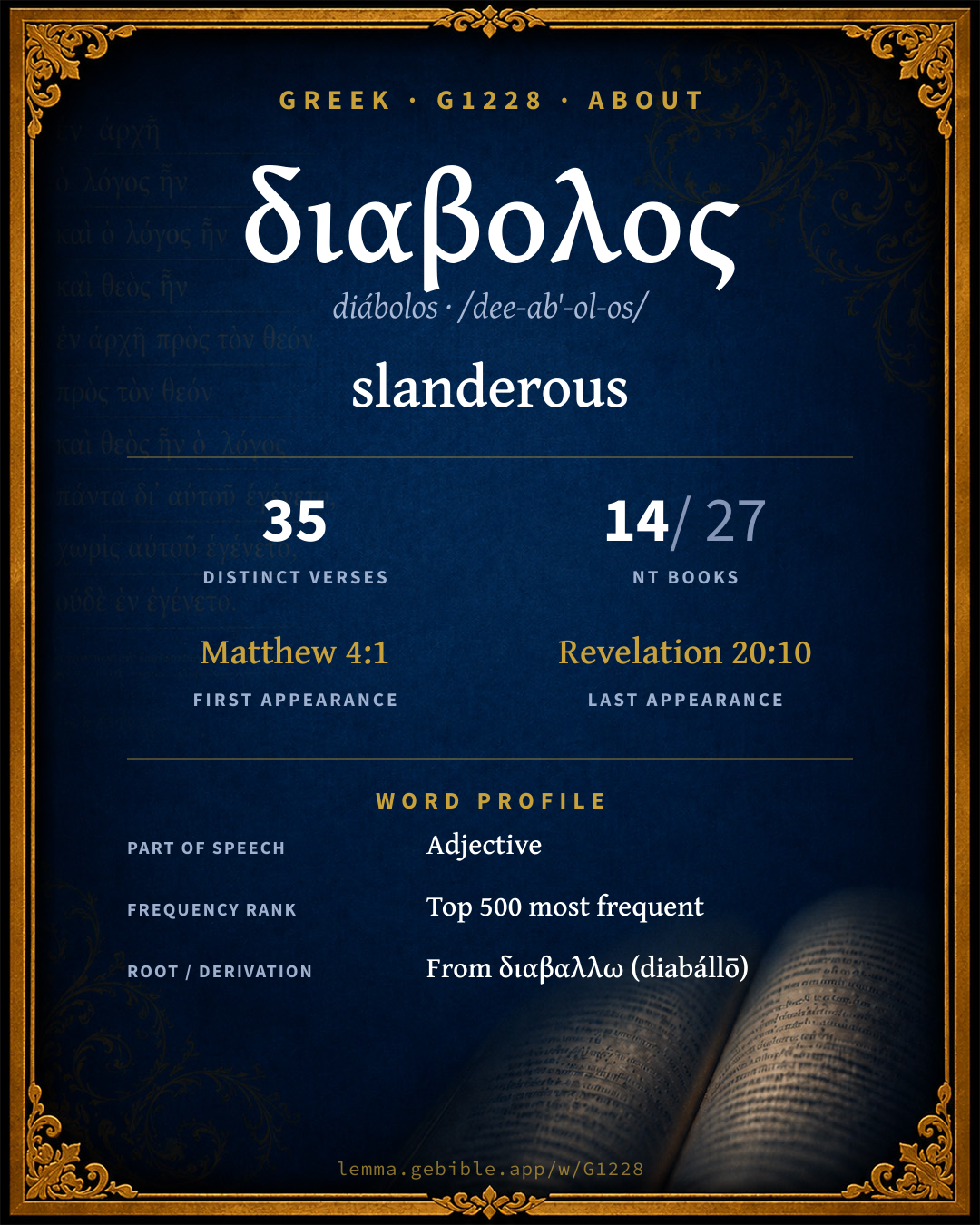
διάβολος
slanderous
also: prone to slander, accusing falsely fuller range ↓
Full lexicon entry — Thayer's Greek Lexicon
From Thayer's Greek Lexicon
Where this word appears
See every Nominative-case word in the Greek New Testament →
Grammar key — what these labels mean
Part of speech
- Adjective
- A word that describes or qualifies a noun.
Case
- Nominative
- The case of the subject (and the predicate nominative).
- Genitive
- The case of source, possession, or “of” — answers “whose / from what.”
- Dative
- The case of the indirect object, means, or location — “to / for / with / in.”
- Accusative
- The case of the direct object and of extent.
Gender
- Masculine
- Grammatically masculine.
- Feminine
- Grammatically feminine.
Number
- Singular
- One.
- Plural
- More than one.
Grammatical forms
- Adjective, Nominative, Singular, Masculine 16 times (43%)
- Adjective, Genitive, Singular, Masculine 13 times (35%)
- Adjective, Dative, Singular, Masculine 4 times (11%)
- Adjective, Accusative, Plural, Feminine 2 times (5%)
- Adjective, Accusative, Singular, Masculine 1 time (3%)
- Adjective, Nominative, Plural, Masculine 1 time (3%)
Parsed forms decoded from the imported morphology (Robinson–Tischendorf, public domain), counted across 37 parsed occurrences — not distinct verses.
Every verse where G1228 appears — 35 distinct verses across 14 books. Click any verse to open its interlinear word-by-word view. Verse text shown in the World English Bible for context — . Each verse’s Greek form is shown with its reference; the English is not keyword-highlighted, since the data carries no word-level English alignment. Use “Compare translations” on any verse to read it across multiple English versions. This concordance covers the Greek New Testament; Septuagint (Greek Old Testament) occurrences of this word are not indexed here.
Matthew 6 verses
- Matthew 4:1 διαβόλου adj gen sg masc Then Jesus was led up by the Spirit into the wilderness to be tempted by the devil.
- Matthew 4:5 διάβολος adj nom sg masc Then the devil took him into the holy city. He set him on the pinnacle of the temple,
- Matthew 4:8 διάβολος adj nom sg masc Again, the devil took him to an exceedingly high mountain, and showed him all the kingdoms of the world, and their glory.
- Matthew 4:11 διάβολος adj nom sg masc Then the devil left him, and behold, angels came and ministered to him.
- Matthew 13:39 διάβολος adj nom sg masc The enemy who sowed them is the devil. The harvest is the end of the age, and the reapers are angels.
- Matthew 25:41 διαβόλῳ adj dat sg masc Then he will say also to those on the left hand, 'Depart from me, you cursed, into the eternal fire which is prepared for the devil and his angels;
Luke 5 verses
- Luke 4:2 διαβόλου adj gen sg masc for forty days, being tempted by the devil. He ate nothing in those days. Afterward, when they were completed, he was hungry.
- Luke 4:3 διάβολος adj nom sg masc The devil said to him, "If you are the Son of God, command this stone to become bread."
- Luke 4:6 διάβολος adj nom sg masc The devil said to him, "I will give you all this authority, and their glory, for it has been delivered to me; and I give it to whomever I want.
- Luke 4:13 διάβολος adj nom sg masc When the devil had completed every temptation, he departed from him until another time.
- Luke 8:12 διάβολος adj nom sg masc Those along the road are those who hear, then the devil comes, and takes away the word from their heart, that they may not believe and be saved.
John 3 verses
- John 6:70 διάβολός adj nom sg masc Jesus answered them, "Didn't I choose you, the twelve, and one of you is a devil?"
- John 8:44 διαβόλου adj gen sg masc You are of your Father, the devil, and you want to do the desires of your father. He was a murderer from the beginning, and doesn't stand in the truth, because there is no truth in him. When he speaks a lie, he speaks on his own; for he is a liar, and the father of it.
- John 13:2 διαβόλου adj gen sg masc After supper, the devil having already put into the heart of Judas Iscariot, Simon's son, to betray him,
Acts 2 verses
- Acts 10:38 διαβόλου adj gen sg masc even Jesus of Nazareth, how God anointed him with the Holy Spirit and with power, who went about doing good and healing all who were oppressed by the devil, for God was with him.
- Acts 13:10 διαβόλου adj gen sg masc and said, "Full of all deceit and all cunning, you son of the devil, you enemy of all righteousness, will you not cease to pervert the right ways of the Lord?
Ephesians 2 verses
1 Timothy 3 verses
- 1 Timothy 3:6 διαβόλου adj gen sg masc not a new convert, lest being puffed up he fall into the same condemnation as the devil.
- 1 Timothy 3:7 διαβόλου adj gen sg masc Moreover he must have good testimony from those who are outside, to avoid falling into reproach and the snare of the devil.
- 1 Timothy 3:11 διαβόλους adj acc pl fem Their wives in the same way must be reverent, not slanderers, temperate, faithful in all things.
2 Timothy 2 verses
Titus 1 verse
Hebrews 1 verse
James 1 verse
1 Peter 1 verse
1 John 2 verses
- 1 John 3:8 διαβόλου διάβολος διαβόλου adj gen sg masc adj nom sg masc adj gen sg masc He who sins is of the devil, for the devil has been sinning from the beginning. To this end the Son of God was revealed, that he might destroy the works of the devil.
- 1 John 3:10 διαβόλου adj gen sg masc In this the children of God are revealed, and the children of the devil. Whoever doesn't do righteousness is not of God, neither is he who doesn't love his brother.
Jude 1 verse
Revelation 5 verses
- Revelation 2:10 διάβολος adj nom sg masc Don't be afraid of the things which you are about to suffer. Behold, the devil is about to throw some of you into prison, that you may be tested; and you will have oppression for ten days. Be faithful to death, and I will give you the crown of life.
- Revelation 12:9 διάβολος adj nom sg masc The great dragon was thrown down, the old serpent, he who is called the devil and Satan, the deceiver of the whole world. He was thrown down to the earth, and his angels were thrown down with him.
- Revelation 12:12 διάβολος adj nom sg masc Therefore rejoice, heavens, and you who dwell in them. Woe to the earth and to the sea, because the devil has gone down to you, having great wrath, knowing that he has but a short time."
- Revelation 20:2 διάβολος adj nom sg masc He seized the dragon, the old serpent, which is the devil and Satan, who deceives the whole inhabited earth, and bound him for a thousand years,
- Revelation 20:10 διάβολος adj nom sg masc The devil who deceived them was thrown into the lake of fire and sulfur, where the beast and the false prophet are also. They will be tormented day and night forever and ever.
About this entry
At a glance — auto-summarized from this page’s data, not written by a person. Every figure links to its source below. This summary describes the numbers; it doesn’t interpret them.
διαβολος — transliterated diábolos — is a Greek adjective carrying the sense “slanderous.” Its earliest occurrence is Matthew 4:1. Spanning 35 verses in 14 books, it ranks among the moderately common words of the Greek New Testament. Thayer's distinguishes 2 senses; alongside “slanderous” it spans “prone to slander” and “accusing falsely”. Sharing its root, it stands alongside διαβαλλω and διαφθειρω. Each statement above links to its evidence; the full detail follows below.
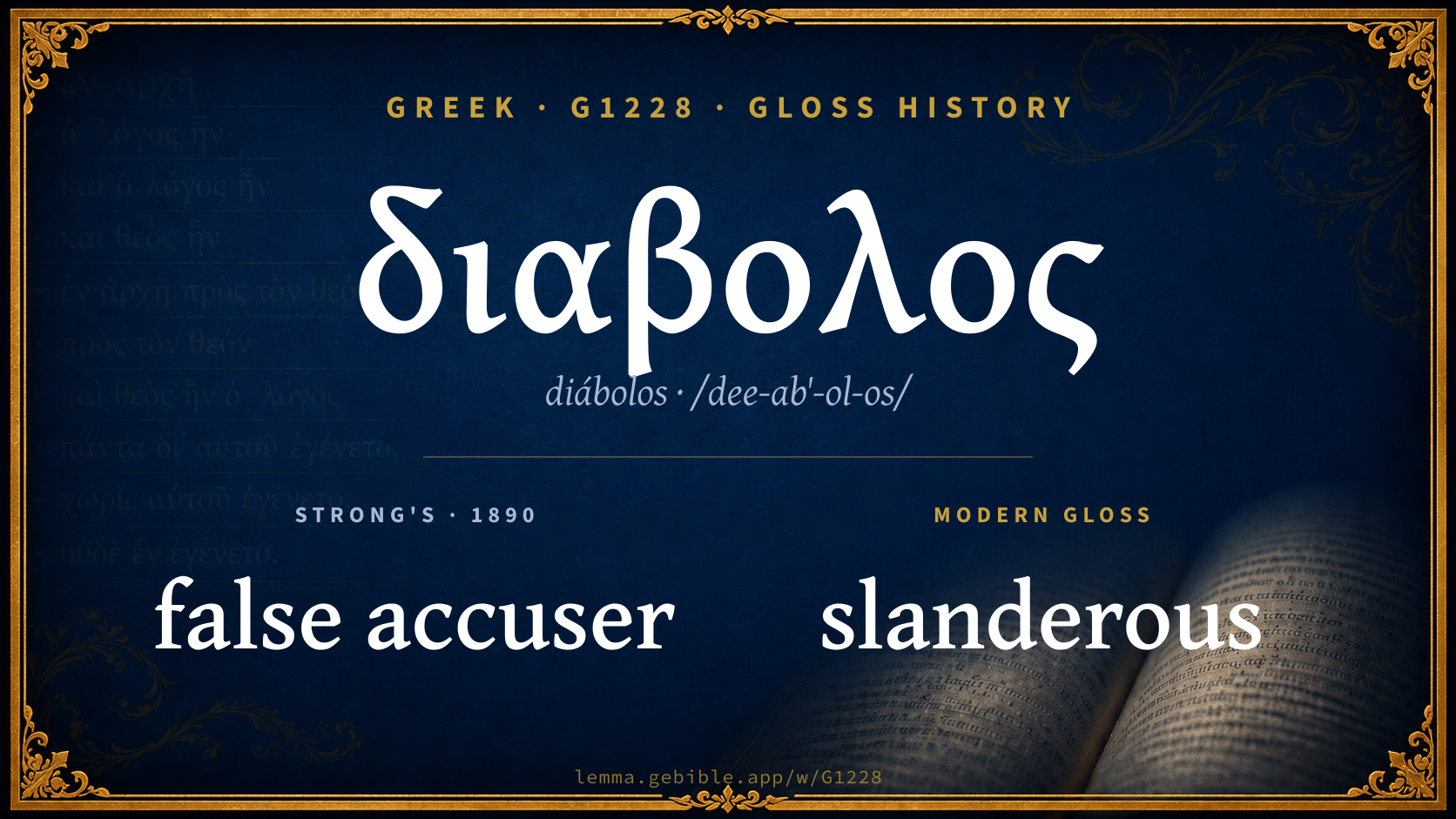
Gloss history
Strong's 1890 vs modern scholarship
About this word
Strong's G1228 catalogs a Greek word from the Greek New Testament.
These counts are not copied from any lexicon or concordance. They are computed here, from the morphology-tagged Greek New Testament. What Lemma adds →
- 35
- distinct verses
- The word appears in 35 distinct verses.
- 14 / 27
- NT books
- The word appears in 14 of 27 New Testament books.
- #397
- by frequency
- Top 500 most frequent Greek words (rank 397 of 5,347 Greek words by occurrence).
View all 35 occurrences in the concordance →
Most concentrated in
- Matthew 6 verses 17%
- Luke 5 verses 14%
- Revelation 5 verses 14%
By section of the New Testament
By traditional corpus
Conventional, traditional groupings — biblical authorship is debated, so this is a traditional corpus grouping, not an authorship claim. Some books belong to more than one corpus (Luke is in both the Gospels and the Lukan corpus, and so on), so these shares overlap and need not total 100%. Each figure is a share of the word’s 35 distinct verses.
- Gospels 14 verses · 40%
- Johannine 10 verses · 29%
- Pauline corpus 8 verses · 23%
- Lukan (Luke–Acts) 7 verses · 20%
- General (Catholic) Epistles 5 verses · 14%
- Revelation 5 verses · 14%
- Hebrews 1 verse · 3%
How translations render this word
Counts come from each version’s own published word-to-Strong’s tagging or interlinear alignment — an approximate guide to how each version renders this word, not a word-level alignment the data otherwise carries. Because each total is that version’s own tagged count, the per-version totals vary from one another and need not match the appearance or distinct-verse counts above. These counts may also differ from a printed concordance because Lemma counts each distinctly tagged rendering and does not collapse phrase taggings into a single head-word total. This is a fixed set of word-tagged versions (KJV, ASV, BSB, ULT) and does not change with the reading translation you choose elsewhere. Each version’s license is shown beside its name below (and on Sources).
- King James Version: Devil 35×, False accusers 2×
- American Standard Version: Devil 32×, Slanderers 3×
- Berean Standard Bible: Devil 32×, Slanderers 2×
- unfoldingWord Literal Text: Devil 33×, Slanderers 2×
King James Version Public Domain
Renders G1228 across 38 tagged occurrences — most commonly:
Plus 1 rendering that appears only once — usually multi-word phrases or single function words the recovered tagging swept in, not distinct renderings.
American Standard Version Public Domain
Renders G1228 across 36 tagged occurrences — most commonly:
Plus 1 rendering that appears only once — usually multi-word phrases or single function words the recovered tagging swept in, not distinct renderings.
Berean Standard Bible Public Domain
Renders G1228 across 36 tagged occurrences — most commonly:
Plus 2 renderings that appear only once — usually multi-word phrases or single function words the recovered tagging swept in, not distinct renderings. Not rendered by a distinct English word in 1 further occurrence.
unfoldingWord Literal Text CC BY-SA 4.0
Renders G1228 across 37 tagged occurrences — most commonly:
Plus 2 renderings that appear only once — usually multi-word phrases or single function words the recovered tagging swept in, not distinct renderings.
Senses in Thayer's
The 2 senses Thayer's distinguishes for this word, in lexicon order (not ranked by frequency or importance). The full entry — with sub-senses — is in the Lexicon Entry tab.
- prone to slander, slanderous, accusing falsely
- metaph. applied to a man who, by opposing the cause of God, may be said to act the part of the devil or to side with him
Word origin
Derived from διαβαλλω (diabállō) (G1225) — to slander.
Forms in the corpus
The 7 distinct written forms G1228 takes in the Greek New Testament, most frequent first — each parse links to that case’s occurrences in the concordance.
| Form | Parsing | Example | Uses |
|---|---|---|---|
| διάβολος diábolos | Adjective, Nominative, Singular, Masculine | Matthew 4:5 | 15 |
| διαβόλου diabólou | Adjective, Genitive, Singular, Masculine | Matthew 4:1 | 13 |
| διαβόλῳ diabólō | Adjective, Dative, Singular, Masculine | Matthew 25:41 | 4 |
| διαβόλους diabólous | Adjective, Accusative, Plural, Feminine | 1 Timothy 3:11 | 2 |
| διάβολοι diáboloi | Adjective, Nominative, Plural, Masculine | 2 Timothy 3:3 | 1 |
| διάβολον diábolon | Adjective, Accusative, Singular, Masculine | Hebrews 2:14 | 1 |
| διάβολός diábolós | Adjective, Nominative, Singular, Masculine | John 6:70 | 1 |
Same root — word family
Other Thayer's entries built from the same root as G1228, grouped by Strong’s listed origin. These share a root / origin per the lexicon — not necessarily a shared meaning. Each links to that word’s own entry.
Derives from
Shares the same root
Compare all same-root words → They share a root, not necessarily a meaning.
Septuagint usage
The same Greek word διαβολος appears 20 times in the Greek Old Testament (Septuagint), across 16 verses in 5 books.
- 20
- LXX occurrences
- Tagged occurrences of this Greek word in the Septuagint.
- 16
- verses
- Distinct Septuagint verses containing this word.
- 5 / 39
- OT books
- The word appears in 5 of the 39 Old Testament books.
Sample Septuagint occurrences
- 1 Chronicles 21:1 διάβολος
- Esther 7:4 διάβολος
- Job 1:6 διάβολος
- Psalms 108:6 διάβολος
- Zechariah 3:1 διάβολος
Septuagint occurrences (same lexeme)
Every verse where the same Strong’s number (G1228) appears in the Greek Septuagint. Verse text shown in the World English Bible for context; the Greek form is the matched word — the English is not keyword-highlighted.
- 1 Chronicles 21:1 διάβολος Satan stood up against Israel, and moved David to number Israel.
- Esther 7:4 διάβολος for we are sold, I and my people, to be destroyed, to be slain, and to perish. But if we had been sold for bondservants and bondmaids, I had held my peace, although the adversary could not have compensated for the king's damage.
- Esther 8:1 διάβολος On that day did the king Ahasuerus give the house of Haman the Jews' enemy to Esther the queen. Mordecai came before the king; for Esther had told what he was to her.
- Job 1:6 διάβολος Now it happened on the day when the sons of God came to present themselves before Yahweh, that Satan also came among them.
- Job 1:7 διάβολος Yahweh said to Satan, "Where have you come from?" Then Satan answered Yahweh, and said, "From going back and forth in the earth, and from walking up and down in it."
- Job 1:9 διάβολος Then Satan answered Yahweh, and said, "Does Job fear God for nothing?
- Job 1:12 διάβολος Yahweh said to Satan, "Behold, all that he has is in your power. Only on himself don't put forth your hand." So Satan went forth from the presence of Yahweh.
- Job 2:1 διάβολος Again it happened on the day when the sons of God came to present themselves before Yahweh, that Satan came also among them to present himself before Yahweh.
- Job 2:2 διάβολος Yahweh said to Satan, "Where have you come from?" Satan answered Yahweh, and said, "From going back and forth in the earth, and from walking up and down in it."
- Job 2:3 διάβολος Yahweh said to Satan, "Have you considered my servant Job? For there is none like him in the earth, a blameless and an upright man, one who fears God, and turns away from evil. He still maintains his integrity, although you incited me against him, to ruin him without cause."
- Job 2:4 διάβολος Satan answered Yahweh, and said, "Skin for skin. Yes, all that a man has will he give for his life.
- Job 2:6 διάβολος Yahweh said to Satan, "Behold, he is in your hand. Only spare his life."
- Job 2:7 διάβολος So Satan went forth from the presence of Yahweh, and struck Job with painful sores from the sole of his foot to his head.
- Psalms 108:6 διάβολος That your beloved may be delivered, Save with your right hand, and answer us.
- Zechariah 3:1 διάβολος He showed me Joshua the high priest standing before the angel of Yahweh, and Satan standing at his right hand to be his adversary.
- Zechariah 3:2 διάβολος Yahweh said to Satan, "Yahweh rebuke you, Satan! Yes, Yahweh who has chosen Jerusalem rebuke you! Isn't this a burning stick plucked out of the fire?"
These are occurrences of the same Greek lexeme (G1228) in the Septuagint — not a translation of any one Hebrew word. The store carries no word-level Hebrew↔Greek alignment, so no Hebrew original is asserted here. Counts come from the recovered LXX Strong's tagging — high-frequency vocabulary is well covered, while rare or late forms may be untagged — so they reflect tagged occurrences and may slightly undercount.