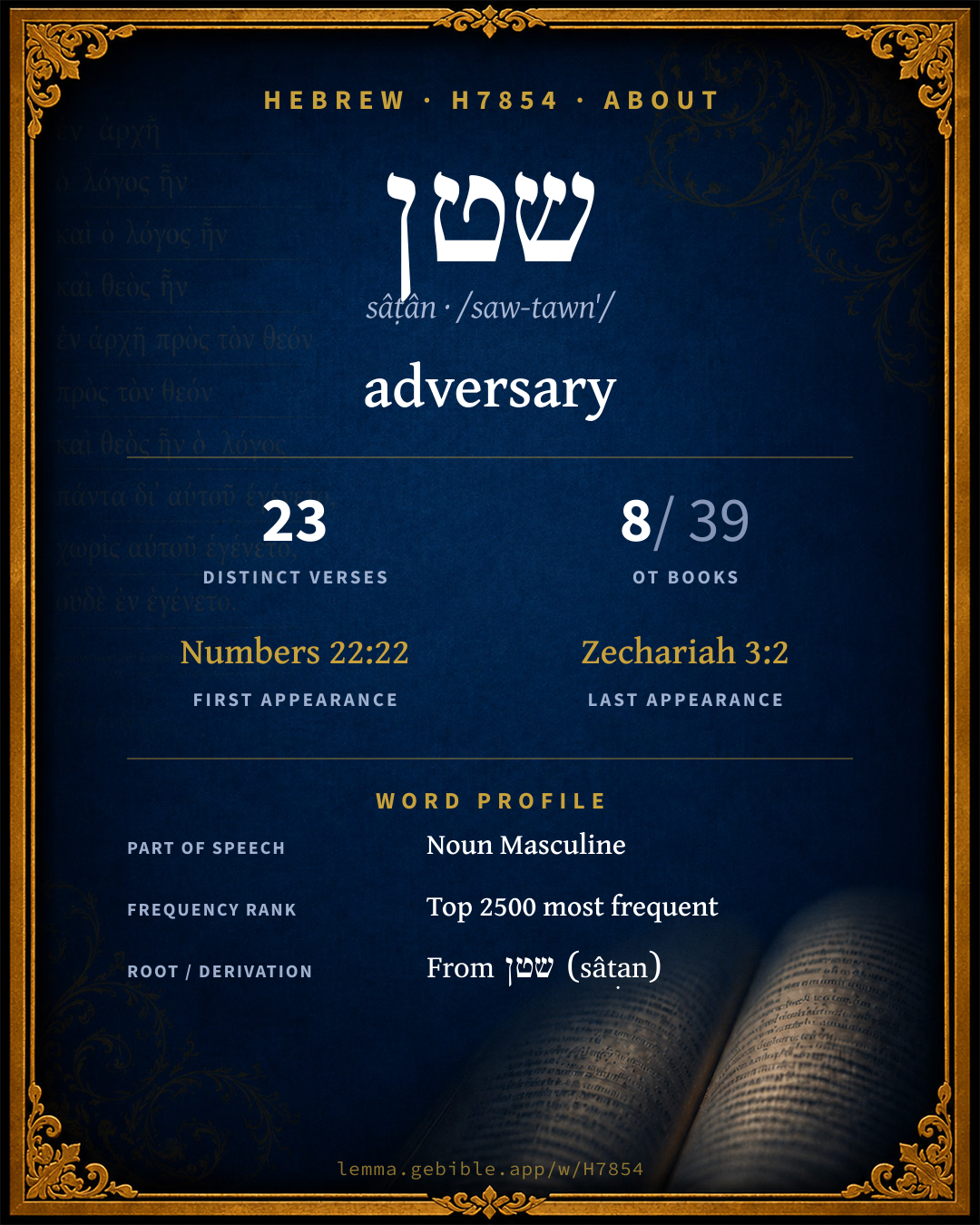
שָׂטָן
adversary
‘adversary’ is one of 2 main senses fuller range ↓
Full lexicon entry — Brown-Driver-Briggs (BDB)
From Brown-Driver-Briggs (BDB)
Where this word appears
Grammar key — what these labels mean
Part of speech
- Noun
- A naming word — a person, place, thing, or idea.
Noun type
- Common
- A common noun — a general class of person, place, or thing (“king,” “city,” “water”), not a specific name.
State
- Absolute
- The independent form of a noun, not bound to a following word.
Gender
- Masculine
- Grammatically masculine.
Number
- Singular
- One.
Every verse where H7854 appears — 23 distinct verses across 8 books. Click any verse to open its interlinear word-by-word view. Verse text shown in the World English Bible for context — . Each verse’s Hebrew form is shown with its reference; the English is not keyword-highlighted, since the data carries no word-level English alignment. Use “Compare translations” on any verse to read it across multiple English versions. This concordance covers the Hebrew Bible; Septuagint (Greek Old Testament) occurrences are not indexed here.
Numbers 2 verses
- Numbers 22:22 לְ/שָׂטָ֣ן prep + n c ms God's anger was kindled because he went; and the angel of Yahweh placed himself in the way for an adversary against him. Now he was riding on his donkey, and his two servants were with him.
- Numbers 22:32 לְ/שָׂטָ֔ן prep + n c ms The angel of Yahweh said to him, Why have you struck your donkey these three times? behold, I am come forth for an adversary, because your way is perverse before me:
1 Samuel 1 verse
2 Samuel 1 verse
1 Kings 4 verses
- 1 Kings 5:4 שָׂטָ֔ן n c ms But now Yahweh my God has given me rest on every side; there is neither adversary, nor evil occurrence.
- 1 Kings 11:14 שָׂטָן֙ n c ms Yahweh raised up an adversary to Solomon, Hadad the Edomite: he was of the king's seed in Edom.
- 1 Kings 11:23 שָׂטָ֔ן n c ms God raised up [another] adversary to him, Rezon the son of Eliada, who had fled from his lord Hadadezer king of Zobah.
- 1 Kings 11:25 שָׂטָ֤ן n c ms He was an adversary to Israel all the days of Solomon, besides the mischief that Hadad [did]: and he abhorred Israel, and reigned over Syria.
1 Chronicles 1 verse
Job 11 verses
- Job 1:6 הַ/שָּׂטָ֖ן ptcl def.art + n c ms Now it happened on the day when the sons of God came to present themselves before Yahweh, that Satan also came among them.
- Job 1:7 הַ/שָּׂטָ֖ן הַ/שָּׂטָ֤ן ptcl def.art + n c ms ptcl def.art + n c ms Yahweh said to Satan, "Where have you come from?" Then Satan answered Yahweh, and said, "From going back and forth in the earth, and from walking up and down in it."
- Job 1:8 הַ/שָּׂטָ֔ן ptcl def.art + n c ms Yahweh said to Satan, "Have you considered my servant, Job? For there is none like him in the earth, a blameless and an upright man, one who fears God, and turns away from evil."
- Job 1:9 הַ/שָּׂטָ֛ן ptcl def.art + n c ms Then Satan answered Yahweh, and said, "Does Job fear God for nothing?
- Job 1:12 הַ/שָּׂטָ֗ן הַ/שָּׂטָ֔ן ptcl def.art + n c ms ptcl def.art + n c ms Yahweh said to Satan, "Behold, all that he has is in your power. Only on himself don't put forth your hand." So Satan went forth from the presence of Yahweh.
- Job 2:1 הַ/שָּׂטָן֙ ptcl def.art + n c ms Again it happened on the day when the sons of God came to present themselves before Yahweh, that Satan came also among them to present himself before Yahweh.
- Job 2:2 הַ/שָּׂטָ֔ן הַ/שָּׂטָ֤ן ptcl def.art + n c ms ptcl def.art + n c ms Yahweh said to Satan, "Where have you come from?" Satan answered Yahweh, and said, "From going back and forth in the earth, and from walking up and down in it."
- Job 2:3 הַ/שָּׂטָ֗ן ptcl def.art + n c ms Yahweh said to Satan, "Have you considered my servant Job? For there is none like him in the earth, a blameless and an upright man, one who fears God, and turns away from evil. He still maintains his integrity, although you incited me against him, to ruin him without cause."
- Job 2:4 הַ/שָּׂטָ֛ן ptcl def.art + n c ms Satan answered Yahweh, and said, "Skin for skin. Yes, all that a man has will he give for his life.
- Job 2:6 הַ/שָּׂטָ֖ן ptcl def.art + n c ms Yahweh said to Satan, "Behold, he is in your hand. Only spare his life."
- Job 2:7 הַ/שָּׂטָ֔ן ptcl def.art + n c ms So Satan went forth from the presence of Yahweh, and struck Job with painful sores from the sole of his foot to his head.
Psalms 1 verse
Zechariah 2 verses
- Zechariah 3:1 וְ/הַ/שָּׂטָ֛ן conj + ptcl def.art + n c ms He showed me Joshua the high priest standing before the angel of Yahweh, and Satan standing at his right hand to be his adversary.
- Zechariah 3:2 הַ/שָּׂטָ֗ן הַ/שָּׂטָ֔ן ptcl def.art + n c ms ptcl def.art + n c ms Yahweh said to Satan, "Yahweh rebuke you, Satan! Yes, Yahweh who has chosen Jerusalem rebuke you! Isn't this a burning stick plucked out of the fire?"
About this entry
At a glance — auto-summarized from this page’s data, not written by a person. Every figure links to its source below. This summary describes the numbers; it doesn’t interpret them.
At its core, שטן (sâṭân) means “adversary.” Scripture first uses it in Numbers 22:22. Spanning 23 verses in 8 books, it ranks among the uncommon words of the Hebrew Bible. Its uses concentrate in Job (48% of all occurrences). Carrying more than one sense, it rewards its full sense range. Each statement above links to its evidence; the full detail follows below.
Gloss history
Strong's 1890 vs modern scholarship
About this word
Strong's H7854 catalogs a Hebrew word from the Hebrew Old Testament.
These counts are not copied from any lexicon or concordance. They are computed here, from the morphology-tagged Hebrew Old Testament. What Lemma adds →
- 23
- distinct verses
- The word appears in 23 distinct verses.
- 8 / 39
- OT books
- The word appears in 8 of 39 Old Testament books.
- #1,226
- by frequency
- Top 2500 most frequent Hebrew words (rank 1,226 of 8,640 Hebrew words by occurrence).
View all 23 occurrences in the concordance →
By section of the Old Testament
By traditional corpus
Conventional, traditional groupings — biblical authorship is debated, so this is a traditional corpus grouping, not an authorship claim. Each share is this word’s portion of its verses in that division of the Hebrew canon. Each figure is a share of the word’s 23 distinct verses.
- Writings (Ketuvim) 13 verses · 57%
- Prophets (Nevi'im) 8 verses · 35%
- Torah (Pentateuch) 2 verses · 9%
How translations render this word
Counts come from each version’s own published word-to-Strong’s tagging or interlinear alignment — an approximate guide to how each version renders this word, not a word-level alignment the data otherwise carries. Because each total is that version’s own tagged count, the per-version totals vary from one another and need not match the appearance or distinct-verse counts above. These counts may also differ from a printed concordance because Lemma counts each distinctly tagged rendering and does not collapse phrase taggings into a single head-word total. This is a fixed set of word-tagged versions (KJV, ASV, BSB, ULT) and does not change with the reading translation you choose elsewhere. Each version’s license is shown beside its name below (and on Sources).
- King James Version: Satan 15×, Adversary 2×
- American Standard Version: Satan 15×, Adversary 2×, Thou 2×
- Berean Standard Bible: Satan 16×, Adversary 4×
- unfoldingWord Literal Text: Adversary 26×
King James Version Public Domain
Renders H7854 across 27 tagged occurrences — most commonly:
Plus 10 renderings that appear only once — usually multi-word phrases or single function words the recovered tagging swept in, not distinct renderings.
American Standard Version Public Domain
Renders H7854 across 27 tagged occurrences — most commonly:
Plus 8 renderings that appear only once — usually multi-word phrases or single function words the recovered tagging swept in, not distinct renderings.
Berean Standard Bible Public Domain
Renders H7854 across 26 tagged occurrences — most commonly:
Plus 6 renderings that appear only once — usually multi-word phrases or single function words the recovered tagging swept in, not distinct renderings. Not rendered by a distinct English word in 1 further occurrence.
unfoldingWord Literal Text CC BY-SA 4.0
Renders H7854 across 28 tagged occurrences — most commonly:
Plus 2 renderings that appear only once — usually multi-word phrases or single function words the recovered tagging swept in, not distinct renderings.
Senses in the full BDB
What do BDB’s symbols mean?
BDB uses these scholarly abbreviations:
| Symbol | Meaning |
|---|---|
| 𝔊 | the Septuagint (the ancient Greek translation, LXX) |
| 𝔙 | the Vulgate (the Latin translation) |
| 𝔖 | the Syriac version (the Peshitta) |
| 𝔗 | the Targum (the Aramaic translation) |
| ψ | the Psalms |
| √ | root (the underlying root or stem) |
| ‖ | parallel passage (a synonymous or contrasted parallel) |
| † | the dagger: every passage where the word occurs is cited |
The 5 senses and sub-senses the full Brown-Driver-Briggs lexicon distinguishes for this word, in lexicon order (not ranked by frequency), with BDB’s own verbatim wording and sub-sense lettering. Shown in Hebrew script with BDB’s own scholarly abbreviations. The condensed entry is in the Lexicon Entry tab. See also the Forms in the corpus table below.
- 1. adversary, in gen., personal or national; (ל) הָיָה לְשׂ׳ Nu 22:22 (JE), 1 S 29:4 (cf. NesMarg. 15), 2 S 19:23, יָצָא לְשׂ׳ Nu 22:32 (JE); שׂ׳ 1 K 5:18; 11:25; הֵקִים שׂ׳ ל, subj. God 1 K 11:14, 23, cf. ψ 109:6 (‖ רָשָׁע). e.g. Numbers 22:22
- 2. superhuman adversary, הַשּׂ׳:
- a. of Job, one of בְּנֵי הָאֱלֹהִים Jb 1:6, 7(×2), 8, 9, 12(×2); 2:1, 2(×2), 3, 4, 6, 7. e.g. Job 1:6
- b. of h. p. of Isr. bef. י׳, Zc 3:1, 2(×2); 𝔊 ὁ διάβολος. e.g. Zechariah 3:1
- c. as n.pr. שׂ׳ Satan 1 Ch 21:1 (interpr. 2 S 24:1), 𝔊 διάβολος (𝔊 σατάν †1 K 11:14, 23; Σατανᾶς Mt 4:10; Mk 1:13; Lk 10:18 + 33 times NT). e.g. 1 Chronicles 21:1
Senses from the full Brown-Driver-Briggs lexicon (Brown, Driver, Briggs; Oxford 1906 — public domain), digitized via Sefaria, supplemented by the OpenScriptures HebrewLexicon (CC BY 4.0). Full attribution on Sources.
Word origin
n.m. ψ 109:6 1. adversary. 2. Satan (NH שָׂטָן, סָטָן; Aramaic שָׂטָנָא, סָטָנָא, Syriac ܣܳܛܳܢܳܐ (Hebr.); NH vb. סָטַן, Aramaic סְטַן; Arabic شَطَنَ is be remote, especially from the truth, and from the mercy of God; شَيْطَانٌ Satan, Ethiopic ሰይጣን );—
— Brown-Driver-Briggs (Oxford 1906, public domain), digitized via Sefaria, supplemented by the OpenScriptures HebrewLexicon (CC BY 4.0). See Sources.
Derived from שטן (sâṭan) (H7853) — to oppose.
Jastrow Dictionary
A second Hebrew/Aramaic lexicon for comparison, covering Aramaic and post-biblical (Talmudic, Targumic, Midrashic) usage that the biblical-Hebrew BDB does not. Matched by lemma rather than by Strong’s number, so a lemma may carry more than one Jastrow headword (shown separately below), and the entries cover usage well beyond the Bible.
סְטַן
- Targ. Y. Num. XXII, 22 למִשְׂטַן (O. לשָׂטָן; ed. Berl. לסָטָן). Ib. 32 למִישְׂטַן (O. ed. Vien. למִסְטַן; ed. Berl. לסָטָן). Targ. Ps. XXXVIII, 21 סָטְנַן Levita (ed. Af.). Ib. CIX, 4 סְטַנוּ (Ms. שַׂטְנוּ); a. e.
- 1. same. Ib. XXXVIII, 21, v. supra.—2) (denom. of same. סָטָן) to mislead. Yoma 20ᵃ לית ליה רשותא לאַסְטוּנֵי (not לאיס׳) has no permission to seduce to sin.
שָׂטַן
- , v. סָטַן
- 1. to accuse, v. סָטַן.
- 2. to lead astroy; Part. מַשִׂטִין seducer. Tanḥ. Vayera 22.
שְׂטַן
- , v. סְטַן
שָׂטָן
- preced.) hostile being, hinderer, disturber; accuser, Satan. Sifré Deut. 218 (ref. to Deut. XXI, 10 sq., a. 18 sq.) אביו של זה … והכניס ש׳ לתוך ביתו וכ׳ this man’s father loved a fair captive, and brought the disturber into his house, and his son became rebellious. Y. Sabb. V, 5ᵇ top, v. קִטְיֵג. Ber. 19ᵃ, a. e. אל יפתח אדם פיו לש׳ man must not open his mouth for Satan, i.e. invite misfortune by ominous words. Sabb. 89ᵃ בשעה שירד … בא ש׳ וכ׳ when Moses had gone down from the presence of the Lord, Satan came, and said &c. Ib. בא ש׳ ועירבב וכ׳ Satan came (to the Israelites), and brought confusion into the world. R. Hash. 16ᵇ, v. עִרְבֵּב. Yalk. Dan. 1063 ביום … נולד שְׂטָנוֹ דריוש on the day that Nebuchadnezzar entered the Temple … his adversary Darius was born. Tanḥ. Vayishl. 8 מפני שהש׳ מזדווג לו because Satan joins him (the wicked on his road); Yalk. Ps. 843 מפני שמלאכי ש׳ מלוין אותו because Satan’s messengers escort him; a. fr.—בכור ש׳, v. בְּכוֹר.—Pl. שְׂטָנִים. Deut. R. s. 11, v. סַמָּאֵל. Cant. R. to I, 1 שלשה ש׳ נזדווגו לו three hindrances befell him (Solomon, I Kings XI, 14; 23; 25); a. e. e.g. Deuteronomy 21:10
שָׂטָן ²
- Targ. I Kings V, 18; a. fr., v. סְטַן II.—Kidd. 30ᵃ; Succ. 38ᵃ Ms. M. 2 (ed. ס׳), v. גִּיר III. Kidd. 81ᵃ אידמי ליה ש׳ כאיתתא Satan (temptation) appeared to him as a woman. Ib. הוה רגיל … גירא בעיניה דש׳ used to say every day, I challenge Satan, v. גִּיר III. Sabb. 32ᵃ ש׳ בתרי אומי וכ׳ Satan has no power over two persons of different nationalities (on the same boat &c.); a. e.—V. סְטַן II.—Pl. שִׂטְנֵי, שׂוֹטְנֵי, v. סְטַן II.
A Dictionary of the Targumim, the Talmud Babli and Yerushalmi, and the Midrashic Literature (Marcus Jastrow; London, Luzac, 1903) — Public Domain. Digitized via Sefaria. Digitized via Sefaria. Full attribution on Sources.
Forms in the corpus
The 16 distinct written forms H7854 takes in the Hebrew Bible, most frequent first — each parse links to that state’s occurrences in the concordance. Hebrew forms include their vowel points and cantillation, so a single lemma takes many written forms.
| Form | Parsing | Example | Uses |
|---|---|---|---|
| הַ/שָּׂטָ֔ן | Noun, Common, Masculine, Singular, Absolute | Job 1:8 | 5 |
| הַ/שָּׂטָ֖ן | Noun, Common, Masculine, Singular, Absolute | Job 1:6 | 3 |
| הַ/שָּׂטָ֗ן | Noun, Common, Masculine, Singular, Absolute | Job 1:12 | 3 |
| הַ/שָּׂטָ֛ן | Noun, Common, Masculine, Singular, Absolute | Job 1:9 | 2 |
| הַ/שָּׂטָ֤ן | Noun, Common, Masculine, Singular, Absolute | Job 1:7 | 2 |
| שָׂטָ֔ן | Noun, Common, Masculine, Singular, Absolute | 1 Kings 5:4 | 2 |
| הַ/שָּׂטָן֙ | Noun, Common, Masculine, Singular, Absolute | Job 2:1 | 1 |
| וְ/הַ/שָּׂטָ֛ן | Noun, Common, Masculine, Singular, Absolute | Zechariah 3:1 | 1 |
| וְ֝/שָׂטָ֗ן | Noun, Common, Masculine, Singular, Absolute | Psalms 109:6 | 1 |
| לְ/שָׂטָ֑ן | Noun, Common, Masculine, Singular, Absolute | 2 Samuel 19:22 | 1 |
| לְ/שָׂטָ֔ן | Noun, Common, Masculine, Singular, Absolute | Numbers 22:32 | 1 |
| לְ/שָׂטָ֖ן | Noun, Common, Masculine, Singular, Absolute | 1 Samuel 29:4 | 1 |
| לְ/שָׂטָ֣ן | Noun, Common, Masculine, Singular, Absolute | Numbers 22:22 | 1 |
| שָׂטָ֖ן | Noun, Common, Masculine, Singular, Absolute | 1 Chronicles 21:1 | 1 |
| שָׂטָ֤ן | Noun, Common, Masculine, Singular, Absolute | 1 Kings 11:25 | 1 |
| שָׂטָן֙ | Noun, Common, Masculine, Singular, Absolute | 1 Kings 11:14 | 1 |
Same root — word family
Other BDB entries built from the same root as H7854, grouped by Strong’s listed origin. These share a root / origin per the lexicon — not necessarily a shared meaning. Each links to that word’s own entry.
Derives from
Shares the same root
Proper names from this root
People and places named from this root — a name, not an additional meaning of the word.
Compare all same-root words → 1 of the same-root words is a proper name (a person or place). They share a root, not necessarily a meaning.
Septuagint verse parallels
This word appears in 22 verses that also exist in the Greek Old Testament (Septuagint), out of the 23 Hebrew verses it occurs in. You can read those verses in Greek by switching the Old Testament edition to the Septuagint.
Read these verses in the Septuagint
- Numbers 22:22
- 1 Samuel 29:4
- 2 Samuel 19:22
- 1 Kings 5:4
- 1 Chronicles 21:1
- Job 1:6
- Psalms 109:6
- Zechariah 3:1
This is a verse-level parallel only — the same verses exist in both the Hebrew and Greek Old Testaments. No word-level Hebrew↔Greek correspondence is claimed: the data carries no such alignment, so no Greek word is shown as this Hebrew word’s translation. Coverage is not total — the Septuagint omits the deuterocanon and renumbers the Psalms, so some Hebrew verses have no direct Greek parallel.