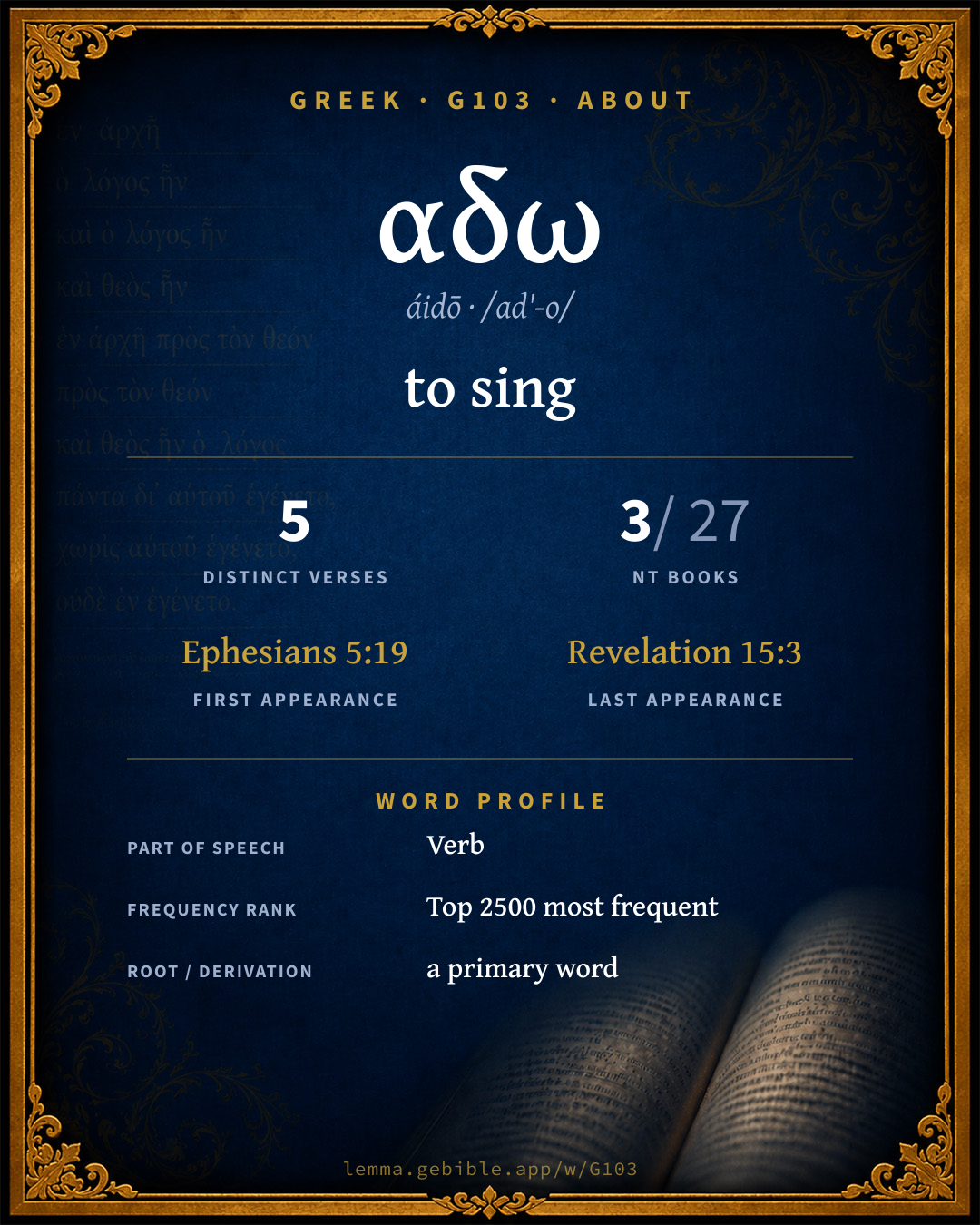
ᾄδω
to sing
Full lexicon entry — Thayer's Greek Lexicon
From Thayer's Greek Lexicon
Where this word appears
Grammar key — what these labels mean
Part of speech
- Verb
- An action or state-of-being word.
Tense
- Present
- Ongoing or general action in present time (imperfective aspect).
Voice
- Active
- The subject performs the action.
Mood
- Indicative
- States a fact or asks a factual question (the mood of reality).
- Participle
- A verbal adjective (“writing,” “having written”).
Case
- Nominative
- The case of the subject (and the predicate nominative).
Person
- 3rd person
- The one spoken about (“he / she / it / they”).
Gender
- Masculine
- Grammatically masculine.
Number
- Plural
- More than one.
Every verse where G103 appears in the Book of Revelation — 3 distinct verses. Click any verse to open its interlinear word-by-word view. Verse text shown in the World English Bible for context — . Each verse’s Greek form is shown with its reference; the English is not keyword-highlighted, since the data carries no word-level English alignment. Use “Compare translations” on any verse to read it across multiple English versions. This concordance covers the Greek New Testament; Septuagint (Greek Old Testament) occurrences of this word are not indexed here.
Revelation
- Revelation 5:9 ᾄδουσιν pres act ind 3pl They sang a new song, saying, "You are worthy to take the book, And to open its seals: For you were killed, And bought us for God with your blood, Out of every tribe, language, people, and nation,
- Revelation 14:3 ᾄδουσιν pres act ind 3pl They sing a new song before the throne, and before the four living creatures and the elders. No one could learn the song except the one hundred forty-four thousand, those who had been redeemed out of the earth.
- Revelation 15:3 ᾄδουσιν pres act ind 3pl They sang the song of Moses, the servant of God, and the song of the Lamb, saying, "Great and marvelous are your works, Lord God, the Almighty; Righteous and true are your ways, you King of the nations.
About this entry
At a glance — auto-summarized from this page’s data, not written by a person. Every figure links to its source below. This summary describes the numbers; it doesn’t interpret them.
At its core, αδω (áidō) means “to sing.” A scarce word — 5 verses in all of the Greek New Testament. The word gravitates to Revelation (60%), then Ephesians and Colossians. First canonically at Ephesians 5:19, it enters the text early. It shares a root with υμνος and ωδη. Each statement above links to its evidence; the full detail follows below.
Gloss history
Strong's 1890 vs modern scholarship
About this word
Strong's G103 catalogs a Greek word from the Greek New Testament.
These counts are not copied from any lexicon or concordance. They are computed here, from the morphology-tagged Greek New Testament. What Lemma adds →
- 5
- distinct verses
- The word appears in 5 distinct verses.
- 3 / 27
- NT books
- The word appears in 3 of 27 New Testament books.
- #1,648
- by frequency
- Top 2500 most frequent Greek words (rank 1,648 of 5,347 Greek words by occurrence).
View all 5 occurrences in the concordance →
Most concentrated in
- Revelation 3 verses 60%
- Ephesians 1 verse 20%
- Colossians 1 verse 20%
By section of the New Testament
By traditional corpus
Conventional, traditional groupings — biblical authorship is debated, so this is a traditional corpus grouping, not an authorship claim. Some books belong to more than one corpus (Luke is in both the Gospels and the Lukan corpus, and so on), so these shares overlap and need not total 100%. Each figure is a share of the word’s 5 distinct verses.
- Johannine 3 verses · 60%
- Revelation 3 verses · 60%
- Pauline corpus 2 verses · 40%
How translations render this word
Counts come from each version’s own published word-to-Strong’s tagging or interlinear alignment — an approximate guide to how each version renders this word, not a word-level alignment the data otherwise carries. Because each total is that version’s own tagged count, the per-version totals vary from one another and need not match the appearance or distinct-verse counts above. These counts may also differ from a printed concordance because Lemma counts each distinctly tagged rendering and does not collapse phrase taggings into a single head-word total. This is a fixed set of word-tagged versions (KJV, ASV, BSB, ULT) and does not change with the reading translation you choose elsewhere. Each version’s license is shown beside its name below (and on Sources).
- King James Version: Singing 2×, They sung 2×
- American Standard Version: They sing 3×, Singing 2×
- Berean Standard Bible: They sang 3×
- unfoldingWord Literal Text: They sing 3×, Singing 2×
King James Version Public Domain
Renders G103 across 5 tagged occurrences — most commonly:
Plus 1 rendering that appears only once — usually multi-word phrases or single function words the recovered tagging swept in, not distinct renderings.
American Standard Version Public Domain
Renders G103 across 5 tagged occurrences — most commonly:
Berean Standard Bible Public Domain
Renders G103 across 5 tagged occurrences — most commonly:
Plus 2 renderings that appear only once — usually multi-word phrases or single function words the recovered tagging swept in, not distinct renderings.
unfoldingWord Literal Text CC BY-SA 4.0
Renders G103 across 5 tagged occurrences — most commonly:
Senses in Thayer's
The 1 sense Thayer's distinguishes for this word, in lexicon order (not ranked by frequency or importance). The full entry — with sub-senses — is in the Lexicon Entry tab.
- to the praise of anyone, to sing
Word origin
Origin: a primary word
A primary verb; to sing : - sing.
— Strong’s Exhaustive Concordance (1890), public domain.
Forms in the corpus
The 2 distinct written forms G103 takes in the Greek New Testament, most frequent first — each parse links to that tense’s occurrences in the concordance.
| Form | Parsing | Example | Uses |
|---|---|---|---|
| ᾄδουσιν ádousin | Verb, Present, Active, Indicative, 3rd person, Plural | Revelation 5:9 | 3 |
| ᾄδοντες ádontes | Verb, Present, Active, Participle, Nominative, Plural, Masculine | Ephesians 5:19 | 2 |
Same root — word family
Other Thayer's entries built from the same root as G103, grouped by Strong’s listed origin. These share a root / origin per the lexicon — not necessarily a shared meaning. Each links to that word’s own entry.
Derived from this word
Compare all same-root words → They share a root, not necessarily a meaning.
Septuagint usage
The same Greek word αδω appears 69 times in the Greek Old Testament (Septuagint), across 64 verses in 11 books.
- 69
- LXX occurrences
- Tagged occurrences of this Greek word in the Septuagint.
- 64
- verses
- Distinct Septuagint verses containing this word.
- 11 / 39
- OT books
- The word appears in 11 of the 39 Old Testament books.
Sample Septuagint occurrences
- Exodus 15:1 ᾄδω
- Numbers 21:17 ᾄδω
- Judges 5:3 ᾄδω
- 2 Samuel 19:36 ᾄδω
- 1 Chronicles 6:16 ᾄδω
- 2 Chronicles 23:13 ᾄδω
- Ezra 2:41 ᾄδω
- Psalms 7:1 ᾄδω
- Ecclesiastes 2:8 ᾄδω
- Isaiah 5:1 ᾄδω
- Jeremiah 20:13 ᾄδω
Septuagint occurrences (same lexeme)
Every verse where the same Strong’s number (G103) appears in the Greek Septuagint — showing the first 50 of 64. Verse text shown in the World English Bible for context; the Greek form is the matched word — the English is not keyword-highlighted.
- Exodus 15:1 ᾄδω Then Moses and the children of Israel sang this song to Yahweh, and said, "I will sing to Yahweh, for he has triumphed gloriously: The horse and his rider he has thrown into the sea.
- Exodus 15:21 ᾄδω Miriam answered them, "Sing to Yahweh, for he has triumphed gloriously: The horse and his rider he has thrown into the sea."
- Numbers 21:17 ᾄδω Then sang Israel this song: Spring up, well; sing you to it:
- Judges 5:3 ᾄδω Hear, you kings; give ear, you princes; I, [even] I, will sing to Yahweh; I will sing praise to Yahweh, the God of Israel.
- 2 Samuel 19:36 ᾄδω Your servant would but just go over the Jordan with the king: and why should the king recompense it me with such a reward?
- 1 Chronicles 6:16 ᾄδω The sons of Levi: Gershom, Kohath, and Merari.
- 1 Chronicles 15:27 ᾄδω David was clothed with a robe of fine linen, and all the Levites who bore the ark, and the singers, and Chenaniah the master of the song [with] the singers: and David had on him an ephod of linen.
- 1 Chronicles 16:9 ᾄδω Sing to him, sing praises to him; Talk you of all his marvelous works.
- 1 Chronicles 16:23 ᾄδω Sing to Yahweh, all the earth; Show forth his salvation from day to day.
- 1 Chronicles 25:7 ᾄδω The number of them, with their brothers who were instructed in singing to Yahweh, even all who were skillful, was two hundred eighty-eight.
- 2 Chronicles 23:13 ᾄδω and she looked, and, behold, the king stood by his pillar at the entrance, and the captains and the trumpets by the king; and all the people of the land rejoiced, and blew trumpets; the singers also [played] on instruments of music, and led the singing of praise. Then Athaliah tore her clothes, and said, Treason! treason!
- 2 Chronicles 29:27 ᾄδω Hezekiah commanded to offer the burnt offering on the altar. When the burnt offering began, the song of Yahweh began also, and the trumpets, together with the instruments of David king of Israel.
- 2 Chronicles 29:28 ᾄδω All the assembly worshiped, and the singers sang, and the trumpeters sounded; all this [continued] until the burnt offering was finished.
- Ezra 2:41 ᾄδω The singers: the children of Asaph, one hundred twenty-eight.
- Ezra 2:65 ᾄδω besides their men-servants and their maid-servants, of whom there were seven thousand three hundred thirty-seven: and they had two hundred singing men and singing women.
- Ezra 2:70 ᾄδω So the priests, and the Levites, and some of the people, and the singers, and the porters, and the Nethinim, lived in their cities, and all Israel in their cities.
- Ezra 7:7 ᾄδω There went up some of the children of Israel, and of the priests, and the Levites, and the singers, and the porters, and the Nethinim, to Jerusalem, in the seventh year of Artaxerxes the king.
- Ezra 7:24 ᾄδω Also we inform you, that touching any of the priests and Levites, the singers, porters, Nethinim, or servants of this house of God, it shall not be lawful to impose tribute, custom, or toll, on them.
- Ezra 8:17 ᾄδω I sent them forth to Iddo the chief at the place Casiphia; and I told them what they should tell Iddo, [and] his brothers the Nethinim, at the place Casiphia, that they should bring to us ministers for the house of our God.
- Ezra 10:24 ᾄδω Of the singers: Eliashib. Of the porters: Shallum, and Telem, and Uri.
- Ezra 17:1 ᾄδω
- Ezra 17:44 ᾄδω
- Ezra 17:67 ᾄδω
- Ezra 17:73 ᾄδω
- Ezra 20:29 ᾄδω
- Ezra 20:40 ᾄδω
- Ezra 21:20 ᾄδω
- Ezra 22:28 ᾄδω
- Ezra 22:29 ᾄδω
- Ezra 22:42 ᾄδω
- Ezra 22:45 ᾄδω
- Ezra 22:46 ᾄδω
- Ezra 22:47 ᾄδω
- Ezra 23:5 ᾄδω
- Ezra 23:10 ᾄδω
- Psalms 7:1 ᾄδω Yahweh, my God, I take refuge in you. Save me from all those who pursue me, and deliver me,
- Psalms 12:6 ᾄδω The words of Yahweh are flawless words, As silver refined in a clay furnace, purified seven times.
- Psalms 20:14 ᾄδω
- Psalms 26:6 ᾄδω I will wash my hands in innocence, So I will go about your altar, Yahweh;
- Psalms 32:3 ᾄδω When I kept silence, my bones wasted away through my groaning all day long.
- Psalms 56:8 ᾄδω You number my wanderings. You put my tears into your bottle. Aren't they in your book?
- Psalms 58:17 ᾄδω
- Psalms 67:5 ᾄδω Let the peoples praise you, God. Let all the peoples praise you.
- Psalms 67:33 ᾄδω
- Psalms 88:2 ᾄδω Let my prayer enter into your presence. Turn your ear to my cry.
- Psalms 95:1 ᾄδω Oh come, let's sing to Yahweh. Let's shout aloud to the rock of our salvation!
- Psalms 95:2 ᾄδω Let's come before his presence with thanksgiving. Let's extol him with songs!
- Psalms 97:1 ᾄδω Yahweh reigns! Let the earth rejoice! Let the multitude of islands be glad!
- Psalms 97:4 ᾄδω His lightning lights up the world. The earth sees, and trembles.
- Psalms 100:1 ᾄδω Shout for joy to Yahweh, all you lands!
These are occurrences of the same Greek lexeme (G103) in the Septuagint — not a translation of any one Hebrew word. The store carries no word-level Hebrew↔Greek alignment, so no Hebrew original is asserted here. Counts come from the recovered LXX Strong's tagging — high-frequency vocabulary is well covered, while rare or late forms may be untagged — so they reflect tagged occurrences and may slightly undercount.