
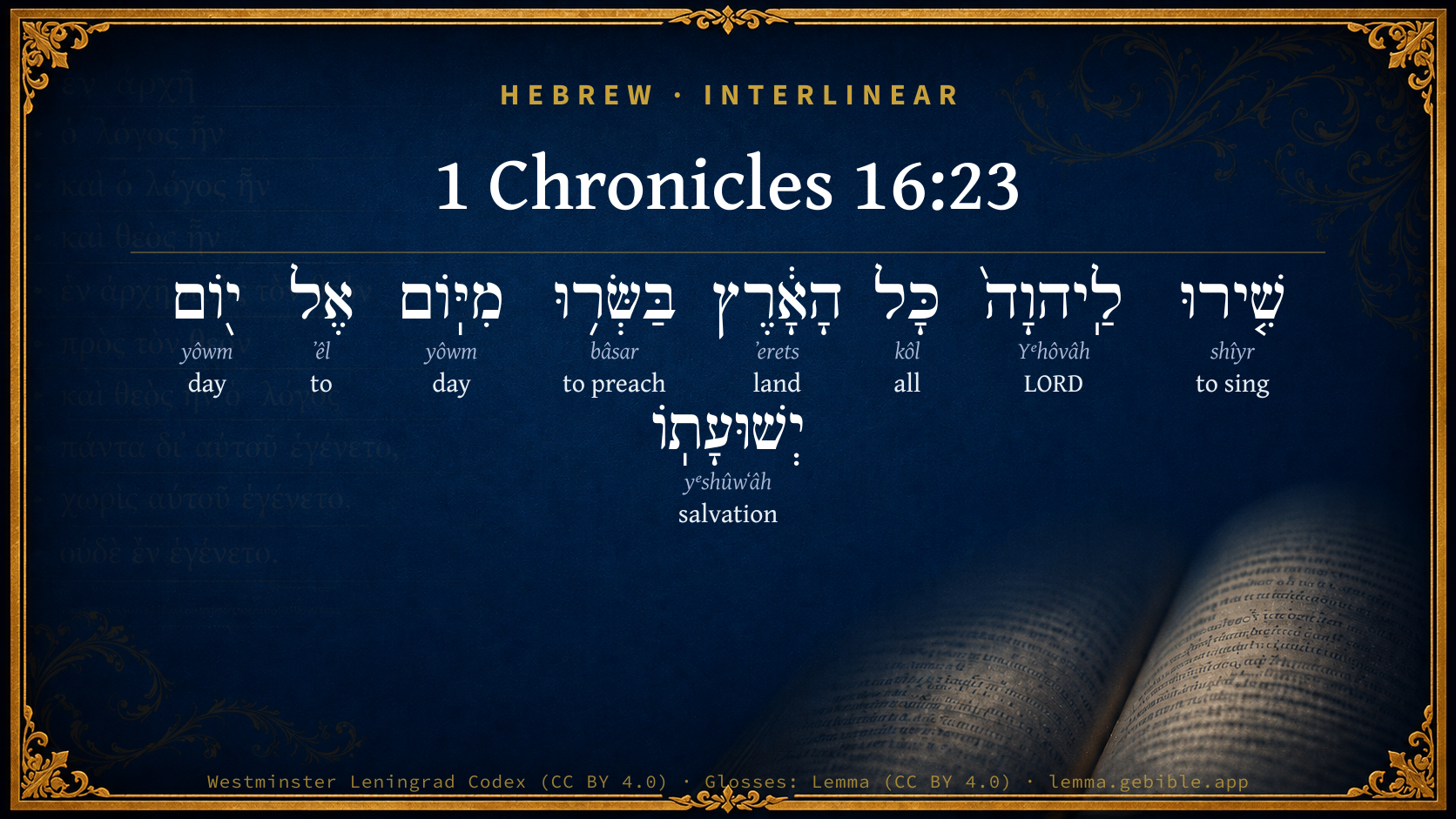
1 Chronicles 16:23

Hebrew (Westminster Leningrad Codex) 1 Chronicles 16:23 appears in the Hebrew Old Testament. The text above is from the Westminster Leningrad Codex. Each word links to its Strong’s number, a concise gloss, and parsing drawn from the Open Scriptures Hebrew Bible morphology. Click any word for its full Brown-Driver-Briggs (BDB) entry.
Download image
Cite this verse

1 Chronicles 16:23 (World English Bible). Public Domain. Lemma interlinear Bible study tool, https://lemma.gebible.app/v/1-chronicles/16/23.

Show BibTeX & RIS
BibTeX
RIS
English Translation
Sing to Yahweh, all the earth; Show forth his salvation from day to day.
World English Bible · Public Domain
Download a study sheet

One document with this verse’s original text, its word-by-word gloss line, the meaning frame, cross-references with their text, attributed commentary, and full source and license credits — printable, and it pastes into notes with its structure intact.

This verse Autodidact and up

Study sheet (.html) Plain text (.txt)

A passage Seminary Student

Up to 50 verses in one chapter. A passage sheet keeps up to 6 commentary sources and 12 cross-references per verse, in the order this page ranks them, and says so on the sheet whenever that leaves anything out. Ask for a single verse and you get the Autodidact verse sheet above.

Everything on this page stays free to read, with no account — the sheet is a download of what is already on screen, not access to it.

Want to remove ads? Support Godless Engineer
Compare translations 3

The same verse in 3 English versions, stacked beneath the original-language interlinear above. Click any original word for its lexicon entry.

Each is an independent rendering of the whole verse — the interlinear is not word-aligned to these translations.

Highlighted words mark where these versions differ — a whole-verse word diff, not a word-by-word alignment.

  • World English Bible Public Domain
    Sing to Yahweh, all the earth; Show forth his salvation from day to day.
  • King James Version Public Domain
    Sing unto the LORD, all the earth; show forth from day to day his salvation.
  • unfoldingWord Literal Text CC BY-SA 4.0
    Sing to Yahweh, all of the earth; announce his salvation from day to day.

unfoldingWord Literal Text — © unfoldingWord, licensed CC BY-SA 4.0. Word-aligned USFM3 via Door43 (git.door43.org/unfoldingWord/en_ult).

Versions to compare (up to 4)

3 of 4 selected

Show all 18 translations

Every available English version of this verse, each an independent rendering of the whole verse.

  • World English Bible Public Domain
    Sing to Yahweh, all the earth; Show forth his salvation from day to day.
  • Berean Standard Bible Public Domain
    Sing to the LORD, all the earth. Proclaim His salvation day after day.
  • Majority Standard Bible Public Domain
    Sing to the LORD, all the earth. Proclaim His salvation day after day.
  • King James Version Public Domain
    Sing unto the LORD, all the earth; show forth from day to day his salvation.
  • American Standard Version (1901) Public Domain
    Sing unto Jehovah, all the earth; Show forth his salvation from day to day.
  • Revised Version (1885) Public Domain
    Sing unto the LORD, all the earth; shew forth his salvation from day to day.
  • Geneva Bible (1599) Public Domain
    Sing vnto the Lord all the earth: declare his saluation from day to day.
  • Douay-Rheims (1899) Public Domain
    Sing ye to the Lord, all the earth: shew forth from day to day his salvation.
  • Young's Literal Translation Public Domain
    Sing to Jehovah, all the earth, Proclaim from day unto day His salvation.
  • Literal Standard Version CC BY-SA 4.0
    Sing to YHWH, all the earth, || Proclaim His salvation from day to day.
  • Unlocked Literal Bible CC BY-SA 4.0
    Sing to Yahweh, all the earth; announce his salvation day after day.
  • unfoldingWord Literal Text CC BY-SA 4.0
    Sing to Yahweh, all of the earth; announce his salvation from day to day.
  • Darby Bible Public Domain
    Sing unto Jehovah, all the earth; Publish his salvation from day to day.
  • World Messianic Bible Public Domain
    Sing to the LORD, all the earth! Display his salvation from day to day.
  • Webster's Bible Public Domain
    Sing to the LORD, all the earth; show forth from day to day his salvation.
  • Free Bible Version CC BY-SA 4.0
    Sing to the Lord, all the earth, sing to the Lord! Each day let everyone know of his salvation!
  • Bible in Basic English Public Domain
    Make songs to the Lord, all the earth; give the good news of his salvation day by day.
  • JPS Tanakh (1917) Public Domain
    Sing unto the LORD, all the earth; proclaim His salvation from day to day.

Literal Standard Version (2020), Covenant Press — licensed CC BY-SA 4.0. Text via the HelloAO Bible API (eBible.org). Unlocked Literal Bible (unfoldingWord) — licensed CC BY-SA 4.0. Text via the HelloAO Bible API (eBible.org). unfoldingWord Literal Text — © unfoldingWord, licensed CC BY-SA 4.0. Word-aligned USFM3 via Door43 (git.door43.org/unfoldingWord/en_ult). Free Bible Version, Dr. Jonathan Gallagher — licensed CC BY-SA 4.0. Text via the HelloAO Bible API (eBible.org).

Word by word

More ways to search: Search by grammar → Find every occurrence → Compare this word →

Practice this passage: Drill this verse → Learn its vocabulary →

בַּשְּׂר֥וּ
bâsar
H1319
“preach”
Verb, Piel, Imperative, 2nd Person, Masculine, Plural
Part of Speech
Verb
Stem
Piel
Form
Imperative
Person
2nd Person
Gender
Masculine
Number
Plural
Full BDB Definition

Origin: a primitive root

TWOT: 291

to bear news, bear tidings, publish, preach, show forth - (Piel) - to gladden with good news - to bear news - to announce (salvation) as good news, preach - (Hithpael) to receive good news
  1. שִׁ֤ירוּ shîyr H7891 “sing” Verb, Qal, Imperative, 2nd Person, Masculine, Plural
  2. לַֽיהוָה֙ Yᵉhôvâh H3068 “to/for · LORD” Preposition + Noun, Proper
  3. כָּל kôl H3605 “all of” Noun, Common, Masculine, Singular, Construct
  4. הָאָ֔רֶץ ʼerets H776 “the · land” Particle, Definite Article + Noun, Common, Both, Singular, Absolute
  5. מִיּֽוֹם yôwm H3117 “from · day” Preposition + Noun, Common, Masculine, Singular, Absolute
  6. אֶל ʼêl H413 “to” Preposition
  7. י֖וֹם yôwm H3117 “day” Noun, Common, Masculine, Singular, Absolute
  8. יְשׁוּעָתֽוֹ yᵉshûwʻâh H3444 “salvation · his” Noun, Common, Feminine, Singular, Construct + Suffix, Personal, 3rd Person, Masculine, Singular

About this verse

These counts appear in no published source. They are computed here, from the morphology-tagged text and Lemma’s own curated glosses. What Lemma adds →

9
words
8
distinct lemmas
Historical
section

Notable vocabulary

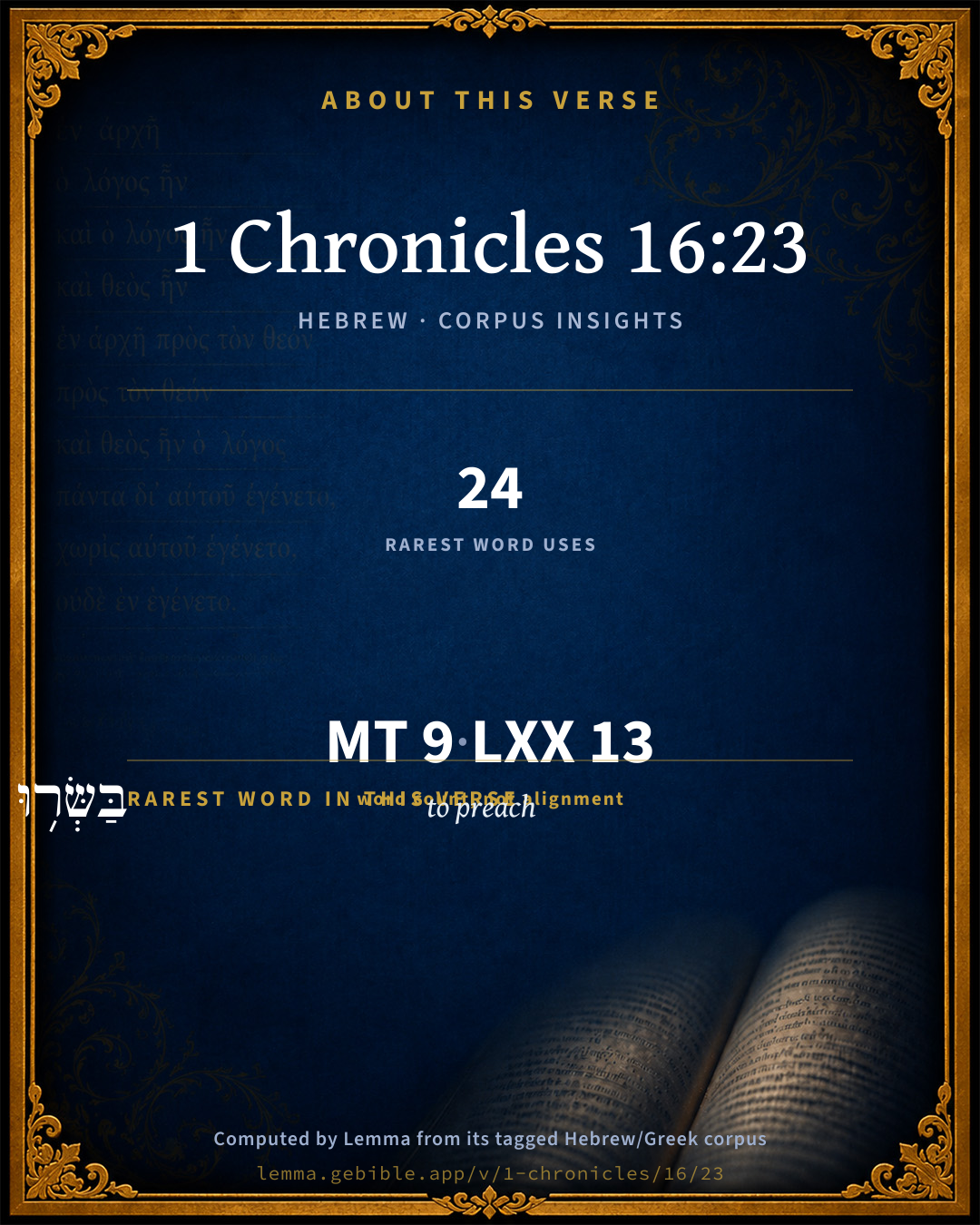
The rarest word here is בַּשְּׂר֥וּ to preach H1319 — appearing just 24 times in the whole Hebrew Bible.

Shared distinctive vocabulary

בַּשְּׂר֥וּ to preach H1319 occurs in 21 verses of the Hebrew Bible. Also found in:

Grammatical profile

  • 2 verbs
  • 6 nouns
  • 1 preposition

Verb forms

  • שִׁ֤ירוּ Qal · Imperative
  • בַּשְּׂר֥וּ Piel · Imperative

Repetition

A word recurs within this verse — often emphatic in Hebrew:

  • מִיּֽוֹם day H3117 ×2

Hebrew & Septuagint length

In English translation the verse runs 14 words from the Hebrew and 15 from the Septuagint (LXX English) — closely comparable.

A rough comparison of the two English renderings, which tokenize alike — not a word-level alignment.

Word counts can differ between the Hebrew and the Greek without any difference in meaning — e.g. the Hebrew direct-object marker אֵת has no separate Greek word, and Greek often adds the article ὁ.

In the original languages it is 9 Hebrew tokens and 13 Greek tokens — but the two are counted differently (Hebrew bundles its prefixes and suffixes into one token; the Greek is in lemma form), so that isn’t a like-for-like length.

Cross-references

8

Topical passages linked to 1 Chronicles 16:23 in the Treasury of Scripture Knowledge — connected by theme and wording, ordered by reader-vote popularity; previews shown in the World English Bible.

  • Psalms 96:1–13 Sing to Yahweh a new song! Sing to Yahweh, all the earth.
  • Psalms 71:15 My mouth will tell about your righteousness, And of your salvation all day, Though I don't know its full measure.
  • Isaiah 51:6–8 Lift up your eyes to the heavens, and look on the earth beneath; for the heavens shall vanish away like smoke, and the earth shall wax old like a garment; and those who dwell therein shall die in like manner: but my salvation shall be forever, and my righteousness shall not be abolished.
  • Isaiah 12:5 Sing to Yahweh, for he has done excellent things! Let this be known in all the earth!
  • Exodus 15:21 Miriam answered them, "Sing to Yahweh, for he has triumphed gloriously: The horse and his rider he has thrown into the sea."
  • 1 Chronicles 16:9 Sing to him, sing praises to him; Talk you of all his marvelous works.
  • Psalms 30:4 Sing praise to Yahweh, you saints of his. Give thanks to his holy name.
  • Psalms 40:10 I have not hidden your righteousness within my heart. I have declared your faithfulness and your salvation. I have not concealed your loving kindness and your truth from the great assembly.

Cross-references courtesy of OpenBible.info (CC BY 4.0).

Hebrew and Greek witnesses Masoretic Hebrew ↔ Greek Septuagint

The same verse in the two great witnesses to the Old Testament, shown verse-for-verse.

These are two independent witnesses, not word-aligned to each other, and the Septuagint is shown in lemma (dictionary) form.

Hebrew 1 Chronicles 16:23 Masoretic · Westminster Leningrad Codex

שִׁ֤ירוּ לַֽיהוָה֙ כָּל הָאָ֔רֶץ בַּשְּׂר֥וּ מִיּֽוֹם אֶל י֖וֹם יְשׁוּעָתֽוֹ

Sing to Yahweh, all the earth; Show forth his salvation from day to day.

World English Bible · Public Domain

Greek LXX 1 Chronicles 16:23 Septuagint · lemma form

ᾄδω ὁ κύριος πᾶς ὁ γῆ ἀναἀγγέλλω ἐκ ἡμέρα εἰς ἡμέρα σωτηρία αὐτός

Sing you⌃ to the Lord, all the earth; proclaim his salvation from day to day.

LXX2012 (modern English Septuagint) · Public Domain

Hebrew: Westminster Leningrad Codex (CC BY 4.0). Greek: Septuagint (public domain); English from LXX2012 (modern English Septuagint) (Public Domain). How the Septuagint differs from the Hebrew →

Commentary

Notes on 1 Chronicles 16:23 from classic Christian and Jewish commentators (each source and its license shown beneath its notes). The classic Christian expositions comment on the surrounding passage and are grouped to its opening verse, so a note may address several verses; the Jewish commentaries on the Tanakh (Rashi and others) are per-verse, so they appear only where the commentator wrote on this verse.

Lemma curates 59 commentaries, every one of them public domain or Creative Commons licensed, each selected and text-cleaned for this edition rather than reprinted as found. About our sources →

Ellicott's Commentary for English Readers

(23-33) See Psalms 96. This psalm, in the Psalter, consists of five strophes or stanzas of six lines each—an artistic arrangement which has been violated here. The subject is the extension of Jehovah’s kingdom over all the world, a thought familiar to the readers of the Book of Isaiah, where most of the ideas and phrases of the psalm may be found.

(23) Sing unto the Lord, all the earth.—The second line of the psalm. The spirited opening of the psalm is purposely weakened, by omission of the first and third lines, in order to make it fit in here. Strophe I. is thus compressed into four lines (1Ch_16:23-24).

All the earth.—All the land (of Israel).

Shew forth.—Heb., tell the (good) news of.

His salvation.—Deliverance (from exile).

(24) Heathen.—Nations (1Ch_16:31).

(25-27) Strophe II. of the psalm. Jehovah is the Creator; other gods are nonentities.

(25) He also.—And he. The conjunction is not in Psalms 96, and is a prosaic addition of the compiler. (Comp. 1Ch_16:20.)

(26) People.—Peoples.

Idols (’ĕlîlîm).—A favourite expression in Isaiah.

(27) Strength and gladness are in his place.—Psa_96:6 : “Strength and beauty are in his sanctuary.” The psalmist’s idea of the heavenly temple seems to have been understood of the earthly; and then his phrase was altered as unsuitable.

Gladness (hedwâh).—A late word, occurring again in Neh_8:10 only. “Beauty” (tiph’èreth) is ancient.

His place—i.e., the tent of the Ark on Mount Zion. (Comp. 1Ch_15:1; 1Ch_15:3.)

(28, 29) Strophe III. of the psalm, mutilated. A call to all nations to come and worship in the Temple of Jehovah.

(28) Kindreds of the people.—Clans (races) of the peoples.

(29) So far each verse of this ode has symmetrically consisted of two clauses. The present verse has three—another mark of awkward compilation.

Come before him.—Psalms 96, “into his courts,” that is, the Temple courts: an expression modified here to suit another application.

Worship the Lord in the beauty of holiness.—Rather, bow ye down to Jehovah, in holy vestments. This line ought to be the first of the next couplet.

(30) Fear (plural).—Literally, Writhe ye.

Before him.—The preposition is a compound form common in the Chronicles; in the psalm it is simple.

The world also shall be stable.—A line, which precedes this in the psalm, is omitted here, to the detriment of the sense. That line—“Say ye among the nations, Jehovah is king”—begins the fourth strophe of the original hymn, but is here strangely transferred to 1Ch_16:31.

(31) Let the heavens be glad, and let the earth rejoice.—In the Hebrew, the initial letters of these words form an acrostic of the sacred Name of Jehovah; and those of the first half of 1Ch_16:32 make up Iahu, another form of the Name.

And let men say.—An adaptation of Psa_96:10 : “Say ye among the nations.”

(32) Let the fields rejoice.—Here begins the fifth strophe of the original psalm.

Fields.—Heb., the field, or open country. Psalms 96 has an archaic spelling of the word (sâdai), which is here modernised (sâdèh).

Rejoice.—Exult (not the same word as in 1Ch_16:31).

(33) At the presence of.—The compound preposition of 1Ch_16:30. The climax of the psalm—“He shall judge the world in righteousness, and peoples in his faithfulness”—is here omitted; and this long and heterogeneous composition terminates with verses borrowed from a third source.

A Bible Commentary for English Readers, edited by Charles John Ellicott (1878–1897) — public domain. Text from a community e-Sword module.

Trapp's Complete Commentary

John Trapp

1Ch 16:23 Sing unto the LORD, all the earth; shew forth from day to day his salvation.

Ver. 23. Sing unto the Lord.] See Psa 96:1, &c {See Trapp on "Psa 96:1"} &c

John Trapp, A Commentary or Exposition upon All the Books of the Old and New Testament (1647–1656) — public domain. Text from a community e-Sword module.

The Biblical Illustrator

Joseph S. Exell

1Ch_16:23-24

Declare His glory among the heathen.

Declaring Gods glory

I. Declare among the heathen the glory of Gods perfections, that they may acknowledge Him as the true God.

II. Declare the glory of His salvation, that they may accept Him as their only Redeemer.

III. Declare the glory of His providence, that they may confide in Him as their faithful guardian.

IV. Declare the glory of His word, that they may prize it as their chief treasure.

V. Declare the glory of His service, that they may choose it as their chief occupation.

VI. Declare the glory or His residence, that they may seek it m their best home. (William Jackson.)

The Biblical Illustrator, edited by Joseph S. Exell (c. 1880s–1900s) — public domain. Text from a community e-Sword module.

The Cambridge Bible for Schools and Colleges

gen. ed. J. J. S. Perowne

23–33 (= Psa_96:1-13)

23. Sing unto the Lord] In Psa_96:1-2 this burden is thrice repeated; in Chron. it is once given. Note that 23 b corresponds with 2 b of the Ps.

The Cambridge Bible for Schools and Colleges (gen. ed. J. J. S. Perowne; Cambridge University Press, 1878–1918) — public domain. Text from a community e-Sword module.

The Pulpit Commentary

Vers. 23-36. The grandeur and unusual comprehensiveness of the adoration and homage here proclaimed, as to be offered to the omnipotent Ruler of all nations, should be well pondered. Our eye and ear may have become too familiar with it, but when put a little into relief, and referred to its original time of day, it is fit to be ranked among the strongest moral evidences of inspiration in the word and the speaker.

This verse is composed of the latter half of each of the first two verses of the psalm (96.).

Vers. 23-25.

Christian joy a witness.

These verses reappear in Psalm 96. In that psalm the sacred nation is charged to praise Jehovah, and to spread the good tidings in all places. Such praise is fitting, seeing that all other deities are nothing, and Jehovah is God alone. Calvin, writing on this psalm, says, "It is an exhortation to praise God, addressed not to the Jews only, but to all nations. Whence we infer that the psalm refers to the kingdom of Christ; for till he was revealed to the world his Name could not be called upon anywhere but in Judaea." It is said that when the sun is going out of sight the pious Swiss herdsman of the Alps takes his Alpine horn and shouts loudly through it, "Praise ye the Lord." Then a brother herdsman on some distant slope takes up the echo, "Praise ye the Lord." Soon another answers, still higher up the mountains, till hill shouts to hill, and peak answers to peak, the sublime anthem of praise to the Lord of all. Characteristic of the psalmist is joy in God: and in this he is the one great Scripture example; Isaiah, perhaps, coming next after him, and St. Paul having much of the same feature marking even his toilsome and suffering life. Joy, as an element of religious life, must in part depend on:

1. Disposition. Some are of sanguine and hopeful, others of desponding, disposition. Some can easily turn everything into song, while others can never get beyond stern prose. We are not responsible for our natural dispositions, but we are for their due modification, harmony, and culture. Often latent and unsuspected faculties can be developed, and it is seldom wise to excuse failure and shortcoming on the ground of "human nature

2. Poetical faculty. Where this is given joy and song would seem to Be easy; yet, on the other side, it may be said that poets are often sad-toned men, probably because accompanying the poetical faculty is a power of insight which brings to the poet"s eye the wrong that lies at the heart of so much that is seemingly good. But this cannot apply to thoughts and views of God. Insight and faculty can only find reasons for joy and song when they have to do with him and his all-merciful ways.

3. Youthful piety. Those who seek God early, as David did, usually have a brightness and gladness and joy of full trust on their whole religious lives Which the later-renewed can never reach. This is one of the best of the rewards given to early piety.

4. Earnest soul-culture. This, by leading to renewals of trust, to firmer hold of revealed truth, and to deeper experiences of Divine communion, bears directly upon the joy side of Christian feeling. When attained, Christian joy becomes a witness for two reasons or in two ways.

I IT MEETS THE COMMON SENTIMENT THAT A THING MUST BE GOOD IN ITSELF IF IT TENDS TO MAKE US BRIGHT AND HAPPY. How common this sentiment is may be shown from ordinary life. The people who always cheer us, we feel sure, must be good people, and the same may be said of books, etc. In this way, therefore, our personal joy in God may become a gracious moral power on all who are around us. And hazy Christians have a most noble and blessed witness.

Sing on your heavenward way, Ye ransomed sinners, sing.

A weary world sadly needs the sweet relief and cheering of much Christian song.

II IT SETS CHRISTIANITY IN A DISTINCT AND IMPRESSIVE CONTRAST WITH ALL OTHER RELIGIONS. They are familiar enough with the sentiment of fear. In perilous rebounds they know seasons of intense sensual excitement, which caricature true joy. But the prevailing tone of all other religions besides Christianity is sad. Only the Christian may "abound in joy through the Holy Ghost." Who could sing before that Athenian altar whereon was inscribed, To the unknown God"? And who could fail to sing ann give praise, that might look into the face of the Father of Jesus, and say, "This God is our God for ever and ever; he will be our Guide even unto death "? R.T.

The Pulpit Commentary (1880–1919), ed. H.D.M. Spence-Jones & Joseph S. Exell — public domain. Text from a community e-Sword module.

unfoldingWord translationNotes

Door43 World Missions Community

General Information:

Parallelism is common in Hebrew poetry. (See: Poetry and Parallelism)

all the earth

This refers to the people of the earth. AT: "all you people who live on the earth" (See: Metonymy)

announce his salvation

The abstract noun "salvation" can be translated using the verb "save." AT: "announce that he has saved us" or "tell people that he is the one who saves" (See: Abstract Nouns)

day after day

"every day"

Declare his glory among the nations

"Tell all the people in every nation about his great glory"

translationWords

Yahweh

earth

save

declare

glory

amazed

works

unfoldingWord translationNotes — © Distant Shores Media and the Door43 World Missions Community, licensed CC BY-SA 4.0. Source: git.door43.org/Door43/en_tn.

Lesson kit

Teaching starters — assembled from the data on this page, not authored interpretation. Every prompt links to the verse data it draws on. Edit before teaching.

1 Chronicles, in the Historical, opens this verse with 9 words (8 distinct Hebrew lemmas). Its most distinctive word is bâsar (“to preach”). A historical commentator’s framing appears above. Read the whole chapter for the surrounding context.

Discussion questions

  1. How does “to preach” (bâsar) shape what this verse is saying?
  2. How does 1 Samuel 4:17, which shares the word «to preach», read alongside this verse?
  3. What does the repetition of “day” (2× in this one verse) do in this verse?
  4. These translations render this verse differently. What is at stake in choosing one wording over another?
  5. «שִׁ֤ירוּ» is a Qal Imperative verb. How does that grammatical form shape the action described?
  6. Compare how Ellicott's Commentary for English Readers and Trapp's Complete Commentary read this verse. Where do they agree or differ?

Things to notice

Reading settings

Reading text

Shown beneath each verse's original-language words.

Old Testament
Old Testament edition

Read the OT as the Masoretic Hebrew (MT) or the Greek Septuagint (LXX).

English shown for the Greek Septuagint (in the Hebrew ↔ Greek comparison).

Comparing translations? Open the Compare panel on any verse page to stack up to four side by side.