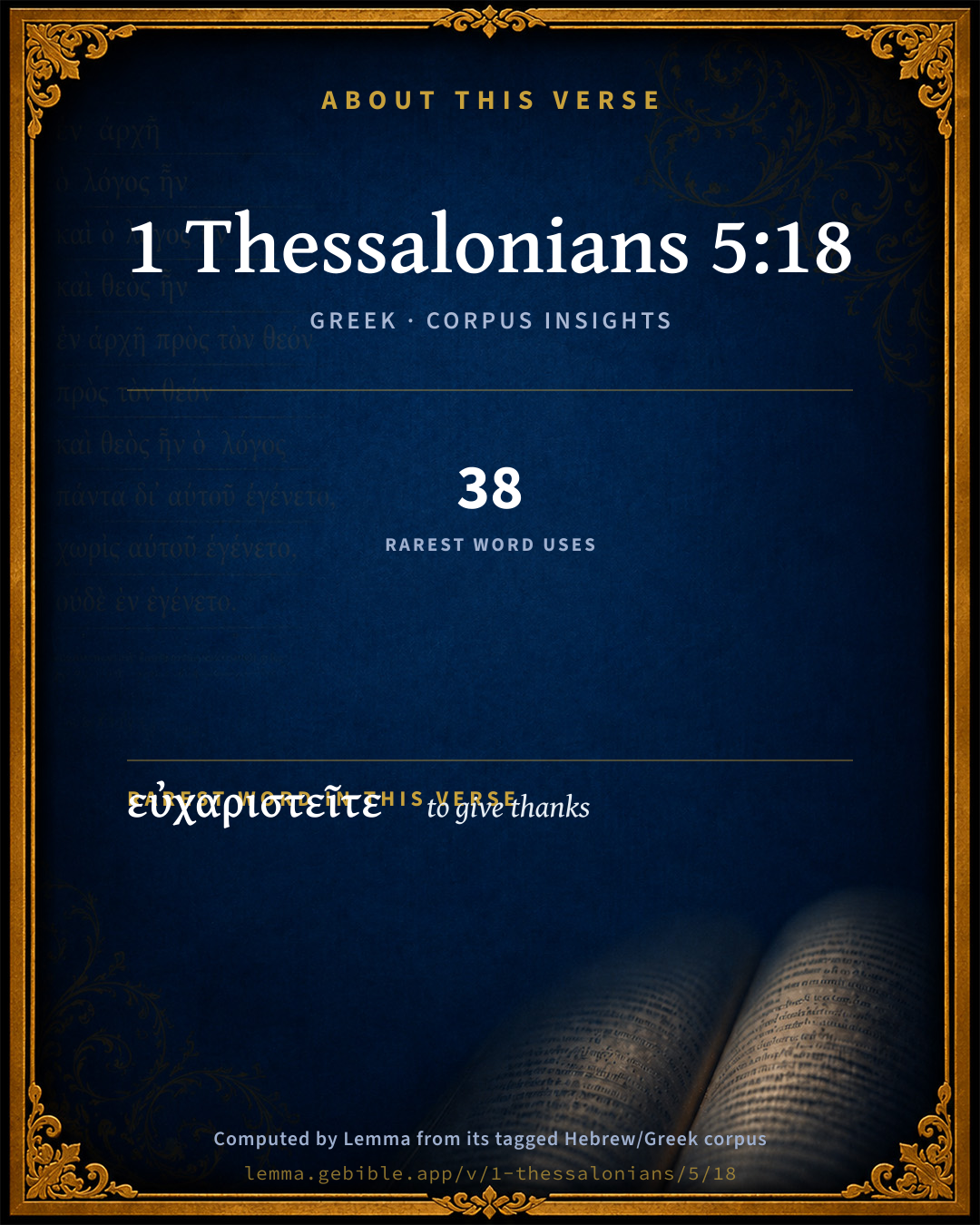
1 Thessalonians 5:18

Greek (Tischendorf 8th ed.) 1 Thessalonians 5:18 appears in the Greek New Testament. The text above is from the Tischendorf 8th edition. Each word links to its Strong’s number and a concise gloss. Click any word for its full Thayer’s Greek Lexicon entry.
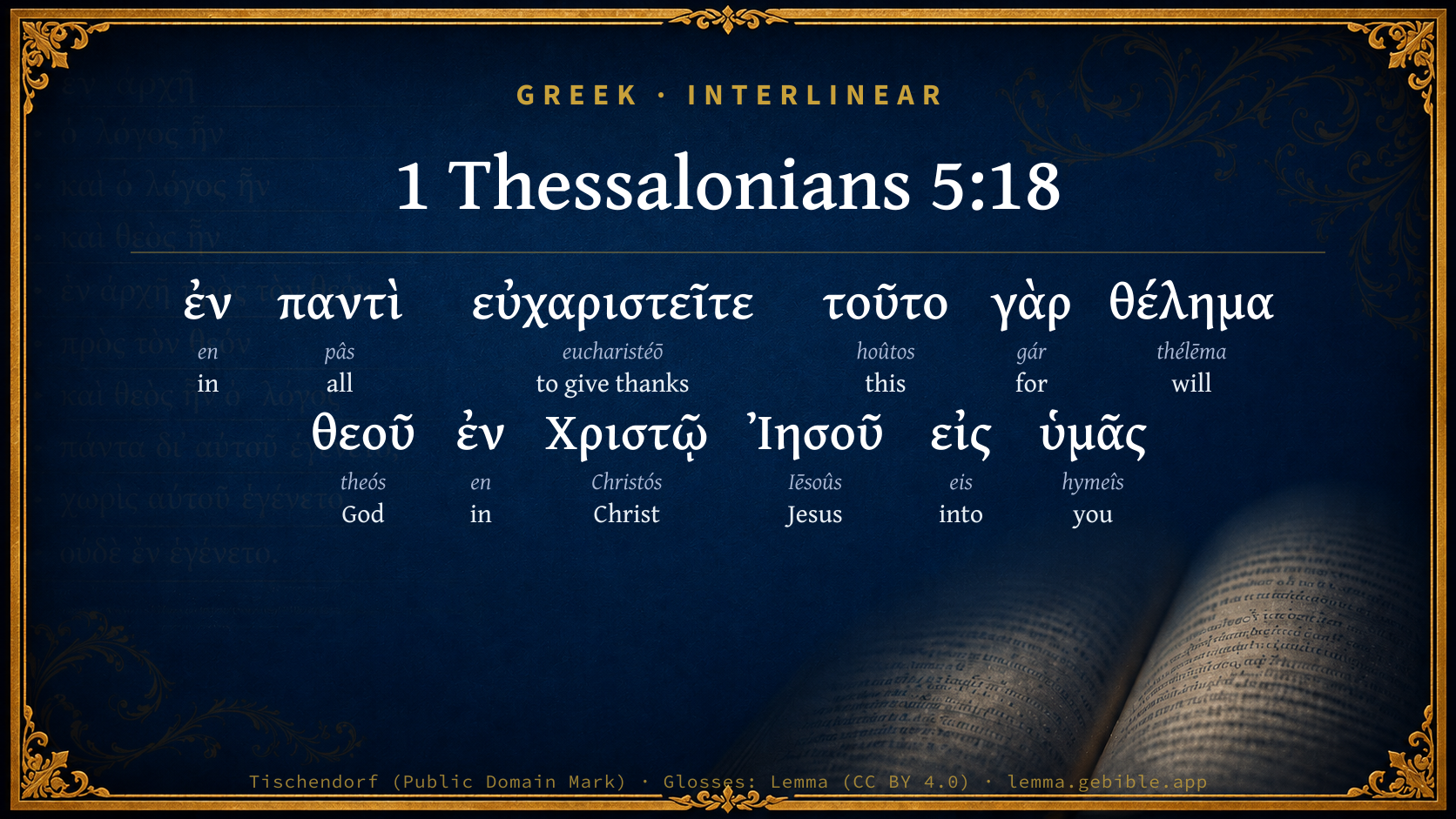
Download image
Cite this verse

1 Thessalonians 5:18 (World English Bible). Public Domain. Lemma interlinear Bible study tool, https://lemma.gebible.app/v/1-thessalonians/5/18.

Show BibTeX & RIS
BibTeX
RIS
English Translation
In everything give thanks, for this is the will of God in Christ Jesus toward you.
World English Bible · Public Domain
Download a study sheet

One document with this verse’s original text, its word-by-word gloss line, the meaning frame, cross-references with their text, attributed commentary, and full source and license credits — printable, and it pastes into notes with its structure intact.

This verse Autodidact and up

Study sheet (.html) Plain text (.txt)

A passage Seminary Student

Up to 50 verses in one chapter. A passage sheet keeps up to 6 commentary sources and 12 cross-references per verse, in the order this page ranks them, and says so on the sheet whenever that leaves anything out. Ask for a single verse and you get the Autodidact verse sheet above.

Everything on this page stays free to read, with no account — the sheet is a download of what is already on screen, not access to it.

Want to remove ads? Support Godless Engineer
Compare translations 3

The same verse in 3 English versions, stacked beneath the original-language interlinear above. Click any original word for its lexicon entry.

Each is an independent rendering of the whole verse — the interlinear is not word-aligned to these translations.

Highlighted words mark where these versions differ — a whole-verse word diff, not a word-by-word alignment.

  • World English Bible Public Domain
    In everything give thanks, for this is the will of God in Christ Jesus toward you.
  • King James Version Public Domain
    In every thing give thanks: for this is the will of God in Christ Jesus concerning you.
  • unfoldingWord Literal Text CC BY-SA 4.0
    In everything give thanks, for this the will of God in Christ Jesus for you.

unfoldingWord Literal Text — © unfoldingWord, licensed CC BY-SA 4.0. Word-aligned USFM3 via Door43 (git.door43.org/unfoldingWord/en_ult).

Versions to compare (up to 4)

3 of 4 selected

Show all 19 translations

Every available English version of this verse, each an independent rendering of the whole verse.

  • World English Bible Public Domain
    In everything give thanks, for this is the will of God in Christ Jesus toward you.
  • Berean Standard Bible Public Domain
    Give thanks in every circumstance, for this is God’s will for you in Christ Jesus.
  • Majority Standard Bible Public Domain
    Give thanks in every circumstance, for this is God’s will for you in Christ Jesus.
  • King James Version Public Domain
    In every thing give thanks: for this is the will of God in Christ Jesus concerning you.
  • American Standard Version (1901) Public Domain
    in everything give thanks: for this is the will of God in Christ Jesus to you-ward.
  • Revised Version (1885) Public Domain
    in everything give thanks: for this is the will of God in Christ Jesus to you-ward.
  • Geneva Bible (1599) Public Domain
    In all thinges giue thankes: for this is the will of God in Christ Iesus toward you.
  • Douay-Rheims (1899) Public Domain
    In all things give thanks; for this is the will of God in Christ Jesus concerning you all.
  • Young's Literal Translation Public Domain
    in every thing give thanks, for this `is' the will of God in Christ Jesus in regard to you.
  • Literal Standard Version CC BY-SA 4.0
    give thanks in everything, for this [is] the will of God in Christ Jesus in regard to you.
  • Unlocked Literal Bible CC BY-SA 4.0
    In everything give thanks. For this is the will of God in Christ Jesus for you.
  • unfoldingWord Literal Text CC BY-SA 4.0
    In everything give thanks, for this the will of God in Christ Jesus for you.
  • Darby Bible Public Domain
    in everything give thanks, for this is [the] will of God in Christ Jesus towards you;
  • World Messianic Bible Public Domain
    In everything give thanks, for this is the will of God in Messiah Yeshua toward you.
  • Webster's Bible Public Domain
    In every thing give thanks: for this is the will of God in Christ Jesus concerning you.
  • Free Bible Version CC BY-SA 4.0
    be thankful in every situation—because this is what God in Christ Jesus wants you to do.
  • Bible in Basic English Public Domain
    In everything give praise: for this is the purpose of God in Christ Jesus for you.
  • Text-Critical English NT CC BY 4.0
    and in everything give thanks; for this is God's will for you in Christ Jesus.
  • Tyndale New Testament (1534) Public Domain
    In all thinges geve thankes. For this is the wyll of God in Christ Iesu towarde you.

Literal Standard Version (2020), Covenant Press — licensed CC BY-SA 4.0. Text via the HelloAO Bible API (eBible.org). Unlocked Literal Bible (unfoldingWord) — licensed CC BY-SA 4.0. Text via the HelloAO Bible API (eBible.org). unfoldingWord Literal Text — © unfoldingWord, licensed CC BY-SA 4.0. Word-aligned USFM3 via Door43 (git.door43.org/unfoldingWord/en_ult). Free Bible Version, Dr. Jonathan Gallagher — licensed CC BY-SA 4.0. Text via the HelloAO Bible API (eBible.org).

Word by word

More ways to search: Search by grammar → Find every occurrence → Compare this word →

Practice this passage: Drill this verse → Learn its vocabulary →

About this verse

These counts appear in no published source. They are computed here, from the morphology-tagged text and Lemma’s own curated glosses. What Lemma adds →

12
words
11
distinct lemmas
Pauline Epistles
section

Shared distinctive vocabulary

εὐχαριστεῖτε to give thanks G2168 occurs in 37 verses of the Greek New Testament. Also found in:

Repetition

A word recurs within this verse:

Cross-references

10

Topical passages linked to 1 Thessalonians 5:18 in the Treasury of Scripture Knowledge — connected by theme and wording, ordered by reader-vote popularity; previews shown in the World English Bible.

  • Ephesians 5:20 giving thanks always concerning all things in the name of our Lord Jesus Christ, to God, even the Father;
  • Philippians 4:6 In nothing be anxious, but in everything, by prayer and petition with thanksgiving, let your requests be made known to God.
  • Colossians 3:17 Whatever you do, in word or in deed, do all in the name of the Lord Jesus, giving thanks to God the Father, through him.
  • Hebrews 13:15 Through him, then, let us offer up a sacrifice of praise to God continually, that is, the fruit of lips which make confession to his name.
  • Job 1:21 He said, "Naked I came out of my mother's womb, and naked shall I return there. Yahweh gave, and Yahweh has taken away. Blessed be the name of Yahweh."
  • 1 Peter 4:2 that you no longer should live the rest of your time in the flesh for the lusts of men, but for the will of God.
  • Psalms 34:1 I will bless Yahweh at all times. His praise will always be in my mouth.
  • 1 Peter 2:15 For this is the will of God, that by well-doing you should put to silence the ignorance of foolish men:
  • 1 John 2:17 The world is passing away with its lusts, but he who does God's will remains forever.
  • 1 Thessalonians 4:3 For this is the will of God: your sanctification, that you abstain from sexual immorality,

Cross-references courtesy of OpenBible.info (CC BY 4.0).

Commentary

Notes on 1 Thessalonians 5:18 from classic Christian and Jewish commentators (each source and its license shown beneath its notes). The classic Christian expositions comment on the surrounding passage and are grouped to its opening verse, so a note may address several verses; the Jewish commentaries on the Tanakh (Rashi and others) are per-verse, so they appear only where the commentator wrote on this verse.

Lemma curates 59 commentaries, every one of them public domain or Creative Commons licensed, each selected and text-cleaned for this edition rather than reprinted as found. About our sources →

The Biblical Illustrator

Joseph S. Exell

1Th_5:18

In everything give thanks, for this is the will of God in Christ Jesus concerning you

Thanksgiving

The duty and privilege of praise are not appreciated.

Worship--ascribing worth to God and describing His worth--is in His Word the leading feature, as in modern days it is the least feature of the assemblies of saints. Worship implies a thankful frame. Nothing left outside of the range of this injunction, because to a true believer all things work together for good. Compare Eph_5:20; Col_3:17.

I. It is the fruit of faith. Natural gratitude is the natural pleasure felt in prosperity; gracious gratitude blesses God, like Job in adversity, because of faith in His wisdom and goodness.

II. It is one of the foremost of blessings, and parent of all other graces. So says Cicero. It disposes to contentment in all conditions, and puts a bridle on desire.

III. It finds blessings as a magnet finds steel.

IV. It fits for greater blessings. God gives more abundantly where previous gifts are properly valued (Psa_50:23). Chrysostom said There is but one calamity--sin; and after many sorrows died, exclaiming, God be praised for everything! (A. T. Pierson, D. D.)

Thankfulness

I. To whom must we give thanks? Only to God: because (Psa_100:4)--

1. It is only by Him we are preserved from evil (Psa_121:7).

2. It is only from Him that we have anything that is good (Jam_1:17).

3. He only is good in Himself (Psa_107:1; Psa_136:1; Luk_18:19).

II. How should we give thanks to Him?

1. By a humble confession of our own unworthiness (Gen_32:10; Eph_3:8), through sin (Psa_51:5; 1Co_15:9), and our abuse of Gods mercies (Jud_1:4).

2. By a humble acknowledgment of Him in all we have (Pro_3:6). His power (Psa_135:1; Psa_135:6); goodness (Psa_145:1-2; Psa_145:9); mercy (Psa_136:1-3).

3. By admiring Him in all we have, and praising (1Ch_29:12-13).

4. By improving all for His glory (Pro_3:9).

5. By walking before Him in all well pleasing (2Ti_1:3).

III. What must we thank Him for? For all things (Eph_5:20).

1. Our mercies.

(1) Spiritual.

(a) His sending Christ to die for us. (Luk_2:14).

(b) His quickening Spirit (2Co_9:15).

(c) His gospel (Mat_11:25)

(d) His restraining grace (1Co_15:57; Rom_7:25).

(e) His renewing and sanctifying grace.

(f) His comforts (Psa_147:1-3).

(g) His ordinances.

(2) Temporal

(a) Creation (Psa_95:6; Psa_100:1-3).

(b) Preservation (Act_17:28)

(c) Provision (Psa_147:7-9 1Ti_6:17).

(d) Health and strength (Psa_18:32).

(e) Gifts and parts (1Co_14:18).

(f) Life and liberty.

(g) Protection.

2. Our afflictions (Job_1:21).

(1) Because they are not so great as we have deserved (Ezr_4:13).

(a) Not spiritual (Psa_147:20).

(b) Not eternal (Lam_3:39).

(2) Because they are still mixed with mercies.

(3) Because they are really spiritual mercies (Rom_8:28; Heb_12:10).

(a) For the deadening of our sins (Job_36:8-10).

(b) For the quickening of our graces (Psa_119:67).

Uses--

1. Reproof.

(1) To such as never think of that God who gives them all things to enjoy (Psa_10:4).

(2) Who think upon Him, but are not thankful to Him.

(3) Who thank Him with their mouths, but not their hearts (Col_3:16).

(4) Who thank Him for some things but not for all (Eph_5:20).

2. Exhortation. Be thankful. Consider--

(1) This is all the requital God expects, or you can give (Psa_50:10; Psa_50:14; Psa_69:30-31).

(2) You cannot expect a blessing on your mercies except you are thankful.

(3) The more thankful you are for mercies received, the more ground you have to expect more. (Bp. Beveridge.)

The duty of thankfulness

I. Some Christians are not eminent for thankfulness.

1. Some are very selfish. Unless the blessing alight on their actual self it matters not where it comes down. They cannot joy in the graces of their brethren. There are some so grievously selfish that they take as matters of right and of course every good and perfect gift, and regard the withholding of them as a personal injury.

2. Others are remarkable for peevishness. There is an ingenious fretfulness, dexterous in detecting flaws, industrious in embittering its own comfort, and wearisome by its pertinacious fault finding. If the house be commodious, the situation is bad: if a friend be kind, he doesnt see you often enough; if a book be otherwise good, there is a word or two you dont like.

3. Many are unthankful from inadvertency. They are surrounded with blessings, but from pure heedlessness they do not perceive from whom they have issued. Gratitude does not depend on the amount of mercies received, but on the amount known and prized.

II. Materials for thankfulness.

1. Personal salvation. We have all felt the glow of returning health; but what is this compared to the joy of salvation.

2. The Bible. How thankful the Psalmists were for the scanty portion of the Word of God possessed by them: how much more grateful should we be for a completed revelation.

3. Devout and congenial society. Who can estimate the blessings of friendship; and if your friend has gone to God, few mercies call for more thankfulness than a friend in heaven.

4. Mercies in the disguise of affliction. These are topics which give scope for the holy ingenuity of loyal saints. In everything, because all things are working together for good.

III. Appropriate expressions of Christian gratitude.

1. It should occupy a prominent place in devotion whether secret or social.

2. Recount Gods mercies to others. In this way you will quicken your own soul to increasing fervour, and kindle the gratitude of others.

3. Sing praises. Few things are better fitted to dispel the evil spirit of censoriousness, selfishness, and sullenness than heart-sung hymns of thanksgiving.

4. Embody your gratitude in offerings of thankfulness. These are the only oblations for which room is left in our new economy. (J. Hamilton, D. D.)

The habit of thankfulness

We hear a great deal of the power of habit. I know there is power in good habits. Is there any in evil habits? Are good habits the greatest blessing in our life? One half of the best work performed by us is done largely through sheer force of habit. When a person is learning to play the piano, he or she goes over the keys awkwardly, and with difficulty, but soon becomes a good player through the force of habit. A man doing something that he is accustomed to will stand well the cares and anxieties which daily burden his mind. But put him at something which he knows nothing about, and they would kill him. Good habits enable one to resist temptation. The only way to conquer evil habits is to put good ones in their place. How often men discard their evil habits, but put nothing in place of them! The bad habits soon return like the unclean spirits of the parable. I wish to speak of the habit of thankfulness.

I. The value of such habit. It helps us to quell the repining over the ills of life. There is an old story of a young man who was walking along a road, full of life, but very poor, when, observing a carriage driven by containing an old man, he began to repine, saying; Oh, what a life I lead! Just look at the genuine, quiet comfort enjoyed by that old man; Oh, that I were in his place! The old man looked out of the window at the same time and sighed: Oh, that I had the youth and strength of that man with all his splendid possibilities, I would give everything that I possess. Now the habit of thankfulness secures us against all this. A child will give thanks to anyone who may make her a present of any kind, and shall we not return thanks to God for what He has given us? Some of us may have sore troubles; but when you remember the Lords goodness and His consolations, you are able to bear them. Paul and Silas sang praises in prison. Thats the way to do. Sing praises under all the ills of life. The Christian idea is to charge upon these ills.

II. The habit of thankfulness leads to deeper penitence. Repentance is the soundest, truest, and most acceptable thing in the eyes of God. All true penitence takes account of Gods goodness, and incites cheerfulness and thankfulness to God.

III. We ought to be thankful for everything painful as well as pleasant. In all things. We can always be thankful that a thing is not worse. If it were worse it would be no more so than our sins make us deserve. When trouble comes over us, we learn to appreciate that as a blessing which is gone. A man does not know the blessing of good health until he loses it. (J. A. Broadus, D. D.)

Thanksgiving to God

I. The duty enjoined. Give thanks--

1. With the soul (Psa_103:1-2).

(1) With the understanding, which weights the value of the benefit conferred.

(2) With the memory, which stores up the remembrance of benefits received.

(3) With the affections, by which benefits are warmly embraced.

2. With the voice: otherwise thanks will be buried. How many aids and witnesses did David summon to assist him in this duty; the mountains to leap, the floods to make a noise, etc. Nature and art have found out many helps and signs--bells, musical instruments, feasting, etc. Yet these are but poor and senseless sacrifices performed by unreasoning deputies, if thanks have no more significant expression; and cheer of the countenance, bodily gestures, dancing, are dumb shows. But by speech one mans heart conveys to another the cheery conceptions and passions of the soul, and so multiplies praise and sets on others to bless God with him.

3. With obedience, which God prefers to all our sacrifices. He that in the way of thankfulness bows and performs the mortification of one sin, the addition of one duty, pleases God better than Solomon with all his beeves and sheep. The life of thankfulness consists in the lives of the thankful; otherwise it is but as one who should sing a good song with his voice and play a bad one with his instrument.

II. The extent of the matter.

1. God will be praised in all His creatures whereof we have the sight or the use; for every one of us have no less benefit by the sun and air, than if we saw or breathed alone.

2. In all the works of His provident administration--public blessings--our countrys good.

3. In all personal favours. Every man that sees another stricken and himself spared is to keep passover for himself.

4. In all crosses, counting it an honour to suffer for Christs sake.

5. In all gifts: temporal or spiritual, and, above all, for Him who is all in all.

6. In all times and places.

III. The supreme motive. This is the will of God. A sufficient answer to the foolish question What addition shall I make to His honour who is self-sufficient? Gods will has binding authority enough, but the winning word is added, In Christ. I have so loved you as to give My Son; the return I expect and will is your thanks. An ingenuous child desires to know only what his father loves, and a grateful courtier only the pleasure of his sovereign. (S. Ward.)

The perpetual thanksgiving of a Christian life

These words form the last of a series of apparently impossible precepts--perpetual joy, perpetual prayer, united in a life of perpetual thanksgiving. Of course these do not refer to acts, but to a state of heart. Yet even then the difficulty is not removed, for toll and rest, success and failure, events that cheer or overshadow, are all to be received not only submissively but thankfully, and so are the tremendous sorrows which shatter the human heart. How can this precept be obeyed?

I. Its difficulty. Why do we not trust God sufficiently to thank Him in every lot in life?

1. One source of the difficulty lies in the constant changes in the souls life produced by temperament and circumstances. There are periods when it is comparatively easy to be thankful--days of sunshine when bare existence is a joy--times of sorrow, too, when we can trace the hand of love--hours of meditation when we get some deeper vision into the Divine meaning of life. But there are other periods when thanksgiving is the hardest task--days of dreariness, coldness of spirit, doubt.

2. But apart from this there are two sources of difficulty which are permanent.

(1) Our fancied knowledge of life. We think we can tell what are great mercies, Whereas that which we pass by as a trifle or shudder as at a calamity maybe heavens greatest blessing in disguise. Constantly we are taught our ignorance, yet constantly we assume to know. Experience has revealed to us that what the child would have chosen the man passes by; and as we pass on in life we learn that the brightest rainbows of hope spring from the darkest clouds of trouble; and that in the deepest valleys of humiliation grow the fairest flowers of faith and love. Yet we forget the lesson, and fancy that we understand all.

(2) Unbelieving distrust of God.

(a) We are afraid to recognize His presence everywhere, acting through every little force in nature and through every trifling change in our careers.

(b) When we do discern the hand of God we are afraid to trust Him perfectly. In our submission we are tempted to bow to a kind of awful will that must have its way, rather than to believe that what God has chosen for us is most wise, just, and kind.

II. The motive. Gods will is so revealed in Christ that, believing in it, we can give thanks in all things. Christ showed--

1. That life was the perpetual providence of the Father. Not a sparrow falleth. Behold the lilies. His life was a ceaseless illustration of this. He went through the world whether men took up stones to stone him or shouted their hallelujahs, equally fearless as though He was sublimely safe, till His work was done. Realize that as true of your life, and if every moment and trifle of our history are under the Fathers providence, for what shall we refuse to be thankful!

2. That that providence is a discipline of human character. Christs teaching and life show us that not getting more, but being greater; not pleasure, but holiness; not success, but heaven is Gods purpose in disciplining the life of men. The learning obedience by the things which He suffered was the end for which the Fathers providence led the Divine man. And so with us.

3. That the discipline of life is explained by eternity alone. The life of Jesus, apart from the eternal glory which crowned it, seems only a failure and a mystery; and the Father, who ordained for Christ His strange dark way, is leading us by a way that must be dark till death lift the veil. We know not what we need for heavens splendour, but know this that the great multitude have come out of great tribulation.

III. The method of its attainment.

1. It is not to be reached by a single resolution, or in a day by an outburst of excited feeling. We may say sincerely, henceforth I resolve to trust God in everything. But little vexations soon shake our trust; greater troubles break down our resolution; the emotion has declined, and we say, No man can be always thankful.

2. It is the gradual result of a life of earnest fellowship with God--a life that in daily meditation realizes the presence of the Father; that by prayer feels the reality of Gods love--that comes at length to walk through all toils and temptations under a deep sense of the all-surrounding God. (E. L. Hull, B. A.)

The faculty of thankfulness

If one should give me a dish of sand, and tell me there were particles of iron in it, I might look for them with my eyes, and search for them with my clumsy fingers, and be unable to detect them; but let me take a magnet and sweep through it, and how it would draw to itself the almost invisible particles by the mere power of attraction! The unthankful heart, like my fingers in the sand, discovers no mercies; but let the thankful heart sweep through the day, and as the magnet finds the iron, so it will find in every hour some heavenly blessings; only the iron in Gods sand is gold. (H. W. Beecher.)

Thanksgiving with prayer

A child knelt at the accustomed time to thank God for the mercies of the day, and pray for His care during the coming night. Then, as usual, came the God bless mother and-- But the prayer was stilled, the little hands unclasped, and a look of sadness and wonder met the mothers eye, as the words of helpless sorrow came from the lips of the kneeling child, I cannot pray for father any more. Since her lips had been able to form the dear name, she had prayed for a blessing upon it. It had followed close after her mothers name. But now he was dead. I waited for some moments, and then urged her to go on. Her pleading eyes met mine, and with a voice that faltered, she said, Oh, mother, I cannot leave him out all at once; let me say, Thank God that I had a dear father once, so I can still go on and keep him in my prayers. And so she still continues to do, and my heart learned a lesson from the loving ingenuity of my child. Remember to thank God for mercies past as well as to ask blessings for the future. (The Christian.)

Thankfulness and unthankfulness

At the dinner table in the cabin of a steamboat there sat a conceited young man, who thought he displayed his own importance by abusing everything placed before him. A clergyman present, remonstrated with him, but in vain. Even on deck he continued his complaints of the ill-cooked, unsavoury fare, until the clergyman thoroughly disgusted, turned away, and, walking toward the steerage, noticed an old man, in his home-spun and well-worn shepherds plaid, crouching behind the paddle box, where he thought himself unobserved. He took from his pocket a piece of dry bread and cheese, and laying them down before him, reverently took off his blue bonnet, his thin white hairs streaming in the wind, clasped his hands together and blessed God for his mercy. In the great Givers hands lie gifts of many kinds, and to the scantiest dole of this worlds fare we oftentimes see added that richer boon--a grateful heart. (Christian Age.)

Exemplary thanksgiving

Objects seem large or little according to the medium through which they are viewed. In the microscope, what a remarkable change they undergo! The humble moss rises into a graceful tree; the beetle, armed for battle, flashes in golden or silver mail; a grain of sand swells into a mass of rock; and, on the other hand, a mountain looked at through the wrong end of a telescope sinks into a molehill, and the broad lake contracts into a tiny pool. Even so, according as we look at them, with the eyes of self-condemning humility, or of self-righteous pride, Gods mercies seem great or little. For example, a minister of the gospel, passing one day near a cottage, was attracted to its door by the sound of a loud and earnest voice. It was a bare and lonely dwelling; the home of a woman who was childless, old, and poor. Drawing near this mean and humble cabin, the stranger at length made out these words: All this, and Jesus too! All this, and Jesus too! as they were repeated over and over in tones of deep emotion, of wonder, gratitude, and praise. His curiosity was roused to see what that could be which called forth such fervent, overflowing thanks. Stealing near, he looked in at the patched and broken window; and there in the form of a gray, bent, worn-out daughter of toil, at a rude table, with hands raised to God, and her eyes fixed on some crusts of bread and water, sat piety, peace, humility, contentment, exclaiming, All this, and Jesus too!

Grounds for thankfulness

I cannot enumerate all the sweet mercies for which you should be thankful--the personal mercies, a sound mind and a healthy body; restorations from sickness; preservations in imminent peril; a good education, abundance of books, and, perhaps, some leisure to read them; a competent share of the good things of this life, a home, food, raiment, occasional rest and recreation, the enlivening of a journey, and the enlightenment of travel. Family mercies: parents that were kind when you were helpless, and wise when you were foolish; the endearing associations of early days; the gentleness of kindred, who, if a little more remote, were scarce less tender than father or mother were; the amenities and joys of your present home; the household lamp and the household hearth, with all the fond familiar faces on which they shine; the voices which make blythe music in your dwelling; the lives which you have got back from the gates of the grave, and those glorified ones whom you would not wish to bring back; with all those numberless indoor delights, those visits of kindness, and advents of gladness, and solacements of sympathy which He, whose home was heaven, loved to witness or create in the homes of earth. Spiritual mercies: the Bible, the Sabbath, the house of prayer, the closet, the family altar, the great congregation, prayer meetings, communion seasons, psalms and hymns and spiritual songs, Christian friends; perhaps a conscience void of offence towards man, and at peace with God through Jesus Christ; perhaps a victory over some temptation; perhaps progress in some grace; perhaps answers to prayer; along with what may either already be your own, or may as assuredly be made your own, as the Bible is already yours--the Comforter, peace in believing, hope in dying, a joyful resurrection, a home in heaven, a blood-bought harp, the inheritance of all things. These are a few of His mercies; but oh! how great is the sum of them! (J. Hamilton, D. D.)

Reasons for thankfulness

King George, at the close of the Revolutionary War, in which he had lost thirty colonies, proclaimed a day of thanksgiving because of the return of peace. His chaplain said to him, For what would your majesty have us give thanks? for the fact that you have lost thirteen of the brightest jewels of your crown? No, not for that, said the king. Because we have added millions to our national debt? No, not for that, said the king. Because tens of thousands of people of the same race and religion have been destroyed? No, not for that, said the king. Why, then, insisted the chaplain, and for what shall we give thanks? Thank God, said the king, with great vehemence--Thank God, because matters are no worse. (J. L. Nye.)

Unthankfulness

Like the Caspian Sea, which has some unseen way of disposing of its waters, so that whatever rains come down, and whatever rivers flow in, its great gulf never fills, and never a rill runs out from it again; so there is a greedy, all-devouring selfishness, which, whatever rivers of pleasure flow into it, and whatever mighty bursts of heaven-descended bounty exhaust their fulness over it, always contrives to dispose of the whole in the caverns and subterraneous passages of its capacious egotism--the vast mare iternum of self, without one drop of overflowing in kindness to man or gratitude to God. (J. Hamilton, D. D.)

The Biblical Illustrator, edited by Joseph S. Exell (c. 1880s–1900s) — public domain. Text from a community e-Sword module.

Tyndale Open Study Notes

Tyndale Open Resources

5:18 Be thankful: God is sovereign and can redeem any situation (Rom 8:28).

Tyndale Open Study Notes — © Tyndale Open Resources, licensed CC BY-SA 4.0. Text via the HelloAO Bible API.

Bengel's Gnomon

Johann Albrecht Bengel

1Th 5:18. Ἐν παντὶ, in every thing) although it may seem adverse; [and that, too, not only generally, but, like David, in particular cases.—V. g.]—τοῦτο, this) that ye should give thanks.—θέλημα, will) which is always good, always keeping in view your salvation in Christ Jesus.

Bengel's Gnomon of the New Testament — English translation (T&T Clark, Edinburgh, 1860) — public domain. Text from a community e-Sword module.

Meyer's Critical & Exegetical Commentary

Heinrich August Wilhelm Meyer

1Th_5:18. Christians ought not only to pray to God, but also to give thanks to Him, and that ἐν παντί] in everything, i.e. under every circumstance, in joy as well as in sorrow; which is different only in form, but not in meaning, from περὶ παντός, for everything. Incorrectly Estius: in omnibus sc. bonis; and Flatt: ἐν παντί, sc. καιρῷ.

τοῦτο] sc. τὸ ἐν παντὶ εὐχαριστεῖν. This is the most natural meaning. Yet it were not incorrect, with Grotius, Scholt, and Bloomfield, to refer τοῦτο to 1Th_5:17, as prayer and thanksgiving form a closely connected unity; comp. Php_4:6; Col_4:2. Also to refer it even to 1Th_5:16 (Cornelius a Lapide, Alford) may be justified from the same reason. On the contrary, there is no reason to refer it to the whole passage from 1Th_5:14 onwards (Musculus, Calovius, and others), as then ταῦτα would require to have been written.

θέλημα] (sc. ἐστίν) denotes will, requirement, as in 1Th_4:3 : the article is here wanting, because the will of God comprehends more than εὐχαριστεῖν: this is only one requirement among many. Otherwise Schott, who finds in θέλημα Θεοῦ the divine decree of salvation indicated. According to him, the meaning is: Huc pertinet sive hoc secum fert decretum divinum (de vobis captum, itemque in Christo positum), ut gratias deo pro omnibus agere debeatis. Vos enim, huic servatori addictos, latere amplius non potest, quaecunque Christianis acciderint, deo volente, eorum saluti consulere aeternae, Rom_8:28 ff. But (1) the ἐστίν to be supplied cannot denote: huc pertinet or hoc secum fert; (2) the article τό would not be wanting either before θέλημα or before ἐν Χριστῷ; (3) the reason alleged is introduced contrary to the context, and so much the more arbitrarily, as τοῦτο γὰρ θέλημα κ.τ.λ. is a dependent clause which is founded on the preceding, not an independent point which requires a reason of its own. Storr also takes θέλημα as the decree of redemption, but he understands τοῦτο in the sense of τοιοῦτο, which is contrary to the Greek.

ἐν Χριστῷ Ἰησοῦ] Christ is, as it were, the vehicle of this requirement, inasmuch as it is made known through Him.

Meyer — Critical and Exegetical Commentary on the New Testament — English translation by Peter Christie, edited by Frederick Crombie (T&T Clark, 1880) — public domain. Text from a community e-Sword module.

Expositor's Greek Testament

ed. W. Robertson Nicoll

1Th 5:18 . Chrysostom, who wrote: τὸ ἀεὶ δηλονότι εὐχαριστεῖν , τοῦτο φιλοσόφου ψυχῆς , gave a practical illustration of this heroic temper by repeating, as he died in the extreme hardships of an enforced and painful exile, δόξα τῷ θεῷ πάντων ἕνεκα . For thanksgiving even in bereavement, cf. Aug., Conf. , ix. 12; and further, ibid ., ix. 7 (tunc hymni et psalmi ut canerentur, secundum morem Orientalium partium, ne populus maeroris taedio contabesceret, institutum est).

The Expositor's Greek Testament, edited by W. Robertson Nicoll (1897–1910) — public domain. Text from a community e-Sword module.

Geneva Bible (1599)

Geneva Bible translators

An acceptable thing to God and such as he liketh well of.

Geneva Bible (1599) marginal notes — public domain. Text via Bolls.life.

Jamieson, Fausset & Brown

Robert Jamieson, A. R. Fausset & David Brown

In every thing--even what seems adverse: for nothing is really so (compare Rom 8:28; Eph 5:20). See Christ's example (Mat 15:36; Mat 26:27; Luk 10:21; Joh 11:41).

this--That ye should "rejoice evermore, pray without ceasing, (and) in every thing give thanks," "is the will of God in Christ Jesus (as the Mediator and Revealer of that will, observed by those who are in Christ by faith, compare Phi 3:14) concerning you." God's will is the believer's law. LACHMANN rightly reads commas at the end of the three precepts (Th1 5:16-18), making "this" refer to all three.

Jamieson, Fausset & Brown — Commentary Critical and Explanatory on the Whole Bible (1871) — public domain (CC PDM 1.0). Text via the HelloAO Bible API.

Adam Clarke's Commentary

Verse 18. In every thing give thanks] For this reason, that all things work together for good to them that love God; therefore, every occurrence may be a subject of gratitude and thankfulness. While ye live to God, prosperity and adversity will be equally helpful to you.

For this is the will of God] That ye should be always happy; that ye should ever be in the spirit of prayer; and that ye should profit by every occurrence in life, and be continually grateful and obedient; for gratitude and obedience are inseparably connected.

Adam Clarke's Commentary on the Bible (1810–1826) — public domain. Text from a community e-Sword/MySword module.

John Calvin's Commentaries

18 For this is the will of God — that is, according to Chrysostom’s opinion — that we give thanks. As for myself, I am of opinion that a more ample meaning is included under these terms — that God has such a disposition towards us in Christ, that even in our afflictions we have large occasion of thanksgiving. For what is fitter or more suitable for pacifying us, than when we learn that God embraces us in Christ so tenderly, that he turns to our advantage and welfare everything that befalls us? Let us, therefore, bear in mind, that this is a special remedy for correcting our impatience — to turn away our eyes from beholding present evils that torment us, and to direct our views to a consideration of a different nature — how God stands affected towards us in Christ.

John Calvin's Commentaries (1540-1563) — public domain. Text from the Calvin Translation Society English edition (1840s-50s) via the Christian Classics Ethereal Library (ccel.org). Calvin's coverage is partial (roughly two-thirds of the Bible); uncommented books and verses are honest gaps, never fabricated. The 19th-century editor's footnotes and remarks are omitted so the notes are faithfully Calvin's own voice.

Ellicott's Commentary for English Readers

(18) In every thing give thanks.—To the Christian who really trusts his Father’s providence, and believes that his prayers are heard, every moment’s occurrence will be just that which he has prayed for—the fulfilment of our Father’s will. It is for this reason that thanksgiving is so inseparably joined with prayer. (See Php_4:6; Col_4:2.)

This is the will of God—i.e., that you should be always full of thanksgiving. This clause hardly enforces thanksgiving as a duty, “Give thanks always, for you recognise the duty of doing God’s will, and this is His will;” but rather encourages the Thessalonians to see that thankfulness is always possible. “Give thanks always, for God has no wish to give you cause for sorrow: His will towards you is to fill you with thankfulness.” “Towards you” seems here a more exact rendering than “concerning you.”

In Christ Jesus.—This kind and loving will of God for our good was most abundantly manifested in the life and death and resurrection of Christ Jesus, and even to this day it is chiefly manifested in what Christ Jesus still is for us (e.g. Heb_6:19-20).

A Bible Commentary for English Readers, edited by Charles John Ellicott (1878–1897) — public domain. Text from a community e-Sword module.

The Cambridge Bible for Schools and Colleges

gen. ed. J. J. S. Perowne

18. In every thing give thanks] This again the Apostle taught by example as well as precept; see ch. 1Th_1:2; 1Th_3:9-10; and comp. Php_4:6; Col_4:2. “In everything,” even in persecution and shame, suffered for Christ’s sake; comp. Php_1:29, 2Co_12:9-10.

Prayer and Thanksgiving are the two wings of the soul by which it rises upward to God.

for this is the will of God in Christ Jesus concerning you] Rather, to you-ward (R. V.):—“You Thessalonian believers—so greatly afflicted and tempted to murmuring and despondency—are the special objects of this Divine purpose, whose attainment is made possible for you in Christ Jesus. God intends that your life should be one of constant prayer, constant joy and thanksgiving.” In ch. 1Th_3:3 it was said that the Thessalonians were “appointed” to their extraordinary sufferings (comp. ch. 1Th_4:3). Now the reason of this appointment is shown; it is that they may grow perfect in thankfulness, grateful for the bitter as well as for the sweet in their experiences,—for

“each rebuff

That turns earth’s smoothness rough,

Each sting that bids nor sit nor stand, bit go.”

Such cheerfulness of soul needs strong faith, and is won through hard trial. Rom_5:3-5 supplies the reasoning by which tribulation is made matter of thanksgiving and the sorrows of the Christian are turned to songs of joy.—On Christ Jesus, see note to ch. 1Th_2:14.

From joy, prayer and thanksgiving the Apostle passes by a natural transition to the Spirit and prophesying. For Christian joy and Christian prayer are inspired by the Holy Spirit. See ch. 1Th_1:6, “with joy of the Holy Spirit”; also Rom_8:26, Eph_6:18, and Judges 20, “praying in the Holy Spirit.” “Praying” and “prophesying” are kindred, spiritual exercises (see 1Co_11:4-5).

The Cambridge Bible for Schools and Colleges (gen. ed. J. J. S. Perowne; Cambridge University Press, 1878–1918) — public domain. Text from a community e-Sword module.

John Gill's Exposition

Quench not the spirit. By which is meant, not the person of the Spirit, but either the graces of the spirit, which may be compared to light, and fire, and heat, to which the allusion is in the text; such as faith, which is a light in the soul, a seeing of the Son, and an evidence of things not seen; and love, which gives a vehement flame, which many waters cannot quench; and zeal, which is the boiling up of love, the fervency of it; and spiritual knowledge, which is also light, and of an increasing nature, and are all graces of the spirit: and though these cannot be totally extinguished, and utterly put out and lost, yet they may be greatly damped; the light of faith may become dim; and the flame of love be abated, and that wax cold; the heat of zeal may pass into lukewarmness, and an indifference of spirit; and the light of knowledge seem to decline instead of increasing; and all through indulging some sin or sins, by keeping ill company, and by neglecting the ordinances of God, prayer, preaching, and other institutions of the Gospel; wherefore such an exhortation is necessary to quicken saints, and stir them up to the use of those means, whereby those graces are cherished and preserved in their lively exercise; though rather the gifts of the Spirit are intended. The extraordinary gifts of the Spirit, bestowed on the apostles at the day of Pentecost, are represented under the symbol of fire, to which perhaps the apostle may here have respect; and the more ordinary gifts of the Spirit are such as are to be stirred up, as coals of fire are stirred up, in order that they may burn, and shine the brighter, and give both light and heat, Ti2 1:6 and which may be said to be quenched, when they are neglected, and lie by as useless; when they are wrapped up in a napkin, or hid in the earth; or when men are restrained from the use of them; or when the use of them is not attended to, or is brought into contempt, and the exercise of them rendered useless and unprofitable, as much as in them lies. And even private persons may quench the Spirit of God, his gifts of light and knowledge, when they hold the truth in unrighteousness, imprison it, and conceal it, and do not publicly profess it as they ought.

and which may be said to be quenched, when they are neglected, and lie by as useless; when they are wrapped up in a napkin, or hid in the earth; or when men are restrained from the use of them; or when the use of them is not attended to, or is brought into contempt, and the exercise of them rendered useless and unprofitable, as much as in them lies. And even private persons may quench the Spirit of God, his gifts of light and knowledge, when they hold the truth in unrighteousness, imprison it, and conceal it, and do not publicly profess it as they ought.

1 Thessalonians 5:20

th1 5:20

th1 5:20

th1 5:20Despise not prophesyings. Or "prophecies"; the prophecies of the Old Testament concerning the first coming of Christ, concerning his person, office, and work, his obedience, sufferings, and death, his resurrection from the dead, ascension and session at God's right hand; for though all these are fulfilled, yet they have still their usefulness; for by comparing these with facts, the perfections of God, his omniscience, truth, faithfulness, wisdom, &c. are demonstrated, the authority of the Scriptures established, the truths of the Gospel illustrated and confirmed, and faith strengthened; and besides, there are many prophecies which regard things to be done, and yet to be done under the Gospel dispensation, and therefore should not be set at nought, but highly valued and esteemed: also the predictions of Christ concerning his own sufferings and death, and resurrection from the dead, and what would befall his disciples afterwards, with many things relating to the destruction of Jerusalem, his second coming, and the end of the world, these should be had in great esteem; nor should what the apostles foretold concerning the rise of antichrist, the man of sin, and the apostasy of the latter days, and the whole book of the Revelations, which is no other than a prophecy of the state of the church, from the times of the apostles to the end of the world, be treated with neglect and contempt, but should be seriously considered, and diligently searched and inquired into. Yea, the prophecies of private men, such as Agabus, and others, in the apostle's time, and in later ages, are not to be slighted; though instances of this kind are rare in our times, and things of this nature should not be precipitantly, and without care, given into: but rather prophesyings here intend the explanation of Scripture, and the preaching of the word, and particularly by persons who had not the gift of tongues, and therefore men were apt to despise them; see Co1 13:2. Just as in our days, if persons have not had a liberal education, and do not understand Latin, Greek, and Hebrew, though they have ministerial gifts, and are capable of explaining the word to edification and comfort, yet are set at nought and rejected, which should not be.

John Gill's Exposition of the Whole Bible (1746–1763) — public domain (CC PDM 1.0). Text via the HelloAO Bible API.

Trapp's Complete Commentary

John Trapp

18 In every thing give thanks: for this is the will of God in Christ Jesus concerning you.

Ver. 18. In everything give thanks] If God give prosperity, praise him, and it shall be increased, saith Augustine. If adversity, praise him, and it shall be removed, or at least sanctified. Job blessed God as well for taking as giving, Job 1:20-22. He knew that God afflicted him, non ad exitium, sed ad exercitium, to refine him, not to ruin him. But this is Christianorum propria virtus, saith Jerome, a practice proper to Christians, to be heartily thankful for crosses. Basil spends all his sermon upon this text in this theme. Every bird can sing in a summer’s day, and it is easy to swim in a warm bath; but in deep affliction to cover God’s altar, not with our tears, as Mal 2:13, but with the calves of our lips, Hos 14:2, this none can do but the truly religious.

John Trapp, A Commentary or Exposition upon All the Books of the Old and New Testament (1647–1656) — public domain. Text from a community e-Sword module.

Albert Barnes' Notes on the Bible

In every thing give thanks - See the Eph 5:20 note; Phi 4:6 note. We can always find something to be thankful for, and there may be reasons why we ought to be thankful for even those dispensations which appear dark and frowning. Chrysostom, once the archbishop of Constantinople, and then driven into exile, persecuted, and despised, died far away form all the splendors of the capital, and all the comforts and honors which he had enjoyed, uttering his favorite motto - δόξα τῷ Θεῷ πάντων ἕνεκεν doxa tō Theō pantōn heneken - “glory to God for all things.” Bibliotheca Sacra, 1:700. So we may praise God for everything that happens to us under his government. A man owes a debt of obligation to him for anything which will recall him from his wanderings, and which will prepare him for heaven. Are there any dealings of God toward people which do not contemplate such an end? Is a man ever made to drink the cup of affliction when no drop of mercy is intermingled? Is he ever visited with calamity which does not in some way contemplate his own temporal or eternal good! Could we see all, we should see that we are never placed in circumstances in which there is not much for which we should thank God. And when, in his dealings, a cloud seems to cover his face, let us remember the good things without number which we have received, and especially remember that we are in the world of redeeming love, and we shall find enough for which to be thankful.

For this is the will of God - That is, that you should be grateful. This is what God is pleased to require you to perform in the name of the Lord Jesus. In the gift of that Saviour he has laid the foundation for that claim, and he requires that you should not be unmindful of the obligation; see the notes, Heb 13:15.

Albert Barnes' Notes on the Bible (1834–1885) — public domain. Text from a community e-Sword/MySword module.

Matthew Poole's English Annotations

In every thing give thanks: when we have obtained mercy by prayer, then we are to give thanks, and whatever we may pray for, that we ought to give thanks for. And so by that understand and limit the general expression in the text. We are not to give thanks when we fall into sin, for that we ought not to pray for; yet if we have the pardon of it, or get any good by it, we should then give thanks: and so may be said concerning affliction; we are to give thanks in every condition, either of prosperity or adversity. And with all our supplications, we are to join thanksgivings, Phi 4:6; Col 4:2; and thanksgiving properly refers to some mercy received, whether privative or positive, temporal or spiritual, private or public, and we are in all these to give thanks. Though praising God may reach further, which is to adore the excellencies of his being as they are glorious in themselves, or the excellencies of his works as they are in themselves praiseworthy. And thanksgiving for mercy received is:

1. A taking notice of it as coming from God.

2. Setting a due value upon it.

3. A sense of God’s goodness and our own unworthiness.

4. Praising him for it.

For this is the will of God: some carry this as a motive to all the preceding duties; but rather to this last mentioned: as if this was in special the will of God, being a duty so much to his own glory and our good; and by will we must by a metonymy understand the thing willed, Eph 6:6; Col 4:12. It is required by the law of nature not written, which is part of God’s will. The heathen are reproved for not being thankful, Rom 1:21; and they made laws to punish it, and accounted it the greatest reproach, ingratum si dixeris omnia dixeris. And it is required by the law of God that is written. The moral law requires it; and the ceremonial law required offerings by way of thanksgiving, which we call gratulatory. And the gospel requires it, it being one of the gospel sacrifices, Heb 13:15, and pleaseth the Lord better than the greatest of the legal sacrifices, Psa 69:30,31; and it being said to be the will of God in the text, it must needs be pleasing to him.

In Christ Jesus; either meant as this will of his is signified to us by him, not only by the law of nature, of Moses, but by Christ Jesus; and so it may be of greater force upon Christians, and hereby it is to be looked upon as one of the commandments of Christ also. Or we may understand it, upon the attempt of Christ, and the great love of God in him. Though thanksgiving is due for the least mercy, yet God’s will especially requires it with respect to Christ. And so especially of Christians who partake of Christ, and the love of God in him; as the apostle here adds, εις υμας.

Concerning you; or towards you in special: the heathens were obliged to thankfulness for rain from heaven, and fruitful seasons, these common blessings; much more are Christians for the special blessings they receive by Christ Jesus.

Matthew Poole's English Annotations on the Holy Bible (1683–1685) — public domain. Text from a community e-Sword/MySword module.

Whedon's Commentary on the Bible

Daniel D. Whedon

18. In every thing—In every condition, fact, and act. Let your rejoice, pray, and thanks, be simultaneous and ever instantaneous. Just because your loving God is always and everywhere.

Pessimism, the doctrine that we live in a scene of chance, where unintelligent causation rules, and remediless misery is predominant, teaches a different doctrine. This pessimism is the child of atheism and the mother of despair. The mental philosophy of Schopenhauer, and the physical philosophy of Tyndall, lead to the same sad deduction. So the founder of Buddhism was the preacher of misery and hopelessness, teaching that death was but a change and no relief, and that the only aim of man is to find the shortest route back to annihilation. But from Christ St. Paul learned and taught a different doctrine. He lays the foundation in God through Christ, he builds his structure of faith, hope, love; and its crowning minaret is pray, thanks, and rejoice evermore.

Daniel D. Whedon (gen. ed.), Commentary on the Old and New Testaments (1874–1909) — public domain. Text from a community e-Sword module.

The Pulpit Commentary

In everything give thanks. In every circumstance in joy and in sorrow; for everything for prosperity and for adversity; in every place in the house of God and on the bed of sickness; Christians should not only be engaged in constant prayer, but in constant thanksgiving; indeed, their prayers should partake largely of the nature of thanksgiving. For this; this thankful spirit. Is the will of God; his desire. In Christ Jesus; the sphere in which this will of God is displayed. Concerning you. God by the gift of his Son has laid us under the obligation of perpetual thanksgiving. Our whole lives ought to be one continued thank-offering for all the blessings of redemption.

The duty of thanksgiving.

It is the natural fruit of joy as it is the natural accompaniment of prayer. "In everything give thanks; for this is the will of God in Christ Jesus concerning you.

I THANKSGIVING IS THE EXERCISE OF A JOYFUL AND PRAYING HEART.

1. It is a mark of the wicked that they have no thankfulness. They who glorified not God "neither were thankful". (Rom_1:21) It is a sign of the antichristian apostasy that men "shall he unthankful". (2Ti_3:2) Since "every good gift and every perfect gift" comes from the Father of Lights, the guilt of such ingratitude is great.

2. It is the mark of the saints in heaven that they are full of thanksgivings. (Rev_19:6, 7 7:12)

3. It is likewise a mark of the saints on earth. "Blessed are they which dwell in thy house: they will be still praising thee". (Psa_84:4) They abound in faith with thanksgiving. (Col_2:7) They offer sacrifices of thanksgiving. (Psa_116:17) They habitually offer thanksgiving. (Dan_6:10)

II THANKSGIVING MUST BE UNIVERSAL IN ITS SPHERE. "In everything give thanks.

1. For the supply of our bodily wants. (1Ti_4:3, 1Ti_4:4)

2. For the gift of Christ. (2Co_9:15)

3. For the goodness and mercy of the Lord. (Psa_106:1)

4. In all circumstances of prosperity and adversity, joy and sorrow, health and sickness. Job could say in the depth of his affliction, "Blessed be the Name of the Lord". (Job_1:8, Job_1:20, Job_1:21)

III THE GROUND AND REASON OF THIS DUTY. "For this is the will of God in Christ Jesus concerning you." The Scripture as well as the light of nature directs to it, as it sets forth that "good and perfect and acceptable will of God," "Whoso offereth praise glorifieth me." In Jesus Christ is this will revealed and made effectual; for all God"s mercies reach us through the channel of his mediation. Therefore we "are to give thanks unto God and the Father by him"; (Col_3:17) therefore "by him let us offer the sacrifice of praise to God continually". T.C. (Heb_13:15)

The Pulpit Commentary (1880–1919), ed. H.D.M. Spence-Jones & Joseph S. Exell — public domain. Text from a community e-Sword module.

John Wesley's Explanatory Notes

For this - That you should thus rejoice, pray, give thanks. Is the will of God - Always good, always pointing at our salvation.

John Wesley, Explanatory Notes Upon the Whole Bible (1754–1765) — public domain. Text via the GEBible commentary corpus.

Burkitt's Expository Notes on the New Testament

William Burkitt

Observe here, 1. The duty required, and that is, thanksgiving.

2. The extent of the duty, In every thing give thanks, that is be thankful in every condition, and for every providential dispensation, both prosperous and adverse.

Quest. "Should Christians be thankful for afflictions?"

Yes, because they are fruits of fatherly love, because they conform us unto Christ, because they prevent sin, and purge out sin, because they fit us for glory, and will add to our crown of glory at the great day.

Quest. "But should Christians be thankful for sin, or when they fall into sin?"

By no means. Rule, What we must not pray for, we may not give thanks for: we must pray to be kept from sin, therefore may not give thanks when we fall into sin; sin dishonours God, disrobes ourselves, exposes to God’s wrath and curse, is the ground of our just detestation, therefore cannot be the ground of thanksgiving; yet when we obtain pardon of sin, or get any good by sin we may and ought to rejoice at it.

Observe, 3. The grounds and reasons of the duty.

1. It is the will of God, his revealed will; this the law of nature directs to, and the light of scripture calls for; and he that performs it spiritually, glorifies God abundantly.

2. It is the will of God in Christ Jesus, that is, this part of Gods’s will is especially revealed to you by the doctrine of Christ Jesus, and by the example of Christ Jesus: Christ was both a great pattern and precedent of thankfulness all his life long: he thanked God frequently and fervently, and has made thankfulness a considerable part of our gospel service, Heb 13:15.

William Burkitt's Expository Notes on the New Testament (1700–1703) — public domain. Text from a community e-Sword module.

McGarvey & Pendleton's Commentaries

J. W. McGarvey

in everything give thanks [not for peace and prosperity only, but also for affliction and persecution ( Act_5:41 ), and as did Paul and Silas at Philippi-- Act_16:25 ]: for this [the discharge of the three duties just named] is the will [desire] of God in Christ Jesus to you-ward .

J. W. McGarvey (with Philip Y. Pendleton), Commentaries on the New Testament (The Fourfold Gospel, 1914; Acts; and the epistles) — public domain. Text from a community e-Sword/MySword module.

The People's New Testament

B. W. Johnson

18. In everything give thanks. Always be thankful for God's benefits, and always express your thanks. For scriptural examples, see Acts 27:35; 2 Cor. 1:11; Acts 28:15; Eph. 5:20. This is the will of God. The three duties just named are probably comprehended.

B. W. Johnson's The People's New Testament with Notes (1889–1891) — public domain. Electronic text from the Christian Classics Ethereal Library (CCEL) ThML edition.

Cambridge Greek Testament for Schools and Colleges

18. D*G and several minn. insert εστιν in 2nd clause (τουτο γαρ εστιν)—an example of seeming Latinisms in the Western text; cf. note on 1Th 4:17 above. Or is εστιν due to the parallel in 1Th 4:3?

א*A, του θεου for θεου.

18. ἐν παντὶ εὐχαριστεῖτε contains the same paradox, for the Thessalonians, as πάντοτε χαίρετε (see note above). “In everything,”—even in persecution and shame; cf. again Php 1:29, 2Co 12:9 f., &c. This too St Paul taught by example: see 1Th 1:2, 1Th 3:9 f.; Act 16:25. Ἐν παντί differs from περὶ παντός (1Th 1:2, &c.) as denoting the circumstances, not the object, nor the occasion (ἐπί), of thanksgiving. For the phrase ἐν παντί (not to be limited by καιρῷ), cf. 2Co 7:5; 2Co 7:11; 2Co 7:16; Php 4:6; Php 4:12. On εὐχαριστέω, see note to 1Th 1:2. Chrysostom’s comment, τὸ ἀεὶ δηλονότι εὐχαριστεῖν, τοῦτο φιλοσόφου ψυχῆς, is very characteristic; to the Greek Christian, an intelligent piety was the true φιλοσοφία.

Prayer and Thanksgiving are companions in the language of Scripture and counterparts, as the two wings of the soul by which it rises toward God. The latter, however, may be tacitly included in προσεύχομαι,—a comprehensive term for devout address to God: see Php 4:6, “In everything by prayer and by supplication, along with thanksgiving, let your requests be made known to God,” where δέησις (cf. δέομαι, 1Th 3:10 above) is distinguished from προσευχή as the “petition” for some specific boon, while “thanksgiving” for past blessings and for promised good accompanies both.

τοῦτο γὰρ θέλημα θεοῦ ἐν Χριστῷ Ἰησοῦ εἰς ὑμᾶς, for this is God’s will in Christ Jesus with regard to you. The three foregoing precepts are thus linked together; they constitute one habit and temper, the spirit of a true devotion to God, so that τοῦτο includes them collectively. Τοῦτο γὰρ θέλημα κ.τ.λ. adduces not so much a reason for obedience to Divine commands, as an assurance of their practicability; the argument is not, “You must do it, for God so wills,” but “Knowing that it is God’s will, you can do it”: cf. 1Th 5:24 below; also 1Th 4:3 (see note), of which this sentence is a repetition; and Php 2:13; 2Co 3:5, &c. As though the Apostles said: “You Thessalonian believers, so greatly afflicted and tempted to murmuring and despondence, are the objects of a special and gracious purpose on God’s part. God intends your life to be one of constant prayer, constant joy and thanksgiving; and this is made possible for you in Christ.” In Christ Jesus (the living, reigning Saviour: cf. note on this locution in 1Th 2:14) the basis is laid and the sphere is found of all saving purpose and action on God’s side (see e.g. 2Co 5:19; 1Co 1:30), and of all experience and attainment of Divine grace on man’s side (Gal 3:14; Eph 2:13, &c.). This θέλημα is not a mere “resolve of God” made known through Christ, but a “volition” operative and effective “in” Him, like “all the promises of God” (2Co 1:20). Εἰς ὑμᾶς, “(going out) unto you,” “(directed) towards you”: for εἰς denoting the direction of mind or moral activity, cf. 1Th 5:15, 2Th 1:11, Php 1:23, Act 26:6, &c.; and see Winer-Moulton, p. 495.

Cambridge Greek Testament for Schools and Colleges (Cambridge University Press, 1896; 21 vols, various authors incl. Carr, Maclear, Plummer, Farrar, Lumby, Moule, M. R. James, Simcox) — public domain. Text from a community e-Sword module.

Alford’s Greek Testament

Henry Alford

18. ἐν παντί] in every thing,—every circumstance: see reff., and cf. ὑπὲρ πάντων, Eph 5:20: κατὰ πάντα, Col 3:22, Col 3:23. Chrys., al., explain it ‘on every occasion’ (καιρῷ); but 2Co 9:8, ἐν παντὶ πάντοτε, precludes this. τοῦτο perhaps refers back to the three—χαίρ., προσεύχ., εὐχαρ., or perhaps, as Ellic. and most modern expositors, to εὐχαρ. alone.

After γάρ, supply ἐστίν, and understand θέλημα, not ‘decree,’ but will, in its practical reference to your conduct.

ἐν χρ. Ἰησ.] in, as its medium; Christ being the Mediator.

Henry Alford, The Greek Testament (1849–1861) — public domain. Text from a community e-Sword module.

International Critical Commentary

18. ἐν παντὶ εὐχαριστεῖτ. “Whatever happens, give thanks to God.” Since in 2Co 9:8 ἐν παντι is distinguished from πάντοτ we must supply here not χρόνῳ or καιρῷbut χρήματ, “in every circumstance of life,” even in the midst of persecutions and friction within the brotherhood. Even when τῷ θεῷ is not expressed, it is to be understood after εὐχαριστεῖ (cf. Rom 1:21, 1Co 10:30, 1Co 11:24, 1Co 14:17, Eph 1:16). Constant joy with constant prayer leads to the expression of thankfulness to God at every turn of life. The stimulating cause of thanksgiving is the Christ within (ἐν Χριστῷ Ἰησου; cf. the δια in Rom 1:8, Rom 7:25 and especially Col 3:17).

The parallelism here between πάντοτ and ἀδιαλείπτω, and the usage of πάντοτ or ἀδιαλείπτω with εὐχαριστεῖ (1:2, 2:13, II 1:3, 2:13, 1Co 1:4, Php 1:3, Eph 5:20, Phm 1:4), χαίρει (Php 4:4; ἀει 2Co 6:10), μνημονεύει (1:2), μνείαν ἔχει (3:6) or ποιεῖσθα (Rom 1:9), προσεύχεσθα (II 1:11; ἐν παντὶ καιρῶ̣ Eph 6:18) make it tempting to take ἐν παντι = πάντοτ (so Chrys. τὸ ἀεὶ εὐχαριστεῖν τοῦτο φιλοσόφου ψυχῆ, Flatt and Dob.). But the usage of ἐν παντι, in the N. T. only in Paul, quite apart from 2Co 9:8, is against that interpretation (cf. 1Co 1:5, 2Co 4:8, 2Co 4:6:4, 2Co 4:7:5, 2Co 4:11, 2Co 4:16, 2Co 4:8:7, 2Co 4:9:11, 2Co 4:11:6, 2Co 4:9, Eph 5:24, Php 4:6, Php 4:12). In the Lxx, ἐν παντι is rare and never temporal (Pro 28:5, Sir. 18:27, 37:28 Dan. (Lxx) 11:37, 4 Mac. 8:3); in Neh 13:6 ἐν παντὶ τούτω̣, it is τούτω̣ not παντι which demands a χρόνω̣ or καιρῶ̣ Had Paul wished to indicate a temporal reference, he would have added χρόνω̣ or καιρῶ̣ (Eph 6:18; cf. Luk 21:36, Act 1:21, Tobit 4:19, Psa 33:1, Psa 33:1 Mac. 12:11 Hermas, Mand. V, 2:3), or written διὰ παντό (II 3:16, Rom 11:10) instead of ἐν παντι On εὐχαριστεῖν, εὐχαριστί (cf. εὐχάριστο Col 3:15), which are frequent words in Paul, see on 1:2, 3:9; cf. Epict. I, 4:32 10:3 χαίρων καὶ τῶ̣ θεῶ̣ εὐχαριστῶ For the collocation of thanksgiving and prayer, apart from the epistolary outline, see 3:9, Php 4:6, Col 4:2.

τοῦτο γὰρ θέλημα θεοῦ κτλ. “For this,” namely, that you rejoice and pray always and give thanks to God whatever happens, “is God’s will.” As in 4:3, Paul insists that what he exhorts. is not of his own but of divine authority. But instead of stopping here, leaving the readers to infer that God was inaccessible and his will impersonal, Paul adds characteristically, using his pregnant phrase ἐν Χριστῷ Ἰησου (2:14; see on 1:1), that God’s will, the authority that has the right to give the difficult injunction, operates in Christ Jesus, thus indicating that the will is distinctively Christian and that Christ in whom God operates is an accessible personal power whose right to command is recognised both by Paul and by his readers (cf. 4:7 f.). With the further addition of εἰς ὑμᾶ, which would be superfluous if ἐν Χ. Ι meant simply that the will of God was declared by Christ, Paul implies not only that the distinctively Christian will of God is directed to the believers but also that it is to their advantage (cf. 2Co 13:4 εἰς ὑμᾶ אAD); and he succeeds in hinting that it is the Christ in the believers who guarantees their ability to execute even this most difficult exhortation.

Since joy, thanksgiving, and prayer are related ideas (cf. 3:9 f.), and since the change from πάντοτ and άδιαλείπτω to ἐν παντι does not compel the singling out of εὐχαριστί as the only element in the will of God requiring immediate emphasis, it is probable that τοῦτ refers not simply to εὐχαριστεῖτ (so Th. Mops., Chrys., Ephr., Ell., Wohl.), or to εὐχαριστεῖτ and προσεύχεσθ (Grot.), but to all three imperatives. While it is possible to understand ο before ἐν Χριστῷ (cf. 2Co 5:19, Eph 4:32), it is probable in the light of Rom 8:39 (τῆς ἀγάπης τοῦ θεοῦ τῆς ἐν Χ. Ἰ) that το is to be understood (cf. 2:13, Php 3:14). Though the stress here is on the will of God as operating in Christ, yet such operation presupposes the presence of God in Christ. The omission of articles in θέλημα θεου indicates either a fixed formula or that one part of the divine will is meant (Ell.). Influenced by 4:3, DEFG add ἐστί after γά; and א A insert του before θεου L omits Ἰησου By putting εἰς ὑμᾶ before ἐν Χ. Ι, A yields the less pregnant sense “will of God directed to you who are in Christ Jesus” (so Dob.).

(11) Spiritual Gifts (5:19-22)

From the distinctively Pauline conception of Christ or the Spirit as the permanent ethical power in the life of the believer (ἐν Χριστῷ Ἰησου), the Apostle turns to the ancient but equally Pauline conception of the Spirit (cf. Rom 15:18, Eph 4:11 of Christ) as the source of the extraordinary phenomena in the Christian life, the spiritual gifts (τὸ πνεῦμ). Though the gifts of the Spirit (χαρίσματ) are as valid to Paul as the fruits of the Spirit, he is ever at pains to insist that the validity of the former depends on their serving an ethical end, namely, love (1 Cor. 12-14).

The presence of the exhortation at this point makes probable the conjecture (see 4:11) that the idlers had demanded ἐν πνεύματ that the workers, in whose hands as leaders was the control of the funds, give them money. This demand was refused on the ground that Paul had enjoined orally that if a man refused to work he should not receive support (II 3:10; I 4:11). The effect on the workers of this misuse of the Spirit was an inclination to doubt the validity not of the Spirit in the ethical life but of the Spirit as manifested in χαρίσματ Hence the first two exhortations, though addressed to all, refer especially to the attitude of the workers. In general, Paul says, the operations of the Spirit are not to be extinguished; and in particular, the manifestations of the Spirit in prophecy are not to be despised. Then, still addressing all, but having in mind especially the idlers who had misinterpreted the Spirit, he urges them to test all things, that is, πάντα εἴδη πνευμάτω (cf. 1Jn 4:1), including prophecy; and then, as a result of the test, to hold fast to the good, that is, those manifestations of the Spirit that make for edification or love, and to hold aloof from every evil sort of πνεῦμ or χάρισμ; for while the good is one, the evil is manifold.

Th. Mops. refers the five injunctions to spiritual gifts (cf. Ephr.); so Chrys. who, however, first interprets τὸ πνεῦμ of the fruits of the Spirit. The triple arrangement of vv. 12-18 is here succeeded by a five-fold, 2 + 3. If, as is almost certain, πάντα δὲ δοκιμάζετ is to be restricted to spiritual gifts in general and prophecy in particular, it follows that both κατέχετ and ἀπέχεσθε which designate the positive and negative results of the testing, are likewise so to be restricted (cf. Th. Mops.). Indeed K, et al., indicate this interpretation by reading δοκιμάζοντε for δοκιμάζετ

19Quench not the gifts of the Spirit; 20do not make light of cases of prophesying; 21on the other hand, test all gifts of the Spirit, holding fast to the good 22and holding aloof from every evil kind.

International Critical Commentary — older volumes (1896–1929), various authors — public domain. Text from a community e-Sword module.

Vincent's Word Studies in the New Testament

Marvin R. Vincent

Will [θελημα] . In the sense of requirement. Comp. ch. 1Th 4:3.

Marvin R. Vincent, Word Studies in the New Testament (1887–1900) — public domain. Text from a community e-Sword/MySword module.

Lesson kit

Teaching starters — assembled from the data on this page, not authored interpretation. Every prompt links to the verse data it draws on. Edit before teaching.

1 Thessalonians, in the Pauline Epistles, opens this verse with 12 words (11 distinct Greek lemmas). Its most distinctive word is eucharistéō (“to give thanks”). A historical commentator’s framing appears above. Read the whole chapter for the surrounding context.

Discussion questions

  1. What does “to give thanks” (eucharistéō) contribute to the verse as a whole?
  2. How does Matthew 15:36, which shares the word «to give thanks», read alongside this verse?
  3. What does the repetition of “in” (2× in this one verse) do in this verse?
  4. These translations render this verse differently; the difference is in the English rendering, not the original. What questions does that raise?
  5. Compare how The Biblical Illustrator and Tyndale Open Study Notes read this verse. Where do they agree or differ?

Things to notice

Reading settings

Reading text

Shown beneath each verse's original-language words.

Old Testament
Old Testament edition

Read the OT as the Masoretic Hebrew (MT) or the Greek Septuagint (LXX).

English shown for the Greek Septuagint (in the Hebrew ↔ Greek comparison).

Comparing translations? Open the Compare panel on any verse page to stack up to four side by side.