

Job 37:7

Hebrew (Westminster Leningrad Codex) Job 37:7 appears in the Hebrew Old Testament. The text above is from the Westminster Leningrad Codex. Each word links to its Strong’s number, a concise gloss, and parsing drawn from the Open Scriptures Hebrew Bible morphology. Click any word for its full Brown-Driver-Briggs (BDB) entry.
Download image
Cite this verse

Job 37:7 (World English Bible). Public Domain. Lemma interlinear Bible study tool, https://lemma.gebible.app/v/job/37/7.

Show BibTeX & RIS
BibTeX
RIS
English Translation
He seals up the hand of every man, That all men whom he has made may know it.
World English Bible · Public Domain
Download a study sheet

One document with this verse’s original text, its word-by-word gloss line, the meaning frame, cross-references with their text, attributed commentary, and full source and license credits — printable, and it pastes into notes with its structure intact.

This verse Autodidact and up

Study sheet (.html) Plain text (.txt)

A passage Seminary Student

Up to 50 verses in one chapter. A passage sheet keeps up to 6 commentary sources and 12 cross-references per verse, in the order this page ranks them, and says so on the sheet whenever that leaves anything out. Ask for a single verse and you get the Autodidact verse sheet above.

Everything on this page stays free to read, with no account — the sheet is a download of what is already on screen, not access to it.

Want to remove ads? Support Godless Engineer
Compare translations 3

The same verse in 3 English versions, stacked beneath the original-language interlinear above. Click any original word for its lexicon entry.

Each is an independent rendering of the whole verse — the interlinear is not word-aligned to these translations.

Highlighted words mark where these versions differ — a whole-verse word diff, not a word-by-word alignment.

  • World English Bible Public Domain
    He seals up the hand of every man, That all men whom he has made may know it.
  • King James Version Public Domain
    He sealeth up the hand of every man; that all men may know his work.
  • unfoldingWord Literal Text CC BY-SA 4.0
    He seals the hand of every man for the knowing of all of men of his making.

unfoldingWord Literal Text — © unfoldingWord, licensed CC BY-SA 4.0. Word-aligned USFM3 via Door43 (git.door43.org/unfoldingWord/en_ult).

Versions to compare (up to 4)

3 of 4 selected

Show all 18 translations

Every available English version of this verse, each an independent rendering of the whole verse.

  • World English Bible Public Domain
    He seals up the hand of every man, That all men whom he has made may know it.
  • Berean Standard Bible Public Domain
    He seals up the hand of every man, so that all men may know His work.
  • Majority Standard Bible Public Domain
    He seals up the hand of every man, so that all men may know His work.
  • King James Version Public Domain
    He sealeth up the hand of every man; that all men may know his work.
  • American Standard Version (1901) Public Domain
    He sealeth up the hand of every man, That all men whom he hath made may know `it'.
  • Revised Version (1885) Public Domain
    He sealeth up the hand of every man; that all men whom he hath made may know it.
  • Geneva Bible (1599) Public Domain
    With the force thereof he shutteth vp euery man, that all men may knowe his worke.
  • Douay-Rheims (1899) Public Domain
    He sealeth up the hand of all men, that every one may know his works.
  • Young's Literal Translation Public Domain
    Into the hand of every man he sealeth, For the knowledge by all men of His work.
  • Literal Standard Version CC BY-SA 4.0
    Into the hand of every man he seals, || For the knowledge by all men of His work.
  • Unlocked Literal Bible CC BY-SA 4.0
    He stops the hand of every man from working, so that all people whom he has made may see his deeds.
  • unfoldingWord Literal Text CC BY-SA 4.0
    He seals the hand of every man for the knowing of all of men of his making.
  • Darby Bible Public Domain
    He sealeth up the hand of every man; that all men may know his work.
  • World Messianic Bible Public Domain
    He seals up the hand of every man, that all men whom he has made may know it.
  • Webster's Bible Public Domain
    He sealeth up the hand of every man; that all men may know his work.
  • Free Bible Version CC BY-SA 4.0
    By this he stops people working so that everyone can understand what he does.
  • Bible in Basic English Public Domain
    He puts an end to the work of every man, so that all may see his work.
  • JPS Tanakh (1917) Public Domain
    He sealeth up the hand of every man, that all men whom He hath made may know it.

Literal Standard Version (2020), Covenant Press — licensed CC BY-SA 4.0. Text via the HelloAO Bible API (eBible.org). Unlocked Literal Bible (unfoldingWord) — licensed CC BY-SA 4.0. Text via the HelloAO Bible API (eBible.org). unfoldingWord Literal Text — © unfoldingWord, licensed CC BY-SA 4.0. Word-aligned USFM3 via Door43 (git.door43.org/unfoldingWord/en_ult). Free Bible Version, Dr. Jonathan Gallagher — licensed CC BY-SA 4.0. Text via the HelloAO Bible API (eBible.org).

Word by word

More ways to search: Search by grammar → Find every occurrence → Compare this word →

Practice this passage: Drill this verse → Learn its vocabulary →

About this verse

These counts appear in no published source. They are computed here, from the morphology-tagged text and Lemma’s own curated glosses. What Lemma adds →

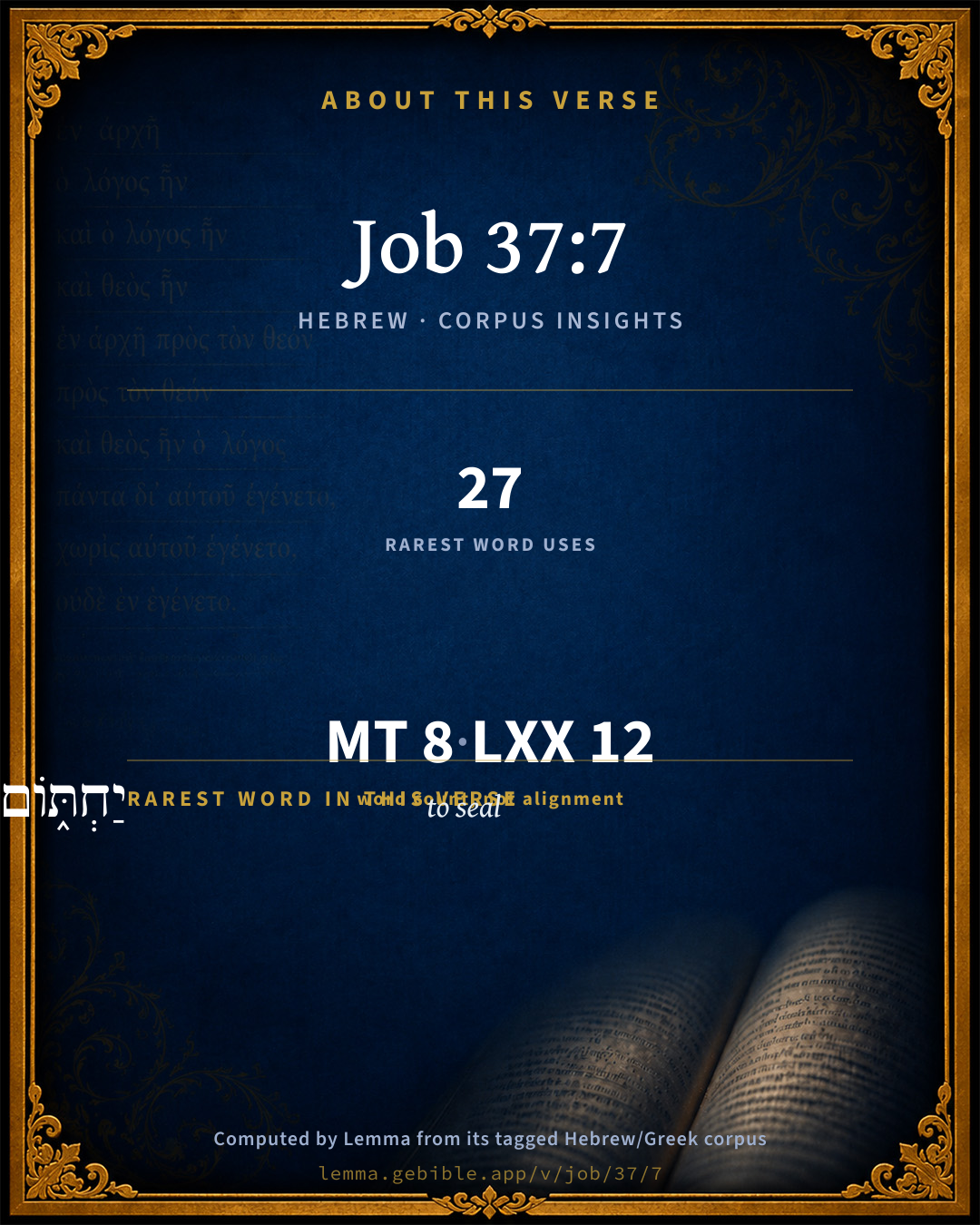
8
words
7
distinct lemmas
Wisdom
section

Shared distinctive vocabulary

יַחְתּ֑וֹם to seal H2856 occurs in 24 verses of the Hebrew Bible. Also found in:

Grammatical profile

  • 2 verbs
  • 6 nouns

Verb forms

  • יַחְתּ֑וֹם Qal · Imperfect
  • לָ֝דַ֗עַת Qal · Infinitive Construct

Repetition

A word recurs within this verse — often emphatic in Hebrew:

Hebrew & Septuagint length

In English translation the verse runs 18 words from the Hebrew and 16 from the Septuagint (LXX English) — closely comparable.

A rough comparison of the two English renderings, which tokenize alike — not a word-level alignment.

Word counts can differ between the Hebrew and the Greek without any difference in meaning — e.g. the Hebrew direct-object marker אֵת has no separate Greek word, and Greek often adds the article ὁ.

In the original languages it is 8 Hebrew tokens and 12 Greek tokens — but the two are counted differently (Hebrew bundles its prefixes and suffixes into one token; the Greek is in lemma form), so that isn’t a like-for-like length.

Cross-references

12

Topical passages linked to Job 37:7 in the Treasury of Scripture Knowledge — connected by theme and wording, ordered by reader-vote popularity; previews shown in the World English Bible.

  • Psalms 111:2 Yahweh's works are great, Pondered by all those who delight in them.
  • Psalms 109:27 That they may know that this is your hand; That you, Yahweh, have done it.
  • Job 5:12 He frustrates the devices of the crafty, So that their hands can't perform their enterprise.
  • Job 9:7 Who commands the sun, and it doesn't rise, And seals up the stars;
  • Job 12:14 Behold, he breaks down, and it can't be built again; He imprisons a man, and there can be no release.
  • Job 36:24 "Remember that you magnify his work, Whereof men have sung.
  • Psalms 46:8 Come, see Yahweh's works, What desolations he has made in the earth.
  • Psalms 64:9 All mankind shall be afraid. They shall declare the work of God, And shall wisely ponder what he has done.
  • Psalms 92:4 For you, Yahweh, have made me glad through your work. I will triumph in the works of your hands.
  • Ecclesiastes 8:17 then I saw all the work of God, that man can't find out the work that is done under the sun, because however much a man labors to seek it out, yet he won't find it. Yes even though a wise man thinks he can comprehend it, he won't be able to find it.
  • Isaiah 5:12 The harp, lyre, tambourine, and flute, with wine, are at their feasts; But they don't regard the work of Yahweh, Neither have they considered the operation of his hands.
  • Isaiah 26:11 Yahweh, your hand is lifted up, yet they don't see: but they shall see [your] zeal for the people, and be disappointed; yes, fire shall devour your adversaries.

Cross-references courtesy of OpenBible.info (CC BY 4.0).

Hebrew and Greek witnesses Masoretic Hebrew ↔ Greek Septuagint

The same verse in the two great witnesses to the Old Testament, shown verse-for-verse.

These are two independent witnesses, not word-aligned to each other, and the Septuagint is shown in lemma (dictionary) form.

Hebrew Job 37:7 Masoretic · Westminster Leningrad Codex

בְּיַד כָּל אָדָ֥ם יַחְתּ֑וֹם לָ֝דַ֗עַת כָּל אַנְשֵׁ֥י מַעֲשֵֽׂהוּ

He seals up the hand of every man, That all men whom he has made may know it.

World English Bible · Public Domain

Greek LXX Job 37:7 Septuagint · lemma form

ἐν χείρ πᾶς ἄνθρωπος κατασφραγίζω ἵνα γιγνώσκω πᾶς ἄνθρωπος ὁ ἑαυτοῦ ἀσθένεια

He seals up the hand of every man, that every man may know his own weakness.

LXX2012 (modern English Septuagint) · Public Domain

On this verse, Albert Barnes' Notes on the Bible discusses the Septuagint’s reading. Read the note in Commentary ↓

Hebrew: Westminster Leningrad Codex (CC BY 4.0). Greek: Septuagint (public domain); English from LXX2012 (modern English Septuagint) (Public Domain). How the Septuagint differs from the Hebrew →

Commentary

Notes on Job 37:7 from classic Christian and Jewish commentators (each source and its license shown beneath its notes). The classic Christian expositions comment on the surrounding passage and are grouped to its opening verse, so a note may address several verses; the Jewish commentaries on the Tanakh (Rashi and others) are per-verse, so they appear only where the commentator wrote on this verse.

Lemma curates 59 commentaries, every one of them public domain or Creative Commons licensed, each selected and text-cleaned for this edition rather than reprinted as found. About our sources →

Trapp's Complete Commentary

John Trapp

Job 37:7 He sealeth up the hand of every man; that all men may know his work.

Ver. 7. He sealeth up the hand of every man] i.e. He, by his great showers, sendeth men home for shelter, glad to intermit their work till better weather. See Exo 9:19. The Hebrews call rain Sagrir, Pro 27:15, from shutting up; because it keeps men at home, from travelling or working abroad. Chiromancy {palmistry} finds here no footing, whatever some have doted; as if God had set certain signs and notes in men’s hands of what should hereafter befall them, and this text is alleged for proof; but absurdly (Vide Joan de Indeg.).

That all men may know his work] i.e. That they may take notice of God’s handiwork in ordering the seasons; and have time to think on their domestic affairs.

John Trapp, A Commentary or Exposition upon All the Books of the Old and New Testament (1647–1656) — public domain. Text from a community e-Sword module.

The Biblical Illustrator

Joseph S. Exell

Job_37:7

He sealeth up the hand of every man.

God known by the sealing up of mans hand

The primary reference to this statement is to the season of winter. Then the earth is hard With frost, and perhaps covered with snow. This brings to man a diminution of power. Scope for his usual activity is cut off. Not only does the labour of the husbandman in great measure cease, but other forms of outdoor labour as well, the necessary materials being no longer plastic in the workmans hand. The hand of man is so effectually sealed that, for a time, numerous industries fail. While this is the primary reference of the statement, it may be much more widely applied. On every side God sets a limit to man. In relation to everything he comes to a point where he finds his hand sealed up. This, no doubt, is a necessity of his limited nature.

1. God sealeth up mans hand in the realm of nature, that we may know His work in the supply of our necessary food. For that we are dependent on the earth, and the elements: and we can do many things towards extracting from them the food which we need. We can plough, and sow, and harrow, and weed. But in this case man comes to a point where God sealeth up his hand. There is another class of operations which is equally necessary to secure the desired result. There must be apportionment of moisture and sunshine; and there may be mildew and blight. But as regards all this, man is utterly helpless. We have no power over the clouds and sunshine. All that kind of operation belongs entirely to God. This is a special reason for adoration and gratitude when the work is completed, seeing it is so peculiarly and manifestly the work of God. If the harvest were, from first to last, our own work, how proud should we be! how self-sufficient and how forgetful of God!

2. God sealeth up the hand of man by events in Providence, that all men may know His work as the Ruler of the world. Providence is just Gods work in this sense. It sets Him before us as the righteous Governor of the universe. Men can do many things, but they cannot do everything. This comes very much from the concealments of Providence. There is a thick veil spread over the doings of God in order that men may fear before Him. This applies to nations as well as to individuals. Both the one and the other must move very much in the dark as regards circumstances and results, but not as regards principles. For principles are immutable, and God intends us to act from these. How often does God actually arrest courses of human action by sudden combinations in providence which make them impossible--as in the confusion of tongues at Babel.

3. God sealeth up mans hand by affliction, that men may know His work in their individual life. Affliction is no doubt a part of providence, but it is an isolated part. It is individual in its action, and it enforces the knowledge of Gods work in the personal sphere. This it does by sealing up the hand. Then we feel how little we had in our own power even when we were at our best, and how completely we were at the mercy of a higher. And we see also how well things can go on without us.

4. God seals up the hand of every man when, by His Spirit, He convinces him of sin, that all may know His work in the matter of the souls salvation. Here we are in the region of conscience. Practical lesson. We must accept our weakness, and all the limitations of our present condition, if we are ever to know Gods work. (A. L. Simpson, D. D.)

The Biblical Illustrator, edited by Joseph S. Exell (c. 1880s–1900s) — public domain. Text from a community e-Sword module.

Tyndale Open Study Notes

Tyndale Open Resources

37:7 everyone stops working . . . watch his power: The ending of the agricultural work season gave people time to meditate on God’s providential control.

Tyndale Open Study Notes — © Tyndale Open Resources, licensed CC BY-SA 4.0. Text via the HelloAO Bible API.

Geneva Bible (1599)

Geneva Bible translators

By rains and thunders God causeth men to keep themselves within their houses.

Geneva Bible (1599) marginal notes — public domain. Text via Bolls.life.

Jamieson, Fausset & Brown

Robert Jamieson, A. R. Fausset & David Brown

In winter God stops man's out-of-doors activity.

sealeth--closeth up (Job 9:7). Man's "hands" are then tied up.

his work--in antithesis to man's own work ("hand") which at other times engages men so as to make them liable to forget their dependence on God. UMBREIT more literally translates, That all men whom He has made (literally, "of His making") may be brought to acknowledgment."

Jamieson, Fausset & Brown — Commentary Critical and Explanatory on the Whole Bible (1871) — public domain (CC PDM 1.0). Text via the HelloAO Bible API.

Adam Clarke's Commentary

Verse 7. He sealeth up the hand of every man] After all that has been said, and much of it most learnedly, on this verse, I think that the act of freezing is probably intended; that when the earth is bound up by intense frost, the hand, yad, labour, of every man is sealed up; he can do no more labour in the field, till the south wind blow, by which a thaw takes place. While the earth is in this state of rigidity, the beasts go into their dens, and remain in their places, Job 37:8, some of them sleeping out the winter in a state of torpor, and others of them feeding on the stores which they had collected in autumn. However, the passage may mean no more than by the severity of the rains beasts are drawn to their covers; and man is obliged to intermit all his labours. The mighty rains are past. Who would have thought that on this verse, as its Scriptural foundation, the doctrine of chiromancy is built! God has so marked the hand of every man by the lines thereon exhibited, that they tell all the good or bad fortune they shall have during life; and he has done this that all men, by a judicious examination of their hands, may know his work! On this John Taisnier, a famous mathematician, lawyer, musician, and poet laureate of Cologne, has written a large folio volume, with more hands in it than fell to the lot of Briareus:-printed at Cologne, 1683.

Adam Clarke's Commentary on the Bible (1810–1826) — public domain. Text from a community e-Sword/MySword module.

The Cambridge Bible for Schools and Colleges

gen. ed. J. J. S. Perowne

7. He sealdh up the hand] Effect of the winter rains and snow on men: all labour in the field is suspended; the hand of man is as it were “sealed up.”

that all men may know his work] The Heb. must be rendered: that all men whom he hath made may know, lit. all men of his workmanship. The meaning is, that men by their enforced inactivity through His operations in nature may know His sovereign power and that they are subject to it. The sense given by the A. V. is that of some of the ancient Versions, but implies a different reading.

The Cambridge Bible for Schools and Colleges (gen. ed. J. J. S. Perowne; Cambridge University Press, 1878–1918) — public domain. Text from a community e-Sword module.

John Gill's Exposition

He sealeth up the hand of every man,.... That is, by deep snows and heavy rains being on the earth; where, as travellers are stopped in their journeys, and cannot proceed, so various artificers are hindered from their work, and husbandmen especially from their employment in the fields; so that their hands are as it were shut up and sealed, that they cannot work with them. Sephorno interprets this of the fruits and increase of the earth being produced and brought to perfection by means of the snow and rain, and so gathered by and into the hands of men; whereby they are led to observe the work of God and his goodness herein, and so to love and fear him; which he takes to be the sense of the following clause,

that all men may know his work; either their own work; what they have to do at home when they cannot work abroad; or that they may have leisure to reflect upon their moral ways and works, and consider how deficient they are: or rather the work of God; that they may know and own the snow and rain are his work, and depend upon his will; or that they may have time and opportunity of considering and meditating on the works of God, in nature, providence, and grace. Some choose to read the words, "that all men of his work may know" (l); may know him the author of their beings, and the God of their mercies. For all men are the work of his hands; he has made them, and not they themselves; and the end of all God's dealings with them is, that they may know him, fear, serve, and glorify him.

(l) "omnes homines operis ipsius", Schmidt, Michaelis; so Schultens.

John Gill's Exposition of the Whole Bible (1746–1763) — public domain (CC PDM 1.0). Text via the HelloAO Bible API.

Albert Barnes' Notes on the Bible

He sealeth up the hand of every man - That is, in the winter, when the snow is on the ground, when the streams are frozen, and when the labors of the husbandman cease. The idea of “sealing up the hand” is derived from the common purpose of a seal, to make fast, to close up, to secure (compare Job 9:7, note; Job 33:16, note), and the sense is, that the hands can no more be used in ordinary toil. Every man in the snow and rain of winter is prevented from going abroad to his accustomed toil, and is, as it were, sealed up in his dwelling. The idea is exquisitely beautiful. God confines human beings and beasts in their houses or caves, until the winter has passed by.

That all men may know his work - The Septuagint renders this,” That every man may know his own weakness” - ἀσθένειαν astheneian. Various interpretations have been given of the passage, but our common version has probably expressed in the main the true sense, that God thus interrupts the labors of man, and confines him in his home, that he may feel his dependence on God, and may recognize the constant agency of his Creator. The Hebrew literally is “For the knowledge of all the men of his making;” that is, that all the people whom he has created may have knowledge. The changing seasons thus keep before us the constant evidence of the unceasing agency of God in his works, and prevent the feeling which we might have, if everything was uniform that the universe was under the control of “fate.” As it is, the succession of the seasons, the snow, the rain, the dew, and the sunshine, all bear marks of being under the control of an intelligent Being, and are so regulated that we need not forget that his unceasing agency is constantly round about us. It may be added, that when the farmer in the winter is laid aside from his usual toil, and confined to his dwelling, it is a favorable time for him to meditate on the works of God, and to acquaint himself with his Creator. The labors of man are thus interrupted; the busy affairs of life come to a pause, and while nature is silent around us, and the earth wrapped in her fleecy mantle forbids the labor of the husbandman, everything invites to the contemplation of the Creator, and of the works of his hands. The winter, therefore, might be improved by every farmer to enlarge his knowledge of God, and should be regarded as a season wisely appointed for him to cultivate his understanding and improve his heart.

Albert Barnes' Notes on the Bible (1834–1885) — public domain. Text from a community e-Sword/MySword module.

Haydock's Catholic Bible Commentary

He sealed up, &c. When he sends those showers of his strength; that is, those storms of rain, he seals up; that is, he shuts up the hands of men from their usual work abroad, and confines them within doors, to consider his works; or to forecast their works; that is, what they themselves are to do. (Challoner) --- We are all the servants of God. He marks us in the hand, as such, Isaias xliv. 5., and Ezechiel ix. 6., and Apocalypse xiii. 6. The Romans marked soldiers with a hot iron in the hands. (Veget. i. 8.) --- The abettors of chiromancy have hence vainly pretended that they can discover each person’s future in the lineaments of his hands. (Calmet)

George Leo Haydock (1774–1849), Haydock's Catholic Family Bible and Commentary, 1859 edition — public domain. Excludes Psalms (Douay-Rheims chapter numbering differs from Protestant) and Deuterocanonical books (Catholic canon only).

Matthew Poole's English Annotations

By these great snows and rains he drives men out of the fields, and seals or binds tap their hands from all that work, and drives them home to their houses, and in a manner shuts them up there. See Gen 7:16; Exo 9:19. Or, by his hand or power (i.e. by those powerful works of his hand here mentioned) he sealeth, or shutteth up, or keepeth close every man, to wit, in his house, as the beasts in their dens, Job 37:8. That all men may know his work; that men being hindered from action and their own work, and so being idle and at perfect leisure, may fall to a serious contemplation of these and other great and glorious works of God. Or, that he (i.e. every man, as was now expressed)

may know (or inquire into, or take an account of) all his workmen; for which the proper season is when they are all hindered from their work, and brought together into the house.

Matthew Poole's English Annotations on the Holy Bible (1683–1685) — public domain. Text from a community e-Sword/MySword module.

Whedon's Commentary on the Bible

Daniel D. Whedon

7. Sealeth up — That is, through storms and cold. He compels men to cease from rural labours, that they who are his work (literally, all men of his work) may be led to reflect upon Him and his ways, “that every man may know his own weakness,” (Septuagint.) A Persian poet (Saadi) has aptly said of the green leaves of the forest,

In the eye of the intelligent,

Every single leaf, is a book of knowledge evincing a creator.

AEschylus uses a like phrase, “the sealing up of thunder,” for restraining it. (Eumen., 830.) Dr. T. Lewis refers to the magnificent description of a thunder storm in Psalms 29, as witnessed from the sheltering temple, whilst at every thunder peal “every one in His temple (Job_37:9) is crying ‘Glory!’” (אמר כבוד.) Similarly, a sheltering home should lead to a like grateful recognition of God, as “he doth fly upon the wings of the wind,” letting loose the forces of nature, and controlling, while intensifying, their power. Palmistry — the art of divining one’s fate by inspecting the lines and lineaments of the hand — founded its foolish pretensions upon a false reading of this passage, making it to mean that God has sealed upon every man’s hand how long he shall live. See WEMYSS on Job, p. 300.

Daniel D. Whedon (gen. ed.), Commentary on the Old and New Testaments (1874–1909) — public domain. Text from a community e-Sword module.

The Pulpit Commentary

He sealeth up the hand of every man. In the winter season, when the snow falls, and the heavy rains pour down (ver. 6), God "seeleth up the hand of every man;" i.e. puts an end to ordinary out-of-doors labour, and establishes a time of pause or rest (comp. Homer, "II," 17:549). He does this with the object that all men may know his work; i.e. that, during the time of their enforced idleness, men may have leisure for reflection, and may employ it in meditating upon him and his marvellous "work."

The Pulpit Commentary (1880–1919), ed. H.D.M. Spence-Jones & Joseph S. Exell — public domain. Text from a community e-Sword module.

John Wesley's Explanatory Notes

Sealeth - By these snows and rains he drives men out of the fields, and seals or binds up their hands from their work. That - They may seriously contemplate on these, and other great and glorious works of God.

John Wesley, Explanatory Notes Upon the Whole Bible (1754–1765) — public domain. Text via the GEBible commentary corpus.

unfoldingWord translationNotes

Door43 World Missions Community

He stops the hand of every man

Here the word "hand" represents the entire person. AT: "He stops every man" (See: Synecdoche)

The storm comes from its chamber in the south and the cold from the scattering winds in the north

In Israel, strong wind storms blow in from the south and cold weather approaches from the north. (See: Assumed Knowledge and Implicit Information)

The storm comes from its chamber in the south

Elihu speaks of the storm blowing in from the south as if the storm has a place where it resides until it comes. (See: Metaphor)

translationWords

hand

works

beast

unfoldingWord translationNotes — © Distant Shores Media and the Door43 World Missions Community, licensed CC BY-SA 4.0. Source: git.door43.org/Door43/en_tn.

Rashi

Rabbi Shlomo Yitzchaki (Rashi)

By the hand of every man he seals When a man sins before Him, the man himself signs his signature on the day of his death to the sins that he committed, which are written before him.

so that every man should know his deed to let him know for what he is being judged.

Rashi on the Tanakh — English translations: “The Judaica Press complete Tanach with Rashi, translated by A. J. Rosenberg” (CC BY 4.0); “Pentateuch with Rashi's commentary by M. Rosenbaum and A.M. Silbermann, 1929-1934” (public domain); “The Metsudah Tanach series, Lakewood, N.J” (CC BY 4.0); and “The Book of Joshua, Metsudah Publications, 1997” (CC BY 4.0). Text via Sefaria.

Lesson kit

Teaching starters — assembled from the data on this page, not authored interpretation. Every prompt links to the verse data it draws on. Edit before teaching.

Job, in the Wisdom, opens this verse with 8 words (7 distinct Hebrew lemmas). Its most distinctive word is châtham (“to seal”). A historical commentator’s framing appears above. Read the whole chapter for the surrounding context.

Discussion questions

  1. The word châtham carries the sense “to seal.” How does it shape the verse?
  2. Leviticus 15:3 shares the word «to seal» with this verse. How do the two illuminate each other?
  3. “all” occurs 2× in this one verse. What is the effect of the repetition?
  4. These translations render this verse differently. What is at stake in choosing one wording over another?
  5. The verb «יַחְתּ֑וֹם» is Qal Imperfect. How does its form color the action?
  6. Reading how Trapp's Complete Commentary and The Biblical Illustrator read this verse, where do the two commentators agree and where do they part?

Things to notice

Reading settings

Reading text

Shown beneath each verse's original-language words.

Old Testament
Old Testament edition

Read the OT as the Masoretic Hebrew (MT) or the Greek Septuagint (LXX).

English shown for the Greek Septuagint (in the Hebrew ↔ Greek comparison).

Comparing translations? Open the Compare panel on any verse page to stack up to four side by side.