
Proverbs 28:22

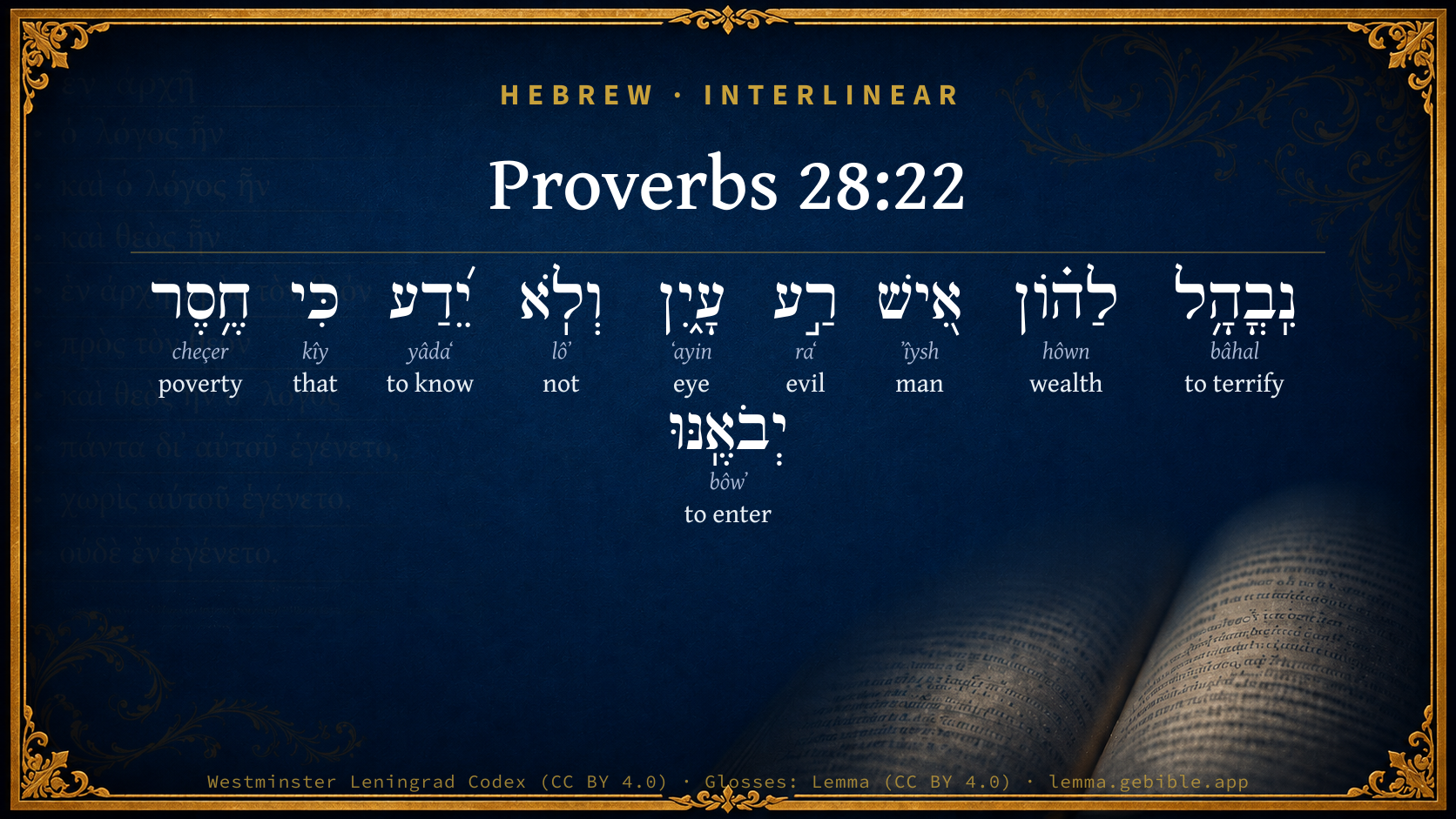
Hebrew (Westminster Leningrad Codex) Proverbs 28:22 appears in the Hebrew Old Testament. The text above is from the Westminster Leningrad Codex. Each word links to its Strong’s number, a concise gloss, and parsing drawn from the Open Scriptures Hebrew Bible morphology. Click any word for its full Brown-Driver-Briggs (BDB) entry.
Download image
Cite this verse

Proverbs 28:22 (World English Bible). Public Domain. Lemma interlinear Bible study tool, https://lemma.gebible.app/v/proverbs/28/22.

Show BibTeX & RIS
BibTeX
RIS
English Translation
A stingy man hurries after riches, And doesn't know that poverty waits for him.
World English Bible · Public Domain
Download a study sheet

One document with this verse’s original text, its word-by-word gloss line, the meaning frame, cross-references with their text, attributed commentary, and full source and license credits — printable, and it pastes into notes with its structure intact.

This verse Autodidact and up

Study sheet (.html) Plain text (.txt)

A passage Seminary Student

Up to 50 verses in one chapter. A passage sheet keeps up to 6 commentary sources and 12 cross-references per verse, in the order this page ranks them, and says so on the sheet whenever that leaves anything out. Ask for a single verse and you get the Autodidact verse sheet above.

Everything on this page stays free to read, with no account — the sheet is a download of what is already on screen, not access to it.

Want to remove ads? Support Godless Engineer
Compare translations 3

The same verse in 3 English versions, stacked beneath the original-language interlinear above. Click any original word for its lexicon entry.

Each is an independent rendering of the whole verse — the interlinear is not word-aligned to these translations.

Highlighted words mark where these versions differ — a whole-verse word diff, not a word-by-word alignment.

  • World English Bible Public Domain
    A stingy man hurries after riches, And doesn't know that poverty waits for him.
  • King James Version Public Domain
    He that hasteth to be rich hath an evil eye, and considereth not that poverty shall come upon him.
  • unfoldingWord Literal Text CC BY-SA 4.0
    One hurrying to the wealth a man of an evil eye, but he does not know that lack will come to him.

unfoldingWord Literal Text — © unfoldingWord, licensed CC BY-SA 4.0. Word-aligned USFM3 via Door43 (git.door43.org/unfoldingWord/en_ult).

Versions to compare (up to 4)

3 of 4 selected

Show all 18 translations

Every available English version of this verse, each an independent rendering of the whole verse.

  • World English Bible Public Domain
    A stingy man hurries after riches, And doesn't know that poverty waits for him.
  • Berean Standard Bible Public Domain
    A stingy man hastens after wealth and does not know that poverty awaits him.
  • Majority Standard Bible Public Domain
    A stingy man hastens after wealth and does not know that poverty awaits him.
  • King James Version Public Domain
    He that hasteth to be rich hath an evil eye, and considereth not that poverty shall come upon him.
  • American Standard Version (1901) Public Domain
    he that hath an evil eye hasteth after riches, And knoweth not that want shall come upon him.
  • Revised Version (1885) Public Domain
    He that hath an evil eye hasteth after riches, and knoweth not that want shall come upon him.
  • Geneva Bible (1599) Public Domain
    A man with a wicked eye hasteth to riches, and knoweth not, that pouertie shall come vpon him.
  • Douay-Rheims (1899) Public Domain
    A man, that maketh haste to be rich, and envieth others, is ignorant that poverty shall come upon him.
  • Young's Literal Translation Public Domain
    Troubled for wealth `is' the man `with' an evil eye, And he knoweth not that want doth meet him.
  • Literal Standard Version CC BY-SA 4.0
    The man [with] an evil eye [is] troubled for wealth, || And he does not know that want meets him.
  • Unlocked Literal Bible CC BY-SA 4.0
    A stingy man hurries after riches, but he does not know that poverty will come upon him.
  • unfoldingWord Literal Text CC BY-SA 4.0
    One hurrying to the wealth a man of an evil eye, but he does not know that lack will come to him.
  • Darby Bible Public Domain
    He that hath an evil eye hasteth after wealth, and knoweth not that poverty shall come upon him.
  • World Messianic Bible Public Domain
    A stingy man hurries after riches, and doesn’t know that poverty waits for him.
  • Webster's Bible Public Domain
    He that hasteth to be rich hath an evil eye, and considereth not that poverty shall come upon him.
  • Free Bible Version CC BY-SA 4.0
    Envious people are in a rush to get rich; they don't realize they'll end up poor.
  • Bible in Basic English Public Domain
    He who is ever desiring wealth goes running after money, and does not see that need will come on him.
  • JPS Tanakh (1917) Public Domain
    He that hath an evil eye hasteneth after riches, and knoweth not that want shall come upon him.

Literal Standard Version (2020), Covenant Press — licensed CC BY-SA 4.0. Text via the HelloAO Bible API (eBible.org). Unlocked Literal Bible (unfoldingWord) — licensed CC BY-SA 4.0. Text via the HelloAO Bible API (eBible.org). unfoldingWord Literal Text — © unfoldingWord, licensed CC BY-SA 4.0. Word-aligned USFM3 via Door43 (git.door43.org/unfoldingWord/en_ult). Free Bible Version, Dr. Jonathan Gallagher — licensed CC BY-SA 4.0. Text via the HelloAO Bible API (eBible.org).

Word by word

More ways to search: Search by grammar → Find every occurrence → Compare this word →

Practice this passage: Drill this verse → Learn its vocabulary →

About this verse

These counts appear in no published source. They are computed here, from the morphology-tagged text and Lemma’s own curated glosses. What Lemma adds →

10
words
10
distinct lemmas
Wisdom
section

Notable vocabulary

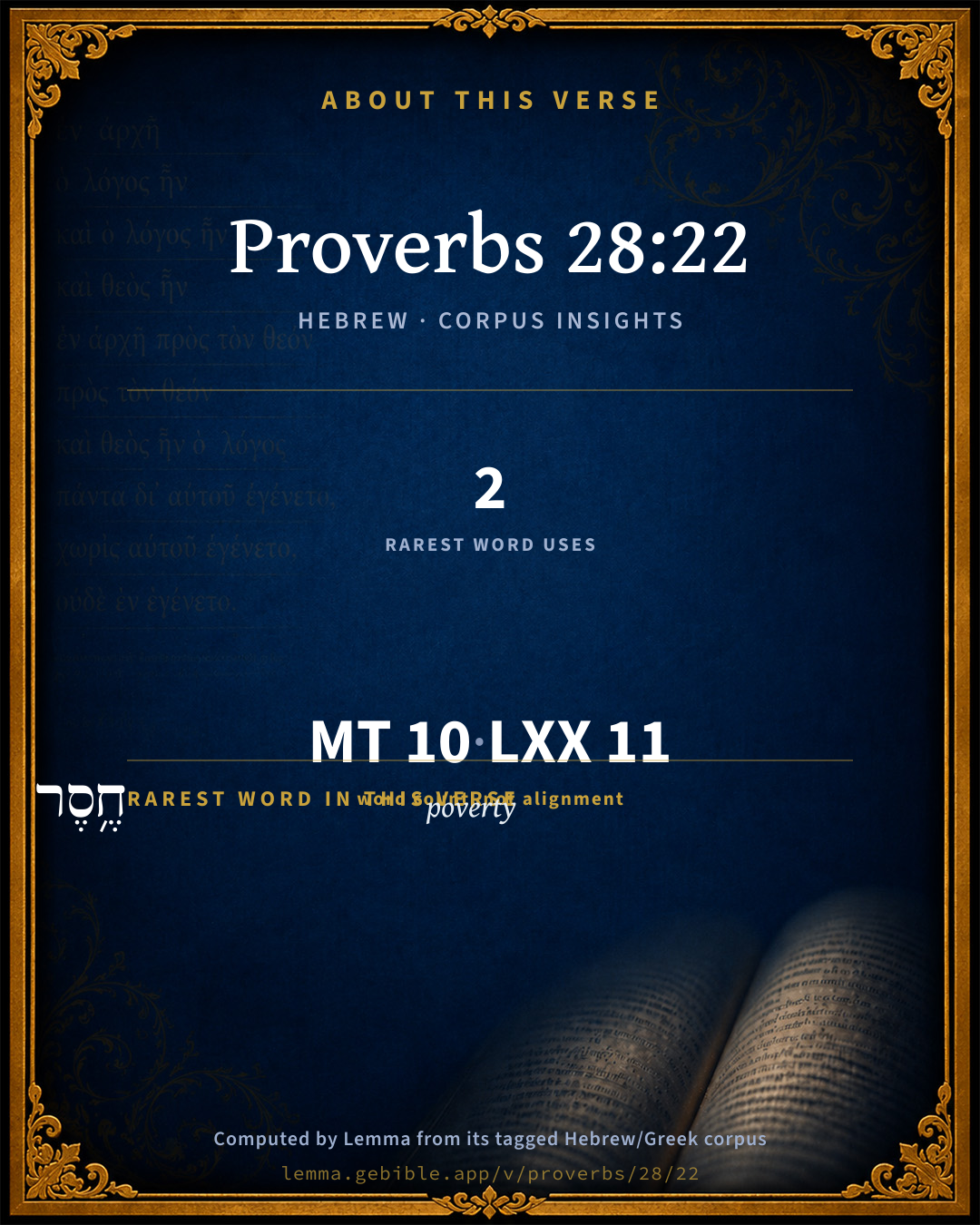
The rarest word here is חֶ֥סֶר poverty H2639 — appearing just 2 times in the whole Hebrew Bible.

Shared distinctive vocabulary

חֶ֥סֶר poverty H2639 occurs in 2 verses of the Hebrew Bible. Also found in:

Grammatical profile

  • 3 verbs
  • 4 nouns
  • 1 adjective
  • 1 conjunction
  • 1 particle

Verb forms

  • נִֽבֳהָ֥ל Niphal · Participle Active
  • יֵ֝דַע Qal · Imperfect
  • יְבֹאֶֽנּוּ Qal · Imperfect

Hebrew & Septuagint length

In English translation the verse runs 14 words from the Hebrew and 21 from the Septuagint (LXX English) — the Septuagint runs noticeably longer here. See the side-by-side →

A rough comparison of the two English renderings, which tokenize alike — not a word-level alignment.

Word counts can differ between the Hebrew and the Greek without any difference in meaning — e.g. the Hebrew direct-object marker אֵת has no separate Greek word, and Greek often adds the article ὁ.

In the original languages it is 10 Hebrew tokens and 11 Greek tokens — but the two are counted differently (Hebrew bundles its prefixes and suffixes into one token; the Greek is in lemma form), so that isn’t a like-for-like length.

Cross-references

9

Topical passages linked to Proverbs 28:22 in the Treasury of Scripture Knowledge — connected by theme and wording, ordered by reader-vote popularity; previews shown in the World English Bible.

  • Proverbs 23:6 Don't eat the food of him who has a stingy eye, And don't crave his delicacies:
  • 1 Timothy 6:9 But those who are determined to be rich fall into a temptation and a snare and many foolish and harmful lusts, such as drown men in ruin and destruction.
  • Proverbs 28:20 A faithful man is rich with blessings; But one who is eager to be rich will not go unpunished.
  • Job 27:16–17 Though he heap up silver as the dust, And prepare clothing as the clay;
  • Matthew 20:15 Isn't it lawful for me to do what I want to with what I own? Or is your eye evil, because I am good?'
  • Genesis 13:10–13 Lot lifted up his eyes, and saw all the plain of the Jordan, that it was well watered every where, before Yahweh destroyed Sodom and Gomorrah, like the garden of Yahweh, like the land of Egypt, as you go to Zoar.
  • Genesis 19:17 It came to pass, when they had taken them out, that he said, "Escape for your life! Don't look behind you, neither stay anywhere in the plain. Escape to the mountain, lest you be consumed!"
  • Job 20:18–22 That for which he labored he shall restore, and shall not swallow it down; According to the substance that he has gotten, he shall not rejoice.
  • Mark 7:22 covetings, wickedness, deceit, lustful desires, an evil eye, blasphemy, pride, and foolishness.

Cross-references courtesy of OpenBible.info (CC BY 4.0).

Hebrew and Greek witnesses Masoretic Hebrew ↔ Greek Septuagint

The same verse in the two great witnesses to the Old Testament, shown verse-for-verse.

Here the Septuagint runs noticeably longer than the Hebrew — LXX2012 (modern English Septuagint) 21 words vs World English Bible 14. A rough length comparison of the two English translations, not a word-level alignment — read both below.

These are two independent witnesses, not word-aligned to each other, and the Septuagint is shown in lemma (dictionary) form.

Hebrew Proverbs 28:22 Masoretic · Westminster Leningrad Codex

נִֽבֳהָ֥ל לַה֗וֹן אִ֭ישׁ רַ֣ע עָ֑יִן וְלֹֽא יֵ֝דַע כִּי חֶ֥סֶר יְבֹאֶֽנּוּ

A stingy man hurries after riches, And doesn't know that poverty waits for him.

World English Bible · Public Domain

Greek LXX Proverbs 28:22 Septuagint · lemma form

σπεύδω πλουτέω ἀνήρ βάσκανος καί οὐ οἶδα ὅτι ἐλεήμων κρατέω αὐτός

An envious man makes haste to be rich, and knows not that the merciful man will have the mastery over him.

LXX2012 (modern English Septuagint) · Public Domain

On this verse, John Gill's Exposition discusses the Septuagint’s reading. Read the note in Commentary ↓

Hebrew: Westminster Leningrad Codex (CC BY 4.0). Greek: Septuagint (public domain); English from LXX2012 (modern English Septuagint) (Public Domain). How the Septuagint differs from the Hebrew →

Commentary

Notes on Proverbs 28:22 from classic Christian and Jewish commentators (each source and its license shown beneath its notes). The classic Christian expositions comment on the surrounding passage and are grouped to its opening verse, so a note may address several verses; the Jewish commentaries on the Tanakh (Rashi and others) are per-verse, so they appear only where the commentator wrote on this verse.

Lemma curates 59 commentaries, every one of them public domain or Creative Commons licensed, each selected and text-cleaned for this edition rather than reprinted as found. About our sources →

The Cambridge Bible for Schools and Colleges

gen. ed. J. J. S. Perowne

22. He that hasteth &c. The order of subject and predicate should be reversed as in A.V. marg. and R.V.: He that hath an evil eye hasteth after riches. After the manner of this Collection, we have three proverbs (Pro_28:20-21) on the same subject brought together. Covetousness is a characteristic of a man who is untrustworthy, Pro_28:20, partial, Pro_28:21, and mean and grudging, Pro_28:22.

poverty] Or, want, R.V. Because it is “the liberal soul” that “shall be made fat,” Pro_11:25. Comp. Isa_32:8.

The Cambridge Bible for Schools and Colleges (gen. ed. J. J. S. Perowne; Cambridge University Press, 1878–1918) — public domain. Text from a community e-Sword module.

Trapp's Complete Commentary

John Trapp

Pro 28:22 He that hasteth to be rich [hath] an evil eye, and considereth not that poverty shall come upon him.

Ver. 22. He that hasteth to be rich hath an evil eye.] He is sick of "the lust of the eye" {1Jn 2:16} - for all sinful lusts are παθηματα, sicknesses - coveting his neighbour’s goods, envying his prosperity, and begrudging him every bit he eats at his table. {Pro 23:6-7} {See Trapp on "Pro 23:6"} {See Trapp on "Pro 23:7"}

And considereth not that poverty shall come upon him.] Etiamsi per mare pauperiem fugeat, per saxa, per ignes; Though he run as fast from beggary as he can flee, yet it will overtake him, and catch him by the back. {Job 27:16-17} Surely as the stars that went before the wise men went when they went and stayed when they stayed, so riches fly the faster from a man the more eagerly he follows them, but then stay when a man’s wind is stayed. "In the fullness of his sufficiency he shall be in straits," saith Zophar, concerning the wicked. {Job 20:22} He is poor in the midst of his riches; but God will strip him of all, and make a poor fool of him. {Jer 17:11}

John Trapp, A Commentary or Exposition upon All the Books of the Old and New Testament (1647–1656) — public domain. Text from a community e-Sword module.

The Biblical Illustrator

Joseph S. Exell

Pro_28:20; Pro_28:22

He that maketh haste to be rich shall not be innocent.

Haste to be rich

Nowhere does the Bible denounce riches. It tells men very plainly what the dangers are. It denounces very strongly the conduct of rich men. But the motive to good conduct, in the Old Testament period, was the promise of secular prosperity--abundance. The Bible asserts that riches are a great blessing; and poverty a great misfortune. It is the method of Gods development and education of the race to bring men up to higher levels by those processes by which men develop larger means, various riches, and the comforts of life, and give to the household broader foundations, ampler powers. It goes against the educated religious feeling of men for one to say that the way of riches was meant to be the way of religion; yet it is true. All barbarous nations are poor. The Bible speaks the sentiment of universal mankind when it regards riches held in the hand of virtue as being an eminent blessing from God.

I. Riches may either be produced or collected. The foundation of all prosperity is production. He increases the riches of a society that applies his reason and skill to the raw material of the globe, or that brings it from inertness to positive service, and gives to matter the power of serving man. He produces wealth. Then comes the man who utilises it; creates it into garments, houses, utensils, etc. The foundation of all value is not what a thing costs in making it, but what is inherent in it of thought and skill. What part of man was used in producing it; and to what part of a man is such properly addressed? The man who produces wealth is the foundation man. It is the law of the production of wealth that a man should render an equivalent for every stage of value. Sudden wealth is not hasty wealth, necessarily.

II. The production of wealth connects itself with benevolence, with sympathy. The man who is developing property, as distinguished from money, is actually increasing the common wealth. It is a sad thing, but in the main true, that the producers of wealth are obliged to eat up the larger part of their product in order to have strength to work. But every man that is developing or producing riches is, at the same time, educating himself in morals, or should be. Patience is a moral quality; another name for self-control. The man who gets wealth legitimately is usually himself built up in inward riches fully as much as he builds up his estate in outward wealth.

III. Haste to be rich is a great danger to men, because it tempts them to employ illegitimate means. Sleights, crafts, disingenuous ways, greed, violations of honesty. Haste runs along the edge of so many dangers, that a mans head must be peculiarly well set on his shoulders, and his brain must be very solid and sober, if he does not topple over into them. A man that is making haste to be rich is tempted to ostentation. But ostentation is expensive, and men are easily tempted to devise schemes to maintain it. Men having sudden wealth are apt to become cruel through indifference to other mens rights. Haste is apt to change into idolatry. (H. W. Beecher.)

The Biblical Illustrator, edited by Joseph S. Exell (c. 1880s–1900s) — public domain. Text from a community e-Sword module.

Joseph Benson's Commentary

Pro 28:22. He that hasteth to be rich — That is pushed on by his desires to get riches by right or wrong; hath an evil eye — Is uncharitable to persons in want, and envious toward those who get any thing besides himself; and considereth not that poverty shall come upon him — And, consequently, that he shall need the pity and help of others, which he cannot reasonably expect, either from God or men, having so hardened his heart against others in misery.

Joseph Benson's Commentary on the Old and New Testaments (1811–1818) — public domain. Text from a community e-Sword module.

Geneva Bible (1599)

Geneva Bible translators

Meaning, him that is covetous.

Geneva Bible (1599) marginal notes — public domain. Text via Bolls.life.

Matthew Henry's Commentary

Here again Solomon shows the sin and folly of those that will be rich; they are resolved that they will be so, per fas, per nefas - right or wrong; they will be so with all speed; they are getting hastily an estate. 1. They have no comfort in it: They have an evil eye, that is, they are always grieving at those that have more than they, and always grudging their necessary expenses, because they think the former keep them from seeming rich, the latter from being so, and between both they must needs be perpetually uneasy. 2. They have no assurance of the continuance of it, and yet take no thought to provide against the loss of it: Poverty shall come upon them, and the riches which they made wings for, that they might fly to them, will make themselves wings to fly from them; but they are secure and improvident, and do not consider this, that while they are making haste to be rich they are really making haste to be poor, else they would not trust to uncertain riches.

Matthew Henry's Commentary on the Whole Bible (1708–1710) — public domain (CC PDM 1.0). Text via the HelloAO Bible API.

Jamieson, Fausset & Brown

Robert Jamieson, A. R. Fausset & David Brown

(Compare Pro 28:20).

evil eye--in the general sense of Pro 23:6, here more specific for covetousness (compare Pro 22:9; Mat 20:15).

poverty . . . him--by God's providence.

Jamieson, Fausset & Brown — Commentary Critical and Explanatory on the Whole Bible (1871) — public domain (CC PDM 1.0). Text via the HelloAO Bible API.

Ellicott's Commentary for English Readers

(22) Hath an evil eye.—Envies others their prosperity, and keeps all he has for himself.

And considereth not that poverty shall come upon him.—For it is “the liberal soul” that “shall be made fat” (Pro_11:25), not such as he, who can get no blessing from God.

A Bible Commentary for English Readers, edited by Charles John Ellicott (1878–1897) — public domain. Text from a community e-Sword module.

John Gill's Exposition

He that hasteth to be rich,.... As every man that is eagerly desirous of riches is; he would be rich at once (z), and cannot wait with any patience in the ordinary course of means:

hath an evil eye; on the substance of others, to get it, right or wrong; is an evil man, and takes evil methods to be rich (a); see Ti1 6:9; or an envious one; is an envious man; as the Septuagint and Arabic versions; he envies others, as the Vulgate Latin version, the riches of other men; he grudges everything that goes beside himself; and that makes him in haste to be rich, that he may be equal to or superior to others: or he is a sordid, avaricious, illiberal man, that will not part with anything for the relief, for others, and is greedy of everything to amass wealth to himself; an evil eye is opposed to a good or bountiful one, that is, to a man that is liberal and generous, Pro 22:9;

and considereth not that poverty shall come upon him; for wealth gotten hastily, and especially wrongfully, diminishes, wastes, and comes to nothing in the end; it sometimes flies away as fast as it comes; it has wings to do the one, as well as the other: this the man in haste to be rich does not consider, or he would have taken another method; since this is not the true way of getting and keeping riches, but of losing them, and coming to want; see Pro 13:11.

(z) "Nam dives qui fieri vult, et cito vult fieri", Juvenal. Satyr. 14. v. 176. (a) "Sed quae reverentia legum? quis metus, ant pudor est unquam properantis avari?" Juvenal, ib.

John Gill's Exposition of the Whole Bible (1746–1763) — public domain (CC PDM 1.0). Text via the HelloAO Bible API.

Albert Barnes' Notes on the Bible

The covetous temper leads not only to dishonesty, but to the “evil eye” of envy; and the temper of grudging, carking care, leads him to poverty.

Albert Barnes' Notes on the Bible (1834–1885) — public domain. Text from a community e-Sword/MySword module.

Haydock's Catholic Bible Commentary

Poverty. Septuagint, "the merciful shall have power over him," ver. 8. (Haydock)

George Leo Haydock (1774–1849), Haydock's Catholic Family Bible and Commentary, 1859 edition — public domain. Excludes Psalms (Douay-Rheims chapter numbering differs from Protestant) and Deuterocanonical books (Catholic canon only).

Matthew Poole's English Annotations

Hath an evil eye; is uncharitable to persons in want, envious towards those who get any thing besides him, and covetous or greedy of getting riches by all ways possible, whether just or unjust. Thus an evil eye is taken, Pro 23:6; Mat 20:15, as a good eye notes the contrary disposition, Pro 22:9.

That poverty shall come upon him; and consequently that he shall need the pity and help of others, which he cannot expect either from God or men, who hath so hardened himself against others in misery.

Matthew Poole's English Annotations on the Holy Bible (1683–1685) — public domain. Text from a community e-Sword/MySword module.

Whedon's Commentary on the Bible

Daniel D. Whedon

22. Hath an evil eye — Is covetous or envious in disposition, and hence is in trembling haste for wealth.

Considereth not… poverty — Yet, though he knows it not, poverty shall come. So some reputable scholars: but others prefer to follow the Authorized Version in the order of the first clause: “He that is eager for wealth is a man of evil eye.” — Conant.

Comp. Pro_28:20.

Daniel D. Whedon (gen. ed.), Commentary on the Old and New Testaments (1874–1909) — public domain. Text from a community e-Sword module.

The Pulpit Commentary

He that hasteth to be rich bath an evil eye (see ver. 20); better, the man of evil eye hasteth after riches. The man of evil eye (Pro_23:6) is the envious and covetous man; such a one tries to improve his position and raise himself speedily to the height of him whom he envies, and is quite unscrupulous as to the means which he uses to effect his purpose, and keeps all that he gains selfishly to himself. And yet he is really blind to his own best interests. (comp Pro_20:21) And considereth not that poverty shall come upon him. (comp. Pro_23:4, Pro_23:5) His grasping greed brings no blessing with it, (Pro_11:25) excites others to defraud him, and in the end consigns him to merited poverty. The LXX here reads somewhat differently, and translates, "An envious man hasteth to be rich, and knows not that the merciful man (chasid instead of cheser) will I have the mastery over him," i.e. will take his wealth, as ver. 8. Proverbs concerning hastily gotten wealth have already been given. Here are a few more: Spanish, "Who would be rich in a year gets hanged in half a year;" Italian, "The river does not become swollen with clear water;" says a Scotch proverb, "Better a wee fire to warm as than a meikle fire to burn us."

The Pulpit Commentary (1880–1919), ed. H.D.M. Spence-Jones & Joseph S. Exell — public domain. Text from a community e-Sword module.

John Wesley's Explanatory Notes

Evil eye - Is uncharitable to persons in want, and envious to those who get any thing besides him. Poverty - And consequently that he shall need the pity and help of others.

John Wesley, Explanatory Notes Upon the Whole Bible (1754–1765) — public domain. Text via the GEBible commentary corpus.

Keil & Delitzsch

C. F. Keil & F. Delitzsch

22 The man of an evil eye hasteneth after riches,

And knoweth not that want shall come upon him.

Hitzig renders 'אישׁ וגו the man of an evil eye as apos. of the subject; but in that case the phrase would have been אישׁ רע עין נבהל להון (cf. e.g., Pro 29:1). רע עין (Pro 23:6) is the jealous, envious, grudging, and at the same time covetous man. It is certainly possible that an envious man consumes himself in ill-humour without quietness, as Hitzig objects; but as a rule there is connected with envy a passionate endeavour to raise oneself to an equal height of prosperity with the one who is the object of envy; and this zeal, proceeding from an impure motive, makes men blind to the fact that thereby they do not advance, but rather degrade themselves, for no blessing can rest on it; discontentedness loses, with that which God has assigned to us, deservedly also that which it has. The pret. נבחל, the expression of a fact; the part. נבהל, the expression of an habitual characteristic action; the word signifies praeceps (qui praeceps fertur), with the root-idea of one who is unbridled, who is not master of himself (vid., under Psa 2:5, and above at Pro 20:21). The phrase wavers between נבהל (Kimchi, under בהל; and Norzi, after Codd. and old editions) and נבהל (thus, e.g., Cod. Jaman); only at Psa 30:8 נבהל stands unquestioned. חסר [want] is recognised by Symmachus, Syr., and Jerome. To this, as the authentic reading, cf. its ingenious rendering of Bereschith Rabba, c. 58, to Gen 23:14. The lxx reads, from 22b, that a חסיד, ἐλεήμων, will finally seize the same riches, according to which Hitzig reads חסד, disgrace, shame (cf. Pro 25:10).

Keil & Delitzsch — Biblical Commentary on the Old Testament (1861–1891) — public domain (CC PDM 1.0). Text via the HelloAO Bible API. (Old Testament only.)

Bridges on Proverbs

Charles Bridges

Another warning word! "Take heed, and beware of covetousness." (Luk 12:15 .) "The lust of the eye" (1Jn 2:16 ) is a deadly blast upon the soul. Abraham was rich without haste, with God’s blessing. (Gen 13:2 .) Little did Lot consider that his haste to be rich was the highroad to poverty. But step by step he "entered into temptation."†1 Every worldly prospect was blasted; and he ends his days, a poor, forlorn, degraded tenant of the desolate cave of Zoar. (Gen 19:30 .) Thus he who sought the world, lost it; he who was ready to lose it, found it. When Ahab’s evil eye envied Naboth the enjoyment of his vineyard; when Jehoiakim was grasping by unjust means all that came into his reach, little did they consider, how this haste to be rich would end in disgrace.†2 But many and loud are the warnings against covetousness, ending in shame, and filled with the curse of an avenging God.†3

"Man of God! Make a covenant with thine eyes;"†4 else thou canst never hold thy covenant with thy God. Remember — Not he who knows, but who loves, most the things of heaven, will be most deadened to the riches of earth. The evil eye fixed on earth, can never look above. So much as thou lovest earth, thou losest of heaven. Is it not thy shame, that if heaven be thy possession, thou shouldest have so much interest there, and yet so few thoughts, so little love? Keep down most carefully thine anxiety to rise in the world. For in its highest glory there is nothing worthy of thine heart. Keep the things of earth as thy outer garment, which thou canst "lay aside," when it entangles thee in the heavenly race. (Heb 12:1 .) But keep heaven next to thine heart — thy treasure — thy love — thy rest — thy crown. Happy to be of the mind of the holy Bishop, who, when he heard of the ruin of all his property by the plunder of the Goths — looked up — ’Thou knowest where my treasure has long been!’†5

Footnotes:

†1 Gen 13:10-13; Gen 14:12 .

†2 1Ki 21:2, 1Ki 21:18-19 . Jer 22:13-19 .

†3 Pro 23:5, with Job 20:18-22 ; Job 27:16-17 . Jer 17:11 . Luk 12:19-20 .

†4 Job 31:1. Psa 119:36-37 .

†5 Paulinus, Bishop of Nola, in the fifth century.

Charles Bridges, An Exposition of the Book of Proverbs (1846) — public domain. Text from a community e-Sword module.

Rashi

Rabbi Shlomo Yitzchaki (Rashi)

He who hastens to [acquire] wealth He who hastens to increase wealth and steals his heave- offerings and tithes.

that want will come upon him Want will come to him, for a curse will be sent upon the work of his hands.

Rashi on the Tanakh — English translations: “The Judaica Press complete Tanach with Rashi, translated by A. J. Rosenberg” (CC BY 4.0); “Pentateuch with Rashi's commentary by M. Rosenbaum and A.M. Silbermann, 1929-1934” (public domain); “The Metsudah Tanach series, Lakewood, N.J” (CC BY 4.0); and “The Book of Joshua, Metsudah Publications, 1997” (CC BY 4.0). Text via Sefaria.

Lesson kit

Teaching starters — assembled from the data on this page, not authored interpretation. Every prompt links to the verse data it draws on. Edit before teaching.

Proverbs, in the Wisdom, opens this verse with 10 words (10 distinct Hebrew lemmas). Its most distinctive word is cheçer (“poverty”). The Greek Septuagint runs longer here. A historical commentator’s framing appears above. Read the whole chapter for the surrounding context.

Discussion questions

  1. How does “poverty” (cheçer) shape what this verse is saying?
  2. How does Job 30:3, which shares the word «poverty», read alongside this verse?
  3. The Septuagint runs longer here than the Hebrew. What might account for the difference?
  4. The translations on this page render this verse differently — a whole-verse word diff, not a word-by-word alignment. What might account for the different wordings?
  5. «נִֽבֳהָ֥ל» is a Niphal Participle Active verb. How does that grammatical form shape the action described?
  6. Compare how The Cambridge Bible for Schools and Colleges and Trapp's Complete Commentary read this verse. Where do they agree or differ?

Things to notice

Reading settings

Reading text

Shown beneath each verse's original-language words.

Old Testament
Old Testament edition

Read the OT as the Masoretic Hebrew (MT) or the Greek Septuagint (LXX).

English shown for the Greek Septuagint (in the Hebrew ↔ Greek comparison).

Comparing translations? Open the Compare panel on any verse page to stack up to four side by side.