
Psalms 17:12

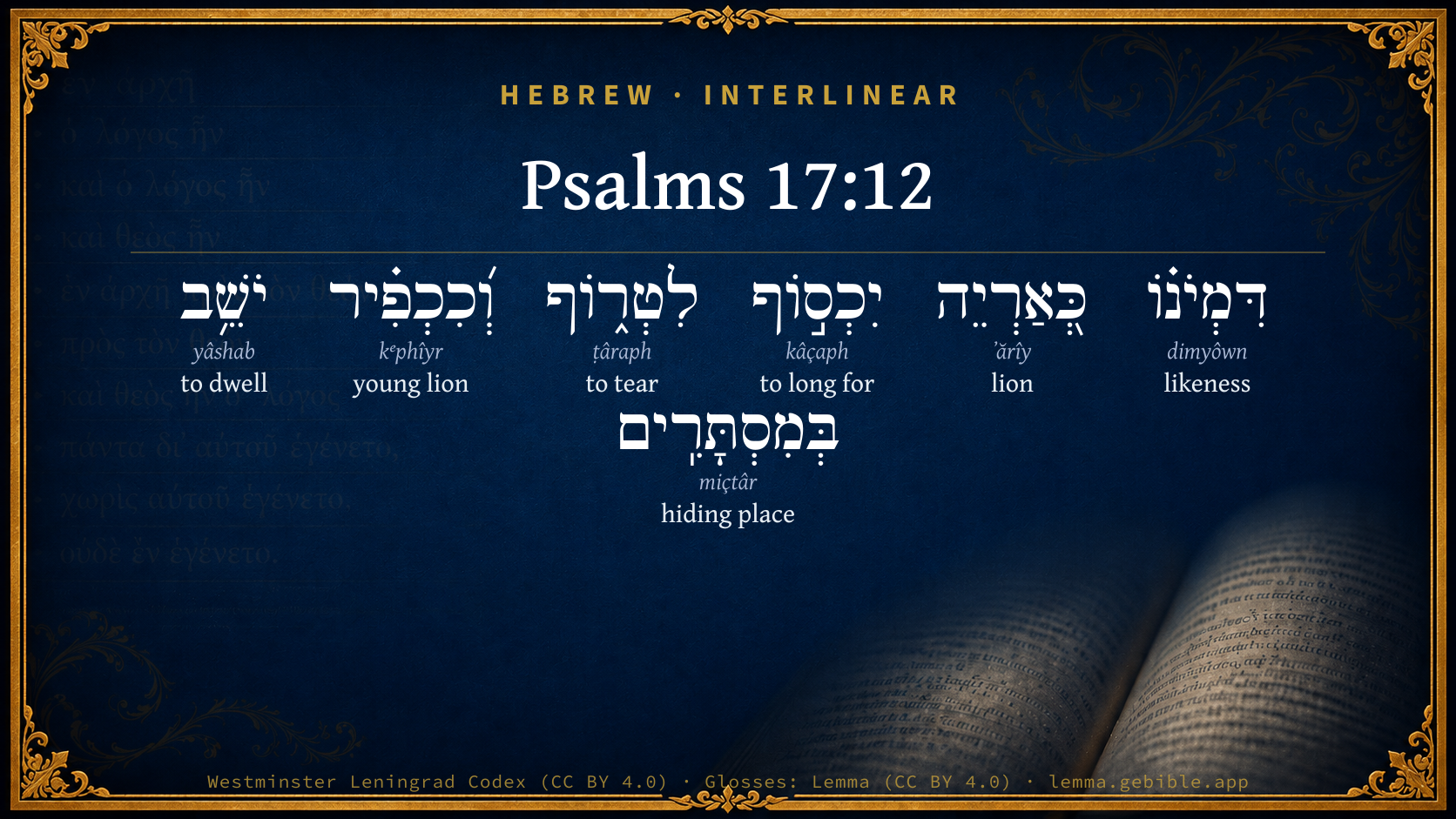
Hebrew (Westminster Leningrad Codex) Psalms 17:12 appears in the Hebrew Old Testament. The text above is from the Westminster Leningrad Codex. Each word links to its Strong’s number, a concise gloss, and parsing drawn from the Open Scriptures Hebrew Bible morphology. Click any word for its full Brown-Driver-Briggs (BDB) entry.
Download image
Cite this verse

Psalms 17:12 (World English Bible). Public Domain. Lemma interlinear Bible study tool, https://lemma.gebible.app/v/psalms/17/12.

Show BibTeX & RIS
BibTeX
RIS
English Translation
He is like a lion that is greedy of his prey, As it were a young lion lurking in secret places.
World English Bible · Public Domain
Highlights
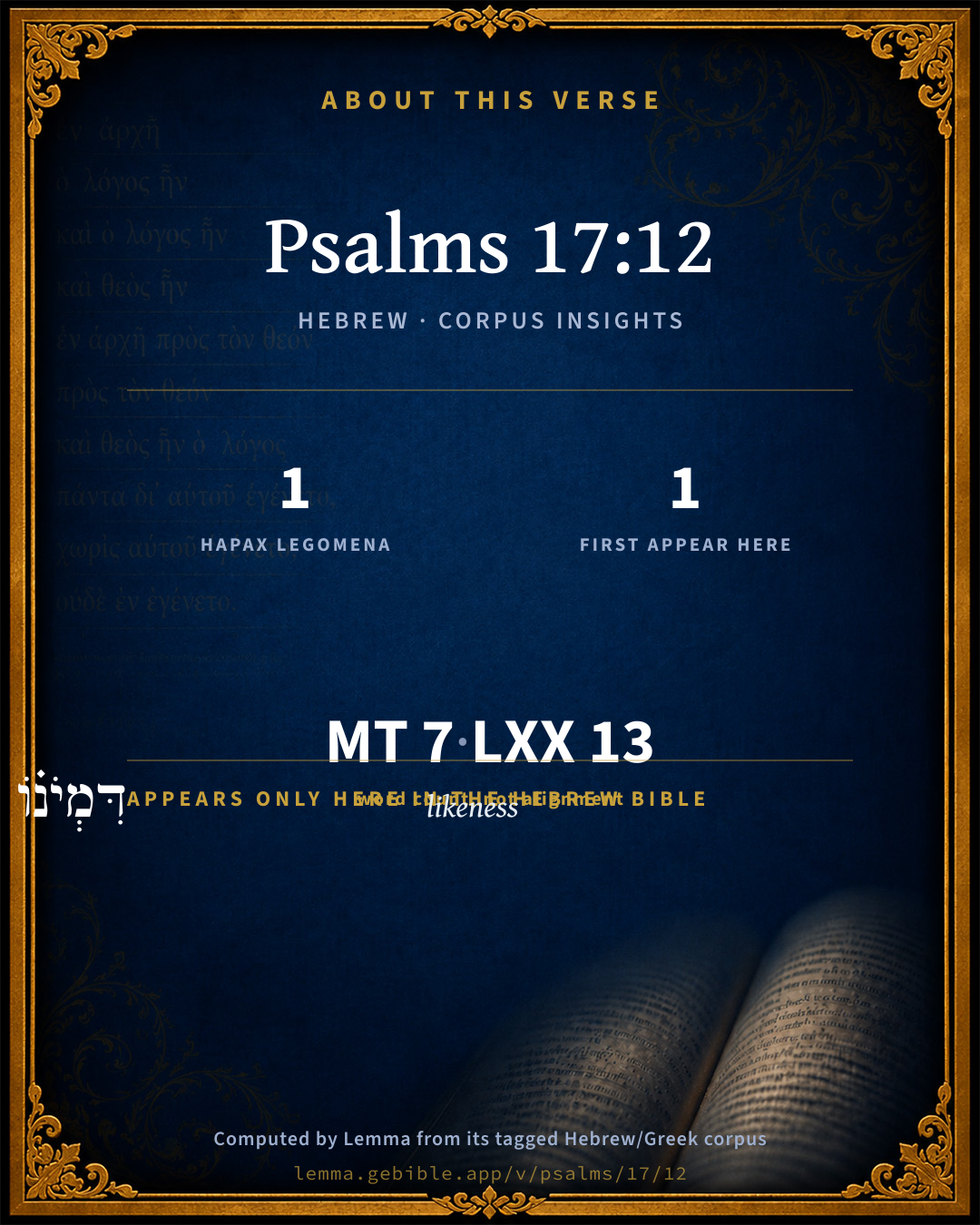
  • 1 hapax legomenon — only here in the Hebrew Bible
  • 1 first appearance in the Hebrew Bible
Full analysis ↓
Download a study sheet

One document with this verse’s original text, its word-by-word gloss line, the meaning frame, cross-references with their text, attributed commentary, and full source and license credits — printable, and it pastes into notes with its structure intact.

This verse Autodidact and up

Study sheet (.html) Plain text (.txt)

A passage Seminary Student

Up to 50 verses in one chapter. A passage sheet keeps up to 6 commentary sources and 12 cross-references per verse, in the order this page ranks them, and says so on the sheet whenever that leaves anything out. Ask for a single verse and you get the Autodidact verse sheet above.

Everything on this page stays free to read, with no account — the sheet is a download of what is already on screen, not access to it.

Want to remove ads? Support Godless Engineer
Compare translations 3

The same verse in 3 English versions, stacked beneath the original-language interlinear above. Click any original word for its lexicon entry.

Each is an independent rendering of the whole verse — the interlinear is not word-aligned to these translations.

Highlighted words mark where these versions differ — a whole-verse word diff, not a word-by-word alignment.

  • World English Bible Public Domain
    He is like a lion that is greedy of his prey, As it were a young lion lurking in secret places.
  • King James Version Public Domain
    Like as a lion that is greedy of his prey, and as it were a young lion lurking in secret places.
  • unfoldingWord Literal Text CC BY-SA 4.0
    His likeness is as a lion, he longs to tear; and as a young lion he is dwelling in hiding places.

unfoldingWord Literal Text — © unfoldingWord, licensed CC BY-SA 4.0. Word-aligned USFM3 via Door43 (git.door43.org/unfoldingWord/en_ult).

Versions to compare (up to 4)

3 of 4 selected

Show all 18 translations

Every available English version of this verse, each an independent rendering of the whole verse.

  • World English Bible Public Domain
    He is like a lion that is greedy of his prey, As it were a young lion lurking in secret places.
  • Berean Standard Bible Public Domain
    like a lion greedy for prey, like a young lion lurking in ambush.
  • Majority Standard Bible Public Domain
    like a lion greedy for prey, like a young lion lurking in ambush.
  • King James Version Public Domain
    Like as a lion that is greedy of his prey, and as it were a young lion lurking in secret places.
  • American Standard Version (1901) Public Domain
    He is like a lion that is greedy of his prey, And as it were a young lion lurking in secret places.
  • Revised Version (1885) Public Domain
    He is like a lion that is greedy of his prey, and as it were a young lion lurking in secret places.
  • Geneva Bible (1599) Public Domain
    Like as a lyon that is greedy of pray, and as it were a lyons whelp lurking in secret places.
  • Douay-Rheims (1899) Public Domain
    They have taken me, as a lion prepared for the prey; and as a young lion dwelling in secret places.
  • Young's Literal Translation Public Domain
    His likeness as a lion desirous to tear, As a young lion dwelling in secret places.
  • Literal Standard Version CC BY-SA 4.0
    His likeness as a lion desirous to tear, || As a young lion dwelling in secret places.
  • Unlocked Literal Bible CC BY-SA 4.0
    They are like a lion eager for a victim, like a young lion crouching in hidden places.
  • unfoldingWord Literal Text CC BY-SA 4.0
    His likeness is as a lion, he longs to tear; and as a young lion he is dwelling in hiding places.
  • Darby Bible Public Domain
    He is like a lion that is greedy of its prey, and as a young lion lurking in secret places.
  • World Messianic Bible Public Domain
    He is like a lion that is greedy of his prey, as it were a young lion lurking in secret places.
  • Webster's Bible Public Domain
    Like as a lion that is greedy of his prey, and as it were a young lion lurking in secret places.
  • Free Bible Version CC BY-SA 4.0
    They are like lions, longing to tear their prey apart; like fierce lions crouching in ambush.
  • Bible in Basic English Public Domain
    Like a lion desiring its food, and like a young lion waiting in secret places.
  • JPS Tanakh (1917) Public Domain
    He is like a lion that is eager to tear in pieces, and like a young lion lurking in secret places.

Literal Standard Version (2020), Covenant Press — licensed CC BY-SA 4.0. Text via the HelloAO Bible API (eBible.org). Unlocked Literal Bible (unfoldingWord) — licensed CC BY-SA 4.0. Text via the HelloAO Bible API (eBible.org). unfoldingWord Literal Text — © unfoldingWord, licensed CC BY-SA 4.0. Word-aligned USFM3 via Door43 (git.door43.org/unfoldingWord/en_ult). Free Bible Version, Dr. Jonathan Gallagher — licensed CC BY-SA 4.0. Text via the HelloAO Bible API (eBible.org).

Word by word

More ways to search: Search by grammar → Find every occurrence → Compare this word →

Practice this passage: Drill this verse → Learn its vocabulary →

About this verse

These counts appear in no published source. They are computed here, from the morphology-tagged text and Lemma’s own curated glosses. What Lemma adds →

7
words
7
distinct lemmas
Wisdom
section

Notable vocabulary

1 hapax legomenon — a word that appears only here in the entire Hebrew Bible:

  • דִּמְיֹנ֗וֹ likeness H1825

First appearance in Scripture

This word makes its first canonical appearance in the Hebrew Bible here:

  • דִּמְיֹנ֗וֹ likeness H1825

Shared distinctive vocabulary

יִכְס֣וֹף to long for H3700 occurs in 5 verses of the Hebrew Bible. Also found in:

Grammatical profile

  • 3 verbs
  • 4 nouns

Verb forms

  • יִכְס֣וֹף Qal · Imperfect
  • לִטְר֑וֹף Qal · Infinitive Construct
  • יֹשֵׁ֥ב Qal · Participle Active

Hebrew & Septuagint length

In English translation the verse runs 21 words from the Hebrew and 20 from the Septuagint (LXX English) — closely comparable.

A rough comparison of the two English renderings, which tokenize alike — not a word-level alignment.

Word counts can differ between the Hebrew and the Greek without any difference in meaning — e.g. the Hebrew direct-object marker אֵת has no separate Greek word, and Greek often adds the article ὁ.

In the original languages it is 7 Hebrew tokens and 13 Greek tokens — but the two are counted differently (Hebrew bundles its prefixes and suffixes into one token; the Greek is in lemma form), so that isn’t a like-for-like length.

Cross-references

5

Topical passages linked to Psalms 17:12 in the Treasury of Scripture Knowledge — connected by theme and wording, ordered by reader-vote popularity; previews shown in the World English Bible.

  • Psalms 7:2 Lest they tear apart my soul like a lion, Ripping it in pieces, while there is none to deliver.
  • Psalms 10:9 He lurks in secret as a lion in his ambush. He lies in wait to catch the helpless. He catches the helpless, when he draws him in his net.
  • 1 Peter 5:8 Be sober and self-controlled. Be watchful. Your adversary the devil, walks around like a roaring lion, seeking whom he may devour.
  • Psalms 22:13 They open their mouths wide against me, Lions tearing prey and roaring.
  • 2 Timothy 4:17 But the Lord stood by me, and strengthened me, that through me the message might be fully proclaimed, and that all the Gentiles might hear; and I was delivered out of the mouth of the lion.

Cross-references courtesy of OpenBible.info (CC BY 4.0).

Hebrew and Greek witnesses Masoretic Hebrew ↔ Greek Septuagint

The same verse in the two great witnesses to the Old Testament, shown verse-for-verse.

You’re reading Greek Psalm 16 (Hebrew Psalm 17). The Septuagint counts the superscription, so verse numbers can differ from the Hebrew — chapter-level alignment, not verse-by-verse. Numbering follows Rahlfs.

These are two independent witnesses, not word-aligned to each other, and the Septuagint is shown in lemma (dictionary) form.

Hebrew Psalms 17:12 Masoretic · Westminster Leningrad Codex

דִּמְיֹנ֗וֹ כְּ֭אַרְיֵה יִכְס֣וֹף לִטְר֑וֹף וְ֝כִכְפִ֗יר יֹשֵׁ֥ב בְּמִסְתָּרִֽים

He is like a lion that is greedy of his prey, As it were a young lion lurking in secret places.

World English Bible · Public Domain

Greek LXX Greek Psalm 16:12 Septuagint · lemma form

ὑπολαμβάνω ἐγώ ὡσεί λέων ἕτοιμος εἰς θήρα καί ὡσεί σκύμνος οἶκος ἐν ἀπόκρυφος

They laid wait for me as a lion ready for prey, and like a lion's whelp dwelling in secret places.

LXX2012 (modern English Septuagint) · Public Domain

Hebrew: Westminster Leningrad Codex (CC BY 4.0). Greek: Septuagint (public domain); English from LXX2012 (modern English Septuagint) (Public Domain). How the Septuagint differs from the Hebrew →

Commentary

Notes on Psalms 17:12 from classic Christian and Jewish commentators (each source and its license shown beneath its notes). The classic Christian expositions comment on the surrounding passage and are grouped to its opening verse, so a note may address several verses; the Jewish commentaries on the Tanakh (Rashi and others) are per-verse, so they appear only where the commentator wrote on this verse.

Lemma curates 59 commentaries, every one of them public domain or Creative Commons licensed, each selected and text-cleaned for this edition rather than reprinted as found. About our sources →

Trapp's Complete Commentary

John Trapp

Psa 17:12 Like as a lion [that] is greedy of his prey, and as it were a young lion lurking in secret places.

Ver. 12. Like as a lion that is greedy, &c.] Cruelty and craft are conjoined in the Church’s enemies; as the ape never wandereth alone, they say, without his companion. David here pointeth out some one special enemy (Saul likely), who should have been a shepherd, but proved a lion.

As a young lion lurking] Therefore as we tender our safety, keep close to God, out of whose hands none can take us, no, not the roaring lion of hell.

John Trapp, A Commentary or Exposition upon All the Books of the Old and New Testament (1647–1656) — public domain. Text from a community e-Sword module.

J. A. Alexander on Psalms

Joseph Addison Alexander

12. (Psa 17:12) His likeness (is) as a lion; he is craving to tear; and as a young lion sitting in secret places. The singular suffix refers to the enemy as an ideal person. The future means that he is just about to feel or gratify the appetite for blood. To tear in pieces, as a wild beast does his prey before devouring it.—Sitting, lurking, lying in wait, with special reference to the patient promptness of the wild beast in such cases.—The comparison is the same as in Psa 10:8-10.

Joseph Addison Alexander, The Psalms Translated and Explained (1850) — public domain. Text from a community e-Sword module.

Jamieson, Fausset & Brown

Robert Jamieson, A. R. Fausset & David Brown

The figure made more special by that of a lion lurking.

Jamieson, Fausset & Brown — Commentary Critical and Explanatory on the Whole Bible (1871) — public domain (CC PDM 1.0). Text via the HelloAO Bible API.

Adam Clarke's Commentary

Verse 12. Like as a lion that is greedy of his prey] I believe the word lion is here used to express Saul in his strength, kingly power, and fierce rapacity. See the observations at the end of the Psalm. See Clarke on Ps 17:15.

Adam Clarke's Commentary on the Bible (1810–1826) — public domain. Text from a community e-Sword/MySword module.

Ellicott's Commentary for English Readers

(12) Young lion.—Heb., kephir. The Hebrew has seven different names for the lion. Milton’s description of Satan naturally recurs to the reader—

“About them round

A lion now he stalks with fiery glare.”

A Bible Commentary for English Readers, edited by Charles John Ellicott (1878–1897) — public domain. Text from a community e-Sword module.

The Cambridge Bible for Schools and Colleges

gen. ed. J. J. S. Perowne

12. Like as a lion &c.] Lit., He is like a lion that is greedy to raven. (Psa_22:13). One of the pursuers (Saul, if the singer is David) is conspicuous for ferocity and craftiness. Cp. Psa_7:2; Psa_10:8-9.

The Cambridge Bible for Schools and Colleges (gen. ed. J. J. S. Perowne; Cambridge University Press, 1878–1918) — public domain. Text from a community e-Sword module.

John Gill's Exposition

Like as a lion that is greedy of his prey,.... Or "the likeness of him is as a lion" (i); meaning Saul, as Kimchi interprets it; or everyone of them that compassed them about, as Aben Ezra observes; sometimes wicked and persecuting princes are compared to lions, for their strength and cruelty; see Pro 28:15; so the devil is called a roaring lion, Pe1 5:8; and the antichristian beast is said to have the mouth of a lion, Rev 13:2;

and as it were a young lion lurking in secret places; to leap upon its prey, and seize it at once, as it has opportunity; this denotes the secret and insidious method which the enemies of Christ take to do mischief; see Psa 10:9.

(i) "similitudo ejus, vel cujusque est tanquam leonis", Pagninus, Montanus, Junius & Tremellius; so Musculus, Gejerus, Michaelis.

John Gill's Exposition of the Whole Bible (1746–1763) — public domain (CC PDM 1.0). Text via the HelloAO Bible API.

Albert Barnes' Notes on the Bible

Like as a lion - Margin, “The likeness of him” (that is, “of every one of them”) is “as a lion that desireth to ravin.” The meaning is plain. They were like a lion intent on securing his prey. They watched the object narrowly; they were ready to spring upon it.

That is greedy of his prey - “He is craving to tear.” Prof. Alexander. - The Hebrew word rendered “is greedy,” means “to pine, to long after, to desire greatly.” The Hebrew word rendered “of his prey,” is a verb, meaning “to pluck, to tear, to rend in pieces.” The reference is to the lion that desires to seize his victim, and to rend it in pieces to devour it.

And, as it were, a young lion - Hebrew, “And like a young lion.”

Lurking in secret places - Margin, as in Hebrew, “sitting.” The allusion is to the lion crouching, or lying in wait for a favorable opportunity to pounce upon his prey. See the notes at Psa 10:8-10. There is no special emphasis to be affixed to the fact that the “lion” is alluded to in one member of this verse, and the “young lion” in the other. It is in accordance with the custom of parallelism in Hebrew poetry where the same idea, with some little variation, is expressed in both members of the sentence. See the introduction to Job, Section 5.

Albert Barnes' Notes on the Bible (1834–1885) — public domain. Text from a community e-Sword/MySword module.

Matthew Poole's English Annotations

Like a lion that is greedy of his prey; when he is hungry, and therefore cruel. See Psa 7:2; 10:8-10.

Matthew Poole's English Annotations on the Holy Bible (1683–1685) — public domain. Text from a community e-Sword/MySword module.

The Treasury of David

Charles H. Spurgeon

Ver. 12. Lions are not more greedy, nor their ways more cunning than are Satan and his helpers when engaged against the children of God. The blood of souls the adversary thirsts after, and all his strength and craft are exerted to the utmost to satisfy his detestable appetite. We are weak and foolish like sheep; but we have a shepherd wise and strong, who knows the old lion's wiles, and is more than a match for his force; therefore will we not fear, but rest in safety in the fold. Let us beware, however, of our lurking foe; and in those parts of the road where we feel most secure, let us look about us lest, peradventure, our foe should leap upon us.

Ver. 12. Like a lion, etc. In "Paradise Lost, "we have a fine poetical conception of the arch enemy prowling around our first parents when he first beheld their happiness, and resolved to ruin them.

About them round A lion now, he stalks with fiery glare; Then, as a tiger, who by chance hath spied In some purlieu, two gentle fawns at play, Straight crouches close, then rising, changes oft His couchant watch, as one who chose his ground, Whence rushing he might surest seize them both, Gripped in each paw.

John Milton.

Ver. 12. We were consulting as to the best means of getting at a rhinoceros cow which we saw standing at some distance under a tree, when a troop of impalas came charging down, with a fine old lioness after them. We went and saw her lying down, but so flat to the ground, head and all, that no man could shoot with any certainty; and she never for a moment took her eyes from us. When we got up to her, she was lying down flat as a plate to the ground; but her head might have been on a pivot, as her watchful eye glared on us all round, without appearing to move her body, as we decreased the circle, in the hopes she would stand up and give us a fair chance of a shot behind the shoulder... I looked for a tree to climb up, near enough to make tolerably sure of my shot, and was just getting up one, when the lioness made off. William Charles Baldwin, F.R.G.S., in "African Hunting, "1863.

None.

Psalms 17:13*

Charles H. Spurgeon's The Treasury of David (1869–1885) — public domain. Psalms only. Text from a community e-Sword/MySword module.

Whedon's Commentary on the Bible

Daniel D. Whedon

12. Like as a lion—Literally, He is like a lion, etc. The sudden change from the plural, in Psa_17:11, to the singular, in this, suggests that the singular be taken distributively. The likeness of him—that is, of every one of them—is as a lion, etc.; or, the singular may represent the body of the wicked collectively.

Daniel D. Whedon (gen. ed.), Commentary on the Old and New Testaments (1874–1909) — public domain. Text from a community e-Sword module.

The Pulpit Commentary

Like as a lion that is greedy of his prey; literally, his likeness is as a lion that is greedy to rend. (comp. Psa_7:2 Psa_10:9 Psa_57:4) And as it were a young lion (kephir , "a lion in the first burst of youthful vigour") lurking in secret places; rather, crouching. The attitude of the lieu when he is just preparing to spring.

The Pulpit Commentary (1880–1919), ed. H.D.M. Spence-Jones & Joseph S. Exell — public domain. Text from a community e-Sword module.

Rashi

Rabbi Shlomo Yitzchaki (Rashi)

which yearns Heb. יכסף, yearns, as (in Gen. 31:30): “for you yearned (נכסף נכספתי).”

Rashi on the Tanakh — English translations: “The Judaica Press complete Tanach with Rashi, translated by A. J. Rosenberg” (CC BY 4.0); “Pentateuch with Rashi's commentary by M. Rosenbaum and A.M. Silbermann, 1929-1934” (public domain); “The Metsudah Tanach series, Lakewood, N.J” (CC BY 4.0); and “The Book of Joshua, Metsudah Publications, 1997” (CC BY 4.0). Text via Sefaria.

Radak

Rabbi David Kimhi (Radak)

He is like a lion that is greedy of his prey, As it were a young lion lurking in secret places: – He is like, singular, of Saul. He says, as he said of him in the Psalm Concerning the words of Cush, a Benjamite (7:3): “Lest he tear my soul like a lion.”

Radak on the Tanakh — English translations: “Sefaria Community Translation” (CC0 1.0 (public-domain dedication)); “Eliyahu Munk, HaChut Hameshulash” (CC BY 4.0); “Rabbi Mike Feuer, Jerusalem Anthology” (CC BY 4.0); and “R. David Kimhi on the first book of Psalms, Translated by R.G. Finch, London, 1919” (public domain). Text via Sefaria.

Lesson kit

Teaching starters — assembled from the data on this page, not authored interpretation. Every prompt links to the verse data it draws on. Edit before teaching.

Psalms, in the Wisdom, opens this verse with 7 words (7 distinct Hebrew lemmas). Its most distinctive word is dimyôwn (“likeness”). A historical commentator’s framing appears above. Read the whole chapter for the surrounding context.

Discussion questions

  1. How does “likeness” (dimyôwn) shape what this verse is saying?
  2. 1 word here appears nowhere else in the Hebrew Bible. Why might the author reach for such rare wording?
  3. This is the first place “likeness” appears in Scripture (first appears here). What does its debut here establish?
  4. How does Genesis 31:30, which shares the word «to long for», read alongside this verse?
  5. The translations on this page render this verse differently — a whole-verse word diff, not a word-by-word alignment. What might account for the different wordings?
  6. «יִכְס֣וֹף» is a Qal Imperfect verb. How does that grammatical form shape the action described?
  7. Compare how Trapp's Complete Commentary and J. A. Alexander on Psalms read this verse. Where do they agree or differ?

Things to notice

Reading settings

Reading text

Shown beneath each verse's original-language words.

Old Testament
Old Testament edition

Read the OT as the Masoretic Hebrew (MT) or the Greek Septuagint (LXX).

English shown for the Greek Septuagint (in the Hebrew ↔ Greek comparison).

Comparing translations? Open the Compare panel on any verse page to stack up to four side by side.