
Numbers 16:23

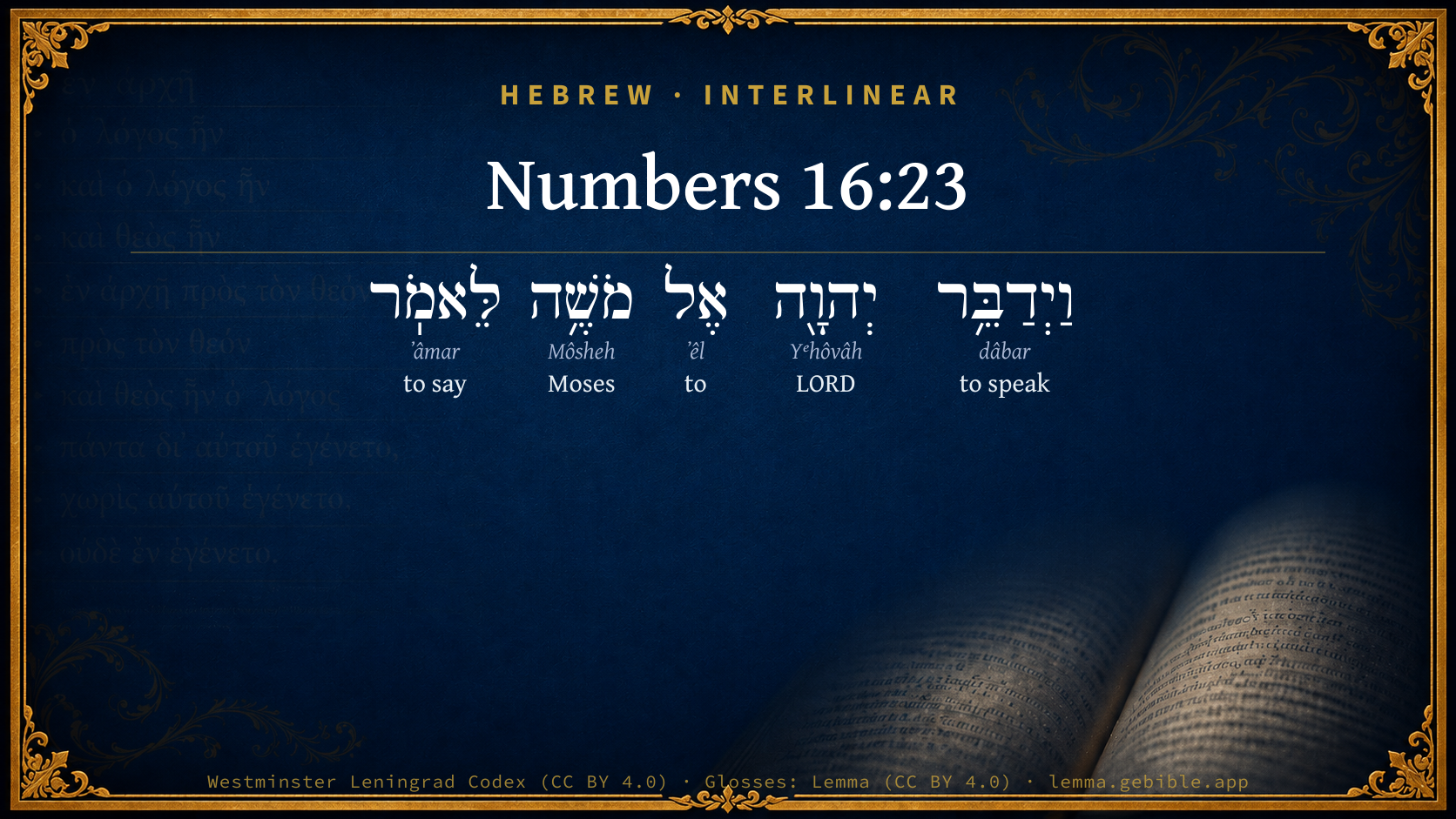
Hebrew (Westminster Leningrad Codex) Numbers 16:23 appears in the Hebrew Old Testament. The text above is from the Westminster Leningrad Codex. Each word links to its Strong’s number, a concise gloss, and parsing drawn from the Open Scriptures Hebrew Bible morphology. Click any word for its full Brown-Driver-Briggs (BDB) entry.
Download image
Cite this verse

Numbers 16:23 (World English Bible). Public Domain. Lemma interlinear Bible study tool, https://lemma.gebible.app/v/numbers/16/23.

Show BibTeX & RIS
BibTeX
RIS
English Translation
Yahweh spoke to Moses, saying,
World English Bible · Public Domain
Download a study sheet

One document with this verse’s original text, its word-by-word gloss line, the meaning frame, cross-references with their text, attributed commentary, and full source and license credits — printable, and it pastes into notes with its structure intact.

This verse Autodidact and up

Study sheet (.html) Plain text (.txt)

A passage Seminary Student

Up to 50 verses in one chapter. A passage sheet keeps up to 6 commentary sources and 12 cross-references per verse, in the order this page ranks them, and says so on the sheet whenever that leaves anything out. Ask for a single verse and you get the Autodidact verse sheet above.

Everything on this page stays free to read, with no account — the sheet is a download of what is already on screen, not access to it.

Want to remove ads? Support Godless Engineer
Compare translations 3

The same verse in 3 English versions, stacked beneath the original-language interlinear above. Click any original word for its lexicon entry.

Each is an independent rendering of the whole verse — the interlinear is not word-aligned to these translations.

Highlighted words mark where these versions differ — a whole-verse word diff, not a word-by-word alignment.

  • World English Bible Public Domain
    Yahweh spoke to Moses, saying,
  • King James Version Public Domain
    And the LORD spake unto Moses, saying,
  • unfoldingWord Literal Text CC BY-SA 4.0
    And Yahweh spoke to Moses, saying,

unfoldingWord Literal Text — © unfoldingWord, licensed CC BY-SA 4.0. Word-aligned USFM3 via Door43 (git.door43.org/unfoldingWord/en_ult).

Versions to compare (up to 4)

3 of 4 selected

Show all 18 translations

Every available English version of this verse, each an independent rendering of the whole verse.

  • World English Bible Public Domain
    Yahweh spoke to Moses, saying,
  • Berean Standard Bible Public Domain
    Then the LORD said to Moses,
  • Majority Standard Bible Public Domain
    Then the LORD said to Moses,
  • King James Version Public Domain
    And the LORD spake unto Moses, saying,
  • American Standard Version (1901) Public Domain
    And Jehovah spake unto Moses, saying,
  • Revised Version (1885) Public Domain
    And the LORD spake unto Moses, saying,
  • Geneva Bible (1599) Public Domain
    And the Lord spake vnto Moses, saying,
  • Douay-Rheims (1899) Public Domain
    And the Lord said to Moses:
  • Young's Literal Translation Public Domain
    And Jehovah speaketh unto Moses, saying,
  • Literal Standard Version CC BY-SA 4.0
    And YHWH speaks to Moses, saying,
  • Unlocked Literal Bible CC BY-SA 4.0
    Yahweh replied to Moses. He said,
  • unfoldingWord Literal Text CC BY-SA 4.0
    And Yahweh spoke to Moses, saying,
  • Darby Bible Public Domain
    And Jehovah spoke to Moses, saying,
  • World Messianic Bible Public Domain
    The LORD spoke to Moses, saying,
  • Webster's Bible Public Domain
    And the LORD spoke to Moses, saying,
  • Free Bible Version CC BY-SA 4.0
    Then the Lord told Moses,
  • Bible in Basic English Public Domain
    And the Lord said to Moses,
  • JPS Tanakh (1917) Public Domain
    And the LORD spoke unto Moses, saying:

Literal Standard Version (2020), Covenant Press — licensed CC BY-SA 4.0. Text via the HelloAO Bible API (eBible.org). Unlocked Literal Bible (unfoldingWord) — licensed CC BY-SA 4.0. Text via the HelloAO Bible API (eBible.org). unfoldingWord Literal Text — © unfoldingWord, licensed CC BY-SA 4.0. Word-aligned USFM3 via Door43 (git.door43.org/unfoldingWord/en_ult). Free Bible Version, Dr. Jonathan Gallagher — licensed CC BY-SA 4.0. Text via the HelloAO Bible API (eBible.org).

Word by word

More ways to search: Search by grammar → Find every occurrence → Compare this word →

Practice this passage: Drill this verse → Learn its vocabulary →

About this verse

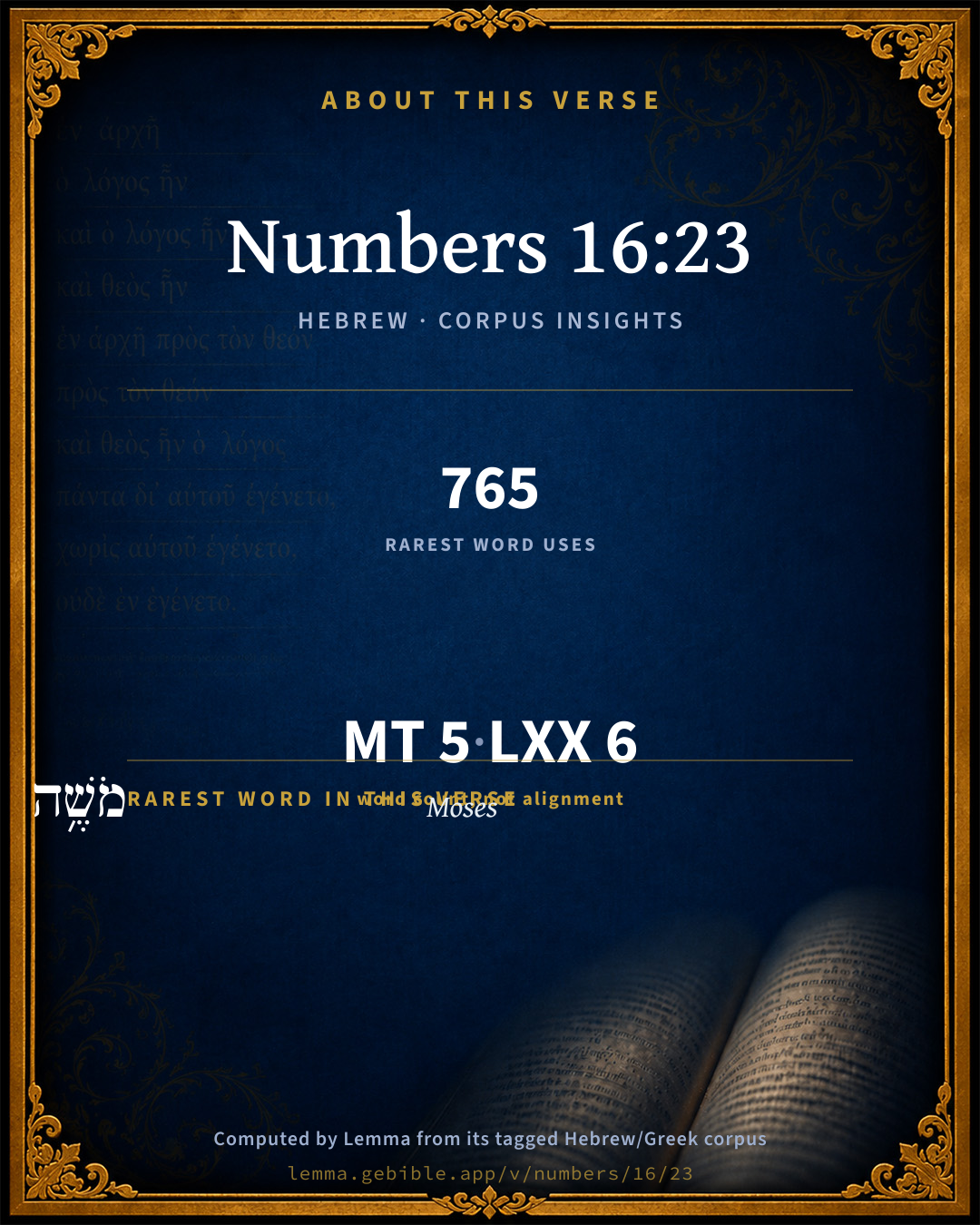
These counts appear in no published source. They are computed here, from the morphology-tagged text and Lemma’s own curated glosses. What Lemma adds →

5
words
5
distinct lemmas
Pentateuch
section

Grammatical profile

  • 2 verbs
  • 2 nouns
  • 1 preposition

Verb forms

  • וַיְדַבֵּ֥ר Piel · Sequential Imperfect
  • לֵּאמֹֽר Qal · Infinitive Construct

Hebrew & Septuagint length

In English translation the verse runs 5 words from the Hebrew and 7 from the Septuagint (LXX English) — closely comparable.

A rough comparison of the two English renderings, which tokenize alike — not a word-level alignment.

Word counts can differ between the Hebrew and the Greek without any difference in meaning — e.g. the Hebrew direct-object marker אֵת has no separate Greek word, and Greek often adds the article ὁ.

In the original languages it is 5 Hebrew tokens and 6 Greek tokens — but the two are counted differently (Hebrew bundles its prefixes and suffixes into one token; the Greek is in lemma form), so that isn’t a like-for-like length.

Hebrew and Greek witnesses Masoretic Hebrew ↔ Greek Septuagint

The same verse in the two great witnesses to the Old Testament, shown verse-for-verse.

These are two independent witnesses, not word-aligned to each other, and the Septuagint is shown in lemma (dictionary) form.

Hebrew Numbers 16:23 Masoretic · Westminster Leningrad Codex

וַיְדַבֵּ֥ר יְהוָ֖ה אֶל מֹשֶׁ֥ה לֵּאמֹֽר

Yahweh spoke to Moses, saying,

World English Bible · Public Domain

Greek LXX Numbers 16:23 Septuagint · lemma form

καί λαλέω κύριος πρός μωυσῆς λέγω

And the Lord spoke to Moses, saying,

LXX2012 (modern English Septuagint) · Public Domain

Hebrew: Westminster Leningrad Codex (CC BY 4.0). Greek: Septuagint (public domain); English from LXX2012 (modern English Septuagint) (Public Domain). How the Septuagint differs from the Hebrew →

Targum (Aramaic paraphrase)

2

The Targum is the ancient Jewish Aramaic paraphrase of the Hebrew Scriptures — an interpretive translation, not the Hebrew text itself. Onkelos (literal) and Pseudo-Jonathan (expansive) render the Torah, and Jonathan the Prophets. Coverage is partial: where no permissively-licensed English translation exists for a verse, only the Aramaic is shown. This is verse-level text, not a word-by-word alignment to the Hebrew.

  1. Targum Onkelos Torah (Genesis–Deuteronomy)
    וּמַלֵיל יְיָ עִם משֶׁה לְמֵימָר

    (no public-domain English translation for this verse)

    Targum Onkelos — Aramaic: “Onkelos Genesis” (public domain); “Onkelos Exodus” (public domain); “Onkelos Leviticus” (public domain); “Onkelos Numbers” (public domain); “Onkelos Deuteronomy” (public domain). English: “Sefaria Community Translation” (CC0 1.0 (public-domain dedication)); “J.W. Etheridge. The Targums of Onkelos and Jonathan Ben Uzziel on the Pentateuch. London: Longmans, Green, 1862” (public domain). Text via Sefaria.

  2. Targum Pseudo-Jonathan Torah (Genesis–Deuteronomy)
    וּמַלֵיל יְיָ עִם משֶׁה לְמֵימָר

    And the Lord spake with Mosheh, saying:

    Targum Pseudo-Jonathan — Aramaic: “Targum Jonathan on Genesis” (public domain); “Targum Jonathan on Exodus” (public domain); “Targum Jonathan on Leviticus” (public domain); “Targum Jonathan on Numbers” (public domain); “Targum Jonathan on Deuteronomy” (public domain). English: “The Targum of Jonathan ben Uzziel, trans. J. W. Etheridge, London, 1862” (public domain). Text via Sefaria.

Commentary

Notes on Numbers 16:23 from classic Christian and Jewish commentators (each source and its license shown beneath its notes). The classic Christian expositions comment on the surrounding passage and are grouped to its opening verse, so a note may address several verses; the Jewish commentaries on the Tanakh (Rashi and others) are per-verse, so they appear only where the commentator wrote on this verse.

Lemma curates 59 commentaries, every one of them public domain or Creative Commons licensed, each selected and text-cleaned for this edition rather than reprinted as found. About our sources →

Matthew Henry's Commentary

We have here the determining of the controversy with Dathan and Abiram, who rebelled against Moses, as in the next paragraph the determining of the controversy with Korah and his company, who would be rivals with Aaron. It should seem that Dathan and Abiram had set up a spacious tabernacle in the midst of the tents of their families, where they kept court, met in council, and hung out their flag of defiance against Moses; it is here called the tabernacle of Korah, Dathan, and Abiram, Num 16:24, Num 16:27. There, as in the place of rendezvous, Dathan and Abiram staid, when Korah and his friends went up to the tabernacle of the Lord, waiting the issue of their trial; but here we are told how they had their business done, before that trial was over. For God will take what method he pleases in his judgments.

I. Public warning is given to the congregation to withdraw immediately from the tents of the rebels. 1. God bids Moses speak to this purport, Num 16:24. This was in answer to Moses's prayer. He had begged that God would not destroy the whole congregation. "Well," says God, "I will not, provided they be so wise as to shift for their own safety, and get out of the way of danger. If they will quit the rebels, well and good, they shall not perish with them; otherwise, let them take what follows." Note, We cannot expect to reap benefit by the prayers of our friends for our salvation, unless we ourselves be diligent and faithful in making use of the means of salvation; for God never promised to save by miracles those that would not save themselves by means. Moses that had prayed for them must preach this to them, and warn them to flee from this wrath to come. 2. Moses accordingly repairs to the head-quarters of the rebels, leaving Aaron at the door of the tabernacle, Num 16:25. Dathan and Abiram had contumaciously refused to come up to him (Num 16:12), yet he humbly condescends to go down to them, to try if he could yet convince and reclaim them. Ministers must thus with meekness instruct those that oppose themselves, and not think it below them to stoop to those that are most stubborn, for their good. Christ himself stretches out his hand to a rebellious and gainsaying people. The seventy elders of Israel attend Moses and his guard, to secure him from the insolence of the rabble, and by their presence to put an honour upon him, and if possible to strike an awe upon the rebels. It is our duty to contribute all we can to the countenance and support of injured innocency and honour. 3. Proclamation is made that all manner of persons, as they tendered their own safety, should forthwith depart from the tents of these wicked men (Num 16:26), and thus should signify that they deserted their cause and interest, detested their crimes and counsels, and dreaded the punishment coming upon them. Note, Those that would not perish with sinners must come out from among them, and be separate. In vain do we pray, Gather not our souls with sinners, if we save not ourselves from the untoward generation. God's people are called out of Babylon, lest they share both in her sins and in her plagues, Rev 18:4.

II. The congregation takes the warning, but the rebels themselves continue obstinate, Num 16:27. 1. God, in mercy, inclined the people to forsake the rebels: They got up from the tabernacle of Korah, Dathan, and Abiram, both those whose lot it was to pitch near them (who doubtless with themselves removed their families, and all their effects) and those also who had come from all parts of their camp to see the issue. It was in answer to the prayer of Moses that God thus stirred up the hearts of the congregation to shift for their own preservation. Note, To those whom God will save he gives repentance, that they may recover themselves out of the snare of the devil. Grace to separate from evil doers is one of the things that accompany salvation. 2. God, in justice, left the rebels to the obstinacy and hardness of their own hearts. Though they saw themselves abandoned by all their neighbours, and set up as a mark to the arrows of God's justice, yet instead of falling down and humbling themselves before God and Moses, owning their crime and begging pardon, instead of fleeing and dispersing themselves to seek for shelter in the crowd, they impudently stood in the doors of their tents, as if they would out-face God himself, and dare him to his worst. Thus were their hearts hardened to their own destruction, and they were fearless when their case was most fearful. But what a pity was it that their little children, who were not capable of guilt or fear, should by the presumption of their parents be put in this audacious posture! Happy they who are taught betimes to bow before God, and not as those unhappy little ones to stand it out against him!

III. Sentence is solemnly pronounced upon them by Moses in the name of the Lord, and the decision of the controversy is put upon the execution of that sentence by the almighty power of God. Moses, by divine instinct and direction, when the eyes of all Israel were fastened upon him, waiting the event, moved with a just and holy indignation at the impudence of the rebels, boldly puts the whole matter to a surprising issue, Num 16:28-30. 1. If the rebels die a common death, he will be content to be called and counted an impostor; not only if they die a natural death, but if they die by any sort of judgment that has formerly been executed on other malefactors. "If they die by the plague, or by fire from heaven, or by the sword, then say, God has disowned Moses;" but, 2. "If the earth open and swallow them up" (a punishment without precedent), "then let all the house of Israel know assuredly that I am God's servant, sent by him, and employed for him, and that those that fight against me fight against him." The judgment itself would have been proof enough of God's displeasure against the rebels, and would have given all men to understand that they had provoked the Lord; but when it was thus solemnly foretold and appealed to by Moses beforehand, when there was not the least previous indication of it from without, the convincing evidence of it was much the stronger, and it was put beyond dispute that he was not only a servant but a favourite of Heaven, who was so intimately acquainted with the divine counsels, and could obtain such extraordinary appearances of the divine power in his vindication.

IV. Execution is immediately done. It appeared that God and his servant Moses understood one another very well; for, as soon as ever Moses had spoken the word, God did the work, the earth clave asunder (Num 16:31), opened her mouth, and swallowed them all up, them and theirs (Num 16:32), and then closed upon them, Num 16:33. This judgment was, 1. Unparalleled. God, in it, created a new thing, did what he never did before; for he has many arrows in his quiver; and there are diversities of operations in wrath as well as mercy. Dathan and Abiram thought themselves safe because they were at a distance from the shechinah, whence the fire of the Lord had sometimes issued, qui procul Jove (they say) procul fulmine - he who is far from Jove is far from the thunderbolt. But God made them to know that he was not tied up to one way of punishing; the earth, when he pleases, shall serve his justice as effectually as the fire. 2. It was very terrible to the sinners themselves to go down alive into their own graves, to be dead and buried in an instant, to go down thus to the bars of the pit when they were in their full strength wholly at ease and quiet. 3. It was severe upon their poor children, who, for the greater terror of the judgment, and fuller indication of the divine wrath, perished as parts of their parents, in which, though we cannot particularly tell how bad they might be to deserve it or how good God might be otherwise to them to compensate it, yet of this we are sure in the general, that Infinite Justice did them no wrong. Far be it from God that he should do iniquity. 4. It was altogether miraculous. The cleaving of the earth was as wonderful, and as much above the power of nature, as the cleaving of the sea, and the closing of the earth again more so than the closing of the waters. God has all the creatures at his command, and can make any of them, when he pleases, instruments of his justice; nor will any of them be our friends if he be our enemy. God now confirmed to Israel what Moses had lately taught them in that prayer of his, Psa 90:11, Who knows the power of thy anger? He has, when he pleases, strange punishments for the workers of iniquity, Job 31:3. Let us therefore conclude, Who is able to stand before this holy Lord God? 5. It was very significant. They set their mouths against the heavens, and their throat was an open sepulchre; justly therefore does the earth open her mouth upon them and swallow them up. They made a rent in the congregation; justly therefore is the earth rent under them. Presumptuous sinners, that hate to be reformed, are a burden to the earth, the whole creation groans under them, which here was signified by this, that the earth sunk under these rebels, as weary of bearing them and being under them. And, considering how the earth is still in like manner loaded with the weight of iniquity, we have reason to wonder that this was the only time it ever sunk under its load. 6. It was typical of the eternal ruin of sinners who die impenitent, who, perhaps in allusion to this, are said to sink down into the pit (Psa 9:15) and to go down quickly into hell, Psa 55:15. But David, even when he sinks in deep mire, yet prays in faith, Let not the pit shut her mouth upon me, as it does on the damned, between whom and life there is a gulf fixed, Psa 69:2-15. His case was bad, but not, like this, desperate.

V. All Israel is alarmed at the judgment: They fled at the cry of them, Num 16:34. They cried for help when it was too late. Their doleful shrieks, instead of fetching their neighbours in to their relief, drove them so much the further off; for knowing their own guilt, and one another's, they hastened one another, saying, Lest the earth swallow us up also. Note, Others' ruins should be our warnings. Could we by faith hear the outcries of those that have gone down to the bottomless pit, we should give more diligence than we do to escape for our lives, lest we also come into that condemnation.

Matthew Henry's Commentary on the Whole Bible (1708–1710) — public domain (CC PDM 1.0). Text via the HelloAO Bible API.

John Gill's Exposition

And the Lord spake unto Moses,.... When on his face in prayer, and bid him rise up, and told him he had granted his request, and then spoke to him:

saying; as follows.

John Gill's Exposition of the Whole Bible (1746–1763) — public domain (CC PDM 1.0). Text via the HelloAO Bible API.

The Pulpit Commentary

The Lord spake unto Moses. No direct answer was apparently vouchsafed to the remonstrance of Moses and Aaron, but it was tacitly allowed.

The Pulpit Commentary (1880–1919), ed. H.D.M. Spence-Jones & Joseph S. Exell — public domain. Text from a community e-Sword module.

Keil & Delitzsch

C. F. Keil & F. Delitzsch

Jehovah then instructed Moses, that the congregation was to remove away (עלה, to get up and away) from about the dwelling-place of Korah, Dathan, and Abiram; and, as we may supply from the context, the congregation fell back from Korah's tent, whilst Dathan and Abiram, possibly at the very first appearance of the divine glory, drew back into their tents. Moses therefore betook himself to the tents of Dathan and Abiram, with the elders following him, and there also commanded the congregation to depart from the tents of these wicked men, and not touch anything they possessed, that they might not be swept away in all their sins.

Keil & Delitzsch — Biblical Commentary on the Old Testament (1861–1891) — public domain (CC PDM 1.0). Text via the HelloAO Bible API. (Old Testament only.)

Kretzmann's Popular Commentary

Paul E. Kretzmann

The Punishment of the Rebellious Faction

v. 23. And the Lord spake unto Moses, saying,

v. 24. Speak unto the congregation, saying, Get you up from about the tabernacle, the place of habitation, of Korah, Dathan, and Abiram.

v. 25. ; And Moses rose up and went unto Dathan and Abiram, who, it seems, had stayed in their tents, as they had said,

v. 12. while Korah led the revolt against the Tabernacle; and the elders of Israel followed him.

v. 26. And he spake unto the congregation, saying, Depart, I pray you, from the tents of these wicked men, and touch nothing of theirs, lest ye be consumed in all their sins, be punished as partakers in their transgression.

v. 27. So they gat up from the tabernacle of Korah, Dathan, and Abiram on every side, moved back in a wide circle from their place of habitation. And Dathan and Abiram came out and stood in the door of their tents, and their wives, and their sons, and their little children, apparently defying the authority of Moses and Aaron to the very last.

v. 28. And Moses said, Hereby ye shall know that the Lord hath sent me to do all these works, everything connected with the leadership of the people; for I have not done them of mine own mind; he was not governed by any selfish motives.

v. 29. If these men die the common death of all men, as men usually die, or if they be visited after the visitation of all men, then the Lord hath not sent me. If Providence would keep the rebellious people from a violent death, then Moses was ready to be accused of being an impostor.

v. 30. But if the Lord make a new thing, something unheard of until now, and the earth open her mouth and swallow them up, with all that appertain unto them, and they go down quick, while still alive, into the pit, then ye shall understand that these men have provoked the Lord.

v. 31. And it came to pass, as he had made an end of speaking all these words, that the ground clave asunder that was under them;

v. 32. and the earth opened her mouth, and swallowed them up and their houses, the families of the leaders, and all the men that appertained unto Korah, that is, his servants, and all their goods. The catastrophe included Korah, although he was probably not in his tent at the time, but somewhere between the Tabernacle and the section of the camp south of the Tabernacle, and next to the camp of the Kohathites, where the tribe of Reuben was encamped.

v. 33. They and all that appertained to them went down alive into the pit, and the earth closed upon them; and they perished from among the congregation. It should be noted that the sons of Korah were not included in this punishment, Num 26:11. Their descendants were later known as the sons of Korah, a noted family of singers, 1Ch 6:18-22; 1Ch 9:19.

v. 34. And all Israel that were round about them fled at the cry of them, for the noise, as the abyss opened beneath them, was mingled with the shrieks of the doomed; for they said, Lest the earth swallow us up also. It was not a case of wholesome fear, however, which would have led them to repentance, but of slavish dread, which cowed without conquering them.

v. 35. And there came out a fire from the Lord and consumed the two hundred and fifty men that offered incense, and thus, like Nadab and Abihu, offered strange fire before the Lord, Lev 10:2.

v. 36. And the Lord spake unto Moses, saying,

v. 37. Speak unto Eleazar, the son of Aaron, the priest, that he take up the censers out of the burning, out of the midst of those that had been destroyed by the fire of the Lord, and scatter thou the fire yonder, that is, the coals of fire that were in the censers; for they are hallowed, consecrated by virtue of the fact that they had been presented before Jehovah.

v. 38. The censers of these sinners against their own souls, who by their sin had forfeited their lives, let them (the artisans) make them broad plates for a covering of the altar; for they offered them before the Lord, although without authority, therefore they are hallowed; and they shall be a sign unto the children of Israel, lest some one else encroach upon the functions of the priesthood in the same manner and perish for his foolhardiness.

v. 39. And Eleazar, the priest, took the brazen censers, wherewith they that were burned had offered; and they were made broad plates for a covering of the altar,

v. 40. to be a memorial unto the children of Israel, that no stranger, which is not of the seed of Aaron, even an Israelite who does not belong to the family of priests, come near to offer incense before the Lord; that he be not as Korah and as his company; as the Lord said to him by the hand of Moses. Christians will also be careful to remember that God is opposed to the haughty spirits who occasionally rise and wish to set aside the regular office of the ministry.

Paul E. Kretzmann, Popular Commentary of the Bible (1921–1924) — public domain. Text from a community e-Sword module.

unfoldingWord translationNotes

Door43 World Missions Community

translationWords

tent

unfoldingWord translationNotes — © Distant Shores Media and the Door43 World Missions Community, licensed CC BY-SA 4.0. Source: git.door43.org/Door43/en_tn.

Lesson kit

Teaching starters — assembled from the data on this page, not authored interpretation. Every prompt links to the verse data it draws on. Edit before teaching.

Numbers, in the Pentateuch, opens this verse with 5 words (5 distinct Hebrew lemmas). Its most distinctive word is Môsheh (“Moses”). A historical commentator’s framing appears above. Read the whole chapter for the surrounding context.

Discussion questions

  1. How does “Moses” (Môsheh) shape what this verse is saying?
  2. These translations render this verse differently; the difference is in the English rendering, not the original. What questions does that raise?
  3. The verb «וַיְדַבֵּ֥ר» is Piel Sequential Imperfect. How does its form color the action?
  4. Reading how Matthew Henry's Commentary and John Gill's Exposition read this verse, where do the two commentators agree and where do they part?

Things to notice

Reading settings

Reading text

Shown beneath each verse's original-language words.

Old Testament
Old Testament edition

Read the OT as the Masoretic Hebrew (MT) or the Greek Septuagint (LXX).

English shown for the Greek Septuagint (in the Hebrew ↔ Greek comparison).

Comparing translations? Open the Compare panel on any verse page to stack up to four side by side.