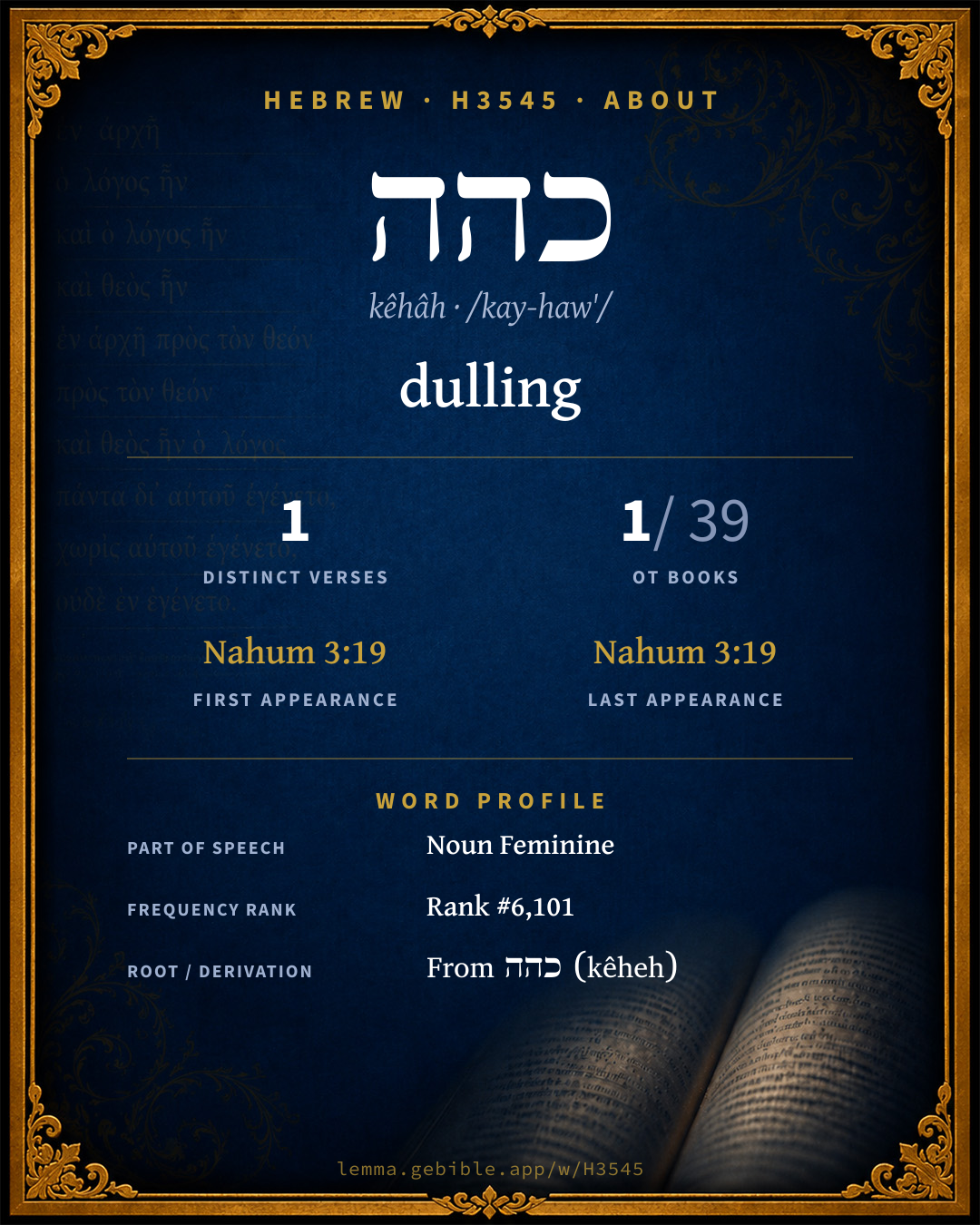
כֵּהָה
dulling
Full lexicon entry — Brown-Driver-Briggs (BDB)
From Brown-Driver-Briggs (BDB)
Where this word appears
Grammar key — what these labels mean
Part of speech
- Noun
- A naming word — a person, place, thing, or idea.
Noun type
- Common
- A common noun — a general class of person, place, or thing (“king,” “city,” “water”), not a specific name.
State
- Absolute
- The independent form of a noun, not bound to a following word.
Gender
- Feminine
- Grammatically feminine.
Number
- Singular
- One.
Every verse where H3545 appears — 1 distinct verse across 1 book. Click any verse to open its interlinear word-by-word view. Verse text shown in the World English Bible for context — . Each verse’s Hebrew form is shown with its reference; the English is not keyword-highlighted, since the data carries no word-level English alignment. Use “Compare translations” on any verse to read it across multiple English versions. This concordance covers the Hebrew Bible; Septuagint (Greek Old Testament) occurrences are not indexed here.
Nahum 1 verse
About this entry
At a glance — auto-summarized from this page’s data, not written by a person. Every figure links to its source below. This summary describes the numbers; it doesn’t interpret them.
The Hebrew noun כהה centers on the idea of “dulling.” A scarce word — 1 verse in all of the Hebrew Bible. Nahum dominates its distribution — 1 of 1 verses. Found nowhere else but Nahum 3:19. For the data behind this summary, explore the sense tree and the renderings breakdown below.
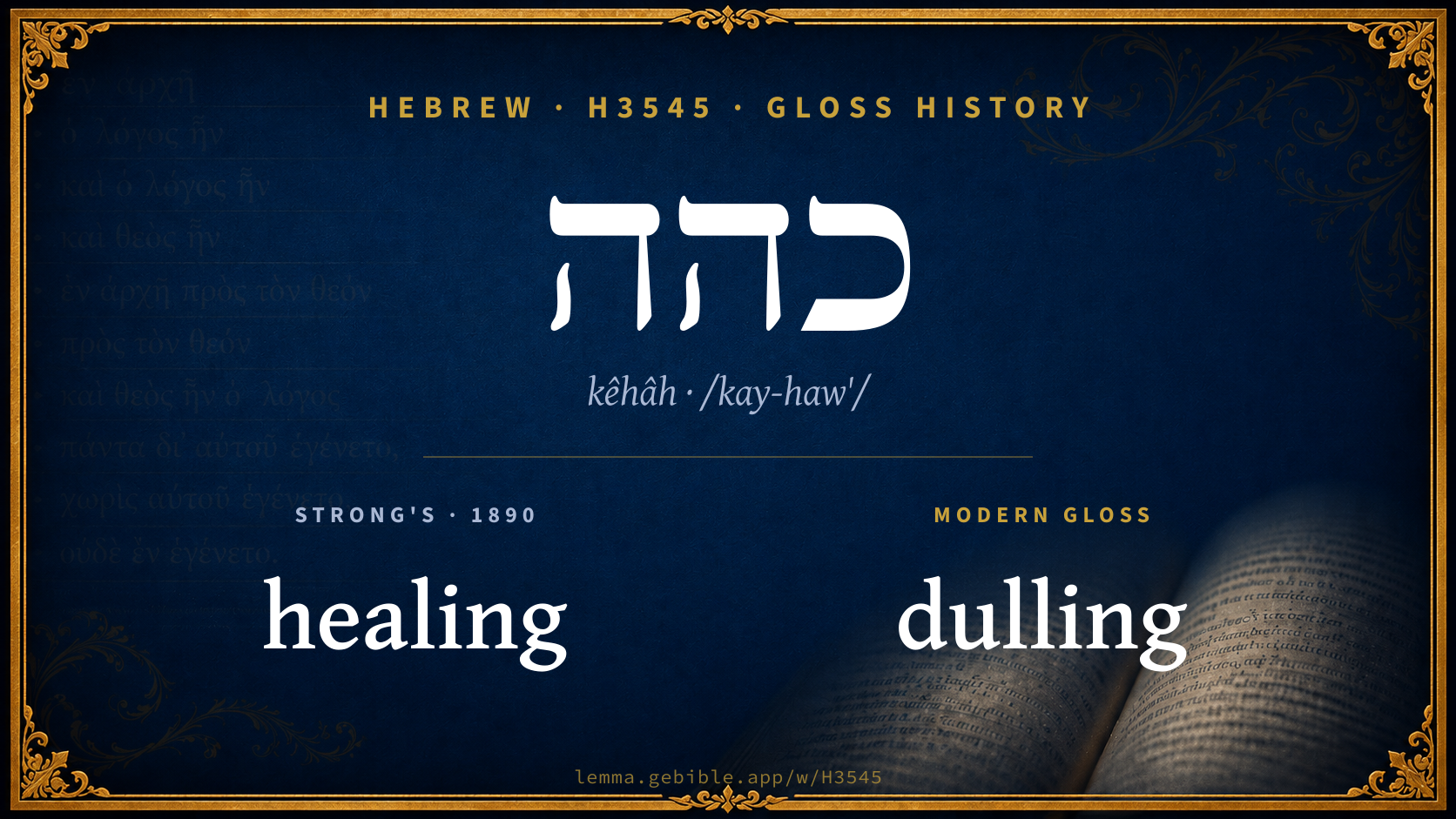
Gloss history
Strong's 1890 vs modern scholarship
About this word
Strong's H3545 catalogs a Hebrew word from the Hebrew Old Testament.
These counts are not copied from any lexicon or concordance. They are computed here, from the morphology-tagged Hebrew Old Testament. What Lemma adds →
- 1
- distinct verses
- The word appears in 1 distinct verse.
- 1 / 39
- OT books
- The word appears in 1 of 39 Old Testament books.
- #6,101
- by frequency
- Rank #6,101 (rank 6,101 of 8,640 Hebrew words by occurrence).
View all 1 occurrence in the concordance →
Most concentrated in
- Nahum 1 verse 100%
By section of the Old Testament
By traditional corpus
Conventional, traditional groupings — biblical authorship is debated, so this is a traditional corpus grouping, not an authorship claim. Each share is this word’s portion of its verses in that division of the Hebrew canon. Each figure is a share of the word’s 1 distinct verse.
- Prophets (Nevi'im) 1 verse · 100%
How translations render this word
Counts come from each version’s own published word-to-Strong’s tagging or interlinear alignment — an approximate guide to how each version renders this word, not a word-level alignment the data otherwise carries. Because each total is that version’s own tagged count, the per-version totals vary from one another and need not match the appearance or distinct-verse counts above. These counts may also differ from a printed concordance because Lemma counts each distinctly tagged rendering and does not collapse phrase taggings into a single head-word total. This is a fixed set of word-tagged versions (KJV, ASV, BSB, ULT) and does not change with the reading translation you choose elsewhere. Each version’s license is shown beside its name below (and on Sources).
- King James Version: Is no healing 1×
- American Standard Version: Is no assuaging 1×
- Berean Standard Bible: Healing 1×
- unfoldingWord Literal Text: Relief 1×
King James Version Public Domain
Renders H3545 across 1 tagged occurrence — most commonly:
American Standard Version Public Domain
Renders H3545 across 1 tagged occurrence — most commonly:
Berean Standard Bible Public Domain
Renders H3545 across 1 tagged occurrence — most commonly:
unfoldingWord Literal Text CC BY-SA 4.0
Renders H3545 across 1 tagged occurrence — most commonly:
Senses in BDB
The 1 sense BDB distinguishes for this word, in lexicon order (not ranked by frequency or importance). The full entry — with sub-senses — is in the Lexicon Entry tab.
- a quenching, dulling, lessening, healing, alleviation
Word origin
n.f. (dimming), lessening, alleviation;—אֵין כ׳ לְשִׁבְרְךָ of Nineveh Na 3:19 (read גֵּהָה, healing?).
— Brown-Driver-Briggs (Oxford 1906, public domain), digitized via Sefaria, supplemented by the OpenScriptures HebrewLexicon (CC BY 4.0). See Sources.
Derived from כהה (kêheh) (H3544) — dim.
Jastrow Dictionary
A second Hebrew/Aramaic lexicon for comparison, covering Aramaic and post-biblical (Talmudic, Targumic, Midrashic) usage that the biblical-Hebrew BDB does not. Matched by lemma rather than by Strong’s number, so a lemma may carry more than one Jastrow headword (shown separately below), and the entries cover usage well beyond the Bible.
כְּהָא
- , v. כהי
כֵּהֶה
- preced.)
- 1. (of light) dim. Gen. R. s. 31 בשעה שהיא כ׳ when it (the jewel) shone faintly.—Pl. כֵּהִים, כֵּהוֹת, כֵּי׳. Ib.; Y. Pes. I, beg. 27ᵃ בשעה שהיו כ׳ וכ׳ when the lights burned dimly, we knew it was day-time. Ib. 27ᵇ top בשעה שהיו כיהות when the jewels were dim.—Pesik. Kumi, p. 145ᵇ (ref. to כ̇ה̇חלנות Ez. XL, 25) חלונות כ׳ היו the windows were dim (stained glass). Ḥag. 16ᵃ עיניו כ׳ his eyes will grow dim; a. e. e.g. Ezekiel 40:25
- 2. (of leprosy) faint, dull, opp. עזה. Neg. II, 1, v. בַּהֶרֶת. Ib. 2 לפי שהכ׳נראית עזה because (in the early morning &c.) the faint spot appears bright; Sifra Thazr., Neg., Par. II, ch. II.—Y. Shebu. I, 32ᵈ הִכְהָה טמא הִכְ׳ מן הַכֵּ׳ טהור if it grows one shade fainter, it is unclean, but when it grows fainter than the next fainter shade, it is clean; Sifra l. c. ed. Ven.; Yalk. Lev. 551 כִּיהָה מן הכֵּ׳; Y. l. c.; a. fr.—
- *3. (trnsf.) doubtful. Nidd. 19ᵃ; Naz. 65ᵇ; Snh. 87ᵇ; Keth. 75ᵇ ר׳ י׳ אומר כ׳ R. Josh. says, It is doubtful; (Neg. IV, 11 ר׳ י׳ קֵיהָה or כִּיהָה, v. כהי, קהי).
כהי
- 1. to be dim (of sight, light). Gen. R. s. 65 כָּהוּ עיניו his eyes grew dim. Ib. שיִכְהוּ עיניו that his eye-sight shall fail. Kidd. 24ᵇ … הכהו וכָהֲתָה if the master struck him on his eye, and it grew dim; a. fr.—Part. pass. כָּהוּי, f. כָּהוּיָה. Ib. הרי שהיתה עינו כ׳ וכ׳ if his eye-sight was dim, and he (the master) made him perfectly blind.
- 2. (of color) to be dull, v. כֵּהֶה. [Tosef. Erub. XI (VIII), 8; Tanḥ. Noah 9, v. כָּחַח.]
- to grow duller, to be shaded. Sifra Thazr., Neg., Par. 2, ch. II אם העז וכ׳ if the spot grew brighter and grew duller again; a. fr.—2) to declare doubtful. Neg. IV, 11 ר׳ י׳ כ׳, v. כֵּהֶה.
- 1. same. Y. Shebu. I, 32ᵈ, v. כֵּהֶה. Neg. XI, 5 ה׳ בתחלה if the suspicious spot grew fainter at once (before the ordered isolation was begun); ה׳ בראשון if it grew faint in the first week; Tosef. ib. V, 6 quot. in R. S. to Neg. l. c. (ed. Zuck. כהה כתחלה, oth. ed. only כתחלה, corr. acc.); a. fr.
- 2. to make dim. Gen. R. l. c. הריני מַכְהֶה וכ׳ I will make his eye-sight dim. Yalk. Ruth 601 ייסורין מַכְהִין וכ׳ … sufferings of poverty dim men’s eyes. Pesik. R. s. 14 מכהה גלגל חמה dimmed (outshone) the sun in brightness; Pesik. Parah, p. 37ᵃ שיַכְהֶה; a. e.
כְּהִי
- Targ. Gen. XXVII, 1. Targ. I Kings XIV, 4; a. e.—Y. Ned. IX, 41ᵇ bot. עיני כַּהֲיָיא my eye-sight is failing.
- 1. to dim, make blind. Yoma 69ᵇ; Snh. 64ᵃ כַּהֲיִינְהוּ לעיניה Ar. (ed. כחלינהו, cmp. כְּבִי) they made his eye-sight dim. Ib. 27ᵃ ליכַהֲיוּהוּ לעיניה (v. Rabb. D. S. a. l. note 80) he shall be blinded.
- 2. (sub. לִבֵּיה) to be angry; (with ב־ of person) to rebuke. Targ. I Sam. III, 13.
- 1. to dim. Targ. Ez. XXXII, 7 באַכְהָיוּתִי when I make dim (h. text בכבותך).
- 2. to make the heart faint, to annoy, reproach (falsely). Ib. XIII, 22 אַכְהֵיתִין לב וכ׳ ye denounced the heart of the righteous to be false (h. text הכאות).
- to be reproached. Ib. (h. text הכאבתיו).
A Dictionary of the Targumim, the Talmud Babli and Yerushalmi, and the Midrashic Literature (Marcus Jastrow; London, Luzac, 1903) — Public Domain. Digitized via Sefaria. Digitized via Sefaria. Full attribution on Sources.
Septuagint verse parallels
This word appears in 1 verse that also exists in the Greek Old Testament (Septuagint), out of the 1 Hebrew verse it occurs in. You can read those verses in Greek by switching the Old Testament edition to the Septuagint.
Read these verses in the Septuagint
This is a verse-level parallel only — the same verses exist in both the Hebrew and Greek Old Testaments. No word-level Hebrew↔Greek correspondence is claimed: the data carries no such alignment, so no Greek word is shown as this Hebrew word’s translation. Coverage is not total — the Septuagint omits the deuterocanon and renumbers the Psalms, so some Hebrew verses have no direct Greek parallel.