
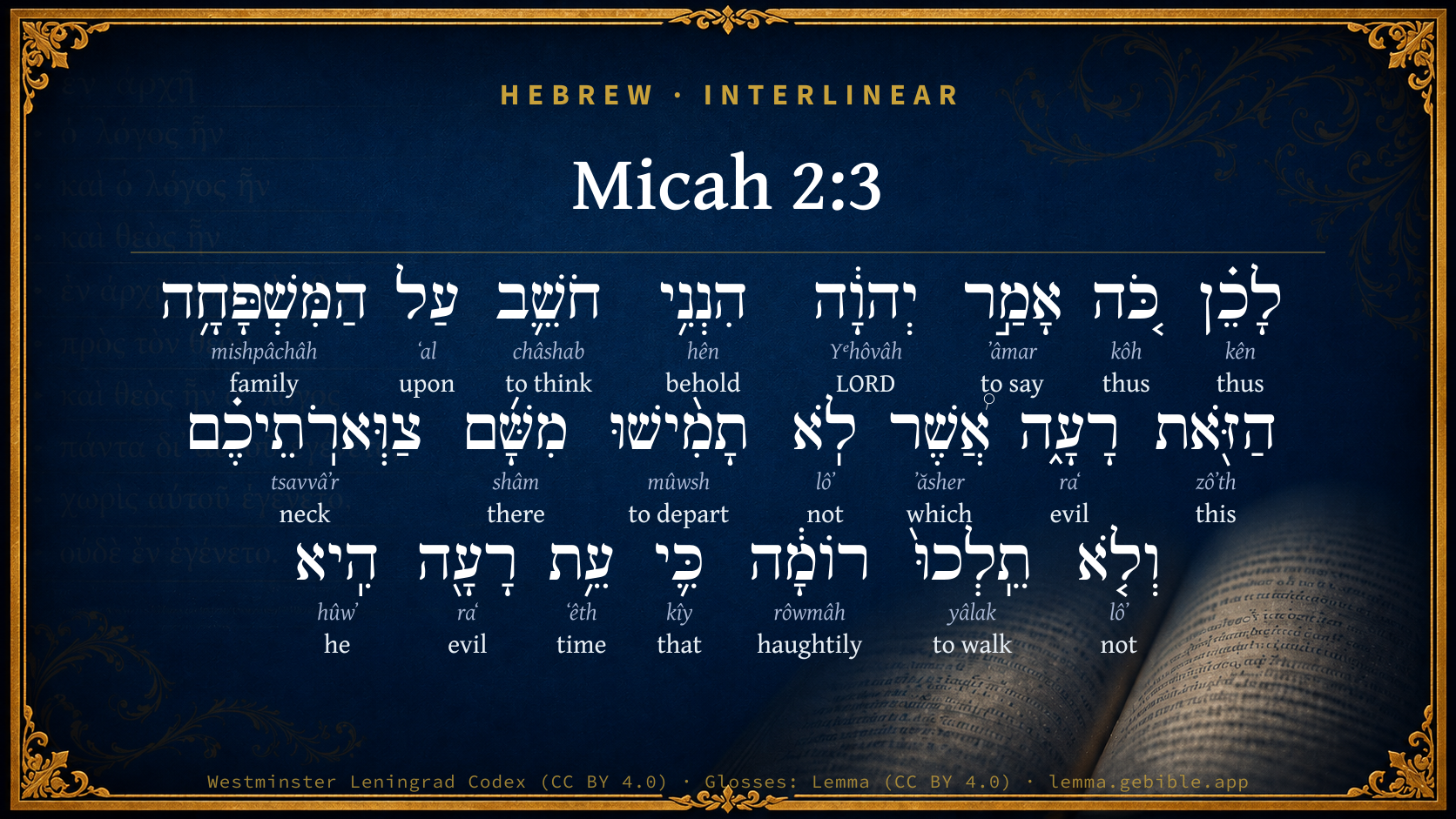
Micah 2:3

Hebrew (Westminster Leningrad Codex) Micah 2:3 appears in the Hebrew Old Testament. The text above is from the Westminster Leningrad Codex. Each word links to its Strong’s number, a concise gloss, and parsing drawn from the Open Scriptures Hebrew Bible morphology. Click any word for its full Brown-Driver-Briggs (BDB) entry.
Download image
Cite this verse

Micah 2:3 (World English Bible). Public Domain. Lemma interlinear Bible study tool, https://lemma.gebible.app/v/micah/2/3.

Show BibTeX & RIS
BibTeX
RIS
English Translation
Therefore thus says Yahweh: "Behold, I am planning against these people a disaster, From which you will not remove your necks, Neither will you walk haughtily; For it is an evil time.
World English Bible · Public Domain
Highlights
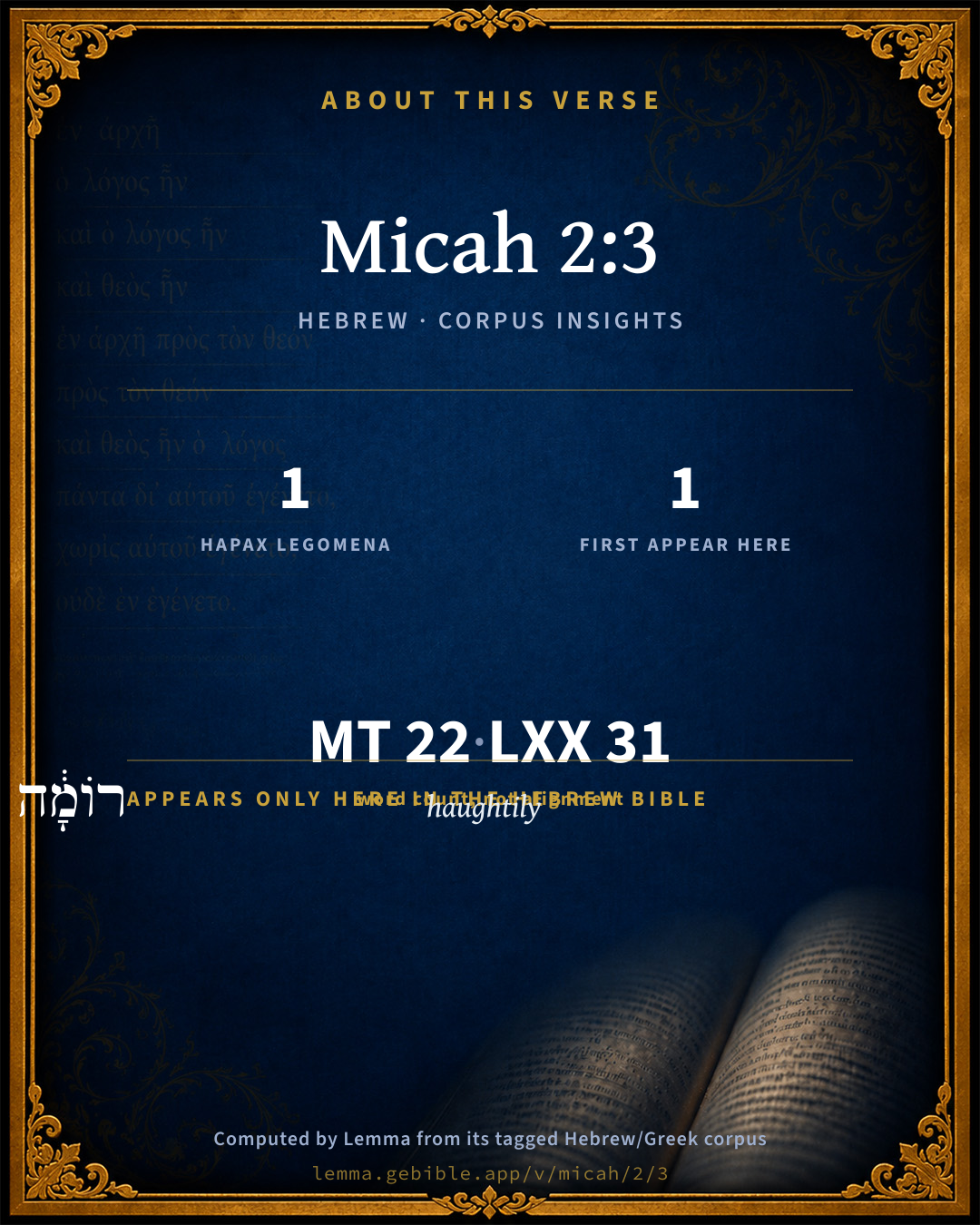
  • 1 hapax legomenon — only here in the Hebrew Bible
  • 1 first appearance in the Hebrew Bible
Full analysis ↓
Download a study sheet

One document with this verse’s original text, its word-by-word gloss line, the meaning frame, cross-references with their text, attributed commentary, and full source and license credits — printable, and it pastes into notes with its structure intact.

This verse Autodidact and up

Study sheet (.html) Plain text (.txt)

A passage Seminary Student

Up to 50 verses in one chapter. A passage sheet keeps up to 6 commentary sources and 12 cross-references per verse, in the order this page ranks them, and says so on the sheet whenever that leaves anything out. Ask for a single verse and you get the Autodidact verse sheet above.

Everything on this page stays free to read, with no account — the sheet is a download of what is already on screen, not access to it.

Want to remove ads? Support Godless Engineer
Compare translations 3

The same verse in 3 English versions, stacked beneath the original-language interlinear above. Click any original word for its lexicon entry.

Each is an independent rendering of the whole verse — the interlinear is not word-aligned to these translations.

Highlighted words mark where these versions differ — a whole-verse word diff, not a word-by-word alignment.

  • World English Bible Public Domain
    Therefore thus says Yahweh: "Behold, I am planning against these people a disaster, From which you will not remove your necks, Neither will you walk haughtily; For it is an evil time.
  • King James Version Public Domain
    Therefore thus saith the LORD; Behold, against this family do I devise an evil, from which ye shall not remove your necks; neither shall ye go haughtily: for this time is evil.
  • unfoldingWord Literal Text CC BY-SA 4.0
    Therefore, thus says Yahweh: "Behold me, devising against this clan disaster, which you will not remove your necks from there, and you will not walk haughtily, for it an evil time.

unfoldingWord Literal Text — © unfoldingWord, licensed CC BY-SA 4.0. Word-aligned USFM3 via Door43 (git.door43.org/unfoldingWord/en_ult).

Versions to compare (up to 4)

3 of 4 selected

Show all 18 translations

Every available English version of this verse, each an independent rendering of the whole verse.

  • World English Bible Public Domain
    Therefore thus says Yahweh: "Behold, I am planning against these people a disaster, From which you will not remove your necks, Neither will you walk haughtily; For it is an evil time.
  • Berean Standard Bible Public Domain
    Therefore this is what the LORD says: “I am planning against this nation a disaster from which you cannot free your necks. Then you will not walk so proudly, for it will be a time of calamity.
  • Majority Standard Bible Public Domain
    Therefore this is what the LORD says: “I am planning against this nation a disaster from which you cannot free your necks. Then you will not walk so proudly, for it will be a time of calamity.
  • King James Version Public Domain
    Therefore thus saith the LORD; Behold, against this family do I devise an evil, from which ye shall not remove your necks; neither shall ye go haughtily: for this time is evil.
  • American Standard Version (1901) Public Domain
    Therefore thus saith Jehovah: Behold, against this family do I devise an evil, from which ye shall not remove your necks, neither shall ye walk haughtily; for it is an evil time.
  • Revised Version (1885) Public Domain
    Therefore thus saith the LORD: Behold, against this family do I devise an evil, from which ye shall not remove your necks, neither shall ye walk haughtily; for it is an evil time.
  • Geneva Bible (1599) Public Domain
    Therefore thus saieth the Lord, Beholde, against this familie haue I deuised a plague, whereout yee shall not plucke your neckes, and ye shall not go so proudly, for this time is euill.
  • Douay-Rheims (1899) Public Domain
    Therefore thus saith the Lord: Behold, I devise an evil against this family: from which you shall not withdraw your necks, and you shall not walk haughtily, for this is a very evil time.
  • Young's Literal Translation Public Domain
    Therefore, thus said Jehovah: Lo, I am devising against this family evil, From which ye do not remove your necks, Nor walk loftily, for a time of evil it `is'.
  • Literal Standard Version CC BY-SA 4.0
    Therefore, thus said YHWH: “Behold, I am devising against this family calamity, || From which you do not remove your necks, || Nor walk loftily, for it [is] a time of evil.
  • Unlocked Literal Bible CC BY-SA 4.0
    Therefore Yahweh says this, “Look, I am about to bring disaster against this clan, from which you will not remove your necks. You will not walk arrogantly, for it will be an evil time.
  • unfoldingWord Literal Text CC BY-SA 4.0
    Therefore, thus says Yahweh: "Behold me, devising against this clan disaster, which you will not remove your necks from there, and you will not walk haughtily, for it an evil time.
  • Darby Bible Public Domain
    Therefore thus saith Jehovah: Behold, against this family do I devise an evil, from which ye shall not remove your necks; neither shall ye walk haughtily: for it is an evil time.
  • World Messianic Bible Public Domain
    Therefore the LORD says: “Behold, I am planning against these people a disaster, from which you will not remove your necks, neither will you walk haughtily, for it is an evil time.
  • Webster's Bible Public Domain
    Therefore thus saith the LORD; Behold, against this family do I devise an evil, from which ye shall not remove your necks; neither shall ye go haughtily: for this time is evil.
  • Free Bible Version CC BY-SA 4.0
    So this is what the Lord says. Watch out! I am planning to bring disaster on such families. They won't be able to escape. You will no longer walk around arrogantly, for this will be a time of disaster.
  • Bible in Basic English Public Domain
    For this cause the Lord has said, See, against this family I am purposing an evil from which you will not be able to take your necks away, and you will be weighted down by it; for it is an evil time.
  • JPS Tanakh (1917) Public Domain
    Therefore thus saith the LORD: Behold, against this family do I devise an evil, from which ye shall not remove your necks, neither shall ye walk upright; for it shall be an evil time.

Literal Standard Version (2020), Covenant Press — licensed CC BY-SA 4.0. Text via the HelloAO Bible API (eBible.org). Unlocked Literal Bible (unfoldingWord) — licensed CC BY-SA 4.0. Text via the HelloAO Bible API (eBible.org). unfoldingWord Literal Text — © unfoldingWord, licensed CC BY-SA 4.0. Word-aligned USFM3 via Door43 (git.door43.org/unfoldingWord/en_ult). Free Bible Version, Dr. Jonathan Gallagher — licensed CC BY-SA 4.0. Text via the HelloAO Bible API (eBible.org).

Word by word

More ways to search: Search by grammar → Find every occurrence → Compare this word →

Practice this passage: Drill this verse → Learn its vocabulary →

רוֹמָ֔ה
rôwmâh
H7317
“haughtily”
Adverb
Part of Speech
Adverb
Full BDB Definition

Origin: fem. of H7315

TWOT: 2133c

proudly, haughtily
  1. לָכֵ֗ן kên H3651 “to/for · thus” Preposition + Adverb
  2. כֹּ֚ה kôh H3541 “thus” Adverb
  3. אָמַ֣ר ʼâmar H559 “to say” Verb, Qal, Perfect, 3rd Person, Masculine, Singular
  4. יְהוָ֔ה Yᵉhôvâh H3068 “LORD” Noun, Proper
  5. הִנְנִ֥י hên H2005 “behold · me” Particle, Demonstrative + Suffix, Personal, 1st Person, Common, Singular
  6. חֹשֵׁ֛ב châshab H2803 “thinking” Verb, Qal, Participle Active, Masculine, Singular, Absolute
  7. עַל ʻal H5921 “upon” Preposition
  8. הַמִּשְׁפָּחָ֥ה mishpâchâh H4940 “the · family” Particle, Definite Article + Noun, Common, Feminine, Singular, Absolute
  9. הַזֹּ֖את zôʼth H2063 “the · this” Particle, Definite Article + Pronoun, Demonstrative, Feminine, Singular
  10. רָעָ֑ה raʻ H7451 “evil” Noun, Common, Feminine, Singular, Absolute
  11. אֲ֠שֶׁר ʼăsher H834 “which” Particle, Relative
  12. לֹֽא lôʼ H3808 “not” Particle, Negative
  13. תָמִ֨ישׁוּ mûwsh H4185 “to depart” Verb, Hiphil, Imperfect, 2nd Person, Masculine, Plural
  14. מִשָּׁ֜ם shâm H8033 “from · there” Preposition + Adverb
  15. צַוְּארֹֽתֵיכֶ֗ם tsavvâʼr H6677 “necks · your” Noun, Common, Masculine, Plural, Construct + Suffix, Personal, 2nd Person, Masculine, Plural
  16. וְלֹ֤א lôʼ H3808 “and · not” Conjunction + Particle, Negative
  17. תֵֽלְכוּ֙ yâlak H3212 “to walk” Verb, Qal, Imperfect, 2nd Person, Masculine, Plural
  18. כִּ֛י kîy H3588 “that” Conjunction
  19. עֵ֥ת ʻêth H6256 “time” Noun, Common, Both, Singular, Absolute
  20. רָעָ֖ה raʻ H7451 “evil” Adjective, Adjective, Feminine, Singular, Absolute
  21. הִֽיא hûwʼ H1931 “he” Pronoun, Personal, 3rd Person, Feminine, Singular

About this verse

These counts appear in no published source. They are computed here, from the morphology-tagged text and Lemma’s own curated glosses. What Lemma adds →

22
words
20
distinct lemmas
Prophets
section

Notable vocabulary

1 hapax legomenon — a word that appears only here in the entire Hebrew Bible:

  • רוֹמָ֔ה haughtily H7317

First appearance in Scripture

This word makes its first canonical appearance in the Hebrew Bible here:

  • רוֹמָ֔ה haughtily H7317

Shared distinctive vocabulary

תָמִ֨ישׁוּ to depart H4185 occurs in 19 verses of the Hebrew Bible. Also found in:

Grammatical profile

  • 4 verbs
  • 5 nouns
  • 1 adjective
  • 2 pronouns
  • 1 preposition
  • 1 conjunction
  • 4 adverbs
  • 4 particles

Verb forms

  • אָמַ֣ר Qal · Perfect
  • חֹשֵׁ֛ב Qal · Participle Active
  • תָמִ֨ישׁוּ Hiphil · Imperfect
  • תֵֽלְכוּ֙ Qal · Imperfect

Repetition

Words recur within this verse — often emphatic in Hebrew:

  • רָעָ֑ה evil H7451 ×2
  • לֹֽא not H3808 ×2

Hebrew & Septuagint length

In English translation the verse runs 32 words from the Hebrew and 33 from the Septuagint (LXX English) — closely comparable.

A rough comparison of the two English renderings, which tokenize alike — not a word-level alignment.

Word counts can differ between the Hebrew and the Greek without any difference in meaning — e.g. the Hebrew direct-object marker אֵת has no separate Greek word, and Greek often adds the article ὁ.

In the original languages it is 22 Hebrew tokens and 31 Greek tokens — but the two are counted differently (Hebrew bundles its prefixes and suffixes into one token; the Greek is in lemma form), so that isn’t a like-for-like length.

Cross-references

20

Topical passages linked to Micah 2:3 in the Treasury of Scripture Knowledge — connected by theme and wording, ordered by reader-vote popularity; previews shown in the World English Bible.

  • Isaiah 2:11–12 The lofty looks of man will be brought low, The haughtiness of men will be bowed down, And Yahweh alone will be exalted in that day.
  • Jeremiah 8:3 Death shall be chosen rather than life by all the residue that remain of this evil family, that remain in all the places where I have driven them, says Yahweh of Hosts.
  • Amos 5:13 Therefore he who is prudent shall keep silence in such a time; For it is an evil time.
  • Jeremiah 18:11 Now therefore, speak to the men of Judah, and to the inhabitants of Jerusalem, saying, Thus says Yahweh: Behold, I frame evil against you, and devise a device against you: return you now everyone from his evil way, and amend your ways and your doings.
  • Isaiah 28:14–18 Why hear the word of Yahweh, you scoffers, that rule this people that is in Jerusalem:
  • Lamentations 2:17 Yahweh has done that which he purposed; he has fulfilled his word that he commanded in the days of old; He has thrown down, and has not pitied: He has caused the enemy to rejoice over you; he has exalted the horn of your adversaries.
  • Lamentations 5:5 Our pursuers are on our necks: We are weary, and have no rest.
  • Amos 9:1–4 I saw the Lord standing beside the altar, and he said, "Strike the tops of the pillars, that the thresholds may shake; and break them in pieces on the head of all of them; and I will kill the last of them with the sword: there shall not one of them flee away, and there shall not one of them escape.
  • James 2:13 For judgment is without mercy to him who has shown no mercy. Mercy triumphs over judgment.
  • Isaiah 3:16 Moreover Yahweh said, "Because the daughters of Zion are haughty, And walk with outstretched necks and flirting eyes, Walking to trip as they go, Jingling ornaments on their feet;
  • Jeremiah 13:15–17 Hear you, and give ear; don't be proud; for Yahweh has spoken.
  • Jeremiah 34:17 Therefore thus says Yahweh: you have not listened to me, to proclaim liberty, every man to his brother, and every man to his neighbor: behold, I proclaim to you a liberty, says Yahweh, to the sword, to the pestilence, and to the famine; and I will make you to be tossed back and forth among all the kingdoms of the earth.
  • Lamentations 1:14 The yoke of my transgressions is bound by his hand; They are knit together, they are come up on my neck; he has made my strength to fail: The Lord has delivered me into their hands, against whom I am not able to stand.
  • Daniel 5:20–23 But when his heart was lifted up, and his spirit was hardened so that he dealt proudly, he was deposed from his kingly throne, and they took his glory from him:
  • Amos 2:14–3:2 Flight will perish from the swift; And the strong won't strengthen his force; Neither shall the mighty deliver himself;
  • Micah 2:1 Woe to those who devise iniquity And work evil on their beds! When the morning is light, they practice it, Because it is in the power of their hand.
  • Zephaniah 1:17–18 I will bring distress on men, that they will walk like blind men, because they have sinned against Yahweh, and their blood will be poured out like dust, and their flesh like dung.
  • Jeremiah 36:23 It happened, when Jehudi had read three or four leaves, that [the king] cut it with the penknife, and cast it into the fire that was in the brazier, until all the scroll was consumed in the fire that was in the brazier.
  • Ephesians 5:16 redeeming the time, because the days are evil.
  • Daniel 4:37 Now I, Nebuchadnezzar, praise and extol and honor the King of heaven; for all his works are truth, and his ways justice; and those who walk in pride he is able to abase.

Cross-references courtesy of OpenBible.info (CC BY 4.0).

Hebrew and Greek witnesses Masoretic Hebrew ↔ Greek Septuagint

The same verse in the two great witnesses to the Old Testament, shown verse-for-verse.

These are two independent witnesses, not word-aligned to each other, and the Septuagint is shown in lemma (dictionary) form.

Hebrew Micah 2:3 Masoretic · Westminster Leningrad Codex

לָכֵ֗ן כֹּ֚ה אָמַ֣ר יְהוָ֔ה הִנְנִ֥י חֹשֵׁ֛ב עַל הַמִּשְׁפָּחָ֥ה הַזֹּ֖את רָעָ֑ה אֲ֠שֶׁר לֹֽא תָמִ֨ישׁוּ מִשָּׁ֜ם צַוְּארֹֽתֵיכֶ֗ם וְלֹ֤א תֵֽלְכוּ֙ רוֹמָ֔ה כִּ֛י עֵ֥ת רָעָ֖ה הִֽיא

Therefore thus says Yahweh: "Behold, I am planning against these people a disaster, From which you will not remove your necks, Neither will you walk haughtily; For it is an evil time.

World English Bible · Public Domain

Greek LXX Micah 2:3 Septuagint · lemma form

διά οὗτος ὅδε λέγω κύριος ἰδού ἐγώ λογίζομαι ἐπί ὁ φυλή οὗτος κακός ἐκ ὅς οὐ μή αἴρω ὁ τράχηλος σύ καί οὐ μή πορεύομαι ὀρθός ἐξαίφνης ὅτι καιρός πονηρός εἰμί

Therefore thus says the Lord; Behold, I devise evils against this family, out of which you⌃ shall not lift up your necks, neither shall you⌃ walk upright speedily: for the time is evil.

LXX2012 (modern English Septuagint) · Public Domain

On this verse, Whedon's Commentary on the Bible discusses the Septuagint’s reading. Read the note in Commentary ↓

Hebrew: Westminster Leningrad Codex (CC BY 4.0). Greek: Septuagint (public domain); English from LXX2012 (modern English Septuagint) (Public Domain). How the Septuagint differs from the Hebrew →

Targum (Aramaic paraphrase)

1

The Targum is the ancient Jewish Aramaic paraphrase of the Hebrew Scriptures — an interpretive translation, not the Hebrew text itself. Onkelos (literal) and Pseudo-Jonathan (expansive) render the Torah, and Jonathan the Prophets. Coverage is partial: where no permissively-licensed English translation exists for a verse, only the Aramaic is shown. This is verse-level text, not a word-by-word alignment to the Hebrew.

  1. Targum Jonathan Prophets (Joshua–Malachi)
    בְּכֵן כִּדְנַן אֲמַר יְיָ הָא אֲנָא מַחְשֵׁיב עַל דָרָא הָדֵין בִּישָׁא דְלָא תַעְדוּן מִתַּמָן צַוְרֵיכוֹן וְלָא תַהֲכוּן בְּקוֹמָה זְקוּפָה אֲרֵי עִדָן בִּישׁ הוּא:

    (no public-domain English translation for this verse)

    Targum Jonathan — Aramaic: “Mikraot Gedolot” (public domain). English: “Sefaria Community Translation” (CC0 1.0 (public-domain dedication)); “London "Chaldee Paraphrase," 1871” (public domain). Text via Sefaria.

Commentary

Notes on Micah 2:3 from classic Christian and Jewish commentators (each source and its license shown beneath its notes). The classic Christian expositions comment on the surrounding passage and are grouped to its opening verse, so a note may address several verses; the Jewish commentaries on the Tanakh (Rashi and others) are per-verse, so they appear only where the commentator wrote on this verse.

Lemma curates 59 commentaries, every one of them public domain or Creative Commons licensed, each selected and text-cleaned for this edition rather than reprinted as found. About our sources →

Trapp's Complete Commentary

John Trapp

Mic 2:3 Therefore thus saith the LORD; Behold, against this family do I devise an evil, from which ye shall not remove your necks; neither shall ye go haughtily: for this time [is] evil.

Ver. 3. Behold, against this family do I devise an evil] They had devised iniquity, Mic 2:1, and now he deviseth their misery. God usually retaliates, and proportions provocation to provocation, Deu 32:21, frowardness to frowardness, Psa 18:26, contrariety to contrariety, Lev 26:18; Lev 26:21, and device to device, as here. He loves to pay sinners home in their own coin; and to make them know, by sad experience, and see, that it is an evil thing and bitter to forsake the Lord and his fear, Jer 2:19. Woe be to that man against whom the Almighty sets himself to devise an evil; such a one shall find, that thought is not free (as that pestilent proverb would make it), either from the notice of God’s holy eye, the censure of his mouth, or the stroke of his hand, see Jer 4:14; Jer 6:19 Rev 2:23 Deu 29:19. And this nature itself had some notion of, as appeareth by his censure who judged that Antiochus did therefore die loathsomely, because he had but an intent to burn Diana’s temple (Polybius). Fecit quisque quantum voluit, saith Seneca; and Incesta est, et sine stupro, quae stuprum cupit, saith the same author. Vain thoughts are very sins, and expose men to punishment; these shall either excuse or accuse at the last day, Rom 2:15. Meanwhile, God is devising what to do to them; he is preparing his bow and making ready his arrows upon the string, even a Tophet of the most tormenting temper will shortly swallow them up, without true and timely repentance.

From which ye shall not remove your necks] It shall so halter and hamper you, that, like "fishes taken in an evil net, and as birds caught in a snare, so shall ye be snared in an evil time, when it falleth suddenly upon you," Ecc 9:12, ye shall never be able either to avoid it or to abide it. But as the bird in a gin, the fish on the hook, the more it strives the more it sticks ( Sic laqueos fera, dum iactat, astringit. Sen.); and as the bullock under the yoke, the more he wriggles the more he galls; so shall it be here. Your fair necks, that would not bear the easy yoke of God’s obedience, shall be ridden on by the enemy and bound to your two furrows, Hos 10:10-11; yea, a yoke of iron shall be put upon thee, until thou be destroyed, Deu 28:48.

Neither shall ye go haughtily] Heb. Romah; and hence haply Roma had its surname, from its height and haughtiness; according to that of the poet (Virg. Aeneid. I),

“ atque altae moenia Romae. ”

The meaning here is, God would deject and darken them, so as that they shall utterly lose their former renown and splendour. He will thrust them down, as it were, with a thump on the back, and there hold them. See Eze 21:26-27; the scene shall be changed, and the haughty abased.

For this time is evil] Both sinfully and penally evil. The apostle seemeth to allude to this text when he saith, "Redeem the time, because the days are evil"; and "Sufficient to the day is the evil thereof" (κακια, i.e. κακωσις), that is, the misery of it, saith Christ, Mat 6:34. And again, Those very days shall be affliction, θλιψις (so the Greek text hath it), Mar 13:19, as if the time were turned into affliction; because of that evil, that only evil, without mixture of mercy, Eze 7:5, here foretold, and therefore foretold that it might have been prevented, ideo minatur Deus ut non puniat.

John Trapp, A Commentary or Exposition upon All the Books of the Old and New Testament (1647–1656) — public domain. Text from a community e-Sword module.

The Biblical Illustrator

Joseph S. Exell

Mic_2:3

Therefore, thus saith the Lord: Behold, against this family do I devise evil

The great antagonist

Here is Micah, the flesh child of the country, who has communed with the Lord God in the ploughed field in the flagrant vineyard, amid the primeval forest, in lonely wilderness, and in secluded height.

He comes to human affairs with keen and unblunted perceptions. Through this mans eyes we may gaze at the outlines and colours of the golden age, we may look upon the causes of lukewarm and congealed affection, and we may also contemplate the fated and inevitable consequences of sin. It is this latter awful vision which I want to bring before yore Behold, against this family do I devise an evil. Let us get the connection of this word. In an earlier chapter I come upon this indictment: Woe to them that devise iniquity upon their beds. The people are busy devising, planning, plotting, scheming. They are building upon falsehood. They are arranging the items of their life in evil sequence. But there is a Counter plotter! Against this family do I devise an evil. The human schemer is confronted by a great Antagonist, God. The Antagonist evidences His working in adversities, disappointments, dissatisfactions, in failures, in fundamental and ignominious defeat. Micahs initial teaching is therefore this: Every sin has its deliberately planned penalty. We cannot isolate the bacillus of sin; it makes its appointed ravages, and no human ministry can fashion an escape. Man devises iniquity; God devises the appropriate issue. One is as certain as the other. Prussic acid is not more certain in its ravages than sin, Now, with this expression of a general and unescapable law before us, let us see what this sharp-eyed prophet regards as some of the inevitable consequences of sin. Uncleanness that destroyeth with a grievous destruction. All sin is uncleanness, and uncleanness is a monster of destruction. As sure as a moth eats away the fabrics of a garment, so sin consumes the robes and habits of the soul. As sure as rust corrodes an instrument of steel, so sin destroys the implements of life. What does sin destroy? Our philosophers arrange the powers and endowments of man in a heightening scale. They begin with mere animal vitality, sheer naked energy, the basal aptitudes and passions, and they ascend through the senses, the intellectual perceptions, the powers of reasoning, the aesthetic tastes, alp to the moral realm, and higher still to the peerless sphere of reverence and veneration, where life looks out upon God! It is all-important that we remember this range of endowment when we are considering the destructiveness of sin. And I will tell you why. When sin breaks out in the life there are parts of this extensive range which appear to be untouched and if a man looked at these alone it might appear that sin has committed no ravages at all. Let us look at this. When a noxious gas gets into a greenhouse the most delicate things are the first things to suffer. When the coarser plants are smitten the finer, ones have long been dead. It is so in the life. When destructive uncleanness enters, the coarsest thing is the last to be hit. The body preserves its life the longest. Let us assume that a man has become ridden by lust. When that mans body begins to shake the more delicate things of the soul are already destroyed. When the passion for drink shows itself in the face, other parts are already in ashes. The fire of sin always begins to flame in the upper chambers, and burns down towards the basement. The first thing to suffer is our affection. When purity goes out of life love droops like a bird whose cage is near the ceiling, and which faints amid the accumulated fumes of the burning gas. Let a man live an impure life, for one day; let falsehood, passion, malice, bear down upon him, and let him watch the effect upon his affection for wife and child. Uncleanness, according to this prophet, destroyeth with a grievous destruction. It shall be night unto you, and ye shall have no vision. You will not be surprised to he taken this second step under the guidance of the prophet Micah. The sentence is descriptive of a second penalty. What is that? It is the loss of spiritual perception. In the higher realms of our being we are like instruments to be played upon by the Spirit of God. But what is the worth of the harp when the strings are eaten away? What is the use of a piano when the wires are corroded? The executant is unable to convey his message because the instrument is unable to receive it. And when the instrument of our higher self is corrupted or impaired we cannot perceive the approaches of the Spirit or discern the whispering counsels of our God. This is a law whose working I have proved by sad experience in my own life. There have been days when the Book of Scripture seemed closed before me. The page appears commonplace; it does not glow with the heavenly Presence. But on the day of moral alertness and strenuousness of spiritual nearness to my God the common bush is aflame, and His word becomes a light unto my path. Sin spoils our spiritual eyes and ears, and makes us poor receivers. Thou shalt eat and not be satisfied. This is the third of the penalties of sin. Sin issues in deep-seated weariness and unrest. The man makes money, but he sighs amid his abundance. His friends speak of him in terms of admiration: He has got everything that heart could wish. Ah, that is just what he has not got! He has got everything that flesh could wish, but the heart is mourning in secret impoverishment. These dissatisfied souls are all about us, in the pulpit and out of it. But our very dissatisfaction is more than the issue of sin; it is the merciful judgment of infinite grace and love. If our Father left us in satisfaction our perdition would be hopeless and complete. (J. H. Jowett, M. A.)

The Biblical Illustrator, edited by Joseph S. Exell (c. 1880s–1900s) — public domain. Text from a community e-Sword module.

Joseph Benson's Commentary

Mic 2:3. Therefore, behold, against this family do I devise evil — As they devise mischief against others, so will I devise an evil against them, as a due punishment for their sin. As they have unjustly deprived others of their inheritances, so a conquering enemy shall dispossess them and carry them into captivity. The word family is equivalent to people, as appears from Jer 1:15. From which ye shall not remove your necks — They laid snares for others, where open force would not suffice, so that the poor could not get out of their hands, but were empoverished and enslaved; and God here threatens that he will deal thus with them by the Assyrians, from whose power they should not be able to defend themselves or to escape. Neither shall ye go haughtily — You have made others hang down their heads, and so shall you now; for this time is evil — You have made it an evil time for sins committed against me, and against the poor and innocent: and I will make it an evil time for calamities and miseries on the whole family of Jacob.

Joseph Benson's Commentary on the Old and New Testaments (1811–1818) — public domain. Text from a community e-Sword module.

Whedon's Commentary on the Bible

Daniel D. Whedon

Mic_2:3-4 announce the judgment.

Therefore — Because they devise evil.

I devise an evil — Or, calamity (Amo_3:6). Jehovah will bring upon the evil doers a calamity from which there can be no escape.

This family — May, perhaps, include the whole nation (Amo_3:1), though it could be used of Judah alone.

Shall not remove your necks — The evil is likened to a yoke that rests heavily upon the neck and cannot be shaken off.

Haughtily — The pressure of the yoke makes impossible walking with heads erect, a sign of pride and arrogance. Evidently the prophet expects the calamity to be inflicted by a foreign conqueror, who will place his yoke upon the nation’s neck.

This time is evil — R.V., “it is an evil time.” The expression is used again in Amo_5:13, but with a slightly different meaning.

The downfall of Israel will cause rejoicing among the conquerors and lamentation among the conquered.

Parable — Hebrews mashal, which denotes any figurative saying; here probably a “taunt song” (compare Isa_14:4; Hab_2:6).

Against you — By the successful opponents. This seems to be the most natural interpretation, though the Hebrew does not make it absolutely necessary to suppose that it is to be uttered by the victorious conqueror.

Lamentation — To be uttered by Israel over the calamity suffered (Amo_5:16). A supposed play upon words in the original, Pusey reproduces by, “They shall wail a wail of woe.” The whole verse is in poetic form and may be rendered more accurately: —

In that day men will raise against you a taunting song,

They will lament a lamentation:

It is finished, they shall say,

We are utterly ruined,

The portion of my people he changeth,

How doth he remove it from (literally, for) me;

Unto the rebellious he divideth our fields.

The purport of the verse is clear. The enemies will taunt Israel because their God has failed to deliver them; Israel will lament because enemies have taken possession of the holy land and divided it among themselves. At the same time it is recognized that all this is Jehovah’s doing; he takes back the land formerly assigned to Israel and hands it over to the enemy.

The Hebrew text of Mic_2:4 contains several peculiarities; the most marked of these are the abrupt transition, without even the slightest indication, from the enemies to Israel (lines 1 and 2), and the unexpected change from plural to singular and singular to plural (lines 4-7; “we”… “my”… “me”… “our”); besides, LXX. varies considerably from the present Hebrew text. For these reasons modern commentators are inclined to regard the text as more or less corrupt. Nowack, following Stade, reconstructs it, partly on the basis of LXX., and partly by conjecture, so that it reads, “Then will be uttered over you a proverb and a lamentation, as follows: —

The portion of my people is divided off with a measuring rod, there is none to give it back,

To those who have led us into exile are apportioned our fields, we are utterly ruined.”

The lament itself Marti restores: —

Alas! how are we utterly ruined! our land is apportioned!

Alas! how our captors do mock! our land is divided!

In both reconstructions the Kinah verse (see on Amo_5:1-3) is used, which is very appropriate in this connection.

With Mic_2:5 the difficulties increase. That in Mic_2:6 the prophet takes up the words of some one else and bases his words upon this utterance is beyond doubt; but who pronounces the curse in Mic_2:5? Some consider the verse a continuation of Mic_2:3-4. There loss of property and deportation are threatened; but, it is said, the prophets always look forward to a restoration, and this was in the mind of Micah when he uttered Mic_2:5; he means to say that when the restoration becomes a reality the ungodly will have no part in the redistribution of the land. Others insist that there is no thought of a restoration in this verse; hence they refer the threat to the immediate future; the ungodly are to have no longer any part in the inheritance of Jehovah, because their families will be cut off in the impending judgment. The singular “thou” is thought to be used in order to indicate that every individual sinner is to be punished; not one will escape the threatened judgment. The first interpretation is perfectly possible, the second is highly improbable, because the context makes no distinction between the fate of the good and the bad at the time of the judgment. In Mic_2:3-4 the threat is made against the whole people; it will be utterly ruined, the enemy will take possession of the entire land, everybody is expected to go into exile. In the exile some will remain loyal to Jehovah, others will apostatize. Between the two classes a separation will be made at the time of the restoration; only the faithful will return to their former home. In this restored community, which is the congregation of Jehovah, the ungodly will have no part.

Others, who insist that the only reference to a restoration in this chapter is in Mic_2:12-13, give a still different interpretation. They consider Mic_2:5 the utterance of a bystander who, as the spokesman of the people, attempts to interrupt the denunciatory discourse of Micah. To a great majority of the people the words of Mic_2:4 would seem blasphemy. How could a man dare to announce that Jehovah was weaker than the gods of the Assyrians, that he could not or would not protect his chosen people; that the sanctuary would be desecrated? A man who uttered words such as Micah dared to utter must be a blasphemer or a madman; in either case he deserved the wrath of God. These thoughts a bystander put into words.

“Because of his blasphemous words, the Jews think, Micah should be killed (compare Jer_26:8-9; Jer_26:11), destroyed with his entire family (Jer_11:19), so that his possessions would fall into the hands of strangers (Amo_7:17); he should suffer the punishment of the false prophet (Deu_13:9), and with him will suffer his descendants (Jer_22:30), who are rooted out before they see the light. The form of this threat corresponds with the prophet’s prediction; he is to suffer the very fate which he threatens them, lose permanently his inheritance.” The most recent commentators, Nowack and Marti, consider Mic_2:5 a later gloss. If the verse is original the choice lies between the first and the third interpretations, and of these the third seems to be, on the whole, the most satisfactory.

Daniel D. Whedon (gen. ed.), Commentary on the Old and New Testaments (1874–1909) — public domain. Text from a community e-Sword module.

The Preacher's Complete Homiletical Commentary

Joseph S. Exell (gen. ed.)

CRITICAL NOTES.]

Mic_2:3. Family] Nation. Devise] Cf. Mic_2:1, “to set clearly before our eyes the jus talionis prevalent in God’s providence” (Exo_21:23; Isa_33:1) [Lange]. Necks] You cannot shake off punishment as ye have done law. Haughtily] Stiff necks will have to bend; they will not carry themselves loftily (Psa_58:9), for their iniquity causes an evil time.

Mic_2:4. Par-] Wickedness and punishment will be subjects of common conversation. Doleful] Lit. laments with a lamentation of lamentations, i.e. a mournfully mournful song. Say] “Actum est! it is all over! an exclamation of despair.” Turning] i.e. causes the inheritance to pass to the heathen; some, “to a rebel, our fields he divideth.”

Mic_2:5. Cast] No possession left for the usual mode of division.

HOMILETICS

RETRIBUTIVE PUNISHMENT.—Mic_2:3-5

Sentence is now pronounced against the sins specified, and the woe threatened (Mic_2:1) is explained. God will inflict such judgments, and bring such times, that will effectually humble their pride and recompense their wickedness.

I. Punishment in kind. God is not an idle spectator of oppression, and delay in punishment is not disregard.

1. They devised evil against others, and evil is devised against them. “Against this family do I devise an evil.” Retribution is measured and planned against wicked men. Infinite wisdom will frustrate and punish human designs.

2. They took the lands of others, and their own land shall be taken from them. The inheritance was given to the foe and would never be divided by lot again. Mercies given by special providence may be removed in righteous judgment for our sin. If we forsake God he will forsake us. Riches, honour, and pleasure he can turn into captivity, and unjust gain will pass into the hands of others. Words are not sown in the wind, and actions written in the dust; but like imperishable seed they spring up and fructify in human life. “Whatsoever a man soweth that shall he also reap.”

II. Punishment most humiliating.

1. They would be humbled in their pride. “Neither shall ye go haughtily.” Men dream that if they cannot avoid judgments they will be undaunted and courageous under them. God can humble the proud, subdue the self-willed, and throw the mightiest into captivity and sorrow.

2. They would become a by-word in their sufferings. “In that day shall one take up a parable against you.” The calamity was not an ordinary one, but a common proverb in the mouth of others. Sinners are often an example of God’s justice and a warning to others. When others insult and jest at our grief it is most bitter to endure. The most haughty and prosperous will then be dejected and sad.

3. Their condition would be most lamentable. “Lament with a doleful lamentation.” (a) Because the change was so great. God had taken their possessions and fixed others in them. “He hath changed the portion of my people.” (b) Because their case was so hopeless. “We be utterly spoiled.” What reverses in life to prove the folly of men and the providence of God. “Son, remember that thou in thy lifetime receivedst thy good things, and likewise Lazarus evil things; but now he is comforted and thou art tormented.”

III. Punishment most irretrievable. “An evil from which ye shall not remove your necks.” It was a yoke they could neither avoid nor shake off. From the two tribes the joke was removed, but the ten were never able to withdraw their necks. The punishment was most severe and proportioned in justice to the sins. Those that will not be ruled by grace will be overcome by judgment. Prefer the easy to the iron yoke. Flee now from sin that you may be saved from judgment at last. “For this time is evil.”

HOMILETIC HINTS AND SUGGESTIONS

Mic_2:4. The dirge which follows is purposely in abrupt brief words, as those in trouble speak, with scarce a breath for utterance. First, in two words, with perhaps a softened inflection, they express the utterness of their desolation. Then, in a threefold sentence, each close consisting of three short words, they say what God has done, but name him not because they are angry with him. God’s chastisements irritate those whom they do not subdue (Amo_6:10) [Pusey].

Spoiled. Joel spoke of the parting of their land, under this same term, as a sin of the heathen (Mic_3:2). Now they say God divideth our fields, not to us, but to the heathen, whose lands he gave us. It was a change of act; in impenitence they think it a change of purpose or will. But what lies in that we be utterly despoiled? Despoiled of everything; of what they felt, temporal things; and of what they did not feel, spiritual things. Despoiled of the land of promise, the good things of this life, but also of the presence of God in his temple, the grace of the Lord, the image of God and everlasting glory [Pusey].

Blessings abused are at last removed by the Almighty Giver.

None by lot. Wickedness casting out a people,

1. From the protection and blessings of God;

2. Will cast out from the presence of God hereafter. Neither part nor lot in this matter (Act_8:21).

ILLUSTRATIONS TO CHAPTER 2

Mic_2:4. He hath divided our fields. The land was but the outward symbol of the inward heritage. Unjust gain kept back is restored with usury; it taketh away the life of the owners thereof (Pro_1:19). The vineyard whereof the Jews said, the inheritance shall be ours, was taken from them and given to others. So now is that awful change begun when Christians, leaving God, their only unchanging good, turn to earthly vanities, and for the grace of God which he withdraws have these only for their fleeting portion, until it shall be finally exchanged in the day of judgment [Pusey].

The Preacher's Complete Homiletical Commentary (gen. ed. Joseph S. Exell; Funk & Wagnalls, c. 1892) — public domain (pre-1929). A full-Bible homiletical/sermon-outline anthology covering 65 of 66 books (2 John is absent from the source module). Text from a community e-Sword module.

Tyndale Open Study Notes

Tyndale Open Resources

2:3-5 The Lord, the Judge, reads out the sentence. He would pay back his people’s evil hearts and actions with evil in kind. The prophet is engaging in wordplay here. The Hebrew word translated “evil” has a wide range of meaning. It can connote moral evil, as in the first instance; it can also connote calamity or disaster as in the second instance. The Lord would bring calamity on them in response to their wickedness.

Tyndale Open Study Notes — © Tyndale Open Resources, licensed CC BY-SA 4.0. Text via the HelloAO Bible API.

Jamieson, Fausset & Brown

Robert Jamieson, A. R. Fausset & David Brown

against this family--against the nation, and especially against those reprobates in Mic 2:1-2.

I devise an evil--a happy antithesis between God's dealings and the Jews dealings (Mic 2:1). Ye "devise evil" against your fellow countrymen; I devise evil against you. Ye devise it wrongfully, I by righteous retribution in kind.

from which ye shall not remove your necks--as ye have done from the law. The yoke I shall impose shall be one which ye cannot shake off. They who will not bend to God's "easy yoke" (Mat 11:29-30), shall feel His iron yoke.

go haughtily--(Compare Note, see on Jer 6:28). Ye shall not walk as now with neck haughtily uplifted, for the yoke shall press down your "neck."

this time is evil--rather, "for that time shall be an evil time," namely, the time of the carrying away into captivity (compare Amo 5:13; Eph 5:16).

Jamieson, Fausset & Brown — Commentary Critical and Explanatory on the Whole Bible (1871) — public domain (CC PDM 1.0). Text via the HelloAO Bible API.

Adam Clarke's Commentary

Verse 3. Against this family (the Israelites) do I devise an evil] You have devised the evil of plundering the upright; I will devise the evil to you of punishment for your conduct; you shall have your necks brought under the yoke of servitude. Tiglath-pileser ruined this kingdom, and transported the people to Assyria, under the reign of Hezekiah, king of Judah; and Micah lived to see this catastrophe. See on Mic 2:9.

Adam Clarke's Commentary on the Bible (1810–1826) — public domain. Text from a community e-Sword/MySword module.

John Calvin's Commentaries

The Prophet shows now that the avaricious were in vain elevated by their frauds and rapacity, because their hope would be disappointed; for God in heaven was waiting his time to appear against them. Though they had anxiously heaped together much wealth, yet God would justly dissipate it altogether. This is what he now declares.

Behold, he says, thus saith Jehovah, I am meditating evil against this family There is here a striking contrast between God and the Jews, between their wicked intentions and the intentions of God, which in themselves were not evil, and yet would bring evil on them. God, he says, thus speaks, Behold, I am purposing; as though he said, “While ye are thus busying yourselves on your beds, while ye are revolving many designs while ye are contriving many artifices, ye think me to be asleep, ye think that I am all the while meditating nothing; nay, I have my thoughts too, and those different from yours; for while ye are awake to devise wickedness I am awake to contrive judgment.” We now then perceive the import of these words: it is God that declares that he meditates evil, and it is not the Prophet that speaks to these avaricious and rapacious men; and the evil is that of punishment, inasmuch as it is the peculiar office of God to repay to all what they deserve, and to render to each the measure of evil they have brought on others.

Ye shall not, he says, remove your necks from under it. Since hypocrites always promise to themselves impunity, and lay hold on subterfuges, whenever God threatens them, the Prophet here affirms, that though they sought every escape, they would yet be held bound by God’s hand, so that they could not by any means shake off the burden designed for them. And this was a reward most fully deserved by those who had withdrawn their necks when God called them to obedience. They then who refuse to obey God, when he requires from them a voluntary service, will at length be drawn by force, not to undergo the yoke, but the burden which will altogether overwhelm them. Whosoever then will not willingly submit to God’s yoke, must at length undergo the great and dreadful burden prepared for the unnamable.

Ye will not then be able to withdraw your necks, and ye shall not walk in your height. He expresses still more clearly what I have referred to, — that they were so elated with pride, that they despised all threatening and all instruction: and this presumption became the cause of perverseness; for were it not that a notion of security deceived men, they would presently bend, when God threatens them. This then is the reason why the Prophet joins this sentence, ye shall no more walk in your height; that is, your haughtiness shall then surely be made to succumb; for it will be a time of evil He means, as I have said, that those who retain a stir and unbending neck towards God, when he would lay on them his yoke, shall at length be made by force to yield, however rebellious they may be. How so? For they shall be broken down, inasmuch as they will not be corrected. The Prophet then adds —

John Calvin's Commentaries (1540-1563) — public domain. Text from the Calvin Translation Society English edition (1840s-50s) via the Christian Classics Ethereal Library (ccel.org). Calvin's coverage is partial (roughly two-thirds of the Bible); uncommented books and verses are honest gaps, never fabricated. The 19th-century editor's footnotes and remarks are omitted so the notes are faithfully Calvin's own voice.

Ellicott's Commentary for English Readers

(3) I devise an evil.—As they devise evil against their brethren, so am I devising an evil against them: they shall bow their necks under a hostile yoke.

A Bible Commentary for English Readers, edited by Charles John Ellicott (1878–1897) — public domain. Text from a community e-Sword module.

The Cambridge Bible for Schools and Colleges

gen. ed. J. J. S. Perowne

3. Therefore, &c.] The ‘devising’ of the dishonest grandees is met by the ‘devising’ of Jehovah; oppression is punished by oppression. Comp. the striking correspondences between sins and their punishments in Isaiah 5.

against this family] The grandees, as the heads and representatives of the nation (Isa_9:15), have involved all ranks in a common ruin. Israel is disparagingly called ‘this family’ (instead of ‘my family’). Comp. Isa_6:10; Isa_28:14; Isa_29:13, Jer_8:5; Jer_13:10 (where the phrase is used of Judah), Isa_8:6; Isa_9:16 (where it seems to refer to the northern kingdom), and Jer_33:24 (where it is applied even to the heathen neighbours of the Jews). Here it evidently refers to the northern and southern kingdoms alike—‘the whole family which I brought up out of the land of Egypt’ (Amo_3:1).

your necks] The ‘evil,’ then, is a foreign yoke; comp. Jer_27:12. They are likened to cattle (as Amo_4:1).

The Cambridge Bible for Schools and Colleges (gen. ed. J. J. S. Perowne; Cambridge University Press, 1878–1918) — public domain. Text from a community e-Sword module.

John Gill's Exposition

Therefore thus saith the Lord, behold, against this family do I devise an evil,.... Because of those evils of covetousness, oppression, and injustice, secretly devised, and deliberately committed, the Lord, who neither slumbers nor sleeps, declares, and would have it observed, that he had devised an evil of punishment against the whole nation of Israel, the ten tribes particularly, among whom these sins greatly prevailed; even an invasion of their land by the Assyrians, and the carrying of them captive from it into foreign parts:

from which ye shall not remove your necks; that is, they should not be able to deliver themselves from it; they would not be able to stop the enemy in his progress, having entered their land; nor oblige him to break up the siege of their city, before which he would sit, and there continue till he had taken it; and being carried captive by him, they would never be able to free themselves from the yoke of bondage put upon them, and under which they remain unto this day. The allusion is to beasts slipping their necks out of the collar or yoke put upon them: these sons of Belial had broke off the yoke of God's commandments, and now he will, put another yoke upon them, they shall never be able to cast off until the time of the restitution of all things, when all Israel shall be saved:

neither shall ye go haughtily; as they now did, in an erect posture, with necks stretched out, and heads lifted up high, and looking upon others with scorn and contempt; but hereafter it should be otherwise, their heads would hang down, their countenances be dejected, and their backs bowed with the burdens upon them:

for this time is evil; very calamitous, afflictive, and distressing; and so not a time for pride and haughtiness, but for dejection and humiliation; see Eph 5:16.

John Gill's Exposition of the Whole Bible (1746–1763) — public domain (CC PDM 1.0). Text via the HelloAO Bible API.

Albert Barnes' Notes on the Bible

Such had been their habitual doings. They had done all this, he says, as one continuous act, up to that time. They were habitually devisers of iniquity, doers of evil. It was ever-renewed. By night they sinned in heart and thought; by day, in act. And so he speaks of it in the present. They do it. But, although renewed in fresh acts, it was one unbroken course of acting. And so he also uses the form, in which the Hebrews spoke of uninterrupted habits, They have coveted, they have robbed, they have taken. Now came God’s part.

Therefore, thus saith the Lord - Since they oppress whole families, behold I will set Myself against this whole family ; since they devise iniquity, behold I too, Myself, by Myself, in My own Person, am devising. Very awful is it, that Almighty God sets His own Infinite Wisdom against the devices of man and employs it fittingly to punish. “I am devising no common punishment, but one to bow them down without escape; “an evil from which” - He turns suddenly to them, “ye shall not remove your necks, neither shall ye go haughtily.” Ribera: “Pride then was the source of that boundless covetousness,” since it was pride which was to be bowed down in punishment. The punishment is proportioned to the sin. They had done all this in pride; they should have the liberty and self-will wherein they had wantoned, tamed or taken from them. Like animals with a heavy yoke upon them, they should live in disgraced slavery.

The ten tribes were never able to withdraw their necks from the yoke. From the two tribes God removed it after the 70 years. But the same sins against the love of God and man brought on the same punishment. Our Lord again spake the woe against their covetousness Luk 16:13-14; Luk 11:39; Mat 23:14, Mat 23:23, Mat 23:25; Mar 12:40. It still shut them out from the service of God, or from receiving Him, their Redeemer. They still spoiled the goods Heb 10:34 of their brethren. In the last dreadful siege , “there were insatiable longings for plunder, searching-out of the houses of the rich; murder of men and insults of women were enacted as sports; they drank down what they had spoiled, with blood.” And so the prophecy was for the third time fulfilled. They who withdraw from Christ’s easy yoke of obedience shall not remove from the yoke of punishment; they who, through pride, will not bow down their necks, but make them stiff, shall be bent low, that they go not upright or haughtily anymore Isa 2:11. The Lord alone shall be exalted in that Day. For it is an evil time. Perhaps he gives a more special meaning to the words of Amos Amo 5:13, that a time of moral evil will be, or will end in, a time, full of evil, that is, of sorest calamity.

Albert Barnes' Notes on the Bible (1834–1885) — public domain. Text from a community e-Sword/MySword module.

Haydock's Catholic Bible Commentary

Time. It was very near. Micheas saw the ruin of Samaria, under Theglathphalassar and Salmanasar.

George Leo Haydock (1774–1849), Haydock's Catholic Family Bible and Commentary, 1859 edition — public domain. Excludes Psalms (Douay-Rheims chapter numbering differs from Protestant) and Deuterocanonical books (Catholic canon only).

Matthew Poole's English Annotations

Therefore; for this great, inhuman, cruel oppression. Thus saith the Lord; the Lord by his prophet declareth what he will do, and adviseth them to consider it, for it is a most manifest retaliation or punishing the offenders, so that every one may see God deals with them, as they dealt with their oppressed neighbours.

Against this family do I devise an evil; they devised, now God will devise; theirs was evil against others, God will devise evil against them; theirs was evil of sin, God’s is an evil of just punishment, against their family, as they devised evil against the family of their poor neighbours. God will bring the Assyrian power upon them.

From which ye shall not remove your necks; they laid snares where open force would not suffice, so that the poor could not get out of their hands, but were impoverished and enslaved; so God will deal with them by the Assyrian, from whose power they shall not escape.

Neither shall ye go haughtily; you have made others hang the head, so shall you now. For this time is evil; you great ones have made it all evil time, evil for sin against me and the innocent, and for cries and griefs to the poor; I will make it an evil time, full of penal calamities and miseries on the whole family or posterity of Jacob.

Matthew Poole's English Annotations on the Holy Bible (1683–1685) — public domain. Text from a community e-Sword/MySword module.

The Pulpit Commentary

The sin shall be followed by its appropriate punishment. As they devised evil, God will devise a penalty. This family. The whole people. (Amo_3:1) An evil. A chastisement, a judgment. (Amo_3:6) Ye. The prophet suddenly addresses them, the "family." Your necks. He speaks of the calamity as a heavy, galling yoke, from which they should be unable to free themselves. (comp. Hos_10:11) This yoke is their conquest and exile at the hands of foreigners. (comp. Jer_27:12) Haughtily. With head erect. Septuagint, oryoi . Their pride shall be brought low. This time is evil; full of calamity, which is announced in the following verses. The words occur in Amo_5:13, but the evil there spoken of is moral. (comp. Eph_5:16)

The Pulpit Commentary (1880–1919), ed. H.D.M. Spence-Jones & Joseph S. Exell — public domain. Text from a community e-Sword module.

John Wesley's Explanatory Notes

Against this family - God will devise evil against their family, as they devised evil against the family of their neighbours. Haughty - You have made others hang the head; so shall you now. Is evil - Full of miseries on the whole family of Jacob.

John Wesley, Explanatory Notes Upon the Whole Bible (1754–1765) — public domain. Text via the GEBible commentary corpus.

Keil & Delitzsch

C. F. Keil & F. Delitzsch

"Therefore thus saith Jehovah, Behold, I devise evil concerning this family, from which ye shall not withdraw your necks, and not walk loftily, for it is an evil time. Mic 2:4. In that day will men raise against you a proverb, and lament a lamentation. It has come to pass, they say; we are waste, laid waste; the inheritance of my people he exchanges: how does he withdraw it from me! To the rebellious one he divides our field." The punishment introduced with lâkhēn (therefore) will correspond to the sin. Because they reflect upon evil, to deprive their fellow-men of their possessions, Jehovah will bring evil upon this generation, lay a heavy yoke upon their neck, out of which they will not be able to necks, and under which they will not be able to walk loftily, or with extended neck. המּשׁפּחה הזּאת is not this godless family, but the whole of the existing nation, whose corrupt members are to be exterminated by the judgment (see Isa 29:20.). The yoke which the Lord will bring upon them is subjugation to the hostile conqueror of the land and the oppression of exile (see Jer 27:12). Hâlakh rōmâh, to walk on high, i.e., with the head lifted up, which is a sign of pride and haughtiness. Rōmâh is different from קוממיּוּת, an upright attitude, in Lev 27:13. כּי עת רעה, as in Amo 5:13, but in a different sense, is not used of moral depravity, but of the distress which will come upon Israel through the laying on of the yoke. Then will the opponents raise derisive songs concerning Israel, and Israel itself will bewail its misery. The verbs yissâ', nâhâh, and 'âmar are used impersonally. Mâshâl is not synonymous with nehı̄, a mournful song (Ros.), but signifies a figurative saying, a proverb-song, as in Isa 14:4; Hab 2:6. The subject to ישּׂא is the opponents of Israel, hence עליכם; on the other hand, the subject to nâhâh and 'âmar is the Israelites themselves, as נשׁדּנוּ teaches. נהיה is not a feminine formation from נהי, a mournful song, lamentum lamenti, i.e., a mournfully mournful song, as Rosenmller, Umbreit, and the earlier commentators suppose; but the niphal of היה (cf. Dan 8:27): actum est! it is all over! - an exclamation of despair (Le de Dieu, Ewald, etc.); and it is written after 'âmar, because נהיה as an exclamation is equivalent in meaning to an object. The omission of the copula Vav precludes our taking 'âmar in connection with what follows (Maurer). The following clauses are a still further explanation of נהיה: we are quite laid waste. The form נשׁדּנוּ for נשׁדּונוּ is probably chosen simply to imitate the tone of lamentation better (Hitzig). The inheritance of my people, i.e., the land of Canaan, He (Jehovah) changes, i.e., causes it to pass over to another possessor, namely, to the heathen. The words receive their explanation from the clauses which follow: How does He cause (sc., the inheritance) to depart from me! Not how does He cause me to depart. לשׁובב is not an infinitive, ad reddendum, or restituendum, which is altogether unsuitable, but nomen verbale, the fallen or rebellious one, like שׁובבה in Jer 31:22; Jer 49:4. This is the term applied by mourning Israel to the heathenish foe, to whom Jehovah apportions the fields of His people. The withdrawal of the land is the just punishment for the way in which the wicked great men have robbed the people of their inheritance.

Keil & Delitzsch — Biblical Commentary on the Old Testament (1861–1891) — public domain (CC PDM 1.0). Text via the HelloAO Bible API. (Old Testament only.)

unfoldingWord translationNotes

Door43 World Missions Community

Look

"Listen carefully" or "Pay attention"

disaster

See how you translated this in Micah 1:12.

this clan

This "clan" refers to the entire community of Israel, whose rich people are oppressing the poor. The sins of the leaders are coming back on the whole nation.

from which you will not remove your necks

Yahweh speaks of punishing the people as if he were putting a yoke around their necks. AT: "from which you will not be able to escape" (See: Metaphor)

sing a song about you

"sing a song to make fun of you"

lament with a wailing lamentation

"they will cry loudly." They are pretending to mourn, as if those they love have died. (See: Irony)

We Israelites ... to traitors

This is the song that the enemies will sing to make fun of the Israelites and laugh as the Israelites suffer. (See: Irony)

How can he remove it from me?

The enemy mocks the surprise the rich leaders of Israel feel because God has taken their land and given it to someone else just as they had taken the land from the poor. This question can be translated as a statement. AT: "How wrong he is to take it from me!" (See: Rhetorical Question and Irony)

Therefore, you rich people will have no descendants to divide up the territory by lot in the assembly of Yahweh

Possible meanings are 1) Micah looks forward to a time after the exile when those who return will divide up the land or 2) he is speaking of a custom of his time when the tribe or clan would divide up their land and give it to individuals.

translationWords

Yahweh

clan

walk

arrogant

evil

adversary

lament

ruin

people of God

lots

assembly

unfoldingWord translationNotes — © Distant Shores Media and the Door43 World Missions Community, licensed CC BY-SA 4.0. Source: git.door43.org/Door43/en_tn.

Rashi

Rabbi Shlomo Yitzchaki (Rashi)

and you shall not walk erect—You shall not walk with an upright stature.

Rashi on the Tanakh — English translations: “The Judaica Press complete Tanach with Rashi, translated by A. J. Rosenberg” (CC BY 4.0); “Pentateuch with Rashi's commentary by M. Rosenbaum and A.M. Silbermann, 1929-1934” (public domain); “The Metsudah Tanach series, Lakewood, N.J” (CC BY 4.0); and “The Book of Joshua, Metsudah Publications, 1997” (CC BY 4.0). Text via Sefaria.

Lesson kit

Teaching starters — assembled from the data on this page, not authored interpretation. Every prompt links to the verse data it draws on. Edit before teaching.

Micah, in the Prophets, opens this verse with 22 words (20 distinct Hebrew lemmas). Its most distinctive word is rôwmâh (“haughtily”). A historical commentator’s framing appears above. Read the whole chapter for the surrounding context.

Discussion questions

  1. What does “haughtily” (rôwmâh) contribute to the verse as a whole?
  2. 1 word here appears nowhere else in the Hebrew Bible. Why might the author reach for such rare wording?
  3. This is the first place “haughtily” appears in Scripture (first appears here). What does its debut here establish?
  4. How does Exodus 13:22, which shares the word «to depart», read alongside this verse?
  5. What does the repetition of “evil” (2× in this one verse) do in this verse?
  6. These translations render this verse differently. What is at stake in choosing one wording over another?
  7. «אָמַ֣ר» is a Qal Perfect verb. How does that grammatical form shape the action described?
  8. Compare how Trapp's Complete Commentary and The Biblical Illustrator read this verse. Where do they agree or differ?

Things to notice

  • 1 word in this verse appears nowhere else in the Hebrew Bible.
  • 1 word makes its first canonical appearance in Scripture here.
  • This verse counts 22 Hebrew ↔ 31 Greek words.
  • These translations choose different wording for 21 words in this verse.
  • “evil” occurs 2× in this single verse.

Reading settings

Reading text

Shown beneath each verse's original-language words.

Old Testament
Old Testament edition

Read the OT as the Masoretic Hebrew (MT) or the Greek Septuagint (LXX).

English shown for the Greek Septuagint (in the Hebrew ↔ Greek comparison).

Comparing translations? Open the Compare panel on any verse page to stack up to four side by side.