
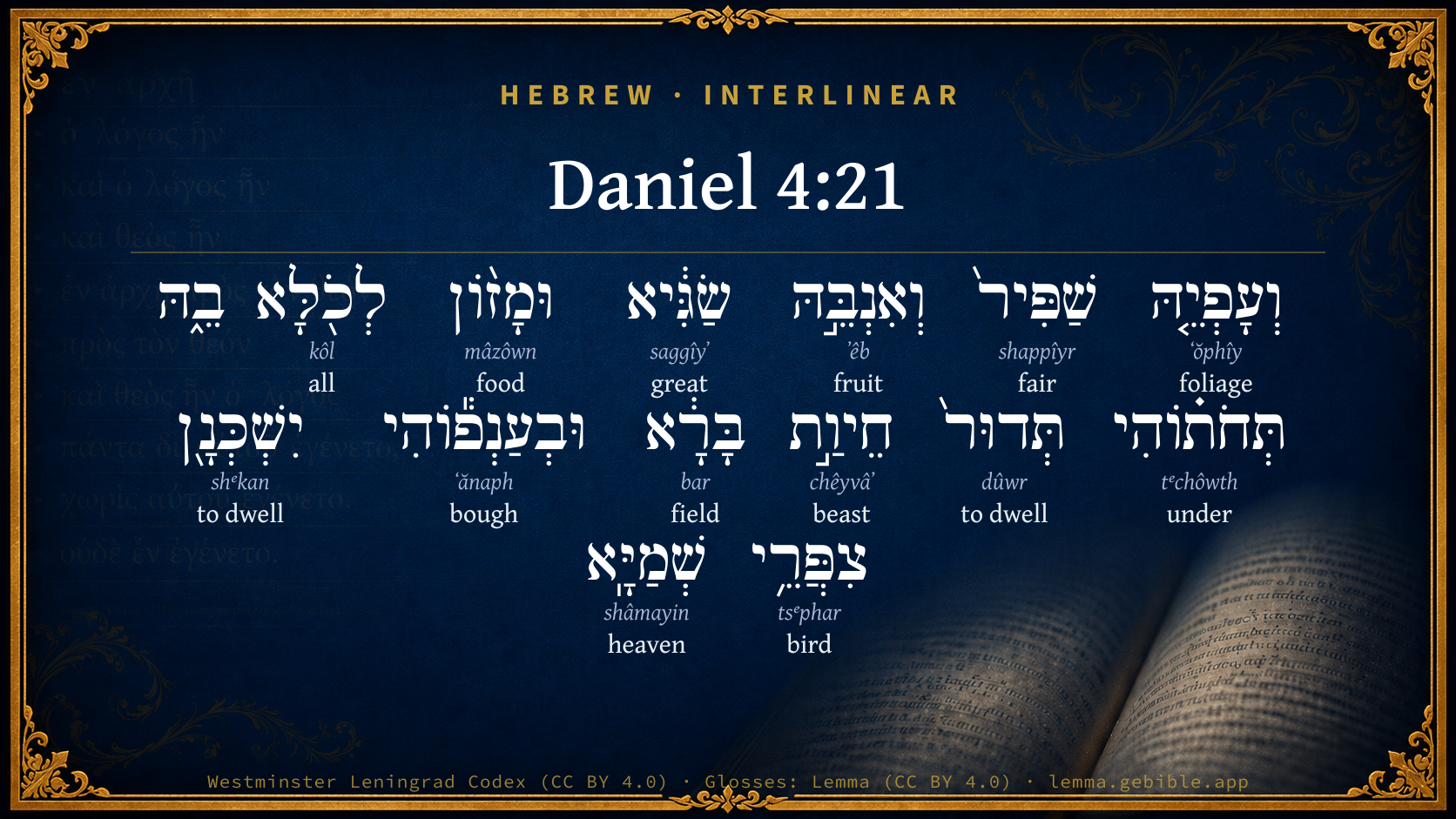
Daniel 4:21

Hebrew (Westminster Leningrad Codex) Daniel 4:21 appears in the Hebrew Old Testament. The text above is from the Westminster Leningrad Codex. Each word links to its Strong’s number, a concise gloss, and parsing drawn from the Open Scriptures Hebrew Bible morphology. Click any word for its full Brown-Driver-Briggs (BDB) entry.
Download image
Cite this verse

Daniel 4:21 (World English Bible). Public Domain. Lemma interlinear Bible study tool, https://lemma.gebible.app/v/daniel/4/21.

Show BibTeX & RIS
BibTeX
RIS
English Translation
whose leaves were beautiful, and the fruit of it much, and in it was food for all; under which the animals of the field lived, and on whose branches the birds of the sky had their habitation:
World English Bible · Public Domain
Download a study sheet

One document with this verse’s original text, its word-by-word gloss line, the meaning frame, cross-references with their text, attributed commentary, and full source and license credits — printable, and it pastes into notes with its structure intact.

This verse Autodidact and up

Study sheet (.html) Plain text (.txt)

A passage Seminary Student

Up to 50 verses in one chapter. A passage sheet keeps up to 6 commentary sources and 12 cross-references per verse, in the order this page ranks them, and says so on the sheet whenever that leaves anything out. Ask for a single verse and you get the Autodidact verse sheet above.

Everything on this page stays free to read, with no account — the sheet is a download of what is already on screen, not access to it.

Want to remove ads? Support Godless Engineer
Compare translations 3

The same verse in 3 English versions, stacked beneath the original-language interlinear above. Click any original word for its lexicon entry.

Each is an independent rendering of the whole verse — the interlinear is not word-aligned to these translations.

Highlighted words mark where these versions differ — a whole-verse word diff, not a word-by-word alignment.

  • World English Bible Public Domain
    whose leaves were beautiful, and the fruit of it much, and in it was food for all; under which the animals of the field lived, and on whose branches the birds of the sky had their habitation:
  • King James Version Public Domain
    Whose leaves were fair, and the fruit thereof much, and in it was meat for all; under which the beasts of the field dwelt, and upon whose branches the fowls of the heaven had their habitation:
  • unfoldingWord Literal Text CC BY-SA 4.0
    and whose leaves were beautiful, and whose fruit was abundant, and in which was food for all, under which the animals of the field dwelt, and in whose branches the birds of the heavens lived—

unfoldingWord Literal Text — © unfoldingWord, licensed CC BY-SA 4.0. Word-aligned USFM3 via Door43 (git.door43.org/unfoldingWord/en_ult).

Versions to compare (up to 4)

3 of 4 selected

Show all 18 translations

Every available English version of this verse, each an independent rendering of the whole verse.

  • World English Bible Public Domain
    whose leaves were beautiful, and the fruit of it much, and in it was food for all; under which the animals of the field lived, and on whose branches the birds of the sky had their habitation:
  • Berean Standard Bible Public Domain
    whose foliage was beautiful and whose fruit was abundant, providing food for all, under which the beasts of the field lived, and in whose branches the birds of the air nested—
  • Majority Standard Bible Public Domain
    whose foliage was beautiful and whose fruit was abundant, providing food for all, under which the beasts of the field lived, and in whose branches the birds of the air nested—
  • King James Version Public Domain
    Whose leaves were fair, and the fruit thereof much, and in it was meat for all; under which the beasts of the field dwelt, and upon whose branches the fowls of the heaven had their habitation:
  • American Standard Version (1901) Public Domain
    whose leaves were fair, and the fruit thereof much, and in it was food for all; under which the beasts of the field dwelt, and upon whose branches the birds of the heavens had their habitation:
  • Revised Version (1885) Public Domain
    whose leaves were fair, and the fruit thereof much, and in it was meat for all; under which the beasts of the field dwelt, and upon whose branches the fowls of the heaven had their habitation:
  • Geneva Bible (1599) Public Domain
    This is the interpretation, O King, and it is the decree of the most High, which is come vpon my lord the King,
  • Douay-Rheims (1899) Public Domain
    And the branches thereof were most beautiful, and its fruit exceeding much, and in it was food for all, under which the beasts of the field dwelt, and the birds of the air had their abode in its branches.
  • Young's Literal Translation Public Domain
    and its leaves `are' fair, and its budding great, and food for all `is' in it, under it dwell doth the beast of the field, and on its boughs sit do the birds of the heavens.
  • Literal Standard Version CC BY-SA 4.0
    and its leaves [are] beautiful, and its budding great, and food for all [is] in it, under it the beast of the field dwells, and on its boughs the birds of the heavens sit.
  • Unlocked Literal Bible CC BY-SA 4.0
    whose leaves were beautiful, and whose fruit was abundant, so that in it was food for all, and under it the animals of the field found shade, and in which the birds of the heavens lived—
  • unfoldingWord Literal Text CC BY-SA 4.0
    and whose leaves were beautiful, and whose fruit was abundant, and in which was food for all, under which the animals of the field dwelt, and in whose branches the birds of the heavens lived—
  • Darby Bible Public Domain
    whose leaves were beautiful, and its fruit abundant, and in it was food for all; under which the beasts of the field dwelt, and in whose branches the birds of the heavens had their habitation:
  • World Messianic Bible Public Domain
    whose leaves were beautiful and its fruit plentiful, and in it was food for all; under which the animals of the field lived, and on whose branches the birds of the sky had their habitation—
  • Webster's Bible Public Domain
    Whose leaves were fair, and the fruit of it abundant, and in it was food for all; under which the beasts of the field dwelt, and upon whose branches the fowls of heaven had their habitation:
  • Free Bible Version CC BY-SA 4.0
    Its leaves were beautiful, and it was full of fruit for all to eat. Wild animals lived under its shade, and birds nested in its branches.
  • Bible in Basic English Public Domain
    Which had fair leaves and much fruit, and had in it food for all; under which the beasts of the field were living, and in the branches of which the birds of heaven had their resting-places:
  • JPS Tanakh (1917) Public Domain
    (4-18) whose leaves were fair, and the fruit thereof much, and in it was food for all; under which the beasts of the field dwelt, and upon whose branches the fowls of the heaven had their habitation;

Literal Standard Version (2020), Covenant Press — licensed CC BY-SA 4.0. Text via the HelloAO Bible API (eBible.org). Unlocked Literal Bible (unfoldingWord) — licensed CC BY-SA 4.0. Text via the HelloAO Bible API (eBible.org). unfoldingWord Literal Text — © unfoldingWord, licensed CC BY-SA 4.0. Word-aligned USFM3 via Door43 (git.door43.org/unfoldingWord/en_ult). Free Bible Version, Dr. Jonathan Gallagher — licensed CC BY-SA 4.0. Text via the HelloAO Bible API (eBible.org).

Word by word

More ways to search: Search by grammar → Find every occurrence → Compare this word →

Practice this passage: Drill this verse → Learn its vocabulary →

שַׁפִּיר֙
shappîyr
H8209
“fair”
Adjective, A
Part of Speech
Adjective
Full BDB Definition

Origin: intensive of a form corresponding to H8208

TWOT: 3046a

fair, beautiful (of foliage)
  1. וְעָפְיֵ֤הּ ʻŏphîy H6074 “and · foliage · his” Adjective, C + Noun, Common, Masculine, Singular, Construct + Suffix, Personal, 3rd Person, Masculine, Singular
  2. וְאִנְבֵּ֣הּ ʼêb H4 “and · fruit · his” Adjective, C + Noun, Common, Masculine, Singular, Construct + Suffix, Personal, 3rd Person, Masculine, Singular
  3. שַׂגִּ֔יא saggîyʼ H7690 “great” Adjective, A
  4. וּמָז֨וֹן mâzôwn H4203 “and · food” Adjective, C + Noun, Common, Masculine, Singular, Absolute
  5. לְכֹ֖לָּא kôl H3606 “to/for · all · the” Adjective, R + Noun, Common, Masculine, Singular, Determined + Particle, Definite Article
  6. תְּחֹת֗וֹהִי tᵉchôwth H8460 “under · him” Adjective, R + Suffix, Personal, 3rd Person, Masculine, Singular
  7. תְּדוּר֙ dûwr H1753 “to dwell” Adjective, V
  8. חֵיוַ֣ת chêyvâʼ H2423 “beast of” Adjective, N, Common
  9. בָּרָ֔א bar H1251 “field · the” Adjective, N, Common + Particle, Definite Article
  10. וּבְעַנְפ֕וֹהִי ʻănaph H6056 “and · in/at · boughs · his” Adjective, C + Preposition + Noun, Common, Masculine, Plural, Construct + Suffix, Personal, 3rd Person, Masculine, Singular
  11. יִשְׁכְּנָ֖ן shᵉkan H7932 “to dwell” Adjective, V
  12. צִפֲּרֵ֥י tsᵉphar H6853 “birds of” Adjective, N, Common
  13. שְׁמַיָּֽא shâmayin H8065 “heaven(s) · the” Adjective, N, Common + Particle, Definite Article

About this verse

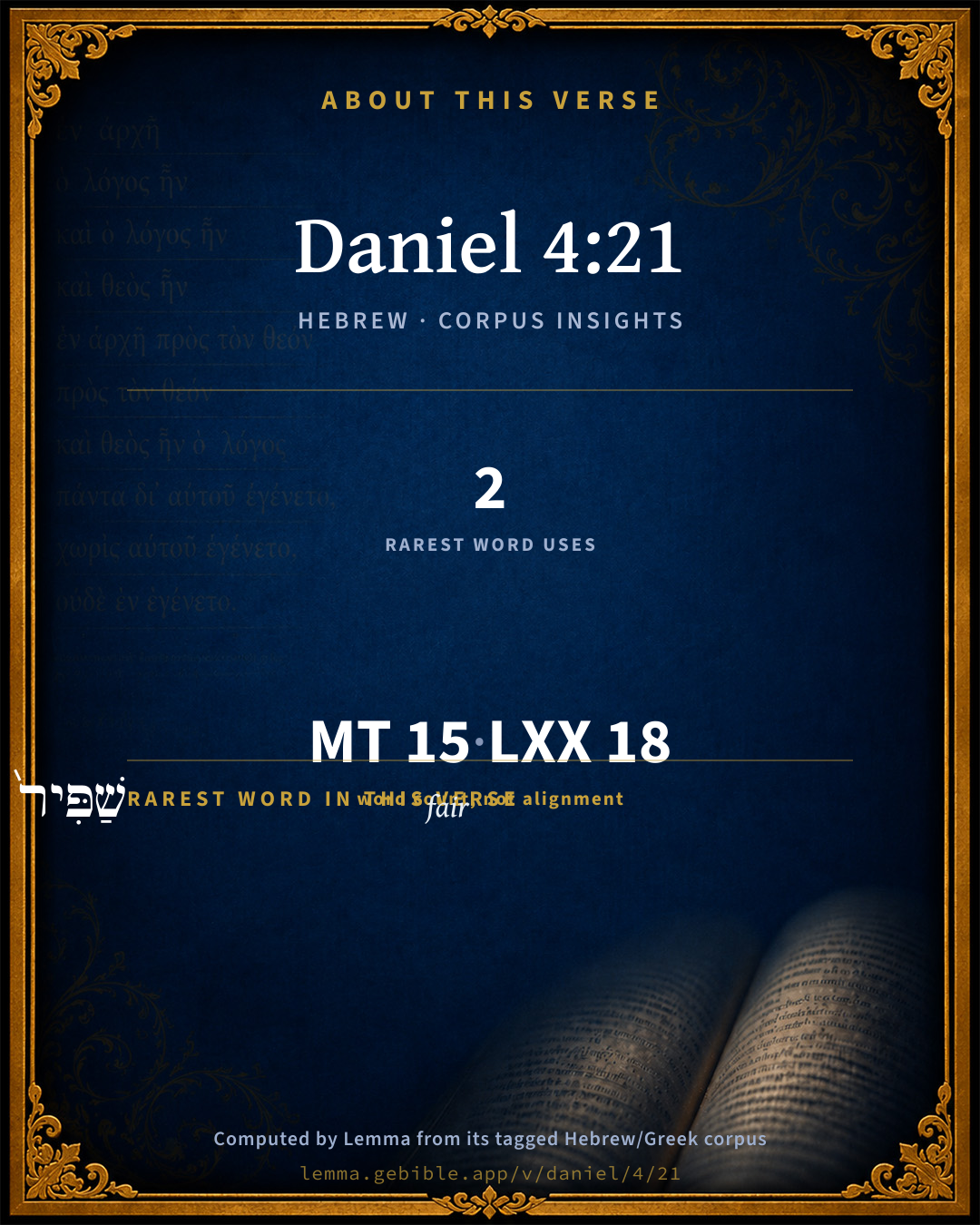
These counts appear in no published source. They are computed here, from the morphology-tagged text and Lemma’s own curated glosses. What Lemma adds →

15
words
14
distinct lemmas
Prophets
section

Notable vocabulary

The rarest word here is שַׁפִּיר֙ fair H8209 — appearing just 2 times in the whole Hebrew Bible.

Shared distinctive vocabulary

שַׁפִּיר֙ fair H8209 occurs in 2 verses of the Hebrew Bible. Also found in:

Grammatical profile

  • 4 nouns
  • 8 adjectives
  • 3 particles

Hebrew & Septuagint length

In English translation the verse runs 37 words from the Hebrew and 25 from the Septuagint (LXX English) — the Septuagint runs noticeably shorter here. See the side-by-side →

A rough comparison of the two English renderings, which tokenize alike — not a word-level alignment.

Word counts can differ between the Hebrew and the Greek without any difference in meaning — e.g. the Hebrew direct-object marker אֵת has no separate Greek word, and Greek often adds the article ὁ.

In the original languages it is 15 Hebrew tokens and 18 Greek tokens — but the two are counted differently (Hebrew bundles its prefixes and suffixes into one token; the Greek is in lemma form), so that isn’t a like-for-like length.

Hebrew and Greek witnesses Masoretic Hebrew ↔ Greek Septuagint

The same verse in the two great witnesses to the Old Testament, shown verse-for-verse.

Here the Septuagint runs noticeably shorter than the Hebrew — LXX2012 (modern English Septuagint) 25 words vs World English Bible 37. A rough length comparison of the two English translations, not a word-level alignment — read both below.

These are two independent witnesses, not word-aligned to each other, and the Septuagint is shown in lemma (dictionary) form.

Hebrew Daniel 4:21 Masoretic · Westminster Leningrad Codex

וְעָפְיֵ֤הּ שַׁפִּיר֙ וְאִנְבֵּ֣הּ שַׂגִּ֔יא וּמָז֨וֹן לְכֹ֖לָּא בֵ֑הּ תְּחֹת֗וֹהִי תְּדוּר֙ חֵיוַ֣ת בָּרָ֔א וּבְעַנְפ֕וֹהִי יִשְׁכְּנָ֖ן צִפֲּרֵ֥י שְׁמַיָּֽא

whose leaves were beautiful, and the fruit of it much, and in it was food for all; under which the animals of the field lived, and on whose branches the birds of the sky had their habitation:

World English Bible · Public Domain

Greek LXX Daniel 4:21 Septuagint · lemma form

καί ἐπί συντέλεια ὁ λόγος ναβουχοδονοσορ ὡς ἀκούω ὁ κρίσις ὁ ὅραμα ὁ λόγος ἐν ὁ καρδία συντηρέω

this is the interpretation of it, O king, and it is a decree of the Most High, which has come upon my lord the king.

LXX2012 (modern English Septuagint) · Public Domain

Hebrew: Westminster Leningrad Codex (CC BY 4.0). Greek: Septuagint (public domain); English from LXX2012 (modern English Septuagint) (Public Domain). How the Septuagint differs from the Hebrew →

Commentary

Notes on Daniel 4:21 from classic Christian and Jewish commentators (each source and its license shown beneath its notes). The classic Christian expositions comment on the surrounding passage and are grouped to its opening verse, so a note may address several verses; the Jewish commentaries on the Tanakh (Rashi and others) are per-verse, so they appear only where the commentator wrote on this verse.

Lemma curates 59 commentaries, every one of them public domain or Creative Commons licensed, each selected and text-cleaned for this edition rather than reprinted as found. About our sources →

Trapp's Complete Commentary

John Trapp

Dan 4:21 Whose leaves [were] fair, and the fruit thereof much, and in it [was] meat for all; under which the beasts of the field dwelt, and upon whose branches the fowls of the heaven had their habitation:

Ver. 21. Whose leaves were fair.] See on Dan 4:12.

Under which the beasts of the field dwelt, &c.] A king should to all his subjects, high and low, extend his favour according to every one’s quality and degree.

John Trapp, A Commentary or Exposition upon All the Books of the Old and New Testament (1647–1656) — public domain. Text from a community e-Sword module.

Ibn Ezra

Rabbi Abraham ibn Ezra

[Daniel 4:21 (4:18 Heb)] This (דְּנָ֥ה): [Meaning:] This (hu) is the interpretation (ha-pitaron) as it will now be told to you (ka'asher ne'emar lach). And the explanation/meaning of [the concept of offering counsel, anticipating Daniel's statement “let my counsel...” (milki) in Daniel 4:24] is similar to [the usage describing internal deliberation in Nehemiah 5:7]: “and my heart took counsel within me” (וַיִּמָּלֵךְ לִבִּי עָלַי - vayimmalech libbi alai).

Ibn Ezra on the Tanakh — English translations: “Sefaria Community Translation” (CC0 1.0 (public-domain dedication)); “Yalkut, Sifsei Chachomim Chumash, Metsudah Publications, 2009” (CC BY 4.0); and “Commentary of Ibn Ezra on Isaiah - trans. by M. Friedlander, 1873” (public domain). Text via Sefaria.

The Cambridge Bible for Schools and Colleges

gen. ed. J. J. S. Perowne

21. meat] food, as Dan_4:12.

The Cambridge Bible for Schools and Colleges (gen. ed. J. J. S. Perowne; Cambridge University Press, 1878–1918) — public domain. Text from a community e-Sword module.

Rashi

Rabbi Shlomo Yitzchaki (Rashi)

which befalls my lord, the king [as translated,] which befalls my lord, the king.

Rashi on the Tanakh — English translations: “The Judaica Press complete Tanach with Rashi, translated by A. J. Rosenberg” (CC BY 4.0); “Pentateuch with Rashi's commentary by M. Rosenbaum and A.M. Silbermann, 1929-1934” (public domain); “The Metsudah Tanach series, Lakewood, N.J” (CC BY 4.0); and “The Book of Joshua, Metsudah Publications, 1997” (CC BY 4.0). Text via Sefaria.

Lesson kit

Teaching starters — assembled from the data on this page, not authored interpretation. Every prompt links to the verse data it draws on. Edit before teaching.

Daniel, in the Prophets, opens this verse with 15 words (14 distinct Hebrew lemmas). Its most distinctive word is shappîyr (“fair”). The Greek Septuagint runs shorter here. A historical commentator’s framing appears above. Read the whole chapter for the surrounding context.

Discussion questions

  1. The word shappîyr carries the sense “fair.” How does it shape the verse?
  2. Daniel 4:12 shares the word «fair» with this verse. How do the two illuminate each other?
  3. Compared with the Hebrew, the Septuagint runs shorter here. What questions does that raise?
  4. These translations render this verse differently. What is at stake in choosing one wording over another?
  5. Reading how Trapp's Complete Commentary and Ibn Ezra read this verse, where do the two commentators agree and where do they part?

Things to notice

Reading settings

Reading text

Shown beneath each verse's original-language words.

Old Testament
Old Testament edition

Read the OT as the Masoretic Hebrew (MT) or the Greek Septuagint (LXX).

English shown for the Greek Septuagint (in the Hebrew ↔ Greek comparison).

Comparing translations? Open the Compare panel on any verse page to stack up to four side by side.