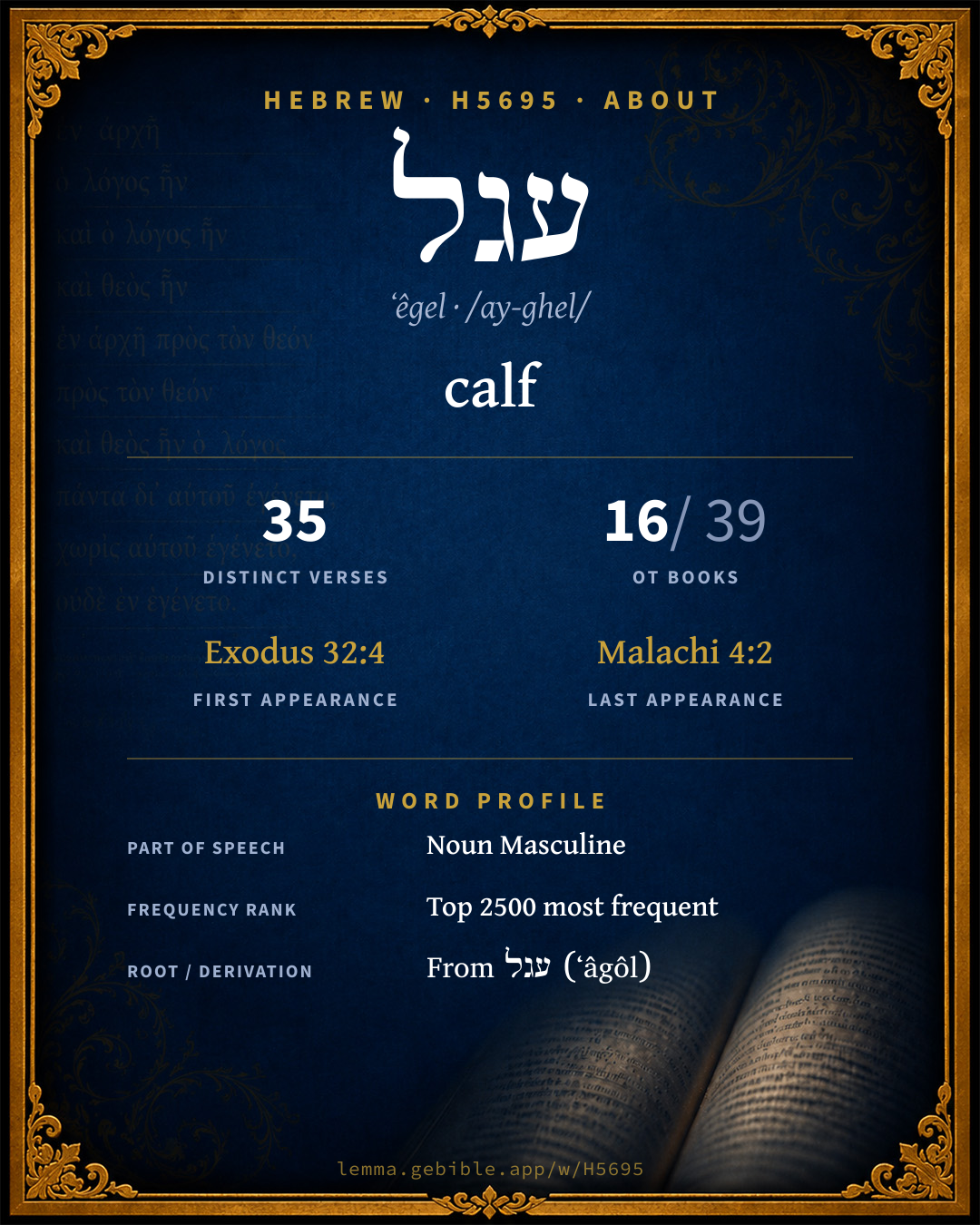
עֵ֫גֶל
calf
Full lexicon entry — Brown-Driver-Briggs (BDB)
From Brown-Driver-Briggs (BDB)
Where this word appears
See every Absolute-state word in the Hebrew Bible →
Grammar key — what these labels mean
Part of speech
- Noun
- A naming word — a person, place, thing, or idea.
Noun type
- Common
- A common noun — a general class of person, place, or thing (“king,” “city,” “water”), not a specific name.
State
- Absolute
- The independent form of a noun, not bound to a following word.
- Construct
- A noun bound to a following noun in a possessive / “of” relationship (the construct chain).
Gender
- Masculine
- Grammatically masculine.
Number
- Singular
- One.
- Plural
- More than one (in Hebrew, generally three or more).
Grammatical forms
- Noun, Common, Masculine, Singular, Absolute 17 times (49%)
- Noun, Common, Masculine, Singular, Construct 6 times (17%)
- Noun, Common, Masculine, Plural, Construct 6 times (17%)
- Noun, Common, Masculine, Plural, Absolute 6 times (17%)
Parsed forms decoded from the imported morphology (morphhb / Westminster Leningrad Codex — WLC text public domain, morphhb tagging CC BY 4.0), counted across 35 parsed occurrences — not distinct verses.
Every verse where H5695 appears — 35 distinct verses across 16 books. Click any verse to open its interlinear word-by-word view. Verse text shown in the World English Bible for context — . Each verse’s Hebrew form is shown with its reference; the English is not keyword-highlighted, since the data carries no word-level English alignment. Use “Compare translations” on any verse to read it across multiple English versions. This concordance covers the Hebrew Bible; Septuagint (Greek Old Testament) occurrences are not indexed here.
Exodus 6 verses
- Exodus 32:4 עֵ֣גֶל n c ms He received what they handed him, and fashioned it with an engraving tool, and made it a molten calf; and they said, "These are your gods, Israel, which brought you up out of the land of Egypt."
- Exodus 32:8 עֵ֖גֶל n c ms They have turned aside quickly out of the way which I commanded them. They have made themselves a molten calf, and have worshiped it, and have sacrificed to it, and said, 'These are your gods, Israel, which brought you up out of the land of Egypt.'"
- Exodus 32:19 הָ/עֵ֖גֶל ptcl def.art + n c ms It happened, as soon as he came near to the camp, that he saw the calf and the dancing: and Moses' anger grew hot, and he threw the tablets out of his hands, and broke them beneath the mountain.
- Exodus 32:20 הָ/עֵ֨גֶל ptcl def.art + n c ms He took the calf which they had made, and burnt it with fire, ground it to powder, and scattered it on the water, and made the children of Israel drink of it.
- Exodus 32:24 הָ/עֵ֥גֶל ptcl def.art + n c ms I said to them, 'Whoever has any gold, let them take it off:' so they gave it me; and I threw it into the fire, and out came this calf."
- Exodus 32:35 הָ/עֵ֔גֶל ptcl def.art + n c ms Yahweh struck the people, because they made the calf, which Aaron made.
Leviticus 3 verses
- Leviticus 9:2 עֵ֣גֶל n c ms and he said to Aaron, "Take a calf from the herd for a sin offering, and a ram for a burnt offering, without blemish, and offer them before Yahweh.
- Leviticus 9:3 וְ/עֵ֨גֶל conj + n c ms You shall speak to the children of Israel, saying, 'Take a male goat for a sin offering; and a calf and a lamb, both a year old, without blemish, for a burnt offering;
- Leviticus 9:8 עֵ֥גֶל n c ms cs So Aaron drew near to the altar, and killed the calf of the sin offering, which was for himself.
Deuteronomy 2 verses
- Deuteronomy 9:16 עֵ֖גֶל n c ms cs I looked, and, behold, you had sinned against Yahweh your God; you had made you a molten calf: you had turned aside quickly out of the way which Yahweh had commanded you.
- Deuteronomy 9:21 הָ/עֵ֗גֶל ptcl def.art + n c ms I took your sin, the calf which you had made, and burnt it with fire, and stamped it, grinding it very small, until it was as fine as dust: and I cast the dust of it into the brook that descended out of the mountain.
1 Samuel 1 verse
1 Kings 2 verses
- 1 Kings 12:28 עֶגְלֵ֣י n c mp cs Whereupon the king took counsel, and made two calves of gold; and he said to them, It is too much for you to go up to Jerusalem: see your gods, Israel, which brought you up out of the land of Egypt.
- 1 Kings 12:32 לָ/עֲגָלִ֣ים prep det + n c mp Jeroboam ordained a feast in the eighth month, on the fifteenth day of the month, like the feast that is in Judah, and he went up to the altar; so did he in Bethel, sacrificing to the calves that he had made: and he placed in Bethel the priests of the high places that he had made.
2 Kings 2 verses
- 2 Kings 10:29 עֶגְלֵי֙ n c mp cs However from the sins of Jeroboam the son of Nebat, with which he made Israel to sin, Jehu didn't depart from after them, [to wit], the golden calves that were in Bethel, and that were in Dan.
- 2 Kings 17:16 עֲגָלִ֑ים n c mp They forsook all the commandments of Yahweh their God, and made them molten images, even two calves, and made an Asherah, and worshiped all the host of the sky, and served Baal.
2 Chronicles 2 verses
- 2 Chronicles 11:15 וְ/לָ/עֲגָלִ֖ים conj + prep det + n c mp and he appointed him priests for the high places, and for the male goats, and for the calves which he had made.
- 2 Chronicles 13:8 עֶגְלֵ֣י n c mp cs Now you think to withstand the kingdom of Yahweh in the hand of the sons of David; and you are a great multitude, and there are with you the golden calves which Jeroboam made you for gods.
Nehemiah 1 verse
Psalms 3 verses
- Psalms 29:6 עֵ֑גֶל n c ms He makes them also to skip like a calf; Lebanon and Sirion like a young, wild ox.
- Psalms 68:30 בְּ/עֶגְלֵ֬י prep + n c mp cs Rebuke the wild animal of the reeds, The multitude of the bulls, with the calves of the peoples. Being humbled, may it bring bars of silver. Scatter the nations that delight in war.
- Psalms 106:19 עֵ֥גֶל n c ms They made a calf in Horeb, And worshiped a molten image.
Isaiah 2 verses
- Isaiah 11:6 וְ/עֵ֨גֶל conj + n c ms The wolf shall dwell with the lamb, and the leopard shall lie down with the kid; and the calf and the young lion and the fattened calf together; and a little child shall lead them.
- Isaiah 27:10 עֵ֛גֶל n c ms For the fortified city is solitary, a habitation deserted and forsaken, like the wilderness: there shall the calf feed, and there shall he lie down, and consume the branches of it.
Jeremiah 4 verses
- Jeremiah 31:18 כְּ/עֵ֖גֶל prep + n c ms I have surely heard Ephraim bemoaning himself [thus], You have chastised me, and I was chastised, as a calf unaccustomed [to the yoke]: turn you me, and I shall be turned; for you are Yahweh my God.
- Jeremiah 34:18 הָ/עֵ֨גֶל֙ ptcl def.art + n c ms I will give the men who have transgressed my covenant, who have not performed the words of the covenant which they made before me, when they cut the calf in two and passed between the parts of it;
- Jeremiah 34:19 הָ/עֵֽגֶל ptcl def.art + n c ms the princes of Judah, and the princes of Jerusalem, the eunuchs, and the priests, and all the people of the land, who passed between the parts of the calf;
- Jeremiah 46:21 כְּ/עֶגְלֵ֣י prep + n c mp cs Also her hired men in the midst of her are like calves of the stall; for they also are turned back, they are fled away together, they didn't stand: for the day of their calamity is come on them, the time of their visitation.
Ezekiel 1 verse
Hosea 3 verses
- Hosea 8:5 עֶגְלֵ֣/ךְ n c ms cs + sfx pers 2fs Let Samaria throw out his calf-idol! My anger burns against them! How long will it be before the are capable of purity?
- Hosea 8:6 עֵ֖גֶל n c ms cs For this is even from Israel! The workman made it, and it is no God; Indeed, the calf of Samaria shall be broken in pieces.
- Hosea 13:2 עֲגָלִ֖ים n c mp Now they sin more and more, And have made themselves molten images of their silver, Even idols according to their own understanding, All of them the work of the craftsmen. They say of them, "They offer human sacrifice and kiss the calves."
Amos 1 verse
Micah 1 verse
Malachi 1 verse
About this entry
At a glance — auto-summarized from this page’s data, not written by a person. Every figure links to its source below. This summary describes the numbers; it doesn’t interpret them.
At its core, עגל (ʻêgel) means “calf.” First canonically at Exodus 32:4, it enters the text early. With 35 verses in 16 books, it is a moderately common word in the Hebrew Bible. From the same root come עגל, מעגל and עגיל. Dig into 35-verse concordance and the renderings breakdown below.
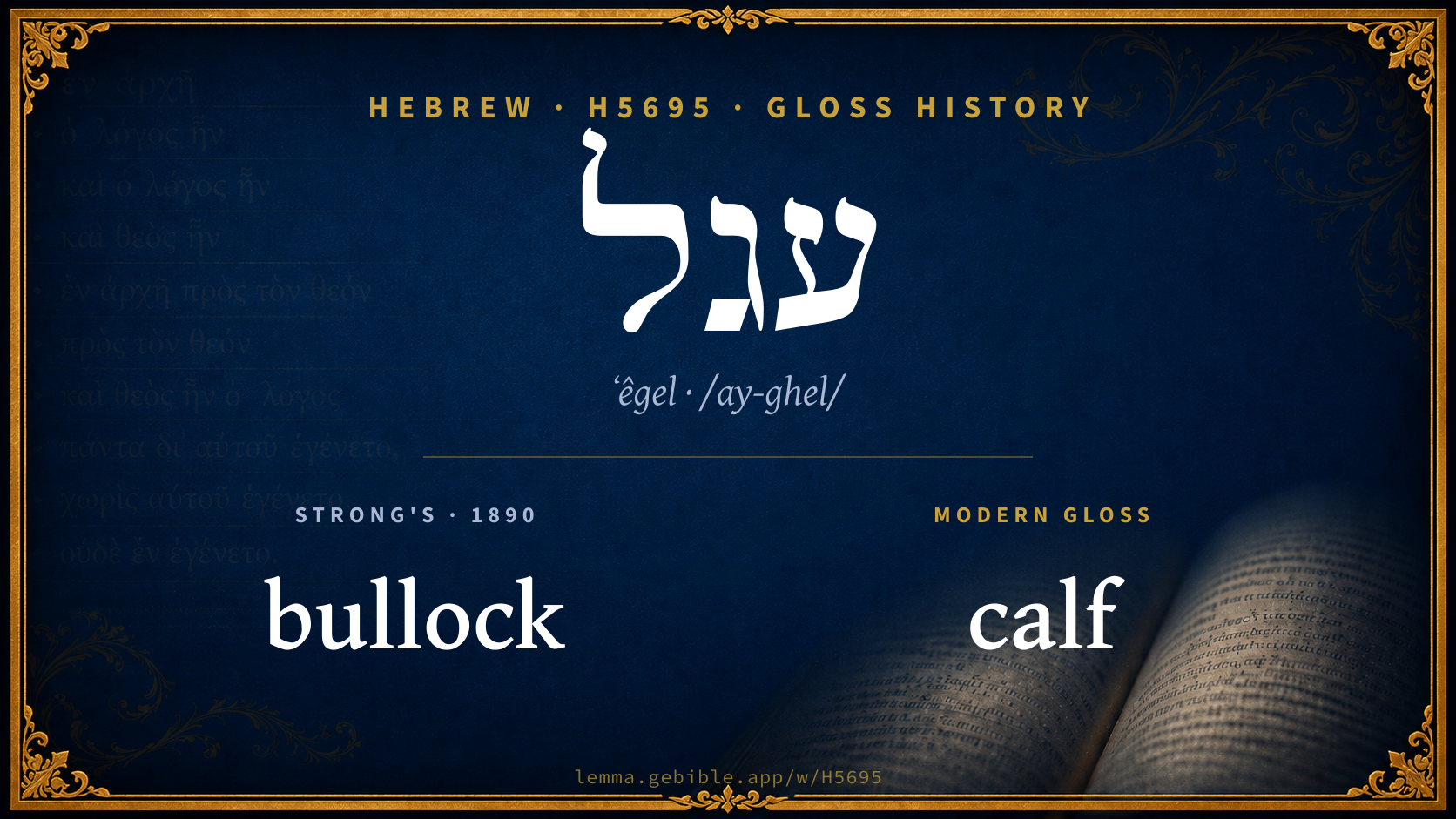
Gloss history
Strong's 1890 vs modern scholarship
About this word
Strong's H5695 catalogs a Hebrew word from the Hebrew Old Testament.
These counts are not copied from any lexicon or concordance. They are computed here, from the morphology-tagged Hebrew Old Testament. What Lemma adds →
- 35
- distinct verses
- The word appears in 35 distinct verses.
- 16 / 39
- OT books
- The word appears in 16 of 39 Old Testament books.
- #1,023
- by frequency
- Top 2500 most frequent Hebrew words (rank 1,023 of 8,640 Hebrew words by occurrence).
View all 35 occurrences in the concordance →
By section of the Old Testament
By traditional corpus
Conventional, traditional groupings — biblical authorship is debated, so this is a traditional corpus grouping, not an authorship claim. Each share is this word’s portion of its verses in that division of the Hebrew canon. Each figure is a share of the word’s 35 distinct verses.
- Prophets (Nevi'im) 18 verses · 51%
- Torah (Pentateuch) 11 verses · 31%
- Writings (Ketuvim) 6 verses · 17%
How translations render this word
Counts come from each version’s own published word-to-Strong’s tagging or interlinear alignment — an approximate guide to how each version renders this word, not a word-level alignment the data otherwise carries. Because each total is that version’s own tagged count, the per-version totals vary from one another and need not match the appearance or distinct-verse counts above. These counts may also differ from a printed concordance because Lemma counts each distinctly tagged rendering and does not collapse phrase taggings into a single head-word total. This is a fixed set of word-tagged versions (KJV, ASV, BSB, ULT) and does not change with the reading translation you choose elsewhere. Each version’s license is shown beside its name below (and on Sources).
- King James Version: Calf 19×, Calves 11×
- American Standard Version: Calf 17×, Calves 10×
- Berean Standard Bible: Calf 20×, Calves 10×
- unfoldingWord Literal Text: Calf 16×, Calves 6×, Calf of 3×
King James Version Public Domain
Renders H5695 across 35 tagged occurrences — most commonly:
Plus 5 renderings that appear only once — usually multi-word phrases or single function words the recovered tagging swept in, not distinct renderings.
American Standard Version Public Domain
Renders H5695 across 35 tagged occurrences — most commonly:
Plus 8 renderings that appear only once — usually multi-word phrases or single function words the recovered tagging swept in, not distinct renderings.
Berean Standard Bible Public Domain
Renders H5695 across 35 tagged occurrences — most commonly:
Plus 5 renderings that appear only once — usually multi-word phrases or single function words the recovered tagging swept in, not distinct renderings.
unfoldingWord Literal Text CC BY-SA 4.0
Renders H5695 across 32 tagged occurrences — most commonly:
Plus 4 renderings that appear only once — usually multi-word phrases or single function words the recovered tagging swept in, not distinct renderings.
Senses in BDB
The 1 sense BDB distinguishes for this word, in lexicon order (not ranked by frequency or importance). The full entry — with sub-senses — is in the Lexicon Entry tab.
- calf, bull-calf
Word origin
n.m. Ex 32:24 calf (as rolling or gamboling? cf. כַּר fr. כָּרַר; NH id.; Ph. (Pu.) עגל id. Lzb 336; עגילו Palm. n.pr. id. Cook89; Aramaic ܥܶܓܠܴܐ, ܥܓܶܠܬܳܐ, עִיגְלָא, עֲגַלְתָּא, id.; Assyrian [agalu], pl. agalê prob. calves DlHWB 16 (cf. against this JenKosmol. 110, but v. also JägerBAS ii. 2, 286); Arabic عِجْلٌ, id.; Ethiopic እጕል, እጉልት, cf. also HomNS 226);—ע׳ abs. Ex 32:19 +; cstr. 1 S 28:24 +; sf. עֶגְלֵךְ Ho 8:5; pl. עֲגָלִים Ho 13:2 +; cstr. עֶגְלֵי 1 K 12:28 +;—calf, Is 11:6; 27:10 in sim. of leaping mts. ψ 29:6; in sim. of foot-sole of cherubim Ez 1:7; ע׳ מַרְבֵּק i.e. a stall-fed (fatted) calf, 1 S 28:24, in sim. Je 46:21; Mal 3:20, cf. ע׳ מִתּוֹךְ מַרְבֵּק Am 6:4; ע׳ לֹא לֻמָּ֑ד Je 31:18 an untrained calf; עֶגְלֵי עַמִּים ψ 68:31 calves of peoples, i.e. peoples like calves, so most; perhaps read בַּעֲלֵי עמ׳ Matthes Che GunkelSchöpf. 66 f. cf. Bae; calf as sacrif. victim Mi 6:6; Lv 9:2, 3, 8 (P); cut in two, in ratifying covenant Je 34:18, 19 (cf. עֶגְלָה Gn 15:9); elsewhere image of calf: made at Horeb, ע׳ מַסֵּכָה Ex 32:4, 8; Dt 9:16; Ne 9:18; ע׳ alone Ex 32:19, 20, 24, 35; Dt 9:21 ψ 106:19; two set up by Jerob. I in N. Isr., 1 K 12:28, 32; 2 K 10:29; 17:16 2 Ch 11:15; 13:8, cf. Ho 8:5, 6 (עֶגְלֵךְ, ע׳ שֹׁמְרוֹן), 13:2; also 10:5 (v. i. עֶגְלָה as fin.).
— Brown-Driver-Briggs (Oxford 1906, public domain), digitized via Sefaria, supplemented by the OpenScriptures HebrewLexicon (CC BY 4.0). See Sources.
Derived from עגל (ʻâgôl) (H5696) — round.
Jastrow Dictionary
A second Hebrew/Aramaic lexicon for comparison, covering Aramaic and post-biblical (Talmudic, Targumic, Midrashic) usage that the biblical-Hebrew BDB does not. Matched by lemma rather than by Strong’s number, so a lemma may carry more than one Jastrow headword (shown separately below), and the entries cover usage well beyond the Bible.
עָגַל
- to be round; to roll; to circle. Sabb. 85ᵇ ועוֹגֵל בה חמשה and inscribes in it a circle of five in diameter.
- to be rounded. Y. Ab. Zar. II, 41ᵇ הוא נסלל ונע׳ the cut in the skin of an animal (whose heart has been taken out while alive) rebounds and becomes rounded.
- 1. to draw a circle. Part. מְעַגֵּל, v. חוֹנִי. Taan. III, 8; a. e.
- 2. to roll, press, make even. Maasr. I, 8 המגורה משיְעַגֵּל when the figs are stored in a bin, they are subject to tithes when he has pressed them. Ib. היה דש … ומעגל וכ׳ if after treading figs in a vessel or pressing in a bin &c. Macc. II, 1 היה מֹעגל במעגילה if he was levelling the roof with a roller, v. מַעֲגִילָה; Y. ib. II, beg. 31ᶜ (also מַעֲגִיל, Hif.).
- 3. to roll on an oiled surface, to smooth a person’s skin. Tosef. Ter. X, 10 ומְעַגְּלוֹ על גביו and oints it (the child) by rolling it on his own body; Y. Maas. Sh. II, 53ᶜ top ומעגלו ע"ג מיעיו.
- 4. to round off, form a round body, v. infra.
- 1. to round off, form a round body. Ohol. VII, 4 עד שיַעֲגִילוּ ראש כפיקה; Tosef. ib. VIII, 8 שעִגְּלוּ וכ׳ (v. R. S. to Ohol. l. c.), v. פִּיקָא I.
- 2. to roll, v. supra.
- 1. to form globules. Nidd. 56ᵃ מה רוק שמִתְעַגֵּל ויוצא וכ׳ as the secretion in the mouth is formed in globules on being discharged &c.; ib. 19ᵇ
- 2. to roll one’s self on an oiled surface, to smooth one’s skin. Tosef. Ter. l. c. על טבלה של שייש להִתְעַגֵּל עליה on a marble plate to anoint himself upon it. Ib. 11; Tosef. Sabb. III (IV), 17; a. e.
עֲגַל I
- , to be round. Y. Erub. II, 20ᵃ בהן דעֵגְלִין in the case of those stones which are round (forming a fence).
- 1. to round off. Men. 94ᵇ דעַגֵּיל להו מִיעַגֵּל he rounded them off.
- 2. to twine around. Y. Kil. IX, end, 32ᵈ [read:] נסב פסקיא דעמר ועַגְּלָהּ וכ׳ (v. פְּסִיקְיָא) he took a woolen band and wound it around both of them.
עֵגֶל
- (b. h.) calf. Sabb. V, 4. Tosef. Bekh. VI, 13; Kidd. 8ᵃ (Ar. עִגּוּל). Pes. 112ᵃ, v. יָנַק; a. fr.—Esp. הע׳ the golden calf which the Israelites made in the desert. Tosef. Sabb. I, 17 אותו … שעשוי בו הע׳ that day was as ominous to Israel as the day whereon they made the golden calf; Sabb. 17ᵃ. Sot. 14ᵃ שכיפר על מעשה הע׳ he made atonement for the sin of the golden calf; a. v. fr.—[Tosef. Neg. VI, 3 בית הע׳ Var., v. עִיגּוּל.]—Pl. עֲגָלִים. Snh. 63ᵇ; a. fr.—[Ab. d’R. N. ch. VI, end מביאין הע׳, read: העִגּוּלִים, v. עִיגּוּל.]—Fem. עֶגְלָה heifer. Sot. VII, 2 פרשת ע׳ ערופה the verses to be read at the ceremony of breaking the heifer’s neck (Deut. XXI, 7 sq.). Ib. IX, 7 (47ᵇ) אם נערפה הע׳ וכ׳ if the murderer was found after the heifer’s neck was broken. Gen. R. s. 44 הראה לו … ע׳ ערופה the Lord showed Abraham the ceremony of &c. Sot. 45ᵃ מדידת ע׳ the measuring which is done for the ceremony of &c. (to ascertain the nearest town). Par. I, 1 ע׳ בת שנתה וכ׳ heifer (mentioned in the Law) means one not yet one year old, and cow means one two years old; a. fr. e.g. Deuteronomy 21:7
עֲגַל II
- v. עֵיגַל
עֲגַל III
- (עֲגַל) [rolling,] swiftness; בע׳, לע׳ very soon, swiftly, suddenly. Targ. Job XX, 5. Targ. Prov. XXIX, 1. Targ. II Esth. VI, 10 בע׳ בע׳ make haste.—Ber. 18ᵇ דלע׳ קא אתית because thou shalt soon come (to us, the dead). Snh. 52ᵃ כי היכי דלישרוף לע׳ in order that he may be burnt to death so much sooner; Pes. 75ᵃ כי היכי דתימות בע׳ (Ms. O. לעגל) that she may die the sooner; Yalk. Lev. 630; a. e.
A Dictionary of the Targumim, the Talmud Babli and Yerushalmi, and the Midrashic Literature (Marcus Jastrow; London, Luzac, 1903) — Public Domain. Digitized via Sefaria. Digitized via Sefaria. Full attribution on Sources.
Forms in the corpus
The 28 distinct written forms H5695 takes in the Hebrew Bible, most frequent first — each parse links to that state’s occurrences in the concordance. Hebrew forms include their vowel points and cantillation, so a single lemma takes many written forms.
Same root — word family
Other BDB entries built from the same root as H5695, grouped by Strong’s listed origin. These share a root / origin per the lexicon — not necessarily a shared meaning. Each links to that word’s own entry.
Derives from
Shares the same root
Derived from this word
Proper names from this root
People and places named from this root — a name, not an additional meaning of the word.
Compare all same-root words → Showing 4 of 7 — not the complete family. 1 of the same-root words is a proper name (a person or place). They share a root, not necessarily a meaning.
Septuagint verse parallels
This word appears in 32 verses that also exist in the Greek Old Testament (Septuagint), out of the 35 Hebrew verses it occurs in. You can read those verses in Greek by switching the Old Testament edition to the Septuagint.
Read these verses in the Septuagint
- Exodus 32:4
- Leviticus 9:2
- Deuteronomy 9:16
- 1 Samuel 28:24
- 1 Kings 12:28
- 2 Kings 10:29
- 2 Chronicles 11:15
- Psalms 29:6
- Isaiah 11:6
- Jeremiah 31:18
- Ezekiel 1:7
- Hosea 8:5
This is a verse-level parallel only — the same verses exist in both the Hebrew and Greek Old Testaments. No word-level Hebrew↔Greek correspondence is claimed: the data carries no such alignment, so no Greek word is shown as this Hebrew word’s translation. Coverage is not total — the Septuagint omits the deuterocanon and renumbers the Psalms, so some Hebrew verses have no direct Greek parallel.