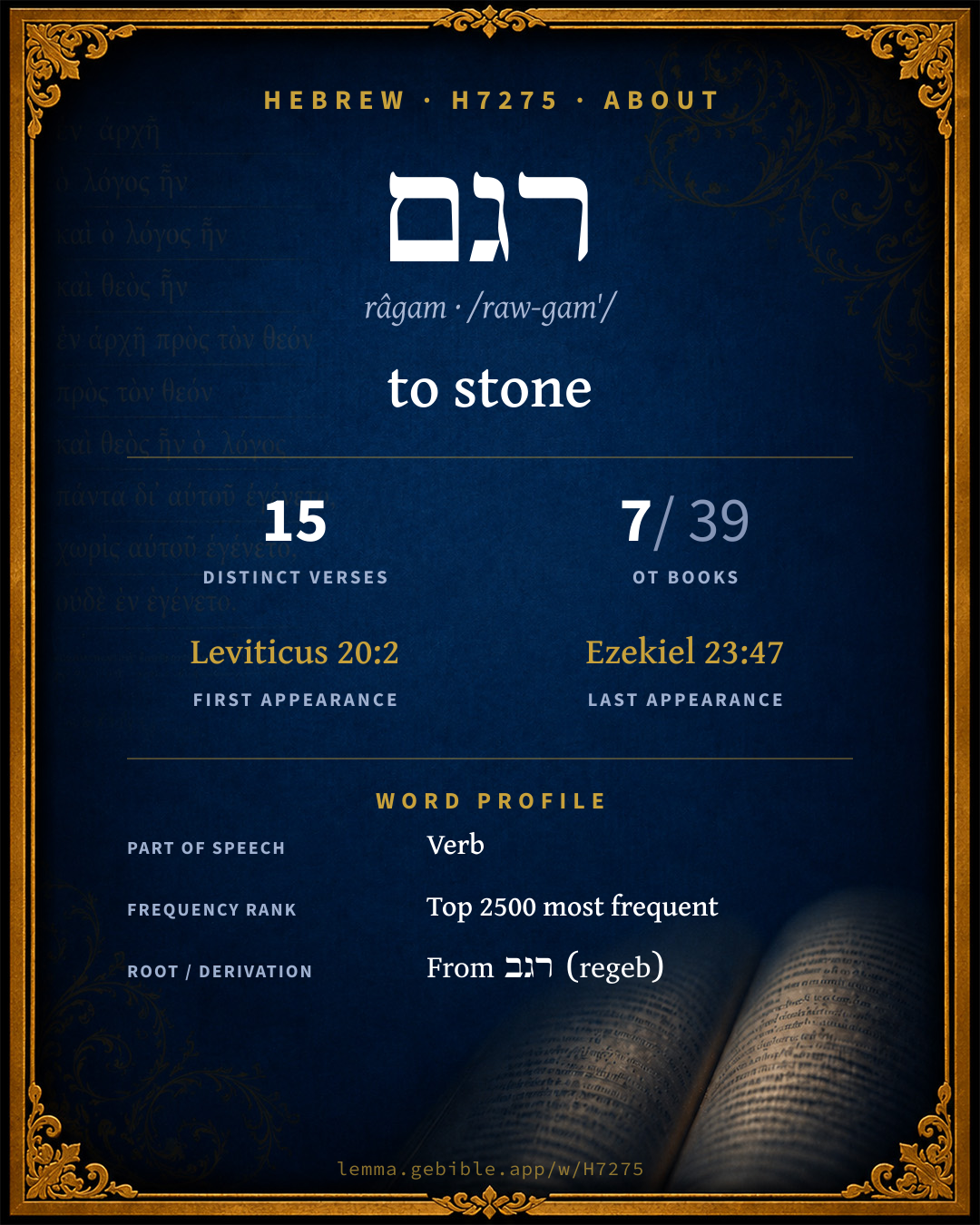
רָגַם
to stone
‘to stone’ is one of 2 main senses fuller range ↓
Full lexicon entry — Brown-Driver-Briggs (BDB)
From Brown-Driver-Briggs (BDB)
Where this word appears
Grammar key — what these labels mean
Part of speech
- Verb
- An action or state-of-being word.
Stem
- Qal
- The basic, simple active stem — the plain form of the verb (“he wrote”).
Form
- Sequential Imperfect
- An imperfect with prefixed waw — the standard past-narrative form (waw-consecutive imperfect).
- Sequential Perfect
- A perfect with prefixed waw continuing a preceding imperfect or command (waw-consecutive perfect).
- Infinitive Absolute
- An unbound verbal noun, often intensifying or standing in for a finite verb.
- Imperfect
- An incomplete, ongoing, or future action (“he will / would write”).
- Perfect
- A completed action or state — Hebrew marks aspect (completeness) more than strict tense (“he wrote”).
- Infinitive Construct
- A bound verbal noun, frequently with prepositions (“to write / in writing”).
Person
- 3rd Person
- The one spoken about (“he / she / it / they”).
Gender
- Masculine
- Grammatically masculine.
- Common
- Either gender — not distinguished for this form.
Number
- Plural
- More than one (in Hebrew, generally three or more).
Grammatical forms
- Verb, Qal, Sequential Imperfect, 3rd Person, Masculine, Plural 6 times (38%)
- Verb, Qal, Sequential Perfect, 3rd Person, Common, Plural 3 times (19%)
- Verb, Qal, Imperfect, 3rd Person, Masculine, Plural 3 times (19%)
- Verb, Qal, Infinitive Absolute 2 times (13%)
- Verb, Qal, Perfect, 3rd Person, Common, Plural 1 time (6%)
- Verb, Qal, Infinitive Construct 1 time (6%)
Parsed forms decoded from the imported morphology (morphhb / Westminster Leningrad Codex — WLC text public domain, morphhb tagging CC BY 4.0), counted across 16 parsed occurrences — not distinct verses.
Every verse where H7275 appears — 15 distinct verses across 7 books. Click any verse to open its interlinear word-by-word view. Verse text shown in the World English Bible for context — . Each verse’s Hebrew form is shown with its reference; the English is not keyword-highlighted, since the data carries no word-level English alignment. Use “Compare translations” on any verse to read it across multiple English versions. This concordance covers the Hebrew Bible; Septuagint (Greek Old Testament) occurrences are not indexed here.
Leviticus 5 verses
- Leviticus 20:2 יִרְגְּמֻ֥/הוּ Qal impf 3mp + sfx pers 3ms "Moreover, you shall tell the children of Israel, 'Anyone of the children of Israel, or of the strangers who live as foreigners in Israel, who gives any of his seed to Molech; he shall surely be put to death. The people of the land shall stone him with stones.
- Leviticus 20:27 יִרְגְּמ֥וּ Qal impf 3mp "'A man or a woman that is a medium, or is a wizard, shall surely be put to death: they shall stone them with stones; their blood shall be upon them.'"
- Leviticus 24:14 וְ/רָגְמ֥וּ conj + Qal pf 3cp "Bring out of the camp him who cursed; and let all who heard him lay their hands on his head, and let all the congregation stone him.
- Leviticus 24:16 רָג֥וֹם יִרְגְּמוּ Qal inf.abs Qal impf 3mp He who blasphemes the name of Yahweh, he shall surely be put to death; all the congregation shall certainly stone him: the foreigner as well as the native-born, when he blasphemes the Name, shall be put to death.
- Leviticus 24:23 וַ/יִּרְגְּמ֥וּ conj + Qal wimpf 3mp Moses spoke to the children of Israel; and they brought forth him who had cursed out of the camp, and stoned him with stones. The children of Israel did as Yahweh commanded Moses.
Numbers 3 verses
- Numbers 14:10 לִ/רְגּ֥וֹם prep + Qal inf.cs But all the congregation bade stone them with stones. The glory of Yahweh appeared in the tent of meeting to all the children of Israel.
- Numbers 15:35 רָג֨וֹם Qal inf.abs Yahweh said to Moses, The man shall surely be put to death: all the congregation shall stone him with stones outside of the camp.
- Numbers 15:36 וַ/יִּרְגְּמ֥וּ conj + Qal wimpf 3mp All the congregation brought him outside of the camp, and stoned him to death with stones; as Yahweh commanded Moses.
Deuteronomy 1 verse
Joshua 1 verse
1 Kings 1 verse
2 Chronicles 2 verses
- 2 Chronicles 10:18 וַ/יִּרְגְּמוּ conj + Qal wimpf 3mp Then king Rehoboam sent Hadoram, who was over the men subject to forced labor; and the children of Israel stoned him to death with stones. King Rehoboam made speed to get him up to his chariot, to flee to Jerusalem.
- 2 Chronicles 24:21 וַ/יִּרְגְּמֻ֥/הוּ conj + Qal wimpf 3mp + sfx pers 3ms They conspired against him, and stoned him with stones at the commandment of the king in the court of the house of Yahweh.
Ezekiel 2 verses
- Ezekiel 16:40 וְ/רָגְמ֥וּ conj + Qal wpf 3cp They shall also bring up a company against you, and they shall stone you with stones, and thrust you through with their swords.
- Ezekiel 23:47 וְ/רָגְמ֨וּ conj + Qal wpf 3cp The company shall stone them with stones, and dispatch them with their swords; they shall kill their sons and their daughters, and burn up their houses with fire.
About this entry
At a glance — auto-summarized from this page’s data, not written by a person. Every figure links to its source below. This summary describes the numbers; it doesn’t interpret them.
רגם (râgam) is a Hebrew verb most often rendered “to stone.” Scripture first uses it in Leviticus 20:2. Spanning 15 verses in 7 books, it ranks among the uncommon words of the Hebrew Bible. Leviticus dominates its distribution — 5 of 15 verses. Ranging over 2 senses, it is not a single-sense word. For the data behind this summary, explore the sense tree and the renderings breakdown below.
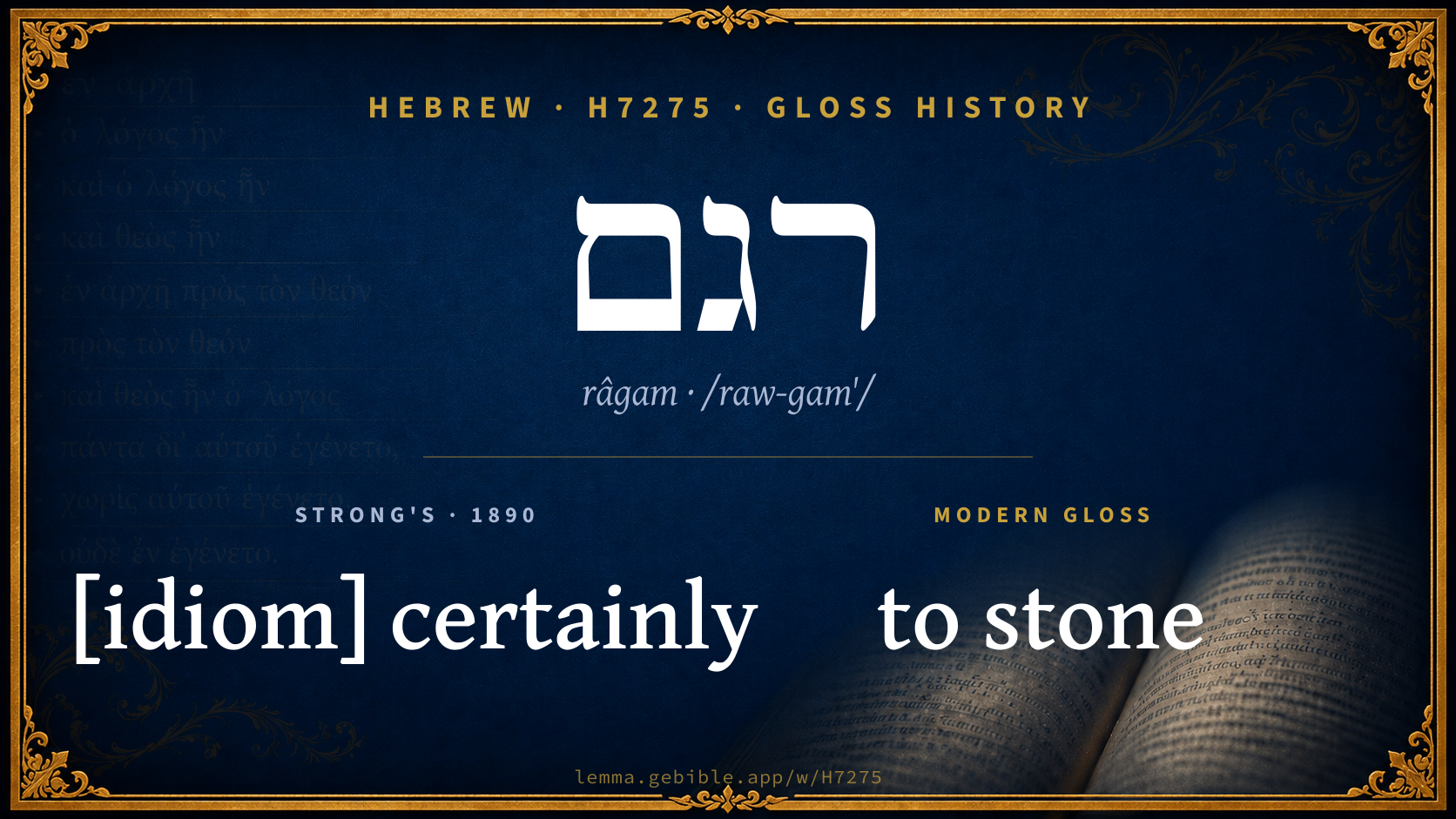
Gloss history
Strong's 1890 vs modern scholarship
About this word
Strong's H7275 catalogs a Hebrew word from the Hebrew Old Testament.
These counts are not copied from any lexicon or concordance. They are computed here, from the morphology-tagged Hebrew Old Testament. What Lemma adds →
- 15
- distinct verses
- The word appears in 15 distinct verses.
- 7 / 39
- OT books
- The word appears in 7 of 39 Old Testament books.
- #1,752
- by frequency
- Top 2500 most frequent Hebrew words (rank 1,752 of 8,640 Hebrew words by occurrence).
View all 15 occurrences in the concordance →
Most concentrated in
- Leviticus 5 verses 33%
- Numbers 3 verses 20%
- 2 Chronicles 2 verses 13%
By section of the Old Testament
By traditional corpus
Conventional, traditional groupings — biblical authorship is debated, so this is a traditional corpus grouping, not an authorship claim. Each share is this word’s portion of its verses in that division of the Hebrew canon. Each figure is a share of the word’s 15 distinct verses.
- Torah (Pentateuch) 9 verses · 60%
- Prophets (Nevi'im) 4 verses · 27%
- Writings (Ketuvim) 2 verses · 13%
How translations render this word
Counts come from each version’s own published word-to-Strong’s tagging or interlinear alignment — an approximate guide to how each version renders this word, not a word-level alignment the data otherwise carries. Because each total is that version’s own tagged count, the per-version totals vary from one another and need not match the appearance or distinct-verse counts above. These counts may also differ from a printed concordance because Lemma counts each distinctly tagged rendering and does not collapse phrase taggings into a single head-word total. This is a fixed set of word-tagged versions (KJV, ASV, BSB, ULT) and does not change with the reading translation you choose elsewhere. Each version’s license is shown beside its name below (and on Sources).
- King James Version: Shall stone 4×, Stone 4×, Stoned 4×
- American Standard Version: Stoned 5×, Shall stone 4×, Stones 4×
- Berean Standard Bible: Stoned 4×, Stone 2×, Will stone 2×
- unfoldingWord Literal Text: And 4×, Stoned 3×, But 2×
King James Version Public Domain
Renders H7275 across 16 tagged occurrences — most commonly:
Plus 4 renderings that appear only once — usually multi-word phrases or single function words the recovered tagging swept in, not distinct renderings.
American Standard Version Public Domain
Renders H7275 across 20 tagged occurrences — most commonly:
Plus 5 renderings that appear only once — usually multi-word phrases or single function words the recovered tagging swept in, not distinct renderings.
Berean Standard Bible Public Domain
Renders H7275 across 15 tagged occurrences — most commonly:
Plus 7 renderings that appear only once — usually multi-word phrases or single function words the recovered tagging swept in, not distinct renderings. Not rendered by a distinct English word in 1 further occurrence.
unfoldingWord Literal Text CC BY-SA 4.0
Renders H7275 across 22 tagged occurrences — most commonly:
Plus 5 renderings that appear only once — usually multi-word phrases or single function words the recovered tagging swept in, not distinct renderings.
Senses in BDB
The 2 senses BDB distinguishes for this word, in lexicon order (not ranked by frequency or importance). The full entry — with sub-senses — is in the Lexicon Entry tab.
- to stone, slay or kill by stoning
- (Qal) to stone
Word origin
[ רָגַם ] vb. stone, kill by stoning
— Brown-Driver-Briggs (Oxford 1906, public domain), digitized via Sefaria, supplemented by the OpenScriptures HebrewLexicon (CC BY 4.0). See Sources.
Derived from רגב (regeb) (H7263) — clod.
Jastrow Dictionary
A second Hebrew/Aramaic lexicon for comparison, covering Aramaic and post-biblical (Talmudic, Targumic, Midrashic) usage that the biblical-Hebrew BDB does not. Matched by lemma rather than by Strong’s number, so a lemma may carry more than one Jastrow headword (shown separately below), and the entries cover usage well beyond the Bible.
רָגַם
- to cast a stone, ball &c., to pelt. Succ. IV, 9; Tosef. ib. III, 16 ורְגָמוּהוּ וכ׳ and all the people pelted him with their Ethrogim. Sot. 37ᵃ (play on רגמתם, Ps. LXVIII, 28) והיו … רוֹגְמִים אותם and the princes of Judah threw stones at them (stirring them up to go into the sea); Mekh. B’shall., s. 5 מְרַגְּמִין וכ׳. Ex. R. s. 1 שר׳ אוהבו וכ׳ who cast stones at the king’s friend; a. e. e.g. Psalms 68:28
- same; to wound with missiles, bruise. Mekh. B’shall. l. c., v. supra.—Tanḥ. K’dosh. ed. Bub. 8; Yalk. Lev. 615 כבר היו מְרַגְּמִין את וכ׳ they would have bruised my face and my whole body with them (the Ethrogim).
- same. Tanḥ. K’dosh. 8 כבר היו מַרְגִּימִין איתי את כל וכ׳ they would have bruised me all over my body &c., v. supra.
רְגַם
- Targ. O. Lev. XXIV, 16. Targ. Lam. I, 18. Targ. Ex. XVII, 4 (O. ed. Berl. ורַגְּמוּנִי Pa.); a. fr.—Kidd. 70ᵇ נפקי … למִירְגְּמֵיה they went out after him ready to stone him. Yalk. Is. 284 [read:] כל חד מינייכו ליתי ליה טינא לחתמא ונִרְגְּמוּנֵיה (גולמא being a gloss to טינא לחתמא, and ונשדי ביה, a Var. of ונרגמוניה) let each of you bring a ball of sealing clay (cylinder) and cast it at it (Jerusalem); Snh. 95ᵃ, v. גּוֹלְמָא.
- same. Targ. II Sam. XVI, 6; 13; a. e.
- to be stoned (to death). Targ. Ex. XIX, 13. Targ. I Kings XXI, 14, sq.; a. e.—[Targ. Is. I, 2, v. רְגֵף.]
רְגָם
- R’gam, v. רְקָם I.
A Dictionary of the Targumim, the Talmud Babli and Yerushalmi, and the Midrashic Literature (Marcus Jastrow; London, Luzac, 1903) — Public Domain. Digitized via Sefaria. Digitized via Sefaria. Full attribution on Sources.
Forms in the corpus
The 13 distinct written forms H7275 takes in the Hebrew Bible, most frequent first — each parse links to that stem’s occurrences in the concordance. Hebrew forms include their vowel points and cantillation, so a single lemma takes many written forms.
| Form | Parsing | Example | Uses |
|---|---|---|---|
| וְ/רָגְמ֥וּ | Verb, Qal, Perfect, 3rd Person, Common, Plural | Leviticus 24:14 | 2 |
| וַ/יִּרְגְּמ֥וּ | Verb, Qal, Sequential Imperfect, 3rd Person, Masculine, Plural | Leviticus 24:23 | 2 |
| וַ/יִּרְגְּמ֨וּ | Verb, Qal, Sequential Imperfect, 3rd Person, Masculine, Plural | 1 Kings 12:18 | 2 |
| וְ/רָגְמ֨וּ | Verb, Qal, Sequential Perfect, 3rd Person, Common, Plural | Ezekiel 23:47 | 1 |
| וַ/יִּרְגְּמֻ֥/הוּ | Verb, Qal, Sequential Imperfect, 3rd Person, Masculine, Plural | 2 Chronicles 24:21 | 1 |
| וַ/יִּרְגְּמוּ | Verb, Qal, Sequential Imperfect, 3rd Person, Masculine, Plural | 2 Chronicles 10:18 | 1 |
| וּ֠/רְגָמֻ/הוּ | Verb, Qal, Sequential Perfect, 3rd Person, Common, Plural | Deuteronomy 21:21 | 1 |
| יִרְגְּמ֥וּ | Verb, Qal, Imperfect, 3rd Person, Masculine, Plural | Leviticus 20:27 | 1 |
| יִרְגְּמֻ֥/הוּ | Verb, Qal, Imperfect, 3rd Person, Masculine, Plural | Leviticus 20:2 | 1 |
| יִרְגְּמוּ | Verb, Qal, Imperfect, 3rd Person, Masculine, Plural | Leviticus 24:16 | 1 |
| לִ/רְגּ֥וֹם | Verb, Qal, Infinitive Construct | Numbers 14:10 | 1 |
| רָג֥וֹם | Verb, Qal, Infinitive Absolute | Leviticus 24:16 | 1 |
| רָג֨וֹם | Verb, Qal, Infinitive Absolute | Numbers 15:35 | 1 |
Same root — word family
Other BDB entries built from the same root as H7275, grouped by Strong’s listed origin. These share a root / origin per the lexicon — not necessarily a shared meaning. Each links to that word’s own entry.
Derives from
Derived from this word
Proper names from this root
People and places named from this root — a name, not an additional meaning of the word.
Compare all same-root words → Showing 4 of 6 — not the complete family. 2 of the same-root words are proper names (people or places). They share a root, not necessarily a meaning.
Septuagint verse parallels
This word appears in 15 verses that also exist in the Greek Old Testament (Septuagint), out of the 15 Hebrew verses it occurs in. You can read those verses in Greek by switching the Old Testament edition to the Septuagint.
Read these verses in the Septuagint
- Leviticus 20:2
- Numbers 14:10
- Deuteronomy 21:21
- Joshua 7:25
- 1 Kings 12:18
- 2 Chronicles 10:18
- Ezekiel 16:40
This is a verse-level parallel only — the same verses exist in both the Hebrew and Greek Old Testaments. No word-level Hebrew↔Greek correspondence is claimed: the data carries no such alignment, so no Greek word is shown as this Hebrew word’s translation. Coverage is not total — the Septuagint omits the deuterocanon and renumbers the Psalms, so some Hebrew verses have no direct Greek parallel.