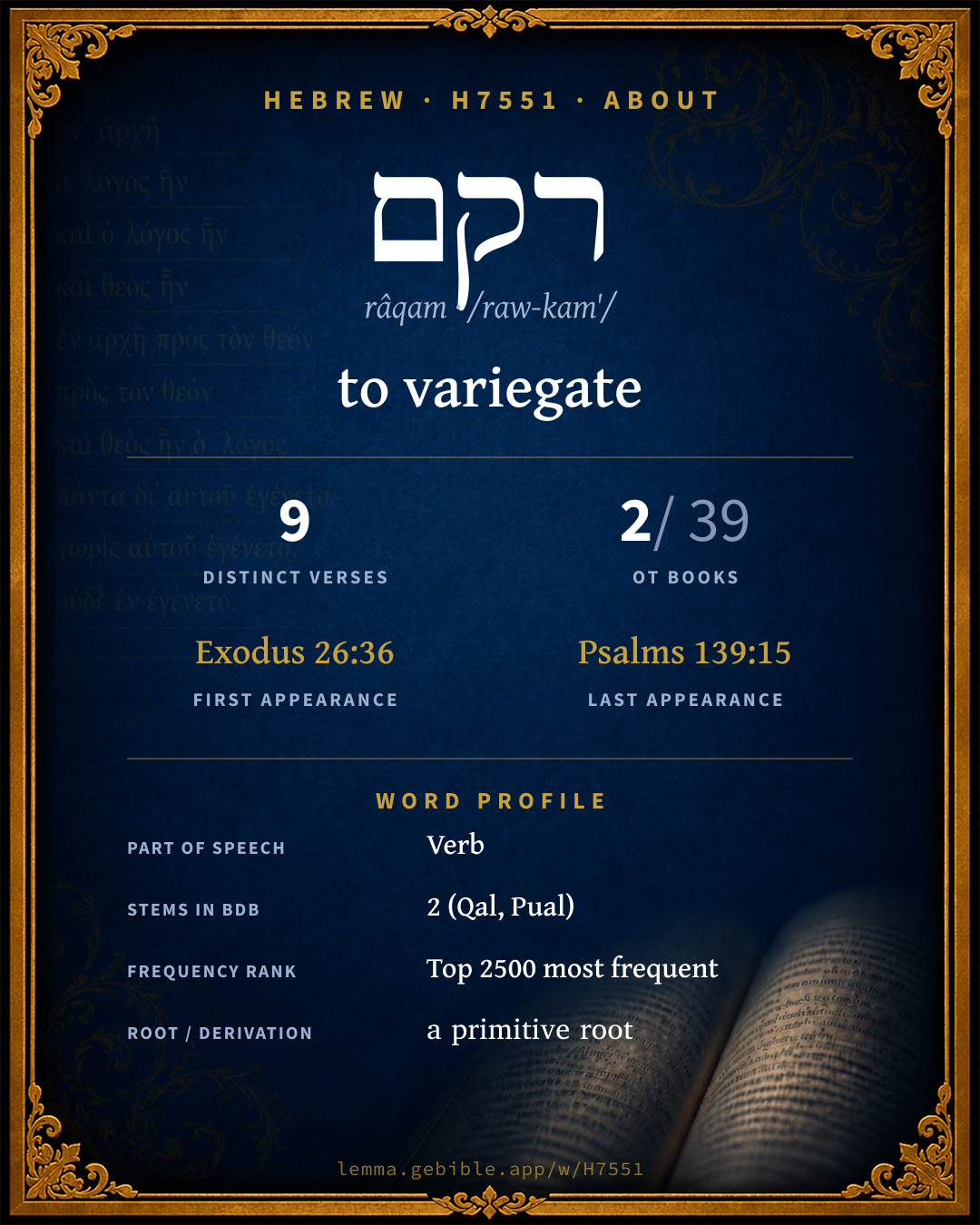
רָקַם
to variegate
‘to variegate’ is one of 3 main senses fuller range ↓
Full lexicon entry — Brown-Driver-Briggs (BDB)
From Brown-Driver-Briggs (BDB)
Where this word appears
See every Qal verb in the Hebrew Bible →
Grammar key — what these labels mean
Part of speech
- Verb
- An action or state-of-being word.
Stem
- Qal
- The basic, simple active stem — the plain form of the verb (“he wrote”). Here: ‘act.’
- Pual
- The passive counterpart of the Piel.
Form
- Participle Active
- A verbal adjective expressing ongoing or characteristic action (“writing / one who writes”).
- Perfect
- A completed action or state — Hebrew marks aspect (completeness) more than strict tense (“he wrote”).
State
- Absolute
- The independent form of a noun, not bound to a following word.
Person
- 1st Person
- The speaker (“I / we”).
Gender
- Masculine
- Grammatically masculine.
- Common
- Either gender — not distinguished for this form.
Number
- Singular
- One.
Grammatical forms
- Verb, Qal, Participle Active, Masculine, Singular, Absolute 8 times (89%)
- Verb, Pual, Perfect, 1st Person, Common, Singular 1 time (11%)
Parsed forms decoded from the imported morphology (morphhb / Westminster Leningrad Codex — WLC text public domain, morphhb tagging CC BY 4.0), counted across 9 parsed occurrences — not distinct verses.
Every verse where H7551 appears — 9 distinct verses across 2 books. Click any verse to open its interlinear word-by-word view. Verse text shown in the World English Bible for context — . Each verse’s Hebrew form is shown with its reference; the English is not keyword-highlighted, since the data carries no word-level English alignment. Use “Compare translations” on any verse to read it across multiple English versions. This concordance covers the Hebrew Bible; Septuagint (Greek Old Testament) occurrences are not indexed here.
Exodus 8 verses
- Exodus 26:36 רֹקֵֽם Qal ptcp.act ms "You shall make a screen for the door of the Tent, of blue, and purple, and scarlet, and fine twined linen, the work of the embroiderer.
- Exodus 27:16 רֹקֵ֑ם Qal ptcp.act ms For the gate of the court shall be a screen of twenty cubits, of blue, and purple, and scarlet, and fine twined linen, the work of the embroiderer; their pillars four, and their sockets four.
- Exodus 28:39 רֹקֵֽם Qal ptcp.act ms You shall weave the coat in checker work of fine linen, and you shall make a turban of fine linen, and you shall make a sash, the work of the embroiderer.
- Exodus 35:35 וְ/רֹקֵ֞ם conj + Qal ptcp.act ms He has filled them with wisdom of heart, to work all manner of workmanship, of the engraver, of the skillful workman, and of the embroiderer, in blue, in purple, in scarlet, and in fine linen, and of the weaver, even of those who do any workmanship, and of those who make skillful works.
- Exodus 36:37 רֹקֵֽם Qal ptcp.act ms He made a screen for the door of the tent, of blue, purple, scarlet, and fine twined linen, the work of an embroiderer;
- Exodus 38:18 רֹקֵ֔ם Qal ptcp.act ms The screen for the gate of the court was the work of the embroiderer, of blue, purple, scarlet, and fine twined linen. Twenty cubits was the length, and the height in the breadth was five cubits, like to the hangings of the court.
- Exodus 38:23 וְ/רֹקֵ֗ם conj + Qal ptcp.act ms With him was Oholiab, the son of Ahisamach, of the tribe of Dan, an engraver, and a skillful workman, and an embroiderer in blue, in purple, in scarlet, and in fine linen.
- Exodus 39:29 רֹקֵ֑ם Qal ptcp.act ms and the sash of fine twined linen, and blue, and purple, and scarlet, the work of the embroiderer, as Yahweh commanded Moses.
Psalms 1 verse
About this entry
At a glance — auto-summarized from this page’s data, not written by a person. Every figure links to its source below. This summary describes the numbers; it doesn’t interpret them.
The Hebrew verb רקם centers on the idea of “to variegate.” The word gravitates to Exodus (89%), then Psalms. It turns up in 9 verses across 2 books, an uncommon footprint. First canonically at Exodus 26:36, it enters the text early. Across 2 stems, its meaning turns on the binyan (Qal, Pual). For the data behind this summary, explore the sense tree and the renderings breakdown below.
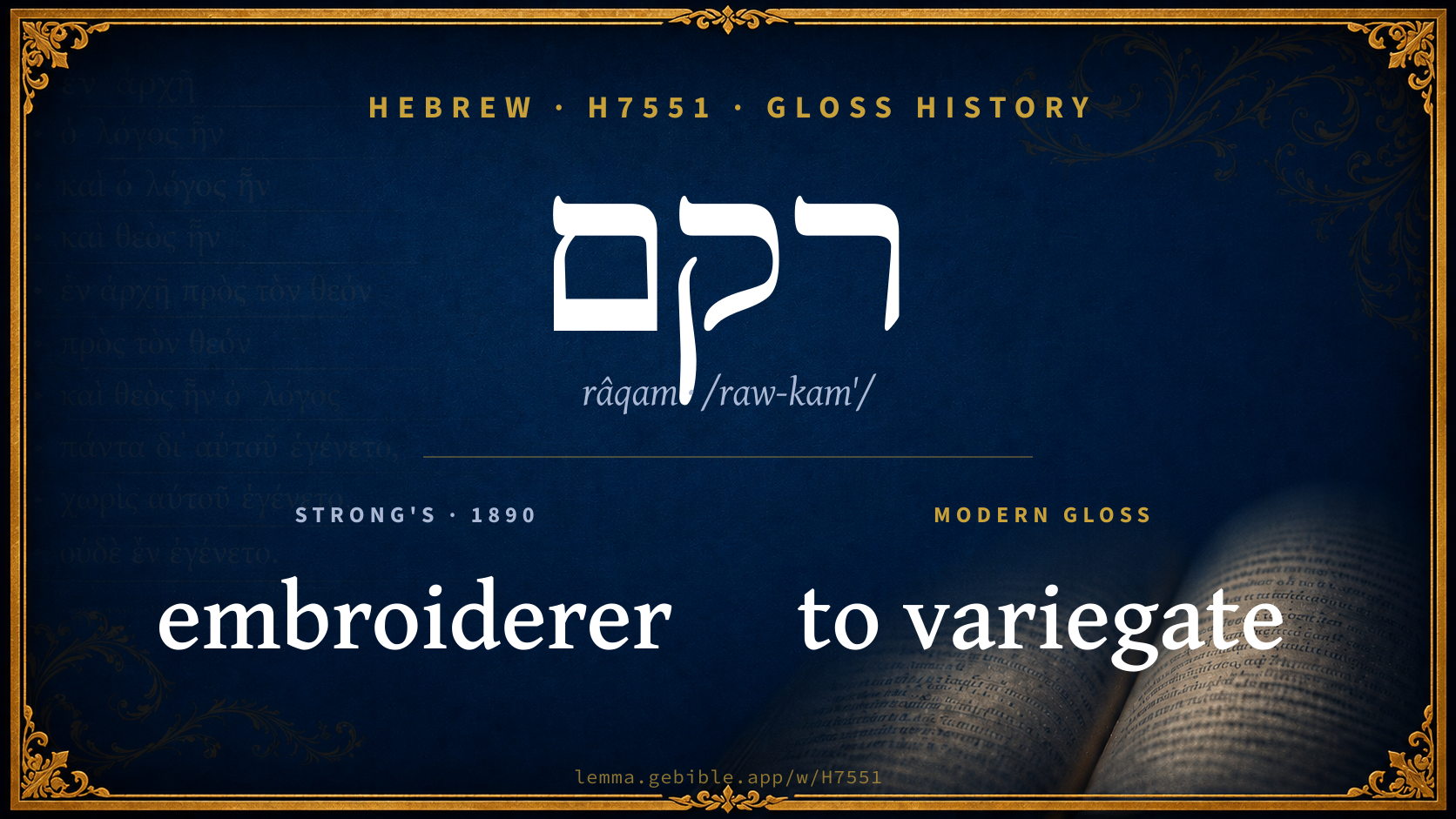
Gloss history
Strong's 1890 vs modern scholarship
About this word
Strong's H7551 catalogs a Hebrew word from the Hebrew Old Testament.
These counts are not copied from any lexicon or concordance. They are computed here, from the morphology-tagged Hebrew Old Testament. What Lemma adds →
- 9
- distinct verses
- The word appears in 9 distinct verses.
- 2 / 39
- OT books
- The word appears in 2 of 39 Old Testament books.
- #2,481
- by frequency
- Top 2500 most frequent Hebrew words (rank 2,481 of 8,640 Hebrew words by occurrence).
View all 9 occurrences in the concordance →
By traditional corpus
Conventional, traditional groupings — biblical authorship is debated, so this is a traditional corpus grouping, not an authorship claim. Each share is this word’s portion of its verses in that division of the Hebrew canon. Each figure is a share of the word’s 9 distinct verses.
- Torah (Pentateuch) 8 verses · 89%
- Writings (Ketuvim) 1 verse · 11%
How translations render this word
Counts come from each version’s own published word-to-Strong’s tagging or interlinear alignment — an approximate guide to how each version renders this word, not a word-level alignment the data otherwise carries. Because each total is that version’s own tagged count, the per-version totals vary from one another and need not match the appearance or distinct-verse counts above. These counts may also differ from a printed concordance because Lemma counts each distinctly tagged rendering and does not collapse phrase taggings into a single head-word total. This is a fixed set of word-tagged versions (KJV, ASV, BSB, ULT) and does not change with the reading translation you choose elsewhere. Each version’s license is shown beside its name below (and on Sources).
- King James Version: Needlework 4×, Embroiderer 2×
- American Standard Version: Work of the embroiderer 4×, Embroiderer 3×
- Berean Standard Bible: Embroidered 4×
- unfoldingWord Literal Text: Embroiderer 8×
King James Version Public Domain
Renders H7551 across 9 tagged occurrences — most commonly:
Plus 3 renderings that appear only once — usually multi-word phrases or single function words the recovered tagging swept in, not distinct renderings.
American Standard Version Public Domain
Renders H7551 across 9 tagged occurrences — most commonly:
Plus 2 renderings that appear only once — usually multi-word phrases or single function words the recovered tagging swept in, not distinct renderings.
Berean Standard Bible Public Domain
Renders H7551 across 9 tagged occurrences — most commonly:
Plus 5 renderings that appear only once — usually multi-word phrases or single function words the recovered tagging swept in, not distinct renderings.
unfoldingWord Literal Text CC BY-SA 4.0
Renders H7551 across 10 tagged occurrences — most commonly:
Plus 2 renderings that appear only once — usually multi-word phrases or single function words the recovered tagging swept in, not distinct renderings.
Senses in the full BDB
Hebrew verbs can shift meaning by stem (binyan): Qal is the basic action, Niphal is often passive or reflexive, Piel often intensifies or makes it factitive, and Hiphil is typically causative. The senses below are grouped under the stem BDB assigns to each. This entry also uses Pual (the passive of Piel).
What do BDB’s symbols mean?
BDB uses these scholarly abbreviations:
| Symbol | Meaning |
|---|---|
| 𝔊 | the Septuagint (the ancient Greek translation, LXX) |
| 𝔙 | the Vulgate (the Latin translation) |
| 𝔖 | the Syriac version (the Peshitta) |
| 𝔗 | the Targum (the Aramaic translation) |
| ψ | the Psalms |
| √ | root (the underlying root or stem) |
| ‖ | parallel passage (a synonymous or contrasted parallel) |
| † | the dagger: every passage where the word occurs is cited |
The 2 senses and sub-senses the full Brown-Driver-Briggs lexicon distinguishes for this word, in lexicon order (not ranked by frequency), with BDB’s own verbatim wording and sub-sense lettering. Shown in Hebrew script with BDB’s own scholarly abbreviations. The condensed entry is in the Lexicon Entry tab. See also the Forms in the corpus table below.
Qal
- Pt. act. רֹקֵם, as subst. variegator, worker (weaver) in colours, c. ב mater. Ex 38:23, מְלֶאכֶת חָרָשׁ וְחשֵׁב זְר׳ 35:35; especially מַעֲשֵׂה ר׳ variegator’s work 26:36; 27:16; 28:39 = 36:37; 38:18; 39:29 (all P; all c. mater. except 28:39). e.g. Exodus 38:23
Pual
- Pf. 1 s. רֻקַּמְתִּי ψ 139:15 I was skilfully wrought (woven, ‖ סכך v 13). e.g. Psalms 139:15
Senses from the full Brown-Driver-Briggs lexicon (Brown, Driver, Briggs; Oxford 1906 — public domain), digitized via Sefaria, supplemented by the OpenScriptures HebrewLexicon (CC BY 4.0). Full attribution on Sources.
Word origin
vb. variegate (NH id.; so Arabic رَقَمَ, Ethiopic ረቀመ:, cf. 𝔗 רְקָם, רִקְמָתָא variegated cloth or skin, Syriac ܬܰܪܩܡܳܬܳܐ freckles);—
— Brown-Driver-Briggs (Oxford 1906, public domain), digitized via Sefaria, supplemented by the OpenScriptures HebrewLexicon (CC BY 4.0). See Sources.
Origin: a primitive root
Jastrow Dictionary
A second Hebrew/Aramaic lexicon for comparison, covering Aramaic and post-biblical (Talmudic, Targumic, Midrashic) usage that the biblical-Hebrew BDB does not. Matched by lemma rather than by Strong’s number, so a lemma may carry more than one Jastrow headword (shown separately below), and the entries cover usage well beyond the Bible.
רָקַם
- (b. h.) to variegate, embroider. Yoma 72ᵇ רוֹקְמִין, v. חָשַׁב. Ib. רוֹקֵם מעשה וכ׳ the embroiderer’s is needle work, therefore it has only one face; a. e.
- same, trnsf. (v. Ps. CXXXIX, 15) to form the limbs of an embryo, shape. Lev. R. s. 29, beg.; Pesik. R. s. 46 שלישית ביום צבר … רִיקְּמוֹ at three hours of the day he gathered his (Adam’s) dust, at four he kneaded him, at five he shaped him; Midr. Till. to Ps. XCII חמשית … ששית רקמו at five he made him a shapeless body, at six he articulated him. Y. Bets. I, 60ᵃ בצים שרִיקֵּימוּ גוזלים שלא העלו עליהן וכ׳ (not העליהן) eggs which developed chicks without a formation of wings. Ḥull. 64ᵃ אם רִיקְּמָה וניקבה if the egg had developed a distinct embryo, and was perforated; a. e.—Part. pass. מְרוּקָּם; f. מְרוּקֶּמֶת. Esth. R. to III, 1 עשה לו צלם מר׳ וכ׳ he (Haman) made himself an image embroidered on his garment over his breast. Nidd. III, 3 (24ᵇ) ואם היה מר׳ and if the fœtus was articulated. Y. ib. 50ᵈ top, v. רָשׁוֹן. Tosef. ib. IV, 12. Ḥull. IX, 6 (126ᵇ) ביצת השרץ המר׳ the egg of a creeping thing (serpent &c.) in a developed state; a. e. e.g. Psalms 139:15
רֶקֶם I
- (preced.) embroidery.—Pl. רְקָמִים, constr. רִקְמֵי, רִי׳. Ab. Zar. 24ᵇ (in an apostrophe to the Ark of the Covenant) המחושקת בר׳ זהב who art lovely in gold-embroidered garments (gold-plated); Gen. R. s. 54; Yalk. Sam. 103; Midr. Sam. ch. XII כרומי (corr. acc.).
רֶקֶם II
- (b. h.) pr. n. pl. Rekem, in Benjamin. Targ. Josh. XVIII, 27.
רְקָם I
- ) pr. n. pl. R’ḳam (or Reḳem);
- 1. also ר׳ דחגרא Sela (Petra) in Edom (v. Hildesh. Beitr. p. 52 sq.) Targ. Gen. XIV, 7 (Y. ed. Vien. רֵיקָם; h. text קדש). Ib. XX, 1; a. e.—Gitt. I, 1 המביא מן הר׳ ומן החגר if a messenger brings a letter of divorce from the district of R. or of Ḥagar. Nidd. VIII, 3; a. e.—Sifré Deut. 51 ר׳ תחגרא (read: דחגרא); Yalk. ib. 874 רגם דח׳; Tosef. Shebi. IV, 11 ed. Zuck. (Var. ורכה דדוגרא, corr. acc.).
- 2. רְקַם גֵּיאָה R’ḳam Geah = Kadesh Barnea. Targ. Num. XXXIV, 4. Targ. Josh. XV, 3; a. e.—Sifré l. c.; Yalk. l. c. (not גאוה); Tosef. l. c. (Var. נאה, corr. acc.); Y. Shebi. V, 36ᶜ ר׳ דגועה.
רְקָם II
- = h. רֶקֶם I, embroidered garment. Targ. Ez. XXVII, 16 (h. text רקמה).
A Dictionary of the Targumim, the Talmud Babli and Yerushalmi, and the Midrashic Literature (Marcus Jastrow; London, Luzac, 1903) — Public Domain. Digitized via Sefaria. Digitized via Sefaria. Full attribution on Sources.
Forms in the corpus
The 6 distinct written forms H7551 takes in the Hebrew Bible, most frequent first — each parse links to that stem’s occurrences in the concordance. Hebrew forms include their vowel points and cantillation, so a single lemma takes many written forms.
Same root — word family
Other BDB entries built from the same root as H7551, grouped by Strong’s listed origin. These share a root / origin per the lexicon — not necessarily a shared meaning. Each links to that word’s own entry.
Derived from this word
Proper names from this root
People and places named from this root — a name, not an additional meaning of the word.
Compare all same-root words → 1 of the same-root words is a proper name (a person or place). They share a root, not necessarily a meaning.
Septuagint verse parallels
This word appears in 7 verses that also exist in the Greek Old Testament (Septuagint), out of the 9 Hebrew verses it occurs in. You can read those verses in Greek by switching the Old Testament edition to the Septuagint.
Read these verses in the Septuagint
This is a verse-level parallel only — the same verses exist in both the Hebrew and Greek Old Testaments. No word-level Hebrew↔Greek correspondence is claimed: the data carries no such alignment, so no Greek word is shown as this Hebrew word’s translation. Coverage is not total — the Septuagint omits the deuterocanon and renumbers the Psalms, so some Hebrew verses have no direct Greek parallel.