
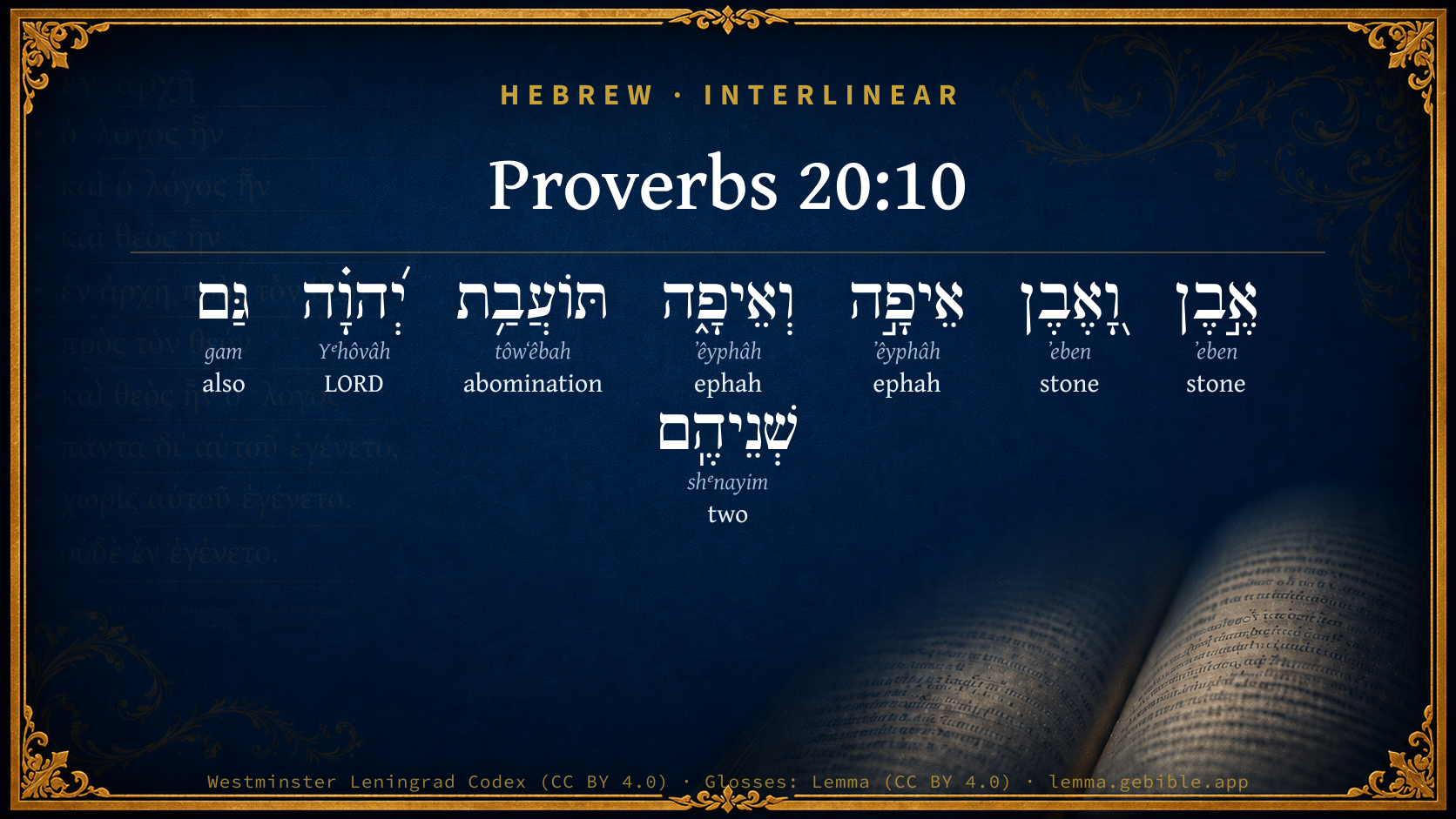
Proverbs 20:10

Hebrew (Westminster Leningrad Codex) Proverbs 20:10 appears in the Hebrew Old Testament. The text above is from the Westminster Leningrad Codex. Each word links to its Strong’s number, a concise gloss, and parsing drawn from the Open Scriptures Hebrew Bible morphology. Click any word for its full Brown-Driver-Briggs (BDB) entry.
Download image
Cite this verse

Proverbs 20:10 (World English Bible). Public Domain. Lemma interlinear Bible study tool, https://lemma.gebible.app/v/proverbs/20/10.

Show BibTeX & RIS
BibTeX
RIS
English Translation
Differing weights and differing measures, Both of them alike are an abomination to Yahweh.
World English Bible · Public Domain
Download a study sheet

One document with this verse’s original text, its word-by-word gloss line, the meaning frame, cross-references with their text, attributed commentary, and full source and license credits — printable, and it pastes into notes with its structure intact.

This verse Autodidact and up

Study sheet (.html) Plain text (.txt)

A passage Seminary Student

Up to 50 verses in one chapter. A passage sheet keeps up to 6 commentary sources and 12 cross-references per verse, in the order this page ranks them, and says so on the sheet whenever that leaves anything out. Ask for a single verse and you get the Autodidact verse sheet above.

Everything on this page stays free to read, with no account — the sheet is a download of what is already on screen, not access to it.

Want to remove ads? Support Godless Engineer
Compare translations 3

The same verse in 3 English versions, stacked beneath the original-language interlinear above. Click any original word for its lexicon entry.

Each is an independent rendering of the whole verse — the interlinear is not word-aligned to these translations.

Highlighted words mark where these versions differ — a whole-verse word diff, not a word-by-word alignment.

  • World English Bible Public Domain
    Differing weights and differing measures, Both of them alike are an abomination to Yahweh.
  • King James Version Public Domain
    Divers weights, and divers measures, both of them are alike abomination to the LORD.
  • unfoldingWord Literal Text CC BY-SA 4.0
    Stone and stone, ephah and ephah an abomination to Yahweh, both the two of them.

unfoldingWord Literal Text — © unfoldingWord, licensed CC BY-SA 4.0. Word-aligned USFM3 via Door43 (git.door43.org/unfoldingWord/en_ult).

Versions to compare (up to 4)

3 of 4 selected

Show all 18 translations

Every available English version of this verse, each an independent rendering of the whole verse.

  • World English Bible Public Domain
    Differing weights and differing measures, Both of them alike are an abomination to Yahweh.
  • Berean Standard Bible Public Domain
    Differing weights and unequal measures—both are detestable to the LORD.
  • Majority Standard Bible Public Domain
    Differing weights and unequal measures—both are detestable to the LORD.
  • King James Version Public Domain
    Divers weights, and divers measures, both of them are alike abomination to the LORD.
  • American Standard Version (1901) Public Domain
    Diverse weights, and diverse measures, Both of them alike are an abomination to Jehovah.
  • Revised Version (1885) Public Domain
    Divers weights, and divers measures, both of them alike are an abomination to the LORD.
  • Geneva Bible (1599) Public Domain
    Diuers weightes, and diuers measures, both these are euen abomination vnto the Lord.
  • Douay-Rheims (1899) Public Domain
    Diverse weights and diverse measures, both are abominable before God.
  • Young's Literal Translation Public Domain
    A stone and a stone, an ephah and an ephah, Even both of them `are' an abomination to Jehovah.
  • Literal Standard Version CC BY-SA 4.0
    A stone and a stone, an ephah and an ephah, || Even both of them [are] an abomination to YHWH.
  • Unlocked Literal Bible CC BY-SA 4.0
    Differing weights and unequal measures— Yahweh hates them both.
  • unfoldingWord Literal Text CC BY-SA 4.0
    Stone and stone, ephah and ephah an abomination to Yahweh, both the two of them.
  • Darby Bible Public Domain
    Divers weights, divers measures, even both of them are abomination to Jehovah.
  • World Messianic Bible Public Domain
    Differing weights and differing measures, both of them alike are an abomination to the LORD.
  • Webster's Bible Public Domain
    Divers weights, and divers measures, both of them are alike abomination to the LORD.
  • Free Bible Version CC BY-SA 4.0
    The Lord hates both dishonest weights and dishonest measures.
  • Bible in Basic English Public Domain
    Unequal weights and unequal measures, they are all disgusting to the Lord.
  • JPS Tanakh (1917) Public Domain
    Divers weights, and divers measures, both of them alike are an abomination to the LORD.

Literal Standard Version (2020), Covenant Press — licensed CC BY-SA 4.0. Text via the HelloAO Bible API (eBible.org). Unlocked Literal Bible (unfoldingWord) — licensed CC BY-SA 4.0. Text via the HelloAO Bible API (eBible.org). unfoldingWord Literal Text — © unfoldingWord, licensed CC BY-SA 4.0. Word-aligned USFM3 via Door43 (git.door43.org/unfoldingWord/en_ult). Free Bible Version, Dr. Jonathan Gallagher — licensed CC BY-SA 4.0. Text via the HelloAO Bible API (eBible.org).

Word by word

More ways to search: Search by grammar → Find every occurrence → Compare this word →

Practice this passage: Drill this verse → Learn its vocabulary →

About this verse

These counts appear in no published source. They are computed here, from the morphology-tagged text and Lemma’s own curated glosses. What Lemma adds →

8
words
6
distinct lemmas
Wisdom
section

Shared distinctive vocabulary

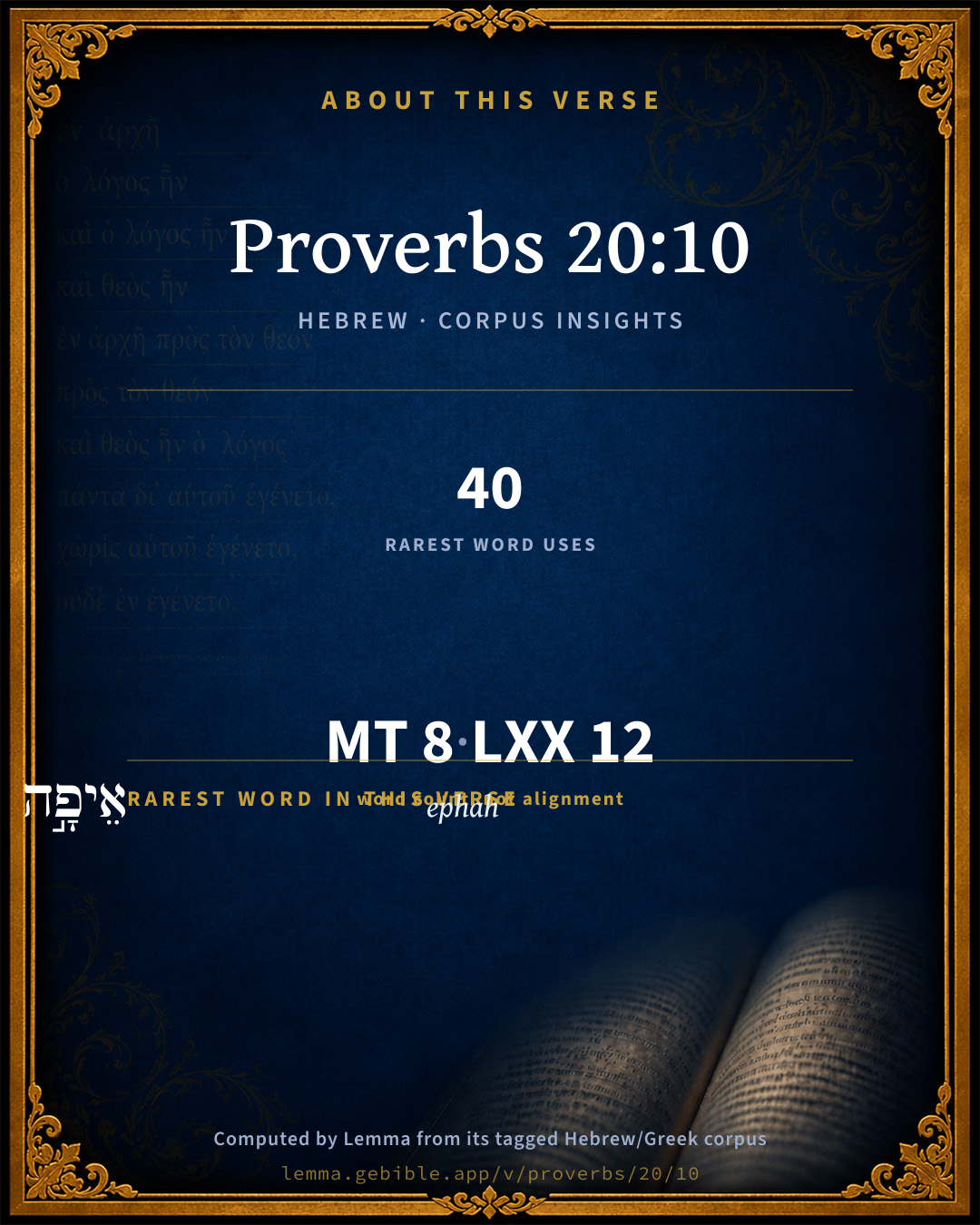
אֵיפָ֣ה ephah H374 occurs in 29 verses of the Hebrew Bible. Also found in:

Grammatical profile

  • 6 nouns
  • 1 adjective
  • 1 particle

Repetition

Words recur within this verse — often emphatic in Hebrew:

  • אֶ֣בֶן stone H68 ×2
  • אֵיפָ֣ה ephah H374 ×2

Hebrew & Septuagint length

In English translation the verse runs 14 words from the Hebrew and 24 from the Septuagint (LXX English) — the Septuagint runs noticeably longer here. See the side-by-side →

A rough comparison of the two English renderings, which tokenize alike — not a word-level alignment.

Word counts can differ between the Hebrew and the Greek without any difference in meaning — e.g. the Hebrew direct-object marker אֵת has no separate Greek word, and Greek often adds the article ὁ.

In the original languages it is 8 Hebrew tokens and 12 Greek tokens — but the two are counted differently (Hebrew bundles its prefixes and suffixes into one token; the Greek is in lemma form), so that isn’t a like-for-like length.

Cross-references

9

Topical passages linked to Proverbs 20:10 in the Treasury of Scripture Knowledge — connected by theme and wording, ordered by reader-vote popularity; previews shown in the World English Bible.

  • Proverbs 11:1 A false balance is an abomination to Yahweh, But accurate weights are his delight.
  • Proverbs 20:23 Yahweh detests differing weights, And dishonest scales are not pleasing.
  • Leviticus 19:35 "'You shall do no unrighteousness in judgment, in measures of length, of weight, or of quantity.
  • Deuteronomy 25:13–15 You shall not have in your bag diverse weights, a great and a small.
  • Proverbs 16:11 Honest balances and scales are Yahweh's; All the weights in the bag are his work.
  • Micah 6:10–11 Are there yet treasures of wickedness in the house of the wicked, And a short ephah that is accursed?
  • Amos 8:4–7 Hear this, you who desire to swallow up the needy, And cause the poor of the land to fail,
  • Revelation 21:8 But for the cowardly, unbelieving, sinners, abominable, murderers, sexually immoral, sorcerers, idolaters, and all liars, their part is in the lake that burns with fire and sulfur, which is the second death."
  • Deuteronomy 7:25–26 The engraved images of their gods shall you burn with fire: you shall not covet the silver or the gold that is on them, nor take it to you, lest you be snared therein; for it is an abomination to Yahweh your God.

Cross-references courtesy of OpenBible.info (CC BY 4.0).

Hebrew and Greek witnesses Masoretic Hebrew ↔ Greek Septuagint

The same verse in the two great witnesses to the Old Testament, shown verse-for-verse.

Here the Septuagint runs noticeably longer than the Hebrew — LXX2012 (modern English Septuagint) 24 words vs World English Bible 14. A rough length comparison of the two English translations, not a word-level alignment — read both below.

These are two independent witnesses, not word-aligned to each other, and the Septuagint is shown in lemma (dictionary) form.

Hebrew Proverbs 20:10 Masoretic · Westminster Leningrad Codex

אֶ֣בֶן וָ֭אֶבֶן אֵיפָ֣ה וְאֵיפָ֑ה תּוֹעֲבַ֥ת יְ֝הוָ֗ה גַּם שְׁנֵיהֶֽם

Differing weights and differing measures, Both of them alike are an abomination to Yahweh.

World English Bible · Public Domain

Greek LXX Proverbs 20:10 Septuagint · lemma form

σταθμίον μέγας καί μικρός καί μέτρον δισσός ἀκάθαρτος ἐνώπιον κύριος καί ἀμφότεροι

A large and small weight, and various measures, are even both of them unclean before the Lord; and so is he that makes them.

LXX2012 (modern English Septuagint) · Public Domain

On this verse, Keil & Delitzsch discusses the Septuagint’s reading. Read the note in Commentary ↓

Hebrew: Westminster Leningrad Codex (CC BY 4.0). Greek: Septuagint (public domain); English from LXX2012 (modern English Septuagint) (Public Domain). How the Septuagint differs from the Hebrew →

Commentary

Notes on Proverbs 20:10 from classic Christian and Jewish commentators (each source and its license shown beneath its notes). The classic Christian expositions comment on the surrounding passage and are grouped to its opening verse, so a note may address several verses; the Jewish commentaries on the Tanakh (Rashi and others) are per-verse, so they appear only where the commentator wrote on this verse.

Lemma curates 59 commentaries, every one of them public domain or Creative Commons licensed, each selected and text-cleaned for this edition rather than reprinted as found. About our sources →

Trapp's Complete Commentary

John Trapp

Pro 20:10 Divers weights, [and] divers measures, both of them [are] alike abomination to the LORD.

Ver. 10. Divers weights, and divers measures, &c.] {See Trapp on "Pro 11:1"} {See Trapp on "Pro 16:11"} Now, if the very weights and measures are abomination, how much more the men that make use of them? And what shall become of such as measure to themselves a whole six days, but curtail God’s seventh or misemploy it?

John Trapp, A Commentary or Exposition upon All the Books of the Old and New Testament (1647–1656) — public domain. Text from a community e-Sword module.

The Biblical Illustrator

Joseph S. Exell

Pro_20:10

Divers weights and divers measures; both of them are alike abomination to the Lord.

Caveat venditor

I. Dishonesty in trade is various in its forms. Divers weights and divers measures . . . and a false balance.

II. Dishonesty in trade is offensive to God.

1. Dishonesty is known to Him: His eye is on our business transactions, and no names or pretences, however plausible, can deceive Him.

2. Dishonesty is abhorred by Him. It is an abomination unto the Lord.

III. Dishonesty in trade is great folly and sin. This seems to be the idea of the latter clause of Pro_20:23 : A false balance is not good. The man who is dishonest for gain sacrifices--

1. The greater for the less.

2. The spiritual for the material.

3. The eternal and permanent for the temporal and uncertain.

4. The Divine for the worldly. Dishonesty is arrant folly; the man who gains by fraud is a great loser.

Conclusion:

1. Transact business by the rule laid down by our Lord (Mat_7:12).

2. Transact business as in the sight of God. (W. Jones.)

Short weights and measures

All pound weights do not draw 16 ounces. Every yard stick is not quite 36 inches long. There are multitudes of things short weight, and not a few short measure. If all men were weighed and measured, some of us would need to be placed under short sticks, or require a big make weight to bring us up to the right standard. Besides men, there are things not quite full measure. Many things sold and used in Manchester, you may depend upon it, would be short measure, especially when compared with the standards the excise officers are in the habit of carrying about with them. I have met many men that would weigh 14 stone, but if you try to weigh their common sense it would not reach 14 ounces. There are hundreds of men whose tailors may be able to tell you how much cloth it would take to cover them; their shoemakers could tell you that their feet measured 9, 10, or 11 inches in length; but if you tried to measure all their good deeds--deeds of kindness done at home--deeds of sympathy to those who are poor--acts of love and mercy such as angels delight to see, and God smiles upon--you could do it with a 35-inch stick. And the misfortune is that these people are always the tall talkers. Talking does little work. Talking, minus doing, is minus weight. But there are some men that weigh too much. When I was a lad I used to see butter sold that was called long weight. Well, what was that? Eighteen ounces to the pound. I have met men more than 18 ounces to the pound. If they are workmen they can do twice as much as others in the same time. If you talk to them about their wives--there are not such women in the world. Their children are perfect models; their horses are better than their neighbours; and if they go out to buy goods, they can always get more for their money than anybody else, often, indeed, 25s worth for their sovereign. But get a little nearer to them, and you will find the work they do needs doing over again; as to their children, they are unruly and impudent; whilst the bargains they make are no bargains at all. I want now to look more particularly at men short weight. (Belshazzar instanced.) Pride? Can a proud man be short weight? Look at him, how big he is! Ah! you can measure some peoples pride, and you will get 37 inches to the yard. It takes 24 yards of silk to cover the pride of some women--and it will take 24 months to pay for it. Belshazzar was not the only proud person the world has known. I am afraid that pride exists in these days as well as in those. (Charles Leach.)

Divers weights and divers measures

Trade tricksters are not called highly respectable in Scripture, whatever they are in society. Apologists for tricks in trade say that the real fault is in the consumer, who will have a cheap article. On which showing, the whole charge of adulteration, and of the wickedness of selling worsted and silk for silk, shoddy for broadcloth, and sloe-juice for vine-wine, is held to amount to nothing. Ciceros rule holds good to-day, that everything should be disclosed, in order that a purchaser may be ignorant of nothing that the seller knows. But few people have leisure for investigating the real quality and quantity of their purchases. It is only necessary, remarks Mr. Emerson, to ask a few questions as to the progress of the articles of commerce from the fields where they grew to our houses, to become aware that we eat and drink, and wear perjury and fraud in a hundred commodities. Christian critics have been fain to admire in Mohammed the vigour and emphasis with which he inculcated a noble sincerity and fairness in dealing. He who sells a defective thing, concealing its defect, will provoke the anger of God and the curses of the angels. Every age has its recognised offenders of this sort, from Solomons days downwards. It was reserved, apparently, for our own age to merit in full the bad eminence of attaining such a pitch of refinement in the art of the falsification of elementary substances, that the very articles used to adulterate are themselves adulterated. (F. Jacox, B. A.)

The Biblical Illustrator, edited by Joseph S. Exell (c. 1880s–1900s) — public domain. Text from a community e-Sword module.

Keil & Delitzsch

C. F. Keil & F. Delitzsch

This proverb passes sentence of condemnation against gross sins in action and life.

Diverse stones, diverse measures -

An abomination to Jahve are they both.

The stones are, as at Pro 11:1; Pro 16:11, those used as weights. Stone and stone, ephah and ephah, means that they are of diverse kinds, one large and one small (the lxx, in which the sequence of the proverbs from Pro 20:10 is different, has μέγα καὶ μικρόν), so that one may be able deceitfully to substitute the one for the other. איפה (from אפה, to bake) may originally have been used to designate such a quantity of meal as supplied a family of moderate wants; it corresponds to the bath (Eze 45:11) as a measure for fluids, and stands here synecdochically instead of all the measures, including, e.g., the cor, of which the ephah was a tenth part, and the seah, which was a third part of it. 10b = Pro 17:5, an echo of Lev 19:36; Deu 25:13-16. Just and equal measure is the demand of a holy God; the contrary is to Him an abhorrence.

Keil & Delitzsch — Biblical Commentary on the Old Testament (1861–1891) — public domain (CC PDM 1.0). Text via the HelloAO Bible API. (Old Testament only.)

Tyndale Open Study Notes

Tyndale Open Resources

20:10 False weights and unequal measures: Merchants, for example, should not cheat their customers by using false weights to weigh out grain (cp. 11:1; 16:11; 20:23).

Tyndale Open Study Notes — © Tyndale Open Resources, licensed CC BY-SA 4.0. Text via the HelloAO Bible API.

Geneva Bible (1599)

Geneva Bible translators

Read Prov. 16:11.

Hebrew, stone and stone, ephah and ephah.

Geneva Bible (1599) marginal notes — public domain. Text via Bolls.life.

Matthew Henry's Commentary

See here, 1. The various arts of deceiving that men have, all which evils the love of money is the root of. In paying and receiving money, which was then commonly done by the scale, they had divers weights, an under-weight for what they paid and an over-weight for what they received; in delivering out and taking in goods they had divers measures, a scanty measure to sell by and a large measure to buy by. This was done wrong with plot and contrivance, and under colour of doing right. Under these is included all manner of fraud and deceit in commerce and trade. 2. The displeasure of God against them. Whether they be about the money or the goods, in the buyer or in the seller, they are all alike an abomination to the Lord. He will not prosper the trade that is thus driven, nor bless what is thus got. He hates those that thus break the common faith by which justice is maintained, and will be the avenger of all such.

Matthew Henry's Commentary on the Whole Bible (1708–1710) — public domain (CC PDM 1.0). Text via the HelloAO Bible API.

Jamieson, Fausset & Brown

Robert Jamieson, A. R. Fausset & David Brown

Various measures, implying that some are wrong (compare Pro 11:1; Pro 16:11).

Jamieson, Fausset & Brown — Commentary Critical and Explanatory on the Whole Bible (1871) — public domain (CC PDM 1.0). Text via the HelloAO Bible API.

Adam Clarke's Commentary

Verse 10. Divers weights and divers measures] A peise and a peise; - Old MS. Bible: from the French pois, weight. Hebrew: "A stone and a stone; an ephah and an ephah." One the standard, the other below it; one to buy with, the other to sell by.

Adam Clarke's Commentary on the Bible (1810–1826) — public domain. Text from a community e-Sword/MySword module.

Ellicott's Commentary for English Readers

(10) Divers weights and divers measures . . .—See above on Pro_11:1.

A Bible Commentary for English Readers, edited by Charles John Ellicott (1878–1897) — public domain. Text from a community e-Sword module.

The Cambridge Bible for Schools and Colleges

gen. ed. J. J. S. Perowne

10. Divers weights] Lit. a stone and a stone, an ephah and an ephah; different weights or measures to buy and to sell with, or when there is risk of detection, and when fraud is safe. Comp. Deu_25:13-14, where the explanatory words, “a great and a small,” are added, as they are here by the LXX. (στάθμιον μέγα καὶ μικρόν); and see ch. Pro_11:1 (note), Pro_16:11.

The Cambridge Bible for Schools and Colleges (gen. ed. J. J. S. Perowne; Cambridge University Press, 1878–1918) — public domain. Text from a community e-Sword module.

John Gill's Exposition

Divers weights, and divers measures,.... Or, "a stone and a stone, and an ephah and an ephah" (d). Stones being in old time used in weighing, and an "ephah" was a common measure among the Jews; and these ought not to be different; one stone or weight for buying, and another for selling; and one measure to buy goods in with, and another to sell out with; the one too heavy, the other too light; the one too large, and the other too scanty; whereby justice is not done between man and man; whereas they ought to be just and equal, Lev 19:35;

both of them are alike abomination to the Lord; who loves righteousness and hates iniquity, and requires of men to do justly; and abhors every act of injustice, and whatever is detrimental to men's properties; see Pro 11:1.

(d) So Montanus, Schulteus.

John Gill's Exposition of the Whole Bible (1746–1763) — public domain (CC PDM 1.0). Text via the HelloAO Bible API.

Albert Barnes' Notes on the Bible

See Pro 11:1 : Here perhaps, as a companion to Pro 20:9, with a wider application to all judging one man by rules which we do not apply to ourselves or to another.

Albert Barnes' Notes on the Bible (1834–1885) — public domain. Text from a community e-Sword/MySword module.

Haydock's Catholic Bible Commentary

Measures. In commerce, (Calmet) as well as in judging. (St. Gregory in Ezechiel iv.)

George Leo Haydock (1774–1849), Haydock's Catholic Family Bible and Commentary, 1859 edition — public domain. Excludes Psalms (Douay-Rheims chapter numbering differs from Protestant) and Deuterocanonical books (Catholic canon only).

Matthew Poole's English Annotations

Divers weights and divers measures; one greater and true for public show, and one lesser and false for private use, when they had an opportunity of deceiving.

Matthew Poole's English Annotations on the Holy Bible (1683–1685) — public domain. Text from a community e-Sword/MySword module.

Whedon's Commentary on the Bible

Daniel D. Whedon

10. Divers weights measures — Literally, a stone and a stone, an epha and an epha, which some interpret to mean a double weight and a double epha; that is, two of each, one true and the other false, one greater than the other, one to buy with and the other to sell with. But the repetition here denotes not plurality but diversity, and hence is well enough rendered by our word “divers.” The epha was a measure equal to about one and a half (some say one and one ninth) bushels, English. The tricks of trade were not unknown in the early times. Compare Pro_11:1; Pro_17:5; and Pro_20:23 below.

Daniel D. Whedon (gen. ed.), Commentary on the Old and New Testaments (1874–1909) — public domain. Text from a community e-Sword module.

The Pulpit Commentary

Divers weights, and divers measures; literally, stone and stone, ephah and ephah. The stones were used for weighing: dishonest traders kept them of different weights, and also measures of different capacities, substituting one for the other in order to defraud unwary customers. The Septuagint makes this plain by rendering, "A weight great and small, and measures double". (see on Pro_11:1 and Pro_16:11; and comp. ver. 23) The ephah was a dry measure, being one-tenth of the homer, and occupying the same position in solids as the bath did in liquids. It equalled about three pecks of our measure. Both of them are alike abomination to the Lord; (Pro_17:15; comp. Lev_19:36 Deu_25:13, etc.) Septuagint, "Are impure before the Lord, even both of them, and he who doeth them." Pseudo-Bernard ("De Pass. Dom.," 17), applying the passage mystically, teaches that a man may be said to keep a double measure, who, being conscious of his own evil character, endeavours to appear righteous to others; who, as he puts it, "Suo judicio terrae proximus est, et aliis cupit elevatus videri." Others, connecting this verse in thought with the preceding, see in it a warning against judging a neighbour by a standard which we do not apply to ourselves. The Septuagint Version arranges the matter from ver. 10 onwards differently from the Hebrew, omitting vers. 14-19, and placing vers. 10-13 after ver. 22.

The Pulpit Commentary (1880–1919), ed. H.D.M. Spence-Jones & Joseph S. Exell — public domain. Text from a community e-Sword module.

John Wesley's Explanatory Notes

Divers - One greater for shew and one lesser for use.

John Wesley, Explanatory Notes Upon the Whole Bible (1754–1765) — public domain. Text via the GEBible commentary corpus.

Bridges on Proverbs

Charles Bridges

This probably refers to the iniquitous custom of having different weights and measures for buying and for selling — one stone too heavy — the other too light. Such practices seem to have been among the crying sins of the nation, that brought down the judgment of God upon it.†1 So opposite are they to the character of "a God of truth and without iniquity,"†2 that the very stone and ephah were abomination to him.†3 The disuse of barter, and the more accurate system of inspection, have in some measure restrained this gross form of fraud. But the cheats of trickery and close dealing, the evasion of legal duties, taking advantage of the ignorance of the unwary — all those deviations from the scriptural standard are alike abomination to the LORD. ’A very grievous thing it is to think of the several kinds of frauds and deceits, wherein men are grown wondrous expert, and so shameless withal, that they think it rather a credit to them, as an argument of their perfect understanding in their several mysteries and particular professions, than any blemish to them in their Christian profession.’†4 What a fearful disclosure will the great day make, to the "shame and everlasting contempt" of the ungodly trafficker! Every man of moral integrity will scorn the flagrant breach of the golden rule. But let this, as every other temptation, be a matter of prayerful watchfulness. And be not satisfied with abstaining from this hateful vice. But blot out its darkness by the bright, steady shining of an upright profession, full of simplicity, love, self-forgetfulness, and active sympathy with our neighbor’s wants. "Let integrity and uprightness preserve me; for I wait on thee." (Psa 25:21 .)

Footnotes:

†1 Hos 12:7. Amo 8:4-5 . Mic 6:10-11 .

†2 Deu 32:4.

†3 Pro 20:23; Pro 11:1 ; Psa 5:6 .

†4 Bishop Sanderson’s Sermon on 1Sa 12:3 .

Charles Bridges, An Exposition of the Book of Proverbs (1846) — public domain. Text from a community e-Sword module.

Kretzmann's Popular Commentary

Paul E. Kretzmann

v. 10. Divers weights, stones as they were used for weights in balances, and divers measures, the reference being not only to the vessels used in dry measure, but to every kind of measure, both of them are alike abomination to the Lord; deception in business, cheating in trade, is sinful and loathsome in His sight.

Paul E. Kretzmann, Popular Commentary of the Bible (1921–1924) — public domain. Text from a community e-Sword module.

Lesson kit

Teaching starters — assembled from the data on this page, not authored interpretation. Every prompt links to the verse data it draws on. Edit before teaching.

Proverbs, in the Wisdom, opens this verse with 8 words (6 distinct Hebrew lemmas). Its most distinctive word is ʼêyphâh (“ephah”). The Greek Septuagint runs longer here. A historical commentator’s framing appears above. Read the whole chapter for the surrounding context.

Discussion questions

  1. How does “ephah” (ʼêyphâh) shape what this verse is saying?
  2. Exodus 16:36 shares the word «ephah» with this verse. How do the two illuminate each other?
  3. “stone” occurs 2× in this one verse. What is the effect of the repetition?
  4. Compared with the Hebrew, the Septuagint runs longer here. What questions does that raise?
  5. These translations render this verse differently. What is at stake in choosing one wording over another?
  6. Reading how Trapp's Complete Commentary and The Biblical Illustrator read this verse, where do the two commentators agree and where do they part?

Things to notice

Reading settings

Reading text

Shown beneath each verse's original-language words.

Old Testament
Old Testament edition

Read the OT as the Masoretic Hebrew (MT) or the Greek Septuagint (LXX).

English shown for the Greek Septuagint (in the Hebrew ↔ Greek comparison).

Comparing translations? Open the Compare panel on any verse page to stack up to four side by side.