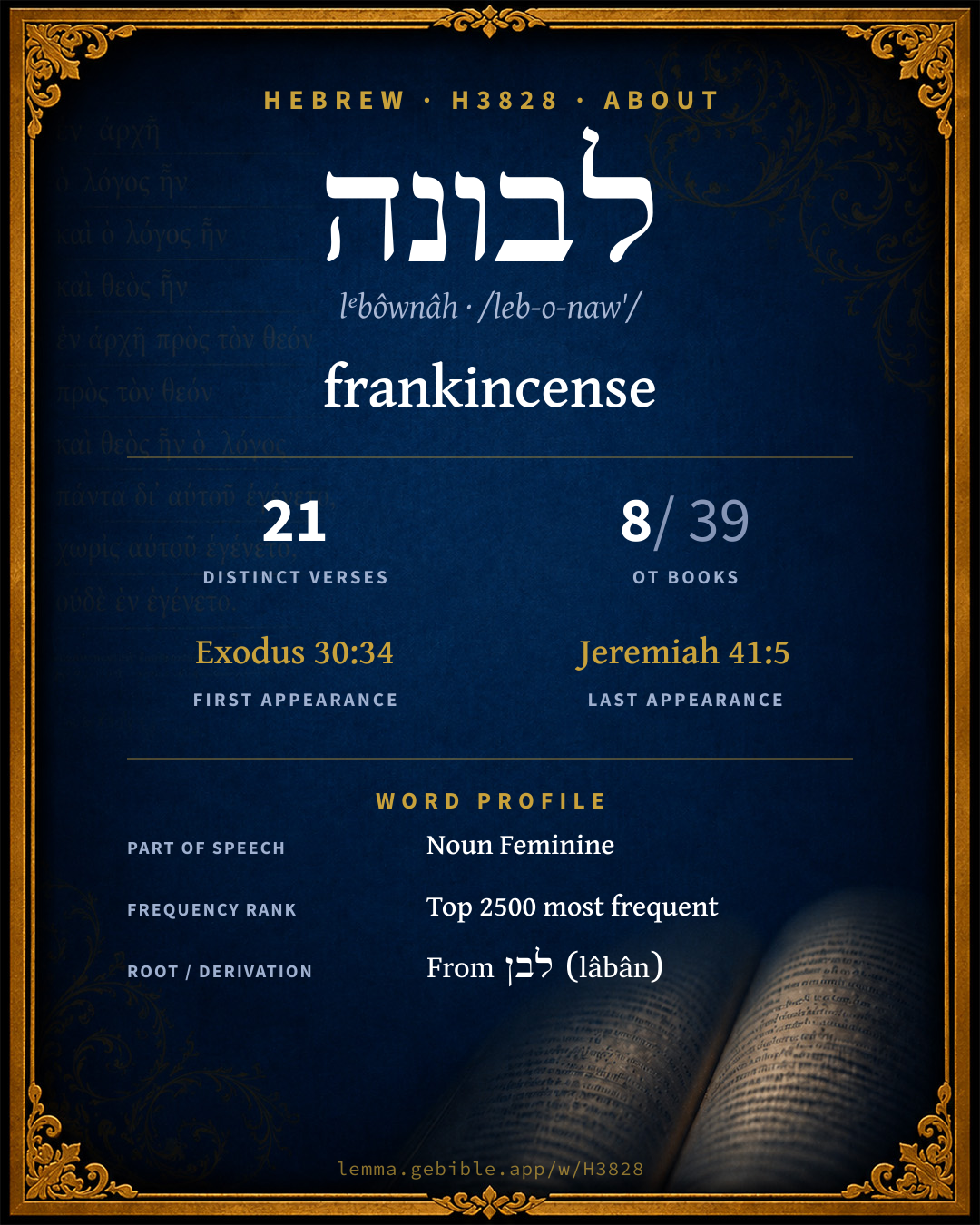
לְבֹנָה
frankincense
‘frankincense’ is one of 2 main senses fuller range ↓
Full lexicon entry — Brown-Driver-Briggs (BDB)
From Brown-Driver-Briggs (BDB)
Where this word appears
See every Absolute-state word in the Hebrew Bible →
Grammar key — what these labels mean
Part of speech
- Noun
- A naming word — a person, place, thing, or idea.
Noun type
- Common
- A common noun — a general class of person, place, or thing (“king,” “city,” “water”), not a specific name.
State
- Absolute
- The independent form of a noun, not bound to a following word.
- Construct
- A noun bound to a following noun in a possessive / “of” relationship (the construct chain).
Gender
- Feminine
- Grammatically feminine.
Number
- Singular
- One.
Grammatical forms
- Noun, Common, Feminine, Singular, Absolute 19 times (90%)
- Noun, Common, Feminine, Singular, Construct 2 times (10%)
Parsed forms decoded from the imported morphology (morphhb / Westminster Leningrad Codex — WLC text public domain, morphhb tagging CC BY 4.0), counted across 21 parsed occurrences — not distinct verses.
Every verse where H3828 appears — 21 distinct verses across 8 books. Click any verse to open its interlinear word-by-word view. Verse text shown in the World English Bible for context — . Each verse’s Hebrew form is shown with its reference; the English is not keyword-highlighted, since the data carries no word-level English alignment. Use “Compare translations” on any verse to read it across multiple English versions. This concordance covers the Hebrew Bible; Septuagint (Greek Old Testament) occurrences are not indexed here.
Exodus 1 verse
Leviticus 7 verses
- Leviticus 2:1 לְבֹנָֽה n c fs "'When anyone offers an offering of a meal offering to Yahweh, his offering shall be of fine flour; and he shall pour oil on it, and put frankincense on it.
- Leviticus 2:2 לְבֹנָתָ֑/הּ n c fs cs + sfx pers 3fs He shall bring it to Aaron's sons the priests; and he shall take his handful of its fine flour, and of its oil, with all its frankincense; and the priest shall burn the memorial of it on the altar, an offering made by fire, of a sweet savor to Yahweh.
- Leviticus 2:15 לְבֹנָ֑ה n c fs You shall put oil on it, and lay frankincense on it: it is a meal offering.
- Leviticus 2:16 לְבֹנָתָ֑/הּ n c fs cs + sfx pers 3fs The priest shall burn as its memorial, part of its bruised grain, and part of its oil, along with all its frankincense: it is an offering made by fire to Yahweh.
- Leviticus 5:11 לְבֹנָ֔ה n c fs "'But if he can't afford two turtledoves, or two young pigeons, then he shall bring his offering for that in which he has sinned, the tenth part of an ephah of fine flour for a sin offering. He shall put no oil on it, neither shall he put any frankincense on it, for it is a sin offering.
- Leviticus 6:15 הַ/לְּבֹנָ֔ה ptcl def.art + n c fs He shall take from there his handful of the fine flour of the meal offering, and of its oil, and all the frankincense which is on the meal offering, and shall burn it on the altar for a sweet savor, as its memorial, to Yahweh.
- Leviticus 24:7 לְבֹנָ֣ה n c fs You shall put pure frankincense on each row, that it may be to the bread for a memorial, even an offering made by fire to Yahweh.
Numbers 1 verse
1 Chronicles 1 verse
Nehemiah 2 verses
- Nehemiah 13:5 הַ/לְּבוֹנָ֜ה ptcl def.art + n c fs had prepared for him a great chamber, where before they laid the meal-offerings, the frankincense, and the vessels, and the tithes of the grain, the new wine, and the oil, which were given by commandment to the Levites, and the singers, and the porters; and the heave-offerings for the priests.
- Nehemiah 13:9 וְ/הַ/לְּבוֹנָֽה conj + ptcl def.art + n c fs Then I commanded, and they cleansed the chambers: and there brought I again the vessels of the house of God, with the meal-offerings and the frankincense.
Song of Solomon 3 verses
- Song of Solomon 3:6 וּ/לְבוֹנָ֔ה conj + n c fs Who is this who comes up from the wilderness like pillars of smoke, Perfumed with myrrh and frankincense, With all spices of the merchant?
- Song of Solomon 4:6 הַ/לְּבוֹנָֽה ptcl def.art + n c fs Until the day is cool, and the shadows flee away, I will go to the mountain of myrrh, To the hill of frankincense.
- Song of Solomon 4:14 לְבוֹנָ֑ה n c fs Spikenard and saffron, Calamus and cinnamon, with every kind of incense tree; Myrrh and aloes, with all the best spices,
Isaiah 3 verses
- Isaiah 43:23 בִּ/לְבוֹנָֽה prep + n c fs You have not brought me of your sheep for burnt offerings; neither have you honored me with your sacrifices. I have not burdened you with offerings, nor wearied you with frankincense.
- Isaiah 60:6 וּ/לְבוֹנָה֙ conj + n c fs The multitude of camels shall cover you, the dromedaries of Midian and Ephah; all they from Sheba shall come; they shall bring gold and frankincense, and shall proclaim the praises of Yahweh.
- Isaiah 66:3 לְבֹנָ֖ה n c fs He who kills an ox is as he who kills a man; he who sacrifices a lamb, as he who breaks a dog's neck; he who offers an offering, [as he who offers] pig's blood; he who burns frankincense, as he who blesses an idol. Yes, they have chosen their own ways, and their soul delights in their abominations:
Jeremiah 3 verses
- Jeremiah 6:20 לְבוֹנָה֙ n c fs To what purpose comes there to me frankincense from Sheba, and the sweet cane from a far country? your burnt offerings are not acceptable, nor your sacrifices pleasing to me.
- Jeremiah 17:26 וּ/לְבוֹנָ֑ה conj + n c fs They shall come from the cities of Judah, and from the places round about Jerusalem, and from the land of Benjamin, and from the lowland, and from the hill-country, and from the South, bringing burnt offerings, and sacrifices, and meal-offerings, and frankincense, and bringing [sacrifices of] thanksgiving, to the house of Yahweh.
- Jeremiah 41:5 וּ/לְבוֹנָה֙ conj + n c fs that there came men from Shechem, from Shiloh, and from Samaria, even eighty men, having their beards shaved and their clothes torn, and having cut themselves, with meal-offerings and frankincense in their hand, to bring them to the house of Yahweh.
About this entry
At a glance — auto-summarized from this page’s data, not written by a person. Every figure links to its source below. This summary describes the numbers; it doesn’t interpret them.
At its core, לבונה (lᵉbôwnâh) means “frankincense.” Scripture first uses it in Exodus 30:34. With 21 verses in 8 books, it is an uncommon word in the Hebrew Bible. Its uses concentrate in Leviticus (33% of all occurrences). Ranging over 2 senses, it is not a single-sense word. Dig into 21-verse concordance and the renderings breakdown below.
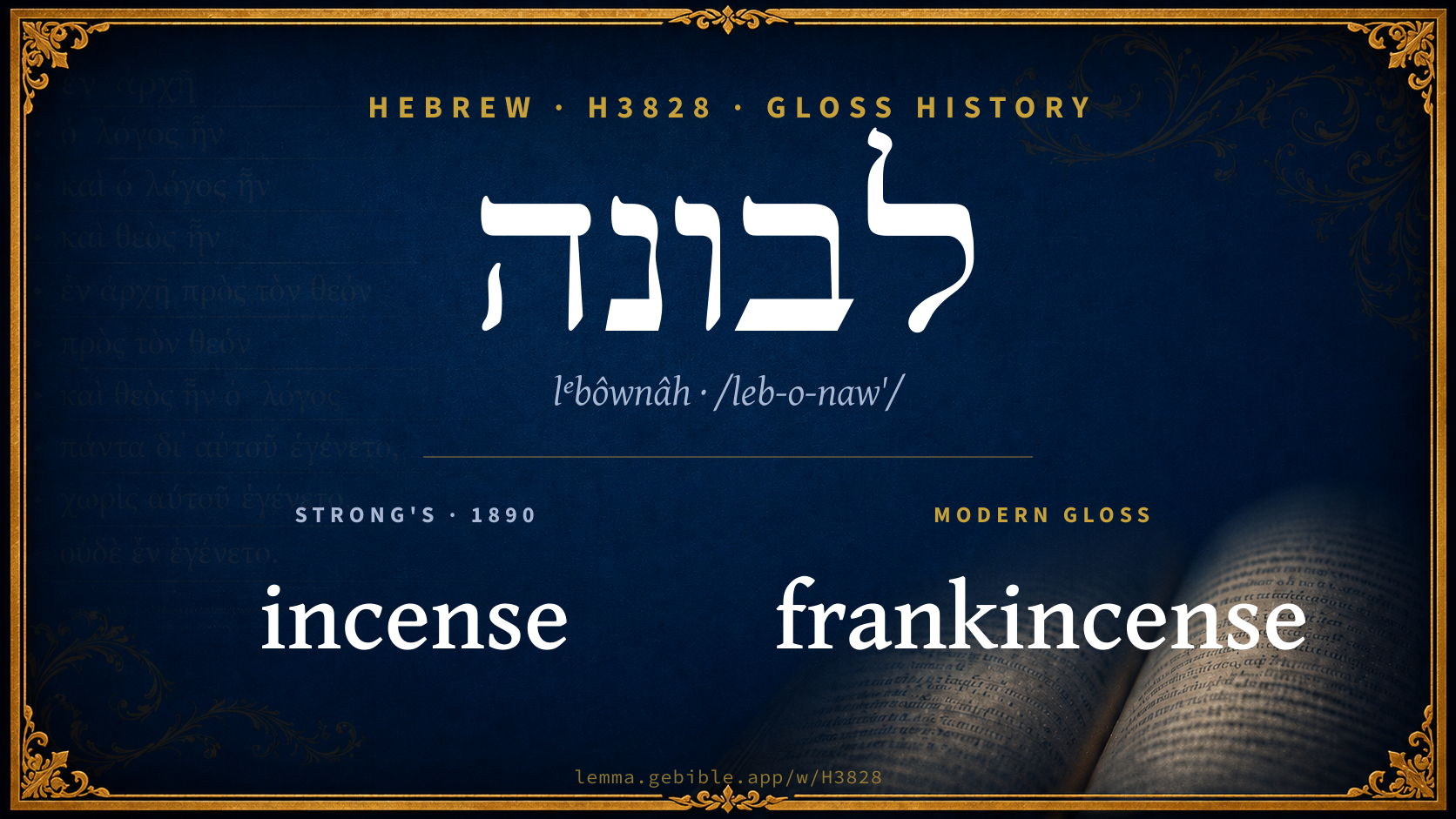
Gloss history
Strong's 1890 vs modern scholarship
About this word
Strong's H3828 catalogs a Hebrew word from the Hebrew Old Testament.
These counts are not copied from any lexicon or concordance. They are computed here, from the morphology-tagged Hebrew Old Testament. What Lemma adds →
- 21
- distinct verses
- The word appears in 21 distinct verses.
- 8 / 39
- OT books
- The word appears in 8 of 39 Old Testament books.
- #1,462
- by frequency
- Top 2500 most frequent Hebrew words (rank 1,462 of 8,640 Hebrew words by occurrence).
View all 21 occurrences in the concordance →
Most concentrated in
- Leviticus 7 verses 33%
- Song of Solomon 3 verses 14%
- Isaiah 3 verses 14%
By section of the Old Testament
By traditional corpus
Conventional, traditional groupings — biblical authorship is debated, so this is a traditional corpus grouping, not an authorship claim. Each share is this word’s portion of its verses in that division of the Hebrew canon. Each figure is a share of the word’s 21 distinct verses.
- Torah (Pentateuch) 9 verses · 43%
- Prophets (Nevi'im) 6 verses · 29%
- Writings (Ketuvim) 6 verses · 29%
How translations render this word
Counts come from each version’s own published word-to-Strong’s tagging or interlinear alignment — an approximate guide to how each version renders this word, not a word-level alignment the data otherwise carries. Because each total is that version’s own tagged count, the per-version totals vary from one another and need not match the appearance or distinct-verse counts above. These counts may also differ from a printed concordance because Lemma counts each distinctly tagged rendering and does not collapse phrase taggings into a single head-word total. This is a fixed set of word-tagged versions (KJV, ASV, BSB, ULT) and does not change with the reading translation you choose elsewhere. Each version’s license is shown beside its name below (and on Sources).
BDB lists this Strong’s number as 2 distinct words (homographs). Each count above pools all of them and is not split by sense — see the Senses section below. A low-frequency rendering may belong to a different one of those words, not the primary meaning.
- King James Version†: Frankincense 11×, Incense 5×, Thereof with all the frankincense 2×
- American Standard Version†: Frankincense 12×
- Berean Standard Bible†: Frankincense 17×
- unfoldingWord Literal Text†: Frankincense 14×, Incense 5×
King James Version Public Domain
Renders H3828 across 21† tagged occurrences — most commonly:
Plus 3 renderings that appear only once — usually multi-word phrases or single function words the recovered tagging swept in, not distinct renderings.
American Standard Version Public Domain
Renders H3828 across 21† tagged occurrences — most commonly:
Plus 9 renderings that appear only once — usually multi-word phrases or single function words the recovered tagging swept in, not distinct renderings.
Berean Standard Bible Public Domain
Renders H3828 across 21† tagged occurrences — most commonly:
Plus 4 renderings that appear only once — usually multi-word phrases or single function words the recovered tagging swept in, not distinct renderings.
unfoldingWord Literal Text CC BY-SA 4.0
Renders H3828 across 21† tagged occurrences — most commonly:
Plus 2 renderings that appear only once — usually multi-word phrases or single function words the recovered tagging swept in, not distinct renderings.
Senses in the full BDB
What do BDB’s symbols mean?
BDB uses these scholarly abbreviations:
| Symbol | Meaning |
|---|---|
| 𝔊 | the Septuagint (the ancient Greek translation, LXX) |
| 𝔙 | the Vulgate (the Latin translation) |
| 𝔖 | the Syriac version (the Peshitta) |
| 𝔗 | the Targum (the Aramaic translation) |
| ψ | the Psalms |
| √ | root (the underlying root or stem) |
| ‖ | parallel passage (a synonymous or contrasted parallel) |
| † | the dagger: every passage where the word occurs is cited |
The 0 senses and sub-senses the full Brown-Driver-Briggs lexicon distinguishes for this word, in lexicon order (not ranked by frequency), with BDB’s own verbatim wording and sub-sense lettering. Shown in Hebrew script with BDB’s own scholarly abbreviations. The condensed entry is in the Lexicon Entry tab. See also the Forms in the corpus table below.
לבונה I frankincense (from white colour, cf. LagBN 33
לבונה II loc., by which, among other places, loc. of Shiloh is fixed Ju 21
Senses from the full Brown-Driver-Briggs lexicon (Brown, Driver, Briggs; Oxford 1906 — public domain), digitized via Sefaria, supplemented by the OpenScriptures HebrewLexicon (CC BY 4.0). Full attribution on Sources.
Word origin
I. n.f. frankincense (from white colour, cf. LagBN 33; NH id.; Aramaic id., לְבוּנְתָּא, ܠܒܽܘܢܬܳܐ; Ph. לבנת; Arabic لُبَانٌ (Lane 3007); Ethiopic ሊባኖስ is from λιβανος);—ל׳ Ex 30:24 + 18 times; לְבֹנָתָהּ Lv 2:2, 16;—used in prep. of holy incense Ex 30:34 (‖ סַמִּים); used as incense Je 6:20, on meal-offering Lv 2:1, 2, 15, 16; 6:8, cf. 5:11 Nu 5:15; also Je 17:26; 41:5; Is 43:23; 66:3; with shew-bread Lv 24:7; Ne 13:5, 9 1 Ch 9:29 (‖ בְּשָׂמִים); burned as perfume (art. of luxury) Ct 3:6 (‖ מֹר); גִּבְעַת חַלְּבוֹנָה 4:6 (‖ הַר הַמּוֹר); עֲצֵי לְבוֹנָה v 14 (‖ נֵרְדְּ, כַּרְכֹּם, קָנֶה, קִנָּמוֹן, מֹר, אֲהָלוֹת); as tribute to Zion Is 60:6 (‖ זהב).—In Hex only P.
I. n.pr.loc., by which, among other places, loc. of Shiloh is fixed Ju 21:19, 𝔊 Λεβωνα; mod. Lubban, c. 3 m. WNW. from Shiloh (Seilûn), RobBR ii. 271 f. GuérinSam. ii, 164 f. BdPal. 217 BuhlGeogr. 175.
— Brown-Driver-Briggs (Oxford 1906, public domain), digitized via Sefaria, supplemented by the OpenScriptures HebrewLexicon (CC BY 4.0). See Sources.
Derived from לבן (lâbân) (H3836) — white.
Jastrow Dictionary
A second Hebrew/Aramaic lexicon for comparison, covering Aramaic and post-biblical (Talmudic, Targumic, Midrashic) usage that the biblical-Hebrew BDB does not. Matched by lemma rather than by Strong’s number, so a lemma may carry more than one Jastrow headword (shown separately below), and the entries cover usage well beyond the Bible.
לְבוֹנָה
- [white] frankincense. Ker. 6ᵃ. Snh. 43ᵃ they gave the culprit קורט של ל׳ וכ׳ a grain of frankincense in a cup of wine to benumb his senses (v. טָרַף); Treat. S’maḥ. ch. II, 9; a. fr.
A Dictionary of the Targumim, the Talmud Babli and Yerushalmi, and the Midrashic Literature (Marcus Jastrow; London, Luzac, 1903) — Public Domain. Digitized via Sefaria. Digitized via Sefaria. Full attribution on Sources.
Forms in the corpus
The 18 distinct written forms H3828 takes in the Hebrew Bible, most frequent first — each parse links to that state’s occurrences in the concordance. Hebrew forms include their vowel points and cantillation, so a single lemma takes many written forms.
Same root — word family
Other BDB entries built from the same root as H3828, grouped by Strong’s listed origin. These share a root / origin per the lexicon — not necessarily a shared meaning. Each links to that word’s own entry.
Derives from
Derived from this word
Proper names from this root
People and places named from this root — a name, not an additional meaning of the word.
Compare all same-root words → Showing 4 of 5 — not the complete family. 2 of the same-root words are proper names (people or places). They share a root, not necessarily a meaning.
Septuagint verse parallels
This word appears in 19 verses that also exist in the Greek Old Testament (Septuagint), out of the 21 Hebrew verses it occurs in. You can read those verses in Greek by switching the Old Testament edition to the Septuagint.
Read these verses in the Septuagint
- Exodus 30:34
- Leviticus 2:1
- Numbers 5:15
- 1 Chronicles 9:29
- Song of Solomon 3:6
- Isaiah 43:23
- Jeremiah 6:20
This is a verse-level parallel only — the same verses exist in both the Hebrew and Greek Old Testaments. No word-level Hebrew↔Greek correspondence is claimed: the data carries no such alignment, so no Greek word is shown as this Hebrew word’s translation. Coverage is not total — the Septuagint omits the deuterocanon and renumbers the Psalms, so some Hebrew verses have no direct Greek parallel.