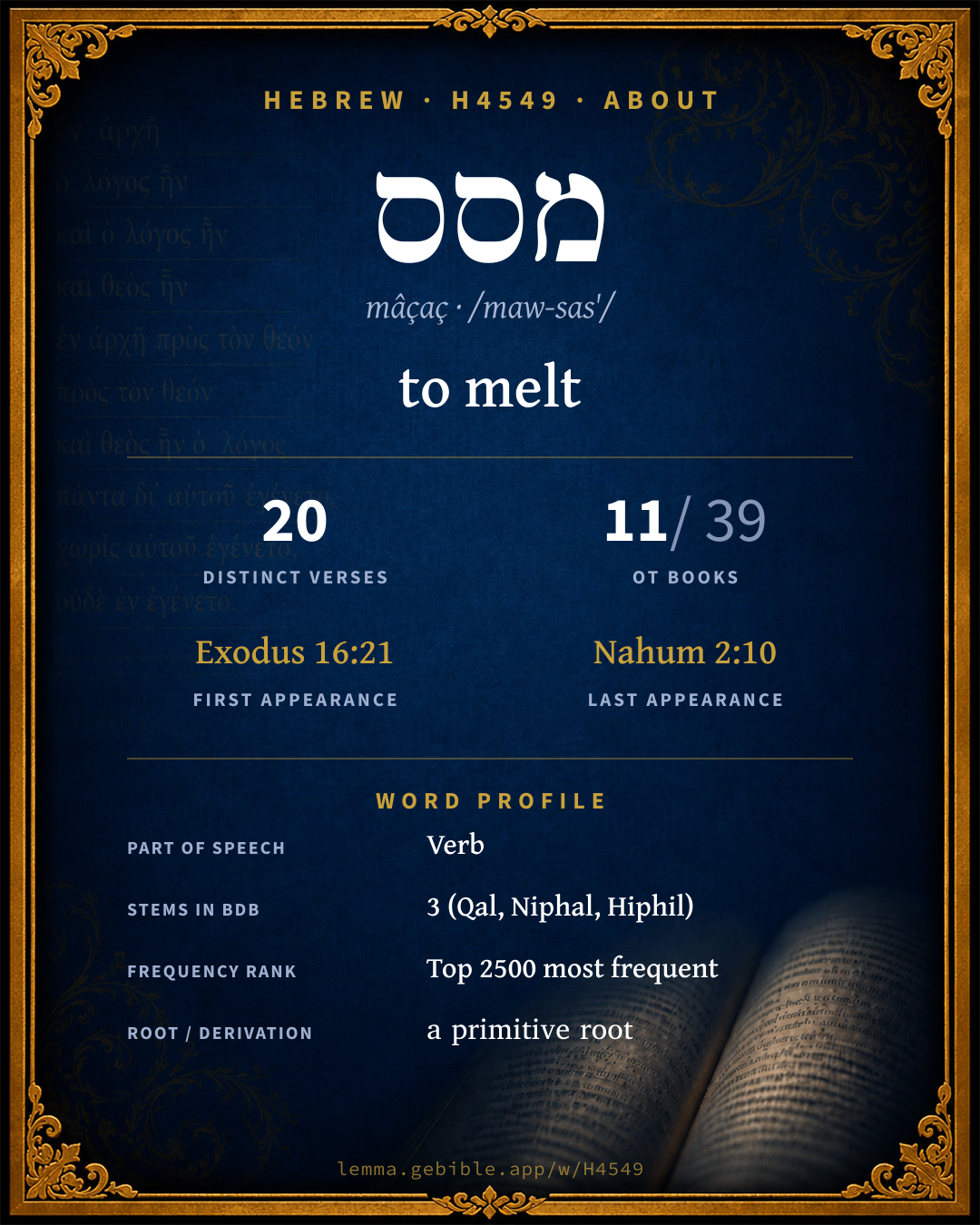
מָסַס
to melt
‘to melt’ is one of 3 main senses fuller range ↓
Full lexicon entry — Brown-Driver-Briggs (BDB)
From Brown-Driver-Briggs (BDB)
Where this word appears
See every Niphal verb in the Hebrew Bible →
Grammar key — what these labels mean
Part of speech
- Verb
- An action or state-of-being word.
Stem
- Niphal
- Usually the simple passive or reflexive of the Qal (“he was written”). Here: ‘melt’
- Qal
- The basic, simple active stem — the plain form of the verb (“he wrote”).
- Hiphil
- The causative active stem (“he caused / brought about”).
Form
- Imperfect
- An incomplete, ongoing, or future action (“he will / would write”).
- Sequential Imperfect
- An imperfect with prefixed waw — the standard past-narrative form (waw-consecutive imperfect).
- Sequential Perfect
- A perfect with prefixed waw continuing a preceding imperfect or command (waw-consecutive perfect).
- Perfect
- A completed action or state — Hebrew marks aspect (completeness) more than strict tense (“he wrote”).
- Participle Active
- A verbal adjective expressing ongoing or characteristic action (“writing / one who writes”).
- Infinitive Construct
- A bound verbal noun, frequently with prepositions (“to write / in writing”).
- Infinitive Absolute
- An unbound verbal noun, often intensifying or standing in for a finite verb.
State
- Absolute
- The independent form of a noun, not bound to a following word.
Person
- 3rd Person
- The one spoken about (“he / she / it / they”).
Gender
- Masculine
- Grammatically masculine.
- Common
- Either gender — not distinguished for this form.
Number
- Singular
- One.
- Plural
- More than one (in Hebrew, generally three or more).
Grammatical forms 12 distinct
- Verb, Niphal, Imperfect, 3rd Person, Masculine, Singular 4 times (19%)
- Verb, Niphal, Sequential Imperfect, 3rd Person, Masculine, Singular 3 times (14%)
- Verb, Niphal, Perfect, 3rd Person, Masculine, Singular 3 times (14%)
- Verb, Niphal, Sequential Perfect, 3rd Person, Common, Plural 2 times (10%)
- Verb, Niphal, Sequential Perfect, 3rd Person, Masculine, Singular 2 times (10%)
- Verb, Niphal, Participle Active, Masculine, Singular, Absolute 1 time (5%)
- Verb, Niphal, Sequential Imperfect, 3rd Person, Masculine, Plural 1 time (5%)
- Verb, Niphal, Infinitive Construct 1 time (5%)
+4 more forms (4 occurrences)
Parsed forms decoded from the imported morphology (morphhb / Westminster Leningrad Codex — WLC text public domain, morphhb tagging CC BY 4.0), counted across 21 parsed occurrences — not distinct verses.
Every verse where H4549 appears — 20 distinct verses across 11 books. Click any verse to open its interlinear word-by-word view. Verse text shown in the World English Bible for context — . Each verse’s Hebrew form is shown with its reference; the English is not keyword-highlighted, since the data carries no word-level English alignment. Use “Compare translations” on any verse to read it across multiple English versions. This concordance covers the Hebrew Bible; Septuagint (Greek Old Testament) occurrences are not indexed here.
Exodus 1 verse
Deuteronomy 2 verses
- Deuteronomy 1:28 הֵמַ֨סּוּ Hiphil pf 3cp Where are we going up? our brothers have made our heart to melt, saying, The people are greater and taller than we; the cities are great and fortified up to the sky; and moreover we have seen the sons of the Anakim there.
- Deuteronomy 20:8 יִמַּ֛ס Niphal impf 3ms The officers shall speak further to the people, and they shall say, What man is there who is fearful and faint-hearted? let him go and return to his house, lest his brother's heart melt as his heart.
Joshua 3 verses
- Joshua 2:11 וַ/יִּמַּ֣ס conj + Niphal wimpf 3ms As soon as we had heard it, our hearts did melt, neither did there remain any more spirit in any man, because of you: for Yahweh your God, he is God in heaven above, and on earth beneath.
- Joshua 5:1 וַ/יִּמַּ֣ס conj + Niphal wimpf 3ms It happened, when all the kings of the Amorites, who were beyond the Jordan westward, and all the kings of the Canaanites, who were by the sea, heard how that Yahweh had dried up the waters of the Jordan from before the children of Israel, until we were passed over, that their heart melted, neither was there spirit in them any more, because of the children of Israel.
- Joshua 7:5 וַ/יִּמַּ֥ס conj + Niphal wimpf 3ms The men of Ai struck of them about thirty-six men; and they chased them [from] before the gate even to Shebarim, and struck them at the descent; and the hearts of the people melted, and became as water.
Judges 1 verse
1 Samuel 1 verse
2 Samuel 1 verse
Psalms 4 verses
- Psalms 22:14 נָ֝מֵ֗ס Niphal pf 3ms I am poured out like water. All my bones are out of joint. My heart is like wax; It is melted within me.
- Psalms 68:2 כְּ/הִמֵּ֣ס prep + Niphal inf.cs As smoke is driven away, So drive them away. As wax melts before the fire, So let the wicked perish at the presence of God.
- Psalms 97:5 נָ֭מַסּוּ Niphal pf 3cp The mountains melt like wax at the presence of Yahweh, At the presence of the Lord of the whole earth.
- Psalms 112:10 וְ/נָמָ֑ס conj + Niphal wpf 3ms The wicked will see it, and be grieved. He shall gnash with his teeth, and melt away. The desire of the wicked will perish.
Isaiah 4 verses
- Isaiah 10:18 כִּ/מְסֹ֥ס prep + Qal inf.cs He will consume the glory of his forest, and of his fruitful field, both soul and body: and it shall be as when a standard-bearer faints.
- Isaiah 13:7 יִמָּס Niphal impf 3ms Therefore shall all hands be feeble, and every heart of man shall melt:
- Isaiah 19:1 יִמַּ֥ס Niphal impf 3ms The burden of Egypt. Behold, Yahweh rides on a swift cloud, and comes to Egypt: and the idols of Egypt shall tremble at his presence; and the heart of Egypt shall melt in the midst of it.
- Isaiah 34:3 וְ/נָמַ֥סּוּ conj + Niphal wpf 3cp Their slain also shall be cast out, and the stench of their dead bodies shall come up; and the mountains shall be melted with their blood.
Ezekiel 1 verse
Micah 1 verse
Nahum 1 verse
About this entry
At a glance — auto-summarized from this page’s data, not written by a person. Every figure links to its source below. This summary describes the numbers; it doesn’t interpret them.
מסס — transliterated mâçaç — is a Hebrew verb carrying the sense “to melt.” Debuting at Exodus 16:21, it then recurs through the corpus. Spanning 20 verses in 11 books, it ranks among the uncommon words of the Hebrew Bible. Different stems carry different senses — BDB groups them under 3 stems, among them Qal and Niphal. From the same root come מס, מס and מסה. Each statement above links to its evidence; the full detail follows below.
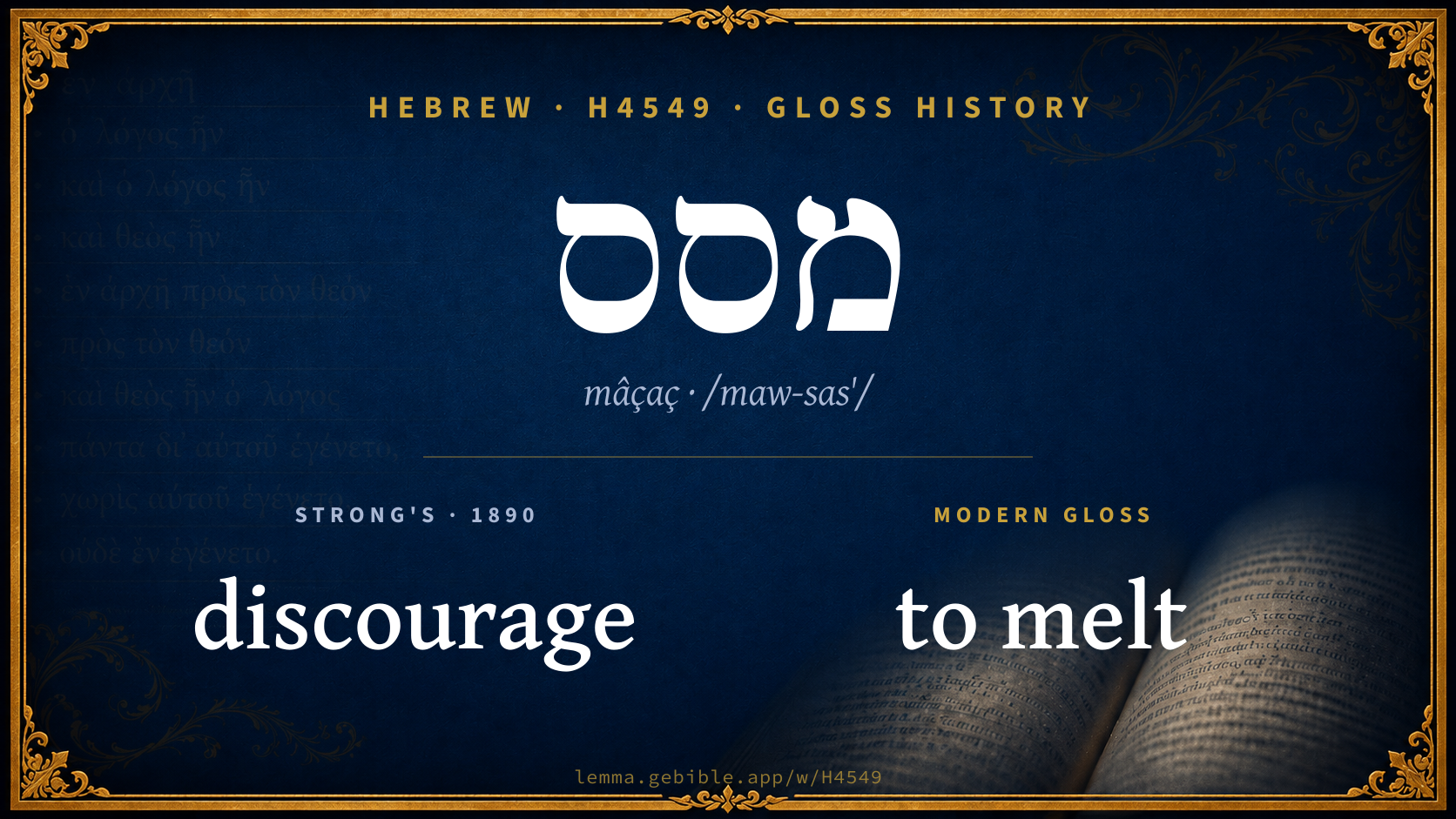
Gloss history
Strong's 1890 vs modern scholarship
About this word
Strong's H4549 catalogs a Hebrew word from the Hebrew Old Testament.
These counts are not copied from any lexicon or concordance. They are computed here, from the morphology-tagged Hebrew Old Testament. What Lemma adds →
- 20
- distinct verses
- The word appears in 20 distinct verses.
- 11 / 39
- OT books
- The word appears in 11 of 39 Old Testament books.
- #1,462
- by frequency
- Top 2500 most frequent Hebrew words (rank 1,462 of 8,640 Hebrew words by occurrence).
View all 20 occurrences in the concordance →
By section of the Old Testament
By traditional corpus
Conventional, traditional groupings — biblical authorship is debated, so this is a traditional corpus grouping, not an authorship claim. Each share is this word’s portion of its verses in that division of the Hebrew canon. Each figure is a share of the word’s 20 distinct verses.
- Prophets (Nevi'im) 13 verses · 65%
- Writings (Ketuvim) 4 verses · 20%
- Torah (Pentateuch) 3 verses · 15%
How translations render this word
Counts come from each version’s own published word-to-Strong’s tagging or interlinear alignment — an approximate guide to how each version renders this word, not a word-level alignment the data otherwise carries. Because each total is that version’s own tagged count, the per-version totals vary from one another and need not match the appearance or distinct-verse counts above. These counts may also differ from a printed concordance because Lemma counts each distinctly tagged rendering and does not collapse phrase taggings into a single head-word total. This is a fixed set of word-tagged versions (KJV, ASV, BSB, ULT) and does not change with the reading translation you choose elsewhere. Each version’s license is shown beside its name below (and on Sources).
- King James Version: Melted 4×, Shall melt 3×, Melteth 2×
- American Standard Version: Melted 4×, Melt 3×, Shall melt 3×
- Berean Standard Bible: Will melt 4×, Melt 3×, Melted 3×
- unfoldingWord Literal Text: And 5×, Melted 4×, Melt 3×
King James Version Public Domain
Renders H4549 across 21 tagged occurrences — most commonly:
Plus 12 renderings that appear only once — usually multi-word phrases or single function words the recovered tagging swept in, not distinct renderings.
American Standard Version Public Domain
Renders H4549 across 21 tagged occurrences — most commonly:
Plus 7 renderings that appear only once — usually multi-word phrases or single function words the recovered tagging swept in, not distinct renderings.
Berean Standard Bible Public Domain
Renders H4549 across 20 tagged occurrences — most commonly:
Plus 10 renderings that appear only once — usually multi-word phrases or single function words the recovered tagging swept in, not distinct renderings. Not rendered by a distinct English word in 1 further occurrence.
unfoldingWord Literal Text CC BY-SA 4.0
Renders H4549 across 30 tagged occurrences — most commonly:
Plus 13 renderings that appear only once — usually multi-word phrases or single function words the recovered tagging swept in, not distinct renderings.
Senses in the full BDB
Hebrew verbs can shift meaning by stem (binyan): Qal is the basic action, Niphal is often passive or reflexive, Piel often intensifies or makes it factitive, and Hiphil is typically causative. The senses below are grouped under the stem BDB assigns to each.
What do BDB’s symbols mean?
BDB uses these scholarly abbreviations:
| Symbol | Meaning |
|---|---|
| 𝔊 | the Septuagint (the ancient Greek translation, LXX) |
| 𝔙 | the Vulgate (the Latin translation) |
| 𝔖 | the Syriac version (the Peshitta) |
| 𝔗 | the Targum (the Aramaic translation) |
| ψ | the Psalms |
| √ | root (the underlying root or stem) |
| ‖ | parallel passage (a synonymous or contrasted parallel) |
| † | the dagger: every passage where the word occurs is cited |
The 6 senses and sub-senses the full Brown-Driver-Briggs lexicon distinguishes for this word, in lexicon order (not ranked by frequency), with BDB’s own verbatim wording and sub-sense lettering. Shown in Hebrew script with BDB’s own scholarly abbreviations. The condensed entry is in the Lexicon Entry tab. See also the Forms in the corpus table below.
Qal
- Inf. cstr. מְסֹס נֹסֵס Is 10:18; like the melting (wasting away) of a נֹסֵס (q.v.) e.g. Isaiah 10:18
Niphal
- Pf. וְנָמֵס consec. Ez 21:12; וְנָמָ֑ס Ex 16:21 ψ 112:10; נָמַ֫סּוּ ψ 97:5 + 2 times; Impf. יִמַּס Dt 20:8 +; וַיִּמַּסּוּ Ju 15:14; Inf. abs. הִמֵּס 2 S 17:10; cstr. id. ψ 68:3; Pt. נָמֵס ψ 22:15 + 2 times;— e.g. Ezekiel 21:12
- 1. melt (intr.) of manna Ex 16:21; wax ψ 68:3 (sim. of wicked); manacles Ju 15:14 (=vanished, dropped off); wicked ψ 112:10 (melt away); especially of hills and mts. Mi 1:4 ψ 97:5 Is 34:3. e.g. Exodus 16:21
- 2. most often fig. of heart=faint, grow fearful, Na 2:11 2 S 17:10(×2) Dt 20:8 (Ges§ 121 b) Jos 2:11; 5:2; 7:5 Is 13:7; 19:1 Ez 21:12 ψ 22:15. e.g. Nahum 2:11
- 3. Pt.=wasted, consumptive (?), 1 S 15:9 (‖ נְמִבְזָה, read נִבְזָה v. בזה Niph.) נִמְאֶסֶת worthless, lit. rejected (v. מאס Niph.) e.g. 1 Samuel 15:9
Hiphil
- Pf. 3 pl. הֵמַסּוּ אֶת־לְבָבֵנוּ Dt 1:28 cause to melt (=intimidate). e.g. Deuteronomy 1:28
Senses from the full Brown-Driver-Briggs lexicon (Brown, Driver, Briggs; Oxford 1906 — public domain), digitized via Sefaria, supplemented by the OpenScriptures HebrewLexicon (CC BY 4.0). Full attribution on Sources.
Word origin
vb. dissolve, melt, intr. (𝔗 מְסַס; cf. מסה, and II. מאס);—
— Brown-Driver-Briggs (Oxford 1906, public domain), digitized via Sefaria, supplemented by the OpenScriptures HebrewLexicon (CC BY 4.0). See Sources.
Origin: a primitive root
Jastrow Dictionary
A second Hebrew/Aramaic lexicon for comparison, covering Aramaic and post-biblical (Talmudic, Targumic, Midrashic) usage that the biblical-Hebrew BDB does not. Matched by lemma rather than by Strong’s number, so a lemma may carry more than one Jastrow headword (shown separately below), and the entries cover usage well beyond the Bible.
הֶמְסֵס
- (מָסַס) [the dissolving (digesting) receptacle,] the first stomach of ruminants, cmp. הַבְלִילָא. Ḥull. III, 1 המסס (= הַהֶ׳, or הַמָּסָס). Lev. R. s. 4; Midr. Till. to Ps. CIII, beg. המ׳ לטחון the first stomach has the function of grinding (the food). Lev. R. s. 18; Koh. R. to XII, 3 ‘the grinders’ (ib.) זו ה׳ that is the stomach. [From later usage, e.g. Tur Yoré Deah 49, and from its Chald. equivalent it would seem that our w. is הֶמְסֵס, and the definite article fused with the ה of the noun.]
מָסַס
- (b. h.) to melt, dissolve.
- , נִימּוֹס, נִימַּס to melt, be liquefied; to fall away; to faint; to despair. Ex. R. s. 25 נִימּוֹסִּין (Var. נִימַּסִּין) they faint. Yalk. ib. 251 התחילו נְמַסִּין they began to lose heart; Mekh. B’shall., Shir., s. 9 לֵהָמֵס. Deut. R. s. 1, end תִּימַּס עינו וכ׳ may this man’s (thy) eye run out. Maasr. I, 2 הרמונים משיִמַּסּוּ pomegranates are subject to tithes when their core becomes pulpy; expl. Y. ib. 48ᵈ bot. משיתמעך אוכל וכ׳ (cmp. מִסְמֵס II) when the eatable portion (core) can be mashed under one’s fingers; [anoth. definition taking our w. in the sense of falling away, diminution; משיכניסו מחצה when the ripening core is reduced to half the capacity of the cavity,—upon which the remark is made, דילמא … הֵמַסּוּ … פלגון לבבנו perhaps he learned it from the homiletical teachers who interpret hemassu &c. (Deut. I, 28), they divided our hearts (an allusion to Num. R. s. 17)]. e.g. Deuteronomy 1:28
- to cause to melt away. Deut. R. s. 2, beg. (ref. to Ps. XXXIX, 12) כל חמדה … הֵמַסְתָּ אותה וכ׳ (not אותו) all the delight which Moses longed for, to enter the land,—thou hast caused it to decay as a moth enters garments and makes them decay. V. מָסָה. e.g. Psalms 39:12
מְסַס
- Targ. II Sam. XVII, 10 מִמַס ימסי (ed. Lag. מִמְסָא מסי), v. מְסֵי
- to melt, decay. Targ. Ps. LXXV, 4.—[אִמִּיס, v. מְאִיס.]
מָסָס
- stomach, v. הֶמְסֵס.
A Dictionary of the Targumim, the Talmud Babli and Yerushalmi, and the Midrashic Literature (Marcus Jastrow; London, Luzac, 1903) — Public Domain. Digitized via Sefaria. Digitized via Sefaria. Full attribution on Sources.
Forms in the corpus
The 20 distinct written forms H4549 takes in the Hebrew Bible, most frequent first — each parse links to that stem’s occurrences in the concordance. Hebrew forms include their vowel points and cantillation, so a single lemma takes many written forms.
Same root — word family
Other BDB entries built from the same root as H4549, grouped by Strong’s listed origin. These share a root / origin per the lexicon — not necessarily a shared meaning. Each links to that word’s own entry.
Derived from this word
Compare all same-root words → They share a root, not necessarily a meaning.
Septuagint verse parallels
This word appears in 18 verses that also exist in the Greek Old Testament (Septuagint), out of the 20 Hebrew verses it occurs in. You can read those verses in Greek by switching the Old Testament edition to the Septuagint.
Read these verses in the Septuagint
- Exodus 16:21
- Deuteronomy 1:28
- Joshua 2:11
- Judges 15:14
- 1 Samuel 15:9
- 2 Samuel 17:10
- Psalms 68:2
- Isaiah 10:18
- Ezekiel 21:7
- Micah 1:4
- Nahum 2:10
This is a verse-level parallel only — the same verses exist in both the Hebrew and Greek Old Testaments. No word-level Hebrew↔Greek correspondence is claimed: the data carries no such alignment, so no Greek word is shown as this Hebrew word’s translation. Coverage is not total — the Septuagint omits the deuterocanon and renumbers the Psalms, so some Hebrew verses have no direct Greek parallel.