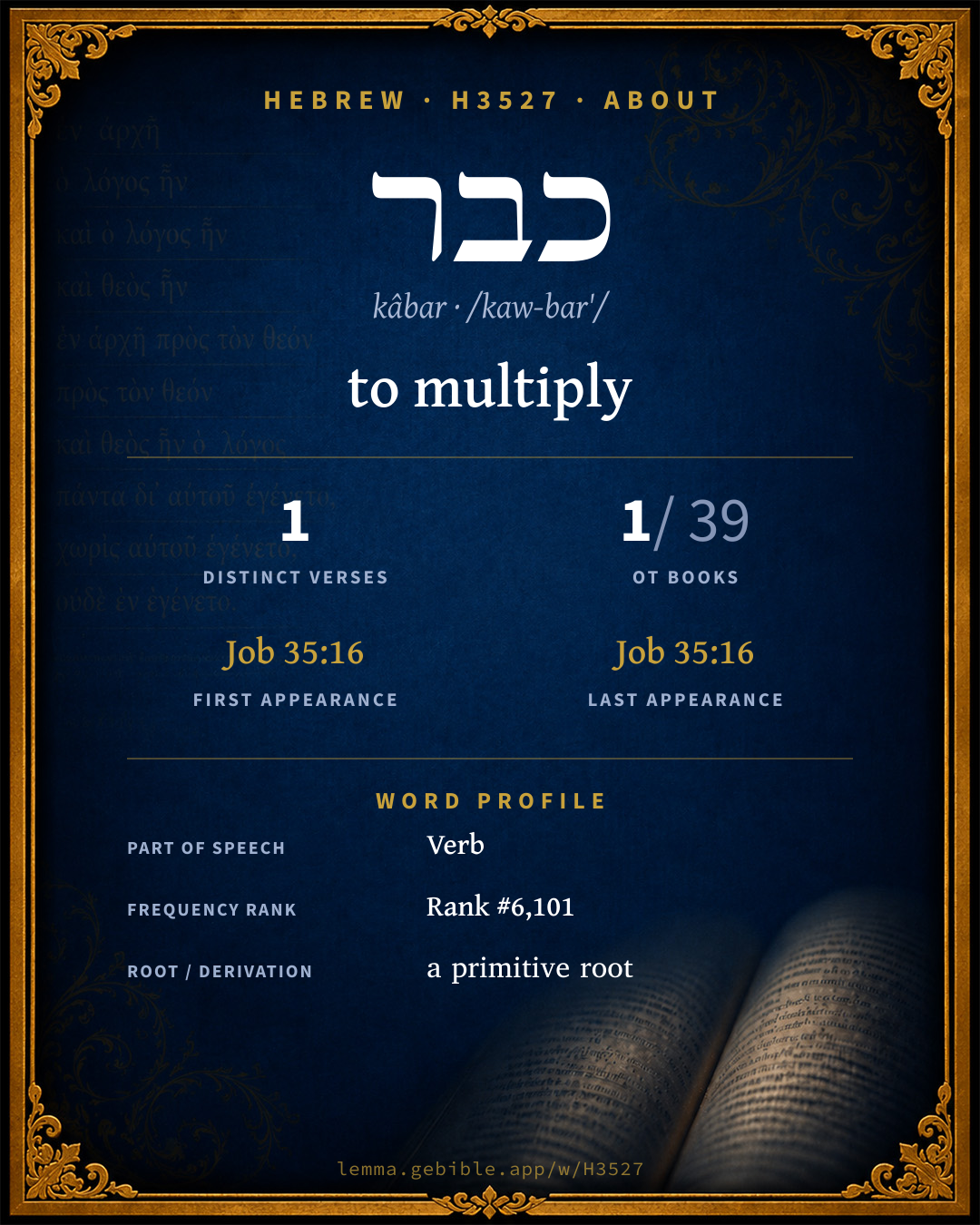
כָּבַר
to multiply
‘to multiply’ is one of 2 main senses fuller range ↓
Full lexicon entry — Brown-Driver-Briggs (BDB)
From Brown-Driver-Briggs (BDB)
Where this word appears
Grammar key — what these labels mean
Part of speech
- Verb
- An action or state-of-being word.
Stem
- Hiphil
- The causative active stem (“he caused / brought about”).
Form
- Imperfect
- An incomplete, ongoing, or future action (“he will / would write”).
Person
- 3rd Person
- The one spoken about (“he / she / it / they”).
Gender
- Masculine
- Grammatically masculine.
Number
- Singular
- One.
Every verse where H3527 appears — 1 distinct verse across 1 book. Click any verse to open its interlinear word-by-word view. Verse text shown in the World English Bible for context — . Each verse’s Hebrew form is shown with its reference; the English is not keyword-highlighted, since the data carries no word-level English alignment. Use “Compare translations” on any verse to read it across multiple English versions. This concordance covers the Hebrew Bible; Septuagint (Greek Old Testament) occurrences are not indexed here.
Job 1 verse
About this entry
At a glance — auto-summarized from this page’s data, not written by a person. Every figure links to its source below. This summary describes the numbers; it doesn’t interpret them.
At its core, כבר (kâbar) means “to multiply.” It is rare — just 1 verse in the entire Hebrew Bible. The word gravitates to Job (100%). A true hapax — its single appearance is Job 35:16. Catalogued under 2 senses, its meaning is not single-sense. Each statement above links to its evidence; the full detail follows below.
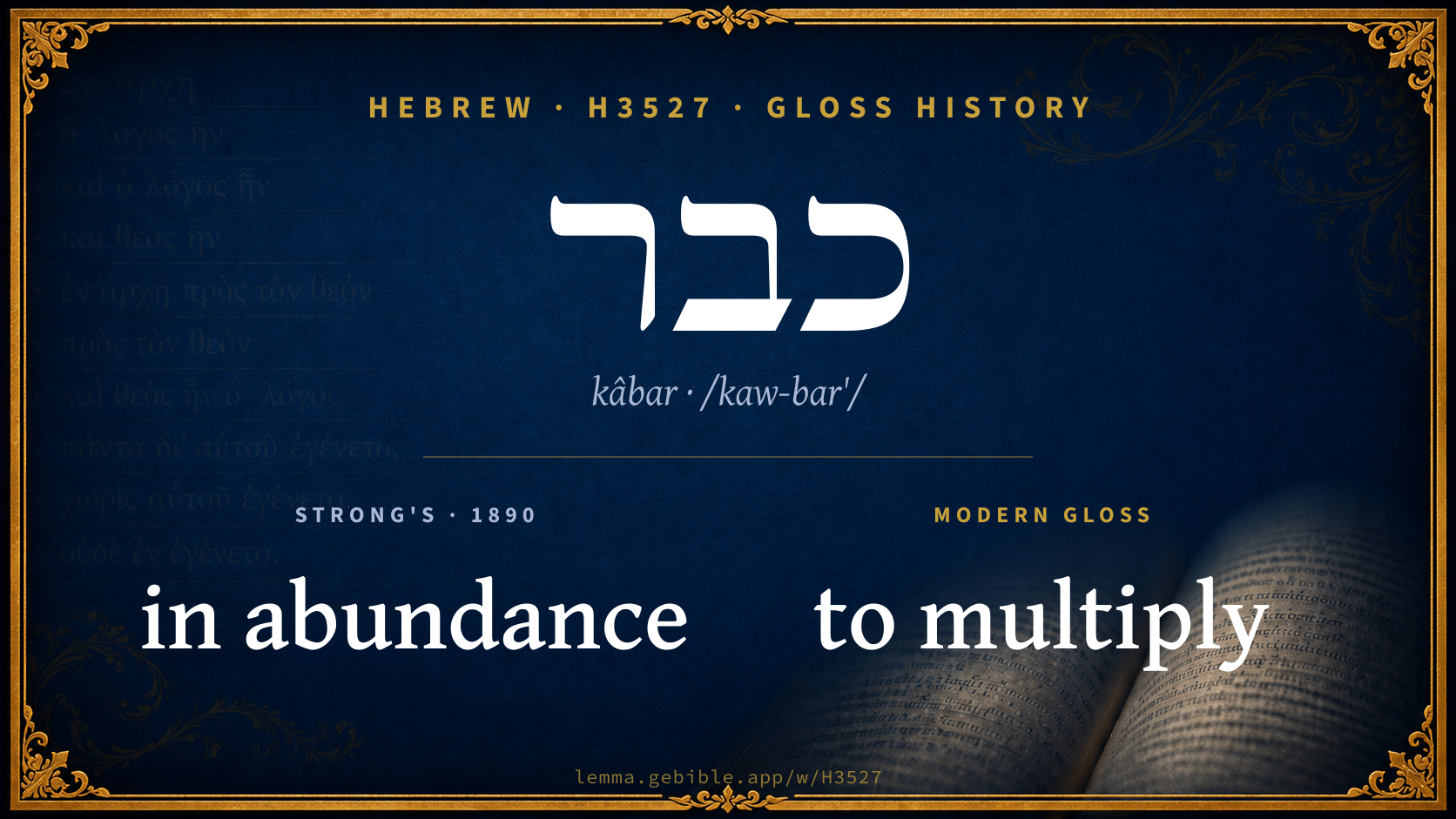
Gloss history
Strong's 1890 vs modern scholarship
About this word
Strong's H3527 catalogs a Hebrew word from the Hebrew Old Testament.
These counts are not copied from any lexicon or concordance. They are computed here, from the morphology-tagged Hebrew Old Testament. What Lemma adds →
- 1
- distinct verses
- The word appears in 1 distinct verse.
- 1 / 39
- OT books
- The word appears in 1 of 39 Old Testament books.
- #6,101
- by frequency
- Rank #6,101 (rank 6,101 of 8,640 Hebrew words by occurrence).
View all 1 occurrence in the concordance →
Most concentrated in
- Job 1 verse 100%
By section of the Old Testament
By traditional corpus
Conventional, traditional groupings — biblical authorship is debated, so this is a traditional corpus grouping, not an authorship claim. Each share is this word’s portion of its verses in that division of the Hebrew canon. Each figure is a share of the word’s 1 distinct verse.
- Writings (Ketuvim) 1 verse · 100%
How translations render this word
Counts come from each version’s own published word-to-Strong’s tagging or interlinear alignment — an approximate guide to how each version renders this word, not a word-level alignment the data otherwise carries. Because each total is that version’s own tagged count, the per-version totals vary from one another and need not match the appearance or distinct-verse counts above. These counts may also differ from a printed concordance because Lemma counts each distinctly tagged rendering and does not collapse phrase taggings into a single head-word total. This is a fixed set of word-tagged versions (KJV, ASV, BSB, ULT) and does not change with the reading translation you choose elsewhere. Each version’s license is shown beside its name below (and on Sources).
- King James Version: He multiplieth 1×
- American Standard Version: He multiplieth 1×
- Berean Standard Bible: Multiplies 1×
- unfoldingWord Literal Text: He multiplies 1×
King James Version Public Domain
Renders H3527 across 1 tagged occurrence — most commonly:
American Standard Version Public Domain
Renders H3527 across 1 tagged occurrence — most commonly:
Berean Standard Bible Public Domain
Renders H3527 across 1 tagged occurrence — most commonly:
unfoldingWord Literal Text CC BY-SA 4.0
Renders H3527 across 1 tagged occurrence — most commonly:
Senses in BDB
The 2 senses BDB distinguishes for this word, in lexicon order (not ranked by frequency or importance). The full entry — with sub-senses — is in the Lexicon Entry tab.
- to be much, be many, be in abundance, intertwine, multiply
- (Hiphil) to make many, make great
Word origin
Origin: a primitive root
Jastrow Dictionary
A second Hebrew/Aramaic lexicon for comparison, covering Aramaic and post-biblical (Talmudic, Targumic, Midrashic) usage that the biblical-Hebrew BDB does not. Matched by lemma rather than by Strong’s number, so a lemma may carry more than one Jastrow headword (shown separately below), and the entries cover usage well beyond the Bible.
כְּבָר I
- (b. h.) pr. n., נְהַר כ׳ river (or channel) K’bar (Chebar) in Babylonia. Gen. R. s. 16 הוא פרת הוא נ׳ כ׳ Euphrates and K. are the same. Ib. כ׳ בפני עצמו וכ׳ K. and Euphrates are different rivers. Ib. כ׳ שמימיו כלין it is called K’bar (v. next w.), because its waters give out; שפירותיו גסין ואינן יורדין בכברה because its fruits are large and go not into the basket; (Yalk. Gen. 22 שמימיו קַלִּין).
כְּבָר II
- (b. h.; = זמן כבר; כבר to be thick, strong, round) a long time since; long ago, already; once. Sabb. 51ᵃ, a. e. כ׳ הורה זקן it has already been decided by an authority. Ber. 63ᵃ bot. כ׳ בנית וכ׳ you have once built and can no more tear down, (having once praised me, you cannot now censure me). Y. Sabb. XIV, 14ᶜ bot. וכ׳ חלה וכ׳ and once when he was taken sick, and &c. Num. R. s. 3, end כ׳ נקדתי עליהם have I not put does upon them (to mark that the words are spurious)? [Ib. כ׳ אמחוק וכ׳, read: אוֹמַר I shall say, I will erase &c.]—Y. Gitt. VII, end, 49ᵃ מִכְּ׳ (retroactively) at once; a. fr.
כְּבַר I
- Targ. Koh. I, 10. Targ. Jer. XXXVIII, 9 כ׳ מית he would have been dead by this time; a. fr.—B. Bath. 167ᵃ, a. e. כ׳ קדמוך רבנן our rabbis have long preceded thee (have warned us before this); a. fr.
כָּבַר
- (denom. of כְּבָרָה) to sift. Gen. R. s. 4 אדם כּוֹבֵר בכברה … if one sifts wheat or straw in a sieve. Ohol. XVIII, 2 וכוֹבְרוֹ בשתי כברות and sifts it twice. Maasr. I, 6 הקיטניות משיִכְבּוֹר peas are subject to tithes from the time he sifts them. Ruth R., end וכ׳ את הצבר וכ׳ (not וכבד) and sifted one pile. Y. Ab. Zar. IV, 44ᵇ top … טוחנין כוללין, read כּוֹבְרִין; a. fr.—Part. pass. כָּבוּר. Y. Maasr. I, 49ᵃ bot. מן הכ׳ וכ׳ from the portion which has been sifted in behalf of that which has not.
- to be sifted. Tosef. Ter. X, 15 שדרכו לִיכָּבֵר (not לוכבד) which it is customary to sift.
כְּבַר II
- , Pa. כַּבֵּיר (denom. of כַּבָּרִיתָא) to fumigate with sulphur, to bleach. Ber. 27ᵇ לכַבָּרוּיֵי סלי to fumigate baskets. B. Kam. 93ᵇ דכַבְּרֵיה כברויי when he (in addition) bleached the wool with sulphur.
*כְּבַר III
- to be heavy, to grieve; Af. אַכְבִּיר to irritate, grieve, v. כְּבַד.
A Dictionary of the Targumim, the Talmud Babli and Yerushalmi, and the Midrashic Literature (Marcus Jastrow; London, Luzac, 1903) — Public Domain. Digitized via Sefaria. Digitized via Sefaria. Full attribution on Sources.
Same root — word family
Other BDB entries built from the same root as H3527, grouped by Strong’s listed origin. These share a root / origin per the lexicon — not necessarily a shared meaning. Each links to that word’s own entry.
Derived from this word
- כביר kᵉbîyr H3523 net
- כביר kabbîyr H3524 mighty
- כבר kᵉbâr H3528 already
- כברה kᵉbârâh H3531 sieve
- מכביר makbîyr H4342 abundance
- מכבר makbêr H4345 lattice
- מכבר makbâr H4346 netted cloth
Compare all same-root words → Showing 4 of 8 — not the complete family. They share a root, not necessarily a meaning.
Septuagint verse parallels
This word appears in 1 verse that also exists in the Greek Old Testament (Septuagint), out of the 1 Hebrew verse it occurs in. You can read those verses in Greek by switching the Old Testament edition to the Septuagint.
Read these verses in the Septuagint
This is a verse-level parallel only — the same verses exist in both the Hebrew and Greek Old Testaments. No word-level Hebrew↔Greek correspondence is claimed: the data carries no such alignment, so no Greek word is shown as this Hebrew word’s translation. Coverage is not total — the Septuagint omits the deuterocanon and renumbers the Psalms, so some Hebrew verses have no direct Greek parallel.