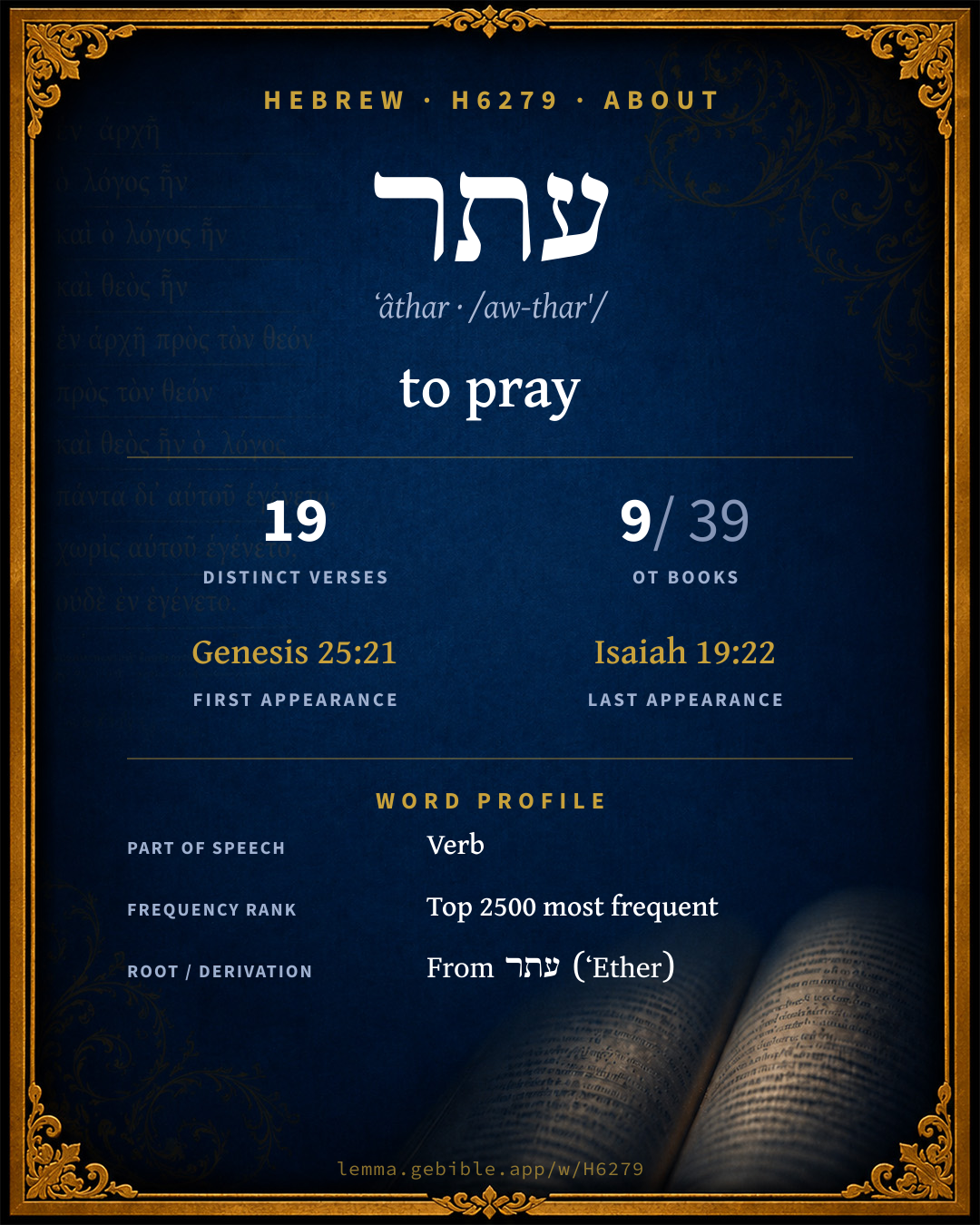
עָתַר
to pray
also: entreat, supplicate fuller range ↓
Full lexicon entry — Brown-Driver-Briggs (BDB)
From Brown-Driver-Briggs (BDB)
Where this word appears
See every Niphal verb in the Hebrew Bible →
Grammar key — what these labels mean
Part of speech
- Verb
- An action or state-of-being word.
Stem
- Niphal
- Usually the simple passive or reflexive of the Qal (“he was written”).
- Qal
- The basic, simple active stem — the plain form of the verb (“he wrote”).
- Hiphil
- The causative active stem (“he caused / brought about”).
Form
- Sequential Imperfect
- An imperfect with prefixed waw — the standard past-narrative form (waw-consecutive imperfect).
- Imperative
- A direct command (“write!”).
- Infinitive Absolute
- An unbound verbal noun, often intensifying or standing in for a finite verb.
- Infinitive Construct
- A bound verbal noun, frequently with prepositions (“to write / in writing”).
- Sequential Perfect
- A perfect with prefixed waw continuing a preceding imperfect or command (waw-consecutive perfect).
- Imperfect
- An incomplete, ongoing, or future action (“he will / would write”).
Person
- 3rd Person
- The one spoken about (“he / she / it / they”).
- 2nd Person
- The one addressed (“you”).
- 1st Person
- The speaker (“I / we”).
Gender
- Masculine
- Grammatically masculine.
- Common
- Either gender — not distinguished for this form.
Number
- Singular
- One.
- Plural
- More than one (in Hebrew, generally three or more).
Grammatical forms 10 distinct
- Verb, Niphal, Sequential Imperfect, 3rd Person, Masculine, Singular 5 times (25%)
- Verb, Qal, Sequential Imperfect, 3rd Person, Masculine, Singular 4 times (20%)
- Verb, Hiphil, Imperative, 2nd Person, Masculine, Plural 4 times (20%)
- Verb, Niphal, Infinitive Absolute 1 time (5%)
- Verb, Niphal, Infinitive Construct 1 time (5%)
- Verb, Niphal, Sequential Perfect, 3rd Person, Masculine, Singular 1 time (5%)
- Verb, Hiphil, Sequential Perfect, 1st Person, Common, Singular 1 time (5%)
- Verb, Hiphil, Imperfect, 1st Person, Common, Singular 1 time (5%)
+2 more forms (2 occurrences)
Parsed forms decoded from the imported morphology (morphhb / Westminster Leningrad Codex — WLC text public domain, morphhb tagging CC BY 4.0), counted across 20 parsed occurrences — not distinct verses.
Every verse where H6279 appears — 19 distinct verses across 9 books. Click any verse to open its interlinear word-by-word view. Verse text shown in the World English Bible for context — . Each verse’s Hebrew form is shown with its reference; the English is not keyword-highlighted, since the data carries no word-level English alignment. Use “Compare translations” on any verse to read it across multiple English versions. This concordance covers the Hebrew Bible; Septuagint (Greek Old Testament) occurrences are not indexed here.
Genesis 1 verse
Exodus 8 verses
- Exodus 8:8 הַעְתִּ֣ירוּ Hiphil impv 2mp Then Pharaoh called for Moses and Aaron, and said, "Entreat Yahweh, that he take away the frogs from me, and from my people; and I will let the people go, that they may sacrifice to Yahweh."
- Exodus 8:9 אַעְתִּ֣יר Hiphil impf 1cs Moses said to Pharaoh, "I give you the honor of setting the time that I should pray for you, and for your servants, and for your people, that the frogs be destroyed from you and your houses, and remain in the river only."
- Exodus 8:28 הַעְתִּ֖ירוּ Hiphil impv 2mp Pharaoh said, "I will let you go, that you may sacrifice to Yahweh your God in the wilderness, only you shall not go very far away. Pray for me."
- Exodus 8:29 וְ/הַעְתַּרְתִּ֣י conj + Hiphil wpf 1cs Moses said, "Behold, I go out from you, and I will pray to Yahweh that the swarms of flies may depart from Pharaoh, from his servants, and from his people, tomorrow; only don't let Pharaoh deal deceitfully any more in not letting the people go to sacrifice to Yahweh."
- Exodus 8:30 וַ/יֶּעְתַּ֖ר conj + Qal wimpf 3ms Moses went out from Pharaoh, and prayed to Yahweh.
- Exodus 9:28 הַעְתִּ֨ירוּ֙ Hiphil impv 2mp Pray to Yahweh; for there has been enough of mighty thunderings and hail. I will let you go, and you shall stay no longer."
- Exodus 10:17 וְ/הַעְתִּ֖ירוּ conj + Hiphil impv 2mp Now therefore please forgive my sin again, and pray to Yahweh your God, that he may also take away from me this death."
- Exodus 10:18 וַ/יֶּעְתַּ֖ר conj + Qal wimpf 3ms He went out from Pharaoh, and prayed to Yahweh.
Judges 1 verse
2 Samuel 2 verses
- 2 Samuel 21:14 וַ/יֵּעָתֵ֧ר conj + Niphal wimpf 3ms They buried the bones of Saul and Jonathan his son in the country of Benjamin in Zela, in the tomb of Kish his father: and they performed all that the king commanded. After that God was entreated for the land.
- 2 Samuel 24:25 וַ/יֵּעָתֵ֤ר conj + Niphal wimpf 3ms David built there an altar to Yahweh, and offered burnt offerings and peace-offerings. So Yahweh was entreated for the land, and the plague was stayed from Israel.
1 Chronicles 1 verse
2 Chronicles 2 verses
- 2 Chronicles 33:13 וַ/יֵּעָ֤תֶר conj + Niphal wimpf 3ms He prayed to him; and he was entreated of him, and heard his supplication, and brought him again to Jerusalem into his kingdom. Then Manasseh knew that Yahweh he was God.
- 2 Chronicles 33:19 וְ/הֵֽעָתֶר conj + Niphal inf.cs His prayer also, and how [God] was entreated of him, and all his sin and his trespass, and the places in which he built high places, and set up the Asherim and the engraved images, before he humbled himself: behold, they are written in the history of Hozai.
Ezra 1 verse
Job 2 verses
Isaiah 1 verse
About this entry
At a glance — auto-summarized from this page’s data, not written by a person. Every figure links to its source below. This summary describes the numbers; it doesn’t interpret them.
At its core, עתר (ʻâthar) means “to pray.” Ranging over 4 senses, its meaning includes “entreat” and “supplicate”. It turns up in 19 verses across 9 books, an uncommon footprint. The word gravitates to Exodus (42%), then 2 Samuel and 2 Chronicles. It first appears in Genesis 25:21. Each statement above links to its evidence; the full detail follows below.
Gloss history
Strong's 1890 vs modern scholarship

About this word
Strong's H6279 catalogs a Hebrew word from the Hebrew Old Testament.
These counts are not copied from any lexicon or concordance. They are computed here, from the morphology-tagged Hebrew Old Testament. What Lemma adds →
- 19
- distinct verses
- The word appears in 19 distinct verses.
- 9 / 39
- OT books
- The word appears in 9 of 39 Old Testament books.
- #1,513
- by frequency
- Top 2500 most frequent Hebrew words (rank 1,513 of 8,640 Hebrew words by occurrence).
View all 19 occurrences in the concordance →
Most concentrated in
- Exodus 8 verses 42%
- 2 Samuel 2 verses 11%
- 2 Chronicles 2 verses 11%
By section of the Old Testament
By traditional corpus
Conventional, traditional groupings — biblical authorship is debated, so this is a traditional corpus grouping, not an authorship claim. Each share is this word’s portion of its verses in that division of the Hebrew canon. Each figure is a share of the word’s 19 distinct verses.
- Torah (Pentateuch) 9 verses · 47%
- Writings (Ketuvim) 6 verses · 32%
- Prophets (Nevi'im) 4 verses · 21%
How translations render this word
Counts come from each version’s own published word-to-Strong’s tagging or interlinear alignment — an approximate guide to how each version renders this word, not a word-level alignment the data otherwise carries. Because each total is that version’s own tagged count, the per-version totals vary from one another and need not match the appearance or distinct-verse counts above. These counts may also differ from a printed concordance because Lemma counts each distinctly tagged rendering and does not collapse phrase taggings into a single head-word total. This is a fixed set of word-tagged versions (KJV, ASV, BSB, ULT) and does not change with the reading translation you choose elsewhere. Each version’s license is shown beside its name below (and on Sources).
- King James Version: Intreat 4×, Intreated 4×, He was intreated 3×
- American Standard Version: Entreat 4×, Entreated 4×, Was entreated 3×
- Berean Standard Bible: Prayed 3×, Pray 2×
- unfoldingWord Literal Text: And 4×, Pray 4×, He was entreated 3×
King James Version Public Domain
Renders H6279 across 20 tagged occurrences — most commonly:
Plus 6 renderings that appear only once — usually multi-word phrases or single function words the recovered tagging swept in, not distinct renderings.
American Standard Version Public Domain
Renders H6279 across 20 tagged occurrences — most commonly:
Plus 9 renderings that appear only once — usually multi-word phrases or single function words the recovered tagging swept in, not distinct renderings.
Berean Standard Bible Public Domain
Renders H6279 across 20 tagged occurrences — most commonly:
Plus 15 renderings that appear only once — usually multi-word phrases or single function words the recovered tagging swept in, not distinct renderings.
unfoldingWord Literal Text CC BY-SA 4.0
Renders H6279 across 25 tagged occurrences — most commonly:
Plus 9 renderings that appear only once — usually multi-word phrases or single function words the recovered tagging swept in, not distinct renderings.
Senses in BDB
The 4 senses BDB distinguishes for this word, in lexicon order (not ranked by frequency or importance). The full entry — with sub-senses — is in the Lexicon Entry tab.
- to pray, entreat, supplicate
- (Qal) to pray, entreat
- (Niphal) to be supplicated, be entreated
- (Hiphil) to make supplication, plead
Word origin
עָתַר pray, supplicate (always to God)
— Brown-Driver-Briggs (Oxford 1906, public domain), digitized via Sefaria, supplemented by the OpenScriptures HebrewLexicon (CC BY 4.0). See Sources.
Derived from עתר (ʻEther) (H6281) — Ether.
Jastrow Dictionary
A second Hebrew/Aramaic lexicon for comparison, covering Aramaic and post-biblical (Talmudic, Targumic, Midrashic) usage that the biblical-Hebrew BDB does not. Matched by lemma rather than by Strong’s number, so a lemma may carry more than one Jastrow headword (shown separately below), and the entries cover usage well beyond the Bible.
עֲתַר
- = h. עָשַׁר
- 1. to be rich, grow rich. Targ. Deut. XXXII, 15 עַתַר ed. Berl. (oth. ed., a. Y. עַתַּר). Targ. Ez. XXVII, 25. Targ. Zech. XI, 5 ed. Lag. (ed. Wil. Af.). Targ. Prov. XXI, 17; a. e.
- 2. to make rich, v. infra.
- 1. to make rich. Targ. Gen. XIV, 23 (ed. Berl. עֲתַ׳, oth. ed. עֲתִ׳; Y. I אַעַתָּרִית Af.). Targ. I Sam. II, 7; a. fr.—Yoma 25ᵇ מְעַתְּרָא it (offering frankincense) makes rich.
- 2. to proclaim rich. Targ. Prov. XIII, 7 (some ed. Af.).—[Gen. R. s. 45 עתר לך Ar. (ed. עביד), read: עַתַּד, v. עֲתַד.]
- 1. to make rich, v. supra.
- 2. to become rich. Targ. Ps. XLIX, 17 יַעְתִּיר Ms. (ed. Ithpa.). Targ. Zech. XI, 5 (v. supra); a. e.
- 1. to become rich. Targ. Ps. l. c.—B. Mets. 59ᵃ דתִתְעַתְּרוּ, v. יְקַר Af.; Yalk. Gen. 68. Hor. 10ᵇ אִיעַתְּרִיתוּ פורתא have you acquired a little wealth? Ned. 50ᵃ; a. e.—
- *2. to endure, prosper. Targ. Job XV, 29 יִתְעַתַּר ed. Lag. (oth. ed. יתעתד, v. עֲתַד).
עֵתֶר
- (עתר, v. עֲתִירָה) shovel or pitchfork. Tosef. Ukts. I, 5 מפני שהופכה בע׳ because he is used to turn it up with the shovel; Succ. 14ᵃ מפני שראויות להופכן בע׳. Ib.; Yeb. 64ᵃ למה … כע׳ מה ע׳ זה מהפך וכ׳ why is the prayer of the righteous symbolized by a shovel (the root עתר being used for praying, v. עֲתִירָה II)? As the shovel turns the grain from place to place, so the prayer of the righteous turns the dispensations of the Lord from anger to mercy; Num. R. s. 10 (with ref. to ויעתר, Jud. XIII, 8). e.g. Judges 13:8
A Dictionary of the Targumim, the Talmud Babli and Yerushalmi, and the Midrashic Literature (Marcus Jastrow; London, Luzac, 1903) — Public Domain. Digitized via Sefaria. Digitized via Sefaria. Full attribution on Sources.
Forms in the corpus
The 18 distinct written forms H6279 takes in the Hebrew Bible, most frequent first — each parse links to that stem’s occurrences in the concordance. Hebrew forms include their vowel points and cantillation, so a single lemma takes many written forms.
Septuagint verse parallels
This word appears in 17 verses that also exist in the Greek Old Testament (Septuagint), out of the 19 Hebrew verses it occurs in. You can read those verses in Greek by switching the Old Testament edition to the Septuagint.
Read these verses in the Septuagint
- Genesis 25:21
- Exodus 8:8
- Judges 13:8
- 2 Samuel 21:14
- 1 Chronicles 5:20
- 2 Chronicles 33:13
- Ezra 8:23
- Job 22:27
- Isaiah 19:22
This is a verse-level parallel only — the same verses exist in both the Hebrew and Greek Old Testaments. No word-level Hebrew↔Greek correspondence is claimed: the data carries no such alignment, so no Greek word is shown as this Hebrew word’s translation. Coverage is not total — the Septuagint omits the deuterocanon and renumbers the Psalms, so some Hebrew verses have no direct Greek parallel.