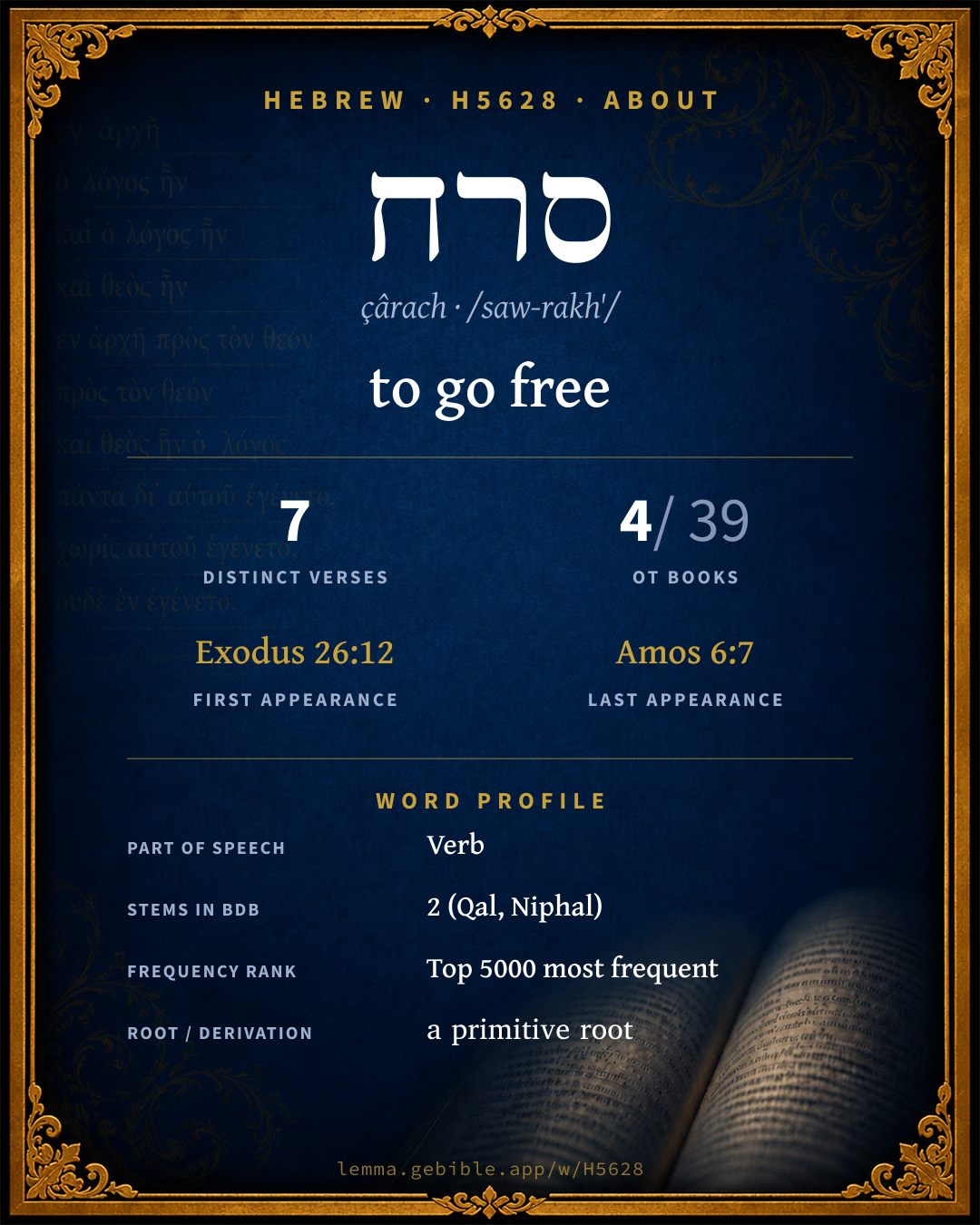
סָרַח
to go free
also: be unrestrained, be overrun, exceed, overhang fuller range ↓
Full lexicon entry — Brown-Driver-Briggs (BDB)
From Brown-Driver-Briggs (BDB)
Where this word appears
See every Qal verb in the Hebrew Bible →
Grammar key — what these labels mean
Part of speech
- Verb
- An action or state-of-being word.
Stem
- Qal
- The basic, simple active stem — the plain form of the verb (“he wrote”). Here: ‘go free’
- Niphal
- Usually the simple passive or reflexive of the Qal (“he was written”).
Form
- Participle Passive
- A verbal adjective expressing action received (“written”).
- Perfect
- A completed action or state — Hebrew marks aspect (completeness) more than strict tense (“he wrote”).
- Imperfect
- An incomplete, ongoing, or future action (“he will / would write”).
- Participle Active
- A verbal adjective expressing ongoing or characteristic action (“writing / one who writes”).
State
- Absolute
- The independent form of a noun, not bound to a following word.
- Construct
- A noun bound to a following noun in a possessive / “of” relationship (the construct chain).
Person
- 3rd Person
- The one spoken about (“he / she / it / they”).
Gender
- Masculine
- Grammatically masculine.
- Feminine
- Grammatically feminine.
Number
- Plural
- More than one (in Hebrew, generally three or more).
- Singular
- One.
Grammatical forms
- Verb, Qal, Participle Passive, Masculine, Plural, Absolute 2 times (29%)
- Verb, Niphal, Perfect, 3rd Person, Feminine, Singular 1 time (14%)
- Verb, Qal, Imperfect, 3rd Person, Feminine, Singular 1 time (14%)
- Verb, Qal, Participle Active, Feminine, Singular, Absolute 1 time (14%)
- Verb, Qal, Participle Passive, Masculine, Plural, Construct 1 time (14%)
- Verb, Qal, Participle Passive, Masculine, Singular, Absolute 1 time (14%)
Parsed forms decoded from the imported morphology (morphhb / Westminster Leningrad Codex — WLC text public domain, morphhb tagging CC BY 4.0), counted across 7 parsed occurrences — not distinct verses.
Every verse where H5628 appears — 7 distinct verses across 4 books. Click any verse to open its interlinear word-by-word view. Verse text shown in the World English Bible for context — . Each verse’s Hebrew form is shown with its reference; the English is not keyword-highlighted, since the data carries no word-level English alignment. Use “Compare translations” on any verse to read it across multiple English versions. This concordance covers the Hebrew Bible; Septuagint (Greek Old Testament) occurrences are not indexed here.
Exodus 2 verses
- Exodus 26:12 תִּסְרַ֕ח Qal impf 3fs The overhanging part that remains of the curtains of the tent, the half curtain that remains, shall hang over the back of the tent.
- Exodus 26:13 סָר֜וּחַ Qal ptcp.pass ms The cubit on the one side, and the cubit on the other side, of that which remains in the length of the curtains of the tent, shall hang over the sides of the tent on this side and on that side, to cover it.
Jeremiah 1 verse
Ezekiel 2 verses
- Ezekiel 17:6 סֹרַ֜חַת Qal ptcp.act fs It grew, and became a spreading vine of low stature, whose branches turned toward him, and the roots of it were under him: so it became a vine, and brought forth branches, and shot forth sprigs.
- Ezekiel 23:15 סְרוּחֵ֤י Qal ptcp.pass mp cs girded with girdles on their loins, with flowing turbans on their heads, all of them princes to look on, after the likeness of the Babylonians in Chaldea, the land of their birth.
Amos 2 verses
- Amos 6:4 וּ/סְרֻחִ֖ים conj + Qal ptcp.pass mp Who lie on beds of ivory, And stretch themselves on their couches, And eat the lambs out of the flock, And the calves out of the midst of the stall;
- Amos 6:7 סְרוּחִֽים Qal ptcp.pass mp Therefore they will now go captive with the first who go captive; And the feasting and lounging will end.
About this entry
At a glance — auto-summarized from this page’s data, not written by a person. Every figure links to its source below. This summary describes the numbers; it doesn’t interpret them.
סרח (çârach) is a Hebrew verb most often rendered “to go free.” Scripture first uses it in Exodus 26:12. Spanning 7 verses in 4 books, it ranks among the uncommon words of the Hebrew Bible. Exodus dominates its distribution — 2 of 7 verses. As a verb its force shifts by stem, across 2 stems (Qal, Niphal, and more). The sections below give every sense, occurrence, and version rendering.
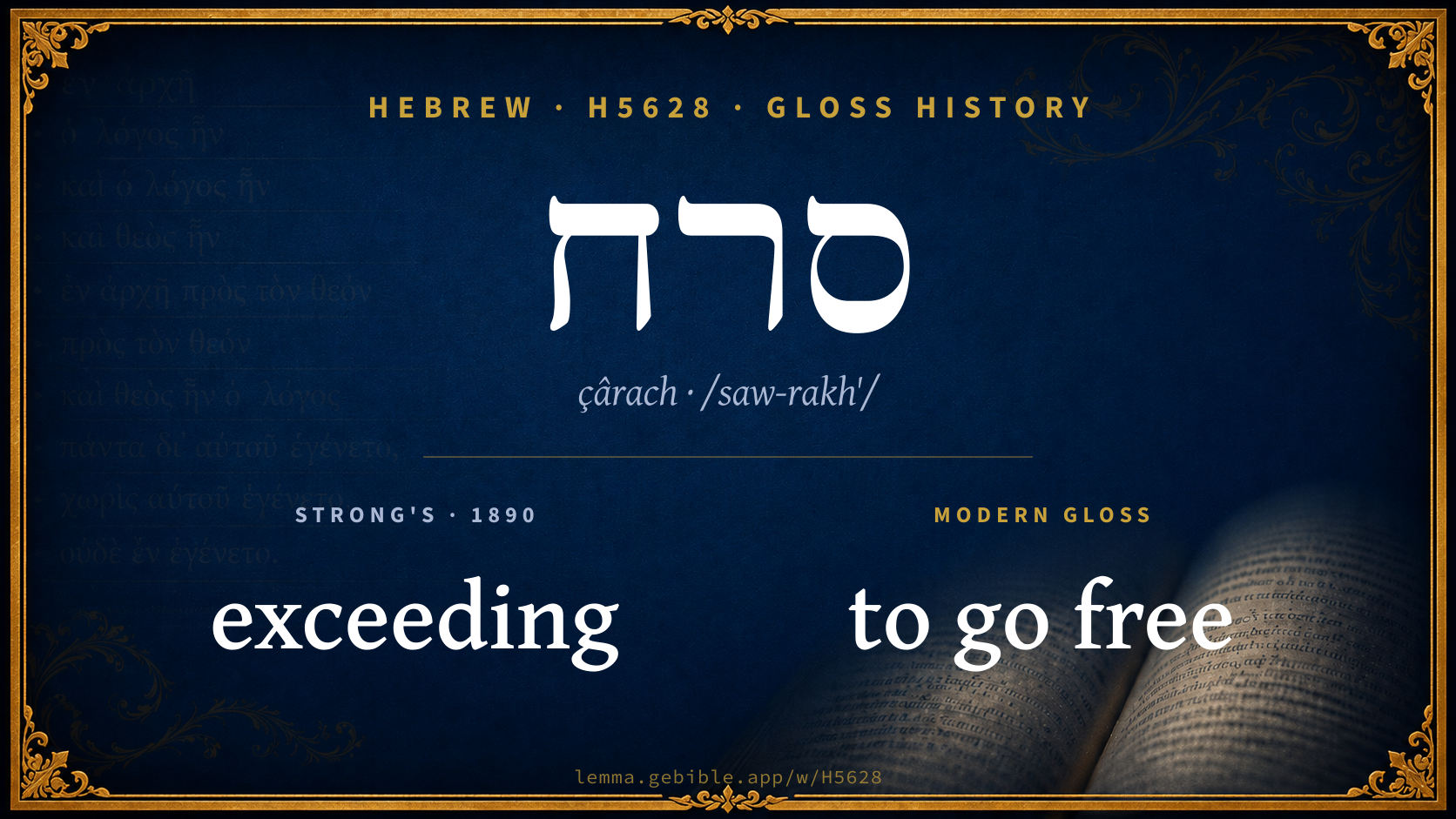
Gloss history
Strong's 1890 vs modern scholarship
About this word
Strong's H5628 catalogs a Hebrew word from the Hebrew Old Testament.
These counts are not copied from any lexicon or concordance. They are computed here, from the morphology-tagged Hebrew Old Testament. What Lemma adds →
- 7
- distinct verses
- The word appears in 7 distinct verses.
- 4 / 39
- OT books
- The word appears in 4 of 39 Old Testament books.
- #2,835
- by frequency
- Top 5000 most frequent Hebrew words (rank 2,835 of 8,640 Hebrew words by occurrence).
View all 7 occurrences in the concordance →
By section of the Old Testament
By traditional corpus
Conventional, traditional groupings — biblical authorship is debated, so this is a traditional corpus grouping, not an authorship claim. Each share is this word’s portion of its verses in that division of the Hebrew canon. Each figure is a share of the word’s 7 distinct verses.
- Prophets (Nevi'im) 5 verses · 71%
- Torah (Pentateuch) 2 verses · 29%
How translations render this word
Counts come from each version’s own published word-to-Strong’s tagging or interlinear alignment — an approximate guide to how each version renders this word, not a word-level alignment the data otherwise carries. Because each total is that version’s own tagged count, the per-version totals vary from one another and need not match the appearance or distinct-verse counts above. These counts may also differ from a printed concordance because Lemma counts each distinctly tagged rendering and does not collapse phrase taggings into a single head-word total. This is a fixed set of word-tagged versions (KJV, ASV, BSB, ULT) and does not change with the reading translation you choose elsewhere. Each version’s license is shown beside its name below (and on Sources).
- King James Version: Shall hang 2×
- American Standard Version: Shall hang 2×
- Berean Standard Bible: Decayed 1×, Flowing 1×, Hang 1×
- unfoldingWord Literal Text: Had 1×, Hang 1×, Lounge 1×
King James Version Public Domain
Renders H5628 across 7 tagged occurrences — most commonly:
Plus 5 renderings that appear only once — usually multi-word phrases or single function words the recovered tagging swept in, not distinct renderings.
American Standard Version Public Domain
Renders H5628 across 7 tagged occurrences — most commonly:
Plus 5 renderings that appear only once — usually multi-word phrases or single function words the recovered tagging swept in, not distinct renderings.
Berean Standard Bible Public Domain
Renders H5628 across 7 tagged occurrences — most commonly:
unfoldingWord Literal Text CC BY-SA 4.0
Renders H5628 across 6 tagged occurrences — most commonly:
Senses in the full BDB
Hebrew verbs can shift meaning by stem (binyan): Qal is the basic action, Niphal is often passive or reflexive, Piel often intensifies or makes it factitive, and Hiphil is typically causative. The senses below are grouped under the stem BDB assigns to each.
What do BDB’s symbols mean?
BDB uses these scholarly abbreviations:
| Symbol | Meaning |
|---|---|
| 𝔊 | the Septuagint (the ancient Greek translation, LXX) |
| 𝔙 | the Vulgate (the Latin translation) |
| 𝔖 | the Syriac version (the Peshitta) |
| 𝔗 | the Targum (the Aramaic translation) |
| ψ | the Psalms |
| √ | root (the underlying root or stem) |
| ‖ | parallel passage (a synonymous or contrasted parallel) |
| † | the dagger: every passage where the word occurs is cited |
The 3 senses and sub-senses the full Brown-Driver-Briggs lexicon distinguishes for this word, in lexicon order (not ranked by frequency), with BDB’s own verbatim wording and sub-sense lettering. Shown in Hebrew script with BDB’s own scholarly abbreviations. The condensed entry is in the Lexicon Entry tab. See also the Forms in the corpus table below.
Qal
- 1. go free, be unrestrained
- 2. of overhanging stuffs (prop. overrunning, exceeding, extended beyond limits)
Niphal
- . usu. is their wisdom let loose (i.e. dismissed, gone)?; but is corrupt
Senses from the full Brown-Driver-Briggs lexicon (Brown, Driver, Briggs; Oxford 1906 — public domain), digitized via Sefaria, supplemented by the OpenScriptures HebrewLexicon (CC BY 4.0). Full attribution on Sources.
Word origin
[ סָרַח ] vb. go free, be unrestrained, overrun, exceed
— Brown-Driver-Briggs (Oxford 1906, public domain), digitized via Sefaria, supplemented by the OpenScriptures HebrewLexicon (CC BY 4.0). See Sources.
Origin: a primitive root
Jastrow Dictionary
A second Hebrew/Aramaic lexicon for comparison, covering Aramaic and post-biblical (Talmudic, Targumic, Midrashic) usage that the biblical-Hebrew BDB does not. Matched by lemma rather than by Strong’s number, so a lemma may carry more than one Jastrow headword (shown separately below), and the entries cover usage well beyond the Bible.
סָרַח I
- (Saf. of ארח; cmp. סרג, סרך) to entangle, intercept. Y. Succ. V, 55ᶜ bot. מפני שהוא סוֹרֵחַ את הנעימה because it (the sound of the organ) intercepts (confounds) the melody of the song; (Arakh. 10ᵇ מערבב)—Esp. (of a rough-edged surface) to catch (cmp. סִכְסֵךְ); to lacerate. Kel. XXX, 4 סוֹרַחַת את היד it (the flask whose mouth is broken off) catches the hand (when you attempt to get the aromatic unguent out). Tosef. Kel. B. Bath. VII, 10 סוֹרְחִין את הפה the rough edges lacerate the lips (R. S. to Kel. XXX, 3 סורקים, read סוֹרְחִים).
- same, to lacerate. Keth. 61ᵇ שפשתן מַסְרִיחַ את הפה the flax (which the spinner moistens with saliva) makes the mouth sore; Y. ib. V, 30ᵃ bot. מַסְרַחַת, v. שִׁלְבֵּק.
- to clutch, grasp. Erub. 54ᵃ (ref. to Ps. LXVIII, 11) אם אדם משים … שמְסָרֶחֶת ואוכלת וכ׳ if one makes himself like a beast of prey which seizes (with its claws) and eats (differ. in comment.), his learning will stay with him, i.e. only he who is plain in his living will become a scholar; Yalk. Ps. 795. e.g. Psalms 68:11
סְרַח
- ; Af. אַסְרַח to clutch. Targ. Prov. XXVIII, 15 מַסְרִיחַ Ms. (ed. מַצְרִיחַ; h. text שקק).
סָרַח II
- Saf. of רוח, cmp. רָוַח; cmp. Arab. saraḥa) to be or to make wide; to extend.—Part. pass. סָרוּחַ; f. סְרוּחָה; pl. סְרוּחִים, סְרוּחִין; סְרוּחות a) overhanging, flapping. Yoma 83ᵇ ואזניו ס׳ and his (the mad dog’s) ears flap.—b) (v. Am. VI, 4; 7) stretched indolently on the couch, banqueting. M. Kat. 28ᵇ; Keth. 69ᵇ; Yalk. Am. 545 נעשה שר לס׳, v. מַר II. Num. R. s. 9, v. סוּר I.—c) emasculated, impotent. Gen. R. s. 32 (ref. to Gen. VII, 16) פרט לס׳ ומחוסרי וכ׳ (ed. Leipz. סרוסים, corr. acc.) to the exclusion of emasculated animals (impotent from old age; ‘Rashi’: animals having overhanging, double, limbs) and mutilated ones. Deut. R. s. 3 (expl. עקר וכ׳, ib. VII, 14) ס׳ ואילוניות (some ed. סריסין) impotent men or barren women. e.g. Amos 6:4
סְרַח ²
- , to hang over. Targ. O. Ex. XXVI, 12. Part. סְרִיחַ. Ib. 13.
- to cause to hang over. Part. pass. מְסָרַח. B. Kam. 117ᵃ ומְסָרְחֵי וכ׳, v. גְּבִינָא I.
סָרַח III
- (v. precd.; cmp. רִיחַ) to evaporate, be decomposed; to decay; to smell badly.—Part. pass. סָרוּחַ; f. סְרוּחָה; pl. סְרוּחִים, סְרוּחִין; סְרוּחוֹת. Ter. III, 1; a. fr.—Trnsf. a) (cmp. חָמַץ) to sin, offend. Snh. 71ᵇ; Keth. 45ᵃ סָרְחָה ולבסוף בגרה if she sinned (had intercourse) and afterwards became of age. Num. R. s. 13 אם אינה סוֹרַחַת … ואם סורחת מלקה (not סוחרת) is she (the ass whom he rides) is not mischievous, he does not strike her, but if she is, he strikes her; Yalk. Lev. 554; Yalk. Prov. 959. Ib. שאם יִסְרַח יהא וכ׳ to chastise him with them in case he should offend. Yoma 75ᵃ הוא ס׳ עלי he (my husband) acted offensively towards me; היא סרחה וכ׳ she acted offensively &c. Ib. 77ᵃ סרחה אומתך thy people has degenerated. Midr. Till. to Ps. VI סרחה עליו מדינתו one of his provinces rebelled against him. Ex. R. s. 43 סָרַחְתָּ כל הסרחון הזה וכ׳ thou hast done all that mischief, and thou criest? Ex. R. s. 42 לא היה לכם לִסְרוֹחַ וכ׳ you ought not to have sinned either on the second or the third day, but must you sin on the very first day?; a. fr.—b) to become senseless (cmp. טַעַם); to be stupid. Sot. IX, 15 (49ᵇ) והכמות סופרים תִּסְרַח (or תִּסָּרֵחַ Nif.) and the wisdom of the scholars shall become vapid (v. Jer. XLIX, 7); Snh. 97ᵃ; Cant. R. to II, 13; Yalk. Am. 549.—Part. pass. as ab. Cant. R. to IV, 8 דיעה ס׳ וכ׳ that senseless fool &c., v. דֵּעָה. Num. R. s. 20; Tanḥ. Bal. 9 (ref. to the peculiar expression inNum. XXII, 29) אע"פ … לשונו ס׳ even when speaking the sacred tongue, the gentile’s speech is tasteless (or obscene). e.g. Jeremiah 49:7
- to become vapid, be stupid. Ḥag. 5ᵇ (ref. to Jer. l. c.) כיון שאבדה … נִסְרַחַת וכ׳ when counsel was gone from the children (of Israel), the wisdom of the nations became vapid.
- 1. to make offensive. Sabb. 62ᵇ (ref. to סרחים, Am. VI, 4) מַסְרִיחִין וכ׳ make their beds offensive with effusion &c.; Kidd. 71ᵇ. Tanḥ. Vaëra 14 הִסְרִיחוּ מצרים they made Egypt stink; a. e. e.g. Amos 6:4
- 2. to become vapid, putrid; to smell badly. Cant. R. to II, 13 היין יַסְרִיחַ the wine will become vapid (Sot. l. c., a. e. היין ביוקר). Gen. R. s. 34 הוא מַסְרִיחַ it becomes putrid; ואינה מַסְרַחַת without decaying. Tanḥ. l. c. ויַסְרִיחוּ במצרים and spread stench in Egypt. Yalk. Ex. 391 חלבנה … מסרחת galbanum gives only an offensive smell; a. fr.
סְרַח ³
- , to decay. Part. pass. סְרִיחָא. Targ. Job XLI, 19 Ms. (ed. בּוּלְטִיתָא).—Esp. to sin. Targ. Y. Num. XV, 28. Targ. II Sam. VII, 14; a. fr.
- to make offensive. Targ. Y. Ex. V, 21 דאַסְרַחְתּוּן (not דאִס׳).
סֶרַח
- Serah, daughter of Asher, a legendary prophetess, a survivor of the Egyptian immigrants to the period of the exodus. Sot. 13ᵃ. Gen. R. s. 94 (some ed. שֶׂ׳). Deut. R. s. 11 פגעה בו סגולה (read: ס׳ בת אשר). Koh. R. to IX, 18; a. e.
A Dictionary of the Targumim, the Talmud Babli and Yerushalmi, and the Midrashic Literature (Marcus Jastrow; London, Luzac, 1903) — Public Domain. Digitized via Sefaria. Digitized via Sefaria. Full attribution on Sources.
Forms in the corpus
The 7 distinct written forms H5628 takes in the Hebrew Bible, most frequent first — each parse links to that stem’s occurrences in the concordance. Hebrew forms include their vowel points and cantillation, so a single lemma takes many written forms.
| Form | Parsing | Example | Uses |
|---|---|---|---|
| וּ/סְרֻחִ֖ים | Verb, Qal, Participle Passive, Masculine, Plural, Absolute | Amos 6:4 | 1 |
| נִסְרְחָ֖ה | Verb, Niphal, Perfect, 3rd Person, Feminine, Singular | Jeremiah 49:7 | 1 |
| סְרוּחִֽים | Verb, Qal, Participle Passive, Masculine, Plural, Absolute | Amos 6:7 | 1 |
| סְרוּחֵ֤י | Verb, Qal, Participle Passive, Masculine, Plural, Construct | Ezekiel 23:15 | 1 |
| סָר֜וּחַ | Verb, Qal, Participle Passive, Masculine, Singular, Absolute | Exodus 26:13 | 1 |
| סֹרַ֜חַת | Verb, Qal, Participle Active, Feminine, Singular, Absolute | Ezekiel 17:6 | 1 |
| תִּסְרַ֕ח | Verb, Qal, Imperfect, 3rd Person, Feminine, Singular | Exodus 26:12 | 1 |
Same root — word family
Other BDB entries built from the same root as H5628, grouped by Strong’s listed origin. These share a root / origin per the lexicon — not necessarily a shared meaning. Each links to that word’s own entry.
Derived from this word
Compare all same-root words → They share a root, not necessarily a meaning.
Septuagint verse parallels
This word appears in 7 verses that also exist in the Greek Old Testament (Septuagint), out of the 7 Hebrew verses it occurs in. You can read those verses in Greek by switching the Old Testament edition to the Septuagint.
Read these verses in the Septuagint
This is a verse-level parallel only — the same verses exist in both the Hebrew and Greek Old Testaments. No word-level Hebrew↔Greek correspondence is claimed: the data carries no such alignment, so no Greek word is shown as this Hebrew word’s translation. Coverage is not total — the Septuagint omits the deuterocanon and renumbers the Psalms, so some Hebrew verses have no direct Greek parallel.