Ecclesiastes 10:3

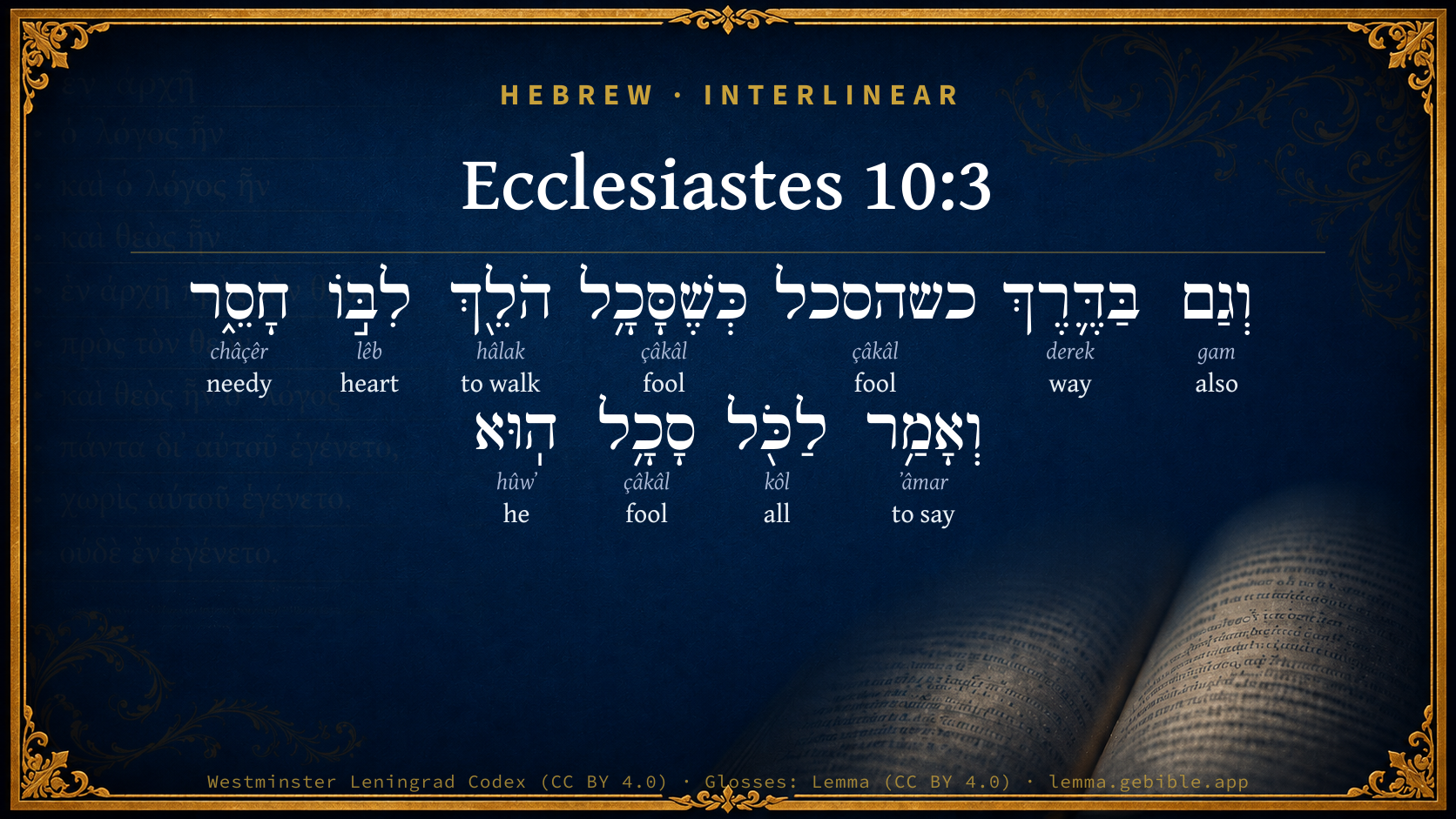
Hebrew (Westminster Leningrad Codex) Ecclesiastes 10:3 appears in the Hebrew Old Testament. The text above is from the Westminster Leningrad Codex. Each word links to its Strong’s number, a concise gloss, and parsing drawn from the Open Scriptures Hebrew Bible morphology. Click any word for its full Brown-Driver-Briggs (BDB) entry.
Download image
Cite this verse

Ecclesiastes 10:3 (World English Bible). Public Domain. Lemma interlinear Bible study tool, https://lemma.gebible.app/v/ecclesiastes/10/3.

Show BibTeX & RIS
BibTeX
RIS
English Translation
Yes also, when the fool walks by the way, his understanding fails him, and he says to everyone that he is a fool.
World English Bible · Public Domain
Download a study sheet

One document with this verse’s original text, its word-by-word gloss line, the meaning frame, cross-references with their text, attributed commentary, and full source and license credits — printable, and it pastes into notes with its structure intact.

This verse Autodidact and up

Study sheet (.html) Plain text (.txt)

A passage Seminary Student

Up to 50 verses in one chapter. A passage sheet keeps up to 6 commentary sources and 12 cross-references per verse, in the order this page ranks them, and says so on the sheet whenever that leaves anything out. Ask for a single verse and you get the Autodidact verse sheet above.

Everything on this page stays free to read, with no account — the sheet is a download of what is already on screen, not access to it.

Want to remove ads? Support Godless Engineer
Compare translations 3

The same verse in 3 English versions, stacked beneath the original-language interlinear above. Click any original word for its lexicon entry.

Each is an independent rendering of the whole verse — the interlinear is not word-aligned to these translations.

Highlighted words mark where these versions differ — a whole-verse word diff, not a word-by-word alignment.

  • World English Bible Public Domain
    Yes also, when the fool walks by the way, his understanding fails him, and he says to everyone that he is a fool.
  • King James Version Public Domain
    Yea also, when he that is a fool walketh by the way, his wisdom faileth him, and he saith to every one that he is a fool.
  • unfoldingWord Literal Text CC BY-SA 4.0
    And even whenever the fool is walking on the road, his heart lacking, and it says to everyone he a fool. q1

unfoldingWord Literal Text — © unfoldingWord, licensed CC BY-SA 4.0. Word-aligned USFM3 via Door43 (git.door43.org/unfoldingWord/en_ult).

Versions to compare (up to 4)

3 of 4 selected

Show all 18 translations

Every available English version of this verse, each an independent rendering of the whole verse.

  • World English Bible Public Domain
    Yes also, when the fool walks by the way, his understanding fails him, and he says to everyone that he is a fool.
  • Berean Standard Bible Public Domain
    Even as the fool walks along the road, his sense is lacking, and he shows everyone that he is a fool.
  • Majority Standard Bible Public Domain
    Even as the fool walks along the road, his sense is lacking, and he shows everyone that he is a fool.
  • King James Version Public Domain
    Yea also, when he that is a fool walketh by the way, his wisdom faileth him, and he saith to every one that he is a fool.
  • American Standard Version (1901) Public Domain
    Yea also, when the fool walketh by the way, his understanding faileth him, and he saith to every one `that' he is a fool.
  • Revised Version (1885) Public Domain
    Yea also, when the fool walketh by the way, his understanding faileth him, and he saith to every one that he is a fool.
  • Geneva Bible (1599) Public Domain
    And also when the foole goeth by the way, his heart faileth, and he telleth vnto all that he is a foole.
  • Douay-Rheims (1899) Public Domain
    Yea, and the fool when he walketh in the way, whereas be himself is a fool, esteemeth all men fools.
  • Young's Literal Translation Public Domain
    And also, when he that is a fool Is walking in the way, his heart is lacking, And he hath said to every one, `He `is' a fool.'
  • Literal Standard Version CC BY-SA 4.0
    And also, when he that is a fool || Is walking in the way, his heart is lacking, || And he has said to everyone, “He [is] a fool.”
  • Unlocked Literal Bible CC BY-SA 4.0
    When a fool walks down a road, his thinking is deficient, proving to everyone he is a fool.
  • unfoldingWord Literal Text CC BY-SA 4.0
    And even whenever the fool is walking on the road, his heart lacking, and it says to everyone he a fool. q1
  • Darby Bible Public Domain
    Yea also, when he that is a fool walketh by the way, his sense faileth [him], and he saith to every one [that] he is a fool.
  • World Messianic Bible Public Domain
    Yes also when the fool walks by the way, his understanding fails him, and he says to everyone that he is a fool.
  • Webster's Bible Public Domain
    Also, when he that is a fool walketh by the way, his wisdom faileth him, and he saith to every one that he is a fool.
  • Free Bible Version CC BY-SA 4.0
    Just the way that fools walk down the road shows they have no sense, making clear to everyone their stupidity.
  • Bible in Basic English Public Domain
    And when the foolish man is walking in the way, he has no sense and lets everyone see that he is foolish.
  • JPS Tanakh (1917) Public Domain
    Yea also, when a fool walketh by the way, his understanding faileth him, and he saith to every one that he is a fool.

Literal Standard Version (2020), Covenant Press — licensed CC BY-SA 4.0. Text via the HelloAO Bible API (eBible.org). Unlocked Literal Bible (unfoldingWord) — licensed CC BY-SA 4.0. Text via the HelloAO Bible API (eBible.org). unfoldingWord Literal Text — © unfoldingWord, licensed CC BY-SA 4.0. Word-aligned USFM3 via Door43 (git.door43.org/unfoldingWord/en_ult). Free Bible Version, Dr. Jonathan Gallagher — licensed CC BY-SA 4.0. Text via the HelloAO Bible API (eBible.org).

Word by word

More ways to search: Search by grammar → Find every occurrence → Compare this word →

Practice this passage: Drill this verse → Learn its vocabulary →

כשהסכל
çâkâl
H5530
“like/as · who/which · the · fool”
Preposition + Particle, Relative + Particle, Definite Article + Noun, Common, Masculine, Singular, Absolute
Part of Speech
Preposition + Particle + Particle + Noun
Type
Common
Gender
Masculine
Number
Singular
State
Absolute
Full BDB Definition

Origin: from H5528

TWOT: 1493a

fool
  1. וְגַם gam H1571 “and · also” Conjunction + Particle, Accusative
  2. בַּדֶּ֛רֶךְ derek H1870 “in/at the · way” Preposition, Determined + Noun, Common, Both, Singular, Absolute
  3. כְּשֶׁסָּכָ֥ל çâkâl H5530 “like/as · who/which · fool” Preposition + Particle, Relative + Noun, Common, Masculine, Singular, Absolute
  4. הֹלֵ֖ךְ hâlak H1980 “walking” Verb, Qal, Participle Active, Masculine, Singular, Absolute
  5. לִבּ֣וֹ lêb H3820 “heart · his” Noun, Common, Masculine, Singular, Construct + Suffix, Personal, 3rd Person, Masculine, Singular
  6. חָסֵ֑ר châçêr H2638 “needy” Verb, Qal, Perfect, 3rd Person, Masculine, Singular
  7. וְאָמַ֥ר ʼâmar H559 “and · to say” Conjunction + Verb, Qal, Sequential Perfect, 3rd Person, Masculine, Singular
  8. לַכֹּ֖ל kôl H3605 “to/for the · all” Preposition, Determined + Noun, Common, Masculine, Singular, Absolute
  9. סָכָ֥ל çâkâl H5530 “fool” Noun, Common, Masculine, Singular, Absolute
  10. הֽוּא hûwʼ H1931 “he” Pronoun, Personal, 3rd Person, Masculine, Singular

About this verse

These counts appear in no published source. They are computed here, from the morphology-tagged text and Lemma’s own curated glosses. What Lemma adds →

11
words
9
distinct lemmas
Wisdom
section

Notable vocabulary

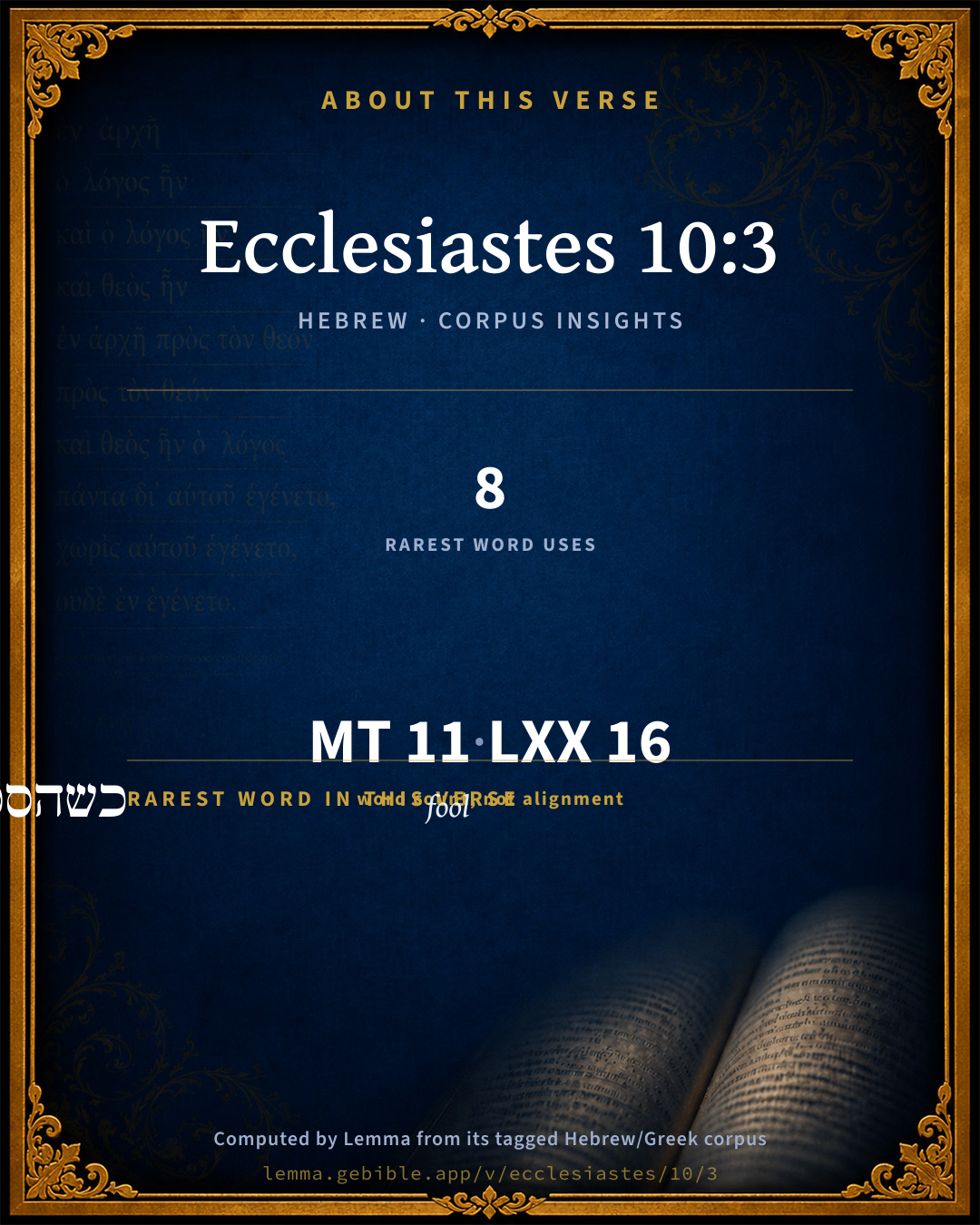
The rarest word here is כשהסכל fool H5530 — appearing just 8 times in the whole Hebrew Bible.

Shared distinctive vocabulary

כשהסכל fool H5530 occurs in 6 verses of the Hebrew Bible. Also found in:

Grammatical profile

  • 3 verbs
  • 6 nouns
  • 1 pronoun
  • 1 particle

Verb forms

  • הֹלֵ֖ךְ Qal · Participle Active
  • חָסֵ֑ר Qal · Perfect
  • וְאָמַ֥ר Qal · Sequential Perfect

Repetition

A word recurs within this verse — often emphatic in Hebrew:

  • כשהסכל fool H5530 ×3

Hebrew & Septuagint length

In English translation the verse runs 23 words from the Hebrew and 22 from the Septuagint (LXX English) — closely comparable.

A rough comparison of the two English renderings, which tokenize alike — not a word-level alignment.

Word counts can differ between the Hebrew and the Greek without any difference in meaning — e.g. the Hebrew direct-object marker אֵת has no separate Greek word, and Greek often adds the article ὁ.

In the original languages it is 11 Hebrew tokens and 16 Greek tokens — but the two are counted differently (Hebrew bundles its prefixes and suffixes into one token; the Greek is in lemma form), so that isn’t a like-for-like length.

Cross-references

5

Topical passages linked to Ecclesiastes 10:3 in the Treasury of Scripture Knowledge — connected by theme and wording, ordered by reader-vote popularity; previews shown in the World English Bible.

  • Proverbs 18:2 A fool has no delight in understanding, But only in revealing his own opinion.
  • Proverbs 13:16 Every prudent man acts from knowledge, But a fool exposes folly.
  • Proverbs 18:6 A fool's lips come into strife, And his mouth invites beatings.
  • Ecclesiastes 5:3 For as a dream comes with a multitude of cares, so a fool's speech with a multitude of words.
  • 1 Peter 4:4 They think it is strange that you don't run with them into the same excess of riot, blaspheming:

Cross-references courtesy of OpenBible.info (CC BY 4.0).

Hebrew and Greek witnesses Masoretic Hebrew ↔ Greek Septuagint

The same verse in the two great witnesses to the Old Testament, shown verse-for-verse.

These are two independent witnesses, not word-aligned to each other, and the Septuagint is shown in lemma (dictionary) form.

Hebrew Ecclesiastes 10:3 Masoretic · Westminster Leningrad Codex

וְגַם בַּדֶּ֛רֶךְ כשהסכל כְּשֶׁסָּכָ֥ל הֹלֵ֖ךְ לִבּ֣וֹ חָסֵ֑ר וְאָמַ֥ר לַכֹּ֖ל סָכָ֥ל הֽוּא

Yes also, when the fool walks by the way, his understanding fails him, and he says to everyone that he is a fool.

World English Bible · Public Domain

Greek LXX Ecclesiastes 10:3 Septuagint · lemma form

καί γέ ἐν ὁδός ὅταν ἄφρων πορεύομαι καρδία αὐτός ὑστερέω καί ὅς λογίζομαι πᾶς ἀφροσύνη εἰμί

Yes, and whenever a fool walks by the way, his heart will fail him, and all that he thinks of is folly.

LXX2012 (modern English Septuagint) · Public Domain

On this verse, Jamieson, Fausset & Brown discusses the Septuagint’s reading. Read the note in Commentary ↓

Hebrew: Westminster Leningrad Codex (CC BY 4.0). Greek: Septuagint (public domain); English from LXX2012 (modern English Septuagint) (Public Domain). How the Septuagint differs from the Hebrew →

Commentary

Notes on Ecclesiastes 10:3 from classic Christian and Jewish commentators (each source and its license shown beneath its notes). The classic Christian expositions comment on the surrounding passage and are grouped to its opening verse, so a note may address several verses; the Jewish commentaries on the Tanakh (Rashi and others) are per-verse, so they appear only where the commentator wrote on this verse.

Lemma curates 59 commentaries, every one of them public domain or Creative Commons licensed, each selected and text-cleaned for this edition rather than reprinted as found. About our sources →

Trapp's Complete Commentary

John Trapp

Ecc 10:3 Yea also, when he that is a fool walketh by the way, his wisdom faileth [him], and he saith to every one [that] he [is] a fool.

Ver. 3. Yea, also when he that is a fool walketh, &c.] In his very gait, gestures, looks, laughings, &c., he bewrays his witlessness, as Jehu did his furiousness, by the manner of his marches. {2Ki 9:20} "He winketh with his eyes, speaketh with his feet, teacheth with his fingers, frowardness is in his heart," &c. {Pro 6:13-14} {See Trapp on "Pro 6:13"} {See Trapp on "Pro 6:14"} Such a froward fool was Julian the apostate, as Nazianzen describes him, with his colli crebrae conversiones, oculi vagi, pedes instabiles, &c., frequent turning of his neck, tossing up his head, wild eyes, wandering feet, &c. And such were those "haughty daughters of Sion, that walked with stretched forth necks and wanton eyes, mincing and making a tinkling as they went"; {Isa 3:16} their haughtiness and hauntiness spake them little better than harlots.

And he saith to every one that he is a fool.] Upon the matter he saith it, though he say nothing. It is said that a fool, while he holds his tongue is held a wise man; {Pro 17:28} that is, if neither by his tongue nor any other part of his body he discover himself: but that can hardly be, since folly flows from man as excrements do from sick folk, and they feel it not, will hardly be persuaded of it. Symmachus, Jerome, and others, refer the last he in this sentence not to the fool himself, but to every one else whom he looks upon as so many fools like himself; {a} ex suo ingenio universos iudicans, judging of others according to his own disposition. For as the philosopher saith, Qualis quisque est tales existimat alios {b} such as any one is, the same he thinks others to be, and as men muse so they use, whether it be for the better or the worse. Jacob could not imagine that his sons were so base as to make away their brother Joseph, but said, "Surely some evil beast hath devoured him." {Gen 37:32} Joshua never suspected the false Gibeonites, nor the rest of the disciples Judas, when our Saviour said, "What thou dost, do quickly"; and again when he said, "One of you shall betray me." On the other side, fools conceit the whole world to be made up of folly; as the Lacedemonians once, neminem bonum fieri publicis literis columna incisis sanxerunt, {c} scored it upon their public posts that there was none good, no, not one; as Claudius and Caligula, being themselves notorious whoremongers, would not be persuaded that there was any chaste person upon earth; {d} as the devil charged God with envy, which is his own proper disease. {Gen 3:5} The old proverb saith, The mother seeks the daughter in the oven, as having been there some time herself. I daresay, quoth Bonner, that Cranmer would recant if he might have his living, {e} so judging of another by himself.

{a} Dicit de omnibus, stultus est.

{b} Arist. Polit., lib. iii. cap. 6.

{c} Plut. in Quaest. Graec.

{d} Dio.

{e} Acts and Mon.

John Trapp, A Commentary or Exposition upon All the Books of the Old and New Testament (1647–1656) — public domain. Text from a community e-Sword module.

Geneva Bible (1599)

Geneva Bible translators

By his doings he betrayeth himself.

Geneva Bible (1599) marginal notes — public domain. Text via Bolls.life.

Jamieson, Fausset & Brown

Robert Jamieson, A. R. Fausset & David Brown

by the way--in his ordinary course; in his simplest acts (Pro 6:12-14). That he "saith," virtually, "that he" himself, &c. [Septuagint]. But Vulgate, "He thinks that every one (else whom he meets) is a fool."

Jamieson, Fausset & Brown — Commentary Critical and Explanatory on the Whole Bible (1871) — public domain (CC PDM 1.0). Text via the HelloAO Bible API.

Adam Clarke's Commentary

Verse 3. When - a fool walketh by the way] In every act of life, and in every company he frequents, the irreligious man shows what he is. Vanity, nonsense, and wickedness are his themes: so that in effect he saith to every one that he is a fool.

Adam Clarke's Commentary on the Bible (1810–1826) — public domain. Text from a community e-Sword/MySword module.

Ellicott's Commentary for English Readers

(3) That he is a fool.—In Hebrew, as in English, the antecedent of “he” may be taken differently, and so the Vulg. and other authorities understand the verse as meaning that the fool in his self-conceit attributes folly to everyone else. But it is better, as well as more obvious, to take the verse of the self-betrayal of the fool (Pro_13:16; Pro_17:28; Pro_18:2).

A Bible Commentary for English Readers, edited by Charles John Ellicott (1878–1897) — public domain. Text from a community e-Sword module.

The Cambridge Bible for Schools and Colleges

gen. ed. J. J. S. Perowne

3. Yea also, when he that is a fool walketh by the way] The general drift of the proverb seems plain enough. “Even when the fool is in the way (either literally, ‘whenever and wherever he goes,’ or figuratively, ‘when he has been put in the right path of conduct’), his heart (i. e. his intellect) fails him, and he manifests his folly.” The last clause, however, admits of two constructions, each of which has the support of high authorities, (1) he saith to every one that he (the fool himself) is a fool, i. e. betrays his unwisdom in every word he utters; or (2) he says to every man that he (the man he meets) is a fool, i. e. in his self-conceit he thinks that he alone is wise (comp. Rom_12:16). On the whole the latter construction seems preferable. So it is notoriously the most significant symptom of insanity that the patient looks on all others as insane. It may be noted that (1) finds a parallel in Pro_13:16; Pro_18:2; (2) in Pro_26:16.

The Cambridge Bible for Schools and Colleges (gen. ed. J. J. S. Perowne; Cambridge University Press, 1878–1918) — public domain. Text from a community e-Sword module.

John Gill's Exposition

Yea also, when he that is a fool walketh by the way,.... The king's highway, the common road; as he passeth along the streets, going to any place, or about any business:

his wisdom faileth him; or "his heart" (p); he appears by his gait, his manner of walking, to want a heart, to be a fool; walking with a froward mouth, winking with his eyes, speaking with his feet, and teaching with his fingers; all which shows the frowardness and folly of his heart, Pro 6:12; or he discovers it throughout his conversation, in all the actions of it, in whatsoever business he is concerned, and in all the affairs of life. The Targum is,

"when he walketh in a perplexed way;''

then his wisdom fails him; he does not know which way to take, whether to the right or left: this can never be understood of the highway of holiness, in which men, though fools, shall not err, Isa 35:8;

and he saith to everyone that he is a fool; his folly is manifest to all; he betrays it, by his words and actions, to every man he has to do with; his sins and transgressions, which are his folly, he hides not, they are evident to all; and, as the Targum expresses it,

"all say he is a fool:''

though indeed he himself says this of every other man, that he is a fool; for, according to the Vulgate Latin version, he, being a fool himself, thinks everybody else is so.

(p) "cor ejus", Pagninus, Montanus, &c.

John Gill's Exposition of the Whole Bible (1746–1763) — public domain (CC PDM 1.0). Text via the HelloAO Bible API.

Albert Barnes' Notes on the Bible

“Way” may be understood either literally (compare Ecc 10:15), or figuratively, of the course of action which he follows.

He saith ... - He exposes his folly to every one he meets.

Albert Barnes' Notes on the Bible (1834–1885) — public domain. Text from a community e-Sword/MySword module.

Haydock's Catholic Bible Commentary

Fools. People judge others by themselves. (Calmet) --- Thus Nero could not believe that any were chaste. (Suetonius)

George Leo Haydock (1774–1849), Haydock's Catholic Family Bible and Commentary, 1859 edition — public domain. Excludes Psalms (Douay-Rheims chapter numbering differs from Protestant) and Deuterocanonical books (Catholic canon only).

Matthew Poole's English Annotations

Walketh by the way; not only in great undertakings, but in his daily conversation with men, in his looks, and gestures, and common talk.

His wisdom faileth him; or, he wants a heart; as if he had said, Did I say, his heart is at his left hand? I must recall it, for in truth he hath no heart in him.

He saith to every one that he is a fool; he publicly discovers his folly to all that meet him, or converse with him.

Matthew Poole's English Annotations on the Holy Bible (1683–1685) — public domain. Text from a community e-Sword/MySword module.

Whedon's Commentary on the Bible

Daniel D. Whedon

3. The fool is the subject. His wisdom faileth, should be, He lacketh wisdom. He, in the last clause, refers to every one, and the sense would be plainer if that were not inserted: He saith to every one, He is a fool! He thinks all others fools.

Daniel D. Whedon (gen. ed.), Commentary on the Old and New Testaments (1874–1909) — public domain. Text from a community e-Sword module.

The Pulpit Commentary

Yea, also, when he that is a fool walketh by the way. As soon as ever he sets his foot outside the house, and mixes with other men, he exhibits his folly. If he remained at home he might keep his real ineptitude concealed; but such persons as he are unconscious of their inanity, and take no pains to hide it; they go where, they act as, their foolish heart prompts them. There is no metaphor here, nor any reference to the fool being put in the right path and perversely turning away. It is simply, as the Septuagint renders, Kai ge ejn oJdw otan afrwn poreuhtai His wisdom (Hebrew, heart) faileth him. Ginsburg and others render, "He lacketh his mind, want of heart being continually taken in the Book of Proverbs as equivalent to deficiency of understanding. (Pro_6:32 Pro_7:7, etc.) But Delitzsch and Wright consider the order of the words and the suffix to be against this view, and they translate as the Authorized Version, i.e. his understanding is at fault. And he saith to every one that he is a fool. The sentence is ambiguous, and capable of two interpretations. The Vulgate has, Cumipse insipiens sit, omnes stultos aestimat. Jerome quotes Symmachus as rendering, "He suspects all men that they are fools." According to this view, the fool in his conceit thinks that every one he meets is a fool, says this in his mind, like the sluggard in Pro_26:16, "Who is wiser in his own conceit than ten men that can render a reason." Another explanation, more closely in accordance with the foregoing clauses, takes the pronoun in "he is a fool" to refer to the man himself, se esse stultum. (comp. Psa_9:20, "Let the nations know themselves to be but men As soon as he goes abroad, his words and actions display his real character; he betrays himself; he says virtually to all with whom he has to do, "I am a fool". (comp. Pro_13:16 Pro_18:2) It is hard to say to which interpretation the Septuagint inclines, giving, Kainta ajfrosunh ejstin, "And all that he will think is folly."

The Pulpit Commentary (1880–1919), ed. H.D.M. Spence-Jones & Joseph S. Exell — public domain. Text from a community e-Sword module.

John Wesley's Explanatory Notes

Walketh - In his daily conversation. He saith - He discovers his folly to all that meet him.

John Wesley, Explanatory Notes Upon the Whole Bible (1754–1765) — public domain. Text via the GEBible commentary corpus.

Keil & Delitzsch

C. F. Keil & F. Delitzsch

This proverb forms, along with the preceding, a tetrastich, for it is divided into two parts by vav. The Kerı̂ has removed the art. in כש and שה, Ecc 6:10, as incompatible with the ש. The order of the words vegam-baderek keshehsachal holek is inverted for vegam keshehsachal baderek holek, cf. Ecc 3:13, and also rav shěyihyn, Ecc 6:3; so far as this signifies, "supposing that they are many." Plainly the author intends to give prominence to "on the way;" and why, but because the fool, the inclination of whose heart, according to 2b, always goes to the left, is now placed in view as he presents himself in his public manner of life. Instead of לב־הוּא חסר we have here the verbal clause חסר לבּו, which is not, after Ecc 6:2, to be translated: corde suo caret (Herzf., Ginsb.), contrary to the suff. and also the order of the words, but, after Ecc 9:8 : cor ejus deficit, i.e., his understanding is at fault; for לב, here and at Ecc 10:2, is thus used in a double sense, as the Greek νοῦς and the Lat. mens can also be used: there it means pure, formal, intellectual soul-life; here, pregnantly (Psychol. p. 249), as at Ecc 7:7, cf. Hos 4:11, the understanding or the knowledge and will of what is right. The fool takes no step without showing that his understanding is not there, - that, so to speak, he does not take it along with him, but has left it at home. He even carries his folly about publicly, and prides himself in it as if it were wisdom: he says to all that he is a fool, se esse stultum (thus, correctly, most Jewish and Christian interpreters, e.g., Rashi and Rambach). The expression follows the scheme of Ps. 9:21: May the heathen know mortales se esse (vid., l.c.). Otherwise Luther, with Symm. and Jerome: "he takes every man as a fool;" but this thought has no support in the connection, and would undoubtedly be expressed by המּה סכלים. Still differently Knobel and Ewald: he says to all, "it is foolish;" Hitzig, on the contrary, justly remarks that סכל is not used of actions and things; this also is true of כּסיל, against himself, Ecc 5:2, where he translates qol kesil by "foolish discourses."

Keil & Delitzsch — Biblical Commentary on the Old Testament (1861–1891) — public domain (CC PDM 1.0). Text via the HelloAO Bible API. (Old Testament only.)

Rashi

Rabbi Shlomo Yitzchaki (Rashi)

and he says to all that he is a fool with his walk and with his speech, everyone recognizes that he is a fool.

Rashi on the Tanakh — English translations: “The Judaica Press complete Tanach with Rashi, translated by A. J. Rosenberg” (CC BY 4.0); “Pentateuch with Rashi's commentary by M. Rosenbaum and A.M. Silbermann, 1929-1934” (public domain); “The Metsudah Tanach series, Lakewood, N.J” (CC BY 4.0); and “The Book of Joshua, Metsudah Publications, 1997” (CC BY 4.0). Text via Sefaria.

Lesson kit

Teaching starters — assembled from the data on this page, not authored interpretation. Every prompt links to the verse data it draws on. Edit before teaching.

Ecclesiastes, in the Wisdom, opens this verse with 11 words (9 distinct Hebrew lemmas). Its most distinctive word is çâkâl (“fool”). A historical commentator’s framing appears above. Read the whole chapter for the surrounding context.

Discussion questions

  1. The word çâkâl carries the sense “fool.” How does it shape the verse?
  2. Ecclesiastes 2:19 shares the word «fool» with this verse. How do the two illuminate each other?
  3. “fool” occurs 3× in this one verse. What is the effect of the repetition?
  4. The translations on this page render this verse differently — a whole-verse word diff, not a word-by-word alignment. What might account for the different wordings?
  5. The verb «הֹלֵ֖ךְ» is Qal Participle Active. How does its form color the action?
  6. Reading how Trapp's Complete Commentary and Geneva Bible (1599) read this verse, where do the two commentators agree and where do they part?

Things to notice

Reading settings

Reading text

Shown beneath each verse's original-language words.

Old Testament
Old Testament edition

Read the OT as the Masoretic Hebrew (MT) or the Greek Septuagint (LXX).

English shown for the Greek Septuagint (in the Hebrew ↔ Greek comparison).

Comparing translations? Open the Compare panel on any verse page to stack up to four side by side.