
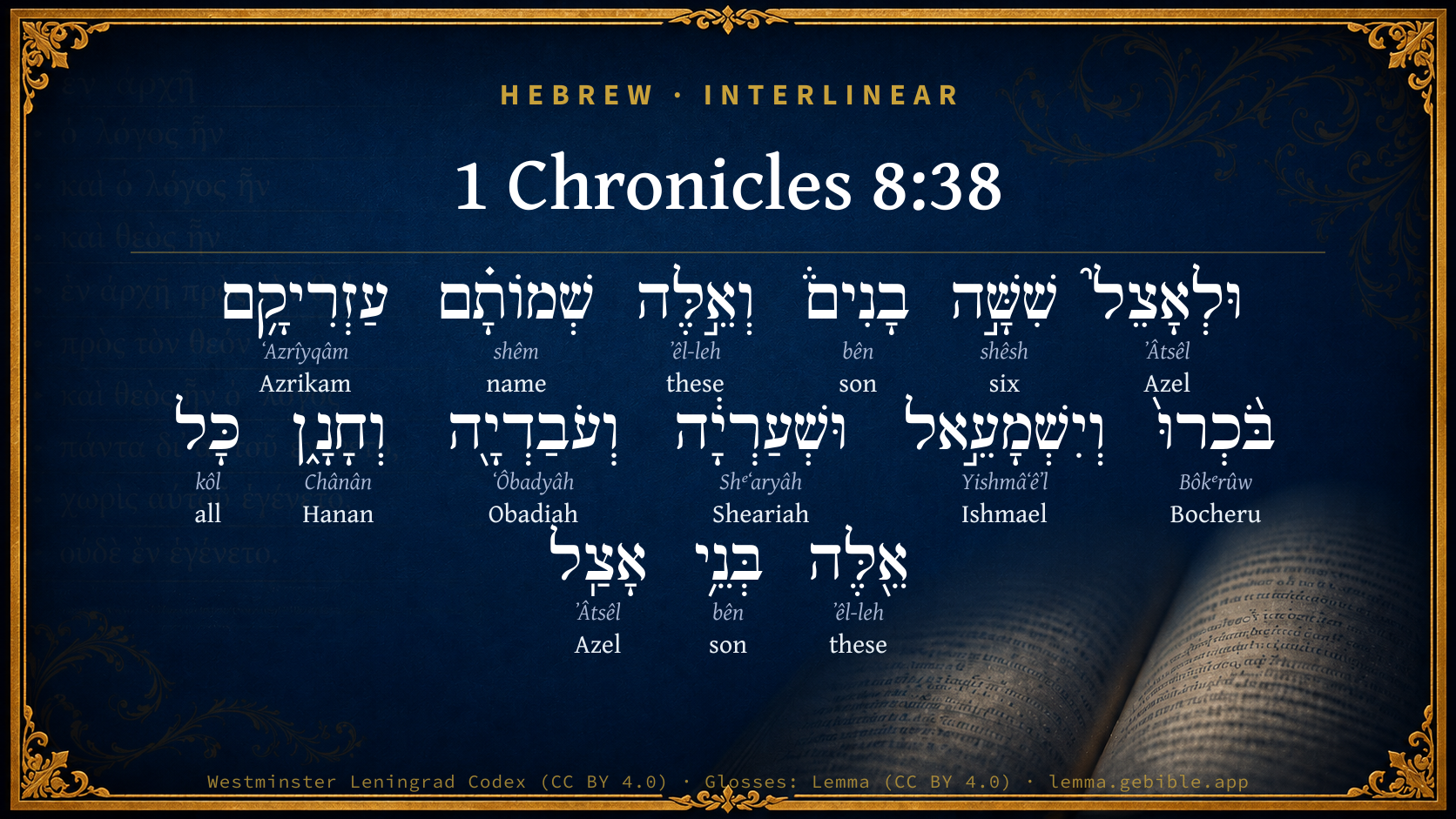
1 Chronicles 8:38

Hebrew (Westminster Leningrad Codex) 1 Chronicles 8:38 appears in the Hebrew Old Testament. The text above is from the Westminster Leningrad Codex. Each word links to its Strong’s number, a concise gloss, and parsing drawn from the Open Scriptures Hebrew Bible morphology. Click any word for its full Brown-Driver-Briggs (BDB) entry.
Download image
Cite this verse

1 Chronicles 8:38 (World English Bible). Public Domain. Lemma interlinear Bible study tool, https://lemma.gebible.app/v/1-chronicles/8/38.

Show BibTeX & RIS
BibTeX
RIS
English Translation
Azel had six sons, whose names are these: Azrikam, Bocheru, and Ishmael, and Sheariah, and Obadiah, and Hanan. All these were the sons of Azel.
World English Bible · Public Domain
Highlights
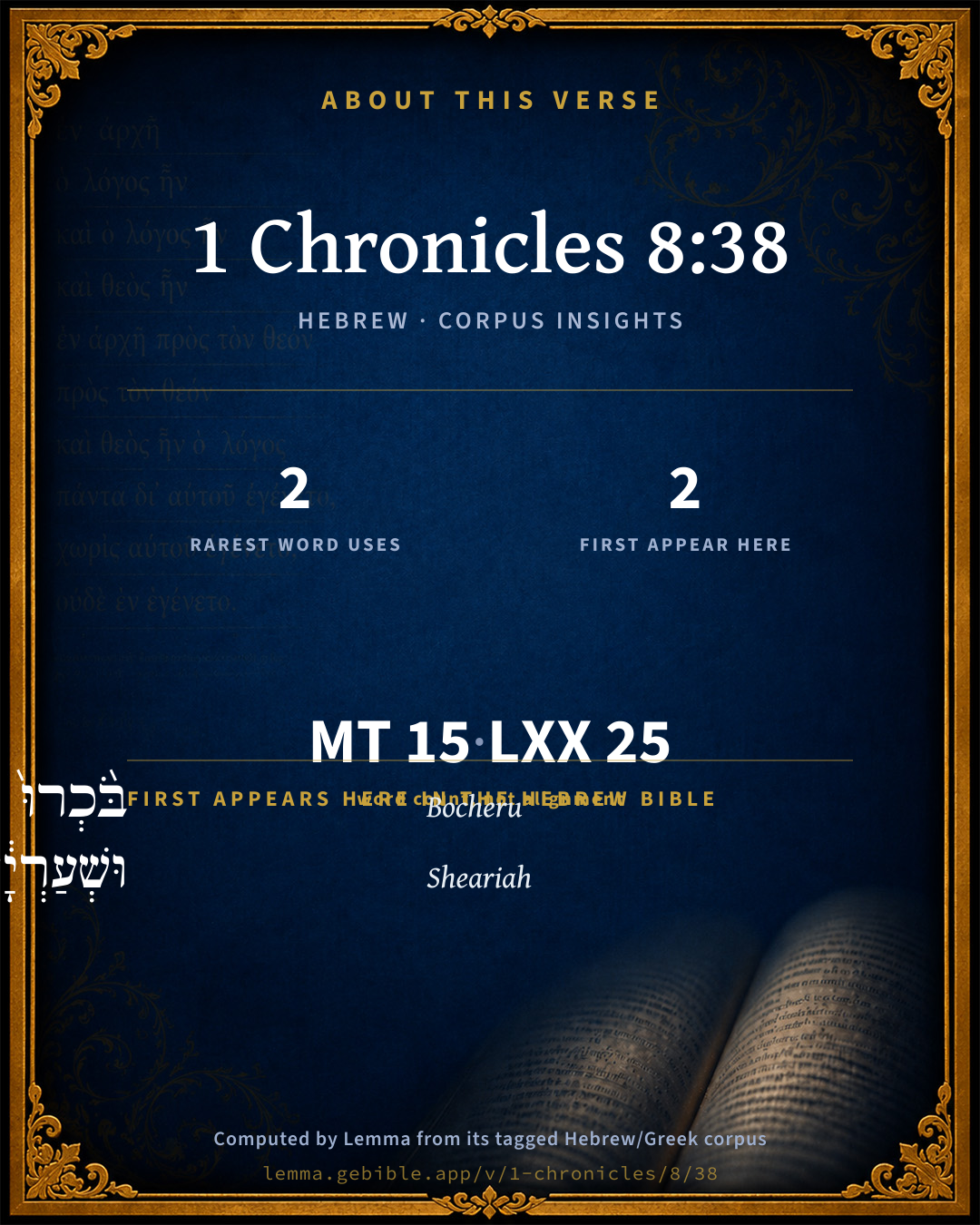
  • 2 first appearances in the Hebrew Bible
Full analysis ↓
Download a study sheet

One document with this verse’s original text, its word-by-word gloss line, the meaning frame, cross-references with their text, attributed commentary, and full source and license credits — printable, and it pastes into notes with its structure intact.

This verse Autodidact and up

Study sheet (.html) Plain text (.txt)

A passage Seminary Student

Up to 50 verses in one chapter. A passage sheet keeps up to 6 commentary sources and 12 cross-references per verse, in the order this page ranks them, and says so on the sheet whenever that leaves anything out. Ask for a single verse and you get the Autodidact verse sheet above.

Everything on this page stays free to read, with no account — the sheet is a download of what is already on screen, not access to it.

Want to remove ads? Support Godless Engineer
Compare translations 3

The same verse in 3 English versions, stacked beneath the original-language interlinear above. Click any original word for its lexicon entry.

Each is an independent rendering of the whole verse — the interlinear is not word-aligned to these translations.

Highlighted words mark where these versions differ — a whole-verse word diff, not a word-by-word alignment.

  • World English Bible Public Domain
    Azel had six sons, whose names are these: Azrikam, Bocheru, and Ishmael, and Sheariah, and Obadiah, and Hanan. All these were the sons of Azel.
  • King James Version Public Domain
    And Azel had six sons, whose names are these, Azrikam, Bocheru, and Ishmael, and Sheariah, and Obadiah, and Hanan. All these were the sons of Azel.
  • unfoldingWord Literal Text CC BY-SA 4.0
    And to Azel six sons. And these their names: Azrikam, Bokeru, and Ishmael and Sheariah and Obadiah and Hanan. All of these the sons of Azel.

unfoldingWord Literal Text — © unfoldingWord, licensed CC BY-SA 4.0. Word-aligned USFM3 via Door43 (git.door43.org/unfoldingWord/en_ult).

Versions to compare (up to 4)

3 of 4 selected

Show all 18 translations

Every available English version of this verse, each an independent rendering of the whole verse.

  • World English Bible Public Domain
    Azel had six sons, whose names are these: Azrikam, Bocheru, and Ishmael, and Sheariah, and Obadiah, and Hanan. All these were the sons of Azel.
  • Berean Standard Bible Public Domain
    Azel had six sons, and these were their names: Azrikam, Bocheru, Ishmael, Sheariah, Obadiah, and Hanan. All these were the sons of Azel.
  • Majority Standard Bible Public Domain
    Azel had six sons, and these were their names: Azrikam, Bocheru, Ishmael, Sheariah, Obadiah, and Hanan. All these were the sons of Azel.
  • King James Version Public Domain
    And Azel had six sons, whose names are these, Azrikam, Bocheru, and Ishmael, and Sheariah, and Obadiah, and Hanan. All these were the sons of Azel.
  • American Standard Version (1901) Public Domain
    And Azel had six sons, whose names are these: Azrikam, Bocheru, and Ishmael, and Sheariah, and Obadiah, and Hanan. All these were the sons of Azel.
  • Revised Version (1885) Public Domain
    And Azel had six sons, whose names are these; Azrikam, Bocheru, and Ishmael, and Sheariah, and Obadiah, and Hanan. All these were the sons of Azel.
  • Geneva Bible (1599) Public Domain
    And Azel had sixe sonnes, whose names are these, Azrikam, Bocheru and Ishmael, and Sheariah, and Obadiah, and Hanan: all these were the sonnes of Azel.
  • Douay-Rheims (1899) Public Domain
    And Asel had six sons whose names were Ezricam, Bochru, Ismahel, Saria, Obdia, and Hanan. All these were the sons of Asel.
  • Young's Literal Translation Public Domain
    And to Azel `are' six sons, and these `are' their names: Azrikam, Bocheru, and Ishmael, and Sheariah, and Obadiah, and Hanan. All these `are' sons of Azel.
  • Literal Standard Version CC BY-SA 4.0
    And to Azel [are] six sons, and these [are] their names: Azrikam, Bocheru, and Ishmael, and Sheariah, and Obadiah, and Hanan. All these [are] sons of Azel.
  • Unlocked Literal Bible CC BY-SA 4.0
    Azel had six sons: Azrikam, Bokeru, Ishmael, Sheariah, Obadiah, and Hanan. All these were sons of Azel.
  • unfoldingWord Literal Text CC BY-SA 4.0
    And to Azel six sons. And these their names: Azrikam, Bokeru, and Ishmael and Sheariah and Obadiah and Hanan. All of these the sons of Azel.
  • Darby Bible Public Domain
    And Azel had six sons, and these are their names: Azrikam, Bochru, and Ishmael, and Sheariah, and Obadiah, and Hanan; all these were sons of Azel.
  • World Messianic Bible Public Domain
    Azel had six sons, whose names are these: Azrikam, Bocheru, Ishmael, Sheariah, Obadiah, and Hanan. All these were the sons of Azel.
  • Webster's Bible Public Domain
    And Azel had six sons, whose names are these, Azrikam, Bocheru, and Ishmael, and Sheariah, and Obadiah, and Hanan. All these were the sons of Azel.
  • Free Bible Version CC BY-SA 4.0
    Azel had six sons. These were their names: Azrikam, Bokeru, Ishmael, Sheariah, Obadiah and Hanan. These were all the sons of Azel.
  • Bible in Basic English Public Domain
    And Azel had five sons, whose names are: Azrikam, his oldest, and Ishmael and Sheariah and Obadiah and Hanan. All these were the sons of Azel.
  • JPS Tanakh (1917) Public Domain
    And Azel had six sons, whose names are these: Azrikam, Bocru, and Ishmael, and Sheariah, and Obadiah, and Hanan. All these were the sons of Azel.

Literal Standard Version (2020), Covenant Press — licensed CC BY-SA 4.0. Text via the HelloAO Bible API (eBible.org). Unlocked Literal Bible (unfoldingWord) — licensed CC BY-SA 4.0. Text via the HelloAO Bible API (eBible.org). unfoldingWord Literal Text — © unfoldingWord, licensed CC BY-SA 4.0. Word-aligned USFM3 via Door43 (git.door43.org/unfoldingWord/en_ult). Free Bible Version, Dr. Jonathan Gallagher — licensed CC BY-SA 4.0. Text via the HelloAO Bible API (eBible.org).

Word by word

More ways to search: Search by grammar → Find every occurrence → Compare this word →

Practice this passage: Drill this verse → Learn its vocabulary →

בֹּ֨כְרוּ֙
Bôkᵉrûw
H1074
“Bocheru”
Noun, Proper
Part of Speech
Noun
Type
Proper
Full BDB Definition

Origin: from H1069

TWOT: None

Bocheru = "firstborn" - a Benjamite
  1. וּלְאָצֵל֮ ʼÂtsêl H682 “and · to/for · Azel” Conjunction + Preposition + Noun, Proper
  2. שִׁשָּׁ֣ה shêsh H8337 “six” Adjective, Cardinal number, Masculine, Singular, Absolute
  3. בָנִים֒ bên H1121 “sons” Noun, Common, Masculine, Plural, Absolute
  4. וְאֵ֣לֶּה ʼêl-leh H428 “and · these” Conjunction + Pronoun, Demonstrative, Common, Plural
  5. שְׁמוֹתָ֗ם shêm H8034 “names · their” Noun, Common, Masculine, Plural, Construct + Suffix, Personal, 3rd Person, Masculine, Plural
  6. עַזְרִיקָ֥ם ʻAzrîyqâm H5840 “Azrikam” Noun, Proper
  7. וְיִשְׁמָעֵ֣אל Yishmâʻêʼl H3458 “and · Ishmael” Conjunction + Noun, Proper
  8. וּשְׁעַרְיָ֔ה Shᵉʻaryâh H8187 “and · Sheariah” Conjunction + Noun, Proper
  9. וְעֹבַדְיָ֖ה ʻÔbadyâh H5662 “and · Obadiah” Conjunction + Noun, Proper
  10. וְחָנָ֑ן Chânân H2605 “and · Hanan” Conjunction + Noun, Proper
  11. כָּל kôl H3605 “all of” Noun, Common, Masculine, Singular, Construct
  12. אֵ֖לֶּה ʼêl-leh H428 “these” Pronoun, Demonstrative, Common, Plural
  13. בְּנֵ֥י bên H1121 “sons of” Noun, Common, Masculine, Plural, Construct
  14. אָצַֽל ʼÂtsêl H682 “Azel” Noun, Proper

About this verse

These counts appear in no published source. They are computed here, from the morphology-tagged text and Lemma’s own curated glosses. What Lemma adds →

15
words
12
distinct lemmas
Historical
section

Notable vocabulary

The rarest word here is בֹּ֨כְרוּ֙ Bocheru H1074 — appearing just 2 times in the whole Hebrew Bible.

First appearance in Scripture

These words make their first canonical appearance in the Hebrew Bible here:

  • בֹּ֨כְרוּ֙ Bocheru H1074
  • וּשְׁעַרְיָ֔ה Sheariah H8187

Shared distinctive vocabulary

בֹּ֨כְרוּ֙ Bocheru H1074 occurs in 2 verses of the Hebrew Bible. Also found in:

Grammatical profile

  • 12 nouns
  • 1 adjective
  • 2 pronouns

Repetition

Words recur within this verse — often emphatic in Hebrew:

  • וּלְאָצֵל֮ Azel H682 ×2
  • בָנִים֒ son H1121 ×2
  • וְאֵ֣לֶּה these H428 ×2

Hebrew & Septuagint length

In English translation the verse runs 25 words from the Hebrew and 30 from the Septuagint (LXX English) — closely comparable.

A rough comparison of the two English renderings, which tokenize alike — not a word-level alignment.

Word counts can differ between the Hebrew and the Greek without any difference in meaning — e.g. the Hebrew direct-object marker אֵת has no separate Greek word, and Greek often adds the article ὁ.

In the original languages it is 15 Hebrew tokens and 25 Greek tokens — but the two are counted differently (Hebrew bundles its prefixes and suffixes into one token; the Greek is in lemma form), so that isn’t a like-for-like length.

Hebrew and Greek witnesses Masoretic Hebrew ↔ Greek Septuagint

The same verse in the two great witnesses to the Old Testament, shown verse-for-verse.

These are two independent witnesses, not word-aligned to each other, and the Septuagint is shown in lemma (dictionary) form.

Hebrew 1 Chronicles 8:38 Masoretic · Westminster Leningrad Codex

וּלְאָצֵל֮ שִׁשָּׁ֣ה בָנִים֒ וְאֵ֣לֶּה שְׁמוֹתָ֗ם עַזְרִיקָ֥ם בֹּ֨כְרוּ֙ וְיִשְׁמָעֵ֣אל וּשְׁעַרְיָ֔ה וְעֹבַדְיָ֖ה וְחָנָ֑ן כָּל אֵ֖לֶּה בְּנֵ֥י אָצַֽל

Azel had six sons, whose names are these: Azrikam, Bocheru, and Ishmael, and Sheariah, and Obadiah, and Hanan. All these were the sons of Azel.

World English Bible · Public Domain

Greek LXX 1 Chronicles 8:38 Septuagint · lemma form

καί ὁ εσηλ ἕξ υἱός καί οὗτος ὁ ὄνομα αὐτός εζρικαμ πρωτότοκος αὐτός καί ισμαηλ καί σαραια καί αβδια καί αναν πᾶς οὗτος υἱός εσηλ

And Esel had six sons, and these were their name; Ezricam his firstborn, and Ismael, and Saraia, and Abdia, and Anan, and Asa: all these were the sons of Esel.

LXX2012 (modern English Septuagint) · Public Domain

On this verse, Ellicott's Commentary for English Readers discusses the Septuagint’s reading. Read the note in Commentary ↓

Hebrew: Westminster Leningrad Codex (CC BY 4.0). Greek: Septuagint (public domain); English from LXX2012 (modern English Septuagint) (Public Domain). How the Septuagint differs from the Hebrew →

Commentary

Notes on 1 Chronicles 8:38 from classic Christian and Jewish commentators (each source and its license shown beneath its notes). The classic Christian expositions comment on the surrounding passage and are grouped to its opening verse, so a note may address several verses; the Jewish commentaries on the Tanakh (Rashi and others) are per-verse, so they appear only where the commentator wrote on this verse.

Lemma curates 59 commentaries, every one of them public domain or Creative Commons licensed, each selected and text-cleaned for this edition rather than reprinted as found. About our sources →

Ellicott's Commentary for English Readers

(38) Bocheru.—Some MSS. read “his firstborn,” with which, with different points, the LXX. and the Syriac agree. This seems right, as the conjunctive particle is wanting between Azrikam and the doubtful word, and Bocheru would be anomalous as a proper name. (See Note on 1Ch_8:40.)

Azel.—A place near Jerusalem was so called (Zec_14:5; Mic_1:11).

A Bible Commentary for English Readers, edited by Charles John Ellicott (1878–1897) — public domain. Text from a community e-Sword module.

The Pulpit Commentary

Vers. 38-40. The genealogy runs on from Micah to Ulam with nothing special to remark upon. Ulam is twelfth from Saul, while his "sons and sons" sons" (ver. 40) are spoken of. The time of Hezekiah must be reached, therefore, who was thirteenth from David. The table of next chapter stops with the name Azel, (1Ch_9:44) and wears the appearance of having just missed the last two verses of this chapter.

The Pulpit Commentary (1880–1919), ed. H.D.M. Spence-Jones & Joseph S. Exell — public domain. Text from a community e-Sword module.

unfoldingWord translationNotes

Door43 World Missions Community

General Information:

All of the names here are the names of men. (See: How to Translate Names)

Jeush the second, and Eliphelet the third

"Jeush, who was born after Ulam, and Eliphelet, who was born after Jeush" (See: Ordinal Numbers)

many sons and grandsons, a total of 150

"a total of one hundred fifty sons and grandsons" (See: Numbers)

translationWords

Obadiah

archer

son

descend

Benjamin

unfoldingWord translationNotes — © Distant Shores Media and the Door43 World Missions Community, licensed CC BY-SA 4.0. Source: git.door43.org/Door43/en_tn.

Lesson kit

Teaching starters — assembled from the data on this page, not authored interpretation. Every prompt links to the verse data it draws on. Edit before teaching.

1 Chronicles, in the Historical, opens this verse with 15 words (12 distinct Hebrew lemmas). Its most distinctive word is Bôkᵉrûw (“Bocheru”). A historical commentator’s framing appears above. Read the whole chapter for the surrounding context.

Discussion questions

  1. The word Bôkᵉrûw carries the sense “Bocheru.” How does it shape the verse?
  2. 2 words here appear for the first time in Scripture. What is being introduced at this debut?
  3. 1 Chronicles 9:44 shares the word «Bocheru» with this verse. How do the two illuminate each other?
  4. “Azel” occurs 2× in this one verse. What is the effect of the repetition?
  5. These translations render this verse differently; the difference is in the English rendering, not the original. What questions does that raise?
  6. Reading how Ellicott's Commentary for English Readers and The Pulpit Commentary read this verse, where do the two commentators agree and where do they part?

Things to notice

Reading settings

Reading text

Shown beneath each verse's original-language words.

Old Testament
Old Testament edition

Read the OT as the Masoretic Hebrew (MT) or the Greek Septuagint (LXX).

English shown for the Greek Septuagint (in the Hebrew ↔ Greek comparison).

Comparing translations? Open the Compare panel on any verse page to stack up to four side by side.