Ezekiel 38:21

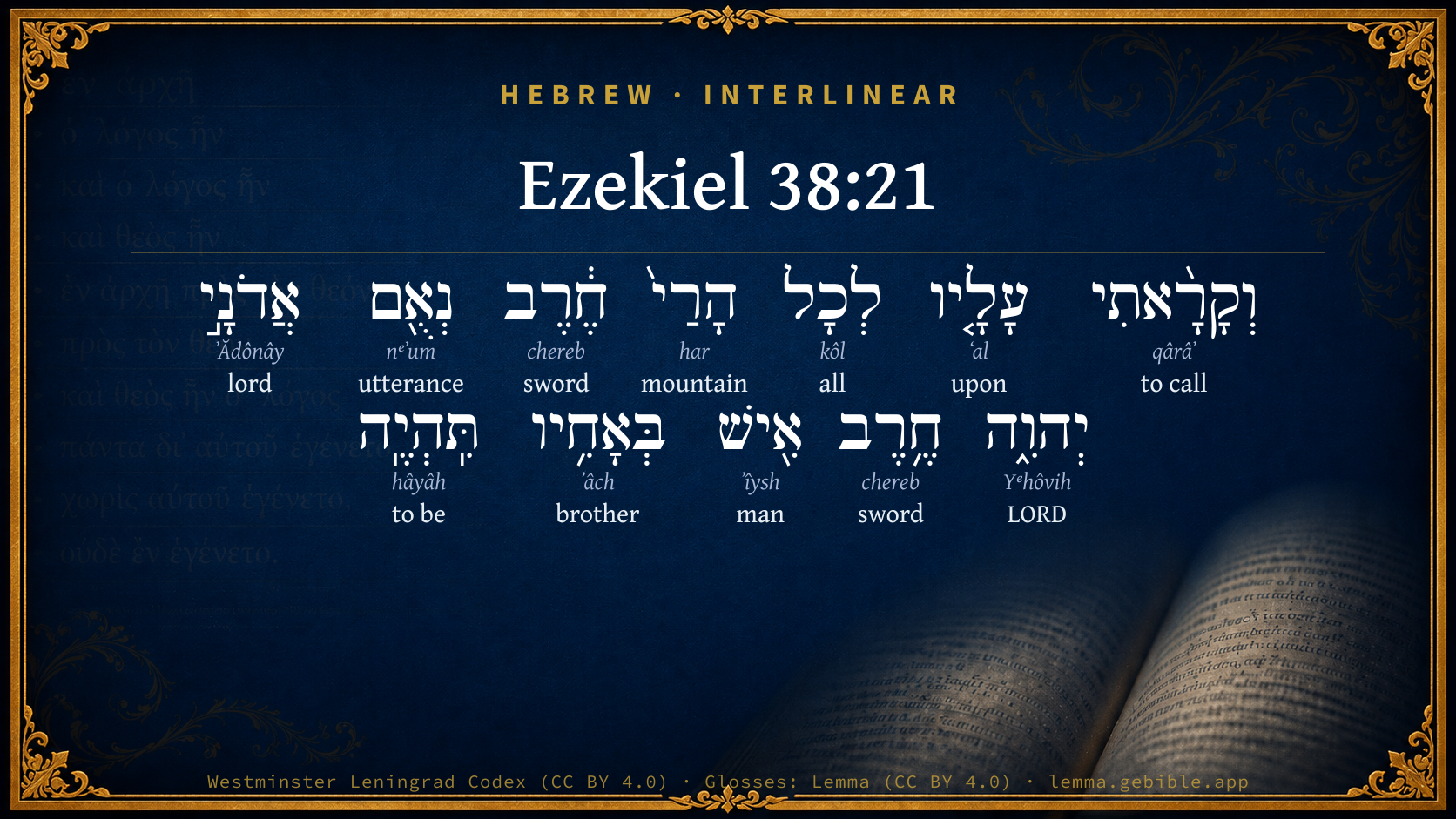
Hebrew (Westminster Leningrad Codex) Ezekiel 38:21 appears in the Hebrew Old Testament. The text above is from the Westminster Leningrad Codex. Each word links to its Strong’s number, a concise gloss, and parsing drawn from the Open Scriptures Hebrew Bible morphology. Click any word for its full Brown-Driver-Briggs (BDB) entry.
Download image
Cite this verse

Ezekiel 38:21 (World English Bible). Public Domain. Lemma interlinear Bible study tool, https://lemma.gebible.app/v/ezekiel/38/21.

Show BibTeX & RIS
BibTeX
RIS
English Translation
I will call for a sword against him to all my mountains, says the Lord Yahweh: every man's sword shall be against his brother.
World English Bible · Public Domain
Download a study sheet

One document with this verse’s original text, its word-by-word gloss line, the meaning frame, cross-references with their text, attributed commentary, and full source and license credits — printable, and it pastes into notes with its structure intact.

This verse Autodidact and up

Study sheet (.html) Plain text (.txt)

A passage Seminary Student

Up to 50 verses in one chapter. A passage sheet keeps up to 6 commentary sources and 12 cross-references per verse, in the order this page ranks them, and says so on the sheet whenever that leaves anything out. Ask for a single verse and you get the Autodidact verse sheet above.

Everything on this page stays free to read, with no account — the sheet is a download of what is already on screen, not access to it.

Want to remove ads? Support Godless Engineer
Compare translations 3

The same verse in 3 English versions, stacked beneath the original-language interlinear above. Click any original word for its lexicon entry.

Each is an independent rendering of the whole verse — the interlinear is not word-aligned to these translations.

Highlighted words mark where these versions differ — a whole-verse word diff, not a word-by-word alignment.

  • World English Bible Public Domain
    I will call for a sword against him to all my mountains, says the Lord Yahweh: every man's sword shall be against his brother.
  • King James Version Public Domain
    And I will call for a sword against him throughout all my mountains, saith the Lord GOD: every man's sword shall be against his brother.
  • unfoldingWord Literal Text CC BY-SA 4.0
    I will summon a sword against him on all my mountains—this is the Lord Yahweh’s declaration—each man’s sword will be against his brother.

unfoldingWord Literal Text — © unfoldingWord, licensed CC BY-SA 4.0. Word-aligned USFM3 via Door43 (git.door43.org/unfoldingWord/en_ult).

Versions to compare (up to 4)

3 of 4 selected

Show all 18 translations

Every available English version of this verse, each an independent rendering of the whole verse.

  • World English Bible Public Domain
    I will call for a sword against him to all my mountains, says the Lord Yahweh: every man's sword shall be against his brother.
  • Berean Standard Bible Public Domain
    And I will summon a sword against Gog on all My mountains, declares the Lord GOD, and every man’s sword will be against his brother.
  • Majority Standard Bible Public Domain
    And I will summon a sword against Gog on all My mountains, declares the Lord GOD, and every man’s sword will be against his brother.
  • King James Version Public Domain
    And I will call for a sword against him throughout all my mountains, saith the Lord GOD: every man's sword shall be against his brother.
  • American Standard Version (1901) Public Domain
    And I will call for a sword against him unto all my mountains, saith the Lord Jehovah: every man's sword shall be against his brother.
  • Revised Version (1885) Public Domain
    And I will call for a sword against him unto all my mountains, saith the Lord GOD: every man’s sword shall be against his brother.
  • Geneva Bible (1599) Public Domain
    For I will call for a sworde against him throughout all my mountaines, saith the Lord God: euery mans sword shalbe against his brother.
  • Douay-Rheims (1899) Public Domain
    And I will call in the sword against him in all my mountains, saith the Lord God: every man's sword shall be pointed against his brother.
  • Young's Literal Translation Public Domain
    And I have called against him, to all My mountains a sword, An affirmation of the Lord Jehovah, The sword of each is against his brother.
  • Literal Standard Version CC BY-SA 4.0
    And I have called for a sword against him throughout all My mountains, || A declaration of Lord YHWH, || The sword of each is against his brother.
  • Unlocked Literal Bible CC BY-SA 4.0
    I will summon a sword against him on all my mountains—this is the Lord Yahweh's declaration—each man's sword will be against his brother.
  • unfoldingWord Literal Text CC BY-SA 4.0
    I will summon a sword against him on all my mountains—this is the Lord Yahweh’s declaration—each man’s sword will be against his brother.
  • Darby Bible Public Domain
    And I will call for a sword against him throughout all my mountains, saith the Lord Jehovah: every man's sword shall be against his brother.
  • World Messianic Bible Public Domain
    I will call for a sword against him to all my mountains,” says the Lord GOD. “Every man’s sword will be against his brother.
  • Webster's Bible Public Domain
    And I will call for a sword against him throughout all my mountains, saith the Lord GOD: every man's sword shall be against his brother.
  • Free Bible Version CC BY-SA 4.0
    I will call for an attack on Gog from all my mountains, declares the Lord God. Everyone will attack his brother with sword.
  • Bible in Basic English Public Domain
    And I will send to all my mountains for a sword against him, says the Lord: every man's sword will be against his brother.
  • JPS Tanakh (1917) Public Domain
    And I will call for a sword against him throughout all my mountains, saith the Lord GOD; every man's sword shall be against his brother.

Literal Standard Version (2020), Covenant Press — licensed CC BY-SA 4.0. Text via the HelloAO Bible API (eBible.org). Unlocked Literal Bible (unfoldingWord) — licensed CC BY-SA 4.0. Text via the HelloAO Bible API (eBible.org). unfoldingWord Literal Text — © unfoldingWord, licensed CC BY-SA 4.0. Word-aligned USFM3 via Door43 (git.door43.org/unfoldingWord/en_ult). Free Bible Version, Dr. Jonathan Gallagher — licensed CC BY-SA 4.0. Text via the HelloAO Bible API (eBible.org).

Word by word

More ways to search: Search by grammar → Find every occurrence → Compare this word →

Practice this passage: Drill this verse → Learn its vocabulary →

יְהוִ֑ה
Yᵉhôvih
H3069
“LORD”
Noun, Proper
Part of Speech
Noun
Type
Proper
Full BDB Definition

Origin: a variation of ( H3068 ) [used after ( H136 ), and pronounced by Jews as H430 , in order to prevent the repetition of the same sound, since they elsewhere pronounce 03068 as 0136]

TWOT: None

Jehovah - used primarily in the combination 'Lord Jehovah'
  1. וְקָרָ֨אתִי qârâʼ H7121 “and · to call” Conjunction + Verb, Qal, Sequential Perfect, 1st Person, Common, Singular
  2. עָלָ֤יו ʻal H5921 “upon · him” Preposition + Suffix, Personal, 3rd Person, Masculine, Singular
  3. לְכָל kôl H3605 “to/for · all of” Preposition + Noun, Common, Masculine, Singular, Construct
  4. הָרַי֙ har H2022 “mountains · my” Noun, Common, Masculine, Plural, Construct + Suffix, Personal, 1st Person, Common, Singular
  5. חֶ֔רֶב chereb H2719 “sword” Noun, Common, Feminine, Singular, Absolute
  6. נְאֻ֖ם nᵉʼum H5002 “utterance of” Noun, Common, Masculine, Singular, Construct
  7. אֲדֹנָ֣י ʼĂdônây H136 “Lord · my” Noun, Common, Masculine, Plural, Construct + Suffix, Personal, 1st Person, Common, Singular
  8. חֶ֥רֶב chereb H2719 “sword of” Noun, Common, Feminine, Singular, Construct
  9. אִ֖ישׁ ʼîysh H376 “man” Noun, Common, Masculine, Singular, Absolute
  10. בְּאָחִ֥יו ʼâch H251 “in/at · brother · his” Preposition + Noun, Common, Masculine, Singular, Construct + Suffix, Personal, 3rd Person, Masculine, Singular
  11. תִּֽהְיֶֽה hâyâh H1961 “to be” Verb, Qal, Imperfect, 3rd Person, Feminine, Singular

About this verse

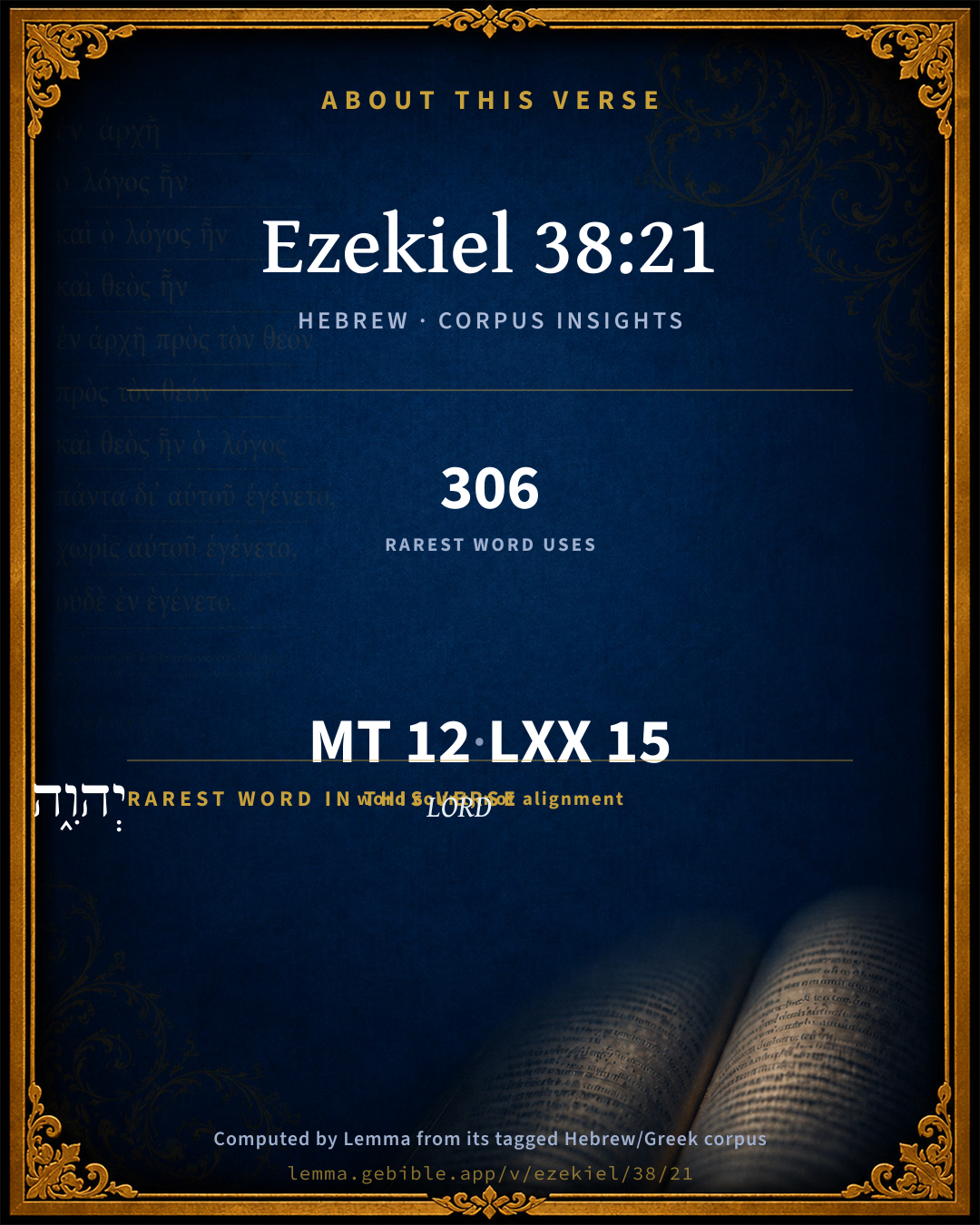
These counts appear in no published source. They are computed here, from the morphology-tagged text and Lemma’s own curated glosses. What Lemma adds →

12
words
11
distinct lemmas
Prophets
section

Grammatical profile

  • 2 verbs
  • 9 nouns
  • 1 preposition

Verb forms

  • וְקָרָ֨אתִי Qal · Sequential Perfect
  • תִּֽהְיֶֽה Qal · Imperfect

Repetition

A word recurs within this verse — often emphatic in Hebrew:

  • חֶ֔רֶב sword H2719 ×2

Hebrew & Septuagint length

In English translation the verse runs 24 words from the Hebrew and 22 from the Septuagint (LXX English) — closely comparable.

A rough comparison of the two English renderings, which tokenize alike — not a word-level alignment.

Word counts can differ between the Hebrew and the Greek without any difference in meaning — e.g. the Hebrew direct-object marker אֵת has no separate Greek word, and Greek often adds the article ὁ.

In the original languages it is 12 Hebrew tokens and 15 Greek tokens — but the two are counted differently (Hebrew bundles its prefixes and suffixes into one token; the Greek is in lemma form), so that isn’t a like-for-like length.

Cross-references

6

Topical passages linked to Ezekiel 38:21 in the Treasury of Scripture Knowledge — connected by theme and wording, ordered by reader-vote popularity; previews shown in the World English Bible.

  • Haggai 2:22 I will overthrow the throne of kingdoms. I will destroy the strength of the kingdoms of the nations. I will overthrow the chariots, and those who ride in them. The horses and their riders will come down, everyone by the sword of his brother.
  • Judges 7:22 They blew the three hundred trumpets, and Yahweh set every man's sword against his fellow, and against all the host; and the host fled as far as Beth-shittah toward Zererah, as far as the border of Abel Meholah, by Tabbath.
  • Ezekiel 14:17 Or if I bring a sword on that land, and say, Sword, go through the land; so that I cut off from it man and animal;
  • 2 Chronicles 20:23 For the children of Ammon and Moab stood up against the inhabitants of Mount Seir, utterly to kill and destroy them: and when they had made an end of the inhabitants of Seir, everyone helped to destroy another.
  • 1 Samuel 14:20 Saul and all the people who were with him were gathered together, and came to the battle: and, behold, every man's sword was against his fellow, [and there was] a very great confusion.
  • Psalms 105:16 He called for a famine on the land. He destroyed the food supplies.

Cross-references courtesy of OpenBible.info (CC BY 4.0).

Hebrew and Greek witnesses Masoretic Hebrew ↔ Greek Septuagint

The same verse in the two great witnesses to the Old Testament, shown verse-for-verse.

These are two independent witnesses, not word-aligned to each other, and the Septuagint is shown in lemma (dictionary) form.

Hebrew Ezekiel 38:21 Masoretic · Westminster Leningrad Codex

וְקָרָ֨אתִי עָלָ֤יו לְכָל הָרַי֙ חֶ֔רֶב נְאֻ֖ם אֲדֹנָ֣י יְהוִ֑ה חֶ֥רֶב אִ֖ישׁ בְּאָחִ֥יו תִּֽהְיֶֽה

I will call for a sword against him to all my mountains, says the Lord Yahweh: every man's sword shall be against his brother.

World English Bible · Public Domain

Greek LXX Ezekiel 38:21 Septuagint · lemma form

καί καλέω ἐπί αὐτός πᾶς φόβος λέγω κύριος μάχαιρα ἄνθρωπος ἐπί ὁ ἀδελφός αὐτός εἰμί

And I will summon against it even every fear, says the Lord: the sword of every man shall be against his brother.

LXX2012 (modern English Septuagint) · Public Domain

On this verse, The Cambridge Bible for Schools and Colleges discusses the Septuagint’s reading. Read the note in Commentary ↓

Hebrew: Westminster Leningrad Codex (CC BY 4.0). Greek: Septuagint (public domain); English from LXX2012 (modern English Septuagint) (Public Domain). How the Septuagint differs from the Hebrew →

Targum (Aramaic paraphrase)

1

The Targum is the ancient Jewish Aramaic paraphrase of the Hebrew Scriptures — an interpretive translation, not the Hebrew text itself. Onkelos (literal) and Pseudo-Jonathan (expansive) render the Torah, and Jonathan the Prophets. Coverage is partial: where no permissively-licensed English translation exists for a verse, only the Aramaic is shown. This is verse-level text, not a word-by-word alignment to the Hebrew.

  1. Targum Jonathan Prophets (Joshua–Malachi)
    וַאֲזַמְנִינֵיהּ לְמִפַּל בְּחַרְבָּא עַל טוּרֵי יִשְׂרָאֵל עַמִי אֲמַר יְיָ אֱלֹהִים חֶרֶב גְבַר בַּאֲחוּהִי תְהֵי:

    (no public-domain English translation for this verse)

    Targum Jonathan — Aramaic: “Mikraot Gedolot” (public domain). English: “Sefaria Community Translation” (CC0 1.0 (public-domain dedication)); “London "Chaldee Paraphrase," 1871” (public domain). Text via Sefaria.

Commentary

Notes on Ezekiel 38:21 from classic Christian and Jewish commentators (each source and its license shown beneath its notes). The classic Christian expositions comment on the surrounding passage and are grouped to its opening verse, so a note may address several verses; the Jewish commentaries on the Tanakh (Rashi and others) are per-verse, so they appear only where the commentator wrote on this verse.

Lemma curates 59 commentaries, every one of them public domain or Creative Commons licensed, each selected and text-cleaned for this edition rather than reprinted as found. About our sources →

Trapp's Complete Commentary

John Trapp

Eze 38:21 And I will call for a sword against him throughout all my mountains, saith the Lord GOD: every man’s sword shall be against his brother.

Ver. 21. And I will call for a sword.] Against Antiochus by the Maccabees; against the Turk and Pope by the Christian princes, Hunniades, Scanderbeg, Queen Elizabeth, the late and present kings of Sweden, the English and French forces in Flanders now before Gravelin, after Dunkirk and Bergen taken from the Spaniard. Certain it is, that ere long the beast and the false prophet shall be taken, and all the fowls of the heaven filled with the flesh of those kings and captains that fight against the gospel. {Rev 19:19-21}

John Trapp, A Commentary or Exposition upon All the Books of the Old and New Testament (1647–1656) — public domain. Text from a community e-Sword module.

Joseph Benson's Commentary

Eze 38:21-22. And I will call — Rather, But I will call, for a sword against him — That is, when he has carried all before him for some time, I will at length raise up those who shall withstand him. God’s doing a thing is often expressed in Scripture by his speaking the word, and giving out his command. Thus he is said Psalm (Psa 105:16) to call for a dearth upon the land of Canaan. Throughout all my mountains — Throughout all the land of Judea; for, as has been observed before, Judea being very mountainous, it is often in Scripture denominated the mountains of Israel, or, the mountains of the Lord. Every man’s sword shall be against his brother — God often destroys his enemies by intestine quarrels among themselves, and making them executioners of his judgments upon each other: see the margin. And I will plead against him with pestilence and with blood — Or, I will plead with him. God pleads with men by his judgments, which are a manifest token of the vengeance due to their sins. And I will rain upon him, &c., an overflowing rain, &c. — I will as plainly show myself in the destruction of these my enemies, as when I discomfited the armies of the Canaanites and Philistines by tempests of thunder and hail, or when I consumed Sodom and Gomorrah by fire and brimstone from heaven. “It is plain that the extraordinary circumstances mentioned in these verses remain to be accomplished on the future enemies of the Jews, when God’s people are reinstated in his favour.” — Bishop Newcome.

Joseph Benson's Commentary on the Old and New Testaments (1811–1818) — public domain. Text from a community e-Sword module.

Tyndale Open Study Notes

Tyndale Open Resources

38:21-23 The sword . . . disease and bloodshed . . . torrential rain, hailstones, fire, and burning sulfur! Israel had experienced similar punishments before (see 13:13); now they were executed on Israel’s enemies. The Divine Warrior was once again defending his people.

Tyndale Open Study Notes — © Tyndale Open Resources, licensed CC BY-SA 4.0. Text via the HelloAO Bible API.

Geneva Bible (1599)

Geneva Bible translators

Against the people of Gog and Magog.

Geneva Bible (1599) marginal notes — public domain. Text via Bolls.life.

Jamieson, Fausset & Brown

Robert Jamieson, A. R. Fausset & David Brown

every man's sword . . . against his brother--I will destroy them partly by My people's sword, partly by their swords being turned against one another (compare Ch2 20:23).

Jamieson, Fausset & Brown — Commentary Critical and Explanatory on the Whole Bible (1871) — public domain (CC PDM 1.0). Text via the HelloAO Bible API.

Adam Clarke's Commentary

Verse 21. I will call for a sword against him] Meaning Judas Maccabeus, who defeated his army under Lysias, making a horrible carnage. - Martin. Cambyses had no wars in the mountains of Israel.

Adam Clarke's Commentary on the Bible (1810–1826) — public domain. Text from a community e-Sword/MySword module.

The Cambridge Bible for Schools and Colleges

gen. ed. J. J. S. Perowne

21. every man’s sword] sign of a supernatural panic caused by Jehovah, Jdg_7:22; 1Sa_14:20. LXX. has read first clause: I will summon against him all terrors (i.e. a panic).

The Cambridge Bible for Schools and Colleges (gen. ed. J. J. S. Perowne; Cambridge University Press, 1878–1918) — public domain. Text from a community e-Sword module.

John Gill's Exposition

And I will plead against him with pestilence and with blood,.... Not only the sword of the Jews and the sword of Christian princes shall be drawn against him, and the sword of Gog's soldiers against one another; but the Lord himself would plead with him by his judgments, or take vengeance on him, as the Targum; and send a pestilence in his army, which should destroy vast numbers of it; as the army of Sennacherib was destroyed by one when before Jerusalem; and make a great slaughter among them by that and other judgments:

and I will rain upon him, and upon his bands, and upon the many people that are with him, an overflowing rain; a horrible tempest of divine wrath, Psa 11:6 as he came into the land of Israel like a storm, so he shall be destroyed by one much more terrible:

and great hailstones; such as were cast upon the Canaanites, Jos 10:11 and as there will be on men, the enemies of the church of God, at the pouring out of the seventh vial, Rev 16:21,

fire and brimstone; as God rained upon Sodom and Gomorrah, Gen 19:24, signifying that in like manner will God deal with those enemies of his people; so at the battle of Armageddon, which seems to be the same with this here, the beast and the false prophet will be taken alive, and cast into a lake of fire burning with brimstone, Rev 19:20, and to this rain or tempest of fire and brimstone upon Gog there is an allusion in Rev 20:9.

John Gill's Exposition of the Whole Bible (1746–1763) — public domain (CC PDM 1.0). Text via the HelloAO Bible API.

Haydock's Catholic Bible Commentary

Sword. The Jews were not in a condition to make resistance. (Calmet) --- Cambyses had his brother Smerdis slain. But another was set on the throne; whereupon, mounting his horse in a fury, he wounded himself with his sword in the thigh, which mortifying, caused his death after twenty days. (Herodotus iii. 21., &c.) --- The historian does not mention what became of his army; but it seems to have perished by discord, as was very common among such a collection of nations. See Judges vii. 22., and Judith xv. 1., and 1 Kings xiv. 20., and 4 Kings ii. 21. (Calmet) --- They were now without a head. (Haydock) --- In the whole universe, God will at last destroy Antichrist and all his adherents. (Worthington)

George Leo Haydock (1774–1849), Haydock's Catholic Family Bible and Commentary, 1859 edition — public domain. Excludes Psalms (Douay-Rheims chapter numbering differs from Protestant) and Deuterocanonical books (Catholic canon only).

Matthew Poole's English Annotations

Call; summon and awaken.

A sword; my army, the people of Israel. Against him; Gog and his powers.

Throughout all my mountains; from all parts of the land, called here mountains, because it was full of mountains.

Matthew Poole's English Annotations on the Holy Bible (1683–1685) — public domain. Text from a community e-Sword/MySword module.

The Pulpit Commentary

Every man"s sword shall be against his brother. (comp. Zec_14:13) The consternation produced by Jehovah"s interposition should be such that the ranks of Gog should fall into utter confusion, and his warriors exterminate each other, as did the Midianites in the days of Gideon, (Jud_1:7:22) and the Moabites, Ammonites, and Seiritea, who invaded Judah in the reign of Jehoshaphat. (2Ch_20:23)

Mutual antagonism.

I MUTUAL ANTAGONISM IS COMMON. In primitive times it was well-nigh universal. Pre-historic man seems to have lived in a state of perpetual warfare; and in the present day savages are often at war one with another; they maintain continuous feuds tribe against tribe, clan against clan, family against family. In these later times, even in enlightened Christendom, Europe appears as an armed comp. Every nation is suspicious of its neighbor, which it regards as a possible enemy. The same miserable attitude of antagonism is held in the political world, though here it is generally found possible to avoid overt violence. Government by party means government in face of antagonism, for there is always "her Majesty"s Opposition." Business life is maintained on the principle of mutual antagonism. The market is ruled by competition. Each house of business fiercely contends with its rivals for popular patronage. The relations between capital and labor have fallen into the same evil condition, and each side just fights for what it can seize at the expense of the other. Unhappily, the same spirit is observed in religion. When the Church should be engaged in conquering the world for Christ, she is consumed with internal discord and the contention of mutually excommunicating parties.

II MUTUAL ANTAGONISM IS WRONG. It springs from an evil root selfishness. War is the awful fruit of national selfishness. In public lifethe good of the people is too often sacrificed to the ambition of the Politician or the interest of the party. Business is degraded into a horrible scramble of selfishness, in which each clutches at whatever he can lay hands on without actually transgressing the law. Religious selfishness is the worst form of selfishness, for it belies the faith it professes. In sheer bigotry the antagonism may be honest; but bigotry is largely inspired by a subtle, unsuspected self-regarding spirit.

III MUTUAL ANTAGONISM MAY BE OVERRULED FOR GOOD. We see it in nature where no moral ideas have dawned, and where, therefore, no blame can be ascribed. The evolution of higher types of life is brought about by the struggle for existence, in which the strong kill out the weak, so that they only survive who are fittest for their habitat. No doubt national jealousy necessitates the maintenance of national vigor. Political partisanship keeps a watch on the government, and checks wrong-doing by a perpetual shower of criticisms. Competitive business cheapens produce for the consumer; it also stimulates invention and enterprise, and therefore encourages progress which monopoly paralyzes. Perhaps even in religious rivalry we may provoke one another to good works. These results cannot excuse selfishness, but they may show how God overrules it for a measure of good.

IV MUTUAL ANTAGONISM CAN ONLY BE CAST OUT BY CHRISTIAN LOVE. Reasoning will not destroy selfishness. The only cure for war is the reign of Christ, the Prince of Peace. Internal peace can only be brought about by the influence of love in the hearts of men. Christ came to set up the kingdom of heaven on earth. One of the essential characteristics of this kingdom, as opposed to all earthly kingdoms, is that it does not appeal chiefly to self-regarding motives. It demands love of God and of one"s neighbor, and it inspires that love by the influence of the constraining love of Christ.

The Pulpit Commentary (1880–1919), ed. H.D.M. Spence-Jones & Joseph S. Exell — public domain. Text from a community e-Sword module.

John Wesley's Explanatory Notes

Sword - Israel. Throughout - From all parts of the land, which was full of mountains. Every man's sword - As it was in Jehoshaphat's time; and these swords may be meant by the sword God will call for through all, for they ranged all over his mountains.

John Wesley, Explanatory Notes Upon the Whole Bible (1754–1765) — public domain. Text via the GEBible commentary corpus.

unfoldingWord translationNotes

Door43 World Missions Community

General Information:

Yahweh continues giving Ezekiel his message about Gog. He speaks of the people of Gog as if they were one man. (See: Metaphor)

I will summon a sword against him

The word "sword" here is a metonym for soldiers who use swords to kill people. AT: "I will cause soldiers to attack him" (See: Metonymy)

on all my mountains

This refers to the land of Israel. AT: "on all the mountains of Israel" (See: Assumed Knowledge and Implicit Information)

each man's sword will be against his brother

Here "sword" is a metonym for the person who uses the sword to fight. AT: "all of his soldiers will fight each other" (See: Metonymy)

his brother

"his fellow soldier"

I will judge him by plague and blood

Here "blood" is a metonym for injury and death. AT: "I will judge him by causing him to be sick and by sending soldiers to kill him" (See: Metonymy)

overflowing rain and hailstones and burning sulfur I will rain down upon him

It may be helpful to change the order of this sentence. AT: "I will rain down overflowing rain and hailstones and burning sulfur upon him"

hailstones

ice that falls out of the sky

show my greatness and my holiness

The abstract nouns "greatness" and "holiness" can be stated as adjectives. AT: "show that I am great and holy" (See: Abstract Nouns)

I will make myself known in the eyes of the many nations

Here "eyes" refers to sight, which is a metonym for understanding. AT: "I will cause many nations to understand who I am" (See: Metonymy)

know that I am Yahweh

When Yahweh says that people will know that he is Yahweh, he is implying that they will know that he is the one true God who has supreme authority and power. See how you translated this in Ezekiel 6:7. AT: "understand that I am Yahweh, the one true God" or "realize that I, Yahweh, have supreme power and authority" (See: Assumed Knowledge and Implicit Information)

translationWords

sword

Lord Yahweh

brother

judge

plague

blood

sulfur

holy

unfoldingWord translationNotes — © Distant Shores Media and the Door43 World Missions Community, licensed CC BY-SA 4.0. Source: git.door43.org/Door43/en_tn.

Rashi

Rabbi Shlomo Yitzchaki (Rashi)

And I will call the sword against him upon all My mountains for the sword to come upon them, against him. “And I will call” means, I will prepare. And what is the sword that I will call against him? Their own sword: “every man’s sword shall be against his brother.”

Rashi on the Tanakh — English translations: “The Judaica Press complete Tanach with Rashi, translated by A. J. Rosenberg” (CC BY 4.0); “Pentateuch with Rashi's commentary by M. Rosenbaum and A.M. Silbermann, 1929-1934” (public domain); “The Metsudah Tanach series, Lakewood, N.J” (CC BY 4.0); and “The Book of Joshua, Metsudah Publications, 1997” (CC BY 4.0). Text via Sefaria.

Lesson kit

Teaching starters — assembled from the data on this page, not authored interpretation. Every prompt links to the verse data it draws on. Edit before teaching.

Ezekiel, in the Prophets, opens this verse with 12 words (11 distinct Hebrew lemmas). Its most distinctive word is Yᵉhôvih (“LORD”). A historical commentator’s framing appears above. Read the whole chapter for the surrounding context.

Discussion questions

  1. What does “LORD” (Yᵉhôvih) contribute to the verse as a whole?
  2. How does Haggai 2:22, which shares this passage’s theme, read alongside this verse?
  3. What does the repetition of “sword” (2× in this one verse) do in this verse?
  4. The translations on this page render this verse differently — a whole-verse word diff, not a word-by-word alignment. What might account for the different wordings?
  5. «וְקָרָ֨אתִי» is a Qal Sequential Perfect verb. How does that grammatical form shape the action described?
  6. Compare how Trapp's Complete Commentary and Joseph Benson's Commentary read this verse. Where do they agree or differ?

Things to notice

Reading settings

Reading text

Shown beneath each verse's original-language words.

Old Testament
Old Testament edition

Read the OT as the Masoretic Hebrew (MT) or the Greek Septuagint (LXX).

English shown for the Greek Septuagint (in the Hebrew ↔ Greek comparison).

Comparing translations? Open the Compare panel on any verse page to stack up to four side by side.