
Daniel 5:28

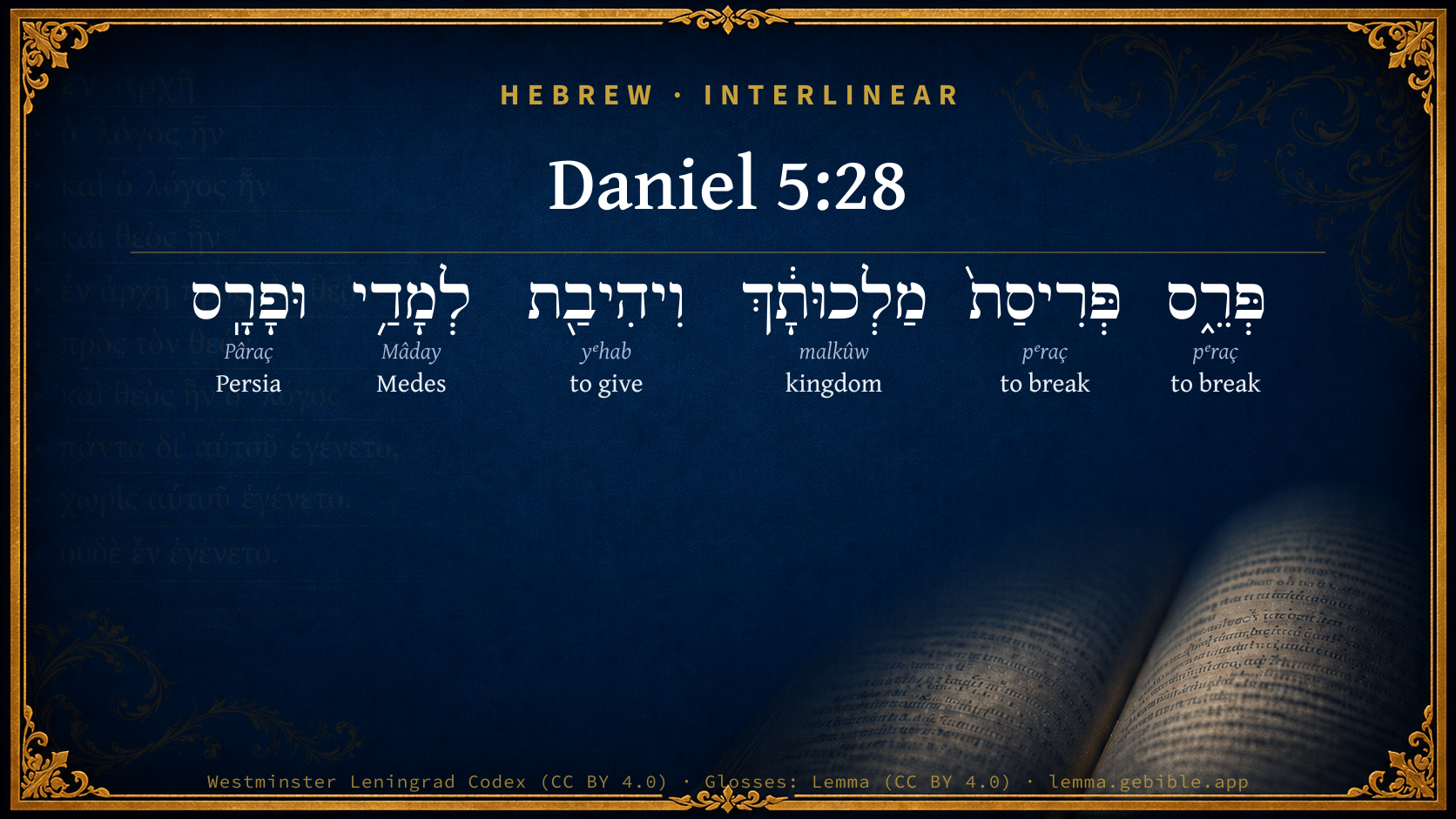
Hebrew (Westminster Leningrad Codex) Daniel 5:28 appears in the Hebrew Old Testament. The text above is from the Westminster Leningrad Codex. Each word links to its Strong’s number, a concise gloss, and parsing drawn from the Open Scriptures Hebrew Bible morphology. Click any word for its full Brown-Driver-Briggs (BDB) entry.
Download image
Cite this verse

Daniel 5:28 (World English Bible). Public Domain. Lemma interlinear Bible study tool, https://lemma.gebible.app/v/daniel/5/28.

Show BibTeX & RIS
BibTeX
RIS
English Translation
PERES; your kingdom is divided, and given to the Medes and Persians.
World English Bible · Public Domain
Download a study sheet

One document with this verse’s original text, its word-by-word gloss line, the meaning frame, cross-references with their text, attributed commentary, and full source and license credits — printable, and it pastes into notes with its structure intact.

This verse Autodidact and up

Study sheet (.html) Plain text (.txt)

A passage Seminary Student

Up to 50 verses in one chapter. A passage sheet keeps up to 6 commentary sources and 12 cross-references per verse, in the order this page ranks them, and says so on the sheet whenever that leaves anything out. Ask for a single verse and you get the Autodidact verse sheet above.

Everything on this page stays free to read, with no account — the sheet is a download of what is already on screen, not access to it.

Want to remove ads? Support Godless Engineer
Compare translations 3

The same verse in 3 English versions, stacked beneath the original-language interlinear above. Click any original word for its lexicon entry.

Each is an independent rendering of the whole verse — the interlinear is not word-aligned to these translations.

Highlighted words mark where these versions differ — a whole-verse word diff, not a word-by-word alignment.

  • World English Bible Public Domain
    PERES; your kingdom is divided, and given to the Medes and Persians.
  • King James Version Public Domain
    PERES; Thy kingdom is divided, and given to the Medes and Persians.
  • unfoldingWord Literal Text CC BY-SA 4.0
    ‘Peres,’ ‘your kingdom has been divided and given to the Medes and Persians.’”

unfoldingWord Literal Text — © unfoldingWord, licensed CC BY-SA 4.0. Word-aligned USFM3 via Door43 (git.door43.org/unfoldingWord/en_ult).

Versions to compare (up to 4)

3 of 4 selected

Show all 18 translations

Every available English version of this verse, each an independent rendering of the whole verse.

  • World English Bible Public Domain
    PERES; your kingdom is divided, and given to the Medes and Persians.
  • Berean Standard Bible Public Domain
    PERES means that your kingdom has been divided and given over to the Medes and Persians.”
  • Majority Standard Bible Public Domain
    PERES means that your kingdom has been divided and given over to the Medes and Persians.”
  • King James Version Public Domain
    PERES; Thy kingdom is divided, and given to the Medes and Persians.
  • American Standard Version (1901) Public Domain
    PERES; thy kingdom is divided, and given to the Medes and Persians.
  • Revised Version (1885) Public Domain
    PERES; thy kingdom is divided, and given to the Medes and Persians.
  • Geneva Bible (1599) Public Domain
    PERES, thy kingdome is deuided, and giuen to the Medes and Persians.
  • Douay-Rheims (1899) Public Domain
    PHARES: thy kingdom is divided, and is given to the Medes and Persians.
  • Young's Literal Translation Public Domain
    Divided -- Divided is thy kingdom, and it hath been given to the Medes and Persians.'
  • Literal Standard Version CC BY-SA 4.0
    Divided—Your kingdom is divided, and it has been given to the Medes and Persians.”
  • Unlocked Literal Bible CC BY-SA 4.0
    'Peres,' 'your kingdom is divided and is given to the Medes and Persians.'”
  • unfoldingWord Literal Text CC BY-SA 4.0
    ‘Peres,’ ‘your kingdom has been divided and given to the Medes and Persians.’”
  • Darby Bible Public Domain
    PERES, Thy kingdom is divided, and given to the Medes and Persians.
  • World Messianic Bible Public Domain
    PERES: your kingdom is divided, and given to the Medes and Persians.”
  • Webster's Bible Public Domain
    PERES; Thy kingdom is divided, and given to the Medes and Persians.
  • Free Bible Version CC BY-SA 4.0
    Divided—your kingdom has been divided and given to the Medes and the Persians.”
  • Bible in Basic English Public Domain
    Peres; your kingdom has been cut up and given to the Medes and Persians.
  • JPS Tanakh (1917) Public Domain
    PERES, thy kingdom is divided, and given to the Medes and Persians.'

Literal Standard Version (2020), Covenant Press — licensed CC BY-SA 4.0. Text via the HelloAO Bible API (eBible.org). Unlocked Literal Bible (unfoldingWord) — licensed CC BY-SA 4.0. Text via the HelloAO Bible API (eBible.org). unfoldingWord Literal Text — © unfoldingWord, licensed CC BY-SA 4.0. Word-aligned USFM3 via Door43 (git.door43.org/unfoldingWord/en_ult). Free Bible Version, Dr. Jonathan Gallagher — licensed CC BY-SA 4.0. Text via the HelloAO Bible API (eBible.org).

Word by word

More ways to search: Search by grammar → Find every occurrence → Compare this word →

Practice this passage: Drill this verse → Learn its vocabulary →

About this verse

These counts appear in no published source. They are computed here, from the morphology-tagged text and Lemma’s own curated glosses. What Lemma adds →

6
words
5
distinct lemmas
Prophets
section

Notable vocabulary

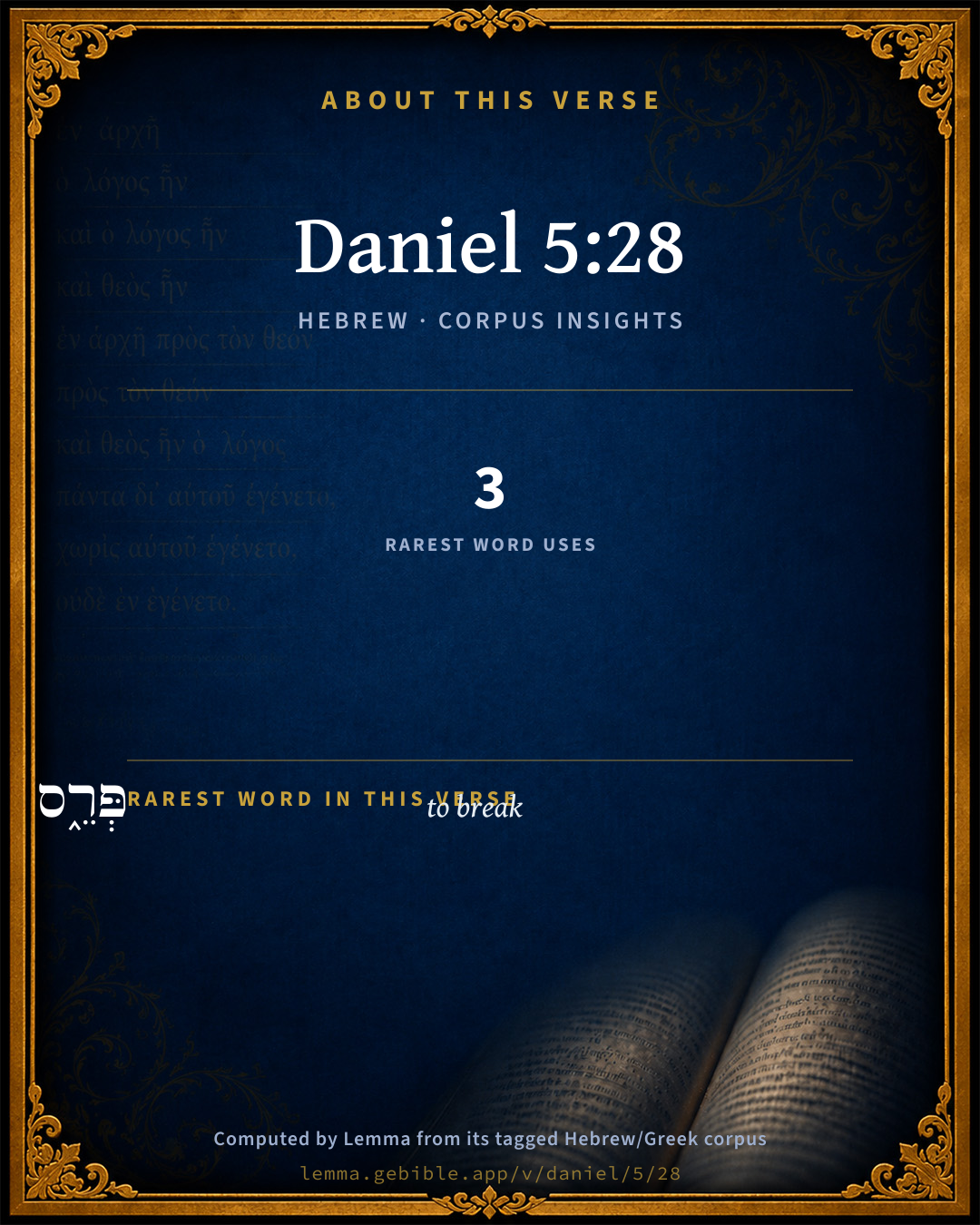
The rarest word here is פְּרֵ֑ס to break H6537 — appearing just 3 times in the whole Hebrew Bible.

Shared distinctive vocabulary

פְּרֵ֑ס to break H6537 occurs in 2 verses of the Hebrew Bible. Also found in:

Grammatical profile

  • 1 verb
  • 2 nouns
  • 3 adjectives

Verb forms

  • וִיהִיבַ֖ת Qal Passive · Perfect

Repetition

A word recurs within this verse — often emphatic in Hebrew:

  • פְּרֵ֑ס to break H6537 ×2

Hebrew & Septuagint length

In English translation the verse runs 12 words from the Hebrew and 12 from the Septuagint (LXX English) — the same length.

A rough comparison of the two English renderings, which tokenize alike — not a word-level alignment.

Word counts can differ between the Hebrew and the Greek without any difference in meaning — e.g. the Hebrew direct-object marker אֵת has no separate Greek word, and Greek often adds the article ὁ.

Cross-references

8

Topical passages linked to Daniel 5:28 in the Treasury of Scripture Knowledge — connected by theme and wording, ordered by reader-vote popularity; previews shown in the World English Bible.

  • Isaiah 13:17 Behold, I will stir up the Medes against them, who shall not regard silver, and as for gold, they shall not delight in it.
  • Daniel 6:28 So this Daniel prospered in the reign of Darius, and in the reign of Cyrus the Persian.
  • Isaiah 21:2 A grievous vision is declared to me; the treacherous man deals treacherously, and the destroyer destroys. Go up, Elam; besiege, Media; all the sighing of it have I made to cease.
  • Daniel 5:31 Darius the Mede received the kingdom, being about sixty-two years old.
  • Isaiah 45:1–2 Thus says Yahweh to his anointed, to Cyrus, whose right hand I have held, to subdue nations before him, and I will loose the loins of kings; to open the doors before him, and the gates shall not be shut:
  • Daniel 8:20 The ram which you saw, that had the two horns, they are the kings of Media and Persia.
  • Daniel 9:1 In the first year of Darius the son of Ahasuerus, of the seed of the Medes, who was made king over the realm of the Chaldeans,
  • Daniel 8:3–4 Then I lifted up my eyes, and saw, and, behold, there stood before the river a ram which had two horns: and the two horns were high; but one was higher than the other, and the higher came up last.

Cross-references courtesy of OpenBible.info (CC BY 4.0).

Hebrew and Greek witnesses Masoretic Hebrew ↔ Greek Septuagint

The same verse in the two great witnesses to the Old Testament, shown verse-for-verse.

These are two independent witnesses, not word-aligned to each other, and the Septuagint is shown in lemma (dictionary) form.

Hebrew Daniel 5:28 Masoretic · Westminster Leningrad Codex

פְּרֵ֑ס פְּרִיסַת֙ מַלְכוּתָ֔ךְ וִיהִיבַ֖ת לְמָדַ֥י וּפָרָֽס

PERES; your kingdom is divided, and given to the Medes and Persians.

World English Bible · Public Domain

Greek LXX Daniel 5:28 Septuagint · lemma form
Phares; your kingdom is divided, and given to the Medes and Persians.

LXX2012 (modern English Septuagint) · Public Domain

Hebrew: Westminster Leningrad Codex (CC BY 4.0). Greek: Septuagint (public domain); English from LXX2012 (modern English Septuagint) (Public Domain). How the Septuagint differs from the Hebrew →

Commentary

Notes on Daniel 5:28 from classic Christian and Jewish commentators (each source and its license shown beneath its notes). The classic Christian expositions comment on the surrounding passage and are grouped to its opening verse, so a note may address several verses; the Jewish commentaries on the Tanakh (Rashi and others) are per-verse, so they appear only where the commentator wrote on this verse.

Lemma curates 59 commentaries, every one of them public domain or Creative Commons licensed, each selected and text-cleaned for this edition rather than reprinted as found. About our sources →

Trapp's Complete Commentary

John Trapp

Dan 5:28 PERES; Thy kingdom is divided, and given to the Medes and Persians.

Ver. 28. PERES; thy kingdom is divided, and given to the Medes.] This had been long before prophesied, Isa 13:17; yea, Gen 9:25; and now Ham’s posterity felt his father’s curse. Nimrod, the founder of Babylon, came of Ham, Madai or the Medes were of Japhet, and Elam or the Persians of Shem. God’s forbearances are no acquittances. Let all wicked ones look to it. What is Mene but death? Tekel but judgment? Peres but hell or utter separation from God? and all to be passed through by their poor souls if timely course be not taken. Hear this, all ye drunkards, who glory in drinking the three outs &c.

John Trapp, A Commentary or Exposition upon All the Books of the Old and New Testament (1647–1656) — public domain. Text from a community e-Sword module.

The Biblical Illustrator

Joseph S. Exell

Dan_5:28

Thy kingdom is divided.

The Last Warning

In the words of our text, we have a warning addressed to a guilty monarch, in a manner too open and public to be ascribed to delusion on his part, or to imposture on that of others--a warning which silenced in a moment the roar of impious mirth.

I. SOME REMARKS EXPLANATORY OF THIS VISION.

1. It was an intimation to Belshazzar of the termination of his reign. It announced to him, not merely a calamity by which his throne might be shaken, or a banishment and captivity from which he might return, and resume his power, but its final close. The doubling of this word intimated, the absolute certainty of the predicted ruin. In this warning, too, it was intimated that his kingdom should be given to the rivals whom he hated, whose siege of his capital he had hitherto resisted, with success, and whose power and skill he had lately so presumptuously defied. This is a circumstance which has often embittered the last hours of falling greatest, that its honours should adorn the head of a rival, and that they should enjoy those scenes of delight which they had prepared for themselves.

2. In this warning of Belshazzar there is an intimation of Jehovahs estimate of the worthlessness of his character: Thou art weighed in the balances, and thou are found wanting.

3. In this warning the connection betwixt his sins and his punishment is strongly marked.

4. It was a warning in which no hope of mercy was exhibited. There was not merely no intimation that it was possible, by any particular course, to escape the impending destruction, but no direction was given how his soul might be saved from the wrath to come. But it may be said, Why was this warning given if his case was desperate? To this it may be answered, that it was an open testimony of the displeasure of Jehovah at the contempt which had been manifested to His name and worship, and was adapted to make the strongest impression in favour of the true religion on the successful besiegers.

5. It was the last warning which Belshazzar received. He had received many admonitions already. The Monitor, who had long struggled with him, had now written the last sentence, and uttered the last voice of admonition, and he was now abandoned of God to his fate.

6. It was quickly realised in Belshazzars ruin. Twelve months elapsed betwixt the warning given to Nebuchadnezzar and his expulsion from human society to all the degradations of wild insanity; but in that very night after this warning was Belshazzar slain. When Jonah cried in Nineveh, Yet forty days, and Nineveh shall be overthrown! word came to the king, and he arose from his throne, and he laid his robe from him, and covered himself in sackcloth, and sat in ashes, and called his people to fasting and prayer; and though no intimation of mercy was given in the warning of Jonah, they said, Who can tell if God will turn, and repent, and turn away from his fierce anger, that we perish not? But no such grief was felt, no such mandate was issued by Belshazzar.

II. SOME OF THE IMPORTANT LESSONS WHICH THIS WARNING SUGGESTS.

1. It shows us that it is the province of Jehovah to fix the continuance, and to bring to a close the power of empires. Beyond the period which he hath set for their continuance, no wealth, nor skill, nor valour, can prolong their existence. In speaking of the revolutions of kingdoms, the wise men of this world confine their attention to the oppressions which made the yoke of princes intolerable; to the artifices by which the hearts of subjects were alienated from their rulers; to those habits of luxury which enervated them, and rendered them an easy prey; but let us recollect that these and ether causes are guided by His hand who hath wisdom and might for His; who changeth the times and the seasons; who removeth kings, and who setteth up kings. The history of the world presents us with other instances, besides this one in the text, of Gods terminating kingdoms and dynasties. Empires, which seemed likely to stand while sun and moon endured, have crumbled down like a house of clay, and not a trace remains that here their palaces stood, their ships rode, or their banners waved. How quickly did the empire of Alexander fall to pieces! His death was the signal for disunion among his generals; and the dominion which had been hastily acquired was as hastily lost.

2. This warning teaches us that Providence assigns the power of which it deprives guilty princes to those whom it pleases.

3. This warning suggests that God gives various indications of His intention of terminating the power of kings, and of transferring it to others. In this age we are not to expect, as in the case of Belshazzar, a sign from Heaven to indicate that the period for the fall of empires is come, but in many ways is this impression produced in the hearts of princes, and it is legible in the events of Providence. Princes, notwithstanding the flatteries of their courtiers, have been unable to shake off the gloomy apprehension of the decline of their glory. In other cases an approaching change is visible in the discontent of the people; in those cabals and murmurs which tell us that a storm is gathering; and in the persisting of rulers in measures which irritate where conciliation is required. Let us mark the signs of the times, not to cherish a croaking spirit of discontent, but to hear the sound of Gods steps, when He comes out of His place to punish, and to flee from the wrath to come.

4. I remark that it teaches us that there are various methods by which God tries the characters, tempers, and conduct of men. There is the balance of the sanctuary, by which I understand those principles for guiding our opinions, and those rules for directing our conduct, which are laid down in Scripture. The world hath its maxims by which it tries the tempers and actions of men. There is the balance of conscience. To this faculty God hath assigned the office of judging of mens thoughts, words, and actions. In some cases it performs this duty in a careless manner. There is the balance of Providence, by the events of which astonishing discoveries are some- times made of the real tempers and characters of men, and they are found quite different from what they were supposed to be both by themselves and others. How many a man has prosperity shown to be in heart haughty and cruel! And there is the balance of judgment. God hath appointed a day in which He will bring every work into judgment, with every secret thing, whether good or evil.

5. There are various persons who, when thus tried, shall be found wanting. The scrutiny is universal. There is none on earth so mighty as to resist it, and none too insignificant to escape it.

6. There are various modes and seasons in which God intimates to the sinner, even in the present life, His estimate of his character. He does this in exposing his true character to the knowledge end the detestation of his fellow-creatures: and how horrible is public shame and infamy when it is considered as an expression of the secret abhorrence of the Judge of all! He does this in the destruction which He brings on sinners around them in their sins, and in the exposure of their wickedness. In such sad events the sinner is made to read his own character, and to hear his own doom. He does this in the melancholy reflections of old age on a life spent without God, and closing without hope. And He often intimates this estimate of the sinners character to him on his death-bed.

7. There is something very solemn and awful about such intimations. There are various considerations which evince this to be the case. Were it merely the expression of human opinion it might be despised, but it is His verdict in whose hand our final destiny rests. It is often unexpected. Little did Belshazzar imagine that such an intimation was approaching. In the eye of fancy he beheld his enemies retiring from the siege of Babylon, public applause placing new crowns on his head, and a long career of prosperity and glory opening before him. Little did the man who had gone to the feast without the wedding garment imagine that on that day he was to be exposed and punished. CONCLUSION. How much is it to be desired that the lessons of this scene should be pondered by the rulers and the judges of the earth! Let them bow before Him by whom kings reign and princes decree justice. How similar to that of Belshazzar was the character and sudden exit of Charles the Second in England!--a monarch whose debaucheries were copied in the licentiousness of his subjects, and whose cruel persecutions the flatterer attempts to excuse, and the bigot to vindicate in vain. This suddenness in his fate, says Evelyn in his Diary, might well create awful feelings in those who had witnessed the life he continued to lead, till the stroke of death arrested him. I saw this evening such a scene of profuse gaming, and luxurious dallying and profaneness in the palace, as I had never before witnessed. A week after he assisted at the proclamation of his successor, and thus records his feelings: I can never forget the luxury and profaneness, gaming and all dissoluteness, and, as it were, total forgetfulness of God, it being Sabbath evening which, this day seennight, I was witness to, the king dallying with his mistresses, a French boy singing wanton songs to amuse them, and a number of the courtiers in deep play round a gaming-table. Six days after all was in the dust. But all ranks of people should listen to the instructions which are taught them by this scene. Let not any say, I shall never be moved, I shall never be in adversity. Mark every intimation which God gives you of the solemn change. Let good men receive the consolation which is imparted to them by this subject, however gloomy it may appear. Whatever disasters may happen, the kindness of God shall not depart from you, and with your joy a stranger cannot intermeddle. Let ungodly men be afraid. Make not the terrors of judgment the subject of your mirth. (H. Belfrage, D.D.)

The Biblical Illustrator, edited by Joseph S. Exell (c. 1880s–1900s) — public domain. Text from a community e-Sword module.

Tyndale Open Study Notes

Tyndale Open Resources

5:28 Parsin means ‘divided’ (or halved): The Babylonian Empire would be divided and given to two peoples, the Medes and the Persians.

Tyndale Open Study Notes — © Tyndale Open Resources, licensed CC BY-SA 4.0. Text via the HelloAO Bible API.

Jamieson, Fausset & Brown

Robert Jamieson, A. R. Fausset & David Brown

Peres--the explanation of "dividers" (Dan 5:25), the active participle plural there being used for the passive participle singular, "dividers" for "divided." The word "Peres" alludes to the similar word "Persia."

divided--namely, among the Medes and Persians [MAURER]; or, "severed" from thee [GROTIUS].

Jamieson, Fausset & Brown — Commentary Critical and Explanatory on the Whole Bible (1871) — public domain (CC PDM 1.0). Text via the HelloAO Bible API.

John Calvin's Commentaries

The word פרס, Pheres, is added, for the word Phersin, meaning his kingdom was divided among the Medes and Persians. I have no doubt that by this word God signified the dispersion of the Monarchy which was at hand. When, therefore, he says Upharsin, and they shall divide, it signifies the instability of the Monarchy, since he wished to destroy or utterly abolish it. But the Prophet alludes very appositely to the division made between the Medes and Persians; and thus his disgrace was increased by the Babylonians being compelled to serve many masters. This is indeed a grave and serious disgrace, when a people has obtained a wide and extensive empire, to be afterwards conquered and subjected to the yoke of a single master; but when it suffers under two masters, then the indignity is greatly increased. So Daniel here shews how God’s wrath was complicated in the destruction of the monarch of Babylon, since it added to the severity of their punishment, to be subdued by both Medes and Persians. The city, indeed, was truly taken by the valor and industry of Cyrus; but since Cyrus admitted his father-in-law to the great honor of allowing him to partake of the royal authority, hence the Medes and Persians are said to have divided the kingdom, although there was properly no division of the kingdom. Cyrus afterwards engaged in other expeditions, as he was led away by his insatiable avarice and ambition. But Darius, as we shall afterwards see, died at the age of sixty years, dwelt quietly at home, and it is very well known that he was a Mede; and if we may believe the majority of historians, his sister, the mother of Cyrus, had been banished to Persia, in consequence of the oracle concerning the fortune and greatness of Cyrus. Since his grandfather had exposed him, he afterwards avenged the injury, yet, not so cruelly as to take his life,-for he desired him to retain some dignity, and hence appointed him a satrap. But his son afterwards reigned over the Medes, with the full permission of Cyrus, who next married his daughter; and thus, on account of this relationship, and through the influence of this new alliance, he wished to have him as a partner in the empire. In this sense, then, Daniel narrates the division of the Monarchy to be at hand, since the Medes and the Persians should divide it among them. It follows, —

John Calvin's Commentaries (1540-1563) — public domain. Text from the Calvin Translation Society English edition (1840s-50s) via the Christian Classics Ethereal Library (ccel.org). Calvin's coverage is partial (roughly two-thirds of the Bible); uncommented books and verses are honest gaps, never fabricated. The 19th-century editor's footnotes and remarks are omitted so the notes are faithfully Calvin's own voice.

The Cambridge Bible for Schools and Colleges

gen. ed. J. J. S. Perowne

28. the Medes and Persians] See on Dan_5:31.

The Cambridge Bible for Schools and Colleges (gen. ed. J. J. S. Perowne; Cambridge University Press, 1878–1918) — public domain. Text from a community e-Sword module.

John Gill's Exposition

PERES,.... The singular of "Pharsin", Dan 5:25. The sense of this word is,

thy kingdom is divided: which, though it consisted of various provinces, united under Belshazzar, now should be broken and separated from him:

and given to the Medes and Persians; to Darius the Mede, and to Cyrus the Persian, who was a partner for a while with his uncle Darius in the government of the empire: there is an elegant play on words in the words "Peres" and "Persians"; and a grievous thing it is to sinners, not only to have body and soul divided at death, but to be divided and separated from God to all eternity; and to hear that sentence, "depart from me, ye cursed, into everlasting fire, prepared for the devil and his angels".

John Gill's Exposition of the Whole Bible (1746–1763) — public domain (CC PDM 1.0). Text via the HelloAO Bible API.

Albert Barnes' Notes on the Bible

Peres - In Dan 5:25 this is “Upharsin.” These are but different forms of the same word - the word in Dan 5:25 being in the plural, and here in the singular. The verb (פרס peras) means, to “divide;” and in this form, as in the previous cases, it is, according to Gesenius, participle meaning “divided.” As it stands here, it would be applicable to anything that was “divided” or “sundered” - whether a kingdom, a palace, a house, territory, etc. “What” was divided could be known only by Divine revelation. If the “word” had been understood by Belshazzar, undoubtedly it would have suggested the idea that there was to be some sort of division or sundering, but what that was to be would not be indicated by the mere use of the word. Perhaps to an affrighted imagination there might have been conveyed the idea that there would be a revolt in some of the provinces of the empire, and that a part would be rent away, but it would not have occurred that it would be so rent that the whole would pass under the dominion of a foreign power. Josephus (“Ant.” b. x. ch. xi. Section 3) says, that the word “Phares in the Greek tongue means a “fragment,” κλασμα klasma - God will, therefore, break thy kingdom in pieces, and divide it among the Medes and Persians.”

Thy kingdom is divided - That is, the proper interpretation of this communication is, that the kingdom is about to be rent asunder, or broken into fragments. It is to be separated or torn from the dynasty that has ruled over it, and to be given to another.

And given to the Medes and Persians - On this united kingdom, see the notes at Isa 13:17. It was “given” to the Medes and Persians when it was taken by Cyrus, and when the kingdom of Babylon became extinct, and thenceforward became a part of the Medo-Persian empire. See the notes at Isa 13:17, Isa 13:19.

Albert Barnes' Notes on the Bible (1834–1885) — public domain. Text from a community e-Sword/MySword module.

Haydock's Catholic Bible Commentary

Persians. Those who confound Baltassar with Nabonides, say that Cyrus made himself master of all the empire. How then was it divided? Darius rather took possession of the greatest part while Cyrus had Persia, (Calmet) till his uncle’s death. (Haydock)

George Leo Haydock (1774–1849), Haydock's Catholic Family Bible and Commentary, 1859 edition — public domain. Excludes Psalms (Douay-Rheims chapter numbering differs from Protestant) and Deuterocanonical books (Catholic canon only).

Matthew Poole's English Annotations

Separated, divided, broken.

Peres signifies two things,

broken off, and

Persian; noting, first, That this kingdom was broken from Belshazzar, and his line and family. Secondly, That it was given from the Chaldeans to the Persians. Then it was divided between the Medes and Persians; for Cyrus took Babylon, he was a Persian; after that he gave part of it to Darius his son-in-law, and he was a Mede; and so they were as it were partners. So this vast empire, that was one sole, entire thing under Belshazzar, becomes now as it were two, divided betwixt the Medes and Persians, which thing is curious to observe, from this word

Phars, Pharsin, Peres, which signifies not only dividing, but

Persian, as Pliny testifies. With the Chaldeans, the Persians, in Scripture, are called Elamites.

Matthew Poole's English Annotations on the Holy Bible (1683–1685) — public domain. Text from a community e-Sword/MySword module.

John Wesley's Explanatory Notes

PERES - Separated, divided, broken. Phars signifies two things, broken off, and Persian; noting that, first, this kingdom was broken down from Belshazzar. Secondly, that it was given to the Persians.

John Wesley, Explanatory Notes Upon the Whole Bible (1754–1765) — public domain. Text via the GEBible commentary corpus.

Rashi

Rabbi Shlomo Yitzchaki (Rashi)

Your kingdom has been broken up, etc. i.e., UFARSIN means two definitions of PEREIS; one is that your kingdom פְּרִיסַת, your kingdom has been broken up, and the second one is that it has been given to Media and Persia (וּפָּרַס).

Rashi on the Tanakh — English translations: “The Judaica Press complete Tanach with Rashi, translated by A. J. Rosenberg” (CC BY 4.0); “Pentateuch with Rashi's commentary by M. Rosenbaum and A.M. Silbermann, 1929-1934” (public domain); “The Metsudah Tanach series, Lakewood, N.J” (CC BY 4.0); and “The Book of Joshua, Metsudah Publications, 1997” (CC BY 4.0). Text via Sefaria.

Lesson kit

Teaching starters — assembled from the data on this page, not authored interpretation. Every prompt links to the verse data it draws on. Edit before teaching.

Daniel, in the Prophets, opens this verse with 6 words (5 distinct Hebrew lemmas). Its most distinctive word is pᵉraç (“to break”). A historical commentator’s framing appears above. Read the whole chapter for the surrounding context.

Discussion questions

  1. The word pᵉraç carries the sense “to break.” How does it shape the verse?
  2. Daniel 5:25 shares the word «to break» with this verse. How do the two illuminate each other?
  3. “to break” occurs 2× in this one verse. What is the effect of the repetition?
  4. These translations render this verse differently; the difference is in the English rendering, not the original. What questions does that raise?
  5. The verb «וִיהִיבַ֖ת» is Qal Passive Perfect. How does its form color the action?
  6. Reading how Trapp's Complete Commentary and The Biblical Illustrator read this verse, where do the two commentators agree and where do they part?

Things to notice

  • These translations choose different wording for 2 words in this verse.
  • “to break” occurs 2× in this single verse.
  • 5 distinct Hebrew lemmas span 6 words in this verse.

Reading settings

Reading text

Shown beneath each verse's original-language words.

Old Testament
Old Testament edition

Read the OT as the Masoretic Hebrew (MT) or the Greek Septuagint (LXX).

English shown for the Greek Septuagint (in the Hebrew ↔ Greek comparison).

Comparing translations? Open the Compare panel on any verse page to stack up to four side by side.