
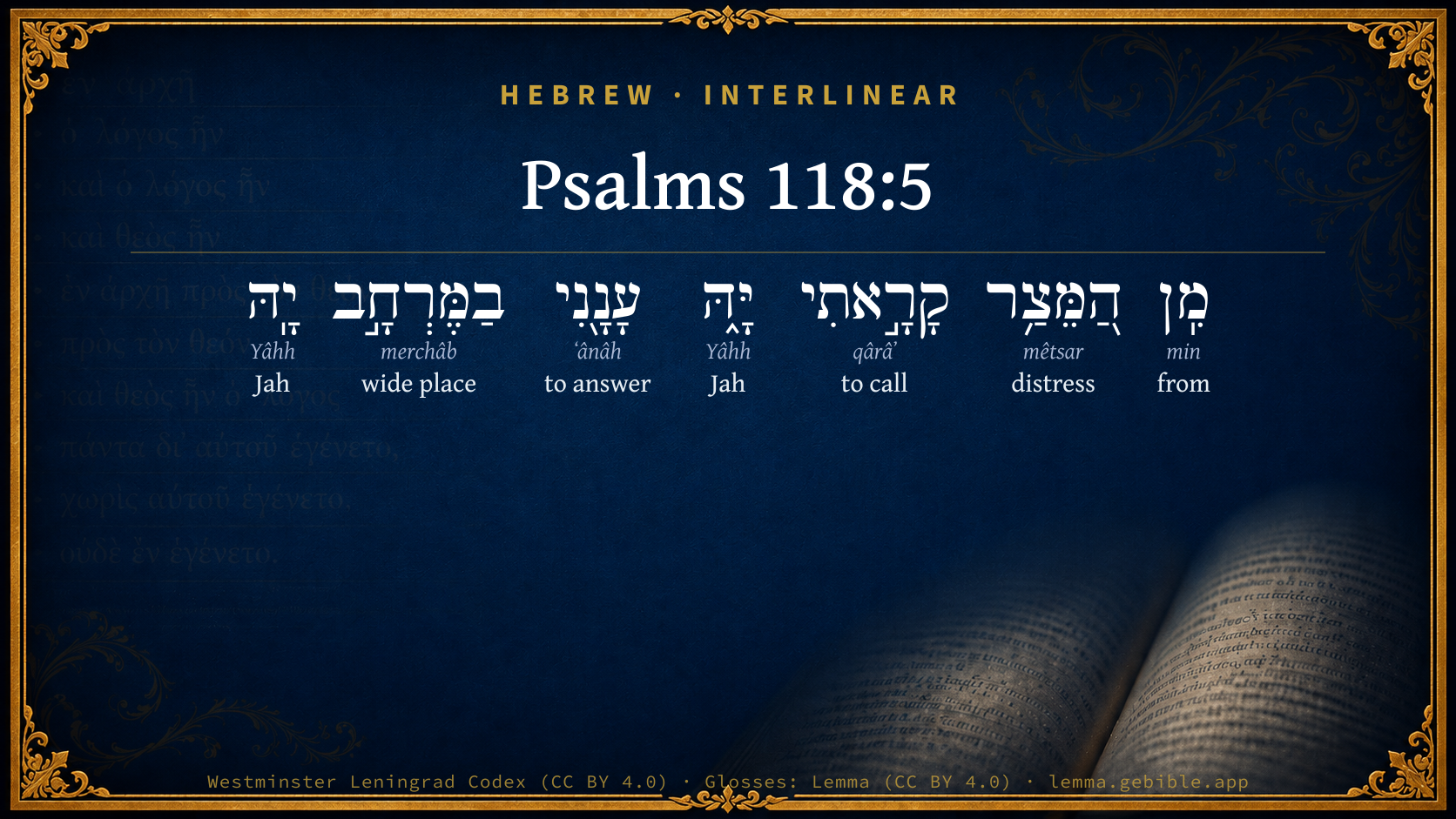
Psalms 118:5

Hebrew (Westminster Leningrad Codex) Psalms 118:5 appears in the Hebrew Old Testament. The text above is from the Westminster Leningrad Codex. Each word links to its Strong’s number, a concise gloss, and parsing drawn from the Open Scriptures Hebrew Bible morphology. Click any word for its full Brown-Driver-Briggs (BDB) entry.
Download image
Cite this verse

Psalms 118:5 (World English Bible). Public Domain. Lemma interlinear Bible study tool, https://lemma.gebible.app/v/psalms/118/5.

Show BibTeX & RIS
BibTeX
RIS
English Translation
Out of my distress, I called on Yah. Yah answered me with freedom.
World English Bible · Public Domain
Download a study sheet

One document with this verse’s original text, its word-by-word gloss line, the meaning frame, cross-references with their text, attributed commentary, and full source and license credits — printable, and it pastes into notes with its structure intact.

This verse Autodidact and up

Study sheet (.html) Plain text (.txt)

A passage Seminary Student

Up to 50 verses in one chapter. A passage sheet keeps up to 6 commentary sources and 12 cross-references per verse, in the order this page ranks them, and says so on the sheet whenever that leaves anything out. Ask for a single verse and you get the Autodidact verse sheet above.

Everything on this page stays free to read, with no account — the sheet is a download of what is already on screen, not access to it.

Want to remove ads? Support Godless Engineer
Compare translations 3

The same verse in 3 English versions, stacked beneath the original-language interlinear above. Click any original word for its lexicon entry.

Each is an independent rendering of the whole verse — the interlinear is not word-aligned to these translations.

Highlighted words mark where these versions differ — a whole-verse word diff, not a word-by-word alignment.

  • World English Bible Public Domain
    Out of my distress, I called on Yah. Yah answered me with freedom.
  • King James Version Public Domain
    I called upon the LORD in distress: the LORD answered me, and set me in a large place.
  • unfoldingWord Literal Text CC BY-SA 4.0
    From the constriction I called out to Yah; Yah answered me with wideness.

unfoldingWord Literal Text — © unfoldingWord, licensed CC BY-SA 4.0. Word-aligned USFM3 via Door43 (git.door43.org/unfoldingWord/en_ult).

Versions to compare (up to 4)

3 of 4 selected

Show all 18 translations

Every available English version of this verse, each an independent rendering of the whole verse.

  • World English Bible Public Domain
    Out of my distress, I called on Yah. Yah answered me with freedom.
  • Berean Standard Bible Public Domain
    In my distress I called to the LORD, and He answered and set me free.
  • Majority Standard Bible Public Domain
    In my distress I called to the LORD, and He answered and set me free.
  • King James Version Public Domain
    I called upon the LORD in distress: the LORD answered me, and set me in a large place.
  • American Standard Version (1901) Public Domain
    Out of my distress I called upon Jehovah: Jehovah answered me `and set me' in a large place.
  • Revised Version (1885) Public Domain
    Out of my distress I called upon the LORD: the LORD answered me and set me in a large place.
  • Geneva Bible (1599) Public Domain
    I called vpon the Lord in trouble, and the Lord heard me, and set me at large.
  • Douay-Rheims (1899) Public Domain
    In my trouble I called upon the Lord: and the Lord heard me, and enlarged me.
  • Young's Literal Translation Public Domain
    From the straitness I called Jah, Jah answered me in a broad place.
  • Literal Standard Version CC BY-SA 4.0
    I called YAH from the narrow place, || YAH answered me in a broad place.
  • Unlocked Literal Bible CC BY-SA 4.0
    In my distress I called out to Yahweh; Yahweh answered me and set me free.
  • unfoldingWord Literal Text CC BY-SA 4.0
    From the constriction I called out to Yah; Yah answered me with wideness.
  • Darby Bible Public Domain
    I called upon Jah in distress; Jah answered me [and set me] in a large place.
  • World Messianic Bible Public Domain
    Out of my distress, I called on the LORD. The LORD answered me with freedom.
  • Webster's Bible Public Domain
    I called upon the LORD in distress: the LORD answered me, and set me in a large place.
  • Free Bible Version CC BY-SA 4.0
    I was suffering badly, so I cried out to the Lord for help. He answered me and set me free from my pain.
  • Bible in Basic English Public Domain
    I made my prayer to the Lord in my trouble: and the Lord gave me an answer, and put me in a wide place.
  • JPS Tanakh (1917) Public Domain
    Out of my straits I called upon the LORD; He answered me with great enlargement.

Literal Standard Version (2020), Covenant Press — licensed CC BY-SA 4.0. Text via the HelloAO Bible API (eBible.org). Unlocked Literal Bible (unfoldingWord) — licensed CC BY-SA 4.0. Text via the HelloAO Bible API (eBible.org). unfoldingWord Literal Text — © unfoldingWord, licensed CC BY-SA 4.0. Word-aligned USFM3 via Door43 (git.door43.org/unfoldingWord/en_ult). Free Bible Version, Dr. Jonathan Gallagher — licensed CC BY-SA 4.0. Text via the HelloAO Bible API (eBible.org).

Word by word

More ways to search: Search by grammar → Find every occurrence → Compare this word →

Practice this passage: Drill this verse → Learn its vocabulary →

About this verse

These counts appear in no published source. They are computed here, from the morphology-tagged text and Lemma’s own curated glosses. What Lemma adds →

7
words
6
distinct lemmas
Wisdom
section

Notable vocabulary

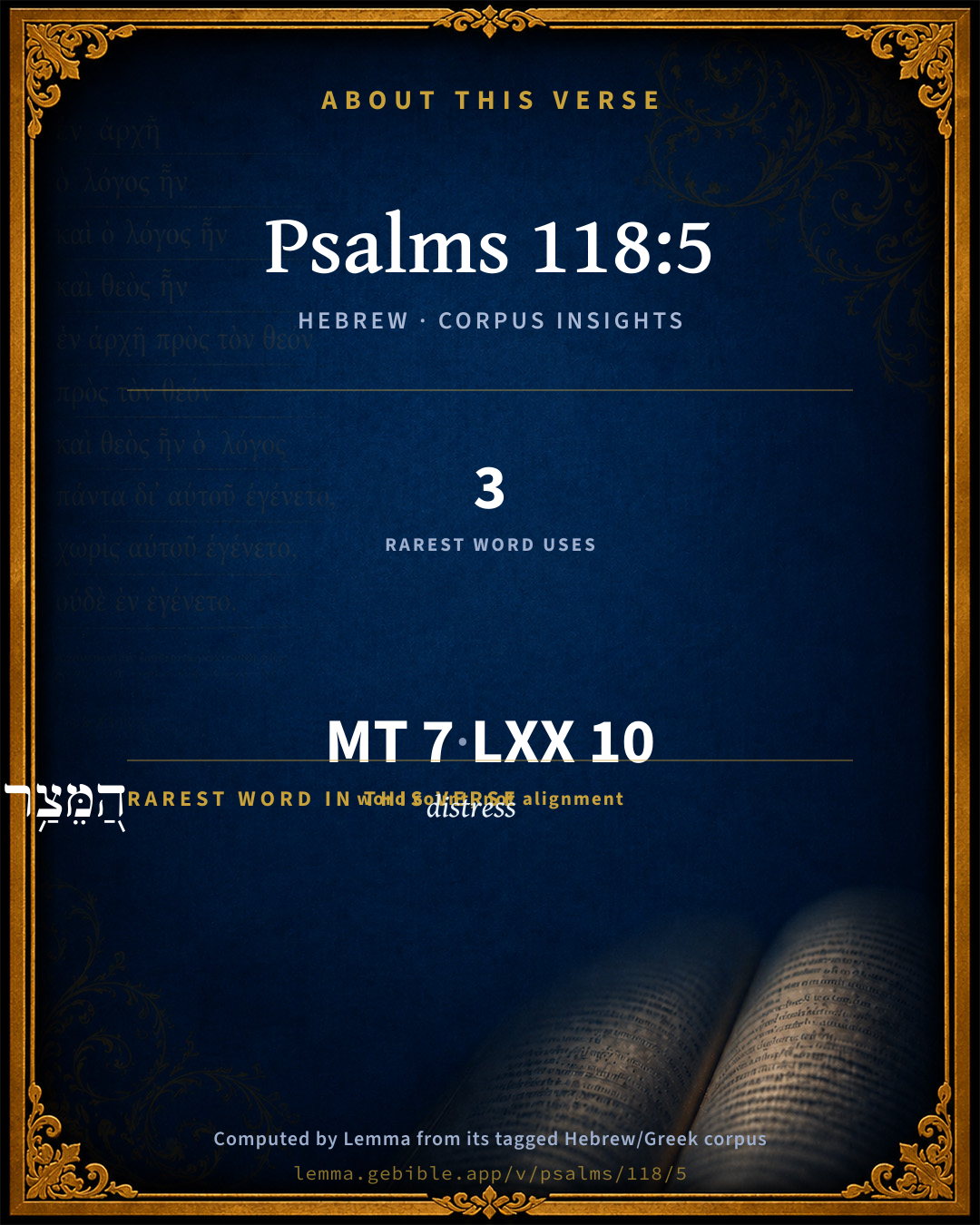
The rarest word here is הַ֭מֵּצַ֥ר distress H4712 — appearing just 3 times in the whole Hebrew Bible.

Shared distinctive vocabulary

הַ֭מֵּצַ֥ר distress H4712 occurs in 3 verses of the Hebrew Bible. Also found in:

Grammatical profile

  • 2 verbs
  • 4 nouns
  • 1 preposition

Verb forms

  • קָרָ֣אתִי Qal · Perfect
  • עָנָ֖נִי Qal · Perfect

Repetition

A word recurs within this verse — often emphatic in Hebrew:

  • יָּ֑הּ Jah H3050 ×2

Hebrew & Septuagint length

In English translation the verse runs 13 words from the Hebrew and 22 from the Septuagint (LXX English) — closely comparable.

A rough comparison of the two English renderings, which tokenize alike — not a word-level alignment.

Word counts can differ between the Hebrew and the Greek without any difference in meaning — e.g. the Hebrew direct-object marker אֵת has no separate Greek word, and Greek often adds the article ὁ.

In the original languages it is 7 Hebrew tokens and 10 Greek tokens — but the two are counted differently (Hebrew bundles its prefixes and suffixes into one token; the Greek is in lemma form), so that isn’t a like-for-like length.

Cross-references

14

Topical passages linked to Psalms 118:5 in the Treasury of Scripture Knowledge — connected by theme and wording, ordered by reader-vote popularity; previews shown in the World English Bible.

  • Psalms 18:19 He brought me forth also into a large place. He delivered me, because he delighted in me.
  • Psalms 18:6 In my distress I called on Yahweh, And cried to my God. He heard my voice out of his temple, My cry before him came into his ears.
  • Psalms 120:1 In my distress, I cried to Yahweh. He answered me.
  • Psalms 107:19 Then they cry to Yahweh in their trouble, He saves them out of their distresses.
  • Psalms 130:1–2 Out of the depths I have cried to you, Yahweh.
  • Psalms 31:8 You have not shut me up into the hand of the enemy. You have set my feet in a large place.
  • 1 Samuel 30:6–8 David was greatly distressed; for the people spoke of stoning him, because the soul of all the people was grieved, every man for his sons and for his daughters: but David strengthened himself in Yahweh his God.
  • Psalms 40:1–3 I waited patiently for Yahweh. He turned to me, and heard my cry.
  • Psalms 107:13 Then they cried to Yahweh in their trouble, And he saved them out of their distresses.
  • Psalms 116:3–4 The cords of death surrounded me, The pains of Sheol got a hold of me. I found trouble and sorrow.
  • Mark 14:31–36 But he spoke all the more, "If I must die with you, I will not deny you." They all said the same thing.
  • Psalms 77:2 In the day of my trouble I sought the Lord. My hand was stretched out in the night, and didn't get tired. My soul refused to be comforted.
  • Genesis 32:7 Then Jacob was greatly afraid and was distressed: and he divided the people who were with him, and the flocks, and the herds, and the camels, into two companies;
  • Genesis 32:9–11 Jacob said, "God of my father Abraham, and God of my father Isaac, Yahweh, who said to me, 'Return to your country, and to your relatives, and I will do you good.'

Cross-references courtesy of OpenBible.info (CC BY 4.0).

Hebrew and Greek witnesses Masoretic Hebrew ↔ Greek Septuagint

The same verse in the two great witnesses to the Old Testament, shown verse-for-verse.

You’re reading Greek Psalm 117 (Hebrew Psalm 118). The Septuagint counts the superscription, so verse numbers can differ from the Hebrew — chapter-level alignment, not verse-by-verse. Numbering follows Rahlfs.

These are two independent witnesses, not word-aligned to each other, and the Septuagint is shown in lemma (dictionary) form.

Hebrew Psalms 118:5 Masoretic · Westminster Leningrad Codex

מִֽן הַ֭מֵּצַ֥ר קָרָ֣אתִי יָּ֑הּ עָנָ֖נִי בַמֶּרְחָ֣ב יָֽהּ

Out of my distress, I called on Yah. Yah answered me with freedom.

World English Bible · Public Domain

Greek LXX Greek Psalm 117:5 Septuagint · lemma form

ἐν θλῖψις ἐπικαλέω ὁ κύριος καί ἐπιἀκούω ἐγώ εἰς πλατυσμός

I called on the Lord out of affliction: and he listened to me, so as to bring me into a wide place.

LXX2012 (modern English Septuagint) · Public Domain

Hebrew: Westminster Leningrad Codex (CC BY 4.0). Greek: Septuagint (public domain); English from LXX2012 (modern English Septuagint) (Public Domain). How the Septuagint differs from the Hebrew →

Commentary

Notes on Psalms 118:5 from classic Christian and Jewish commentators (each source and its license shown beneath its notes). The classic Christian expositions comment on the surrounding passage and are grouped to its opening verse, so a note may address several verses; the Jewish commentaries on the Tanakh (Rashi and others) are per-verse, so they appear only where the commentator wrote on this verse.

Lemma curates 59 commentaries, every one of them public domain or Creative Commons licensed, each selected and text-cleaned for this edition rather than reprinted as found. About our sources →

Trapp's Complete Commentary

John Trapp

Psa 118:5 I called upon the LORD in distress: the LORD answered me, [and set me] in a large place.

Ver. 5. I called upon the Lord in distress] Heb. out of distress, q.d. I celebrate not God’s mercy of course, but out of experience.

The Lord answered me] Heb. Yah answered me with a large roomth. See Psa 4:2.

John Trapp, A Commentary or Exposition upon All the Books of the Old and New Testament (1647–1656) — public domain. Text from a community e-Sword module.

The Biblical Illustrator

Joseph S. Exell

Psa_118:5-7

The Lord . . . set me in a large place.

God the Deliverer and Defender of His people

I. The deliverer (verse 5).

1. The deliverance seems to have consisted in raising him from a circumscribed to an expansive position.

2. The Almighty is constantly delivering men in this way, lifting them from the narrow to the broad.

(1) Secularly. Often by His providence He takes men from the narrowness of poverty out into the broad places of worldly prosperity.

(2) Intellectually. He takes men from the narrowness of ignorance and prejudice, and habit, out into the broad places of knowledge and freedom.

(3) Spiritually. From the narrowness of guilt and corruption He takes men by the Gospel of His Son, into the broad realms of forgiveness and virtue.

II. The defender (verse 6). The Lord is for me.

1. Because of this we need not fear. If He is for us, who can be against us? God is our refuge and strength. If He is for us, we have not only the whole universe for us, but even our very enemies shall be made to subserve our interest.

2. Because of this we shall conquer (verse 7). The word desire is not in the Hebrew. The words should be, and I shall look upon my haters, look with calm defiance, look with expectant triumph. (Homilist.)

An urtrammelled life

The Christian is absolutely the freest and most untrammelled man in the world. I am a freer man, a richer man, a blither man, a stronger man, a hopefuller man, because I am a Christian. He has set me in a large place.

I. I have a grand, broad creed.

1. First, a God whose love is universal; who is pledged to every soul to whom He has given being; to whom every soul is as dear as every other, and who works to realize the meet perfect blessedness of all.

2. A creed which makes its best possible for everybody. You can be a hero anywhere; you can be a saint anywhere; you may win your place in Gods legion of honour anywhere. Cribbd, cabined, confined? Nay! God has set me in a large place.

3. A creed which invites me to examine and explore it, which courts criticism, which positively invites men to do what many imagine it forbids. One of its proudest mottoes is, I speak as unto wise men; judge ye what I say. The Gospel invites you to explore all its territories, to dig for its hidden treasures; indeed, will only give itself to him who will question, think, search.

II. A broad, rounded, healthful life. A life that includes every sweet and noble thing.

1. Every bright and healthful pleasure. All natural pleasures are mine. Mirth which is medicine and food is mine. All intellectual feasts are mine. Oh magic books which I love, in which I delight to dig!

2. A life that is to attain its blessedness, the ideal aimed at, not by prohibitions, but by growth. The way to kill the bad life in you--the old man, as Paul calls it--is by filling yourself with the rich graces of life as seen in Christ Jesus. Courage and sweet help for those who need it, the brave love that can bear any cross--the life of Jesus,--there is room in that; it is a large place. Live it, and you will grow in Gods own bliss.

III. The noblest enterprises, the most royal work, the grandest aims, for the betterment of the world. Broaden the soul! Nothing broadens the soul like work for the wants and woes of men, and nothing inspires men to work like the dreams, the hopes, and promises of the Gospel of Jesus Christ. We have caught a vision of the world as He saw it, yearned for it, died for it. We also carry this world in our heart; the African, the Hindoo, the South Sea Islander, are also children of God, and we will toil for their redemption.

IV. I have noble and inspiring hopes. Rich indeed are the hopes which the Gospel gives me; immortality is a grand word. I find a large place for myself under the broad skies of eternal life. Man, according to the Gospel, has room to grow and time to grow. Over-hurry spoils the best work. Few of us have the courage of Brownings grammarian, who refused to hurry; who never dreamt that he could finish his studies here, but was sure that he should be allowed to finish them yonder. Let us also be a little wiser; we will not get scared and spoil cur work by over-hurry. Eternity is ours. Give me room; plant me with the noble sky of immortality over me; I will grow into my full stature then. Set me where God set me--in a large place. (J. Morlais Jones.)

The Biblical Illustrator, edited by Joseph S. Exell (c. 1880s–1900s) — public domain. Text from a community e-Sword module.

The Treasury of David

Charles H. Spurgeon

Ver. 5. I called upon the LORD in distress, or, "out of anguish I invoked Jah." Nothing was left him but prayer, his agony was too great for aught beside; but having the heart and the privilege to pray he possessed all things. Prayers which come out of distress generally come out of the heart, and therefore they go to the heart of God. It is sweet to recollect our prayers, and often profitable to tell others of them after they are heard. Prayer may be bitter in the offering, but it will be sweet in the answering. The man of God had called upon the Lord when he was not in distress, and therefore he found it natural and easy to call upon him when he was in distress. He worshipped he praised, he prayed: for all this is included in calling upon God, even when he was in a straitened condition. Some read the original "a narrow gorge"; and therefore it was the more joy to him when he could say "The Lord answered me, and set me in a large place." He passed out of the defile of distress into the well watered plain of delight. He says, "Jah heard me in a wide place, "for God is never shut up, or straitened. In God's case hearing means answering, hence the translators rightly put, "The Lord answered me, "though the original word is "heard." The answer was appropriate to the prayer, for he brought him out of his narrow and confined condition into a place of liberty where he could walk at large, free from obstruction and oppression. Many of us can join with the Psalmist in the declarations of this verse; deep was our distress on account of sin, and we were shut up as in a prison under the law, but in answer to the prayer of faith we obtained the liberty of full justification wherewith Christ makes men free, and we are free indeed. It was the Lord who did it, and unto his name we ascribe all the glory; we had no merits, no strength, no wisdom, all we could do was to call upon him, and even that was his gift; but the mercy which is to eternity came to our rescue, we were brought out of bondage, and we were made to delight ourselves in the length and breadth of a boundless inheritance. What a large place is that in which the great God has placed us! All things are ours, all times are ours, all places are ours, for God himself is ours; we have earth to lodge in and heaven to dwell in, what larger place can be imagined? We need all Israel, the whole house of Aaron, and all them that fear the Lord, to assist us in the expression of our gratitude; and when they have aided us to the utmost, and we ourselves have done our best, all will fall short of the praises that are due to our gracious Lord.

Ver. 5. Perhaps Ps 118:5, which says, I called upon the LORD in distress (literally, out of the narrow gorge), and the LORD answered me on the open plain which describes the deliverance of Israel from their captivity, may have been sung as they defiled from a narrow ravine into the plain; and when they arrived at the gate of the temple, then they broke forth in full chorus into the words, "Open to me the gates of righteousness" (Ps 118:19). Christopher Wordsworth.

Ver. 5. It is said, I called upon the LORD. Thou must learn to call, and not to sit there by thyself, and lie on the bench, hang and shake thy head, and bite and devour thyself with thy thoughts; but come on, thou indolent knave, down upon thy knees, up with thy hands and eyes to heaven, take a Psalm or a prayer, and set forth thy distress with tears before God. Martin Luther.

Ver. 5. The LORD answered me, and set me in a large place. It may be rendered, The LORD answered me largely;as he did Solomon, when he gave him more than he asked for; and as he does his people, when he gives them a sufficiency and an abundance of his grace; not only above their deserts, but above their thoughts and expectations. See Eph 3:20. John Gill.

Ver. 5.

1. The season for prayer"in distress."

2. The answer in season"The Lord answered me."

3. The answer beyond the request"And set me, "etc.

Psalms 118:6*

Charles H. Spurgeon's The Treasury of David (1869–1885) — public domain. Psalms only. Text from a community e-Sword/MySword module.

Joseph Benson's Commentary

Psa 118:5-7. I called upon the Lord in distress — As if he had said, You may see an example of the divine mercy in me, who was in grievous straits and dangers, but, imploring God’s protection and help, he answered me, and set me in a large place — He not only delivered me, but placed me in a secure condition, free from all such molestation. Dr. Waterland renders the clause, The Lord answered me with enlargement. The Lord is on my side — It is evident he takes my part; I will not fear, &c. — Though I have many enemies, I am not afraid of them, for greater is he that is for me than all those that are against me. What can man do unto me? — Man, a frail and impotent creature in himself, and much more when he is opposed to the almighty God. He can do nothing to me but what God permits him to do; nothing but what God can and will make to work for my good. The apostle quotes this verse with application to all true Christians, Heb 13:6. The Lord taketh my part, &c. — He is present with my helpers, and enables them to defend me; therefore shall I see my desire, &c. — I shall see my enemies defeated in their designs against me.

Joseph Benson's Commentary on the Old and New Testaments (1811–1818) — public domain. Text from a community e-Sword module.

J. A. Alexander on Psalms

Joseph Addison Alexander

5. (Psa 118:5) Out of anguish I invoked Jah; heard me in a wide place Jah. The first noun is a rare one, common to this place and Psa 116:3, another indication of affinity. Heard, in the pregnant sense of heard favourably, heard and answered. See above, on Psa 22:21. As the word translated anguish originally means pressure, confinement, the appropriate figure for relief from it is a wide room, ample space, enlargement. See above, on Psa 4:1. To answer in a wide place is to grant his prayer by bringing him forth into such a place.

Joseph Addison Alexander, The Psalms Translated and Explained (1850) — public domain. Text from a community e-Sword module.

Tyndale Open Study Notes

Tyndale Open Resources

118:5-9 The Lord alone is the psalmist’s helper.

Tyndale Open Study Notes — © Tyndale Open Resources, licensed CC BY-SA 4.0. Text via the HelloAO Bible API.

Geneva Bible (1599)

Geneva Bible translators

We are here taught that the more that troubles oppress us, the more ought we to be instant in prayer.

Geneva Bible (1599) marginal notes — public domain. Text via Bolls.life.

Adam Clarke's Commentary

Verse 5. I called upon the Lord] I am a standing proof and living witness of God's mercy. Take encouragement from me.

Adam Clarke's Commentary on the Bible (1810–1826) — public domain. Text from a community e-Sword/MySword module.

John Calvin's Commentaries

5 I called upon God in my distress. We have here a particular application of the doctrine we formerly mentioned, to the person of David; with which also is conjoined the rejoicing of the whole Church, for whose public welfare God made provision by upholding him. By his own example he establishes the faithful, showing them that they ought not to faint in the day of adversity. He seems designedly to anticipate an objection, which is apt to arise in the minds of men the moment that the goodness of God is proclaimed, “Why does he permit his servants to be so sore oppressed and afflicted?” David therefore reminds them, notwithstanding, that God’s mercy never fails, for we have in prayer, consolation and an antidote for all our ills. The season, too, in which he says that he made supplication, by means of which he obtained deliverance, was that of distress, which touches us, that the time of sad adversity is most proper for abounding in prayer.

John Calvin's Commentaries (1540-1563) — public domain. Text from the Calvin Translation Society English edition (1840s-50s) via the Christian Classics Ethereal Library (ccel.org). Calvin's coverage is partial (roughly two-thirds of the Bible); uncommented books and verses are honest gaps, never fabricated. The 19th-century editor's footnotes and remarks are omitted so the notes are faithfully Calvin's own voice.

Ellicott's Commentary for English Readers

(5) I called.—Better, out of the straitness I cried to Jah; answered me, with freedom, Jah. The meaning of the last clause (literally, with room. Comp.: “Ay, marry, now my soul has elbow-room”—King John) is determined by the parallelism of Psa_18:19. The versions read “freedom of Jah,” i.e., boundless freedom,”

A Bible Commentary for English Readers, edited by Charles John Ellicott (1878–1897) — public domain. Text from a community e-Sword module.

The Cambridge Bible for Schools and Colleges

gen. ed. J. J. S. Perowne

5. Out of the straitness in which I was I called upon Jah:

Jah answered me (and set me) in a wide place.

Israel had been hemmed in and harassed by enemies (Neh_4:7 ff.): they prayed (Neh_4:9), and were set free to move and act without let or hindrance. Cp. Psa_18:19; Psa_31:8. The name Jah is perhaps chosen here and in Psa_118:14; Psa_118:17-19, in order to recall the memories of the Exodus. See Psa_118:14[76].

[76] The A.V. and R.V. follow the Eastern or Babylonian reading in repeating Jah in the second line. The Massora, according to the Western or Palestinian recension, makes the syllable jah simply the termination of the preceding word.

5–9. Israel speaks as one man; acknowledging that it is Jehovah Who has delivered them. With Him as their ally they have nothing to fear.

The Cambridge Bible for Schools and Colleges (gen. ed. J. J. S. Perowne; Cambridge University Press, 1878–1918) — public domain. Text from a community e-Sword module.

John Gill's Exposition

The Lord taketh my part with them that help me,.... With the four hundred men that were with David, and stood by him in his troubles, Sa1 22:2; see Psa 54:4; and with those who ministered unto Christ as man, Luk 8:3. Or, "the Lord is for me, with" or "among my helpers" (t); he is the principal helper, he is one for all; he is in the room and stead of other helpers; having him, there is no need of any other: the Lord is the only helper of his people, vain is the help of man; he helps them out of all their troubles and difficulties, in the exercise of every grace, and in the discharge of every duty; he helps them to all their mercies temporal and spiritual, to grace here, and glory hereafter. The Targum is,

"the Word of the Lord is to help me;''

therefore shall I see my desire upon them that hate me; see "vengeance" on them, as the Targum; which was desired by David, by the Messiah, and by the saints; not for the sake of that itself, but for the glory of divine justice. David saw this, Psa 54:7; so will the Messiah, when all his enemies, that will not have him to reign over them, will be slain before him; and so will the people of God, when antichrist is destroyed.

(t) "pro me est cum iis qui auxiliantur mihi", Vatablus; so Cocceius, Gejerus.

John Gill's Exposition of the Whole Bible (1746–1763) — public domain (CC PDM 1.0). Text via the HelloAO Bible API.

Albert Barnes' Notes on the Bible

I called upon the Lord in distress - Margin, as in Hebrew, “out of distress.” In the very midst of trouble he called upon the Lord; his voice was heard, as it were, coming from the depth of his sorrows. See the notes at Psa 18:6.

The Lord answered me - That is, he heard my prayers, and delivered me. See the notes at Psa 18:6.

And set me in a large place - I was before pressed on every side; sorrows compassed me around; I could not move; I had no liberty. Now he gave me space and freedom on every side, so that I could move without obstruction or pain. This is literally, “The Lord” - (not יהוה Yahweh here, but יה Yâhh) “answered me in a large place.” See Psa 4:1, note; Psa 18:19, note.

Albert Barnes' Notes on the Bible (1834–1885) — public domain. Text from a community e-Sword/MySword module.

Matthew Poole's English Annotations

Set me; which verb is tacitly included in the former, and is easily understood out of Psa 31:8, where the full phrase is expressed, and from the following word. See the like examples in the Hebrew text, Gen 12:15; Psa 22:21, &c.

Matthew Poole's English Annotations on the Holy Bible (1683–1685) — public domain. Text from a community e-Sword/MySword module.

Whedon's Commentary on the Bible

Daniel D. Whedon

5. In distress—Literally, From the strait. Same word as is rendered pain, Psa_116:3, where see note.

Large place—A wide, open field or space, standing opposed to the strait, narrow gorge, or exigency, in the previous line. Sin brings us into straitness and oppression, but the answer of penitent prayer brings enlargement.

Daniel D. Whedon (gen. ed.), Commentary on the Old and New Testaments (1874–1909) — public domain. Text from a community e-Sword module.

The Pulpit Commentary

I called upon the Lord in distress; literally, from the strait place; i.e. from the straits in which I was. It is generally agreed that the Babylonian captivity is intended. The nation had called to God in its distress by the mouth of Daniel (Dan_9:4-19) and of other holy men. The Lord answered me, and set me in a large place; literally, the Lord answered me on the open plain. The idea is, "The Lord gave me enlargement took me out of my straits my feet in a large room". (Psa_31:8)

Vers. 5, 6. God"s power in a human life.

The figure in ver. 5 is very striking and suggestive. The Hebrew is, "I called upon the Lord from the straitness;" or, "From the narrow gorge I called upon Jab, and Jab answered me in the open plain." It is not necessary to fix any historical associations to the psalm in order to see the point of such a figure. It does but poetically represent a common experience. Continually in human life we come upon times of straitness; our way is hedged up; it is as if we were in a narrow gorge, full of fears lest the overhanging rocks should fall on us, and seeing no way out. Who has not thus felt hemmed in? "All these things are against us." Human wisdom, energy, and persistency alike are baffled and beaten back. "We cannot do the things that we would." Every one and everything seems to be against us. And at such times we easily think hard things of our fellow-men, and think that they are actively against us, when they are only indifferent. What can the psalmist say of such times?

I FROM THE NARROW GORGE HE CALLED UPON GOD. That at least we can always do. No circumstances of human life need ever prevent the soul"s uplook, or silence the soul"s cry. Bunyan pictures his pilgrim in sore straitness, picking his perilous way through the Valley of the Shadow. Weapons are of no use there. Human care and skill and watching are of small avail there. But there is one thing the pilgrim can do, and that one thing is everything he can pray; he can "call upon the Lord." It is well to fix that truth of fact, and to illustrate it fully. There is no perplexity, worry, disaster, or depression can ever come to any man, and destroy his power to pray. Oppress and alarm a man how you may, in any narrow gorge of life, he can always pray. Nothing can overwhelm a man while he can call upon God.

II IN THE OPEN PLAIN BE HAD THE RESPONSE OF GOD. The figure is kept up. The pilgrim-soul, with the uplifted eyes, presses forward through the darkness or the mist, which permits him to see but one step at a time; and then suddenly the dawn breaks or the mist lifts, and he is filled with a joyous surprise. He is in the gorge no longer; behold, it is the "open plain;" there is plenty of space all around, and the restful blue sky up above, and a clear way before his feet; God has heard his call; he is on his side. Neither man nor things can hurt him now. And such is the experience of all the saints. R.T.

The Pulpit Commentary (1880–1919), ed. H.D.M. Spence-Jones & Joseph S. Exell — public domain. Text from a community e-Sword module.

unfoldingWord translationNotes

Door43 World Missions Community

set me free

The writer speaks of Yahweh saving him from distress as if Yahweh had taken him from a place of confinement to a wide open space where he could move about freely. (See: Metaphor)

what can man do to me?

The writer asks this rhetorical question to emphasize that there is nothing that man can do to hurt him since Yahweh is with him. This question can be translated as a statement. AT: "people cannot do anything to harm me." (See: Rhetorical Question)

Yahweh is on my side as my helper

To be on one's side is an idiomatic expression that indicates that that person approves of and will help another. AT: "Yahweh approves of me and will help me" (See: Idiom)

I will look in triumph on those who hate me

It is implied that Yahweh is the one who will defeat the writer's enemies, while the writer looks on. The full meaning of this can be made clear. AT: "I will see Yahweh defeating all those who hate me" (See: Assumed Knowledge and Implicit Information)

translationWords

call

free

fear

unfoldingWord translationNotes — © Distant Shores Media and the Door43 World Missions Community, licensed CC BY-SA 4.0. Source: git.door43.org/Door43/en_tn.

Lesson kit

Teaching starters — assembled from the data on this page, not authored interpretation. Every prompt links to the verse data it draws on. Edit before teaching.

Psalms, in the Wisdom, opens this verse with 7 words (6 distinct Hebrew lemmas). Its most distinctive word is mêtsar (“distress”). A historical commentator’s framing appears above. Read the whole chapter for the surrounding context.

Discussion questions

  1. How does “distress” (mêtsar) shape what this verse is saying?
  2. How does Psalms 116:3, which shares the word «distress», read alongside this verse?
  3. What does the repetition of “Jah” (2× in this one verse) do in this verse?
  4. The translations on this page render this verse differently — a whole-verse word diff, not a word-by-word alignment. What might account for the different wordings?
  5. «קָרָ֣אתִי» is a Qal Perfect verb. How does that grammatical form shape the action described?
  6. Compare how Trapp's Complete Commentary and The Biblical Illustrator read this verse. Where do they agree or differ?

Things to notice

Reading settings

Reading text

Shown beneath each verse's original-language words.

Old Testament
Old Testament edition

Read the OT as the Masoretic Hebrew (MT) or the Greek Septuagint (LXX).

English shown for the Greek Septuagint (in the Hebrew ↔ Greek comparison).

Comparing translations? Open the Compare panel on any verse page to stack up to four side by side.