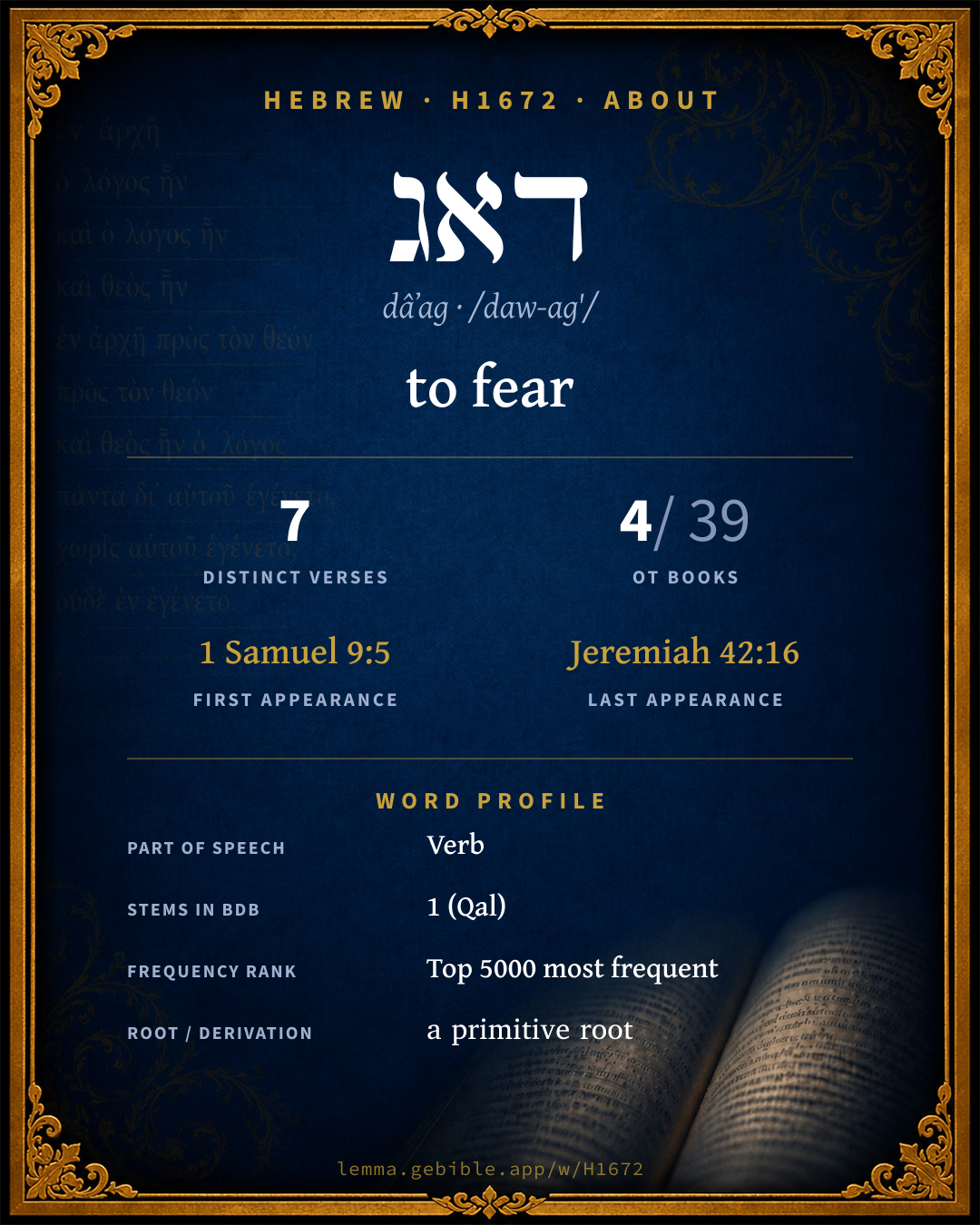
דָּאַג
to fear
also: be anxious, be concerned, be afraid, be careful fuller range ↓
Full lexicon entry — Brown-Driver-Briggs (BDB)
From Brown-Driver-Briggs (BDB)
Where this word appears
Grammar key — what these labels mean
Part of speech
- Verb
- An action or state-of-being word.
Stem
- Qal
- The basic, simple active stem — the plain form of the verb (“he wrote”). Here: ‘be anxious’
Form
- Perfect
- A completed action or state — Hebrew marks aspect (completeness) more than strict tense (“he wrote”).
- Imperfect
- An incomplete, ongoing, or future action (“he will / would write”).
- Participle Active
- A verbal adjective expressing ongoing or characteristic action (“writing / one who writes”).
State
- Absolute
- The independent form of a noun, not bound to a following word.
Person
- 3rd Person
- The one spoken about (“he / she / it / they”).
- 1st Person
- The speaker (“I / we”).
- 2nd Person
- The one addressed (“you”).
Gender
- Masculine
- Grammatically masculine.
- Common
- Either gender — not distinguished for this form.
- Feminine
- Grammatically feminine.
Number
- Singular
- One.
- Plural
- More than one (in Hebrew, generally three or more).
Grammatical forms
- Verb, Qal, Perfect, 3rd Person, Masculine, Singular 2 times (29%)
- Verb, Qal, Imperfect, 1st Person, Common, Singular 1 time (14%)
- Verb, Qal, Imperfect, 3rd Person, Masculine, Singular 1 time (14%)
- Verb, Qal, Perfect, 2nd Person, Feminine, Singular 1 time (14%)
- Verb, Qal, Participle Active, Masculine, Plural, Absolute 1 time (14%)
- Verb, Qal, Participle Active, Masculine, Singular, Absolute 1 time (14%)
Parsed forms decoded from the imported morphology (morphhb / Westminster Leningrad Codex — WLC text public domain, morphhb tagging CC BY 4.0), counted across 7 parsed occurrences — not distinct verses.
Every verse where H1672 appears — 7 distinct verses across 4 books. Click any verse to open its interlinear word-by-word view. Verse text shown in the World English Bible for context — . Each verse’s Hebrew form is shown with its reference; the English is not keyword-highlighted, since the data carries no word-level English alignment. Use “Compare translations” on any verse to read it across multiple English versions. This concordance covers the Hebrew Bible; Septuagint (Greek Old Testament) occurrences are not indexed here.
1 Samuel 2 verses
- 1 Samuel 9:5 וְ/דָ֥אַג conj + Qal pf 3ms When they had come to the land of Zuph, Saul said to his servant who was with him, Come, and let us return, lest my father leave off caring for the donkeys, and be anxious for us.
- 1 Samuel 10:2 וְ/דָאַ֤ג conj + Qal pf 3ms When you are departed from me today, then you shall find two men by Rachel's tomb, in the border of Benjamin at Zelzah; and they will tell you, The donkeys which you went to seek are found; and, behold, your father has left off caring for the donkeys, and is anxious for you, saying, What shall I do for my son?
Psalms 1 verse
Isaiah 1 verse
Jeremiah 3 verses
- Jeremiah 17:8 יִדְאָ֔ג Qal impf 3ms For he shall be as a tree planted by the waters, who spreads out its roots by the river, and shall not fear when heat comes, but its leaf shall be green; and shall not be careful in the year of drought, neither shall cease from yielding fruit.
- Jeremiah 38:19 דֹאֵ֣ג Qal ptcp.act ms Zedekiah the king said to Jeremiah, I am afraid of the Jews who are fallen away to the Chaldeans, lest they deliver me into their hand, and they mock me.
- Jeremiah 42:16 דֹּאֲגִ֣ים Qal ptcp.act mp then it shall happen, that the sword, which you fear, shall overtake you there in the land of Egypt; and the famine, about which you are afraid, shall follow hard after you there in Egypt; and there you shall die.
About this entry
At a glance — auto-summarized from this page’s data, not written by a person. Every figure links to its source below. This summary describes the numbers; it doesn’t interpret them.
The Hebrew verb דאג centers on the idea of “to fear.” Its earliest occurrence is 1 Samuel 9:5. It turns up in 7 verses across 4 books, an uncommon footprint. The word gravitates to Jeremiah (43%), then 1 Samuel and Psalms. Alongside “to fear” the lexicon also lists “be anxious”, “be concerned”, and “be afraid” — part of its full sense range. Dig into 7-verse concordance and the renderings breakdown below.
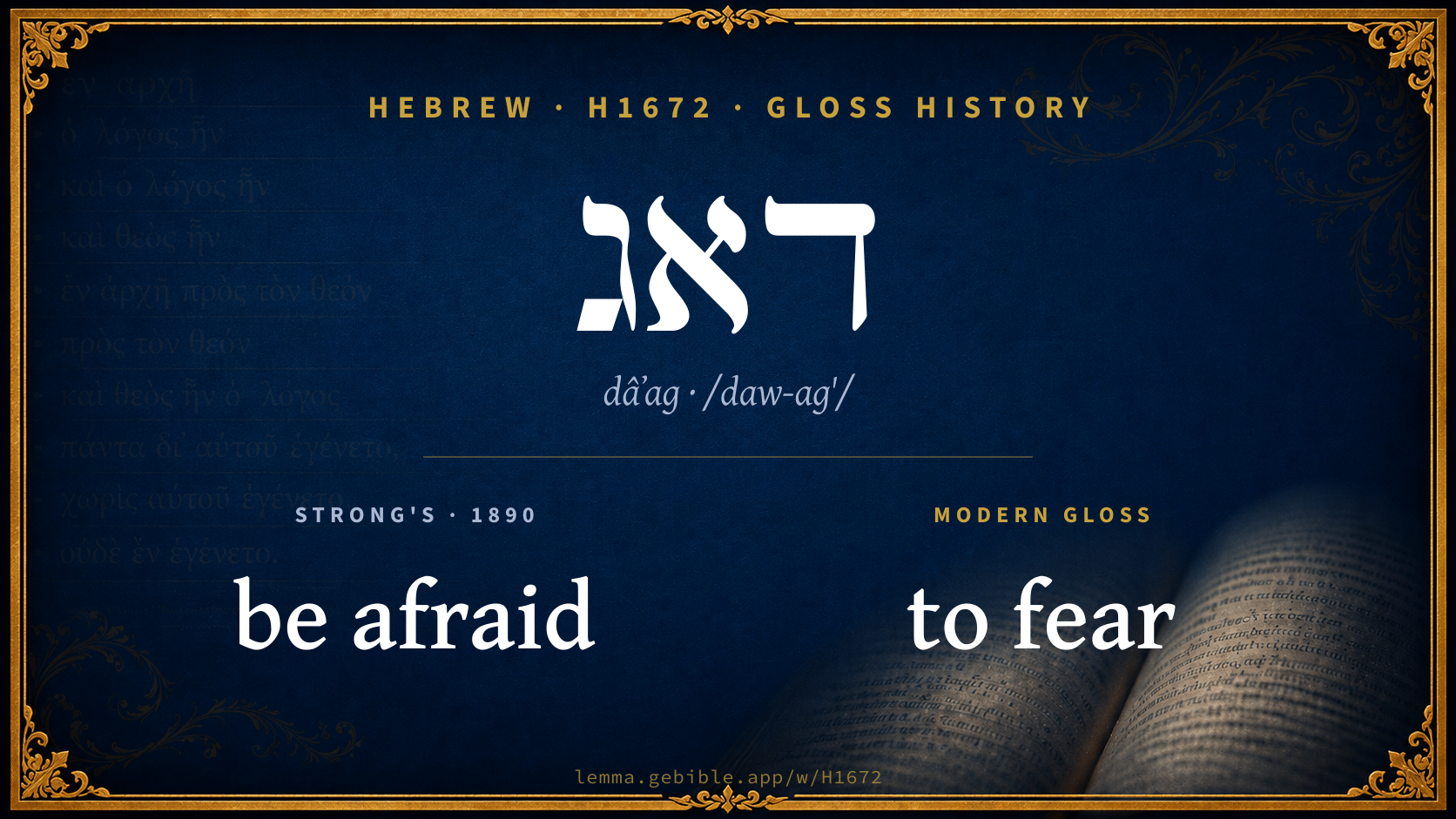
Gloss history
Strong's 1890 vs modern scholarship
About this word
Strong's H1672 catalogs a Hebrew word from the Hebrew Old Testament.
These counts are not copied from any lexicon or concordance. They are computed here, from the morphology-tagged Hebrew Old Testament. What Lemma adds →
- 7
- distinct verses
- The word appears in 7 distinct verses.
- 4 / 39
- OT books
- The word appears in 4 of 39 Old Testament books.
- #2,835
- by frequency
- Top 5000 most frequent Hebrew words (rank 2,835 of 8,640 Hebrew words by occurrence).
View all 7 occurrences in the concordance →
By section of the Old Testament
By traditional corpus
Conventional, traditional groupings — biblical authorship is debated, so this is a traditional corpus grouping, not an authorship claim. Each share is this word’s portion of its verses in that division of the Hebrew canon. Each figure is a share of the word’s 7 distinct verses.
- Prophets (Nevi'im) 6 verses · 86%
- Writings (Ketuvim) 1 verse · 14%
How translations render this word
Counts come from each version’s own published word-to-Strong’s tagging or interlinear alignment — an approximate guide to how each version renders this word, not a word-level alignment the data otherwise carries. Because each total is that version’s own tagged count, the per-version totals vary from one another and need not match the appearance or distinct-verse counts above. These counts may also differ from a printed concordance because Lemma counts each distinctly tagged rendering and does not collapse phrase taggings into a single head-word total. This is a fixed set of word-tagged versions (KJV, ASV, BSB, ULT) and does not change with the reading translation you choose elsewhere. Each version’s license is shown beside its name below (and on Sources).
- King James Version: Hast thou been afraid 1×, I am afraid 1×, I will be sorry 1×
- American Standard Version: Be anxious for us 1×, Hast thou been afraid 1×, I am afraid 1×
- Berean Standard Bible: Am afraid 1×, Dread 1×, Have you dreaded 1×
- unfoldingWord Literal Text: Anxious 1×, Become concerned 1×, Do you dread 1×
King James Version Public Domain
Renders H1672 across 7 tagged occurrences — most commonly:
American Standard Version Public Domain
Renders H1672 across 7 tagged occurrences — most commonly:
Berean Standard Bible Public Domain
Renders H1672 across 7 tagged occurrences — most commonly:
unfoldingWord Literal Text CC BY-SA 4.0
Renders H1672 across 6 tagged occurrences — most commonly:
Senses in the full BDB
What do BDB’s symbols mean?
BDB uses these scholarly abbreviations:
| Symbol | Meaning |
|---|---|
| 𝔊 | the Septuagint (the ancient Greek translation, LXX) |
| 𝔙 | the Vulgate (the Latin translation) |
| 𝔖 | the Syriac version (the Peshitta) |
| 𝔗 | the Targum (the Aramaic translation) |
| ψ | the Psalms |
| √ | root (the underlying root or stem) |
| ‖ | parallel passage (a synonymous or contrasted parallel) |
| † | the dagger: every passage where the word occurs is cited |
The 3 senses and sub-senses the full Brown-Driver-Briggs lexicon distinguishes for this word, in lexicon order (not ranked by frequency), with BDB’s own verbatim wording and sub-sense lettering. Shown in Hebrew script with BDB’s own scholarly abbreviations. The condensed entry is in the Lexicon Entry tab. See also the Forms in the corpus table below.
Qal
- Pf. 3 ms. וְדָאַג consec. 1 S 9:5; 10:2; 2 fs. דָּאַגְתְּ Is 57:11; Impf. 3 ms. יִדְאָ֑ג Je 17:8; אֶדְאַג ψ 38:19; Pt. דֹּאֵג Je 38:19, דֹּאֲגִים Je 42:16;— e.g. 1 Samuel 9:5
- 1. be anxious, concerned, with reference to, in behalf of, c. לְ 1 S 9:5; 10:2; id. c. מִן Je 42:16 (famine personif.); sq. מֵחַטָּאתִי ψ 38:19; be anxious, abs. Je 17:8 (‖ יָרֵא). e.g. 1 Samuel 9:5
- 2. fear, dread, sq. acc. of pers. feared Is 57:11 (‖ יָרֵא) Je 38:19 (where also sq. cl. with פֶּן). e.g. Isaiah 57:11
Senses from the full Brown-Driver-Briggs lexicon (Brown, Driver, Briggs; Oxford 1906 — public domain), digitized via Sefaria, supplemented by the OpenScriptures HebrewLexicon (CC BY 4.0). Full attribution on Sources.
Word origin
vb. be anxious, concerned, fear (Talm. דְּאֵיג, דְּאִג id.)—
— Brown-Driver-Briggs (Oxford 1906, public domain), digitized via Sefaria, supplemented by the OpenScriptures HebrewLexicon (CC BY 4.0). See Sources.
Origin: a primitive root
Jastrow Dictionary
A second Hebrew/Aramaic lexicon for comparison, covering Aramaic and post-biblical (Talmudic, Targumic, Midrashic) usage that the biblical-Hebrew BDB does not. Matched by lemma rather than by Strong’s number, so a lemma may carry more than one Jastrow headword (shown separately below), and the entries cover usage well beyond the Bible.
דֹּאֵג
- , v. דּוֹאֵג
דָּאַג
- (b. h.) [to melt,] cmp. דאב a. יצף, to be low-spirited, to sorrow, fear. Snh. 106ᵇ (play on דאג, I Sam. XXI, 8, a. דוֹיֹג, ib. XXII, 18) at first יושב הקב"ה ודוֹאֵג וכ׳ the Lord sat in anxiety, that he (Doeg) might degenerate; after …, He said ו̇וי̇ שיצא זה woe that he did &c. Ber. 40ᵃ יִדְאַג מריח וכ׳ must be in fear of contracting &c. Succ. 29ᵃ. Ḥag. 13ᵃ שלבו דואג בקרבו whose heart within him is in fear of sin (reverential). Sabb. 105ᵇ sq. יִדְאֲגוּ כל האחין all the brothers should feel troubled (examine their ways). Midr. Till. to Ps. XLVIII a man committed a sin והיה דואג בלבו and was troubled in his heart; a. fr. e.g. 1 Samuel 21:8
A Dictionary of the Targumim, the Talmud Babli and Yerushalmi, and the Midrashic Literature (Marcus Jastrow; London, Luzac, 1903) — Public Domain. Digitized via Sefaria. Digitized via Sefaria. Full attribution on Sources.
Forms in the corpus
The 7 distinct written forms H1672 takes in the Hebrew Bible, most frequent first — each parse links to that stem’s occurrences in the concordance. Hebrew forms include their vowel points and cantillation, so a single lemma takes many written forms.
| Form | Parsing | Example | Uses |
|---|---|---|---|
| אֶ֝דְאַ֗ג | Verb, Qal, Imperfect, 1st Person, Common, Singular | Psalms 38:18 | 1 |
| דֹאֵ֣ג | Verb, Qal, Participle Active, Masculine, Singular, Absolute | Jeremiah 38:19 | 1 |
| דָּאַ֤גְתְּ | Verb, Qal, Perfect, 2nd Person, Feminine, Singular | Isaiah 57:11 | 1 |
| דֹּאֲגִ֣ים | Verb, Qal, Participle Active, Masculine, Plural, Absolute | Jeremiah 42:16 | 1 |
| וְ/דָ֥אַג | Verb, Qal, Perfect, 3rd Person, Masculine, Singular | 1 Samuel 9:5 | 1 |
| וְ/דָאַ֤ג | Verb, Qal, Perfect, 3rd Person, Masculine, Singular | 1 Samuel 10:2 | 1 |
| יִדְאָ֔ג | Verb, Qal, Imperfect, 3rd Person, Masculine, Singular | Jeremiah 17:8 | 1 |
Same root — word family
Other BDB entries built from the same root as H1672, grouped by Strong’s listed origin. These share a root / origin per the lexicon — not necessarily a shared meaning. Each links to that word’s own entry.
Derived from this word
Proper names from this root
People and places named from this root — a name, not an additional meaning of the word.
Compare all same-root words → 1 of the same-root words is a proper name (a person or place). They share a root, not necessarily a meaning.
Septuagint verse parallels
This word appears in 6 verses that also exist in the Greek Old Testament (Septuagint), out of the 7 Hebrew verses it occurs in. You can read those verses in Greek by switching the Old Testament edition to the Septuagint.
Read these verses in the Septuagint
This is a verse-level parallel only — the same verses exist in both the Hebrew and Greek Old Testaments. No word-level Hebrew↔Greek correspondence is claimed: the data carries no such alignment, so no Greek word is shown as this Hebrew word’s translation. Coverage is not total — the Septuagint omits the deuterocanon and renumbers the Psalms, so some Hebrew verses have no direct Greek parallel.