
Revelation 21:18

Greek (Tischendorf 8th ed.) Revelation 21:18 appears in the Greek New Testament. The text above is from the Tischendorf 8th edition. Each word links to its Strong’s number and a concise gloss. Click any word for its full Thayer’s Greek Lexicon entry.
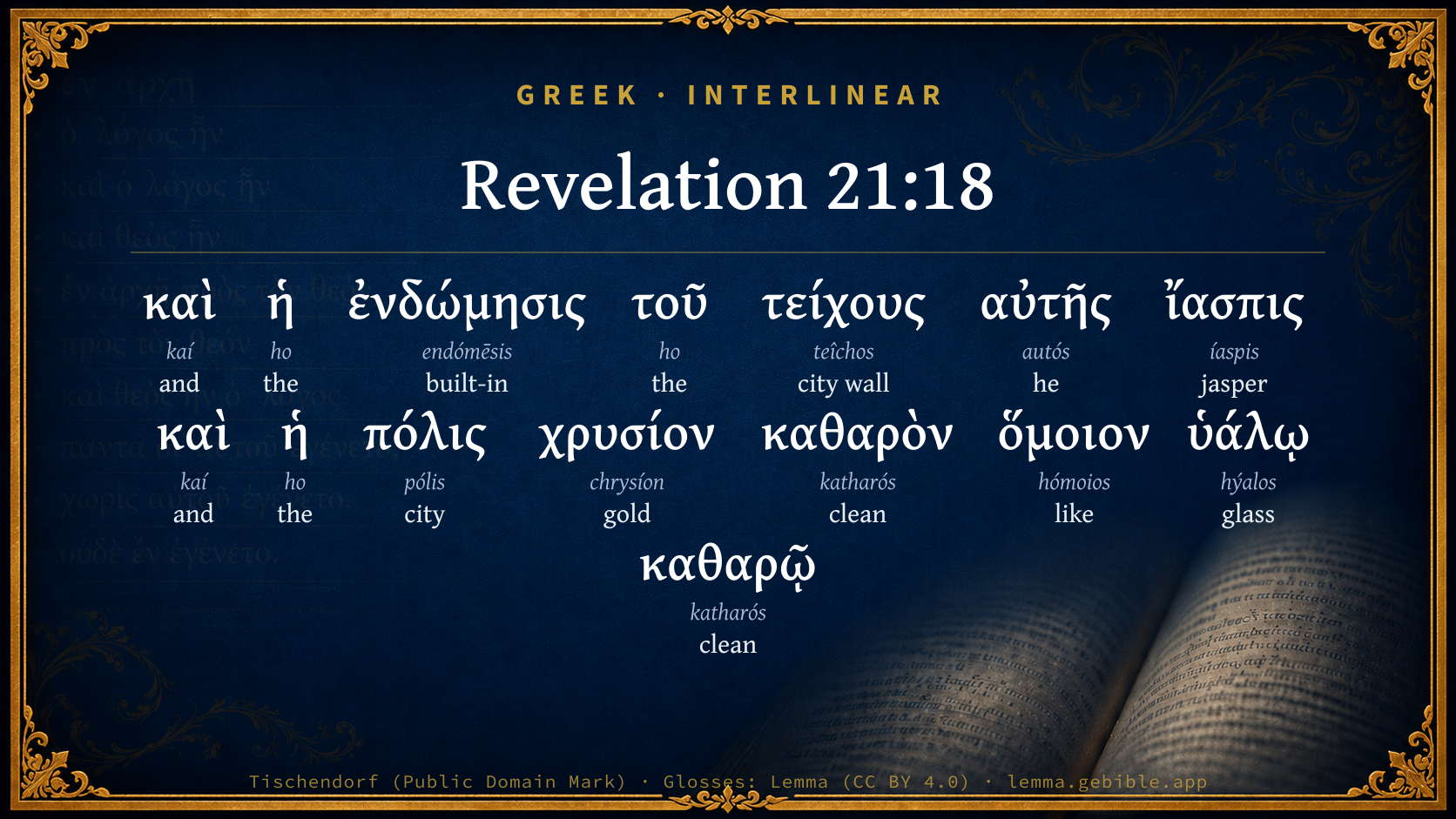
Download image
Cite this verse

Revelation 21:18 (World English Bible). Public Domain. Lemma interlinear Bible study tool, https://lemma.gebible.app/v/revelation/21/18.

Show BibTeX & RIS
BibTeX
RIS
English Translation
The construction of its wall was jasper. The city was pure gold, like pure glass.
World English Bible · Public Domain
Highlights
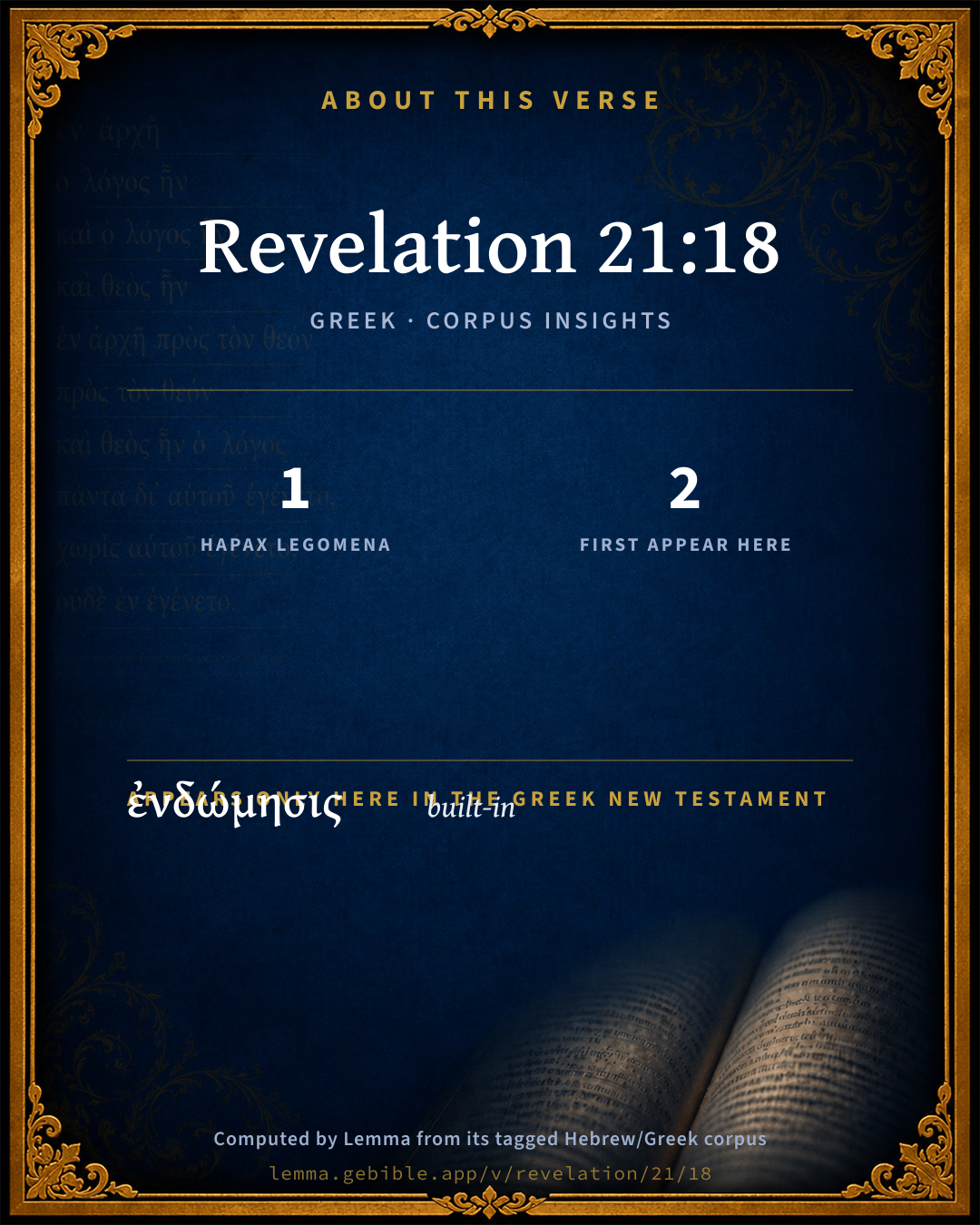
  • 1 hapax legomenon — only here in the Greek New Testament
  • 2 first appearances in the Greek New Testament
Full analysis ↓
Download a study sheet

One document with this verse’s original text, its word-by-word gloss line, the meaning frame, cross-references with their text, attributed commentary, and full source and license credits — printable, and it pastes into notes with its structure intact.

This verse Autodidact and up

Study sheet (.html) Plain text (.txt)

A passage Seminary Student

Up to 50 verses in one chapter. A passage sheet keeps up to 6 commentary sources and 12 cross-references per verse, in the order this page ranks them, and says so on the sheet whenever that leaves anything out. Ask for a single verse and you get the Autodidact verse sheet above.

Everything on this page stays free to read, with no account — the sheet is a download of what is already on screen, not access to it.

Want to remove ads? Support Godless Engineer
Compare translations 3

The same verse in 3 English versions, stacked beneath the original-language interlinear above. Click any original word for its lexicon entry.

Each is an independent rendering of the whole verse — the interlinear is not word-aligned to these translations.

Highlighted words mark where these versions differ — a whole-verse word diff, not a word-by-word alignment.

  • World English Bible Public Domain
    The construction of its wall was jasper. The city was pure gold, like pure glass.
  • King James Version Public Domain
    And the building of the wall of it was of jasper: and the city was pure gold, like unto clear glass.
  • unfoldingWord Literal Text CC BY-SA 4.0
    And the material of her wall jasper, and the city pure gold, like pure glass.

unfoldingWord Literal Text — © unfoldingWord, licensed CC BY-SA 4.0. Word-aligned USFM3 via Door43 (git.door43.org/unfoldingWord/en_ult).

Versions to compare (up to 4)

3 of 4 selected

Show all 19 translations

Every available English version of this verse, each an independent rendering of the whole verse.

  • World English Bible Public Domain
    The construction of its wall was jasper. The city was pure gold, like pure glass.
  • Berean Standard Bible Public Domain
    The wall was made of jasper, and the city itself of pure gold, as pure as glass.
  • Majority Standard Bible Public Domain
    The wall was made of jasper, and the city itself of pure gold, as pure as glass.
  • King James Version Public Domain
    And the building of the wall of it was of jasper: and the city was pure gold, like unto clear glass.
  • American Standard Version (1901) Public Domain
    And the building of the wall thereof was jasper: and the city was pure gold, like unto pure glass.
  • Revised Version (1885) Public Domain
    And the building of the wall thereof was jasper: and the city was pure gold, like unto pure glass.
  • Geneva Bible (1599) Public Domain
    And ye building of the wall of it was of Iasper: and the citie was pure golde, like vnto cleare glasse.
  • Douay-Rheims (1899) Public Domain
    And the building of the wall thereof was of jasper stone: but the city itself pure gold, like to clear glass.
  • Young's Literal Translation Public Domain
    and the building of its wall was jasper, and the city `is' pure gold -- like to pure glass;
  • Literal Standard Version CC BY-SA 4.0
    and the building of its wall was jasper, and the city [is] pure gold—like to pure glass.
  • Unlocked Literal Bible CC BY-SA 4.0
    The wall was built of jasper and the city of pure gold, like clear glass.
  • unfoldingWord Literal Text CC BY-SA 4.0
    And the material of her wall jasper, and the city pure gold, like pure glass.
  • Darby Bible Public Domain
    And the building of its wall [was] jasper; and the city pure gold, like pure glass:
  • World Messianic Bible Public Domain
    The construction of its wall was jasper. The city was pure gold, like pure glass.
  • Webster's Bible Public Domain
    And the building of the wall of it was of jasper: and the city was pure gold, like clear glass.
  • Free Bible Version CC BY-SA 4.0
    The wall was built out of jasper. The city was made of pure gold that looked like glass.
  • Bible in Basic English Public Domain
    And the building of its wall was of jasper, and the town was clear gold, clear as glass.
  • Text-Critical English NT CC BY 4.0
    The wall was made of jasper, while the city was pure gold, like clear glass.
  • Tyndale New Testament (1534) Public Domain
    And the byldinge of the wall of it was of iaspar. And the cite was pure gold lyke vnto cleare glasse

Literal Standard Version (2020), Covenant Press — licensed CC BY-SA 4.0. Text via the HelloAO Bible API (eBible.org). Unlocked Literal Bible (unfoldingWord) — licensed CC BY-SA 4.0. Text via the HelloAO Bible API (eBible.org). unfoldingWord Literal Text — © unfoldingWord, licensed CC BY-SA 4.0. Word-aligned USFM3 via Door43 (git.door43.org/unfoldingWord/en_ult). Free Bible Version, Dr. Jonathan Gallagher — licensed CC BY-SA 4.0. Text via the HelloAO Bible API (eBible.org).

Word by word

More ways to search: Search by grammar → Find every occurrence → Compare this word →

Practice this passage: Drill this verse → Learn its vocabulary →

ἐνδώμησις
endómēsis
G1739
“built-in”
Noun, Nominative, Singular, Feminine
Part of Speech
Noun
Case
Nominative
Number
Singular
Gender
Feminine
Full Thayer's Definition

Origin: from a compound of G1722 and a derivative of the base of G1218

TDNT: None

1. that which is build in a. the material built into a wall, i.e. of which the wall is composed b. a mole built into the sea to form a breakwater, and so construct a harbour
  1. καὶ kaí G2532 “and” Conjunction
  2. ἡ ho G3588 “the” Article, Nominative, Singular, Feminine
  3. τοῦ ho G3588 “the” Article, Genitive, Singular, Neuter
  4. τείχους teîchos G5038 “city wall” Noun, Genitive, Singular, Neuter
  5. αὐτῆς autós G846 “he” Personal pronoun, Genitive, Singular, Feminine
  6. ἴασπις íaspis G2393 “jasper” Noun, Nominative, Singular, Feminine
  7. καὶ kaí G2532 “and” Conjunction
  8. ἡ ho G3588 “the” Article, Nominative, Singular, Feminine
  9. πόλις pólis G4172 “city” Noun, Nominative, Singular, Feminine
  10. χρυσίον chrysíon G5553 “gold” Noun, Nominative, Singular, Neuter
  11. καθαρὸν katharós G2513 “clean” Adjective, Nominative, Singular, Neuter
  12. ὅμοιον hómoios G3664 “like” Adjective, Nominative, Singular, Neuter
  13. ὑάλῳ hýalos G5194 “glass” Noun, Dative, Singular, Masculine
  14. καθαρῷ katharós G2513 “clean” Adjective, Dative, Singular, Masculine

About this verse

These counts appear in no published source. They are computed here, from the morphology-tagged text and Lemma’s own curated glosses. What Lemma adds →

15
words
11
distinct lemmas
Revelation
section

Notable vocabulary

1 hapax legomenon — a word that appears only here in the entire Greek New Testament:

  • ἐνδώμησις built-in G1739

First appearance in Scripture

These words make their first canonical appearance in the Greek New Testament here:

  • ἐνδώμησις built-in G1739
  • ὑάλῳ glass G5194

Shared distinctive vocabulary

ὑάλῳ glass G5194 occurs in 2 verses of the Greek New Testament. Also found in:
Repetition

Words recur within this verse:

Cross-references

3

Topical passages linked to Revelation 21:18 in the Treasury of Scripture Knowledge — connected by theme and wording, ordered by reader-vote popularity; previews shown in the World English Bible.

  • Revelation 21:11 having the glory of God. Her light was like a most precious stone, as if it was a jasper stone, clear as crystal;
  • Revelation 21:21 The twelve gates were twelve pearls. Each one of the gates was made of one pearl. The street of the city was pure gold, like transparent glass.
  • Revelation 21:19 The foundations of the city's wall were adorned with all kinds of precious stones. The first foundation was jasper; the second, sapphire; the third, chalcedony; the fourth, emerald;

Cross-references courtesy of OpenBible.info (CC BY 4.0).

Commentary

Notes on Revelation 21:18 from classic Christian and Jewish commentators (each source and its license shown beneath its notes). The classic Christian expositions comment on the surrounding passage and are grouped to its opening verse, so a note may address several verses; the Jewish commentaries on the Tanakh (Rashi and others) are per-verse, so they appear only where the commentator wrote on this verse.

Lemma curates 59 commentaries, every one of them public domain or Creative Commons licensed, each selected and text-cleaned for this edition rather than reprinted as found. About our sources →

The Cambridge Bible for Schools and Colleges

gen. ed. J. J. S. Perowne

The building foundations and street, Rev_21:18-21

18. And the building] The word is a half-technical one, as it were “the superstructure,” as distinct from the foundations.

jasper] See on Rev_4:3.

the city was pure gold] i.e. the houses included within the wall.

like … glass] This gold is transparent, not like the earthly: see note on Rev_21:11. The epithet of the glass is the same as that of the gold: both should be rendered pure.

The Cambridge Bible for Schools and Colleges (gen. ed. J. J. S. Perowne; Cambridge University Press, 1878–1918) — public domain. Text from a community e-Sword module.

The Biblical Illustrator

Joseph S. Exell

Rev_21:18

And the building of the wall of It was of jasper.

The jasper super-structure

That is, the superstructure, all that part of the wall which rises above the foundation rows, was one great mass of brilliant jasper. There was jasper at the foundation and jasper at the summit; this stone is the beginning and the end, the Alpha and the Omega, of the heavenly building, clasping the intervening rows together by two perfect bands of light. Now what this jasper was cannot be exactly ascertained; but it is perfectly certain that it was not the stone which bears that name now. The common jasper is of many kinds. Sometimes purple, sometimes cerulean, sometimes green, and more frequently a green stone streaked with veins of red. Moreover, it is not very precious, not distinguished by its brilliancy, and it is far surpassed both in beauty and worth by many others. These marks prove beyond question that our jasper is not the stone which was in the apostles mind. The descriptions which are given of it in the Apocalypse correspond exactly with the characters of the diamond, and unless the diamond was unknown to the ancients, which is hardly possible, the jasper must have been this stone. But whether the diamond or not, the jasper of Johns vision had all the characteristic features of the diamond. It was the most precious of stones, it shone like the sun, and, while showing no particular colour, contained all the colours in its pure, white light. Bear in mind, further, that the jasper throughout the Apocalypse is the type of Christ. He that sat upon the throne was to look upon like a jasper, says the inspired writer; and, further, God Almighty and the Lamb are the light of the city, and this light is like unto a jasper. The thought of our text, then, is this--that above the foundation rows, with their stones of various colours and of various price, is the stone most precious, most brilliant, shining with the pure, white glorious light of Christ. Christ is the top-stone as He is the chief corner-stone, the superstructure as He is the foundation.

I. The superstructure of this building contains in perfection and completeness all that the foundations save in imperfection and incompleteness. The sapphire, the chalcedony, the sardius, and the rest, are very beautiful; but they are stones of one or, at most, two colours, and these colours not clear, but flecked and stained with spots and dark lines; while the white light of the jasper, like the white light of the sun, contains all the colours, and contains them in unmixed purity. As all the hues of the rainbow are in the suns rays, so all the hues of the twelve foundation stones are combined in the splendid jasper band which crowns the summit. Or, putting it in other words, while the foundations have each their separate grace, and shine each with their distinct glory, the jasper superstructure holds all the graces, there all the glories unite. All the special qualities found separately in the stones below are found in splendid combination in the building above. And this means--

1. That Christ combines in Himself all actual and possible graces. The prophets and apostles and holy men of old were like the rows of foundation stones, men of one colour, of some one or two distinguishing graces. At their best they were still one-sided men; giants in one Christ-like virtue. Gods glory shone through them all, but they were imperfect mediums. They intercepted more than they transmitted of it: they showed only one or two hues of the jasper light in perfection. But Christ unites them all, and shows them all in their most complete and glorious form. It is this all-comprehending beauty and perfection of Christ that charms us, touches every fibre of our moral nature, and chains our wandering fancies to His feet. Everything that we have ever admired, or ever longed for in our best moods, meets us here. Here is perfect love and sinless anger; mighty self-assertion, and still mightier self-abnegation; a childs humility, and a kings dignity; a peasants simplicity, and a philosophers profundity; Davids fearlessness, Elijahs zeal, Isaiahs raptures, Jeremiahs tears, a womans tenderness, and Gods almighty strength. Yes: in Him is all that the most aspiring souls ever longed for, and the most heroic hearts ever throbbed for. He is the chief among ten thousand, and the altogether lovely.

2. The ideal Church, the Church that is to be, combines in itself, like Christ, all the graces. It is growing up out of the parti-coloured stones into the white, all-embracing jasper. The Church, as we have known it in history and experience, has always been one-sided; the successive ages of the Church have been almost exactly like the foundation stones, showing each of them one prominent colour. Each period in the Churchs history has been distinguished by one strongly marked Christian virtue. The first age was bold in confessing Christ, strong in its contempt for the world, full of the martyrs zeal; yet strangely impatient, almost inviting martyrdom. That early Church was sublime in some of its moods, but altogether childish in others. Look at the early monastic age again. There also the Church is strong in its contempt for the worlds pleasures, in its power to trample on the lusts of the flesh and the pride of life; but there is no Christ-like sympathy, no concern for a guilty, sorrowing world. See again the Church of the Reformation. It has a giants strength and courage; faith mighty enough to remove mountains. It walks with God, but its sternness is not tempered by the gentleness of Christ. It has the Masters hatred of sin without the Masters mercy for the sinner. And the Church of to-day, while great in charity and humanitarianism, is in danger of becoming, if it has not already become, just as one-sided in another way. It is tempted to look only on the gentle side of Christian doctrine, to let charity enfeeble its robustness, and pity for the sinner engender shallow views of sin. But the Church is striving up, patiently, through the coloured rows, to the superstructure. When it has attained that it will no longer be a partial, one-sided Church, but beautiful, with all the graces of the Master. More faithful than the early Church, purer from the worlds stains than the Monastic Church, stronger in its zeal against sin than the Reformation Church, and more tender and charitable than the Church of to-day. Nothing will be lacking to its completeness.

3. The same thing is true of the individual believer. Our growth in Christ is like that of the Church--each stage characterised by some prominent grace, but not one of them uniting all the graces. In the early stages of the Christian life there is much faith and courage, but little patience; in the later stages, great patience, but often diminished zeal. The average Christian is never eminently Christ-like at more than one or two points. It is as if he had to starve one grace to feed another. When our lives are fairest and our faith strongest we still show only one or two sides of the beauty of our Lord. We have His tenderness without His strength, or His gentleness without His stern hatred of sin, or His boldness without His forbearance. But this is because the building has not yet risen above the foundation rows. The superstructure of it is of jasper. We shall be complete in Christ. When He has finished the work in us there will be nothing wanting. No partial colouring there, but the white jasper light which combines all the hues. For each believer, then, as well as for the Church, the building of the wall is of jasper.

II. The beauty and glory of the superstructure are made up in great part of the elements which compose the foundation. If you could take the twelve rows of stones, bring all their varied colours into combination, concentrate their diffused radiance, and remove all impurity, the result would be just such a brilliant diamond belt as the wall of jasper. As you trace the foundation stones from the base to the summit, you see them becoming continually more glorious and ethereal, nearer to the perfect white, the higher bands taking in all the colours of the underlying ones until the jasper completes and embraces all. And the thought is this, that the glory of the perfected Church will be made up, as it were, of all that it has been and done and suffered through all the ages of its history. In spite of all evidences to the contrary, the Church of to-day is stronger and more faithful and more able to wrestle and endure, more like her Master than she has ever been before. For she has learnt something, and won something, from every one of her past experiences. The fervour of the first centuries, the purity and contempt for the world of the monastic age, the strong warrior-like faith and courage of the Reformation period, have influenced her, moulded her, bequeathed their best features to her. And all her waiting, all her labours, all her conflicts, are still helping to supply the colours which are wanted for her perfect beauty, so that the jasper wall may be at last complete. And this truth holds of individual believers just as fully as of the Church. The superstructure of our lives, the glory to which we are growing in Christ, is made up in large measure of the trials and struggles and patience, the faith and hope and love, of our present changeful experience. If you look at the solar spectrum--that is, sunlight divided into its component rays by passage through a prism--you will see all the colours of the rainbow there; and not only these colours, but dark lines, thousands and thousands of them--dark lines, and quite mysterious, for scientists cannot explain them, or say what purpose they serve. Yet they are necessary parts of the ray, they join with the colours to make the light complete. And so it is with our lives when they are fashioned into Christs perfect beauty, made up of many colours bright and sombre, from sorrowful blood-red to triumphant purple, and crossed with dark lines innumerable, incomprehensible. We would leave some of these colours out if we could, we should like to erase all the dark lines. We would have no red, especially--no passion, no tears, no sorrow. But the result would be miserably disappointing. For the royal purple is made up of blue and red, and the golden has red for its base, and the perfect white light needs all the colours and all the dark lines to make it complete. We cannot reach the jasper superstructure without passing through the trial and patience which are symbolised by the stones below. But all these things are helping to form the perfect Christ in us. The foundation-stones are beautiful because Christ is in them, but they are not like the top-stone which knows no darkness, no lines of sin, no incompleteness, and where joy and peace are stamped in perfect and eternal characters. We are reaching up to that, Christs strong hand holding ours to make the ascent secure. And the superstructure is of jasper. (J. G. Greenhough, M. A.)

The jasper wall

The picture of the measurement of the city has a colour and tone of triumph in it. Heaven rejoices in its divinely perfect proportions. Goal marks with the exactness of love the holy city that mirrors heavens own beauty, and would proclaim its lineaments and proportions of glory to all the world. There are some things that are not worth measuring. Heaven will take no copy of some lives, that they may die the sooner. The measurement also symbolises heavens inexorable demand for ideal perfection in human life. In the city of God there must be no defect or redundancy. The vessels of Gods glory must be without flaw and without alloy. No column in His temple shall be broken or deficient. God will not stop half-way, or be content with rough approximations to His ideal. Hence it is that the best human structures must fail and be condemned. This measuring is, therefore, further, a symbol of eternal preservation. To measure off implies a selection for some purpose or other, and here it is clearly for the purpose of honour and preservation. In the first verse of the eleventh chapter we find the temple of God and the altar, and them that worship therein, measured in the same way, while the court without the temple is left unmeasured. In that passage the symbol is explained by the assertion that the outer court is so far left unprotected that it has been given unto the nations for forty and two months.

I. The first question that presses for an answer in any attempt to interpret this symbol is, What relation does the jasper wall hold to the general structure and constitution of that city?

1. In the first place, the jasper wall gives unity to the varied expanse of the city. In the ancient conception, a city without a surrounding wall scarcely found a place in the mind at all, except as a picture of desolation and ruin. The myriad-sided life of the city and State can never be gathered into perfect harmony except within the wall of jasper, except by being pervaded by the Divine life in its profoundest manifestation of love. Men will of a certainty remain scattered, in spite of all human devices, until they are united by that transcendent love which comes through faith in Jesus Christ. Through this, and through this alone, are those strong conflicting interests overcome that separate men from one another.

2. Further, this wall of jasper marks the extent of the city. With the encompassing wall the city ends. The description which John gives, therefore, represents the ideal city as being of vast and magnificent extent. It is bounded by the jasper wall--that is, by nothing of narrower dimensions than the vast thought, purpose, and power of redeeming love. At this point John adds symbol to symbol, in order that there may be no mistake as to his meaning, and that the meaning may be emphasised in the strongest way. The length and breadth and height of the city are given in symbolic numbers. The three are equal, and their measurement is twelve thousand furlongs. That is, we are informed by a new symbol that this city is as vast as the energies of the Divine kingdom of redeeming love. Of course, it is now clear that the length and the breadth and the height of it cannot be other than equal. In every direction of its life it must reach the full measurement of redeeming power. As far as the love of Calvary can transform the lives of men, as far as it can lift the thoughts and purposes and attainments of men towards the lofty heavens, so great is the length, the breadth, and the height of the holy city.

3. It is instructive to note, further, that the wall of a city was its great watch-tower. Upon its summit the watchman stood to take observation of the country around, to warn the city of danger, and to instruct it concerning the outer world. The walls of the ideal city are not only ramparts, but also watch-towers, the place of furthest vision. The blind children of this world make the mistake of supposing that the city of redemption is a narrow enclosure, which hides from us the wide and varied prospect which they imagine lies before themselves. They pity us, and invite us to leave the narrowness of the Cross, and the fetters of redeeming love, that our vision may become as free as theirs. It is they that are enclosed around, and cannot see afar off. The Cross is the true watch-tower of the mind, as well as of the spirit. It is not only the centre of power, but also of wisdom and knowledge. It is the light of God in which we also shall see light. In proportion as we rise to the knowledge of the revelation of God in Christ, all the vast realm of thought will appear in its true character and proportions before us; for the God-man is, in every sense, the light of the world.

4. The jasper wall is, further, representative of the defence of the city. The need of defence against attack was probably the earliest reason for the construction of the ancient city walls, the other ideas of which we have spoken having afterwards grown upon this underlying one. So the ideal city is safe for ever, guarded by this wall of jasper, which is great and high. No battering ram can beat down these walls, for they are constructed out of the mightiest forces of omnipotence, the forces of eternal grace and infinite love.

II. A few words will suffice to show the relation of the jasper wall to the foundations of the city. The first thing that strikes us as impressively suggestive is the fact that the deepest base of the city and its towering walls are composed of the same material. When we begin to search for the strength of the twelve foundations, John meets us with the assertion: The foundation is jasper. When we raise our eyes to behold its lofty ramparts, and would fain know what its topmost glory is that mingles with the skies, John again says: The building of the wall thereof was jasper. It is the symbolic representation of the utterance of the Divine Saviour, who says: I am the Alpha and the Omega, the first and the last, the beginning and the end. In Christ, the effulgence of the Fathers glory, the first foundations are laid of the city of a glorified human life, and in Him its final splendour will be realised. The name of Jesus is the all-potent source of new life for the fallen sons of earth, and it shall be the eternal boast and wonder of the glorified. As is the lowest foundation of the holy city, so shall be its supremest splendour. The Cross can never be superseded. The wall of jasper is a living growth out of the foundations of precious stones. This living relation in the growth of the ideal city is determined by eternal and inexorable law. The citys jasper wall cannot be built unless the foundations are set in precious stones, and the deepest of these is jasper. Passing from symbolic language to plainer speech, the quality of a citys life cannot rise higher than its deepest foundations. The nature of the principles and ideals upon which men proceed will determine the value and permanence of such a social life as they are likely to create. Upon foundations of iron and brass nothing better than iron and brass can ever be built. If our ideals fall short of the divinest that are possible to men, if our deepest principles fall short of the glory of the eternal skies, then the building of the ideal city becomes for ever impossible for us. On the other hand, the foundations of precious stones cannot fail to issue in the wall of jasper. When Divine forces form the base, the city is certain to rise in the likeness of God. Out of the love of the Cross a kingdom of love shall of necessity grow. All ye that desire to build the jasper wall, remember that it cannot be built except on the jasper foundation.

III. There are one or two points remaining in the characterisation of the jasper wall which must receive brief notice. One consists in the measurement of the thickness of the wall, which is declared to be a hundred and forty and four cubits--that is, twelve cubits by twelve. This is clearly, once more, the number that symbolises redemption, and so brings the thickness of the city-wall into line with the twelve thousand furlongs that measure the length and breadth and height of it. In the last place, it is instructive to note that the city when measured proves to be an exact cube. The length and the breadth and the height thereof are equal. The cube has from ancient times been regarded as a symbol of ideal perfection. Here human life is at last full and complete, having found the complete cycle of its power. Probably, however, Johns picture is more immediately connected with the form of the holy of holies in the tabernacle, which was also a perfect cube, no doubt based upon the ancient idea of that form as being specially perfect and sacred. (John Thomas, M. A.)

The Biblical Illustrator, edited by Joseph S. Exell (c. 1880s–1900s) — public domain. Text from a community e-Sword module.

Tyndale Open Study Notes

Tyndale Open Resources

21:18 The wall is built of jasper (see study note on 21:11; cp. 4:3). The city is fashioned in gold, which is not opaque like earthly gold; rather, like God’s transformed people, the heavenly gold is clear and pure.

Tyndale Open Study Notes — © Tyndale Open Resources, licensed CC BY-SA 4.0. Text via the HelloAO Bible API.

Bengel's Gnomon

Johann Albrecht Bengel

Rev 21:18. Ἡ ἐνδόμησις) Hesychius, δώμησις (for it is written with ω and ο) οἰκοδομή. Therefore the structure itself of the wall is here of jasper, as it is commonly of stone. Ἐν, in this particular compound word, has the sense of entirely.

Bengel's Gnomon of the New Testament — English translation (T&T Clark, Edinburgh, 1860) — public domain. Text from a community e-Sword module.

Geneva Bible (1599)

Geneva Bible translators

The matter most precious and glittering which the presence of God maketh most glorious.

Geneva Bible (1599) marginal notes — public domain. Text via Bolls.life.

Jamieson, Fausset & Brown

Robert Jamieson, A. R. Fausset & David Brown

the building--"the structure" [TREGELLES], Greek, "endomeesis."

gold, like . . . clear glass--Ideal gold, transparent as no gold here is [ALFORD]. Excellencies will be combined in the heavenly city which now seem incompatible.

Jamieson, Fausset & Brown — Commentary Critical and Explanatory on the Whole Bible (1871) — public domain (CC PDM 1.0). Text via the HelloAO Bible API.

Adam Clarke's Commentary

Verse 18. The building of the wall of it was of jasper] The oriental jasper is exceedingly hard, and almost indestructible. Pillars made of this stone have lasted some thousands of years, and appear to have suffered scarcely any thing from the tooth of time.

Pure gold, like unto clear glass.] Does not this imply that the walls were made of some beautifully bright yellow stone, very highly polished? This description has been most injudiciously applied to heaven; and in some public discourses, for the comfort and edification of the pious, we hear of heaven with its golden walls, golden pavements, gates of pearl, c., c., not considering that nothing of this description was ever intended to be literally understood and that gold and jewels can have no place in the spiritual and eternal world. But do not such descriptions as these tend to keep up a fondness for gold and ornaments? In symbols they are proper but construed into realities, they are very improper.

The ancient Jews teach that "when Jerusalem and the temple shall be built, they will be all of precious stones, and pearls, and sapphire, and with every species of jewels."-Sepher Rasiel Haggadol, fol. 24, 1.

The same authors divide paradise into seven parts or houses; the third they describe thus: "The third house is built of gold and pure silver, and all kinds of jewels and pearls. It is very spacious, and in it all kinds of the good things, either in heaven or earth, are to be found. All kinds of precious things, perfumes, and spiritual virtues, are there planted. In the midst of it is the tree of life, the height of which is five hundred years; (i.e., it is equal in height to the journey which a man might perform in five hundred years,) and under it dwell Abraham, Isaac, Jacob, the twelve patriarchs, and all that came out of Egypt, and died in the wilderness. Over these Moses and Aaron preside, and teach them the law," c.-Yalcut Rubeni, fol. 13, 4. In the same tract, fol. 182, 1, we find these words: "Know that we have a tradition, that when the Messiah, with the collected captivity, shall come to the land of Israel, in that day the dead in Israel shall rise again and in that day the fiery walls of the city of Jerusalem shall descend from heaven, and in that day the temple shall be builded of jewels and pearls."

Adam Clarke's Commentary on the Bible (1810–1826) — public domain. Text from a community e-Sword/MySword module.

Ellicott's Commentary for English Readers

THE BUILDING OR MATERIAL OF THE CITY.

(18) And the building of the wall . . .—Or, And the building-work (or, the masonry, so Alford) of the wall of it was jasper, and the city was pure gold, like pure glass. The general aspect of the city was jasperlike, because the material of the wall was of the jasper stone. On this stone, see Note on Rev_4:3, and on Rev_21:11 above. The city was gold. On the meaning of the gold see Note on Rev_21:15 and on Rev_3:18. To what has been said may be added the following:—“Gold has an inalienable reference to the sun itself, consequently, to the symbol of the face of God, or Christ, i.e., to the manifestation of God’s love” (Lange).

The wealth of heaven is love; love is the circulating medium of all holy activity and of all holy work: all who dwell within the heavenly city are encompassed by it; all who tread the streets of that city move along the ways of love; no dimness or obscuring motives of self-interest mar its lustre—the gold is clear as pure glass.

A Bible Commentary for English Readers, edited by Charles John Ellicott (1878–1897) — public domain. Text from a community e-Sword module.

John Gill's Exposition

And the building of the wall of it was of jasper,.... Which is expressive of the impregnableness, duration, brightness, and glory of salvation by Christ, the jasper being a very hard, durable, and bright stone; and salvation can never be made void, and of none effect; it will last for ever, and in this state will come forth as light, and as a lamp that burneth; it is represented by the same precious stone as God and Christ themselves are; see Rev 4:2. And the city was pure gold, like unto clear glass; it was made or built of gold; its parts, buildings, houses, and palaces, were all of gold, and that the best; and it was like to transparent glass; that is, either the city, as most copies read, or the gold; for the Alexandrian copy reads, and so the Vulgate Latin version; the gold of which it was is different from common gold; and as this city, the new Jerusalem, designs the saints, the precious sons of Zion, comparable to fine gold, the inhabitants of the new earth; this denotes the solidity, excellency, and preciousness of them, the rich and happy state they will be in, as well as their purity and freedom from all sin and corruption, and the clear knowledge of things they themselves will have, and others will have of them; their hearts and actions will be open to all; nor will this gold have any rust upon it any more, or ever be changed, and become dim.

. And the city was pure gold, like unto clear glass; it was made or built of gold; its parts, buildings, houses, and palaces, were all of gold, and that the best; and it was like to transparent glass; that is, either the city, as most copies read, or the gold; for the Alexandrian copy reads, and so the Vulgate Latin version; the gold of which it was is different from common gold; and as this city, the new Jerusalem, designs the saints, the precious sons of Zion, comparable to fine gold, the inhabitants of the new earth; this denotes the solidity, excellency, and preciousness of them, the rich and happy state they will be in, as well as their purity and freedom from all sin and corruption, and the clear knowledge of things they themselves will have, and others will have of them; their hearts and actions will be open to all; nor will this gold have any rust upon it any more, or ever be changed, and become dim.

Revelation 21:19

rev 21:19

rev 21:19

rev 21:19And the foundations of the wall of the city,.... Which were twelve; see Rev 21:14 were garnished with all manner of precious stones: see Isa 54:11 not that there were all manner of precious stones in every foundation, but in them all there were, and each foundation had its stone peculiar to it, as follows; and which are not applicable to the persons of the apostles, who were not the foundations, but on them their names only were written: and besides, the order of them, as given in the Evangelists and Acts of the Apostles, is not certain, and always the same, to which these several stories may be adjusted; though they are doubtless comparable to them for their preciousness in the sight of God, and Christ, and all the saints; and for the brightness and purity of their doctrine and lives; and for their zeal in the cause of Christ; and for their solidity, and invincible courage and constancy: much less are these precious stones applicable to a set of ministers in the latter day, who are to be useful in the conversion of the Jews in the several parts of the world, where these stones are found, as Brightman thinks, but to Jesus Christ, the one and only foundation: and without entering into the particular virtues and excellencies of these stones, in general, they set forth the worth and preciousness of Christ, who is the pearl of great price; the pleasure and delight had in viewing his excellencies and perfections; his brightness, purity, and glory, and his firmness and durableness, as a foundation. There may be some allusion to the twelve stones in the breastplate of the high priest, on which the names of the tribes of Israel were written (i).

The first foundation was jasper; it was laid with a jasper stone, of which see Rev 4:3. On this stone, in the breastplate, Benjamin's name was written.

The second, sapphire; its colour is azure, or sky blue; it is transparent, and exceeding hard. Schroder says there are very good ones found in the borders of Bohemia and Silesia; but those which are brought from Pegu are most valuable: on this stone Issachar's name was engraven.

The third, a chalcedony; it is of a misty grey colour, clouded with blue, yellow, or purple; the best is that which has a pale cast of blue; it is very much like the common agate; and the Hebrew word "cadcod", is rendered agate in Isa 54:12 though it is thought to answer to the carbuncle in the breastplate, on which was written the name of Levi. And Pliny (k) speaks of carbuncles, called "charcedonies", which R. Leo Mutinensis says (l) had their name in memory of the city of Carthagena. There is a precious stone mentioned in the Targum of Jonathan, called "cadcodin", which answers to the diamond in the breastplate, on which Zabulon's name was written; and in the Jerusalem Targum it is called "cadcedana", and answers to the emerald, which had Judah's name on it, and seems to be put for "chalcodin" and "chalcedana", which agrees with the name of this stone.

The fourth, an emerald; of which see Rev 4:3. The best of this sort are the eastern ones. Schroder says (m) they are found in Cyprus, Britain, and other places, but not so good as the rest. On this stone Judah's name was written.

(i) Vid. Targum Jon. & Jerus. in Exod. xxviii. 17. Targum in Cant. v. 14. Shemot Rabba, sect. 38. fol. 138. 2. Bemidbar Rabba, sect. 2. fol. 178. 3. (k) Nat. Hist. l. 37. c. 7. (l) Shilte Hagibborim, fol. 45. 4. (m) Pharmacopoeia, l. 3. c. 5. p. 18.

John Gill's Exposition of the Whole Bible (1746–1763) — public domain (CC PDM 1.0). Text via the HelloAO Bible API.

Trapp's Complete Commentary

John Trapp

18 And the building of the wall of it was of jasper: and the city was pure gold, like unto clear glass.

Ver. 18. Was of jasper] A stone of great worth and glory, the beauty whereof, saith one, it is easier to admire than to declare. It hath a variety of sweetness in it; such as none of the most cunning wits and sharpest eyes are able to distinguish. Heaven (we are sure) is such as eye hath not seen, ear hath not heard, &c. Sermo non valet exprimere, experimento opus est. Words are too weak to utter its happiness; get to it once, and you will say so. (Chrysost.)

Pure gold] A metal that shineth in the fire wasteth not in the use, rusteth not with long lying, rotteth not though cast into brine or vinegar (as Pliny noteth), to show that this city is incorruptible, invincible.

Like unto clear glass] Glittering gold, such as this world affords not. No, not those two islands in India called Chryse and Arger, for the abundance of gold and silver there found, as Soline telleth us.

John Trapp, A Commentary or Exposition upon All the Books of the Old and New Testament (1647–1656) — public domain. Text from a community e-Sword module.

Albert Barnes' Notes on the Bible

And the building of the wall of it - The material of which the wall was composed. This means the wall above the foundation, for that was composed of twelve rows of precious stones, Rev 21:14, Rev 21:19-20. The height of the foundation is not stated, but the entire wall above was composed of jasper.

Was of jasper - See the notes on Rev 4:3. Of course, this cannot be taken literally; and an attempt to explain all this literally would show that that method of interpreting the Apocalypse is impracticable.

And the city was pure gold - The material of which the edifices were composed.

Like unto clear glass - The word rendered “glass” in this place - ὕαλος hualos - occurs in the New Testament only here and in Rev 21:21. It means, properly, “anything transparent like water”; as, for example, any transparent stone or gem, or as rock-salt, crystal, glass (Robinson, Lexicon). Here the meaning is, that the golden city would be so bright and burnished that it would seem to be glass reflecting the sunbeams. Would the appearance of a city, as the sun is setting, when the reflection of its beams from thousands of panes of glass gives it the appearance of burnished gold, represent the idea here? If we were to suppose a city made entirely of glass, and the setting sunbeams falling on it, it might convey the idea represented here. It is certain that, as nothing could be more magnificent, so nothing could more beautifully combine the two ideas referred to here - that of “gold and glass.”

Perhaps the reflection of the sunbeams from the “Crystal Palace,” erected for the late “industrial exhibition” in London, would convey a better idea of what is intended to be represented here than anything which our world has furnished. The following description from one who was an eyewitness, drawn up by him at the time, and without any reference to this passage, and furnished at my request, will supply a better illustration of the passage before us than any description which I could give: “Seen as the morning vapors rolled around its base - its far-stretching roofs rising one above another, and its great transept, majestically arched, soaring out of the envelope of clouds - its pillars, window-bars, and pinnacles, looked literally like a castle in the air; like some palace, such as one reads of in idle tales of Arabian enchantment, having about it all the ethereal softness of a dream. Looked at from a distance at noon, when the sunbeams came pouring upon the terraced and vaulted roof, it resembles a regal palace of silver, built for some Eastern prince; ‘when the sun at eventide sheds on its sides his parting rays, the edifice is transformed into a temple of gold and rubies;’ and in the calm hours of night, when the moon walketh in her brightness, the immense surface of glass which the building presents looks like a sea, or like throwing back, in flickering smile, the radiant glances of the queen of heaven.”

Albert Barnes' Notes on the Bible (1834–1885) — public domain. Text from a community e-Sword/MySword module.

Matthew Poole's English Annotations

And the building of the wall of it was of jasper; strong and impregnable, not subject to impressions from enemies, as it is said of the jasper, that no hammer will break it.

And the city was pure gold; all that make up this city are perfect and noble.

Like unto clear glass; pure, without spots.

Matthew Poole's English Annotations on the Holy Bible (1683–1685) — public domain. Text from a community e-Sword/MySword module.

Whedon's Commentary on the Bible

Daniel D. Whedon

18. The building—That is, the superstructure standing above and upon the foundations.

Daniel D. Whedon (gen. ed.), Commentary on the Old and New Testaments (1874–1909) — public domain. Text from a community e-Sword module.

The Pulpit Commentary

And the building of the wall of it was of jasper: and the city was pure gold, like unto clear glass; pure glass. The exceeding brightness and purity is the idea contained in both expressions the light of ver. 11, which is there associated with jasper and crystal. (On "jasper," see on ver. 11 and Rev_4:3) The whole description is, of course, typical, not literal.

The Pulpit Commentary (1880–1919), ed. H.D.M. Spence-Jones & Joseph S. Exell — public domain. Text from a community e-Sword module.

John Wesley's Explanatory Notes

And the building of the wall was jasper - That is, the wall was built of jasper. And the city - The houses, was of pure gold.

John Wesley, Explanatory Notes Upon the Whole Bible (1754–1765) — public domain. Text via the GEBible commentary corpus.

Burkitt's Expository Notes on the New Testament

William Burkitt

Some will have all this to signify and represent the purest state of the church here upon earth; but if there shall be any state on this side eternity which answereth this glorious representation, how much more will the perfect glorious church in heaven fully answer it; What was said of Jerusalem of old may be truly spoken of the New Jerusalem above, Very excellent things are spoken of thee thou city of God, Psa 87:3 : her pavement of gold, her gates of pearl, her walls of precious stones, denoting the durableness and permanency of the saints’ happiness, the delight and satisfaction that accompany it, and the resplendent glory of it; as gold excels all metals, and is not subject to corruption, as precious stones are full of splendour and glory, in like manner will the mansions of heaven be most glorious, the conversation there pure and incorrupt, affording saints such an entire satisfaction as entirely exceeds all that the most rich and glorious things of this world can afford for the gratification of the outward senses.

William Burkitt's Expository Notes on the New Testament (1700–1703) — public domain. Text from a community e-Sword module.

The People's New Testament

B. W. Johnson

18. The wall of it was of jasper. A brightly radiant stone. See verse 11. The city was pure gold. The symbols indicate that the city is beautiful and rich beyond conception. The costliest materials known to mortals are named in order to give us some idea.

B. W. Johnson's The People's New Testament with Notes (1889–1891) — public domain. Electronic text from the Christian Classics Ethereal Library (CCEL) ThML edition.

unfoldingWord translationNotes

Door43 World Missions Community

The wall was built of jasper and the city of pure gold

This can be stated in active form. AT: "Someone had built the wall with jasper and the city with pure gold" (See: Active or Passive)

pure gold, like clear glass

The gold was so clear that it is spoken of as if it were glass. (See: Simile)

The foundations of the wall were adorned

This can be stated in active form. AT: "Someone adorned the foundations of the wall" (See: Active or Passive)

jasper ... emerald ... carnelian

These are valuable stones. Jasper may have been clear like glass or crystal, and carnelian may have been red. Emeralds are green. See how you translated these in Revelation 4:3. (See: Translate Unknowns)

sapphire ... agate ... onyx ... chrysolite ... beryl ... topaz ... chrysoprase ... jacinth ... amethyst

These are all precious gems. (See: Translate Unknowns)

translationWords

pure

gold

found

unfoldingWord translationNotes — © Distant Shores Media and the Door43 World Missions Community, licensed CC BY-SA 4.0. Source: git.door43.org/Door43/en_tn.

Expositor's Greek Testament

ed. W. Robertson Nicoll

The materials of the city. ἐνδώμησις , so an undated but pre-Christian inscription, τ . ἐνδώμησιν τοῦ τεμένους (Dittenberger’s Sylloge inscript . Graec. 583), where the orthography is pronounced “nova” (see reff.).

While the city itself (or its streets, Rev 21:21 ) is supposed to be constructed of transparent gold like the house of Zeus πολύχρυσον ( Hippol. 69), the wall appearing above the monoliths or foundation-stones is made entirely of jasper, which again is the special ornament assigned to the first foundation-stone (Rev 21:19 , see on Rev 21:11 ). The Babylonian zikkurats were picked out with coloured bricks; but the exterior of this second city is to be what only the interior of a Babylonian sanctuary had been brilliant as the sun flashing with precious stones and gold and silver. In Yasht Rev 13:3 the heavenly Zoroastrian palace of the sky also “shines in its body of ruby.” The general sketch is suggested by Isa 54:11-12 , and even more directly by Tob 13:16-17 (“For Jerusalem shall be builded with sapphire and emerald, thy walls with precious stones, the towers and battlements with pure gold; and the streets of Jerusalem shall be paved with beryl and carbuncle and stones of Ophir”). The Egyptian mansion of Life is also composed of jasper, with four walls, facing the south, the north, the east, and the west ( cf. Records of Past , 6:113). The twelve gems correspond upon the whole to those set in gold ( cf. Eze 28:13 ) upon the high priest’s breastplate in 2 Peter (Exo 28:17-20 ; Exo 39:10-13 ), which the writer loosely reproduces from memory. What the old covenant confined to the high priest is now a privilege extended to the whole people of God ( cf. Rev 21:22 ); for the astrological basis and the relation of the two O.T. and the present lists, cf. Flinders Petrie in Hastings’ D. B. 4:619 621; Myres in E. Bi. 4800 f.; St. Clair in Journ. Theol. Studies , 8:213 f.; and Jeremias, 68, 88 f. No occult or mystical significance attaches to these stones. The writer is simply trying to convey the impression of a radiant and superb structure. σάπφειρος = lapis lazuli (sapphirus et aureis punctis collucet. Caeruleae et sapphiri, raroque cum purpura, Pliny, H. N. 37:39), a blue stone prized in Egypt and in Assyria, where it was often “used to overlay the highest parts of buildings” ( E. Bi. 2710). χαλκηδών = either a variety of dioptase or emerald gathered on a mountain in Chalcedon (Pliny), or more probably an agate (ḳarkedrâ Pesh. rendering of שׁבר = LXX ἀχάτης Exo 28:19 ), i.e. , a variegated stone, whose base is chalcedony. The modern chalcedony is merely a translucent (grey) quartz, with a milky tinge. χρυσόλιθος = a gem of some (sparkling?) golden hue (LXX = תּרשׁישׁ ), perhaps some variety of our topaz or beryl, which ranges from emerald-green to pale blue and yellow. The modern chrysolite is merely a hard greenish mineral, of no particular value. χρυσόλιθος and χρυσόπρασος (a leek-coloured gem) are probably varieties of the ancient beryl, unless the latter is the green chalcedony, and the former the modern topaz. μαργαρῖται κ . τ . λ . (on their value in the ancient world, see Usener’s study in Theol. Abhand. 203 213): the conception is simplified from an old Jewish fancy of R. Jochanan preserved in Baba-Bathra, f. 75, 1, “Deus adducet gemmas et margaritas, triginta cubitos longas totidemque latas, easque excauabit in altitudinem xx cubitorum, et latitudinem x cubitorum, collocabitque in portis Hierosolymorum”. ἡ πλατεῖα , generic = “the streets” (like ξύλον , Rev 22:2 ), unless it has the sense of “forum” or “market-place” (as 2Ch 32:6 , Job 29:7 LXX). But the singular may allude to the fact that “the typical Eastern city had … one street which led from the void place at the entering in of the gate to the court of the king’s palace” (Simcox). Philo ( quis haer. § 44., leg. alleg. § 20.) had already made gold emblematic of the divine nature diffused through all the world, owing to the metal’s fusible qualities.

[923]P Codex Porphyrianus (sæc. ix.), at St. Petersburg, collated by Tischendorf. Its text is deficient for chap. Rev 2:13-16 .

The Expositor's Greek Testament, edited by W. Robertson Nicoll (1897–1910) — public domain. Text from a community e-Sword module.

Cambridge Greek Testament for Schools and Colleges

18–21. THE BUILDING, FOUNDATIONS AND STREET

18. καὶ ἡ. So Lach[838] Tisch[839] W. H[840] and Weiss with אcAP; א* has ἦν for ἡ; Text. Rec[841] reads καὶ ἦν ἡ with B2, vg[842] and Primas[843]

[838] Lachmann’s larger edition.

[839] Tischendorf: eighth edition; where the text aud notes differ the latter are cited.

[840] H. Westcott aud Hort.

[841] Rec. Textus Receptus as printed by Scrivener.

[842] Vulgate.

[843] Primasius, edited by Haussleiter.

18. ἡ ἐνδώμησις. A half technical word, as it were ‘the superstructure’ as distinct from the foundations.

ἴασπις. See on Rev 4:3.

ἡ πόλις, i.e., the houses included within the wall.

ὑάλῳ καθαρῷ. See on κρυσταλλίζοντι Rev 21:11; the refulgence of untarnished metal has a certain resemblance to glass: it seems as if we can see into it as we can see through glass.

Cambridge Greek Testament for Schools and Colleges (Cambridge University Press, 1896; 21 vols, various authors incl. Carr, Maclear, Plummer, Farrar, Lumby, Moule, M. R. James, Simcox) — public domain. Text from a community e-Sword module.

Alford’s Greek Testament

Henry Alford

18-27.] Material, and further description of the city. And the building-work (Jos. in ref. is speaking of the harbour of Cæsarea, as built by Herod the Great: he describes it as being τῇ δομήσει περίβλεπτον, because the materials were costly and brought from a distance: and says, ἡ δὲ ἐνδόμησις ὅσην ἐνεβάλετο κατὰ τῆς θαλάττης εἰς διακοσίους πόδας. This would be, as appears when he afterwards describes (as here) its materials, a mole or breastwork, against the sea. The word seems to be no where else found) of the wall of it (was) jasper (ch. 4:3, note), and the city (was) pure gold (χρυσός, the metal itself: χρυσίον, the same wrought into any form for use: so with ἄργυρος and ἀργυρίον) like to pure glass (i. e. ideal gold, transparent, such as no gold is here, but surpassing it in splendour). The foundation-stones of the wall of the city (see above, ver. 14) (were) adorned with every (cf. πᾶν, ch. 18:12) precious stone (not that the stones were merely set on the θεμέλιοι, but that the θεμ. themselves consisted of them: see below, and cf. Isa 54:12): the first foundation-stone (was) jasper (the material of the upper building of the wall, ver. 18), the second, sapphire (סַפִּיר, reff. The stone described under this name by Pliny seems to be our lapis lazuli: he says, xxxvii. 39, “Sapphirus et aureis punctis collucet. Cæruleæ et sapphiri, raroque cum purpura.” But the sapphire of the Scriptures seems more like the present hard sky-blue stone known by that name: see ref. Eze_1: and Winer, Realw., Edelstein, 5), the third, chalcedony (this name is unknown: corresponding perhasps to שְׁבוֹ, Exo 28:19, Exo 39:12 [36:18], which the LXX and Josephus render ἀχάτης, agate. There seems to have been an agate brought from Chalcedon. It is described as semi-opaque, sky-blue, with stripes of other colours: “morientibus arboribus similes,” Plin. xxxvii. 30. See Winer, ut supra, 8, and 16), the fourth, emerald (note, ch. 4:3), the fifth, sardonyx (יַהֲלוֹם, Exo 39:11; Eze 28:13: Pliny, xxxvii. 24, says, “Sardonyches olim ut ex nomine ipso apparet, intelligebantur candore in sarda, hoc est velut carnibus in ungue hominis imposito, et utroque translucido.” The ancient versions and Josephus call it onyx. See Winer, ut supra, 6), the sixth, sardius (ch. 4:3, note), the seventh, chrysolith (תַּרִשִׁישׁ: reff. al. and Josephus thus render it. The stone at present so called is pale green, transparent, and crystallized with shifting colours. But the ancient chrysoliths are described by Pliny as “aureo fulgore translucentes,” and have been supposed the same as our topaz: or by some, as amber: see Winer, ut supra, 10), the eighth, beryl (שֹׁהַם, ref. Exod.: rendered by the LXX in Gen 2:12, λίθος ὁ πράσινος, and variously in other places. Epiphanius in Wetst. says, βηρύλλιον γλαυκίζων μέν ἐστι θαλασσοβαφής, ἔχων εἶδος καὶ τῆς ὑδαρεστέρας ὑακίνθου: and Pliny xxxvii. 20, “viriditatem puri maris imitantur,” Winer, ut supra, 11), the ninth, topaz (פִּטְדָה, reff. and al. Strabo describes it as διαφανής, χρυσοειδὲς ἀπολάμπων φέγγος, xvi. p. 770, Wetst., where see more testimonies. But Plin. xxxvii. 32, says “egregia etiamnum to-pazio gloria est, suo virenti genere:” whence some have supposed it our chrysolith: see above. Cf. Job 28:19: and Winer ut supra, 2), the tenth, chrysoprasus (this word is found only in Pliny, xxxvii. 20, “vicinum genus huic (beryllo) est pallidius, et a quibusdam proprii generis existimatur, vocaturque chrysoprasus:” and 21, “amethysti fulgens purpura”), the eleventh, jacinth (לֶשֶׁם: so alii apud Tromm. in Exo 28:19, where the LXX have λιγύριον, which again occurs in Eze 28:13, where לֶשֶׁם is not found: while in Exo 28:20 Symm. renders תַּרְשִׁישׁ by ὑάκινθος. The word is not found in LXX as the name of a gem. Pliny, xxxvii. 41: “ille emicans in amethysto fulgor violaceus dilutus est in hyacintho”), the twelfth, amethyst (אַחְלָמָה reff. Pliny, xxxvii. 40, reckons the amethyst among the purple stones, and says of the best, the Indian, “absolutum felicis purpuræ colorem habent … perlucent autem omnes violaceo colore.” So that it seems to be the stone now known by that name). And the twelve gates, twelve pearls (Isa 54:12, “carbuncles.” Wetst. quotes from the Rabbinical Bava Bathra, f. 75. 1: “Deus S. B. adducet gemmas et margaritas, triginta cubitos longas totidemque latas: easque excavabit in altitudinem xx cubitorum, et latitudinem x cubitorum, collocabitque eas in portis Hierosolymorum.” See many more in Wetst. and Schöttgen), each one separately (reff.) of the gates was (made) out of one pearl. And the street (generic: the street-material, throughout) of the city (was) pure gold like transparent glass (see above on ver. 18). And a temple I saw not in it: for the Lord God Almighty is the temple of it, and the Lamb (i. e. the inhabitants need no place of worship or sacrifice, the object of all worship being present, and the great Sacrifice Himself being there). And the city hath not need of the sun nor yet of the moon, that they should shine on her (αὐτῇ, dat. commodi): for the glory of God (the brightness of His presence, the Shechinah: see above, ver. 11) lightened her, and her lamp was the Lamb (see Isa 60:19, Isa 60:20. No assignment of the members of the sentence must be thought of, such as that ἡ δόξα τ. θεοῦ is her Sun, and τὸ ἀρνίον her Moon: so Grot. and Ewald (not De Wette, as Düsterd., who only thinks that φωτίζειν corresponds to the sun and λύχνος to the moon, but protests against applying these to the divine Persons separately)): and the nations shall walk by means of her light (i. e. she shall be so bright as to serve for light,—for sun and moon both,—to the world that then is, and her inhabitants. For such inhabitants are clearly supposed; see below, and ch. 22:2). And the kings of the earth (no longer hostile to Christ) bring (pres. of habit and certainty, as so often in this prophecy) their (the kings’, not the nations’, as ver. 26) glory (cf. Isa 60:3: all in which they glory) into her: and her gates shall never be shut by day (i. e. in meaning, shall never be shut, seeing it will always be day: shall never be shut, for if they were, they must be shut by day): for night shall not exist there. And they (men) shall bring the glory and the costliness of the nations into her (Isa 66:12. Among the mysteries of this new heaven and new earth this is set forth to us: that, besides the glorified church, there shall still be dwelling on the renewed earth nations, organized under kings, and (ch. 22:2) saved by means of the influences of the heavenly city). And there shall never enter into her, every thing unclean, and working abomination and falsehood, but only (lit. except) they that are written in the book of life of the Lamb (if then the kings of the earth, and the nations, bring their glory and their treasures into her, and if none shall ever enter into her that is not written in the book of life, it follows, that these kings, and these nations, are written in the book of life. And so perhaps some light may be thrown on one of the darkest mysteries of redemption. There may be,—I say it with all diffidence,—those who have been saved by Christ without ever forming a part of his visible organized Church).

Henry Alford, The Greek Testament (1849–1861) — public domain. Text from a community e-Sword module.

Vincent's Word Studies in the New Testament

Marvin R. Vincent

The building [ενδομησις] . Only here in the New Testament. From ejn in and dwmaw to build. Lit., that which is built in. Hence the building of the wall is the material built into the wall; of which the wall was composed.

Glass [υαλω] . Only here and ver. 21. For the kindred adjective uJalinov of glass, see on ch. Rev 4:6.

Marvin R. Vincent, Word Studies in the New Testament (1887–1900) — public domain. Text from a community e-Sword/MySword module.

Lesson kit

Teaching starters — assembled from the data on this page, not authored interpretation. Every prompt links to the verse data it draws on. Edit before teaching.

Revelation, in the Revelation, opens this verse with 15 words (11 distinct Greek lemmas). Its most distinctive word is endómēsis (“built-in”). A historical commentator’s framing appears above. Read the whole chapter for the surrounding context.

Discussion questions

  1. The word endómēsis carries the sense “built-in.” How does it shape the verse?
  2. 1 word here appears nowhere else in the Greek New Testament. Why might the author reach for such rare wording?
  3. 2 words make their first appearance in Scripture here. What does this debut establish?
  4. How does Revelation 21:21, which shares the word «glass», read alongside this verse?
  5. What does the repetition of “clean” (2× in this one verse) do in this verse?
  6. The translations on this page render this verse differently — a whole-verse word diff, not a word-by-word alignment. What might account for the different wordings?
  7. Compare how The Cambridge Bible for Schools and Colleges and The Biblical Illustrator read this verse. Where do they agree or differ?

Things to notice

  • 1 word in this verse appears nowhere else in the Greek New Testament.
  • 2 words make their first canonical appearance in Scripture here.
  • These translations choose different wording for 4 words in this verse.
  • “clean” occurs 2× in this single verse.
  • 11 distinct Greek lemmas span 15 words in this verse.

Reading settings

Reading text

Shown beneath each verse's original-language words.

Old Testament
Old Testament edition

Read the OT as the Masoretic Hebrew (MT) or the Greek Septuagint (LXX).

English shown for the Greek Septuagint (in the Hebrew ↔ Greek comparison).

Comparing translations? Open the Compare panel on any verse page to stack up to four side by side.