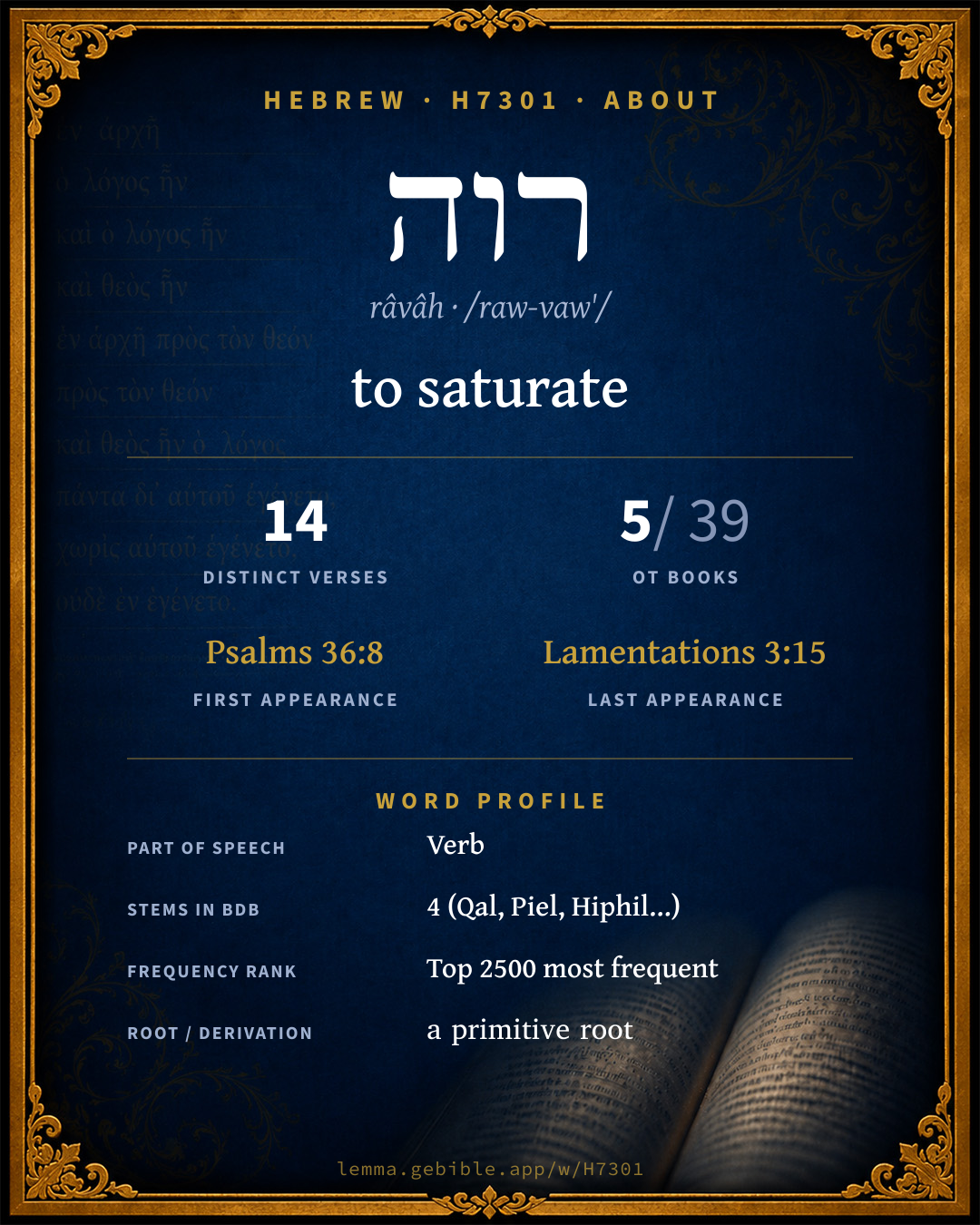
רָוָה
to saturate
‘to saturate’ is one of 3 main senses fuller range ↓
Full lexicon entry — Brown-Driver-Briggs (BDB)
From Brown-Driver-Briggs (BDB)
Where this word appears
See every Piel verb in the Hebrew Bible →
Grammar key — what these labels mean
Part of speech
- Verb
- An action or state-of-being word.
Stem
- Hiphil
- The causative active stem (“he caused / brought about”).
- Piel
- An intensive or resultative active stem. Here: ‘be intoxicated’
- Qal
- The basic, simple active stem — the plain form of the verb (“he wrote”).
Form
- Participle Active
- A verbal adjective expressing ongoing or characteristic action (“writing / one who writes”).
- Sequential Perfect
- A perfect with prefixed waw continuing a preceding imperfect or command (waw-consecutive perfect).
- Perfect
- A completed action or state — Hebrew marks aspect (completeness) more than strict tense (“he wrote”).
- Infinitive Absolute
- An unbound verbal noun, often intensifying or standing in for a finite verb.
- Imperfect
- An incomplete, ongoing, or future action (“he will / would write”).
- Jussive
- A third- or second-person volitional form expressing wish or command (“let him write”).
- Cohortative
- A first-person volitional form expressing wish or resolve (“let me / let us write”).
State
- Absolute
- The independent form of a noun, not bound to a following word.
Person
- 1st Person
- The speaker (“I / we”).
- 3rd Person
- The one spoken about (“he / she / it / they”).
- 2nd Person
- The one addressed (“you”).
Gender
- Masculine
- Grammatically masculine.
- Common
- Either gender — not distinguished for this form.
- Feminine
- Grammatically feminine.
Number
- Singular
- One.
- Plural
- More than one (in Hebrew, generally three or more).
Grammatical forms 13 distinct
- Verb, Hiphil, Perfect, 3rd Person, Masculine, Singular 2 times (14%)
- Verb, Hiphil, Participle Active, Masculine, Singular, Absolute 1 time (7%)
- Verb, Piel, Sequential Perfect, 1st Person, Common, Singular 1 time (7%)
- Verb, Piel, Sequential Perfect, 3rd Person, Feminine, Singular 1 time (7%)
- Verb, Qal, Sequential Perfect, 3rd Person, Feminine, Singular 1 time (7%)
- Verb, Hiphil, Perfect, 1st Person, Common, Singular 1 time (7%)
- Verb, Hiphil, Perfect, 2nd Person, Masculine, Singular 1 time (7%)
- Verb, Piel, Infinitive Absolute 1 time (7%)
+5 more forms (5 occurrences)
Parsed forms decoded from the imported morphology (morphhb / Westminster Leningrad Codex — WLC text public domain, morphhb tagging CC BY 4.0), counted across 14 parsed occurrences — not distinct verses.
Every verse where H7301 appears — 14 distinct verses across 5 books. Click any verse to open its interlinear word-by-word view. Verse text shown in the World English Bible for context — . Each verse’s Hebrew form is shown with its reference; the English is not keyword-highlighted, since the data carries no word-level English alignment. Use “Compare translations” on any verse to read it across multiple English versions. This concordance covers the Hebrew Bible; Septuagint (Greek Old Testament) occurrences are not indexed here.
Psalms 2 verses
- Psalms 36:8 יִ֭רְוְיֻ/ן Qal impf 3mp + sfx n They shall be abundantly satisfied with the abundance of your house. You will make them drink of the river of your pleasures.
- Psalms 65:10 רַ֭וֵּה Piel inf.abs You drench its furrows. You level its ridges. You soften it with showers. You bless it with a crop.
Proverbs 3 verses
- Proverbs 5:19 יְרַוֻּ֣/ךָ Piel juss 3mp + sfx pers 2ms A loving doe and a graceful deer-- Let her breasts satisfy you at all times. Be captivated always with her love.
- Proverbs 7:18 נִרְוֶ֣ה Qal coh 1cp Come, let's take our fill of loving until the morning. Let's solace ourselves with loving.
- Proverbs 11:25 וּ֝/מַרְוֶ֗ה conj + Hiphil ptcp.act ms The liberal soul shall be made fat. He who waters shall be watered also himself.
Isaiah 5 verses
- Isaiah 16:9 אֲרַיָּ֨וֶ/ךְ֙ Piel impf 1cs + sfx pers 2fs Therefore I will weep with the weeping of Jazer for the vine of Sibmah; I will water you with my tears, Heshbon, and Elealeh: for on your summer fruits and on your harvest the [battle] shout is fallen.
- Isaiah 34:5 רִוְּתָ֥ה Piel pf 3fs For my sword has drunk its fill in the sky: behold, it shall come down on Edom, and on the people of my curse, to judgment.
- Isaiah 34:7 וְ/רִוְּתָ֤ה conj + Piel wpf 3fs The wild-oxen shall come down with them, and the bulls with the bulls: and their land shall be drunken with blood, and their dust made fat with fatness.
- Isaiah 43:24 הִרְוִיתָ֑/נִי Hiphil pf 2ms + sfx pers 1cs You have bought me no sweet cane with money, neither have you filled me with the fat of your sacrifices; but you have burdened me with your sins, you have wearied me with your iniquities.
- Isaiah 55:10 הִרְוָ֣ה Hiphil pf 3ms For as the rain comes down and the snow from the sky, and doesn't return there, but waters the earth, and makes it bring forth and bud, and gives seed to the sower and bread to the eater;
Jeremiah 3 verses
- Jeremiah 31:14 וְ/רִוֵּיתִ֛י conj + Piel wpf 1cs I will satiate the soul of the priests with fatness, and my people shall be satisfied with my goodness, says Yahweh.
- Jeremiah 31:25 הִרְוֵ֖יתִי Hiphil pf 1cs For I have satiated the weary soul, and every sorrowful soul have I replenished.
- Jeremiah 46:10 וְ/רָוְתָ֖ה conj + Qal wpf 3fs For that day is [a day] of the Lord, Yahweh of Hosts, a day of vengeance, that he may avenge him of his adversaries: and the sword shall devour and be satiate, and shall drink its fill of their blood; for the Lord, Yahweh of hosts, has a sacrifice in the north country by the river Euphrates.
Lamentations 1 verse
About this entry
At a glance — auto-summarized from this page’s data, not written by a person. Every figure links to its source below. This summary describes the numbers; it doesn’t interpret them.
The Hebrew verb רוה centers on the idea of “to saturate.” As a verb its force shifts by stem, across 4 stems (Qal, Piel, and more). It appears 14 verses across 5 books of the Hebrew Bible, among its uncommon vocabulary. The word gravitates to Isaiah (36%), then Proverbs and Jeremiah. Its earliest occurrence is Psalms 36:8. Dig into 14-verse concordance and the renderings breakdown below.
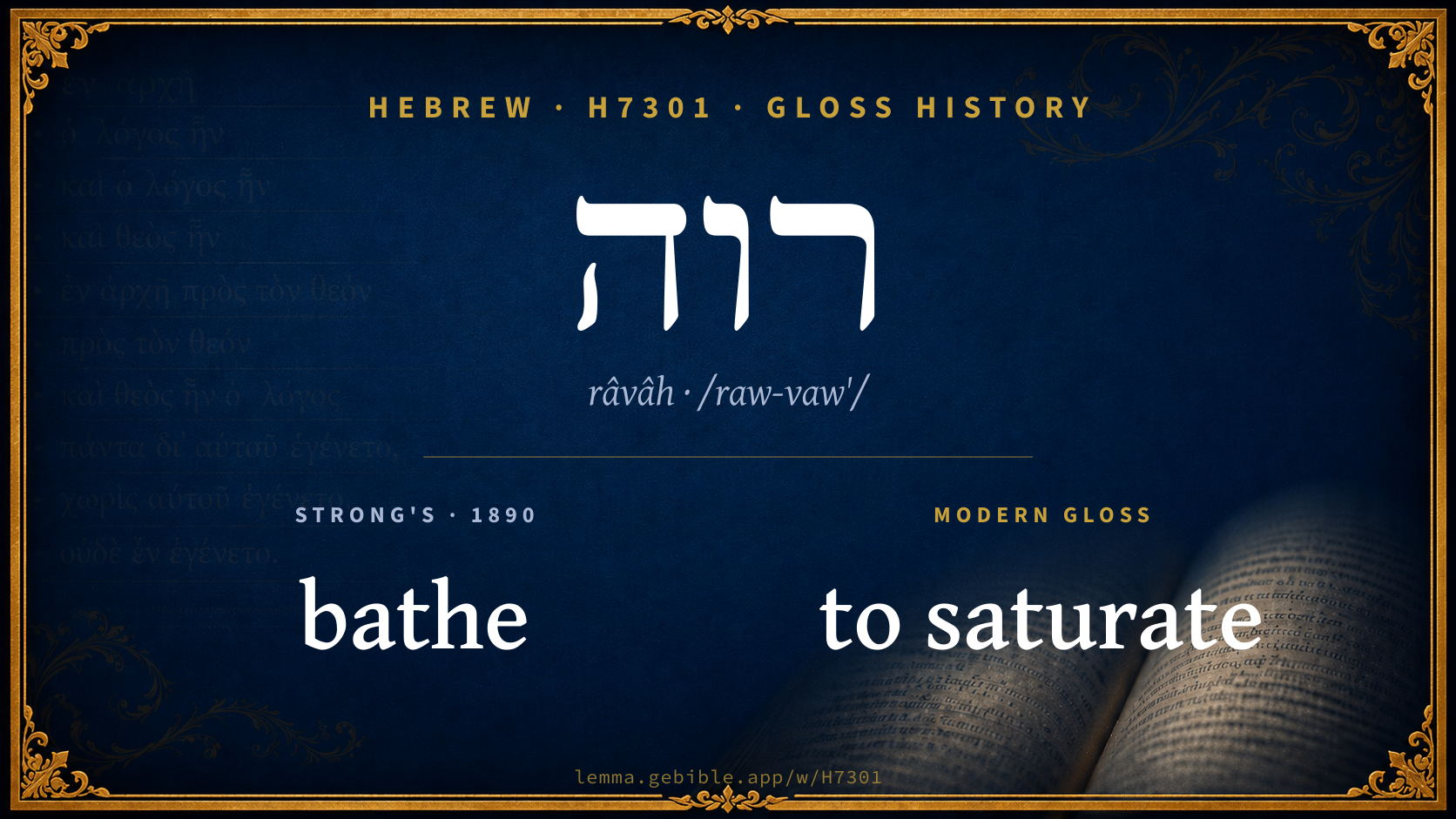
Gloss history
Strong's 1890 vs modern scholarship
About this word
Strong's H7301 catalogs a Hebrew word from the Hebrew Old Testament.
These counts are not copied from any lexicon or concordance. They are computed here, from the morphology-tagged Hebrew Old Testament. What Lemma adds →
- 14
- distinct verses
- The word appears in 14 distinct verses.
- 5 / 39
- OT books
- The word appears in 5 of 39 Old Testament books.
- #1,910
- by frequency
- Top 2500 most frequent Hebrew words (rank 1,910 of 8,640 Hebrew words by occurrence).
View all 14 occurrences in the concordance →
By section of the Old Testament
By traditional corpus
Conventional, traditional groupings — biblical authorship is debated, so this is a traditional corpus grouping, not an authorship claim. Each share is this word’s portion of its verses in that division of the Hebrew canon. Each figure is a share of the word’s 14 distinct verses.
- Prophets (Nevi'im) 8 verses · 57%
- Writings (Ketuvim) 6 verses · 43%
How translations render this word
Counts come from each version’s own published word-to-Strong’s tagging or interlinear alignment — an approximate guide to how each version renders this word, not a word-level alignment the data otherwise carries. Because each total is that version’s own tagged count, the per-version totals vary from one another and need not match the appearance or distinct-verse counts above. These counts may also differ from a printed concordance because Lemma counts each distinctly tagged rendering and does not collapse phrase taggings into a single head-word total. This is a fixed set of word-tagged versions (KJV, ASV, BSB, ULT) and does not change with the reading translation you choose elsewhere. Each version’s license is shown beside its name below (and on Sources).
- King James Version: Hast thou filled 1×, He hath made me drunken 1×, He that watereth 1×
- American Standard Version: Abundantly 1×, Hast thou filled 1×, Hath drunk 1×
- Berean Standard Bible: Has drunk its fill 1×, He has intoxicated me 1×, He who refreshes others 1×
- unfoldingWord Literal Text: And 1×, Drench you 1×, Has slaked 1×
King James Version Public Domain
Renders H7301 across 15 tagged occurrences — most commonly:
Plus other, less common renderings.
American Standard Version Public Domain
Renders H7301 across 15 tagged occurrences — most commonly:
Plus other, less common renderings.
Berean Standard Bible Public Domain
Renders H7301 across 14 tagged occurrences — most commonly:
Plus other, less common renderings.
unfoldingWord Literal Text CC BY-SA 4.0
Renders H7301 across 14 tagged occurrences — most commonly:
Plus other, less common renderings.
Senses in the full BDB
Hebrew verbs can shift meaning by stem (binyan): Qal is the basic action, Niphal is often passive or reflexive, Piel often intensifies or makes it factitive, and Hiphil is typically causative. The senses below are grouped under the stem BDB assigns to each. This entry also uses Hophal (the passive of Hiphil).
What do BDB’s symbols mean?
BDB uses these scholarly abbreviations:
| Symbol | Meaning |
|---|---|
| 𝔊 | the Septuagint (the ancient Greek translation, LXX) |
| 𝔙 | the Vulgate (the Latin translation) |
| 𝔖 | the Syriac version (the Peshitta) |
| 𝔗 | the Targum (the Aramaic translation) |
| ψ | the Psalms |
| √ | root (the underlying root or stem) |
| ‖ | parallel passage (a synonymous or contrasted parallel) |
| † | the dagger: every passage where the word occurs is cited |
The 6 senses and sub-senses the full Brown-Driver-Briggs lexicon distinguishes for this word, in lexicon order (not ranked by frequency), with BDB’s own verbatim wording and sub-sense lettering. Shown in Hebrew script with BDB’s own scholarly abbreviations. The condensed entry is in the Lexicon Entry tab. See also the Forms in the corpus table below.
Qal
- Pf. 3 fs. consec. וְרָֽוְתָה מִדָּמָם Je 46:10, fig. of sword (‖ שָֽׂבְעָה, אָֽכְלָה); Impf. 3 mpl. יִרְוְיֻן כִ דֶּשֶׁן בֵּיתֶ֑ךָ ψ 36:9 (Ges§ 75 u) fig. of men (‖ תַּשְׁקֵם); 1 pl. נִרְוֶה דֹדִים Pr 7:18 we will take our fill of love (‖ נִתְעַלְּסָה). e.g. Jeremiah 46:10
Piel
- Pf. 3 fs. רִוְּתָה Is 34:5, וְר׳ consec. v 7; 1 s. consec. וְרִוֵּיתִי Je 31:14; Impf. 1 s. sf. אֲרַיָּ֫וֶךְ Is 16:9 (read prob. אֲרַוַּ֫יִךְ MargolisAm. J. Sem. Lang., Oct. 1902, 48, vid. also Köi. 589 f.; > אֲרַוָּ֫יֶךְ Sta§ 634 e Ges§ 75 dd); 3 mpl. sf. יְרַוֻּךָ Pr 5:19; Inf. abs. רַוֵּה ψ 65:11 (Ges§ 113 z);— e.g. Isaiah 34:5
- 1. intens. be intoxicated, drunk Is 34:5, fig. of sword; + מִדָּם v 7, of land (‖ יְדֻשָּׁ֑ן). e.g. Isaiah 34:5
- 2. causat., drench, water abundantly, c. acc. תְּלָמֶיהָ ψ 65:11; Is 16:9 c. acc. pers. + דִּמְעָתִי material; saturate (fig.), sate, ור׳ נֶפֶשׁ הַכֹּהֲנִים דָּ֑שֶׁן Je 31:14 (‖ שׂבע); sexually, דַּדֶּיהָ יְרַוֻּךָ Pr 5:19. e.g. Psalms 65:11
Hiphil
- Pf. 3 ms. הִרְוָה Is 55:10, sf. הִרְוַנִי La 3:15; 2 ms. sf. הִרְוִיתָ֑נִי Is 43:24; 1 s. הִרְוֵיתִי Je 31:25; Pt. מַרְוֶה Pr 11:25;—saturate, water, c. acc. ארץ Is 55:10 (subj. שֶׁלֶג, גֶּשֶׁם); cause to drink (fig.), c.acc. pers.etrei (לַעֲנָה) La 3:15 (‖ הִשְׂבִּיעַנִי); c. acc. pers. only (נֶפֶשׁ) Je 31:25 (‖ מִלֵּאתִי), abs. Pr 11:25; of Isr. satisfying י׳, חֵלֶב זְבָתִים Is 43:24. e.g. Isaiah 55:10
Hophal
- Impf. יוּרֶא (יָרְוֶה?) Pr 11:25 v. Toy and ירא p. 432. e.g. Proverbs 11:25
Senses from the full Brown-Driver-Briggs lexicon (Brown, Driver, Briggs; Oxford 1906 — public domain), digitized via Sefaria, supplemented by the OpenScriptures HebrewLexicon (CC BY 4.0). Full attribution on Sources.
Word origin
vb. be saturated, drink one’s fill (NH in der. spec.; Arabic رَوِىَ; Ethiopic ረወየ: Aramaic רְוִי, ܪܘܳܐ );—
— Brown-Driver-Briggs (Oxford 1906, public domain), digitized via Sefaria, supplemented by the OpenScriptures HebrewLexicon (CC BY 4.0). See Sources.
Origin: a primitive root
Jastrow Dictionary
A second Hebrew/Aramaic lexicon for comparison, covering Aramaic and post-biblical (Talmudic, Targumic, Midrashic) usage that the biblical-Hebrew BDB does not. Matched by lemma rather than by Strong’s number, so a lemma may carry more than one Jastrow headword (shown separately below), and the entries cover usage well beyond the Bible.
רָוָה
- , v. רוי
רוי
- (b. h.) to be moist, be saturated, drip. Y. Maasr. I, 49ᵃ top משיִרְווּ (not שיורו), v. מַרְוִית.
- to saturate; to refresh; trnsf. to delight. B. Bath. 14ᵇ; Ber. 7ᵇ (play on רוּת) שזכתה … שׁרִיוָּהוּ להקב"ה וכ׳ she was privileged in that from her descended David, who delighted the Lord with songs and hymns.
- same. Midr. Till. to Ps. CL (ref. to Is. XXXIV, 5) [read:] מַרְוֶה אותה ומפילהו לשרה וכ׳ he saturates it (the sword with blood), and brings her tutelary angel to fall, and then it (the sword) will come down upon her (Rome; v. Cant. R. to VIII, 14). e.g. Isaiah 34:5
- to be saturated, refreshed. Gen. R. s. 33 ירדו … ונ׳ העולם rain fell, and the world was refreshed; Lev. R. s. 34 (not ונתרווח); Yalk. Lev. 665; Yalk. Ps. 888 (corr. acc.). Y. M. Kat. III, 82ᶜ bot. כשם שׁנִתְרַוִּיתֶם וכ׳ as you were saturated with the oil of inauguration for seven days &c.; a. e.
A Dictionary of the Targumim, the Talmud Babli and Yerushalmi, and the Midrashic Literature (Marcus Jastrow; London, Luzac, 1903) — Public Domain. Digitized via Sefaria. Digitized via Sefaria. Full attribution on Sources.
Forms in the corpus
The 14 distinct written forms H7301 takes in the Hebrew Bible, most frequent first — each parse links to that stem’s occurrences in the concordance. Hebrew forms include their vowel points and cantillation, so a single lemma takes many written forms.
Same root — word family
Other BDB entries built from the same root as H7301, grouped by Strong’s listed origin. These share a root / origin per the lexicon — not necessarily a shared meaning. Each links to that word’s own entry.
Derived from this word
Compare all same-root words → They share a root, not necessarily a meaning.
Septuagint verse parallels
This word appears in 13 verses that also exist in the Greek Old Testament (Septuagint), out of the 14 Hebrew verses it occurs in. You can read those verses in Greek by switching the Old Testament edition to the Septuagint.
Read these verses in the Septuagint
This is a verse-level parallel only — the same verses exist in both the Hebrew and Greek Old Testaments. No word-level Hebrew↔Greek correspondence is claimed: the data carries no such alignment, so no Greek word is shown as this Hebrew word’s translation. Coverage is not total — the Septuagint omits the deuterocanon and renumbers the Psalms, so some Hebrew verses have no direct Greek parallel.