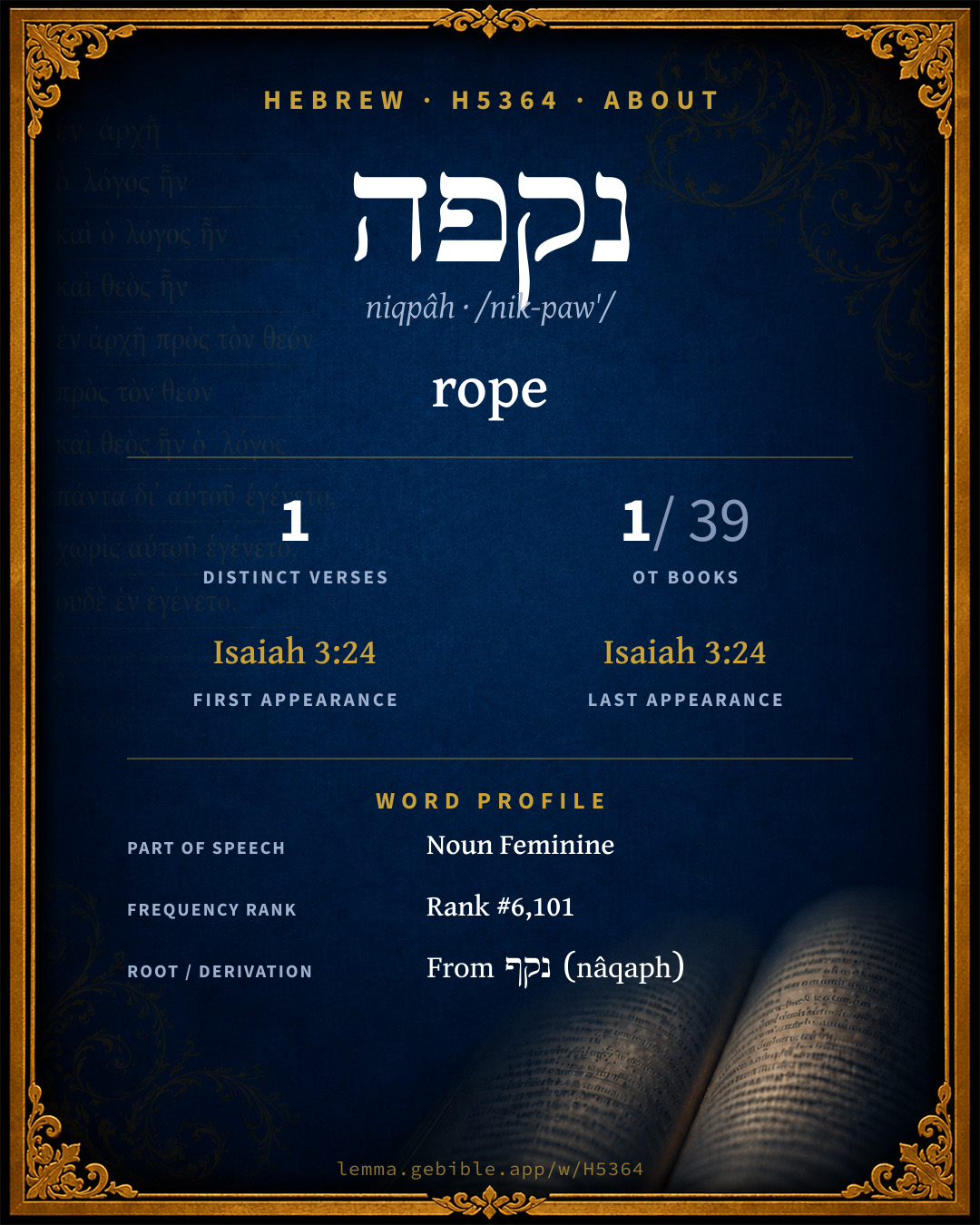
נִקְפָּה
rope
Full lexicon entry — Brown-Driver-Briggs (BDB)
From Brown-Driver-Briggs (BDB)
Where this word appears
Grammar key — what these labels mean
Part of speech
- Noun
- A naming word — a person, place, thing, or idea.
Noun type
- Common
- A common noun — a general class of person, place, or thing (“king,” “city,” “water”), not a specific name.
State
- Absolute
- The independent form of a noun, not bound to a following word.
Gender
- Feminine
- Grammatically feminine.
Number
- Singular
- One.
Every verse where H5364 appears — 1 distinct verse across 1 book. Click any verse to open its interlinear word-by-word view. Verse text shown in the World English Bible for context — . Each verse’s Hebrew form is shown with its reference; the English is not keyword-highlighted, since the data carries no word-level English alignment. Use “Compare translations” on any verse to read it across multiple English versions. This concordance covers the Hebrew Bible; Septuagint (Greek Old Testament) occurrences are not indexed here.
Isaiah 1 verse
About this entry
At a glance — auto-summarized from this page’s data, not written by a person. Every figure links to its source below. This summary describes the numbers; it doesn’t interpret them.
The Hebrew noun נקפה centers on the idea of “rope.” It occurs a mere 1 verse across Scripture. The word gravitates to Isaiah (100%). Its lone occurrence is Isaiah 3:24. It clusters with נקף, נקף and תקופה under a shared root. For the data behind this summary, explore the sense tree and the renderings breakdown below.
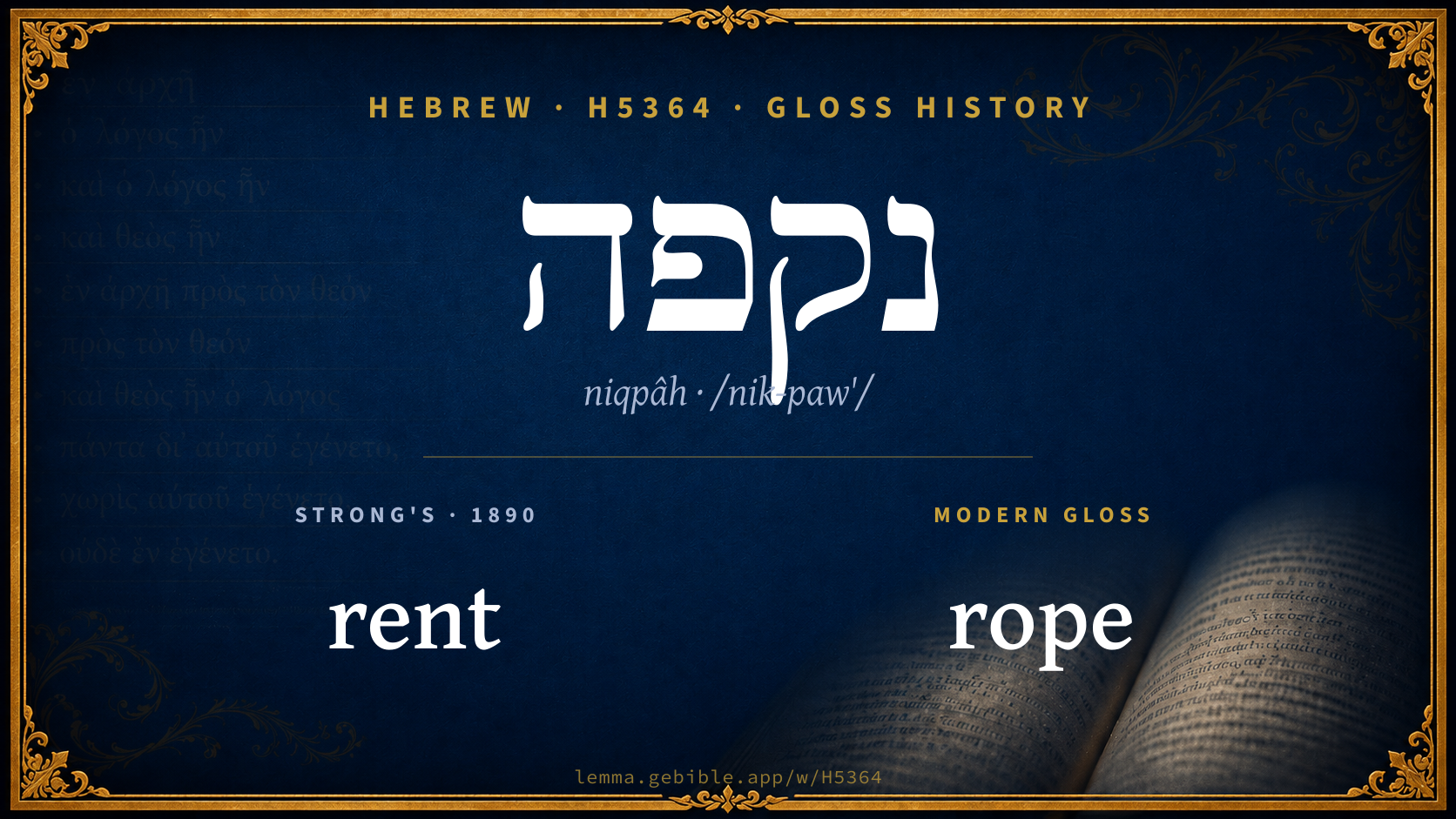
Gloss history
Strong's 1890 vs modern scholarship
About this word
Strong's H5364 catalogs a Hebrew word from the Hebrew Old Testament.
These counts are not copied from any lexicon or concordance. They are computed here, from the morphology-tagged Hebrew Old Testament. What Lemma adds →
- 1
- distinct verses
- The word appears in 1 distinct verse.
- 1 / 39
- OT books
- The word appears in 1 of 39 Old Testament books.
- #6,101
- by frequency
- Rank #6,101 (rank 6,101 of 8,640 Hebrew words by occurrence).
View all 1 occurrence in the concordance →
Most concentrated in
- Isaiah 1 verse 100%
By section of the Old Testament
By traditional corpus
Conventional, traditional groupings — biblical authorship is debated, so this is a traditional corpus grouping, not an authorship claim. Each share is this word’s portion of its verses in that division of the Hebrew canon. Each figure is a share of the word’s 1 distinct verse.
- Prophets (Nevi'im) 1 verse · 100%
How translations render this word
Counts come from each version’s own published word-to-Strong’s tagging or interlinear alignment — an approximate guide to how each version renders this word, not a word-level alignment the data otherwise carries. Because each total is that version’s own tagged count, the per-version totals vary from one another and need not match the appearance or distinct-verse counts above. These counts may also differ from a printed concordance because Lemma counts each distinctly tagged rendering and does not collapse phrase taggings into a single head-word total. This is a fixed set of word-tagged versions (KJV, ASV, BSB, ULT) and does not change with the reading translation you choose elsewhere. Each version’s license is shown beside its name below (and on Sources).
- King James Version: Rent 1×
- American Standard Version: Rope 1×
- Berean Standard Bible: Rope 1×
- unfoldingWord Literal Text: Rope 1×
King James Version Public Domain
Renders H5364 across 1 tagged occurrence — most commonly:
American Standard Version Public Domain
Renders H5364 across 1 tagged occurrence — most commonly:
Berean Standard Bible Public Domain
Renders H5364 across 1 tagged occurrence — most commonly:
unfoldingWord Literal Text CC BY-SA 4.0
Renders H5364 across 1 tagged occurrence — most commonly:
Senses in BDB
The 1 sense BDB distinguishes for this word, in lexicon order (not ranked by frequency or importance). The full entry — with sub-senses — is in the Lexicon Entry tab.
- tether, rope, encircling rope
Word origin
n.f. encircling rope (of captive), תַּחַת חֲגוֹרָה נִקְפָּה Is 3:24.
— Brown-Driver-Briggs (Oxford 1906, public domain), digitized via Sefaria, supplemented by the OpenScriptures HebrewLexicon (CC BY 4.0). See Sources.
Derived from נקף (nâqaph) (H5362) — to strike.
Jastrow Dictionary
A second Hebrew/Aramaic lexicon for comparison, covering Aramaic and post-biblical (Talmudic, Targumic, Midrashic) usage that the biblical-Hebrew BDB does not. Matched by lemma rather than by Strong’s number, so a lemma may carry more than one Jastrow headword (shown separately below), and the entries cover usage well beyond the Bible.
קפי
- (b. h.) [to bend, arch, be arched,]
- 1. to be on top, float on the surface. Part. pass. קָפוּי; f. קְפוּיָה; pl. קְפוּיִים, קְפוּיִין; קְפוּיוֹת light of weight. Pes. 50ᵃ (ref. to יקרות וקפאון, Zech. XIV, 6) אור שיקר בעוה"ז ק׳ הוא וכ׳ Ms. M. (ed. וק׳) light which is weighty (precious, rare) in this world shall be light (little esteemed, an ordinary thing) in the world to come; ib. נגעים … וקפויין וכ׳ (Ms. M. קפויות) the treatises Negaim and Oholoth, which are heavy (difficult, obscure) in this world, shall be light (easily understood) &c., ib. אלו בני אדם … (ו)ק׳ הם וכ׳ those who are weighty (important on account of their wealth, though otherwise without merit) in this world, shall be light (disregarded) &c.; Yalk. Zech. 583. e.g. Zechariah 14:6
- 2. to coagulate, be curdled. Gen. R. s. 4 כיון שירד … מיד הוא קוֹפֵא ועומד ed. Wil. (oth. ed. קוֹפֶה) as soon as a drop of m’so (v. מְסוֹ) is put in, the milk curdles and ‘stands’ (v. עָמַד); ib. s. 14 קופה (ed. Wil. קָפוּי); Lev. R. s. 14 נִקְפָּא. Tanḥ. B’shall. 17; Mekh. ib., Shirah, s. 6 קפא עליהם וכ׳ the sea around them was congealed as far as &c.; Yalk. Ex. 248 נִקְפָּה; a. e.—[Tosef. Maasr. I, 7, v. infra.]
- to skim, take off the scum and the substances that gather on wine when it begins to ferment. Maasr. I, 7 היין משיְקַפֶּה אע"פ שקי׳ וכ׳ Y. ed. (Bab. and Mish. ed. שקִפָּה) wine is subject to tithes when the manufacturer begins to skim; but although he has skimmed, he may take &c.; Tosef. ib. I, 7 אע"פ שקופה ed. Zuck. (Var. שקיפה); Ab. Zar. 56ᵃ; Y. B. Mets. VII, beg. 11ᵇ; [Maim. to Maasr. l. c. seems to read משיִקְפֶּה, expl. to form scum]. Tosef. l. c. שולה וקופה ed. Zuck. (Var. שילה וקיפה), v. שָׁלָה. Maasr. IV, 1 המְקַפֵּא לתבשיל he that skims for the purpose of taking wine for a dish; Tosef. ib. I, 9 המְקַפֶּה בעריבה he that skims and takes wine out in a trough; a. fr.—In gen. to take from the top. Ter. IV, 11 סאה … וְקִפְּאָהּ if one S’ah of T’rumah fell on top of a pile, and he took it off. Ib. יְקַפְּאֶנָּה Mish. ed. (Bab. ed. יַקְפִּיאֶנָּה Hif.; Y. ed. Krot. ייקפינה, read: יְקַפֶּינָּה; Ms. M. יקיפנה, corr. acc.) let him take it off. Y. ib. 43ᵃ bot. קפה וחזר וק׳ if he took from the top once and again; a. e.
- 1. same, v. supra.—2)
- to cause to float. Ber. 40ᵃ המַקְפֶּה אכילתו במים he that makes his food float in water (who drinks freely after meals). Sabb. 21ᵃ להַקְפּוֹת to keep the wick floating.—3) to curdle, congeal; to cause coagulation; to become thick. Ḥull. 120ᵃ; Men. 21ᵃ ה׳ את הדם if he made the blood thick (through boiling); ib. הִקְפָּהוּ באור Mss. (v. Rabb. D. S. a. l. note 30) if he made it thick by means of artificial heat; הקפהו בחמה by exposure to the sun. Lev. R. s. 14 (ref. to Job X, 10) הִקְפִיאֲתָנִי אינו אומר וכ׳ it does not read, thou hast curdled me, but thou wilt &c.; Gen. R. s. 14 הִקְפֵּאתַנִי (some ed. הִקְפֵּתַנִי). Num. R. s. 9 (ref. to Ex. XV, 8) ה׳ שלישו של ים he made one-third of the sea thick (v. supra); a. e. e.g. Job 10:10
- to be curdled, made thick. Lev. R. l. c.; Yalk. Ex. 248, v. supra.—[Y. Ned. VII, end, 40ᶜ ניקפת, read: נִיכְפֵּית, v. כָּפָה.]
A Dictionary of the Targumim, the Talmud Babli and Yerushalmi, and the Midrashic Literature (Marcus Jastrow; London, Luzac, 1903) — Public Domain. Digitized via Sefaria. Digitized via Sefaria. Full attribution on Sources.
Same root — word family
Other BDB entries built from the same root as H5364, grouped by Strong’s listed origin. These share a root / origin per the lexicon — not necessarily a shared meaning. Each links to that word’s own entry.
Derives from
Shares the same root
Compare all same-root words → They share a root, not necessarily a meaning.
Septuagint verse parallels
This word appears in 1 verse that also exists in the Greek Old Testament (Septuagint), out of the 1 Hebrew verse it occurs in. You can read those verses in Greek by switching the Old Testament edition to the Septuagint.
Read these verses in the Septuagint
This is a verse-level parallel only — the same verses exist in both the Hebrew and Greek Old Testaments. No word-level Hebrew↔Greek correspondence is claimed: the data carries no such alignment, so no Greek word is shown as this Hebrew word’s translation. Coverage is not total — the Septuagint omits the deuterocanon and renumbers the Psalms, so some Hebrew verses have no direct Greek parallel.