

Psalms 106:15

Hebrew (Westminster Leningrad Codex) Psalms 106:15 appears in the Hebrew Old Testament. The text above is from the Westminster Leningrad Codex. Each word links to its Strong’s number, a concise gloss, and parsing drawn from the Open Scriptures Hebrew Bible morphology. Click any word for its full Brown-Driver-Briggs (BDB) entry.
Download image
Cite this verse

Psalms 106:15 (World English Bible). Public Domain. Lemma interlinear Bible study tool, https://lemma.gebible.app/v/psalms/106/15.

Show BibTeX & RIS
BibTeX
RIS
English Translation
He gave them their request, But sent leanness into their soul.
World English Bible · Public Domain
Highlights
  • 1 first appearance in the Hebrew Bible
Full analysis ↓
Download a study sheet

One document with this verse’s original text, its word-by-word gloss line, the meaning frame, cross-references with their text, attributed commentary, and full source and license credits — printable, and it pastes into notes with its structure intact.

This verse Autodidact and up

Study sheet (.html) Plain text (.txt)

A passage Seminary Student

Up to 50 verses in one chapter. A passage sheet keeps up to 6 commentary sources and 12 cross-references per verse, in the order this page ranks them, and says so on the sheet whenever that leaves anything out. Ask for a single verse and you get the Autodidact verse sheet above.

Everything on this page stays free to read, with no account — the sheet is a download of what is already on screen, not access to it.

Want to remove ads? Support Godless Engineer
Compare translations 3

The same verse in 3 English versions, stacked beneath the original-language interlinear above. Click any original word for its lexicon entry.

Each is an independent rendering of the whole verse — the interlinear is not word-aligned to these translations.

Highlighted words mark where these versions differ — a whole-verse word diff, not a word-by-word alignment.

  • World English Bible Public Domain
    He gave them their request, But sent leanness into their soul.
  • King James Version Public Domain
    And he gave them their request; but sent leanness into their soul.
  • unfoldingWord Literal Text CC BY-SA 4.0
    So he gave to them their request, but he sent a wasting disease upon their lives.

unfoldingWord Literal Text — © unfoldingWord, licensed CC BY-SA 4.0. Word-aligned USFM3 via Door43 (git.door43.org/unfoldingWord/en_ult).

Versions to compare (up to 4)

3 of 4 selected

Show all 18 translations

Every available English version of this verse, each an independent rendering of the whole verse.

  • World English Bible Public Domain
    He gave them their request, But sent leanness into their soul.
  • Berean Standard Bible Public Domain
    So He granted their request, but sent a wasting disease upon them.
  • Majority Standard Bible Public Domain
    So He granted their request, but sent a wasting disease upon them.
  • King James Version Public Domain
    And he gave them their request; but sent leanness into their soul.
  • American Standard Version (1901) Public Domain
    And he gave them their request, But sent leanness into their soul.
  • Revised Version (1885) Public Domain
    And he gave them their request; but sent leanness into their soul.
  • Geneva Bible (1599) Public Domain
    Then he gaue them their desire: but he sent leannesse into their soule.
  • Douay-Rheims (1899) Public Domain
    And he gave them their request: and sent fulness into their souls.
  • Young's Literal Translation Public Domain
    And He giveth to them their request, And sendeth leanness into their soul.
  • Literal Standard Version CC BY-SA 4.0
    And He gives to them their request, || And sends leanness into their soul.
  • Unlocked Literal Bible CC BY-SA 4.0
    So he gave them what they requested, but he sent a horrible disease upon them.
  • unfoldingWord Literal Text CC BY-SA 4.0
    So he gave to them their request, but he sent a wasting disease upon their lives.
  • Darby Bible Public Domain
    Then he gave them their request, but sent leanness into their soul.
  • World Messianic Bible Public Domain
    He gave them their request, but sent leanness into their soul.
  • Webster's Bible Public Domain
    And he gave them their request; but sent leanness into their soul.
  • Free Bible Version CC BY-SA 4.0
    He gave them what they wanted, but sent them a plague as well.
  • Bible in Basic English Public Domain
    And he gave them their request, but sent a wasting disease into their souls.
  • JPS Tanakh (1917) Public Domain
    And He gave them their request; but sent leanness into their soul.

Literal Standard Version (2020), Covenant Press — licensed CC BY-SA 4.0. Text via the HelloAO Bible API (eBible.org). Unlocked Literal Bible (unfoldingWord) — licensed CC BY-SA 4.0. Text via the HelloAO Bible API (eBible.org). unfoldingWord Literal Text — © unfoldingWord, licensed CC BY-SA 4.0. Word-aligned USFM3 via Door43 (git.door43.org/unfoldingWord/en_ult). Free Bible Version, Dr. Jonathan Gallagher — licensed CC BY-SA 4.0. Text via the HelloAO Bible API (eBible.org).

Word by word

More ways to search: Search by grammar → Find every occurrence → Compare this word →

Practice this passage: Drill this verse → Learn its vocabulary →

About this verse

These counts appear in no published source. They are computed here, from the morphology-tagged text and Lemma’s own curated glosses. What Lemma adds →

6
words
5
distinct lemmas
Wisdom
section

Notable vocabulary

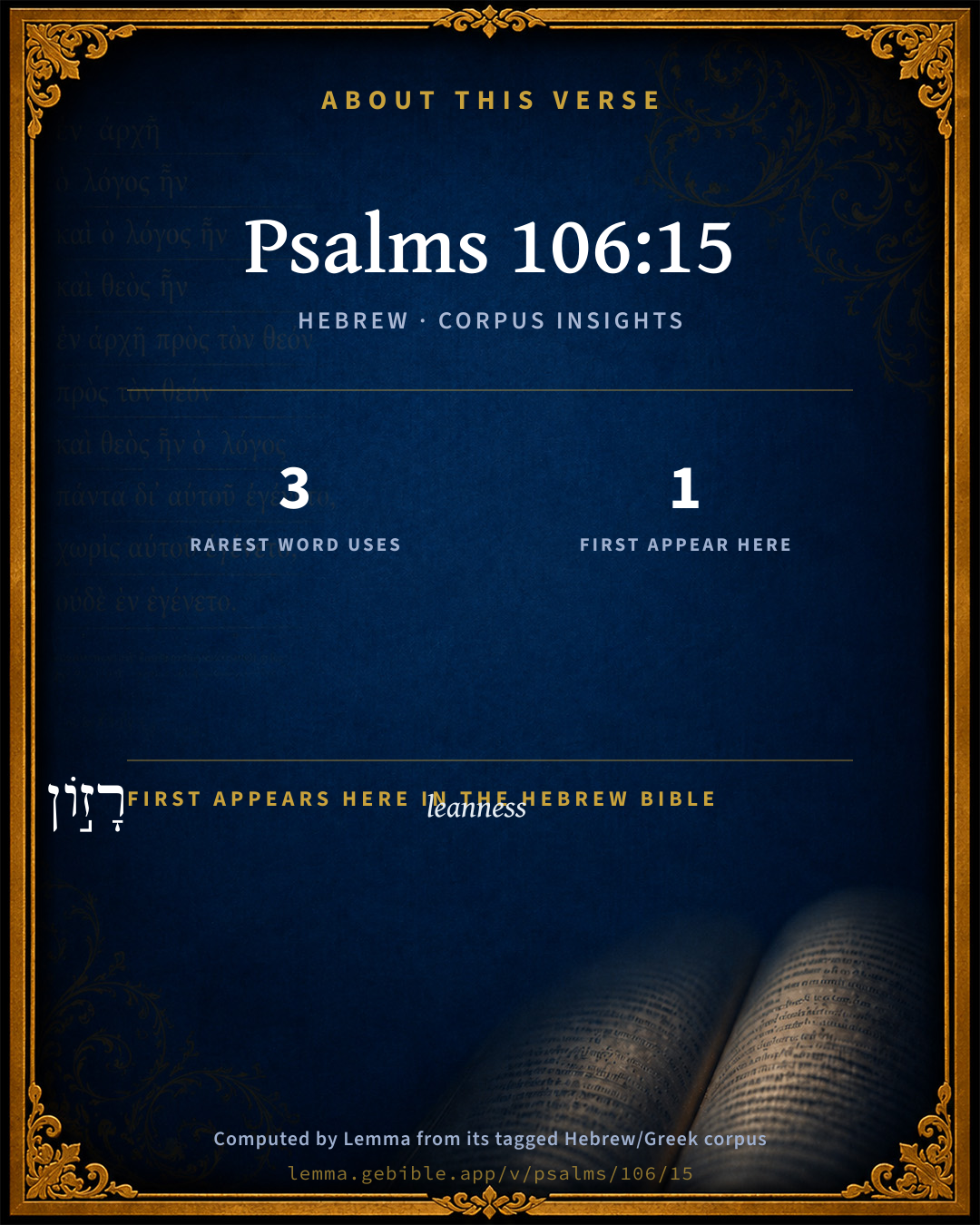
The rarest word here is רָז֣וֹן leanness H7332 — appearing just 3 times in the whole Hebrew Bible.

First appearance in Scripture

This word makes its first canonical appearance in the Hebrew Bible here:

  • רָז֣וֹן leanness H7332

Shared distinctive vocabulary

רָז֣וֹן leanness H7332 occurs in 3 verses of the Hebrew Bible. Also found in:

Grammatical profile

  • 2 verbs
  • 3 nouns
  • 1 preposition

Verb forms

  • וַיִּתֵּ֣ן Qal · Sequential Imperfect
  • וַיְשַׁלַּ֖ח Piel · Sequential Imperfect

Hebrew & Septuagint length

In English translation the verse runs 11 words from the Hebrew and 12 from the Septuagint (LXX English) — closely comparable.

A rough comparison of the two English renderings, which tokenize alike — not a word-level alignment.

Word counts can differ between the Hebrew and the Greek without any difference in meaning — e.g. the Hebrew direct-object marker אֵת has no separate Greek word, and Greek often adds the article ὁ.

Cross-references

4

Topical passages linked to Psalms 106:15 in the Treasury of Scripture Knowledge — connected by theme and wording, ordered by reader-vote popularity; previews shown in the World English Bible.

  • Numbers 11:31–34 There went forth a wind from Yahweh, and brought quails from the sea, and let them fall by the camp, about a day's journey on this side, and a day's journey on the other side, round about the camp, and about two cubits above the surface of the earth.
  • Isaiah 10:16 Therefore will the Lord, Yahweh of Hosts, send among his fat ones leanness; and under his glory there shall be kindled a burning like the burning of fire.
  • Psalms 78:29–31 So they ate, and were well filled. He gave them their own desire.
  • Isaiah 24:16 From the uttermost part of the earth have we heard songs: Glory to the righteous. But I said, I pine away, I pine away, woe is me! the treacherous have dealt treacherously; yes, the treacherous have dealt very treacherously.

Cross-references courtesy of OpenBible.info (CC BY 4.0).

Hebrew and Greek witnesses Masoretic Hebrew ↔ Greek Septuagint

The same verse in the two great witnesses to the Old Testament, shown verse-for-verse.

You’re reading Greek Psalm 105 (Hebrew Psalm 106). The Septuagint counts the superscription, so verse numbers can differ from the Hebrew — chapter-level alignment, not verse-by-verse. Numbering follows Rahlfs.

These are two independent witnesses, not word-aligned to each other, and the Septuagint is shown in lemma (dictionary) form.

Hebrew Psalms 106:15 Masoretic · Westminster Leningrad Codex

וַיִּתֵּ֣ן לָ֭הֶם שֶׁאֱלָתָ֑ם וַיְשַׁלַּ֖ח רָז֣וֹן בְּנַפְשָֽׁם

He gave them their request, But sent leanness into their soul.

World English Bible · Public Domain

Greek LXX Greek Psalm 105:15 Septuagint · lemma form

καί δίδωμι αὐτός ὁ αἴτημα αὐτός καί ἐκ ἀποστέλλω πλησμονή εἰς ὁ ψυχή αὐτός

And he gave them their request, and sent fullness into their souls.

LXX2012 (modern English Septuagint) · Public Domain

On this verse, Ellicott's Commentary for English Readers discusses the Septuagint’s reading. Read the note in Commentary ↓

Hebrew: Westminster Leningrad Codex (CC BY 4.0). Greek: Septuagint (public domain); English from LXX2012 (modern English Septuagint) (Public Domain). How the Septuagint differs from the Hebrew →

Commentary

Notes on Psalms 106:15 from classic Christian and Jewish commentators (each source and its license shown beneath its notes). The classic Christian expositions comment on the surrounding passage and are grouped to its opening verse, so a note may address several verses; the Jewish commentaries on the Tanakh (Rashi and others) are per-verse, so they appear only where the commentator wrote on this verse.

Lemma curates 59 commentaries, every one of them public domain or Creative Commons licensed, each selected and text-cleaned for this edition rather than reprinted as found. About our sources →

Trapp's Complete Commentary

John Trapp

Psa 106:15 And he gave them their request; but sent leanness into their soul.

Ver. 15. And he gave them their request] Deus saepe dat iratus quod negat propitius (Aug.).

Munera magna quidem misit, sed misit in hamo

(Martial).

Quails they had, but to choke them; as afterwards a king, but to vex them, &c.

But sent leanness into their soul] i.e. Into their bodies, such a loathing as caused leanness, Num 11:20, a plague upon their bodies, a curse upon their souls. Many men eat that on earth which they digest in hell. It is dangerous feeding on sin’s murdering morsels.

John Trapp, A Commentary or Exposition upon All the Books of the Old and New Testament (1647–1656) — public domain. Text from a community e-Sword module.

J. A. Alexander on Psalms

Joseph Addison Alexander

15. (Psa 106:15) And he gave them their request and sent (them) leanness in their soul. The last phrase is by some translated against, by others into their soul; but it is really a qualifying phrase, designed to shew that the emaciation or decay which was sent upon them was not bodily but spiritual. See Num 11:18, and compare Psa 78:10; Psa 78:18.

Joseph Addison Alexander, The Psalms Translated and Explained (1850) — public domain. Text from a community e-Sword module.

Tyndale Open Study Notes

Tyndale Open Resources

106:15 he sent a plague: See Exod 32:35; Num 11:33.

Tyndale Open Study Notes — © Tyndale Open Resources, licensed CC BY-SA 4.0. Text via the HelloAO Bible API.

Geneva Bible (1599)

Geneva Bible translators

The abundance that God gave them, profited not, but made them pine away, because God cursed it.

Geneva Bible (1599) marginal notes — public domain. Text via Bolls.life.

Adam Clarke's Commentary

Verse 15. Sent leanness] They despised the manna, and called it light, that is, innutritive, bread. God gave flesh as they desired, but gave no blessing with it; and in consequence they did not fatten, but grew lean upon it. Their souls also suffered want.

Adam Clarke's Commentary on the Bible (1810–1826) — public domain. Text from a community e-Sword/MySword module.

John Calvin's Commentaries

15. He gave them their desire There is a fine paronomasia in the word רזון, razon, for if, instead of ז, zain, we read ץ, tsädhé, the word would signify good pleasure. The prophet, therefore, in allusion to their lusting, by a word which is very similar to good pleasure or desire, says that God sent leanness into their souls; meaning by that, that he had indeed gratified the inordinate desires of the people, in such a way, however, as that those who had loathed the manna, now received nothing but leanness. Thus the prophet would seem to charge the people with what we daily observe among those who live luxuriously and are fastidious, especially when their stomach, in consequence of the fluids poured into it, being vitiated, has no relish for wholesome food. For such persons only relish that food which is pernicious; and, therefore, the more they pamper themselves with it, so much the more do they become the creatures of noxious habits; and thus in a very short time, the very food itself makes them pine away. The prophet, seems, therefore, to apply to the mind what he says about the unhealthy state of the body, and to compare the Jews to those morbid persons, whose voraciousness, instead of promoting health, injures it, because they do not derive any nourishment from their food. The reason is, that God withheld his blessing from the food which they had so immoderately longed for, in order that this their punishment for their transgression might humble them. But their perversity is seen to be very great, in that even this mode of punishing them did not overcome their stubborn hearts. It is a proverbial saying, that fools learn wisdom from the experience of evil. How insane and incorrigible must they have been, whom even compulsion itself could not reform!

John Calvin's Commentaries (1540-1563) — public domain. Text from the Calvin Translation Society English edition (1840s-50s) via the Christian Classics Ethereal Library (ccel.org). Calvin's coverage is partial (roughly two-thirds of the Bible); uncommented books and verses are honest gaps, never fabricated. The 19th-century editor's footnotes and remarks are omitted so the notes are faithfully Calvin's own voice.

Ellicott's Commentary for English Readers

(15) Leanness.—The LXX., Vulg., and Syriac read “satiety.” As Mr. Burgess points out, by accepting this reading, and giving nephesh its very usual signification of “lust” (comp. Psa_78:18, where also the word rendered “request” occurs) we get two exact synthetical clauses:—

“And he gave them their request,

And sent satiety for their lust.”

A Bible Commentary for English Readers, edited by Charles John Ellicott (1878–1897) — public domain. Text from a community e-Sword module.

The Cambridge Bible for Schools and Colleges

gen. ed. J. J. S. Perowne

15. They complained “Our soul is dried away” (Num_11:6), our vitality is exhausted; but the satisfaction of their self-willed lust brought sickness and death not life and vigour, and “the graves of lust” marked the scene of their sin and its punishment.

The Cambridge Bible for Schools and Colleges (gen. ed. J. J. S. Perowne; Cambridge University Press, 1878–1918) — public domain. Text from a community e-Sword module.

John Gill's Exposition

And he gave them their request,.... Flesh and feathered fowl in great abundance; see Psa 78:27. So God sometimes gives to wicked men what they ask for, as much as they can desire, yea, more than heart could wish.

But sent leanness into their soul: or "body"; the Septuagint, Vulgate Latin, and all the Oriental versions, read, "he sent fulness into their souls"; he gave them flesh to the full, even to a nausea; they fed too heartily on it, and were surfeited with it; which not being digested brought a repletion, and issued in a consumption; or rather death, immediate death, is meant, as Jarchi, Aben Ezra, Kimchi, and Ben Melech, interpret it; for while the flesh was in their mouths, and they were chewing it between their teeth, the wrath of God came upon them and slew them, Num 11:33. It is true in a spiritual sense, that while the bodies of wicked men are fed and pampered, their souls are starved, and at last eternally lost; as the rich man's in the Gospel, who fared sumptuously every day: and worldly professors are very lean ones; such who mind earth and earthly things never thrive in spirituals; and either they soon drop their profession, err from the faith, and turn apostates; or, if they continue, the cares of the world, and the deceitfulness of riches, choke the word; so that it is unprofitable to them, not being mixed with faith by them; and hence leanness under the best of means: yea, there is sometimes a leanness in the souls of the people of God, when corruptions prevail, the graces of the spirit are low in exercise; when there is a want of a spiritual appetite to the word; and when they fall into bad company, or do not improve conversation with one another in a spiritual way; or are too much taken up, ensnared, and entangled with the things of the world; see Isa 24:16.

John Gill's Exposition of the Whole Bible (1746–1763) — public domain (CC PDM 1.0). Text via the HelloAO Bible API.

Albert Barnes' Notes on the Bible

And he gave them their request - By sending great quantities of quails. Num 11:31-32.

But sent leanness into their soul - The word translated “leanness” is from a verb - רזה râzeh - to make thin; to cause to waste away; to destroy. The radical idea is that of abrading or “scraping;” and hence, it means to become lean, to waste away. It occurs only here and in Isa 10:16, rendered “leanness,” and in Mic 6:10, rendered “scant;” margin, “leanness.” It means here that the effect of all this on their souls was similar to the effect on the body when it wastes away by disease or want of food. This effect often occurs. In the gratification of their desires, in great temporal success and prosperity, individuals, churches, nations, often forget their dependence on God; lose their sense of the value of spiritual privileges and blessings: are satisfied with their condition; become selfconfident and proud, and forfeit the favor of God. If we pray for temporal prosperity, we should also pray that we may at the same time have grace commensurate with it, that it may be a blessing and not a curse; if we are visited with prosperity when it has not been a direct object of our prayer - if we inherit riches, or if our plans are successful beyond our expectations - or, in the language of the world, if “fortune smiles upon us,” there should be special prayer on our part that it may not be a curse rather than a blessing; that it may be so received and used as not to alienate our minds from God. Few are the Christian people who can bear continued success in life; few are those who are not injured by it; rare is it that growth in grace keeps pace with uninterrupted worldly prosperity; rare is it that the blessings of earth are so received and employed that they are seen to be a means of grace, and not a hindrance to growth in piety. A man does not know what is best for him when his heart is set on worldly prosperity; and God is more benevolent to people than they are to themselves, in withholding what is so often the object of their intense desire. “What is asked in passion, is often given in wrath” - Henry.

Albert Barnes' Notes on the Bible (1834–1885) — public domain. Text from a community e-Sword/MySword module.

Matthew Poole's English Annotations

Either into their persons; or rather, their bodies, which are oft understood by this word; of which see the notes upon Psa 16:10. So their inordinate desire of pleasing and pampering their bodies was the occasion of destroying them; whilst God denied his blessing, which alone makes food able to nourish us, and inflicted his curse, which made their food as destructive as poison to them.

Matthew Poole's English Annotations on the Holy Bible (1683–1685) — public domain. Text from a community e-Sword/MySword module.

The Treasury of David

Charles H. Spurgeon

Ver. 15. And he gave them their request. Prayer may be answered in anger and denied in love. That God gives a man his desire is no proof that he is the object of divine favour, everything depends upon what that desire is.

But sent leanness into their soul. Ah, that "but!" It embittered all. The meat was poison to them when it came without a blessing; whatever it might do in fattening the body, it was poor stuff when it made the soul lean. If we must know scantiness, may God grant it may not be scantiness of soul: yet this is a common attendant upon worldly prosperity. When wealth grows with many a man his worldly estate is fatter, but his soul's state is leaner. To gain silver and lose gold is a poor increase; but to win for the body and lose for the soul is far worse. How earnestly might Israel have unprayed her prayers had she known what would come with their answer! The prayers of lust will have to be wept over. We fret and fume till we have our desire, and then we have to fret still note because the attainment of it ends in bitter disappointment.

Ver. 15. And he gave them their request, etc. The throat's pleasure did shut up paradise, sold the birthright, beheaded the Baptist, and it was the chief of the cooks, Nebuzaradan, that first set fire to the temple, and razed the city. These effects are,

1. Grossness; which takes away agility to any good work; which makes a man more like a tun upon two pottle pots. Caesar said he mistrusted not Antony and Dolabella for any practices, because they were fat; but Casca and Cassius, lean, hollow fellows, who did think too much. The other are the devil's crammed fowls, too fat to lay. Indeed, what need they travel far, whose felicity is at home; placing paradise in their throats, and heaven in their food? 2. Macilency of grace; for as it puts fatness into their bodies, so leanness into their souls. God fatted the Israelites with quails, but withal sent leanness into their soul. The flesh is blown up, the spirit doth languish. They are worse than man eaters, for they are self eaters: they put a pleurisy into their bloods, and an apoplexy into their souls. Thomas Adams.

Ver. 15 Sent leanness into their soul. God affords us as great means for our increase in these Gospel times as ever he did; he puts us into fat pastures, and well watered, Ps 23:1-6; therefore it is a shame for God's people not to grow, not to "bring forth twins", as So 6:6. They should grow twice as fast, bring forth twice as fast, bring forth twice as many lambs, twice as much wool, twice as much milk, as those that go upon bare commons. All the world may cry shame on such a man that is high fed, and often fed with fat and sweet ordinances, if he be still like Pharaoh's lean kine, as lean and ill favoured as ever he was before. Certainly, fat ordinances and lean souls do not well agree. We are to look upon it as the greatest of judgments to have leanness sent into our souls while we are fed with manna. We look on it as an affliction to have an over lean body; but it's a far sadder condition to have a lean soul. Of the two, it were far better to have a well thriving body and a lean soul: it is a great mercy when both prosper, 3Jo 1:2: "I wish above all things that thou mayest prosper and be in health, even as thy soul prospereth." Oh it is a sweet thing, especially to have a prospering soul, and still upon the growing hand: and God expects it should be so, where he affords good diet, great means of grace; as Da 1:10: "The prince of the eunuchs said unto Daniel, I fear my lord the king, who hath appointed your meat and your drink." If you should look ill, who fare so well, I should be sure to bear the blame; it were so much as my head is worth. So certainly, where God affords precious food for precious souls, if these souls be lean under fat ordinances, either those that are fed, or those that feed them; either the stewards or the household; either minister, or people, or both, are sure to bear the blame. It is but equal and just that such should grow. We do not wonder to see lean sheep upon bare commons, but when we see sheep continue lean in fat pastures, we think their meat is ill bestowed on them; and therefore let us strive to be on the growing hand. Matthew Lawrence.

Ver. 15. Leanness is rendered "loathing" by Bishop Horsley, which accords with the literal state of the case; but I think leanness, as applied to the soul is exceedingly descriptive of its spiritual barrenness and emptiness of aught like Divine tastes or enjoyments. Thomas Chalmers.

Psalms 106:16*

Charles H. Spurgeon's The Treasury of David (1869–1885) — public domain. Psalms only. Text from a community e-Sword/MySword module.

Whedon's Commentary on the Bible

Daniel D. Whedon

15. Gave them their request—See note on Psa_78:29-31.

Sent leanness—As their prayer was wicked, springing from unlawful desires and unbelief, (Jas_4:2-3,) so the answer was in wrath. Isa_10:16. God “slew the fattest of them,” (Num_11:33-34; Psa_78:31;) that is, the most robust and healthy, to show it was a direct judgment for their sin.

Daniel D. Whedon (gen. ed.), Commentary on the Old and New Testaments (1874–1909) — public domain. Text from a community e-Sword module.

The Pulpit Commentary

And he gave them their request. By sending the quails. (Num_11:31, Num_11:32) But sent leanness into their soul. By "leanness" is meant dissatisfaction or disgust. After eating freely of the quails for a full month, the food became "loathsome" to them. (Num_11:20) Whether it actually produced the pestilence which followed. (Num_11:33) or whether that was a separate and distinct affliction, it is impossible to determine. (compare, on the whole subject, Psa_78:18-31, and the comment ad loc. )

Outward prosperity, inward decline.

Let no one think that God"s goodness to us is to be measured by the degree in which he satisfies our craving. It may be that the worst thing that can happen to us is to secure

(1) the bodily gratification, or

(2) the unhallowed ambition, or

(3) the unfavourable friendship on which we have set our hearts.

God"s truest kindnesses are often found in his withholding or his removing the objects of our regard. He "breaks our schemes of earthly joy," that we "may find our all" in him and his service.

"But sent leanness into their soul.

Kibroth-Hattaavah, or "the graves of lust." So the place has been named, for it testified to the terrible truth declared in our text. The history to which it refers is familiar enough, And what followed for Israel has followed again and again, and does so still.

I SEE INSTANCES OF IT.

1. Israel here. The leanness in their souls was caused by a sense of God"s condemnation they knew they had done wrong; terror of his wrath; hardening of their hearts in sin; the plague that followed.

2. Israel"s desiring a king. (Hos_13:11)

3. Judas. He had plotted and planned, and thought success was sure; but when he saw Jesus was condemned, those thirty pieces of silver burnt him as with the fires of hell.

4. The rich fool. His desire for wealth had been granted; but the Lord had said, "Thou fool" (cf. also 2Sa_13:15). The full purse and the lean soul are common companions.

5. The whips" with which our pleasant vices" scourge us. Cf. Ecclesiastes: "Vanity of vanities; all," etc.; cf. Ahab"s getting Naboth"s vineyard, and Elijah along with it. "Hast thou found me, O mine enemy?". (1Ki_21:20)

II THE CAUSES OF IT.

1. Not necessary. If God give us our heart"s desire, that need not send leanness into our soul. Cf. Psa 116: there was no "leanness" there, but the reverse. And, indeed, the sense of God"s favour and help does aid the soul"s true life.

2. But are found in the motive of the prayer, which may be sinful and selfish only; and in the use we make of the answer. If we love God"s gifts better than the Giver of them, then "leanness" will be sure to follow.

III THE LESSONS OF IT. The lines which follow tell them"Not what we wish, but what we want, Oh let thy grace supply! The good, unasked, in mercy grant; The ill, though asked, deny. S.C.

Gratifying sinful wants creates sinful wants.

"And he gave them their desire: and sent leanness withal into their soul" (Prayer book Version). These people longed for food of a luxurious character; they asked for it, received what they asked, and discovered that self-indulgence nourished appetite into passion, which carried them away beyond all possibility of self-restraint. Indulgence involved loss of moral power. Feed the body and you will inevitably starve the soul, bring "leanness into the soul." "The gratification of wilful and presumptuous desire begets only an intenser sense of want." Chateaubriand tells how the "Meschacebe, soon after leaving its source among the hills, began to feel weary of being a simple brook, and so asked for snow from the mountains, water from the torrents, rain from the tempests, until, its petitions granted, it burst its bounds, and ravaged its hitherto delightsome banks. At first the proud stream exulted in its force, but seeing ere long that it carried desolation in its flow, that its progress was now doomed to solitude, and that its waters were forever turbid, it came to regret the humble bed hollowed out for it by nature, the birds, the flowers, the trees, and the brooks, hitherto the modest companions of its tranquil course." In Num_11:4 we are told that "the mixed multitude that was among them fell a-lusting," and the Israelites joined them in crying for flesh to eat. What ought they to have done?

I SINFUL DESIRES WILL SOMETIMES ARISE EVEN IN GOOD MEN. Wanting what is not provided, or what is contrary to the Divine will, under the urgings of bodily passion, is a constant experience. It is even illustrated in the idea of making bread out of stones, to satisfy hunger, which came to Jesus in the wilderness. Every man must take account of the fact that his bodily passions may at any time become temptations.

II SINFUL DESIRES MUST BE REPRESSED WITHIN SAFE LIMITS. And this we do by refusing to let them say anything or do anything. Compelled silence soon weakens them. That power of self-mastery a man may have and hold if he gains it in the first occasion of struggle with uprising desires; but it is very hard to win again if once it is lost.

III SINFUL DESIRES INDULGED GAIN RUINOUS MASTERY. The common law of wanting to do a thing again which we have once done acts in this. And all indulgence tends to weaken moral power. Illustrated by the drunkard and by the devil possessions (Legion) of the New Testament. R.T.

The Pulpit Commentary (1880–1919), ed. H.D.M. Spence-Jones & Joseph S. Exell — public domain. Text from a community e-Sword module.

John Wesley's Explanatory Notes

Souls - Into their bodies. So their inordinate desire of pampering their bodies, was the occasion of destroying them.

John Wesley, Explanatory Notes Upon the Whole Bible (1754–1765) — public domain. Text via the GEBible commentary corpus.

Rashi

Rabbi Shlomo Yitzchaki (Rashi)

but He sent emaciation into their soul (Num. 11:33) “and the Lord’s wrath was kindled against the people.”

Rashi on the Tanakh — English translations: “The Judaica Press complete Tanach with Rashi, translated by A. J. Rosenberg” (CC BY 4.0); “Pentateuch with Rashi's commentary by M. Rosenbaum and A.M. Silbermann, 1929-1934” (public domain); “The Metsudah Tanach series, Lakewood, N.J” (CC BY 4.0); and “The Book of Joshua, Metsudah Publications, 1997” (CC BY 4.0). Text via Sefaria.

Lesson kit

Teaching starters — assembled from the data on this page, not authored interpretation. Every prompt links to the verse data it draws on. Edit before teaching.

Psalms, in the Wisdom, opens this verse with 6 words (5 distinct Hebrew lemmas). Its most distinctive word is râzôwn (“leanness”). A historical commentator’s framing appears above. Read the whole chapter for the surrounding context.

Discussion questions

  1. What does “leanness” (râzôwn) contribute to the verse as a whole?
  2. This is the first place “leanness” appears in Scripture (first appears here). What does its debut here establish?
  3. How does Isaiah 10:16, which shares the word «leanness», read alongside this verse?
  4. These translations render this verse differently; the difference is in the English rendering, not the original. What questions does that raise?
  5. «וַיִּתֵּ֣ן» is a Qal Sequential Imperfect verb. How does that grammatical form shape the action described?
  6. Compare how Trapp's Complete Commentary and J. A. Alexander on Psalms read this verse. Where do they agree or differ?

Things to notice

  • 1 word makes its first canonical appearance in Scripture here.
  • These translations choose different wording for 7 words in this verse.
  • 5 distinct Hebrew lemmas span 6 words in this verse.

Reading settings

Reading text

Shown beneath each verse's original-language words.

Old Testament
Old Testament edition

Read the OT as the Masoretic Hebrew (MT) or the Greek Septuagint (LXX).

English shown for the Greek Septuagint (in the Hebrew ↔ Greek comparison).

Comparing translations? Open the Compare panel on any verse page to stack up to four side by side.