

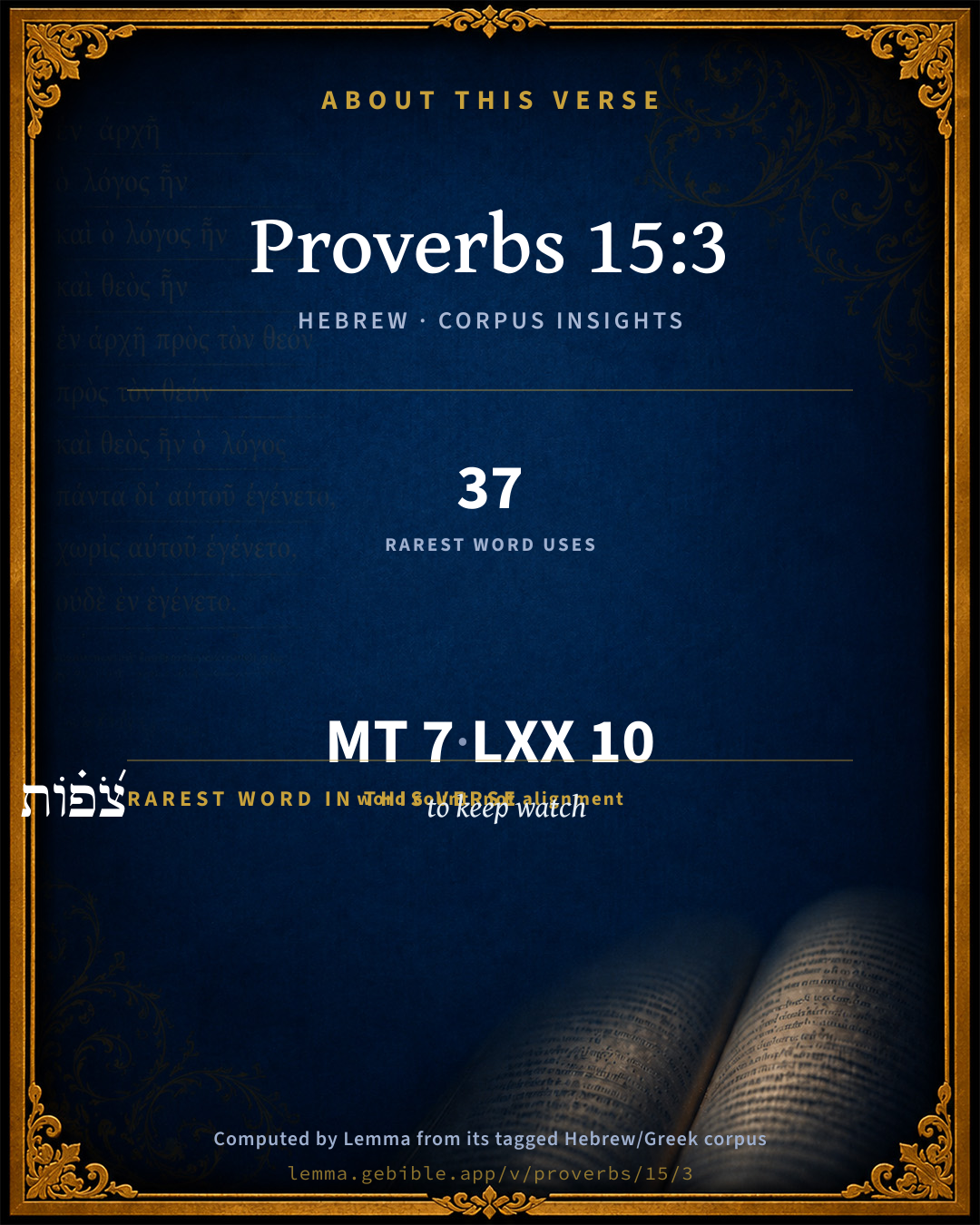
Proverbs 15:3

Hebrew (Westminster Leningrad Codex) Proverbs 15:3 appears in the Hebrew Old Testament. The text above is from the Westminster Leningrad Codex. Each word links to its Strong’s number, a concise gloss, and parsing drawn from the Open Scriptures Hebrew Bible morphology. Click any word for its full Brown-Driver-Briggs (BDB) entry.
Download image
Cite this verse

Proverbs 15:3 (World English Bible). Public Domain. Lemma interlinear Bible study tool, https://lemma.gebible.app/v/proverbs/15/3.

Show BibTeX & RIS
BibTeX
RIS
English Translation
Yahweh's eyes are everywhere, Keeping watch on the evil and the good.
World English Bible · Public Domain
Download a study sheet

One document with this verse’s original text, its word-by-word gloss line, the meaning frame, cross-references with their text, attributed commentary, and full source and license credits — printable, and it pastes into notes with its structure intact.

This verse Autodidact and up

Study sheet (.html) Plain text (.txt)

A passage Seminary Student

Up to 50 verses in one chapter. A passage sheet keeps up to 6 commentary sources and 12 cross-references per verse, in the order this page ranks them, and says so on the sheet whenever that leaves anything out. Ask for a single verse and you get the Autodidact verse sheet above.

Everything on this page stays free to read, with no account — the sheet is a download of what is already on screen, not access to it.

Want to remove ads? Support Godless Engineer
Compare translations 3

The same verse in 3 English versions, stacked beneath the original-language interlinear above. Click any original word for its lexicon entry.

Each is an independent rendering of the whole verse — the interlinear is not word-aligned to these translations.

Highlighted words mark where these versions differ — a whole-verse word diff, not a word-by-word alignment.

  • World English Bible Public Domain
    Yahweh's eyes are everywhere, Keeping watch on the evil and the good.
  • King James Version Public Domain
    The eyes of the LORD are in every place, beholding the evil and the good.
  • unfoldingWord Literal Text CC BY-SA 4.0
    The eyes of Yahweh in every place, watching the evil and the good.

unfoldingWord Literal Text — © unfoldingWord, licensed CC BY-SA 4.0. Word-aligned USFM3 via Door43 (git.door43.org/unfoldingWord/en_ult).

Versions to compare (up to 4)

3 of 4 selected

Show all 18 translations

Every available English version of this verse, each an independent rendering of the whole verse.

  • World English Bible Public Domain
    Yahweh's eyes are everywhere, Keeping watch on the evil and the good.
  • Berean Standard Bible Public Domain
    The eyes of the LORD are in every place, observing the evil and the good.
  • Majority Standard Bible Public Domain
    The eyes of the LORD are in every place, observing the evil and the good.
  • King James Version Public Domain
    The eyes of the LORD are in every place, beholding the evil and the good.
  • American Standard Version (1901) Public Domain
    The eyes of Jehovah are in every place, Keeping watch upon the evil and the good.
  • Revised Version (1885) Public Domain
    The eyes of the LORD are in every place, keeping watch upon the evil and the good.
  • Geneva Bible (1599) Public Domain
    The eyes of the Lord in euery place beholde the euill and the good.
  • Douay-Rheims (1899) Public Domain
    The eyes of the Lord in every place behold the good and the evil.
  • Young's Literal Translation Public Domain
    In every place are the eyes of Jehovah, Watching the evil and the good.
  • Literal Standard Version CC BY-SA 4.0
    The eyes of YHWH are in every place, || Watching the evil and the good.
  • Unlocked Literal Bible CC BY-SA 4.0
    The eyes of Yahweh are everywhere, keeping watch over the evil and the good.
  • unfoldingWord Literal Text CC BY-SA 4.0
    The eyes of Yahweh in every place, watching the evil and the good.
  • Darby Bible Public Domain
    The eyes of Jehovah are in every place, beholding the evil and the good.
  • World Messianic Bible Public Domain
    The LORD’s eyes are everywhere, keeping watch on the evil and the good.
  • Webster's Bible Public Domain
    The eyes of the LORD are in every place, beholding the evil and the good.
  • Free Bible Version CC BY-SA 4.0
    The Lord sees everywhere, watching the evil and the good.
  • Bible in Basic English Public Domain
    The eyes of the Lord are in every place, keeping watch on the evil and the good.
  • JPS Tanakh (1917) Public Domain
    The eyes of the LORD are in every place, keeping watch upon the evil and the good.

Literal Standard Version (2020), Covenant Press — licensed CC BY-SA 4.0. Text via the HelloAO Bible API (eBible.org). Unlocked Literal Bible (unfoldingWord) — licensed CC BY-SA 4.0. Text via the HelloAO Bible API (eBible.org). unfoldingWord Literal Text — © unfoldingWord, licensed CC BY-SA 4.0. Word-aligned USFM3 via Door43 (git.door43.org/unfoldingWord/en_ult). Free Bible Version, Dr. Jonathan Gallagher — licensed CC BY-SA 4.0. Text via the HelloAO Bible API (eBible.org).

Word by word

More ways to search: Search by grammar → Find every occurrence → Compare this word →

Practice this passage: Drill this verse → Learn its vocabulary →

About this verse

These counts appear in no published source. They are computed here, from the morphology-tagged text and Lemma’s own curated glosses. What Lemma adds →

7
words
7
distinct lemmas
Wisdom
section

Shared distinctive vocabulary

צֹ֝פ֗וֹת to keep watch H6822 occurs in 33 verses of the Hebrew Bible. Also found in:

Grammatical profile

  • 1 verb
  • 4 nouns
  • 2 adjectives

Verb forms

  • צֹ֝פ֗וֹת Qal · Participle Active

Hebrew & Septuagint length

In English translation the verse runs 12 words from the Hebrew and 15 from the Septuagint (LXX English) — closely comparable.

A rough comparison of the two English renderings, which tokenize alike — not a word-level alignment.

Word counts can differ between the Hebrew and the Greek without any difference in meaning — e.g. the Hebrew direct-object marker אֵת has no separate Greek word, and Greek often adds the article ὁ.

In the original languages it is 7 Hebrew tokens and 10 Greek tokens — but the two are counted differently (Hebrew bundles its prefixes and suffixes into one token; the Greek is in lemma form), so that isn’t a like-for-like length.

Cross-references

8

Topical passages linked to Proverbs 15:3 in the Treasury of Scripture Knowledge — connected by theme and wording, ordered by reader-vote popularity; previews shown in the World English Bible.

  • Hebrews 4:13 There is no creature that is hidden from his sight, but all things are naked and laid open before the eyes of him with whom we have to do.
  • Jeremiah 16:17 For my eyes are on all their ways; they are not hidden from my face, neither is their iniquity concealed from my eyes.
  • Jeremiah 23:24 Can any hide himself in secret places so that I shall not see him? says Yahweh. Don't I fill heaven and earth? says Yahweh.
  • 2 Chronicles 16:9 For the eyes of Yahweh run back and forth throughout the whole earth, to show himself strong in the behalf of them whose heart is perfect toward him. Herein you have done foolishly; for from henceforth you shall have wars.
  • Proverbs 5:21 For the ways of man are before the eyes of Yahweh. He examines all his paths.
  • Job 31:4 Doesn't he see my ways, And number all my steps?
  • Job 34:21–22 "For his eyes are on the ways of a man, He sees all his goings.
  • Jeremiah 32:19 great in counsel, and mighty in work; whose eyes are open on all the ways of the sons of men, to give everyone according to his ways, and according to the fruit of his doings:

Cross-references courtesy of OpenBible.info (CC BY 4.0).

Hebrew and Greek witnesses Masoretic Hebrew ↔ Greek Septuagint

The same verse in the two great witnesses to the Old Testament, shown verse-for-verse.

These are two independent witnesses, not word-aligned to each other, and the Septuagint is shown in lemma (dictionary) form.

Hebrew Proverbs 15:3 Masoretic · Westminster Leningrad Codex

בְּֽכָל מָ֭קוֹם עֵינֵ֣י יְהוָ֑ה צֹ֝פ֗וֹת רָעִ֥ים וטוֹבִֽים

Yahweh's eyes are everywhere, Keeping watch on the evil and the good.

World English Bible · Public Domain

Greek LXX Proverbs 15:3 Septuagint · lemma form

ἐν πᾶς τόπος ὀφθαλμός κύριος σκοπεύω κακός τε καί ἀγαθός

The eyes of the Lord behold both the evil and the good in every place.

LXX2012 (modern English Septuagint) · Public Domain

On this verse, The Cambridge Bible for Schools and Colleges discusses the Septuagint’s reading. Read the note in Commentary ↓

Hebrew: Westminster Leningrad Codex (CC BY 4.0). Greek: Septuagint (public domain); English from LXX2012 (modern English Septuagint) (Public Domain). How the Septuagint differs from the Hebrew →

Commentary

Notes on Proverbs 15:3 from classic Christian and Jewish commentators (each source and its license shown beneath its notes). The classic Christian expositions comment on the surrounding passage and are grouped to its opening verse, so a note may address several verses; the Jewish commentaries on the Tanakh (Rashi and others) are per-verse, so they appear only where the commentator wrote on this verse.

Lemma curates 59 commentaries, every one of them public domain or Creative Commons licensed, each selected and text-cleaned for this edition rather than reprinted as found. About our sources →

Trapp's Complete Commentary

John Trapp

Pro 15:3 The eyes of the LORD [are] in every place, beholding the evil and the good.

Ver. 3. The eyes of the Lord are in every place.] He is πανοφθαλμος, all-eye: and his providence like a well drawn picture, that vieweth all that come into the room. I know thy works, and thy labour; {Rev 2:2} not thy works only, but thy labour in doing them. And as for the offender, though he think to hide himself from God, by hiding God from himself, yet God is nearer to him than the bark is to the tree; "for in him all things subsist," {Col 1:17} "and move"; - understand {Act 17:28} it to be the mind’s motions also. And this the very heathen saw by nature’s rush candle. {a} For Thales Milesius being asked, Whether the gods knew not when a man doth ought amiss? Yea, said he, if he do but think amiss. Deus intimior nobis intimo nostro, saith another, God is nearer to us, than we are to ourselves. {b} Repletively he is everywhere, though inclusively nowhere. Nusquam est, et ubique est. As for the world, it is to him as "a sea of glass"; {Rev 4:6} corpus diaphanum - a clear transparent body; he sees through it.

Beholding the evil and the good.] The evil are first mentioned, because they make question of this truth. But what saith a worthy divine, yet alive: Think not that he who is invisible cannot see; God, like the optic virtue in the eye, sees all, and is seen of none. No man needs a window in his breast (as the heathen Momus wished), for God to look in at; every man before God is all window. {Job 34:22} The eyes of Christ are "as a flaming fire." {Rev 1:14} And the school of nature teacheth that the fiery eye needs no outward light, that sees extra mittendo, by sending out a ray, &c.

{a} Vide Sen. Ep. ad Lucil. 34.

{b} Interest animis nostris et cogitationibus. - Sen.

John Trapp, A Commentary or Exposition upon All the Books of the Old and New Testament (1647–1656) — public domain. Text from a community e-Sword module.

The Preacher's Complete Homiletical Commentary

Joseph S. Exell (gen. ed.)

CRITICAL NOTES.—

Pro_15:3. Beholding, rather “watching,” “observing” (so Stuart, Miller, and Delitzsch).

Pro_15:4. Whole-some, “gentle,” “soft,” perverseness or “transgression,” a breach, “a crushing,” “a wounding.”

MAIN HOMILETICS OF Pro_15:3

DIVINE INTELLIGENCE

I. The Eternal has a perfect knowledge of all places. The sun, in its meridian height, can only penetrate half the globe at the same time, and even then there are deep valleys and caves of the earth, and ocean beds where its rays never come; but God’s eye rests at once not only on all places of His dominion in this planet, which is but as a grain of sand amongst the worlds, but upon every spot in His boundless universe.

II. He has a perfect knowledge of the spirits of His creatures. The human soul has power to hide its secrets from the gaze of every fellow creature. “For what man knoweth the things of a man, save the spirit of a man which is in him?” (1Co_2:11). But God’s omniscient eye pierces into the hidden mazes of the soul and reads the silent thoughts and intents of the heart. In this most secret region He walks at large. “O Lord, Thou hast searched me, and known me. Thou knowest my downsitting and mine uprising, Thou understandest my thought afar off” (Psa_139:1-2). God is the one potentate and judge who can claim a perfect knowledge of all His subjects from personal acquaintance with each individual. Not one is lost in the crowd; each one stands before Him as distinctly as if He were the only creature in the universe.

III. God’s perfect knowledge of His creatures leads Him to contemplate both what is congenial and what is repugnant. He “beholds the evil and the good.” Men, when by Divine grace they become partakers of the Divine Nature, are much moved to gladness by the sight of that which is morally good, and turn with loathing from the evil which they must also contemplate. Yet their happiness springs from that which is within them and not from that which is around, or the preponderance of evil would make life unbearable. So the everblessed God, conscious of His perfect rectitude, has within Him a source of eternal satisfaction notwithstanding the “evil” that He beholds with Divine indignation and sorrow.

OUTLINES AND SUGGESTIVE COMMENTS

He mentions the “evil” first because they avowedly, or else practically, deny God’s providence (Jer_16:17).—Fausset.

When we perceive that a vast number of objects enter in at our eye by a very small passage, and yet are so little jumbled in the crowd that they open themselves regularly, though there is no great space for that either, and that they give us a distinct apprehension of many objects that lie before us, both of their nature, colour, and size, and by a secret geometry, from the angles that they make in our eye, we judge of the distance of all objects, both from us and from one another—if to this we add the vast number of figures that we receive and retain long, and with great order, in our brains, which we easily fetch up either in our thoughts or in our discourse, we shall find it less difficult to apprehend how an Infinite Mind should have the universal view of all things ever present before it.—Burnet.

The darkness of the air may hide thee from men, and the darkness of thine understanding may hide thee from thyself, but there is no darkness can hide from God.… It was a pretty fancy of one that would have his chamber painted full of eyes, that which way soever he looked he might still have some eye upon him. And it was a wise answer of Livius Drusus, when an artist offered so to contrive his house that he might do what he would and none should see him. “No,” saith Drusus, “contrive it so, rather, that all may see me, for I am not ashamed to be seen.” If the eyes of men make even the vilest forbear their beloved lusts for awhile, and they that are drunk are drunken in the night, how powerful will the eye and presence of God be with those that fear His anger and know the sweetness of His favour. The thoughts of this omnipresence of God will quicken thee to holiness. The soldiers of Israel and Judah were prodigal of their blood in the presence of their two generals (2Sa_2:14). Servants will generally work hard while their master looks on. The eye of God, as of the sun, will call the Christian to his work. Those countries that are governed by viceroys seldom flourish or thrive so well as those kingdoms where the prince is present in person. Conscience, God’s viceroy, may much quicken a Christian to holiness, but God, the Prince, much more. “I have kept Thy precepts,” saith David, “for all my ways are before Thee.”—Swinnock.

He is all-eye, and His providence like a well-drawn picture, that vieweth all that come into the room. I know Thy works and Thy labour (Revelation 2); not Thy works only, but Thy labour in doing them. And as for the offender, though he think to hide himself from God by hiding God from himself, yet God is nearer to him than the bark is to the tree, “for in Him all things subsist” (Col_1:17) and move (Act_17:28); understand it of the mind’s motions also. And this the very heathen saw by nature’s rush candle. For Thales Milesius being asked whether the gods know not when a man doth aught amiss, “Yea,” saith he, “if he do but think amiss.” “God is nearer to us than we are to ourselves,” saith another. Repletively He is everywhere, though inclusively nowhere. As for the world, it is to Him as “a sea of glass,” a clear, transparent body; He sees through it. No man needs a window in his breast (as the heathen Monus wished) for God to look in at: every man before God is all window (Job_34:22).—Trapp.

Such is the extent of wickedness that in every place He beholdeth the evil and the good. Yea, if there be but one in a place, that one is both evil and good, and God beholdeth both his evil and his good. The evil God beholdeth first, but they are the good on whom He resteth, as approving of them, and as delighting in them. For their eyes are upon God in every place, as God’s eyes are upon them. The other looketh not after God, and so God looketh after them, as that He looketh from them in auger at their wickedness. He contemplates and considers, which is more than simply to behold, for contemplation addeth to a simple apprehension a deeper degree of knowledge.—Jermin.

The doctrine of Divine omniscience, although owned and argued for by men’s lips, is neglected or resisted in their lives. The unholy do not like to have a holy eye ever open upon them, whatever their profession may be. If fallen man, apart from the one Mediator, say or think that the presence of God is pleasant to them, it is because they have radically mistaken either their own character or His. They have either falsely lifted up their own attainments or falsely dragged down the character of the judge.… In every place our hearts and lives are open in the sight of Him with whom we have to do. The proposition is absolutely universal. We must beware, however, lest that feature of the word which should make it powerful only renders it indefinite and meaningless. Man’s fickle mind treats universal truths that come from heaven as the eye treats the visible heaven itself. At a distance from the observer all around the blue canopy seems to descend and lean upon the earth, but where he stands it is far above, out of his sight. It touches not him at all; and when he goes forward to the line where now it seems to touch other men, he finds it still far above, and the point which applies to this lower world is distant as ever. Heavenly truth, like heaven, seems to touch all the world around, but not his own immediate sphere, or himself its centre. The grandest truths are practically lost in this way when they are left whole. We must rightly divide the word, and let the bits come into every crook of our own character. Besides the assent to general truth, there must be specific personal application. A man may own omniscience and yet live without God in the world.—Arnot.

The subjects of Pro_15:4-5 have been considered before. (See Homiletics on chap. Pro_12:17-18, page 274, and on chap. Pro_13:1, page 293.)

OUTLINES AND SUGGESTIVE COMMENTS

Pro_15:4. Rueetschi carries the idea of gentleness (see Critical Notes) through the two clauses as the central idea: “It is precisely with this gentle speech, which otherwise does so much good, that the wicked is wont to deceive, and then one is by this more sorely and deeply stricken and distressed than before.”—Lange’s Commentary.

That tongue which is “a witness of truth,” and therefore “saves souls” (chap. Pro_14:25), “is a tree of life.” Go into any garden of the lost, and where no such tree is, all are pagans. One sees, therefore, how the figure is kept up. If I am born into a land where there are gospel tongues; that is, if, when I grow up, I am not in China, and not in India, but in a Christian village, where people have and spread the gospel, that “tongue, as a healing thing, is (my) tree of life.” Where I get “life” is from its branches.—Miller.

This verse may be compared with the second. The tongue which “useth knowledge aright” has a morally and spiritually healing influence. It imparts instruction to the ignorant. It speaks peace to the troubled conscience. It soothes the anguish of the afflicted. It subdues the swelling of passion. It allays the self-inflicted tortures of envy. It heals divisions and animosities. These and other blessed fruits entitle it to the designation, “a tree of life;” productive, as it is, of genuine, varied, and valuable joys to all within the reach of its influence. And when the tongue makes known God’s saving health,”—the salvation revealed by Him in the gospel,—it then gives life in the highest and most important sense.—Wardlaw.

A high image of what the tongue ought to be; not negative, not harmless, but wholesome, or healing, as the salt cast into the spring cleansed the bitter waters (2Ki_2:21).… But the meekest of men felt perverseness a breach in the spirit (Num_16:8-15). The tongue of Job’s friends broke “the bruised reed” (Job_13:1-5). Even our beloved Lord, who never shrunk from external evil, keenly felt the piercing edge of this sword (Psa_69:19-20).—Bridges.

One stripe of the tongue woundeth three—the backbiter, him that giveth ear to the backbiting, and the backbitten.—Cawdray.

Saith the old philosopher, “Than a good tongue there is nothing better, than an evil nothing worse. It hath no mean; it is either exceedingly good or excessively evil. It knows nothing but extremes, and is either best of all, or worst of all (Jas_3:8). The tongue is every man’s best or worst moveable.… A good tongue is the best part of a man, and most worthy of the honour of sacrifice. This only when it is well seasoned. Seasoned, I say, with salt, as the apostle admonisheth; not with fire” (Col_4:6).—T. Adams.

Everlasting benediction be upon that tongue, which spake, as no other ever did, or could speak, pardon, peace, and comfort to lost mankind. This was the tree of life, whose leaves were for the healing of the nations.—Bishop Horne.

The root of this tree goeth down to the heart, whence it sucketh the juice of wisdom; its body lieth in the head, where things are ruminated and concocted by it; the branches of it are the several speeches of the mouth; the fruit of it is spread abroad as wide as good occasion is offered.—Jermin.

Not a silent tongue; mere abstinence from evil is not good.… Idleness is evil under the administration of God.… Not a smooth tongue: it may be soft on the surface, while the poison of asps lies cherished underneath. The serpent licks his victim all over before he swallows it. Smoothness is not an equivalent for truth.… Not a voluble tongue; that active member may labour much to little purpose.… Not a sharp tongue: some instruments are made keen-edged for the purpose of wounding.… Not even a true tongue. Truth is necessary, but it is not enough. The true tongue must also be wholesome. Before anything can be wholesome in its effects on others it must be whole in itself.… “Winged words” have fluttered about in poetry and prose through all the languages of the civilised world from old Homer’s day till now. The permanence and prevalency of the expression proves that it embodies a recognised truth. Words have wings indeed, but they are the wings of seeds rather than of birds or butterflies. We are all accustomed in autumn to observe multitudes of diminitive seeds, each balanced on its own tiny wing, floating past on the breeze.… Words are like these seeds, in their winged character, their measureless multitude, and their winged speed. They drop off in inconceivable numbers: they fly far: they are widely spread. It is of deep importance that they should be for good, and not for evil. The tongue is a prolific tree, it concerns the whole community that it should be a tree of life, and not of death.—Arnot.

Pro_15:5. He that regardeth reproof is prudent. Wise he is, and wiser he will be. This made David prize and pray for a reprover (Psa_141:5).—Trapp.

The Preacher's Complete Homiletical Commentary (gen. ed. Joseph S. Exell; Funk & Wagnalls, c. 1892) — public domain (pre-1929). A full-Bible homiletical/sermon-outline anthology covering 65 of 66 books (2 John is absent from the source module). Text from a community e-Sword module.

Tyndale Open Study Notes

Tyndale Open Resources

15:3 Knowing that thethe eyes of the Lord is watching everywhere is motivation for wise behavior.

Tyndale Open Study Notes — © Tyndale Open Resources, licensed CC BY-SA 4.0. Text via the HelloAO Bible API.

Matthew Henry's Commentary

The great truths of divinity are of great use to enforce the precepts of morality, and none more than this - That the eye of God is always upon the children of men. 1. An eye to discern all, not only from which nothing can be concealed, but by which every thing is actually inspected, and nothing overlooked or looked slightly upon: The eyes of the Lord are in every place; for he not only sees all from on high (Psa 33:13), but he is every where present. Angels are full of eyes (Rev 4:8), but God is all eye. It denotes not only his omniscience, that he sees all, but his universal providence, that he upholds and governs all. Secret sins, services, and sorrows, are under his eye. 2. An eye to distinguish both persons and actions. He beholds the evil and the good, is displeased with the evil and approves of the good, and will judge men according to the sight of his eyes, Psa 1:6; Psa 11:4. The wicked shall not go unpunished, nor the righteous unrewarded, for God has his eye upon both and knows their true character; this speaks as much comfort to saints as terror to sinners.

Matthew Henry's Commentary on the Whole Bible (1708–1710) — public domain (CC PDM 1.0). Text via the HelloAO Bible API.

Jamieson, Fausset & Brown

Robert Jamieson, A. R. Fausset & David Brown

beholding--watching (compare Pro 5:21; Psa 66:7).

Jamieson, Fausset & Brown — Commentary Critical and Explanatory on the Whole Bible (1871) — public domain (CC PDM 1.0). Text via the HelloAO Bible API.

Adam Clarke's Commentary

Verse 3. The eyes of the Lord are in every place] He not only sees all things, by his omnipresence, but his providence is everywhere. And if the consideration that his eye is in every place, have a tendency to appal those whose hearts are not right before him, and who seek for privacy, that they may commit iniquity; yet the other consideration, that his providence is everywhere, has a great tendency to encourage the upright, and all who may be in perilous or distressing circumstances.

Adam Clarke's Commentary on the Bible (1810–1826) — public domain. Text from a community e-Sword/MySword module.

Ellicott's Commentary for English Readers

(3) Beholding the evil and the good.—Waiting till the iniquity of the one is full (Gen_15:16), watching to aid the other (Psa_34:15; Psa_34:17).

A Bible Commentary for English Readers, edited by Charles John Ellicott (1878–1897) — public domain. Text from a community e-Sword module.

The Cambridge Bible for Schools and Colleges

gen. ed. J. J. S. Perowne

3. beholding] Rather, keeping watch upon, R.V. σκοπεύουσι, LXX. The word is commonly used of a watchman (1Sa_14:16; 2Sa_13:34; 2Sa_18:24), and calls up the figure of the Almighty observing, as it were, from His lofty watch-tower in heaven all the doings of the dwellers upon earth. The same word is rendered, looketh well to, Pro_31:27.

The Cambridge Bible for Schools and Colleges (gen. ed. J. J. S. Perowne; Cambridge University Press, 1878–1918) — public domain. Text from a community e-Sword module.

John Gill's Exposition

The eyes of the Lord are in every place,.... Which are expressive of his omniscience, of the full, clear, distinct, and perfect knowledge, which he has of all creatures and things; so that nothing is hid from him, but all open and manifest to him; as they are to Christ the essential Word, Heb 4:13; and also of the providence of God with respect to all persons in general, and to his own people in particular; and as he is infinite and immense, omnipresent and in all places of the world, so his omniscience and providence reach everywhere, to places most distant and secret, and to persons in them, who cannot be concealed from him, since he fills heaven and earth, Jer 23:23;

beholding the evil and the good; meaning not evil things and good things, though that is true; the one he beholds with dislike, the other with pleasure; but evil men and good men: he beholds them as from a watch tower, as the word (u) signifies, from above, from heaven, where he is; see Psa 33:13. By "evil" men may be meant both profane sinners and carnal professors; such as are more openly wicked, and declare their sin, as Sodom, or more secretly so; he sees into all the wickedness there is in their hearts, all their secret devices against his people; the works done by them in the dark, as well as their more open ones; and his eyes are upon all of them, to bring them into judgment at the last day: his eyes are particularly on the proud, to abase them; such as are under a disguise of religion, and have a form of godliness, he has his eyes upon; he sees through all their disguises; he knows on what foot they took up their profession; he discerns between that and true grace; he sees how they retain their lusts with their profession; observes the springs and progress of their apostasy; and will fix his eyes on the man without a righteousness, not having on the wedding garment, and order him into outer darkness. He also beholds "good" men; he sees all their bad things, their sins, and corrects them for them; their good things, their graces, and the exercise of them; their good works, the fruits of his own grace; their weaknesses, and supports and strengthens them; their wants, and supplies them; their persons, and never withdraws his eyes from them: these are on them continually, to protect and defend them; nor will he leave them till he has brought them safe to heaven; see Ch1 16:9.

(u) "prospectantes velut a specula", Michaelis; "speculatores", Schultens; "speculantes", Montanus, Junius & Tremellius, Piscator; "speculatur", Cocceius.

John Gill's Exposition of the Whole Bible (1746–1763) — public domain (CC PDM 1.0). Text via the HelloAO Bible API.

Albert Barnes' Notes on the Bible

The teaching which began with the fear of the Lord Pro 1:7 would not be complete without this assertion of His omni-present knowledge.

Albert Barnes' Notes on the Bible (1834–1885) — public domain. Text from a community e-Sword/MySword module.

Matthew Poole's English Annotations

The eyes of the Lord; his knowledge and providence.

The evil; who are first mentioned, because they either doubt of or deny God’s providence.

Matthew Poole's English Annotations on the Holy Bible (1683–1685) — public domain. Text from a community e-Sword/MySword module.

Whedon's Commentary on the Bible

Daniel D. Whedon

3. Beholding the evil (the wicked) and the good — In order, as is implied, to judge accurately of their character and conduct, and to reward and punish accordingly. Shall not the Judge of all the earth do right?

Gen_18:21; Gen_18:25; Pro_5:21; Pro_15:11; Job_34:21; Psa_33:13; Psa_90:8; Psa_139:1-12; Jer_16:17; Jer_32:19; Heb_4:13; 2Ch_16:9.

Daniel D. Whedon (gen. ed.), Commentary on the Old and New Testaments (1874–1909) — public domain. Text from a community e-Sword module.

The Pulpit Commentary

The eyes of the Lord are in every place, beholding keeping watch onthe evil and the good. The omnipresence and omniscience of Jehovah, the covenant God, is strongly insisted upon, and the sacred name recurs continually in this and the next chapter, and indeed throughout this Book of the Proverbs (see Wordsworth, in loc. ). The LXX renders the verb skopeuoiusi "are watching," as from a tower or high place. To the usual references we may add Ecc 15:18, Ecc 15:19; Ecc 23:19, Ecc 23:20. Corn. a Lapide quotes Prudentius"s hymn, used in the Latin Church at Thursday Lauds"Speculator adstat desuper, Qui nos diebus omnibus Actusque nostros prospicit A luce prima in vesperum." "For God our Maker, ever nigh, Surveys us with a watchful eye; Our every thought and act he knows, From early dawn to daylight"s close.

"The eyes of the Lord.

I GOD HAS EYES. We must always describe the Infinite and Invisible One in figurative language. But just as we speak of the arms and hands of God when thinking of his power and activity, so we cannot better conceive of his wonderful observing faculty than by saying that he has eyes. God can see; he can watch his creatures. It would be an awful thing if the universe were governed by a blind power. Yet that is the condition imagined by those who regard force, unconscious energy, as the highest existence in the universe and the cause of all things. We could but tremble before a blind god. What awful confusion, what terrible disasters, would result from the almighty energy of such a being crashing through all the complicated and delicate machinery of the world"s life!

II GOD USES HIS EYES. He is not a sleeping deity. He never slumbers, never closes his eyes. Day and night are alike to him. There is never a moment when he ceases to observe the world and all that is in it. There are men of whom we can say, "Eyes have they, but they see not;" unobservant people, who pass by the most obvious facts without noticing them; dreamers, who live in a world of their own fancies, and fail to see the things that are really happening about them. God is not thus self-contained. He has an outer life in the universe, and he neither scorns nor fails to observe all that is happening. We have to do with an ever-watchful, keenly observant God.

III GOD"S EYES ARE EVERYWHERE. We can only see clearly what is near to us. All but the largest objects are lost in distance, and the horizon melts into obscurity. Not so with God.

1. He sees the distant. Indeed, nothing is distant from him. He is everywhere, so that what we should regard as the most remote objects are under his close ken. No Siberian solitude, no far-off deserted planet, no star lost to the rest of the universe and rushing off into the awful waste of space, can be far from God"s presence and observation.

2. He sees the obscure. No fog dims his vision; no night blots out the objects he is ever gazing upon; no hiding in secret chambers, deep cellars, black mines of the earth, can remove anything from God"s sight.

3. He sees the unattractive. Our vision is selective. Many objects pass close before our eyes, yet we never see them, because we are not interested in them. God is interested in all things. Not a sparrow falls to the ground without his notice.

IV GOD"S EYES SEE THE EVIL. Though he is merciful, he is too true to refuse to see the sin of his children.

1. The sinner cannot escape by secrecy. If God does not strike at once, this is not because he does not know. Meanwhile the deluded sinner is but "treasuring up wrath.

2. God is long suffering. If he forbears to strike at once and yet knows all, it must be that he waits to give us an opportunity to repent. His gospel is offered in full view of our sin. There is nothing to be discovered later on that may turn God"s mercy from us. He knows the worst when he offers grace.

V GOD"S EYES SEE THE GOOD.

1. He observes his childrens secret devotion. Unnoticed by men, they are not unheeded by God. Misunderstood and misjudged on earth, they are quite understood by him. Should it not be enough to know that God knows all, and will recognize faithful service?

2. He observes his childrens need. Prayer is necessary to express our faith, etc., but not to give information to God. He knows our condition better than we do. Therefore, though he seems to neglect us, it cannot be so really. No mother ever watched over her sick infant as God watches over his poor children.

The omnipresence of God.

I GOD IS A SPIRIT. We cannot exhaust the sublimity, the awfulness, the comfort, the meaning, in this thought.

II GOD SEES ALL AND KNOWS ALL. Both the good and the evil. In looking upon evil deeds which pass unchastised in appearance, we are ready to exclaim, "And yet God has never spoken a word!" But God has seen, and will requite.

III HENCE LET US POSSESS OUR SOULS IN PATIENCE. Commit them unto him in well doing, and wait for the "end of the Lord." He knows, among other things, the need of his children, and bethinks him of helping and delivering them. J.

God"s searching glance.

The text, with others treating of the same subject, assures us, concerning the Divine notice of us, that

I IT IS ABSOLUTELY UNIVERSAL. The eyes of the Lord are "in every place." There is no secret place, however screened from the sight of man, which is not "naked and open unto the eyes of him with whom we have to do". (see Ps 139 Jer_23:24 Heb_4:13)

II IT IS CONSTANT. Absolutely unintermitted, day and night; through youth and age; in prosperity end in adversity; under all imaginable conditions.

III IT IS THOROUGH. Penetrating to the innermost sanctuary of the soul, searching its most secret places, "discerning the thoughts and intents of the heart;" discovering

(1) beneath the fair exterior that which is foul within;

(2) beneath the rugged surface the inward beauty which is breaking forth.

IV IT IS TO BE FEARED BY THE REBELLIOUS AND THE DISOBEDIENT.

1. Those who are living and are purposing to live in the commission of some flagrant sin.

2. Those who are deliberately rejecting the authority and disregarding the merciful overtures of God in Jesus Christ.

3. And also those who are continually postponing the hour of decision and of return to their allegiance. These souls may fear to think that the eye of the Holy One is continually upon them; or they may be ashamed as they think that the eye of the appealing and disappointed Saviour is regarding them.

V IT IS TO BE COURTED BY THE TRUE AND FAITHFUL.

1. The hearts that are turning toward a Divine Redeemer may been couraged to believe that his glance of kind encouragement is upon them. (see Mar_10:21)

2. The hearts that are surrendering themselves to Christ in faith and love may fill with peace and rest as they are assured of his acceptance. (Mat_11:28-30 Joh_5:24 Joh_6:46, Joh_6:47)

3. The hearts that, in his holy service, are honestly and earnestly striving to follow and to honour him and to do his work may be glad with a pure, well founded joy as they count on his precious regard, his loving approval. To these it will be a perpetual delight that the "eyes of the Lord are in every place," beholding every human heart and. every human life. C.

The Pulpit Commentary (1880–1919), ed. H.D.M. Spence-Jones & Joseph S. Exell — public domain. Text from a community e-Sword module.

Bridges on Proverbs

Charles Bridges

Adored be this All-seeing God!†1 His inspection of the universe so minute, exact, unwearied!†2 The first mark of the apostasy was a dread of his presence.†3 The ungodly try to forget it,†4 and often succeed in banishing him out of their thoughts. (Psa 10:4 .) Yet in despite of all their efforts to hide, he does see them. His eyes are in every place. Heaven, hell, the secret places of the earth, are all open before him.†5 He beholds the evil; whether the king on his throne;†6 or in his palace;†7 or the servant indulging his secret sin.†8 Yes — he may shut out the sun from his retreat, but he cannot shut out the eye of God, "from whom the darkness hideth not."†9 Reckless indeed is he to do or think what he would hide from God; and then — such is the secret root of atheism!†10 — thinking he can do so. (Isa 29:15 .)

But his eyes also behold the good. He sees them in outward destitution,†11 in secret retirement,†12 in deep affliction.†13 He pierces the prison walls.†14 He "covers their heads in the day of battle."†15 He is with them in the furnace,†16 and in the tempest.†17 His eye guides them as their journeying God, and will guide them safe home;†18 full of blessing,†19 protection,†20 and support.†21 ’He fills hell with his severity, heaven with his glory, his people with his grace.’†22

But how shall I meet these eyes? As a rebel or as a child? Do they inspire me with terror, or with love? Do I walk carefully under their lively impressions? (Gen 17:1 .) Conscious corruption leads me to shrink from the eyes of man. But oh! my God! I would lay myself naked and open to thee. Search me; try me; shew me to myself. Bring out my hidden iniquities, and slay them before thee. (Psa 139:24 .) How is the overwhelming thought of this piercing eye more than counterbalanced by the view of the great High Priest, who covers and cleanses all infirmities and defilements, and pleads and maintains my acceptance notwithstanding all discouragement! (Heb 4:13-14 .)

Footnotes:

†1 Psa 139:1-6.

†2 Jer 23:24. Psa 11:4 .

†3 Gen 3:8.

†4 Psa 10:11. Eze 8:12 .

†5 Pro 15:11. Psa 139:8 .

†6 Act 12:23.

†7 Dan 5:5.

†8 2Ki 5:20 .

†9 Job 34:21-22. Jer 16:17 .

†10 Psa 14:1.

†11 Gen 16:7, Gen 16:13 .

†12 Joh 1:48.

†13 Exo 3:7. Psa 91:15 .

†14 Gen 39:21. 2Ch 33:12-13 .

†15 Psa 140:7.

†16 Dan 3:25.

†17 Act 27:23.

†18 Psa 23:4; Psa 48:14 . Isa 42:16 .

†19 Gen 26:3.

†20 2Ch 16:9 . 1Pe 3:12 .

†21 Isa 41:10.

†22 Charnock.

Charles Bridges, An Exposition of the Book of Proverbs (1846) — public domain. Text from a community e-Sword module.

Kretzmann's Popular Commentary

Paul E. Kretzmann

v. 3. The eyes of the Lord are in every place, His omniscience seeing everything that goes on in the world, beholding the evil and the good, watching their every act, familiar with their desires, words, and acts.

Paul E. Kretzmann, Popular Commentary of the Bible (1921–1924) — public domain. Text from a community e-Sword module.

unfoldingWord translationNotes

Door43 World Missions Community

The eyes of Yahweh are everywhere

Here the word "eyes" represents Yahweh and emphasizes his ability to see everything. AT: "Yahweh sees everything" (See: Synecdoche)

the evil and the good

The words "evil" and "good" refer to people. AT: "evil people and good people" (See: Nominal Adjectives)

A healing tongue is a tree of life

The word "tongue" refers to speech. The writer speaks of the words of a person who says things that help and encourage others as if they were a tree that provides life-giving nourishment. AT: "Kind words are like a tree that gives life" (See: Metonymy and Metaphor)

a deceitful tongue crushes the spirit

The phrase "a deceitful tongue" refers to speech that is deceitful or hurtful. The writer speaks of a person being hurt or in despair as if that person's spirit were an object that words have crushed. AT: "deceitful speech causes a person to despair" (See: Metonymy and Metaphor)

translationWords

Yahweh

watch

evil

tongue

life

deceive

spirit

unfoldingWord translationNotes — © Distant Shores Media and the Door43 World Missions Community, licensed CC BY-SA 4.0. Source: git.door43.org/Door43/en_tn.

Lesson kit

Teaching starters — assembled from the data on this page, not authored interpretation. Every prompt links to the verse data it draws on. Edit before teaching.

Proverbs, in the Wisdom, opens this verse with 7 words (7 distinct Hebrew lemmas). Its most distinctive word is tsâphâh (“to keep watch”). A historical commentator’s framing appears above. Read the whole chapter for the surrounding context.

Discussion questions

  1. The word tsâphâh carries the sense “to keep watch.” How does it shape the verse?
  2. Genesis 31:49 shares the word «to keep watch» with this verse. How do the two illuminate each other?
  3. These translations render this verse differently. What is at stake in choosing one wording over another?
  4. The verb «צֹ֝פ֗וֹת» is Qal Participle Active. How does its form color the action?
  5. Reading how Trapp's Complete Commentary and The Preacher's Complete Homiletical Commentary read this verse, where do the two commentators agree and where do they part?

Things to notice

Reading settings

Reading text

Shown beneath each verse's original-language words.

Old Testament
Old Testament edition

Read the OT as the Masoretic Hebrew (MT) or the Greek Septuagint (LXX).

English shown for the Greek Septuagint (in the Hebrew ↔ Greek comparison).

Comparing translations? Open the Compare panel on any verse page to stack up to four side by side.