
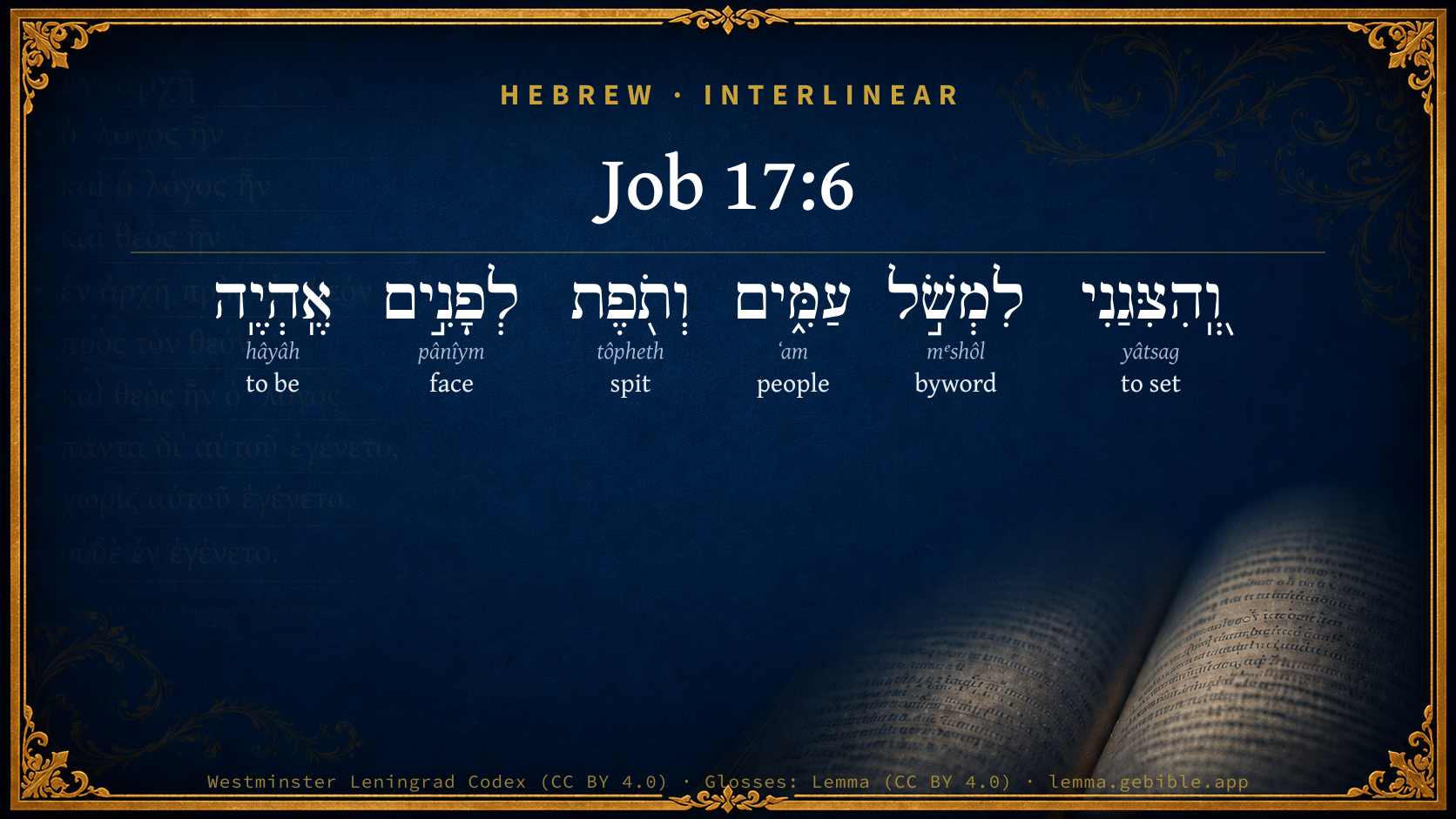
Job 17:6

Hebrew (Westminster Leningrad Codex) Job 17:6 appears in the Hebrew Old Testament. The text above is from the Westminster Leningrad Codex. Each word links to its Strong’s number, a concise gloss, and parsing drawn from the Open Scriptures Hebrew Bible morphology. Click any word for its full Brown-Driver-Briggs (BDB) entry.
Download image
Cite this verse

Job 17:6 (World English Bible). Public Domain. Lemma interlinear Bible study tool, https://lemma.gebible.app/v/job/17/6.

Show BibTeX & RIS
BibTeX
RIS
English Translation
"But he has made me a byword of the people. They spit in my face.
World English Bible · Public Domain
Highlights
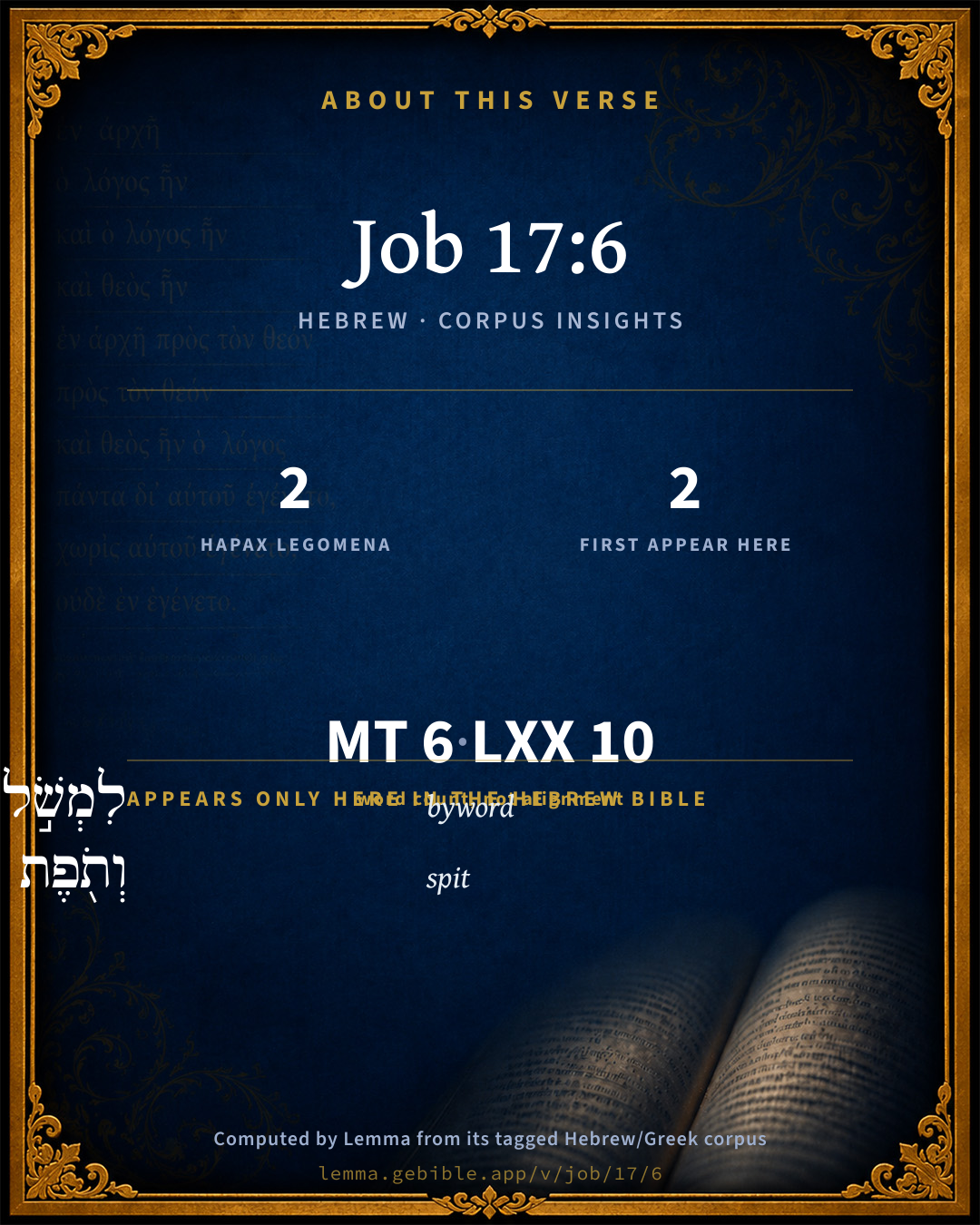
  • 2 hapax legomena — only here in the Hebrew Bible
  • 2 first appearances in the Hebrew Bible
Full analysis ↓
Download a study sheet

One document with this verse’s original text, its word-by-word gloss line, the meaning frame, cross-references with their text, attributed commentary, and full source and license credits — printable, and it pastes into notes with its structure intact.

This verse Autodidact and up

Study sheet (.html) Plain text (.txt)

A passage Seminary Student

Up to 50 verses in one chapter. A passage sheet keeps up to 6 commentary sources and 12 cross-references per verse, in the order this page ranks them, and says so on the sheet whenever that leaves anything out. Ask for a single verse and you get the Autodidact verse sheet above.

Everything on this page stays free to read, with no account — the sheet is a download of what is already on screen, not access to it.

Want to remove ads? Support Godless Engineer
Compare translations 3

The same verse in 3 English versions, stacked beneath the original-language interlinear above. Click any original word for its lexicon entry.

Each is an independent rendering of the whole verse — the interlinear is not word-aligned to these translations.

Highlighted words mark where these versions differ — a whole-verse word diff, not a word-by-word alignment.

  • World English Bible Public Domain
    "But he has made me a byword of the people. They spit in my face.
  • King James Version Public Domain
    He hath made me also a byword of the people; and aforetime I was as a tabret.
  • unfoldingWord Literal Text CC BY-SA 4.0
    But he has made me a saying of the peoples, and I have become a spitting in the face,

unfoldingWord Literal Text — © unfoldingWord, licensed CC BY-SA 4.0. Word-aligned USFM3 via Door43 (git.door43.org/unfoldingWord/en_ult).

Versions to compare (up to 4)

3 of 4 selected

Show all 18 translations

Every available English version of this verse, each an independent rendering of the whole verse.

  • World English Bible Public Domain
    "But he has made me a byword of the people. They spit in my face.
  • Berean Standard Bible Public Domain
    He has made me a byword among the people, a man in whose face they spit.
  • Majority Standard Bible Public Domain
    He has made me a byword among the people, a man in whose face they spit.
  • King James Version Public Domain
    He hath made me also a byword of the people; and aforetime I was as a tabret.
  • American Standard Version (1901) Public Domain
    But he hath made me a byword of the people; And they spit in my face.
  • Revised Version (1885) Public Domain
    He hath made me also a byword of the people; and I am become an open abhorring.
  • Geneva Bible (1599) Public Domain
    Hee hath also made mee a byword of the people, and I am as a Tabret before them.
  • Douay-Rheims (1899) Public Domain
    He hath made me as it were a byword of the people, and I am an example before them.
  • Young's Literal Translation Public Domain
    And he set me up for a proverb of the peoples, And a wonder before them I am.
  • Literal Standard Version CC BY-SA 4.0
    And He set me up for a proverb of the peoples, || And I am a wonder before them.
  • Unlocked Literal Bible CC BY-SA 4.0
    But he has made me a byword of the people; they spit in my face.
  • unfoldingWord Literal Text CC BY-SA 4.0
    But he has made me a saying of the peoples, and I have become a spitting in the face,
  • Darby Bible Public Domain
    And he hath made me a proverb of the peoples; and I am become one to be spit on in the face.
  • World Messianic Bible Public Domain
    “But he has made me a byword of the people. They spit in my face.
  • Webster's Bible Public Domain
    He hath made me also a by-word of the people; and in former time I was as a tabret.
  • Free Bible Version CC BY-SA 4.0
    He has made me a proverb of ridicule among the people; they spit in my face.
  • Bible in Basic English Public Domain
    He has made me a word of shame to the peoples; I have become a mark for their sport.
  • JPS Tanakh (1917) Public Domain
    He hath made me also a byword of the people; and I am become one in whose face they spit.

Literal Standard Version (2020), Covenant Press — licensed CC BY-SA 4.0. Text via the HelloAO Bible API (eBible.org). Unlocked Literal Bible (unfoldingWord) — licensed CC BY-SA 4.0. Text via the HelloAO Bible API (eBible.org). unfoldingWord Literal Text — © unfoldingWord, licensed CC BY-SA 4.0. Word-aligned USFM3 via Door43 (git.door43.org/unfoldingWord/en_ult). Free Bible Version, Dr. Jonathan Gallagher — licensed CC BY-SA 4.0. Text via the HelloAO Bible API (eBible.org).

Word by word

More ways to search: Search by grammar → Find every occurrence → Compare this word →

Practice this passage: Drill this verse → Learn its vocabulary →

About this verse

These counts appear in no published source. They are computed here, from the morphology-tagged text and Lemma’s own curated glosses. What Lemma adds →

6
words
6
distinct lemmas
Wisdom
section

Notable vocabulary

2 hapax legomena — words that appear only here in the entire Hebrew Bible:

  • לִמְשֹׁ֣ל byword H4914
  • וְתֹ֖פֶת spit H8611

First appearance in Scripture

These words make their first canonical appearance in the Hebrew Bible here:

  • לִמְשֹׁ֣ל byword H4914
  • וְתֹ֖פֶת spit H8611

Shared distinctive vocabulary

וְֽ֭הִצִּגַנִי to set H3322 occurs in 16 verses of the Hebrew Bible. Also found in:

Grammatical profile

  • 3 verbs
  • 3 nouns

Verb forms

  • וְֽ֭הִצִּגַנִי Hiphil · Perfect
  • לִמְשֹׁ֣ל Qal · Infinitive Construct
  • אֶֽהְיֶֽה Qal · Imperfect

Hebrew & Septuagint length

In English translation the verse runs 15 words from the Hebrew and 18 from the Septuagint (LXX English) — closely comparable.

A rough comparison of the two English renderings, which tokenize alike — not a word-level alignment.

Word counts can differ between the Hebrew and the Greek without any difference in meaning — e.g. the Hebrew direct-object marker אֵת has no separate Greek word, and Greek often adds the article ὁ.

In the original languages it is 6 Hebrew tokens and 10 Greek tokens — but the two are counted differently (Hebrew bundles its prefixes and suffixes into one token; the Greek is in lemma form), so that isn’t a like-for-like length.

Cross-references

5

Topical passages linked to Job 17:6 in the Treasury of Scripture Knowledge — connected by theme and wording, ordered by reader-vote popularity; previews shown in the World English Bible.

  • Job 30:9 "Now I have become their song. Yes, I am a byword to them.
  • Psalms 44:14 You make us a byword among the nations, A shaking of the head among the peoples.
  • Genesis 31:27 Why did you flee secretly, and deceive me, and didn't tell me, that I might have sent you away with mirth and with songs, with tambourine and with harp;
  • 1 Kings 9:7 then will I cut off Israel out of the land which I have given them; and this house, which I have made holy for my name, will I cast out of my sight; and Israel shall be a proverb and a byword among all peoples.
  • Isaiah 5:12 The harp, lyre, tambourine, and flute, with wine, are at their feasts; But they don't regard the work of Yahweh, Neither have they considered the operation of his hands.

Cross-references courtesy of OpenBible.info (CC BY 4.0).

Hebrew and Greek witnesses Masoretic Hebrew ↔ Greek Septuagint

The same verse in the two great witnesses to the Old Testament, shown verse-for-verse.

These are two independent witnesses, not word-aligned to each other, and the Septuagint is shown in lemma (dictionary) form.

Hebrew Job 17:6 Masoretic · Westminster Leningrad Codex

וְֽ֭הִצִּגַנִי לִמְשֹׁ֣ל עַמִּ֑ים וְתֹ֖פֶת לְפָנִ֣ים אֶֽהְיֶֽה

"But he has made me a byword of the people. They spit in my face.

World English Bible · Public Domain

Greek LXX Job 17:6 Septuagint · lemma form

τίθημι δέ ἐγώ θρύλημα ἐν ἔθνος γέλως δέ αὐτός ἀποβαίνω

But you have made me a byword among the nations, and I am become a scorn to them.

LXX2012 (modern English Septuagint) · Public Domain

On this verse, Trapp's Complete Commentary discusses the Septuagint’s reading. Read the note in Commentary ↓

Hebrew: Westminster Leningrad Codex (CC BY 4.0). Greek: Septuagint (public domain); English from LXX2012 (modern English Septuagint) (Public Domain). How the Septuagint differs from the Hebrew →

Commentary

Notes on Job 17:6 from classic Christian and Jewish commentators (each source and its license shown beneath its notes). The classic Christian expositions comment on the surrounding passage and are grouped to its opening verse, so a note may address several verses; the Jewish commentaries on the Tanakh (Rashi and others) are per-verse, so they appear only where the commentator wrote on this verse.

Lemma curates 59 commentaries, every one of them public domain or Creative Commons licensed, each selected and text-cleaned for this edition rather than reprinted as found. About our sources →

Trapp's Complete Commentary

John Trapp

Job 17:6 He hath made me also a byword of the people; and aforetime I was as a tabret.

Ver. 6. He hath made me also a byword of the people] Here Job returns to his old task of setting forth his own misery; for what men are most sensible of that their tongues do most of all run upon. Job is a byword, or a proverb, to this day, for we say, As poor as Job; as of old they said, Iro pauperior, &c. He was become a common proverb, a public mocking stock, yea, he was pro cantione ad tympanum trita, as some sense the next words. And before time (or, to men’s faces) I was (or I am) a tabret; they sing my miseries to the tabret, as a matter of mirth; they compose comedies out of my tragedies; and this greateneth my grief. I am openly a tabret; so Broughton reads it. The Vulgate hath it, I am an example before them. The Chaldea paraphrast, I am as hell before them. The Hebrew word is Tophet, taken afterwards indeed for hell, but not so in Job’s time. The Septuagint, I became a sport, γελως, to them. David met with the like measure, Psa 69:10-11, and the Church, Lam 2:15. And Christ on the cross was matter of mirth to the malicious Jews. God had made Job all this. He (that is, God) hath made me, &c.: his name he spares in reverence; but everywhere he acknowledgeth God the author of his troubles, as Mercer here noteth. The whole verse may be read thus; He hath made me also a byword of the people, whereas beforetime I was as a tabret; that is, I am now a scorn to them who delighted in me in my prosperity.

John Trapp, A Commentary or Exposition upon All the Books of the Old and New Testament (1647–1656) — public domain. Text from a community e-Sword module.

Joseph Benson's Commentary

Job 17:6. He — That is, God, who is generally designed by this pronoun in this book; hath made me also a by-word of the people — Or, a proverb, or subject of common talk. My miseries are so great and unprecedented that they fill all people with discourse, and are become proverbial to express extreme misery. And, or rather, but, or although, aforetime I was as a tabret — That is, I was the people’s delight and darling, the matter of their praise, and received by them with applauses, and, as it were, with instruments of music. Thus he aggravates his present misery by the mention of his former prosperity.

Joseph Benson's Commentary on the Old and New Testaments (1811–1818) — public domain. Text from a community e-Sword module.

Keil & Delitzsch

C. F. Keil & F. Delitzsch

6 And He hath made me a proverb to the world,

And I became as one in whose face they spit.

7 Then mine eye became dim with grief,

And all my members were like a shadow.

8 The upright were astonished at it,

And the innocent is stirred up over the godless;

9 Nevertheless the righteous holdeth fast on his way,

And he that hath clean hands waxeth stronger and stronger.

Without a question, the subj. of Job 17:6 is God. It is the same thing whether משׁל is taken as inf. followed by the subject in the nominative (Ges. 133, 2), or as a subst. (lxx θρύλλημα; Aq., Symm., Theod., παραβολήν), like שׂחוק, Job 12:4, followed by the gen. subjectivus. משׁל is the usual word for ridicule, expressed in parables of a satirical character, e.g., Joe 2:17 (according to which, if משׁל were intended as inf., משׁל־בּי עמּים might have been expected); עמּים signifies both nations and races, and tribes or people, i.e., members of this and that nation, or in gen. of mankind (Job 12:2). We have intentionally chosen an ambiguous expression in the translation, for what Job says can be meant of a wide range of people (comp. on Job 2:11 ad fin.), as well as of those in the immediate neighbourhood; the friends themselves represent different tribes; and a perishable gipsy-like troglodyte race, to whom Job is become a derision, is specially described further on (Job 24, 30).

Job 17:6

By תּפת (translated by Jer. exemplum, and consequently mistaken for מופת) the older expositors are reminded of the name of the place where the sacrifices were offered to Moloch in the valley of the sons of Hinnom (whence גּיהנּם, γέεννα, hell), since they explain it by "the fire of hell," but only from want of a right perception; the לפנים standing with it, which nowhere signifies palam, and cannot here (where אהיה, although in the signification ἐγενόμην, follows) signify a multo tempore, shows that תפת here is to be derived from תּוּף, to spit out (as נפת, gum, from נוּף). This verb certainly cannot be supported in Hebr. and Aram. (since רקק is the commoner word), except two passages in the Talmud (Nidda 42a, comp. Sabbath 99b, and Chethuboth 61b); but it is confirmed by the Aethiopic and Coptic and an onomatopoetic origin, as the words πτύειν, ψύειν, spuere, Germ. speien, etc., show.

(Note: תוף is related to the Sanskrit root shttı̂v, as τέγη, τρύχους, τρύζω, and the like, to στέγη, στρύχνος, στρύζω,, vid., Kuhn's Zeitschrift, Bd. iv. Abh. i. (the falling away of s before mutes).)

Cognate is the Arabic taffafa, to treat with contempt, and the interjection tuffan, fie upon thee,

(Note: Almost all modern expositors repeat the remark here, that this tuffan is similar in meaning to ῥακά, Mat 5:22, while they might learn from Lightfoot that it has nothing to do with רק, to spit, but is equivalent to ריקא, κενέ.)

e.g., in the proverb (quoted by Umbreit): ‛aini fihi watuffan ‛aleihi, my eye rests on it wishfully, and yet I feel disgust at it. Therefore לפנים (spitting upon the face) is equivalent to בפנים, Num 12:14; Deu 25:9 (to spit in the face). In consequence of this deep debasement of the object of scorn and spitting, the brightness and vision of his eye (sense of sight) are become dim (comp. Psa 6:8; Psa 31:10) מכּעשׂ (always written with שׂ, not ס, in the book of Job), from grief, and his frames, i.e., bodily frame = members (Jer. membra, Targ. incorrectly: features), are become like a shadow all of them, as fleshless and powerless as a shadow, which is only appearance without substance. His suffering, his miserable form (זאת), is of such a kind that the upright are astonished (שׁמם, to become desolate, silent), and the guiltless (like himself and other innocent sufferers) become excited (here with vexation as in Psa 37:1, as in Job 31:29 with joy) over the godless (who is none the less prosperous); but the righteous holds firm (without allowing himself to be disconcerted by this anomalous condition of things, though impenetrably mysterious) on his way (the way of good to which he has pledged himself), and the pure of hands (וּטהר־ as Pro 22:11, according to another mode of writing וּטהר־ with Chateph-Kametz under the ט and Gaja under the ו; comp. Isa 54:9, where the form of writing וּמגּער־ umiggoor is well authorized) increases (יוסיף, of inward increase, as Ecc 1:18) in strength (אמץ only here in the book of Job); i.e., far from allowing suffering to draw him from God to the side of the godless, he gathers strength thereby only still more perseveringly to pursue righteousness of life and purity of conduct, since suffering, especially in connection with such experiences as Job now has with the three friends, drives him to God and makes his communion with Him closer and firmer. These words of Job (if we may be allowed the figure) are like a rocket which shoots above the tragic darkness of the book, lighting it up suddenly, although only for a short time. The confession which breaks through in lyric form in Ps 73 here finds expression of a more brief, sententious kind. The point of Eliphaz' reproach (Job 15:4), that Job makes void the fear of God, and depreciates communion with God, is destroyed by this confession, and the assurance of Satan (Job 2:5) is confronted by a fact of experience, which, if it should also become manifest in the case of Job, puts to shame and makes void the hope of the evil spirit.

Keil & Delitzsch — Biblical Commentary on the Old Testament (1861–1891) — public domain (CC PDM 1.0). Text via the HelloAO Bible API. (Old Testament only.)

Tyndale Open Study Notes

Tyndale Open Resources

17:6 To spit in someone’s face was even more insulting than a slap (16:10) because spit made the person unclean (Num 12:14).

Tyndale Open Study Notes — © Tyndale Open Resources, licensed CC BY-SA 4.0. Text via the HelloAO Bible API.

Geneva Bible (1599)

Geneva Bible translators

That is, as a continual sound in their ears.

God hath made all the world to speak of me, because of mine afflictions.

Geneva Bible (1599) marginal notes — public domain. Text via Bolls.life.

Jamieson, Fausset & Brown

Robert Jamieson, A. R. Fausset & David Brown

He--God. The poet reverentially suppresses the name of God when speaking of calamities inflicted.

by-word-- (Deu 28:37; Psa 69:11). My awful punishment makes my name execrated everywhere, as if I must have been superlatively bad to have earned it.

aforetime . . . tabret--as David was honored (Sa1 18:6). Rather from a different Hebrew root, "I am treated to my face as an object of disgust," literally, "an object to be spit upon in the face" (Num 12:14). So Raca means (Mat 5:22) [UMBREIT].

Jamieson, Fausset & Brown — Commentary Critical and Explanatory on the Whole Bible (1871) — public domain (CC PDM 1.0). Text via the HelloAO Bible API.

Adam Clarke's Commentary

Verse 6. He hath made me also a by-word] My afflictions and calamities have become a subject of general conversation, so that my poverty and affliction are proverbial. As poor as Job, As afflicted as Job, are proverbs that have even reached our times and are still in use.

Aforetime I was as a tabret.] This is not the translation of the Hebrew ותפת לפנים אהיה vethopheth lephanim eheyeh. Instead of לפנים lephanim, I would read לפניהם liphneghem, and then the clause might be translated thus: I shall be as a furnace, or consuming fire (Topheth) before them. They shall have little reason to mock when they see the end of the Lord's dealings with me; my example will be a consuming fire to them, and my false friends will be confounded. COVERDALE translates thus: He hath made me as it were a byworde of the comon people. I am his gestinge stocke amonge them.

Adam Clarke's Commentary on the Bible (1810–1826) — public domain. Text from a community e-Sword/MySword module.

Ellicott's Commentary for English Readers

(6) He (i.e., God) hath made me also a byword of the people; and aforetime I was as a tabret.—Or, I am become as a tabret, or drum openly, i.e., a signal of warning. “My case will be fraught with warning for others.” But some render it, “I am become an open abhorrence, or one in whose face they spit.” The general meaning is perfectly clear, though the way it may be expressed varies.

A Bible Commentary for English Readers, edited by Charles John Ellicott (1878–1897) — public domain. Text from a community e-Sword module.

The Cambridge Bible for Schools and Colleges

gen. ed. J. J. S. Perowne

6. This verse reads,

I am made also a byeword or the peoples,

And am become one to be spit on in the face.

The words, I am made might mean, as A.V., He hath made me, the reference being to God. Undoubtedly Job turns away here from men and refers to a broader evil, the inexplicable course of the world in God’s hand. But probably the allusion to God is made in this indirect way. By the “peoples” Job means mankind in its various tribes, for his calamity and the wickedness that was inferred from it would be widely known. Comp. what is said by Job of his treatment by the debased races of men about him, ch. Job_30:9 seq.; and see a similar statement in Bildad’s reply, ch. Job_18:20.

aforetime I was as a tabret] Rather as above; lit. I am (must be) a spitting-in-the-face. A tabret is a timbrel or tambourine (comp. tabering, i. e. beating, upon their breasts, Nah_2:7); the Heb. word topheth (spitting) has been wrongly assumed by the A.V. to be of the same meaning as toph (timbrel).

The Cambridge Bible for Schools and Colleges (gen. ed. J. J. S. Perowne; Cambridge University Press, 1878–1918) — public domain. Text from a community e-Sword module.

John Gill's Exposition

He hath made me also a byword of the people,.... Either Eliphaz, or God; for whatsoever befell him, whether more immediately by the hand of God, or by any instrument, the ascribes it to him, as being suffered in Providence to befall him; as when he became a byword or proverb to the people in common, to whom an example might be set by one or more of Job's friends. The name of Job is to this day a byword or proverb among men, both for his poverty and his patience; if a man is described as very poor, he is said to be as poor as Job; or if very patient under his afflictions, he is said to be as patient as Job; but as neither of these are to the disgrace of Job, something else seems rather intended here, even something to his reproach; as when a man was represented as a very wicked man, or an hypocrite, it used to be said, such an one is as wicked a creature, and as arrant an hypocrite, as Job:

and aforetime I was as a tabret; the delight of the people, who, when he appeared in the public streets, came out and went before him, singing, and dancing, and beating on tabrets, and such like musical instruments, to express their joy upon the sight of him; but now it was otherwise with him, and he whom they could not sufficiently extol and commend, now knew not well what to say bad enough of him; such a change in the sentiments and conduct of men must needs be very chagrining: or "aforetime I was as a lord", as Ben Gersom, from the use of the word in Dan 3:2; as he supposes; he was like a lord or nobleman, or as one in some high office, and now as the offscouring of all things; or it denotes what he was "before them", the people, in their sight at present, and should be: the word used is "Tophet", which Aben Ezra takes to be the name of a place, and as it seems of that place where children were offered to Moloch, and which place was in being, and such practices used by the Canaanites in the times of Job; and this place, which was also called the valley of Hinnom, being afterwards used for hell, led the Targum to paraphrase the words thus, "and hell from within shall I be"; and so Sephorno, in appearance hell to all that see me; and in general it may signify that he was, or should be, avoided, as any unclean place, very ungrateful and disagreeable, as that place was; or as anything abominable, and to be loathed and rejected, and this way go several interpreters (s); though some think respect is had to the punishment of tympanization, in which sufferers were beaten upon in several parts of their bodies, as if men were beating upon a tabret or drum, which gave great pain and torment, see Heb 11:35; and with such like cruelty and indignity Job suggests he was or should be used; and therefore begs for a surety, for one to interpose and plead on his behalf; let the carriage of men to him be what it will, that is here referred to; compare with this Psa 69:11.

(s) Schmidt, Michaelis, Schultens.

John Gill's Exposition of the Whole Bible (1746–1763) — public domain (CC PDM 1.0). Text via the HelloAO Bible API.

Albert Barnes' Notes on the Bible

He hath also - That is, God has done this.

Also a by-word - A proverb (משׁל mâshâl); a term of reproach, ridicule, or scorn. lie has exposed me to derision.

And aforetime - Margin “before them.” The margin is the correct translation of the Hebrew, פנים pânı̂ym. It means, in their presence, or in their view.

I was as a tabret - This is an unhappy translation. The true meaning is,” I am become their “abhorrence,” or am to them an object of contempt.” Vulgate, “I am an exampie (“exemplum”) to them.” Septuagint, “I am become a laughter (γέλως gelōs) to them.” The Chaldee renders it, “Thou hast placed me for a proverb to the people, and I shall be Gehenna (גיהנם gayhı̂nnôm) to them.” The Hebrew word תפת tôpheth - or “Tophet,” is the name which is often given in the Scriptures to the valley of Hinnom - the place where children were sacrificed to Moloch; see the notes at Mat 5:22. But there is no evidence or probability that the word was so used in the time of Job. It is never used in the Scriptures in the sense of a “tabret,” that is a tabor or small drum; though the word תף toph is thus used; see the notes at Isa 5:12. The word used here is derived, probably, from the obsolete verb תיף typ - “to spit out;” and then to spit out with contempt. The verb is so used in Chaldee. “Castell.” The meaning of the word probably still lives in the Arabic, The Arabic word means to spit out with contempt; and the various forms of the nouns derived from the verb are applied to anything detested, or detestable; to the parings of the nails; to an abandoned woman; to a dog, etc. See “Castell” on this word. I have no doubt that is the sense here, and that we have here a word whose true signification is to be sought in the Arabic; and that Job means to say that he was treated as the most loathsome and execrable object.

Albert Barnes' Notes on the Bible (1834–1885) — public domain. Text from a community e-Sword/MySword module.

Haydock's Catholic Bible Commentary

Example. Protestants, "a tabret." (Haydock) --- The people sing over my misfortune, Lamentations iii. 14. I am represented as a victim of God’s just indignation. (Calmet) --- Septuagint, "a laughter," or laughing-stock. (Haydock)

George Leo Haydock (1774–1849), Haydock's Catholic Family Bible and Commentary, 1859 edition — public domain. Excludes Psalms (Douay-Rheims chapter numbering differs from Protestant) and Deuterocanonical books (Catholic canon only).

Matthew Poole's English Annotations

He, i.e. God, who is oft designed by this pronoun in this book.

A by-word, or proverb, or common talk. My calamities are so great and prodigious, that they fill all people with discourse, and are become proverbial to express extreme miseries. Compare Num 21:27,28; Deu 28:37.

And, or but, or although, as this particle is oft used.

Aforetime; so he aggravateth his present misery by the mention of his former prosperity. Or, to their faces, or openly. They do not only reproach me behind my back, but revile and mock me, and make a sport of my calamities, even to my face. I was as a tabret, i.e. I was the people’s delight and darling, and matter of their praise, and entertained by them with applauses, and as it were with instruments of music. Or,

I am as a tabret, i.e. matter of sport and merriment to them.

Matthew Poole's English Annotations on the Holy Bible (1683–1685) — public domain. Text from a community e-Sword/MySword module.

Whedon's Commentary on the Bible

Daniel D. Whedon

6. Aforetime I was as a tabret — Literally, I am become a spitting upon the face; that is, one into whose face they (the people) spit.

Tabret — Hebrew, topheth. Its meaning is determined by kindred dialects — for instance, the Arabic taffafa, to spit with contempt. The valley of Topheth was a valley of abomination. Job’s treatment in this respect resembled that of his divine antitype.

Daniel D. Whedon (gen. ed.), Commentary on the Old and New Testaments (1874–1909) — public domain. Text from a community e-Sword module.

The Pulpit Commentary

He hath made me also a byword of the people. God, by the unprecedented character of his afflictions, has made Job a byword among the surrounding nations a byword, that is, for an afflicted person. Job, by the manner in which he bore his afflictions, made himself a byword for patience and endurance among God"s people throughout all ages. (see Jam_5:11) And aforetime I was as a tabret; rather, I am become an abomination before them ; or, as our Revisers translate, I am become an open abhorring. (comp. Job_30:10)

The Pulpit Commentary (1880–1919), ed. H.D.M. Spence-Jones & Joseph S. Exell — public domain. Text from a community e-Sword module.

unfoldingWord translationNotes

Door43 World Missions Community

General Information:

Job continues to speak.

he has made me a byword of the people

This means that people speak of him in a mocking way and use his name as an insult. AT: "because of him, people use my name as an insult" or "because of them, people use my name as a byword" (See: Assumed Knowledge and Implicit Information)

they spit in my face

"people spit in my face." In this culture spitting on someone was a great insult. If spitting has a different meaning in your culture you can write this differently. AT: "people insult me greatly, by spitting in my face" (See: Symbolic Action)

My eye is also dim because of sorrow

Job speaks of his vision as his "eyes." AT: "My vision has become weak because I am so sad" or "I am almost blind because of my sorrow" (See: Metonymy)

all my body parts are as thin as shadows

Shadows have no thickness and are infinitely thin. That is an exaggeration of how thin Job's body parts are. AT: "all my body parts are very thin" (See: Simile and Hyperbole and Generalization)

all my body parts

This is a generalization used to emphasize that his whole body is thin, but refers specifically to his arms and legs. AT: "my arms and legs" (See: Hyperbole and Generalization)

will be stunned

"will be shocked" or "will be horrified"

by this

"by what has happened to me"

will stir himself up against

This is an idiom. AT: "will be distressed because of" or "will be very angry with" (See: Idiom)

translationWords

righteous

innocent

godly

unfoldingWord translationNotes — © Distant Shores Media and the Door43 World Missions Community, licensed CC BY-SA 4.0. Source: git.door43.org/Door43/en_tn.

Rashi

Rabbi Shlomo Yitzchaki (Rashi)

and...a drum Heb. תפת, like תּוֹף, a drum.

before them lit. to the face; [i.e., to the face] of the people, I am [a drum].

Rashi on the Tanakh — English translations: “The Judaica Press complete Tanach with Rashi, translated by A. J. Rosenberg” (CC BY 4.0); “Pentateuch with Rashi's commentary by M. Rosenbaum and A.M. Silbermann, 1929-1934” (public domain); “The Metsudah Tanach series, Lakewood, N.J” (CC BY 4.0); and “The Book of Joshua, Metsudah Publications, 1997” (CC BY 4.0). Text via Sefaria.

Lesson kit

Teaching starters — assembled from the data on this page, not authored interpretation. Every prompt links to the verse data it draws on. Edit before teaching.

Job, in the Wisdom, opens this verse with 6 words (6 distinct Hebrew lemmas). Its most distinctive word is mᵉshôl (“byword”). A historical commentator’s framing appears above. Read the whole chapter for the surrounding context.

Discussion questions

  1. What does “byword” (mᵉshôl) contribute to the verse as a whole?
  2. 2 words here appear nowhere else in the Hebrew Bible. Why might the author reach for such rare wording?
  3. 2 words make their first appearance in Scripture here. What does this debut establish?
  4. How does Genesis 30:38, which shares the word «to set», read alongside this verse?
  5. These translations render this verse differently; the difference is in the English rendering, not the original. What questions does that raise?
  6. «וְֽ֭הִצִּגַנִי» is a Hiphil Perfect verb. How does that grammatical form shape the action described?
  7. Compare how Trapp's Complete Commentary and Joseph Benson's Commentary read this verse. Where do they agree or differ?

Things to notice

Reading settings

Reading text

Shown beneath each verse's original-language words.

Old Testament
Old Testament edition

Read the OT as the Masoretic Hebrew (MT) or the Greek Septuagint (LXX).

English shown for the Greek Septuagint (in the Hebrew ↔ Greek comparison).

Comparing translations? Open the Compare panel on any verse page to stack up to four side by side.