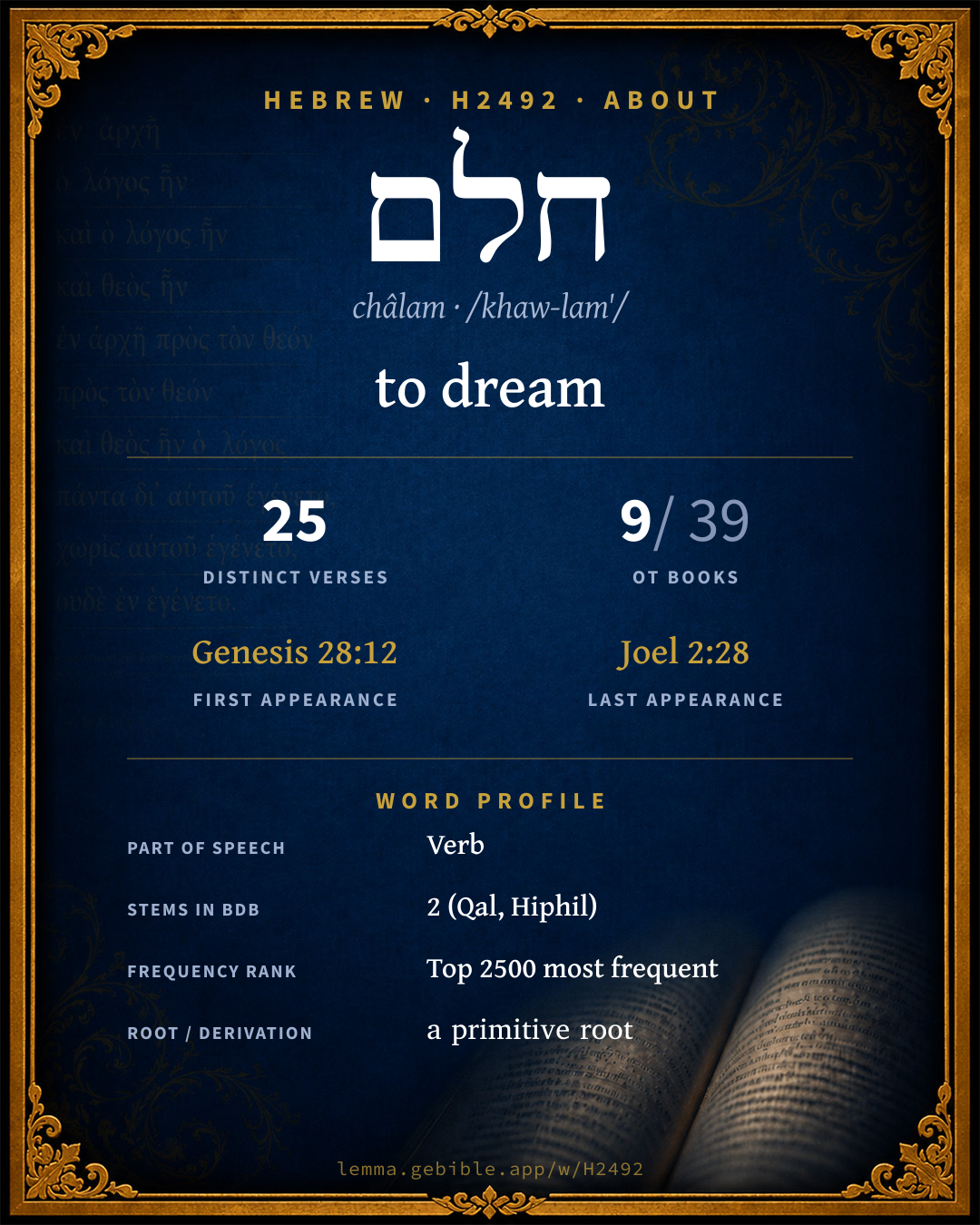
חָלַם
to dream
‘to dream’ is one of 3 main senses fuller range ↓
Full lexicon entry — Brown-Driver-Briggs (BDB)
From Brown-Driver-Briggs (BDB)
Where this word appears
See every Qal verb in the Hebrew Bible →
Grammar key — what these labels mean
Part of speech
- Verb
- An action or state-of-being word.
Noun type
- Common
- A common noun — a general class of person, place, or thing (“king,” “city,” “water”), not a specific name.
Stem
- Qal
- The basic, simple active stem — the plain form of the verb (“he wrote”). Here: ‘of ordinary dreams of sleep Is 29’
- Hiphil
- The causative active stem (“he caused / brought about”).
Form
- Perfect
- A completed action or state — Hebrew marks aspect (completeness) more than strict tense (“he wrote”).
- Sequential Imperfect
- An imperfect with prefixed waw — the standard past-narrative form (waw-consecutive imperfect).
- Participle Active
- A verbal adjective expressing ongoing or characteristic action (“writing / one who writes”).
- Imperfect
- An incomplete, ongoing, or future action (“he will / would write”).
State
- Construct
- A noun bound to a following noun in a possessive / “of” relationship (the construct chain).
- Absolute
- The independent form of a noun, not bound to a following word.
Person
- 1st Person
- The speaker (“I / we”).
- 3rd Person
- The one spoken about (“he / she / it / they”).
- 2nd Person
- The one addressed (“you”).
Gender
- Common
- Either gender — not distinguished for this form.
- Masculine
- Grammatically masculine.
Number
- Singular
- One.
- Plural
- More than one (in Hebrew, generally three or more).
Grammatical forms 15 distinct
- Verb, Qal, Perfect, 1st Person, Common, Singular 7 times (23%)
- Verb, Qal, Sequential Imperfect, 3rd Person, Masculine, Singular 4 times (13%)
- Verb, Qal, Participle Active, Masculine, Singular, Construct 3 times (10%)
- Verb, Qal, Imperfect, 3rd Person, Masculine, Singular 2 times (7%)
- Verb, Qal, Perfect, 1st Person, Common, Plural 2 times (7%)
- Verb, Qal, Perfect, 3rd Person, Masculine, Singular 2 times (7%)
- Verb, Qal, Imperfect, 3rd Person, Masculine, Plural 2 times (7%)
- Verb, Hiphil, Imperfect, 2nd Person, Masculine, Singular 1 time (3%)
+7 more forms (7 occurrences)
Parsed forms decoded from the imported morphology (morphhb / Westminster Leningrad Codex — WLC text public domain, morphhb tagging CC BY 4.0), counted across 30 parsed occurrences — not distinct verses.
Every verse where H2492 appears — 25 distinct verses across 9 books. Click any verse to open its interlinear word-by-word view. Verse text shown in the World English Bible for context — . Each verse’s Hebrew form is shown with its reference; the English is not keyword-highlighted, since the data carries no word-level English alignment. Use “Compare translations” on any verse to read it across multiple English versions. This concordance covers the Hebrew Bible; Septuagint (Greek Old Testament) occurrences are not indexed here.
Genesis 12 verses
- Genesis 28:12 וַֽ/יַּחֲלֹ֗ם conj + Qal wimpf 3ms He dreamed. Behold, a stairway set up on the earth, and the top of it reached to heaven. Behold, the angels of God ascending and descending on it.
- Genesis 37:5 וַ/יַּחֲלֹ֤ם conj + Qal wimpf 3ms Joseph dreamed a dream, and he told it to his brothers, and they hated him all the more.
- Genesis 37:6 הַ/חֲל֥וֹם חָלָֽמְתִּי ptcl def.art + n c ms Qal pf 1cs He said to them, "Please hear this dream which I have dreamed:
- Genesis 37:9 וַ/יַּחֲלֹ֥ם חָלַ֤מְתִּֽי conj + Qal wimpf 3ms Qal pf 1cs He dreamed yet another dream, and told it to his brothers, and said, "Behold, I have dreamed yet another dream: and behold, the sun and the moon and eleven stars bowed down to me."
- Genesis 37:10 חָלָ֑מְתָּ Qal pf 2ms He told it to his father and to his brothers. His father rebuked him, and said to him, "What is this dream that you have dreamed? Will I and your mother and your brothers indeed come to bow ourselves down to you to the earth?"
- Genesis 40:5 וַ/יַּֽחַלְמוּ֩ conj + Qal wimpf 3mp They both dreamed a dream, each man his dream, in one night, each man according to the interpretation of his dream, the cupbearer and the baker of the king of Egypt, who were bound in the prison.
- Genesis 40:8 חָלַ֔מְנוּ Qal pf 1cp They said to him, "We have dreamed a dream, and there is no one who can interpret it." Joseph said to them, "Don't interpretations belong to God? Please tell it to me."
- Genesis 41:1 חֹלֵ֔ם Qal ptcp.act ms It happened at the end of two full years, that Pharaoh dreamed: and, behold, he stood by the river.
- Genesis 41:5 וַֽ/יַּחֲלֹ֖ם conj + Qal wimpf 3ms He slept and dreamed a second time: and, behold, seven heads of grain came up on one stalk, healthy and good.
- Genesis 41:11 וַ/נַּֽחַלְמָ֥/ה חָלָֽמְנוּ conj + Qal wimpf 1cp + sfx h Qal pf 1cp We dreamed a dream in one night, I and he. We dreamed each man according to the interpretation of his dream.
- Genesis 41:15 חָלַ֔מְתִּי Qal pf 1cs Pharaoh said to Joseph, "I have dreamed a dream, and there is no one who can interpret it. I have heard it said of you, that when you hear a dream you can interpret it."
- Genesis 42:9 חָלַ֖ם Qal pf 3ms Joseph remembered the dreams which he dreamed about them, and said to them, "You are spies! You have come to see the nakedness of the land."
Deuteronomy 3 verses
- Deuteronomy 13:1 חֹלֵ֣ם Qal ptcp.act ms cs If there arise in the midst of you a prophet, or a dreamer of dreams, and he give you a sign or a wonder,
- Deuteronomy 13:3 חוֹלֵ֥ם Qal ptcp.act ms cs you shall not listen to the words of that prophet, or to that dreamer of dreams: for Yahweh your God proves you, to know whether you love Yahweh your God with all your heart and with all your soul.
- Deuteronomy 13:5 חֹלֵם֩ Qal ptcp.act ms cs That prophet, or that dreamer of dreams, shall be put to death, because he has spoken rebellion against Yahweh your God, who brought you out of the land of Egypt, and redeemed you out of the house of bondage, to draw you aside out of the way which Yahweh your God commanded you to walk in. So shall you put away the evil from the midst of you.
Judges 1 verse
Job 1 verse
Psalms 1 verse
Isaiah 2 verses
- Isaiah 29:8 יַחֲלֹ֨ם יַחֲלֹ֤ם Qal impf 3ms Qal impf 3ms It shall be as when a hungry man dreams, and, behold, he eats; but he awakes, and his soul is empty: or as when a thirsty man dreams, and, behold, he drinks; but he awakes, and, behold, he is faint, and his soul has appetite: so shall the multitude of all the nations be, that fight against Mount Zion.
- Isaiah 38:16 וְ/תַחֲלִימֵ֖/נִי conj + Hiphil impf 2ms + sfx pers 1cs Lord, by these things men live; Wholly therein is the life of my spirit: You restore me, and cause me to live.
Jeremiah 2 verses
- Jeremiah 23:25 חָלַ֖מְתִּי חָלָֽמְתִּי Qal pf 1cs Qal pf 1cs I have heard what the prophets have said, who prophesy lies in my name, saying, I have dreamed, I have dreamed.
- Jeremiah 29:8 מַחְלְמִֽים Hiphil ptcp.act mp For thus says Yahweh of hosts, the God of Israel: Don't let your prophets who are in the midst of you, and your diviners, deceive you; neither listen you to your dreams which you cause to be dreamed.
Daniel 2 verses
Joel 1 verse
About this entry
At a glance — auto-summarized from this page’s data, not written by a person. Every figure links to its source below. This summary describes the numbers; it doesn’t interpret them.
At its core, חלם (châlam) means “to dream.” Scripture first uses it in Genesis 28:12. With 25 verses in 9 books, it is an uncommon word in the Hebrew Bible. Its uses concentrate in Genesis (48% of all occurrences). Different stems carry different senses — BDB groups them under 2 stems, among them Qal and Hiphil. Each statement above links to its evidence; the full detail follows below.
Gloss history
Strong's 1890 vs modern scholarship
About this word
Strong's H2492 catalogs a Hebrew word from the Hebrew Old Testament.
These counts are not copied from any lexicon or concordance. They are computed here, from the morphology-tagged Hebrew Old Testament. What Lemma adds →
- 25
- distinct verses
- The word appears in 25 distinct verses.
- 9 / 39
- OT books
- The word appears in 9 of 39 Old Testament books.
- #1,139
- by frequency
- Top 2500 most frequent Hebrew words (rank 1,139 of 8,640 Hebrew words by occurrence).
View all 25 occurrences in the concordance →
Most concentrated in
- Genesis 12 verses 48%
- Deuteronomy 3 verses 12%
- Isaiah 2 verses 8%
By section of the Old Testament
By traditional corpus
Conventional, traditional groupings — biblical authorship is debated, so this is a traditional corpus grouping, not an authorship claim. Each share is this word’s portion of its verses in that division of the Hebrew canon. Each figure is a share of the word’s 25 distinct verses.
- Torah (Pentateuch) 15 verses · 60%
- Prophets (Nevi'im) 6 verses · 24%
- Writings (Ketuvim) 4 verses · 16%
How translations render this word
Counts come from each version’s own published word-to-Strong’s tagging or interlinear alignment — an approximate guide to how each version renders this word, not a word-level alignment the data otherwise carries. Because each total is that version’s own tagged count, the per-version totals vary from one another and need not match the appearance or distinct-verse counts above. These counts may also differ from a printed concordance because Lemma counts each distinctly tagged rendering and does not collapse phrase taggings into a single head-word total. This is a fixed set of word-tagged versions (KJV, ASV, BSB, ULT) and does not change with the reading translation you choose elsewhere. Each version’s license is shown beside its name below (and on Sources).
BDB lists this Strong’s number as 2 distinct words (homographs). Each count above pools all of them and is not split by sense — see the Senses section below. A low-frequency rendering may belong to a different one of those words, not the primary meaning.
- King James Version†: I have dreamed 5×, Dreamed 4×, He dreamed 3×
- American Standard Version†: Dreamed 4×, He dreamed 3×, I have dreamed 3×
- Berean Standard Bible†: Had a dream 4×, Dreamer 3×, Dream 2×
- unfoldingWord Literal Text†: Dreamed 4×, I dreamed 4×, Dreamer of 3×
King James Version Public Domain
Renders H2492 across 29† tagged occurrences — most commonly:
Plus 15 renderings that appear only once — usually multi-word phrases or single function words the recovered tagging swept in, not distinct renderings.
American Standard Version Public Domain
Renders H2492 across 29† tagged occurrences — most commonly:
Plus 17 renderings that appear only once — usually multi-word phrases or single function words the recovered tagging swept in, not distinct renderings.
Berean Standard Bible Public Domain
Renders H2492 across 21† tagged occurrences — most commonly:
Plus 6 renderings that appear only once — usually multi-word phrases or single function words the recovered tagging swept in, not distinct renderings. Not rendered by a distinct English word in 8 further occurrences.
unfoldingWord Literal Text CC BY-SA 4.0
Renders H2492 across 31† tagged occurrences — most commonly:
Plus 10 renderings that appear only once — usually multi-word phrases or single function words the recovered tagging swept in, not distinct renderings.
7 senses and sub-senses in the full BDB
Hebrew verbs can shift meaning by stem (binyan): Qal is the basic action, Niphal is often passive or reflexive, Piel often intensifies or makes it factitive, and Hiphil is typically causative. The senses below are grouped under the stem BDB assigns to each.
What do BDB’s symbols mean?
BDB uses these scholarly abbreviations:
| Symbol | Meaning |
|---|---|
| 𝔊 | the Septuagint (the ancient Greek translation, LXX) |
| 𝔙 | the Vulgate (the Latin translation) |
| 𝔖 | the Syriac version (the Peshitta) |
| 𝔗 | the Targum (the Aramaic translation) |
| ψ | the Psalms |
| √ | root (the underlying root or stem) |
| ‖ | parallel passage (a synonymous or contrasted parallel) |
| † | the dagger: every passage where the word occurs is cited |
The 7 senses and sub-senses the full Brown-Driver-Briggs lexicon distinguishes for this word, in lexicon order (not ranked by frequency), with BDB’s own verbatim wording and sub-sense lettering. Shown in Hebrew script with BDB’s own scholarly abbreviations. The condensed entry is in the Lexicon Entry tab. See also the Forms in the corpus table below.
חלם I be healthy, strong (NH id.
Qal
- Impf. יַחְלְמוּ בְנֵיהֶם Jb 39:4 their young are healthy. e.g. Job 39:4
Hiphil
- Impf. 2 ms. וְתַחֲלִימֵנִי Is 38:16 and restore me to health (‖ וִהַחֲיֵ֫ינִי). e.g. Isaiah 38:16
חלם II dream (NH id.
Qal
- Pf. ח׳ Gn 42:9 Dn 2:1, חָלַמְתִּי Gn 37:9 + 3 times, חָלָ֑מְתִּי Gn 37:6 + 2 times, etc., + 3 times Pf.; Impf. יַחֲלֹם Is 29:8 + 5 times, יַחְלְמוּ Jb 39:4, וַיַּחַלְמוּ Gn 40:5, יַחֲלֹמ֑וּן Jo 3:1, נַחַלְמָה Gn 41:11, Pt. חוֹלֵם Dt 13:4, חֹלֵם Gn 41:1 Dt 13:2, 6, חֹלְמִים ψ 126:1—dream: e.g. Genesis 42:9
- a. of ordinary dreams of sleep Is 29:8(×2) ψ 126:1. e.g. Isaiah 29:8
- b. of dreams with prophetic meaning: of Jacob Gn 28:12, Joseph Gn 37:5, 6, 9(×2), 10; 42:9, of Pharaoh and his servants Gn 40:5, 8; 41:1, 5, 11(×2), 15 (all E, not elsewhere in Hex.); of Midianite Ju 7:13, Nebuchad. Dn 2:1, 3, old men in latter days Jo 3:1. e.g. Genesis 28:12
- c. of dreams of false prophets Dt 13:2, 4, 6 Je 23:25(×2). e.g. Deuteronomy 13:2
Hiphil
- Pt. מַחְלְמִים dream (of false prophets, c. acc. cogn.) Je 29:8 (but read חֹלְמִים [מ by dittogr. from אַתֶּם], Hi Gf Gie Gr). e.g. Jeremiah 29:8
Senses from the full Brown-Driver-Briggs lexicon (Brown, Driver, Briggs; Oxford 1906 — public domain), digitized via Sefaria, supplemented by the OpenScriptures HebrewLexicon (CC BY 4.0). Full attribution on Sources.
Word origin
I. vb. be healthy, strong (NH id.; Aramaic ܚܠܰܡ Ethp. be made healthy, strong Aph. causat., also deriv.; חֲלַם press firmly together)—
II. vb. dream (NH id.; Aramaic ܚܠܰܡ; חֲלַם; Ethiopic ሐለመ: Arabic حَلَمَ, dream, experience an emission of the seminal fluid, attain to puberty)—
— Brown-Driver-Briggs (Oxford 1906, public domain), digitized via Sefaria, supplemented by the OpenScriptures HebrewLexicon (CC BY 4.0). See Sources.
Origin: a primitive root
Jastrow Dictionary
A second Hebrew/Aramaic lexicon for comparison, covering Aramaic and post-biblical (Talmudic, Targumic, Midrashic) usage that the biblical-Hebrew BDB does not. Matched by lemma rather than by Strong’s number, so a lemma may carry more than one Jastrow headword (shown separately below), and the entries cover usage well beyond the Bible.
חָלַם I
- [to be soft, moist, viscous,] to have good humors, to be well. Part. pass. חָלוּם, f. חֲלוּמָה sane, opp. to שוטה; well, opp. to חולה. Tosef. Ter. I, 3 פעמים … ח׳ if one is at times insane, at times sane; R. Hash. 28ᵃ חַלִּים (Ch. form).—Y. Gitt. VII, beg. 48ᶜ.—Pes. 78ᵇ.—Fem. חֲלוּמָה. Y. Yeb. XIV, beg. 14ᵇ
חֲלַם
- v. חַלִּים
- to join closely. Kidd. 25ᵃ זמנין דח׳ שפוותיה Ar. (ed. שפתיה) sometimes a man closes his lips firmly.
חָלַם II
- v. preced. wds.) [to gather humors, to sleep well (cmp. יָשַׁן).—Denom. חֲלוֹם (cmp. ἐνύπνιος, somnium) dream; from which חָלַם] to dream. Ber. 55ᵇ חלום חָלַמְתִּי I had a dream. Ib. חלום שׁח׳ לו חבירו a dream which his neighbor had about him. Tosef. Sabb. VI (VII), 7 שתהא חוֹלֵם חלומות that you may have dreams; a. fr.
חֲלַם ²
- Targ. Gen. XXXVII, 5. Ib. XLI, 1; a. fr.
- to consult an interpreter of dreams or a dreamer. Targ. Jer. XXIX, 8, v. חָלְמָא.
חֲלֹם
- , v. חֲלוֹם
A Dictionary of the Targumim, the Talmud Babli and Yerushalmi, and the Midrashic Literature (Marcus Jastrow; London, Luzac, 1903) — Public Domain. Digitized via Sefaria. Digitized via Sefaria. Full attribution on Sources.
Forms in the corpus
The 29 distinct written forms H2492 takes in the Hebrew Bible, most frequent first — each parse links to that stem’s occurrences in the concordance. Hebrew forms include their vowel points and cantillation, so a single lemma takes many written forms.
Same root — word family
Other BDB entries built from the same root as H2492, grouped by Strong’s listed origin. These share a root / origin per the lexicon — not necessarily a shared meaning. Each links to that word’s own entry.
Derived from this word
- אחלמה ʼachlâmâh H306 amethyst
- חלום chălôwm H2472 dream
- חלם chêlem H2493 dream
- חלמות challâmûwth H2495 purslane
- חלמיש challâmîysh H2496 flint
Proper names from this root
People and places named from this root — a name, not an additional meaning of the word.
Compare all same-root words → Showing 4 of 8 — not the complete family. 2 of the same-root words are proper names (people or places). They share a root, not necessarily a meaning.
Septuagint verse parallels
This word appears in 23 verses that also exist in the Greek Old Testament (Septuagint), out of the 25 Hebrew verses it occurs in. You can read those verses in Greek by switching the Old Testament edition to the Septuagint.
Read these verses in the Septuagint
- Genesis 28:12
- Deuteronomy 13:1
- Judges 7:13
- Job 39:4
- Psalms 126:1
- Isaiah 29:8
- Jeremiah 23:25
- Daniel 2:1
This is a verse-level parallel only — the same verses exist in both the Hebrew and Greek Old Testaments. No word-level Hebrew↔Greek correspondence is claimed: the data carries no such alignment, so no Greek word is shown as this Hebrew word’s translation. Coverage is not total — the Septuagint omits the deuterocanon and renumbers the Psalms, so some Hebrew verses have no direct Greek parallel.