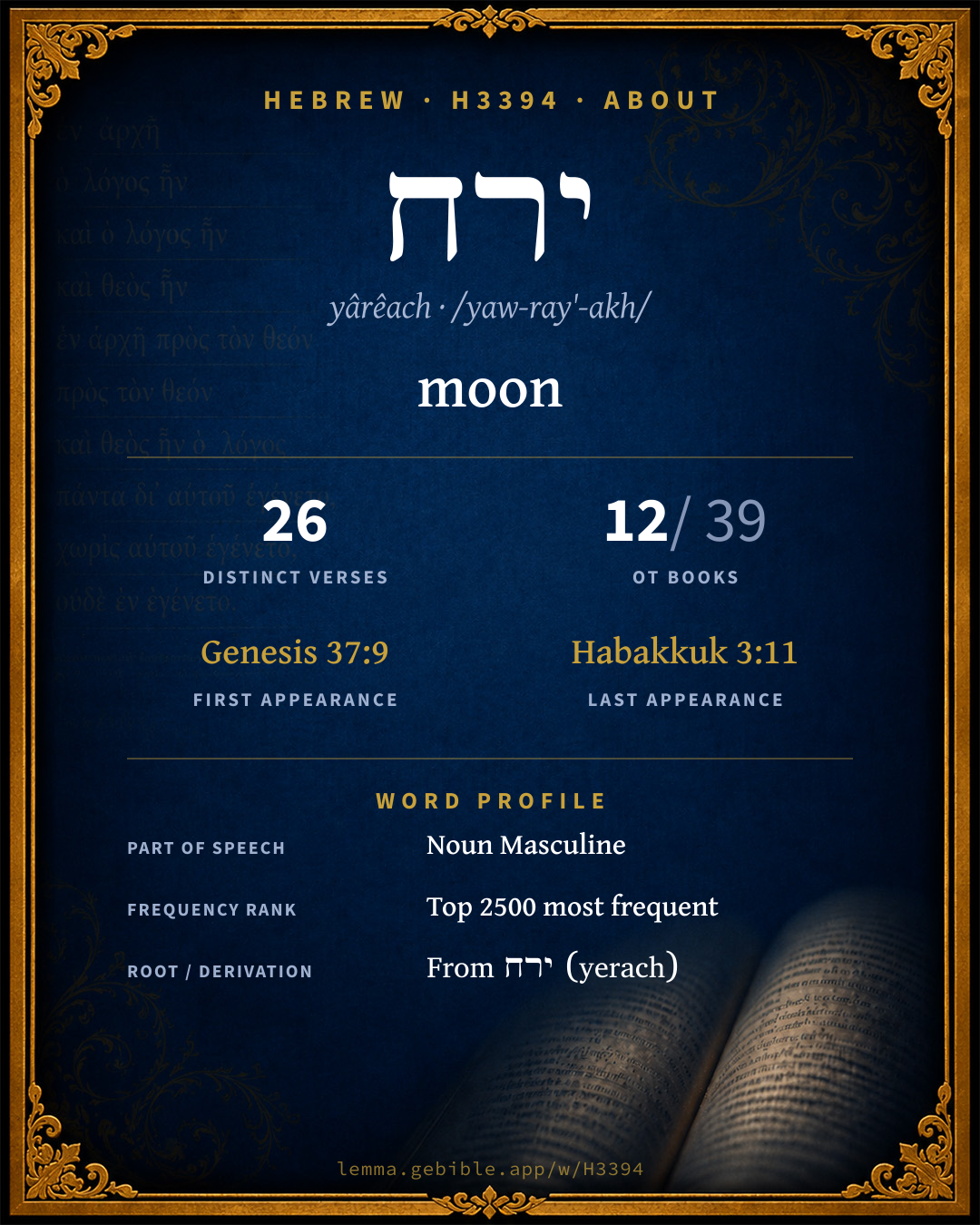
יָרֵחַ
moon
Full lexicon entry — Brown-Driver-Briggs (BDB)
From Brown-Driver-Briggs (BDB)
Where this word appears
Grammar key — what these labels mean
Part of speech
- Noun
- A naming word — a person, place, thing, or idea.
Noun type
- Common
- A common noun — a general class of person, place, or thing (“king,” “city,” “water”), not a specific name.
State
- Absolute
- The independent form of a noun, not bound to a following word.
Gender
- Masculine
- Grammatically masculine.
Number
- Singular
- One.
Every verse where H3394 appears — 26 distinct verses across 12 books. Click any verse to open its interlinear word-by-word view. Verse text shown in the World English Bible for context — . Each verse’s Hebrew form is shown with its reference; the English is not keyword-highlighted, since the data carries no word-level English alignment. Use “Compare translations” on any verse to read it across multiple English versions. This concordance covers the Hebrew Bible; Septuagint (Greek Old Testament) occurrences are not indexed here.
Genesis 1 verse
Deuteronomy 2 verses
- Deuteronomy 4:19 הַ/יָּרֵ֜חַ ptcl def.art + n c ms and lest you lift up your eyes to the sky, and when you see the sun and the moon and the stars, even all the host of the sky, you are drawn away and worship them, and serve them, which Yahweh your God has allotted to all the peoples under the whole sky.
- Deuteronomy 17:3 לַ/יָּרֵ֗חַ prep det + n c ms and has gone and served other gods, and worshiped them, or the sun, or the moon, or any of the host of the sky, which I have not commanded;
Joshua 2 verses
- Joshua 10:12 וְ/יָרֵ֖חַ conj + n c ms Then spoke Joshua to Yahweh in the day when Yahweh delivered up the Amorites before the children of Israel; and he said in the sight of Israel, Sun, stand you still on Gibeon; You, Moon, in the valley of Aijalon.
- Joshua 10:13 וְ/יָרֵ֣חַ conj + n c ms The sun stood still, and the moon stayed, Until the nation had avenged themselves of their enemies. Isn't this written in the book of Jashar? The sun stayed in the midst of the sky, and didn't hurry to go down about a whole day.
2 Kings 1 verse
Job 2 verses
Psalms 8 verses
- Psalms 8:3 יָרֵ֥חַ n c ms When I consider your heavens, the work of your fingers, The moon and the stars, which you have ordained;
- Psalms 72:5 יָ֝רֵ֗חַ n c ms They shall fear you while the sun endures; And as long as the moon, throughout all generations.
- Psalms 72:7 יָרֵֽחַ n c ms In his days, the righteous shall flourish, And abundance of peace, until the moon is no more.
- Psalms 89:37 כְּ֭/יָרֵחַ prep + n c ms It will be established forever like the moon, The faithful witness in the sky." Selah.
- Psalms 104:19 יָ֭רֵחַ n c ms He appointed the moon for seasons. The sun knows when to set.
- Psalms 121:6 וְ/יָרֵ֥חַ conj + n c ms The sun will not harm you by day, Nor the moon by night.
- Psalms 136:9 הַ/יָּרֵ֣חַ ptcl def.art + n c ms The moon and stars to rule by night; For his loving kindness endures forever:
- Psalms 148:3 וְ/יָרֵ֑חַ conj + n c ms Praise him, sun and moon! Praise him, all you shining stars!
Ecclesiastes 1 verse
Isaiah 2 verses
- Isaiah 13:10 וְ/יָרֵ֖חַ conj + n c ms For the stars of the sky and the constellations of it shall not give their light; the sun shall be darkened in its going forth, and the moon shall not cause its light to shine.
- Isaiah 60:19 הַ/יָּרֵ֖חַ ptcl def.art + n c ms The sun shall be no more your light by day; neither for brightness shall the moon give light to you: but Yahweh will be to you an everlasting light, and your God your glory.
Jeremiah 2 verses
- Jeremiah 8:2 וְ/לַ/יָּרֵ֜חַ conj + prep det + n c ms and they shall spread them before the sun, and the moon, and all the host of the sky, which they have loved, and which they have served, and after which they have walked, and which they have sought, and which they have worshiped: they shall not be gathered, nor be buried, they shall be for dung on the surface of the earth.
- Jeremiah 31:35 יָרֵ֥חַ n c ms Thus says Yahweh, who gives the sun for a light by day, and the ordinances of the moon and of the stars for a light by night, who stirs up the sea, so that the waves of it roar; Yahweh of hosts is his name:
Ezekiel 1 verse
Joel 3 verses
- Joel 2:10 וְ/יָרֵ֨חַ֙ conj + n c ms The earth quakes before them. The heavens tremble. The sun and the moon are darkened, And the stars withdraw their shining.
- Joel 2:31 וְ/הַ/יָּרֵ֖חַ conj + ptcl def.art + n c ms The sun will be turned into darkness, And the moon into blood, Before the great and terrible day of Yahweh comes.
- Joel 3:15 וְ/יָרֵ֖חַ conj + n c ms The sun and the moon are darkened, And the stars withdraw their shining."
Habakkuk 1 verse
About this entry
At a glance — auto-summarized from this page’s data, not written by a person. Every figure links to its source below. This summary describes the numbers; it doesn’t interpret them.
ירח — transliterated yârêach — is a Hebrew noun carrying the sense “moon.” Debuting at Genesis 37:9, it then recurs through the corpus. With 26 verses in 12 books, it is a moderately common word in the Hebrew Bible. Its uses concentrate in Psalms (31% of all occurrences). Sharing its root, it stands alongside ירח, ירח and ירח. Each statement above links to its evidence; the full detail follows below.
Gloss history
Strong's 1890 vs modern scholarship
About this word
Strong's H3394 catalogs a Hebrew word from the Hebrew Old Testament.
These counts are not copied from any lexicon or concordance. They are computed here, from the morphology-tagged Hebrew Old Testament. What Lemma adds →
- 26
- distinct verses
- The word appears in 26 distinct verses.
- 12 / 39
- OT books
- The word appears in 12 of 39 Old Testament books.
- #1,251
- by frequency
- Top 2500 most frequent Hebrew words (rank 1,251 of 8,640 Hebrew words by occurrence).
View all 26 occurrences in the concordance →
Most concentrated in
- Psalms 8 verses 31%
- Joel 3 verses 12%
- Deuteronomy 2 verses 8%
By section of the Old Testament
By traditional corpus
Conventional, traditional groupings — biblical authorship is debated, so this is a traditional corpus grouping, not an authorship claim. Each share is this word’s portion of its verses in that division of the Hebrew canon. Each figure is a share of the word’s 26 distinct verses.
- Prophets (Nevi'im) 12 verses · 46%
- Writings (Ketuvim) 11 verses · 42%
- Torah (Pentateuch) 3 verses · 12%
How translations render this word
Counts come from each version’s own published word-to-Strong’s tagging or interlinear alignment — an approximate guide to how each version renders this word, not a word-level alignment the data otherwise carries. Because each total is that version’s own tagged count, the per-version totals vary from one another and need not match the appearance or distinct-verse counts above. These counts may also differ from a printed concordance because Lemma counts each distinctly tagged rendering and does not collapse phrase taggings into a single head-word total. This is a fixed set of word-tagged versions (KJV, ASV, BSB, ULT) and does not change with the reading translation you choose elsewhere. Each version’s license is shown beside its name below (and on Sources).
- King James Version: Moon 19×, Or the moon 2×
- American Standard Version: Moon 17×
- Berean Standard Bible: Moon 25×
- unfoldingWord Literal Text: Moon 22×, And 2×
King James Version Public Domain
Renders H3394 across 26 tagged occurrences — most commonly:
Plus 5 renderings that appear only once — usually multi-word phrases or single function words the recovered tagging swept in, not distinct renderings.
American Standard Version Public Domain
Renders H3394 across 26 tagged occurrences — most commonly:
Plus 9 renderings that appear only once — usually multi-word phrases or single function words the recovered tagging swept in, not distinct renderings.
Berean Standard Bible Public Domain
Renders H3394 across 27 tagged occurrences — most commonly:
Plus 2 renderings that appear only once — usually multi-word phrases or single function words the recovered tagging swept in, not distinct renderings.
unfoldingWord Literal Text CC BY-SA 4.0
Renders H3394 across 28 tagged occurrences — most commonly:
Plus 4 renderings that appear only once — usually multi-word phrases or single function words the recovered tagging swept in, not distinct renderings.
Senses in BDB
The 1 sense BDB distinguishes for this word, in lexicon order (not ranked by frequency or importance). The full entry — with sub-senses — is in the Lexicon Entry tab.
- moon
Word origin
n.m. Jos 10:13 moon, especially poet. (NH id.; Ph. ירח; Assyrian iriḥu, according to PinchesBOR Aug. 1888, 207; Ethiopic ወርሕ moon, month; cf. sub יֶרַח)—abs. יָרֵחַ Gn 37:9 + 25 times; sf. וִיֽרֵחֵךְ Is 60:20:—moon, usually named with sun Jos 10:12, 13 (poem in JE), ψ 72:5 (עִם־שָׁ֑מֶשׁ וְלִפְנֵי יָרֵחַ), 89:38 (in these two, a symbol of permanence), 121:6 Is 60:19 Hb 3:11 Jo 3:4; obj. of idolatrous worship Jb 31:26 (+ sun); in same sense also + sun and stars Dt 4:19; 17:3 2 K 23:5 Je 8:2; as determiner of feast-times ψ 104:19 (‖ sun); + stars, as shining by night ψ 136:9 (‖ sun, by day), so חֻקֹּת יָרֵחַ Je 31:35 (‖ id.); elsewhere + sun and stars Gn 37:9 (E), Is 13:10 Ez 32:7 Jo 2:10; 4:15 ψ 148:3 Ec 12:2; + stars ψ 8:4 Jb 25:5; with neither sun nor stars only עַד־בְּלִי יָרֵחַ ψ 72:7.
— Brown-Driver-Briggs (Oxford 1906, public domain), digitized via Sefaria, supplemented by the OpenScriptures HebrewLexicon (CC BY 4.0). See Sources.
Derived from ירח (yerach) (H3391) — month.
Jastrow Dictionary
A second Hebrew/Aramaic lexicon for comparison, covering Aramaic and post-biblical (Talmudic, Targumic, Midrashic) usage that the biblical-Hebrew BDB does not. Matched by lemma rather than by Strong’s number, so a lemma may carry more than one Jastrow headword (shown separately below), and the entries cover usage well beyond the Bible.
יָרֵחַ
- [traveller,] moon. Ḥull. 60ᵇ אמרה י׳ וכ׳ said the Moon to the Lord; Yalk. Gen. 8. Ib. מיעטתי את הי׳. v. מָעַט. Ber. 56ᵇ Ms. M. (ed. סיהרא).
יֶרַח
- 1. (b. h.; preced.; Assyr. arḥu) month. R. Hash. 11ᵃ, v. זֵיוְתָן. Tanḥ. Noah 11, v. בּוּל III; a. e.
- 2. pr. n. pl. Yeraḥ, at the southernmost point of Lake Tiberias; בית י׳ Beth-Yeraḥ, near Yeraḥ, a twin-town of Sennabris (v. סִנְבְּרַאי). Gen. R. s. 98 (expl. כנות, Deut. III, 17) R. El. says י׳; R. Samuel … בית י׳; R. Judah … Sennabris and Beth Yeraḥ. Y. Meg. I, 70ᵃ two autonomies כגון בית י׳ וכ׳ like B. Y. and Sennabris. Midr. Sam. ch. XXX, XXXII, expl. חרשי, II Sam. XXIV, 6 בית י׳.—Tosef. Bekh. VII, 4 איזהו ירדן מבית יְרֵחוֹ ולמטה (ed. Zuck. יריחו) the real Jordan is from B. Y’reḥo and down; Bekh. 55ᵃ אין ירדן אלא מבית יריחו וכ׳. e.g. Deuteronomy 3:17
יְרַח
- (= h. יָרֵחַ a. יֶרַח) moon; month.—יומא די׳ or י׳ (sub. ריש) the first day of the month, New-Moon-Day. Targ. Is. XLVII, 13. Ib. LXVI, 23. Targ. I Sam. XX, 18. Targ. Ez. XLVI, 1; a. fr.—Targ. O. Deut. XXI, 13 יִרַח יומין ed. Berl. (oth. ed. יְרַח; Y. תלתא יַרְחִין).—Lev. R. s. 29; Pesik. R. s. 40 (ref. to בחדש השביעי, Lev. XXIII, 24) בי׳ דשבועתא in the month of oaths (Gen. XXII, 16). Sabb. 86ᵇ בחד בשבא איקבע י׳ the New-Moon was declared on the first day of the week. Ib. פליגי בקביע די׳ they differ as to the day on which the New Moon was declared. Bets. 4ᵇ והשתא דידעינן בקביעא די׳ and now that we know the time of the New Moon (by fixed calendar); a. fr.—Pl. יַרְחִין, יַרְחַיָּא, יַרְחֵי. Targ. Y. Gen. I, 14. Targ. Ex. II, 2; a. fr.—R. Hash. 20ᵃ בשאר י׳ as to the other months (than Nisan and Tishri). Y. ib. II, 57ᵈ bot. Macc. 23ᵇ; a. fr.—תריסר ירחי שתא twelve months (forming) a year, twelve months from date. B. Mets. 16ᵇ; 35ᵃ. Ab. Zar. 8ᵇ; a. e. e.g. Leviticus 23:24
A Dictionary of the Targumim, the Talmud Babli and Yerushalmi, and the Midrashic Literature (Marcus Jastrow; London, Luzac, 1903) — Public Domain. Digitized via Sefaria. Digitized via Sefaria. Full attribution on Sources.
Forms in the corpus
The 20 distinct written forms H3394 takes in the Hebrew Bible, most frequent first — each parse links to that state’s occurrences in the concordance. Hebrew forms include their vowel points and cantillation, so a single lemma takes many written forms.
| Form | Parsing | Example | Uses |
|---|---|---|---|
| וְ/יָרֵ֖חַ | Noun, Common, Masculine, Singular, Absolute | Ezekiel 32:7 | 4 |
| וְ/הַ/יָּרֵ֖חַ | Noun, Common, Masculine, Singular, Absolute | Ecclesiastes 12:2 | 2 |
| יָ֭רֵחַ | Noun, Common, Masculine, Singular, Absolute | Job 25:5 | 2 |
| יָרֵ֥חַ | Noun, Common, Masculine, Singular, Absolute | Jeremiah 31:35 | 2 |
| הַ/יָּרֵ֖חַ | Noun, Common, Masculine, Singular, Absolute | Isaiah 60:19 | 1 |
| הַ/יָּרֵ֜חַ | Noun, Common, Masculine, Singular, Absolute | Deuteronomy 4:19 | 1 |
| הַ/יָּרֵ֣חַ | Noun, Common, Masculine, Singular, Absolute | Psalms 136:9 | 1 |
| וְ/הַ/יָּרֵ֗חַ | Noun, Common, Masculine, Singular, Absolute | Genesis 37:9 | 1 |
| וְ/יָרֵ֑חַ | Noun, Common, Masculine, Singular, Absolute | Psalms 148:3 | 1 |
| וְ/יָרֵ֣חַ | Noun, Common, Masculine, Singular, Absolute | Joshua 10:13 | 1 |
| וְ/יָרֵ֥חַ | Noun, Common, Masculine, Singular, Absolute | Psalms 121:6 | 1 |
| וְ/יָרֵ֨חַ֙ | Noun, Common, Masculine, Singular, Absolute | Joel 2:10 | 1 |
| וְ/לַ/יָּרֵ֜חַ | Noun, Common, Masculine, Singular, Absolute | Jeremiah 8:2 | 1 |
| וְ/לַ/יָּרֵ֨חַ֙ | Noun, Common, Masculine, Singular, Absolute | 2 Kings 23:5 | 1 |
| וְ֝/יָרֵ֗חַ | Noun, Common, Masculine, Singular, Absolute | Job 31:26 | 1 |
| יָ֝רֵ֗חַ | Noun, Common, Masculine, Singular, Absolute | Psalms 72:5 | 1 |
| יָרֵ֖חַ | Noun, Common, Masculine, Singular, Absolute | Habakkuk 3:11 | 1 |
| יָרֵֽחַ | Noun, Common, Masculine, Singular, Absolute | Psalms 72:7 | 1 |
| כְּ֭/יָרֵחַ | Noun, Common, Masculine, Singular, Absolute | Psalms 89:37 | 1 |
| לַ/יָּרֵ֗חַ | Noun, Common, Masculine, Singular, Absolute | Deuteronomy 17:3 | 1 |
Same root — word family
Other BDB entries built from the same root as H3394, grouped by Strong’s listed origin. These share a root / origin per the lexicon — not necessarily a shared meaning. Each links to that word’s own entry.
Derives from
Shares the same root
Proper names from this root
People and places named from this root — a name, not an additional meaning of the word.
Compare all same-root words → Showing 4 of 6 — not the complete family. 3 of the same-root words are proper names (people or places). They share a root, not necessarily a meaning.
Septuagint verse parallels
This word appears in 23 verses that also exist in the Greek Old Testament (Septuagint), out of the 26 Hebrew verses it occurs in. You can read those verses in Greek by switching the Old Testament edition to the Septuagint.
Read these verses in the Septuagint
- Genesis 37:9
- Deuteronomy 4:19
- Joshua 10:12
- 2 Kings 23:5
- Job 25:5
- Psalms 8:3
- Ecclesiastes 12:2
- Isaiah 13:10
- Jeremiah 8:2
- Ezekiel 32:7
- Joel 2:10
- Habakkuk 3:11
This is a verse-level parallel only — the same verses exist in both the Hebrew and Greek Old Testaments. No word-level Hebrew↔Greek correspondence is claimed: the data carries no such alignment, so no Greek word is shown as this Hebrew word’s translation. Coverage is not total — the Septuagint omits the deuterocanon and renumbers the Psalms, so some Hebrew verses have no direct Greek parallel.