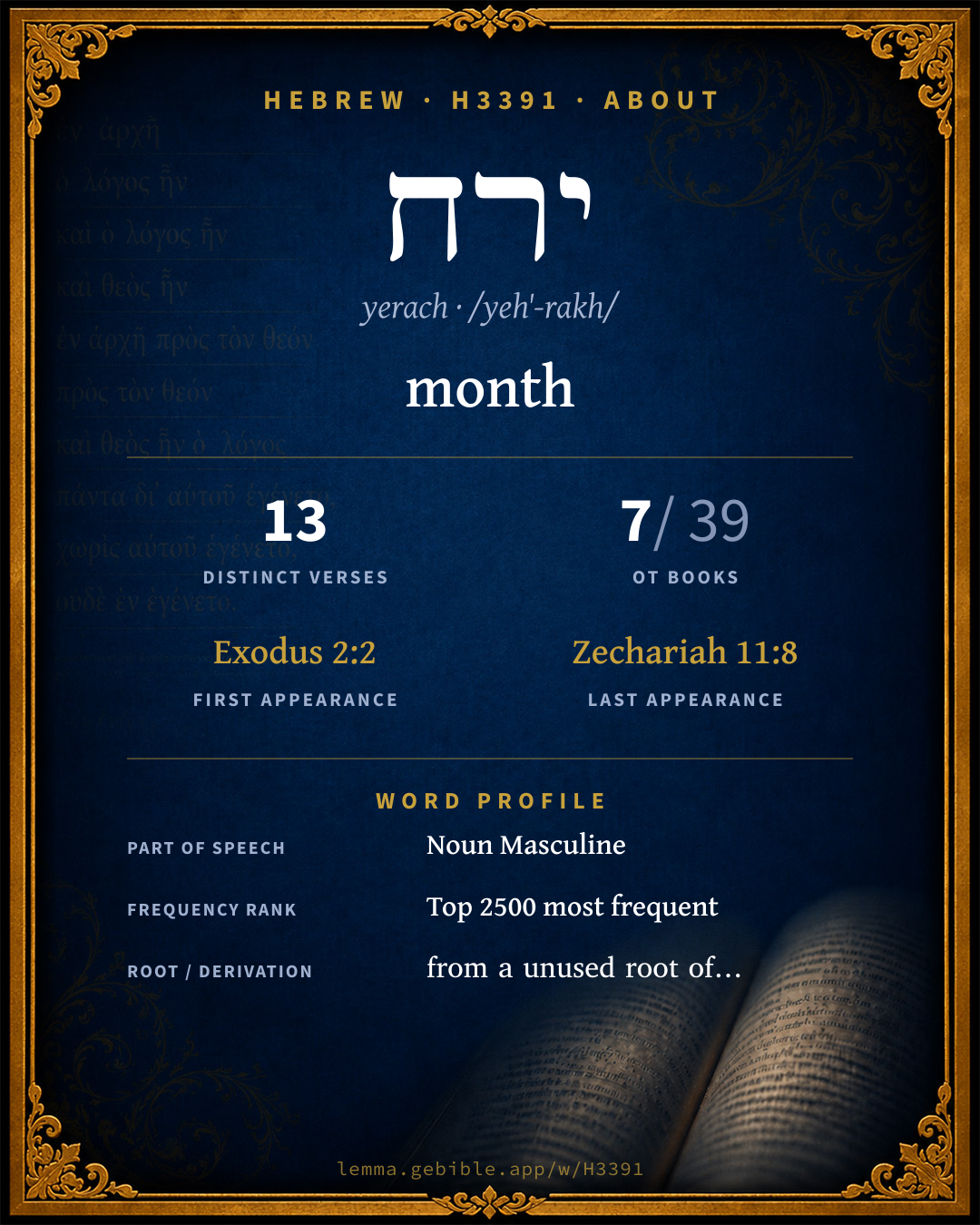
יֶ֫רַח
month
‘month’ is one of 3 main senses fuller range ↓
Full lexicon entry — Brown-Driver-Briggs (BDB)
From Brown-Driver-Briggs (BDB)
Where this word appears
See every Construct-state word in the Hebrew Bible →
Grammar key — what these labels mean
Part of speech
- Noun
- A naming word — a person, place, thing, or idea.
Noun type
- Common
- A common noun — a general class of person, place, or thing (“king,” “city,” “water”), not a specific name.
State
- Absolute
- The independent form of a noun, not bound to a following word.
- Construct
- A noun bound to a following noun in a possessive / “of” relationship (the construct chain).
Gender
- Masculine
- Grammatically masculine.
Number
- Plural
- More than one (in Hebrew, generally three or more).
- Singular
- One.
Grammatical forms
- Noun, Common, Masculine, Singular, Construct 6 times (46%)
- Noun, Common, Masculine, Plural, Absolute 4 times (31%)
- Noun, Common, Masculine, Plural, Construct 2 times (15%)
- Noun, Common, Masculine, Singular, Absolute 1 time (8%)
Parsed forms decoded from the imported morphology (morphhb / Westminster Leningrad Codex — WLC text public domain, morphhb tagging CC BY 4.0), counted across 13 parsed occurrences — not distinct verses.
Every verse where H3391 appears — 13 distinct verses across 7 books. Click any verse to open its interlinear word-by-word view. Verse text shown in the World English Bible for context — . Each verse’s Hebrew form is shown with its reference; the English is not keyword-highlighted, since the data carries no word-level English alignment. Use “Compare translations” on any verse to read it across multiple English versions. This concordance covers the Hebrew Bible; Septuagint (Greek Old Testament) occurrences are not indexed here.
Exodus 1 verse
Deuteronomy 2 verses
- Deuteronomy 21:13 יֶ֣רַח n c ms cs and she shall put the clothing of her captivity from off her, and shall remain in your house, and bewail her father and her mother a full month: and after that you shall go in to her, and be her husband, and she shall be your wife.
- Deuteronomy 33:14 יְרָחִֽים n c mp For the precious things of the fruits of the sun, For the precious things of the growth of the moons,
1 Kings 3 verses
- 1 Kings 6:37 בְּ/יֶ֖רַח prep + n c ms cs In the fourth year was the foundation of the house of Yahweh laid, in the month Ziv.
- 1 Kings 6:38 בְּ/יֶ֣רַח prep + n c ms cs In the eleventh year, in the month Bul, which is the eighth month, was the house finished throughout all the parts of it, and according to all the fashion of it. So was he seven years in building it.
- 1 Kings 8:2 בְּ/יֶ֥רַח prep + n c ms cs All the men of Israel assembled themselves to king Solomon at the feast, in the month Ethanim, which is the seventh month.
2 Kings 1 verse
Job 4 verses
- Job 3:6 יְ֝רָחִ֗ים n c mp As for that night, let thick darkness seize on it. Let it not rejoice among the days of the year. Let it not come into the number of the months.
- Job 7:3 יַרְחֵי n c mp cs So am I made to possess months of misery, Wearisome nights are appointed to me.
- Job 29:2 כְ/יַרְחֵי prep + n c mp cs "Oh that I were as in the months of old, As in the days when God watched over me;
- Job 39:2 יְרָחִ֣ים n c mp Can you number the months that they fulfill? Or do you know the time when they give birth?
Isaiah 1 verse
Zechariah 1 verse
About this entry
At a glance — auto-summarized from this page’s data, not written by a person. Every figure links to its source below. This summary describes the numbers; it doesn’t interpret them.
ירח — transliterated yerach — is a Hebrew noun carrying the sense “month.” Its English rendering has broadened — “month” classically, “month of” (unfoldingWord Literal Text) in modern versions; see the renderings breakdown. Spanning 13 verses in 7 books, it ranks among the uncommon words of the Hebrew Bible. Its uses concentrate in Job (31% of all occurrences). The lexicon spreads it across several senses; see its full sense range. Each statement above links to its evidence; the full detail follows below.
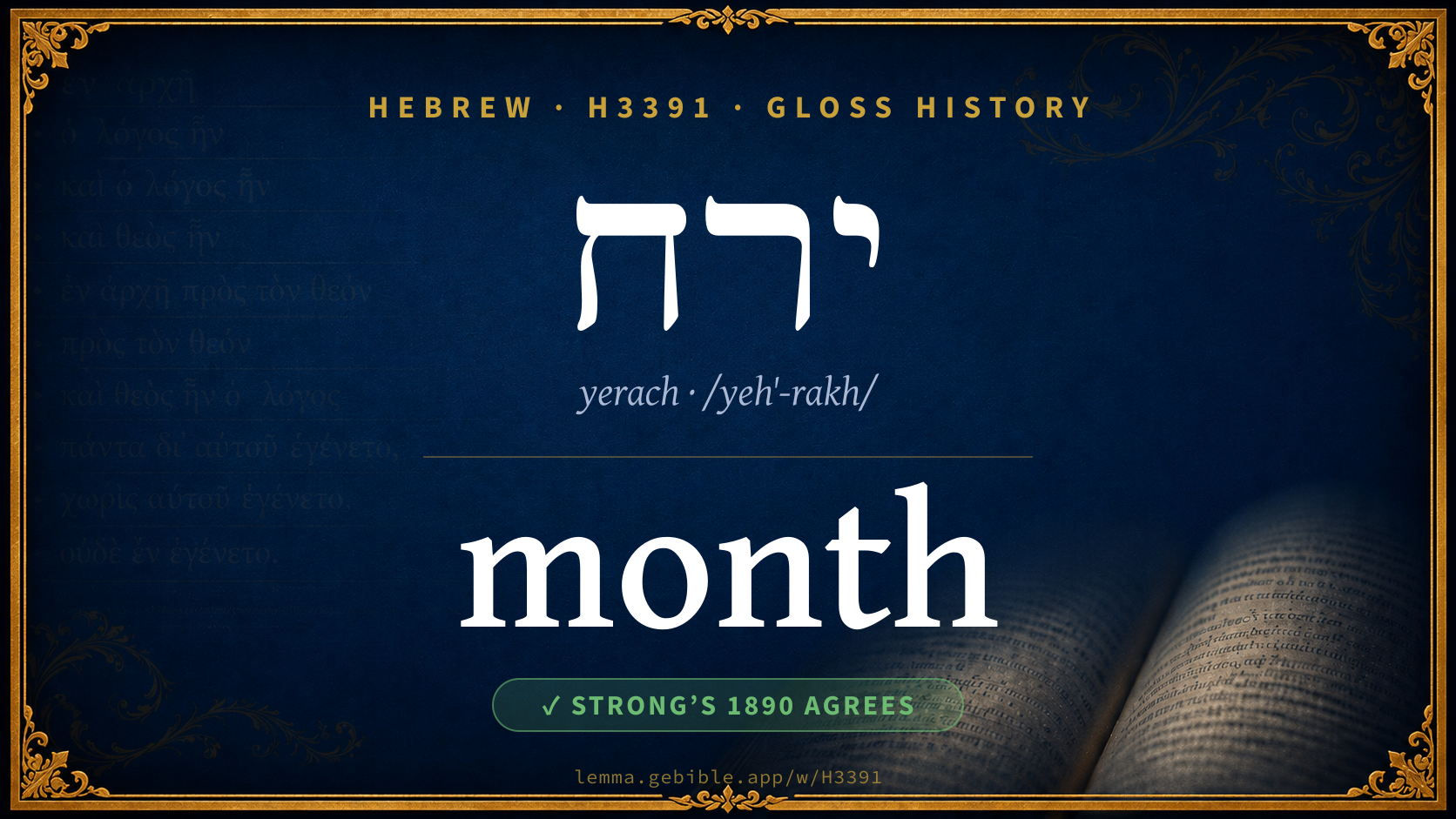
Gloss history
Strong's 1890 vs modern scholarship
About this word
Strong's H3391 catalogs a Hebrew word from the Hebrew Old Testament.
These counts are not copied from any lexicon or concordance. They are computed here, from the morphology-tagged Hebrew Old Testament. What Lemma adds →
- 13
- distinct verses
- The word appears in 13 distinct verses.
- 7 / 39
- OT books
- The word appears in 7 of 39 Old Testament books.
- #2,001
- by frequency
- Top 2500 most frequent Hebrew words (rank 2,001 of 8,640 Hebrew words by occurrence).
View all 13 occurrences in the concordance →
Most concentrated in
- Job 4 verses 31%
- 1 Kings 3 verses 23%
- Deuteronomy 2 verses 15%
By section of the Old Testament
By traditional corpus
Conventional, traditional groupings — biblical authorship is debated, so this is a traditional corpus grouping, not an authorship claim. Each share is this word’s portion of its verses in that division of the Hebrew canon. Each figure is a share of the word’s 13 distinct verses.
- Prophets (Nevi'im) 6 verses · 46%
- Writings (Ketuvim) 4 verses · 31%
- Torah (Pentateuch) 3 verses · 23%
How translations render this word
Counts come from each version’s own published word-to-Strong’s tagging or interlinear alignment — an approximate guide to how each version renders this word, not a word-level alignment the data otherwise carries. Because each total is that version’s own tagged count, the per-version totals vary from one another and need not match the appearance or distinct-verse counts above. These counts may also differ from a printed concordance because Lemma counts each distinctly tagged rendering and does not collapse phrase taggings into a single head-word total. This is a fixed set of word-tagged versions (KJV, ASV, BSB, ULT) and does not change with the reading translation you choose elsewhere. Each version’s license is shown beside its name below (and on Sources).
BDB lists this Strong’s number as 2 distinct words (homographs). Each count above pools all of them and is not split by sense — see the Senses section below. A low-frequency rendering may belong to a different one of those words, not the primary meaning.
- King James Version†: Month 6×, Months 4×
- American Standard Version†: Month 6×, Months 4×
- Berean Standard Bible†: Months 5×, Month 4×
- unfoldingWord Literal Text†: Month of 5×, Months 3×, Months of 2×
King James Version Public Domain
Renders H3391 across 13† tagged occurrences — most commonly:
Plus 3 renderings that appear only once — usually multi-word phrases or single function words the recovered tagging swept in, not distinct renderings.
American Standard Version Public Domain
Renders H3391 across 13† tagged occurrences — most commonly:
Plus 3 renderings that appear only once — usually multi-word phrases or single function words the recovered tagging swept in, not distinct renderings.
Berean Standard Bible Public Domain
Renders H3391 across 12† tagged occurrences — most commonly:
Plus 3 renderings that appear only once — usually multi-word phrases or single function words the recovered tagging swept in, not distinct renderings.
unfoldingWord Literal Text CC BY-SA 4.0
Renders H3391 across 14† tagged occurrences — most commonly:
Plus 4 renderings that appear only once — usually multi-word phrases or single function words the recovered tagging swept in, not distinct renderings.
Senses in the full BDB
What do BDB’s symbols mean?
BDB uses these scholarly abbreviations:
| Symbol | Meaning |
|---|---|
| 𝔊 | the Septuagint (the ancient Greek translation, LXX) |
| 𝔙 | the Vulgate (the Latin translation) |
| 𝔖 | the Syriac version (the Peshitta) |
| 𝔗 | the Targum (the Aramaic translation) |
| ψ | the Psalms |
| √ | root (the underlying root or stem) |
| ‖ | parallel passage (a synonymous or contrasted parallel) |
| † | the dagger: every passage where the word occurs is cited |
The 2 senses and sub-senses the full Brown-Driver-Briggs lexicon distinguishes for this word, in lexicon order (not ranked by frequency), with BDB’s own verbatim wording and sub-sense lettering. Shown in Hebrew script with BDB’s own scholarly abbreviations. The condensed entry is in the Lexicon Entry tab. See also the Forms in the corpus table below.
ירח I
- 1. month, as measure of time, during, or in which Ex 2:2 (E), Zc 11:8 Jb 39:2; יַרְחֵי שָׁ֑וְא Jb 7:3; יַרְחֵי קֶדֶם 29:2; pleon. יֶרַח יָמִים a month (of) days = a month of time Dt 21:13 2 K 15:13. e.g. Exodus 2:2
- 2. calendar month, with name יֶרַח זִו 1 K 6:37 (2nd mo., cf. v 1); יֶרַח בּוּל v 38 (8th mo.); יֶרַח הָאֵתָנִים 1 K 8:2 (7th mo.); cf. בְּמִסְפַּי יְרָחִים אַל־יָבֹא Jb 3:6; גֶּרֶשׁ יְרָחִים Dt 33:14 produce of months, i.e. of various seasons of years.—Cf. synon. חֹדֶשׁ. e.g. 1 Kings 6:37
ירח II m. ‘son’ of Joktan, only יָ֑רַח Gn 10
Senses from the full Brown-Driver-Briggs lexicon (Brown, Driver, Briggs; Oxford 1906 — public domain), digitized via Sefaria, supplemented by the OpenScriptures HebrewLexicon (CC BY 4.0). Full attribution on Sources.
Word origin
I. n.m. Zc 11:8 month (Aramaic יַרְחָא, ܝܰܪܚܳܐ new moon, month; Palm. ירח VogNo. 1; Assyrian arḫu COTGloss. Muss-ArnoltJBL xi. 1892, 73, 163; cf. Ph. Ethiopic sub יָרֵחַ; Sab. ורחֿ month, DHMZMG 1876, 603; 1883, 369 HalJAS vii, 1 516)—abs. יֶ֫רַח 1 K 6:37 + 3 times; cstr. id. Dt 21:13 2 K 15:13; pl. יְרָחִים Ex 2:2 + 3 times; cstr. יַרְחֵי Jb 7:3; 29:2;—
II. n.pr.m. ‘son’ of Joktan, only יָ֑רַח Gn 10:26 (𝔊 Ιαραδ, 𝔊L Ιεραχ) = 1 Ch 1:20 (𝔊L Ιαρε).
— Brown-Driver-Briggs (Oxford 1906, public domain), digitized via Sefaria, supplemented by the OpenScriptures HebrewLexicon (CC BY 4.0). See Sources.
Origin: from a unused root of uncertain signification
Jastrow Dictionary
A second Hebrew/Aramaic lexicon for comparison, covering Aramaic and post-biblical (Talmudic, Targumic, Midrashic) usage that the biblical-Hebrew BDB does not. Matched by lemma rather than by Strong’s number, so a lemma may carry more than one Jastrow headword (shown separately below), and the entries cover usage well beyond the Bible.
יָרֵחַ
- [traveller,] moon. Ḥull. 60ᵇ אמרה י׳ וכ׳ said the Moon to the Lord; Yalk. Gen. 8. Ib. מיעטתי את הי׳. v. מָעַט. Ber. 56ᵇ Ms. M. (ed. סיהרא).
יֶרַח
- 1. (b. h.; preced.; Assyr. arḥu) month. R. Hash. 11ᵃ, v. זֵיוְתָן. Tanḥ. Noah 11, v. בּוּל III; a. e.
- 2. pr. n. pl. Yeraḥ, at the southernmost point of Lake Tiberias; בית י׳ Beth-Yeraḥ, near Yeraḥ, a twin-town of Sennabris (v. סִנְבְּרַאי). Gen. R. s. 98 (expl. כנות, Deut. III, 17) R. El. says י׳; R. Samuel … בית י׳; R. Judah … Sennabris and Beth Yeraḥ. Y. Meg. I, 70ᵃ two autonomies כגון בית י׳ וכ׳ like B. Y. and Sennabris. Midr. Sam. ch. XXX, XXXII, expl. חרשי, II Sam. XXIV, 6 בית י׳.—Tosef. Bekh. VII, 4 איזהו ירדן מבית יְרֵחוֹ ולמטה (ed. Zuck. יריחו) the real Jordan is from B. Y’reḥo and down; Bekh. 55ᵃ אין ירדן אלא מבית יריחו וכ׳. e.g. Deuteronomy 3:17
יְרַח
- (= h. יָרֵחַ a. יֶרַח) moon; month.—יומא די׳ or י׳ (sub. ריש) the first day of the month, New-Moon-Day. Targ. Is. XLVII, 13. Ib. LXVI, 23. Targ. I Sam. XX, 18. Targ. Ez. XLVI, 1; a. fr.—Targ. O. Deut. XXI, 13 יִרַח יומין ed. Berl. (oth. ed. יְרַח; Y. תלתא יַרְחִין).—Lev. R. s. 29; Pesik. R. s. 40 (ref. to בחדש השביעי, Lev. XXIII, 24) בי׳ דשבועתא in the month of oaths (Gen. XXII, 16). Sabb. 86ᵇ בחד בשבא איקבע י׳ the New-Moon was declared on the first day of the week. Ib. פליגי בקביע די׳ they differ as to the day on which the New Moon was declared. Bets. 4ᵇ והשתא דידעינן בקביעא די׳ and now that we know the time of the New Moon (by fixed calendar); a. fr.—Pl. יַרְחִין, יַרְחַיָּא, יַרְחֵי. Targ. Y. Gen. I, 14. Targ. Ex. II, 2; a. fr.—R. Hash. 20ᵃ בשאר י׳ as to the other months (than Nisan and Tishri). Y. ib. II, 57ᵈ bot. Macc. 23ᵇ; a. fr.—תריסר ירחי שתא twelve months (forming) a year, twelve months from date. B. Mets. 16ᵇ; 35ᵃ. Ab. Zar. 8ᵇ; a. e. e.g. Leviticus 23:24
A Dictionary of the Targumim, the Talmud Babli and Yerushalmi, and the Midrashic Literature (Marcus Jastrow; London, Luzac, 1903) — Public Domain. Digitized via Sefaria. Digitized via Sefaria. Full attribution on Sources.
Forms in the corpus
The 11 distinct written forms H3391 takes in the Hebrew Bible, most frequent first — each parse links to that state’s occurrences in the concordance. Hebrew forms include their vowel points and cantillation, so a single lemma takes many written forms.
| Form | Parsing | Example | Uses |
|---|---|---|---|
| בְּ/יֶ֣רַח | Noun, Common, Masculine, Singular, Absolute | Zechariah 11:8 | 2 |
| יְרָחִֽים | Noun, Common, Masculine, Plural, Absolute | Deuteronomy 33:14 | 2 |
| בְּ/יֶ֖רַח | Noun, Common, Masculine, Singular, Construct | 1 Kings 6:37 | 1 |
| בְּ/יֶ֥רַח | Noun, Common, Masculine, Singular, Construct | 1 Kings 8:2 | 1 |
| וִ/ירֵחֵ֖/ךְ | Noun, Common, Masculine, Singular, Construct | Isaiah 60:20 | 1 |
| יְ֝רָחִ֗ים | Noun, Common, Masculine, Plural, Absolute | Job 3:6 | 1 |
| יְרָחִ֣ים | Noun, Common, Masculine, Plural, Absolute | Job 39:2 | 1 |
| יֶ֣רַח | Noun, Common, Masculine, Singular, Construct | Deuteronomy 21:13 | 1 |
| יֶֽרַח | Noun, Common, Masculine, Singular, Construct | 2 Kings 15:13 | 1 |
| יַרְחֵי | Noun, Common, Masculine, Plural, Construct | Job 7:3 | 1 |
| כְ/יַרְחֵי | Noun, Common, Masculine, Plural, Construct | Job 29:2 | 1 |
Same root — word family
Other BDB entries built from the same root as H3391, grouped by Strong’s listed origin. These share a root / origin per the lexicon — not necessarily a shared meaning. Each links to that word’s own entry.
Derived from this word
Proper names from this root
People and places named from this root — a name, not an additional meaning of the word.
Compare all same-root words → 1 of the same-root words is a proper name (a person or place). They share a root, not necessarily a meaning.
Septuagint verse parallels
This word appears in 11 verses that also exist in the Greek Old Testament (Septuagint), out of the 13 Hebrew verses it occurs in. You can read those verses in Greek by switching the Old Testament edition to the Septuagint.
Read these verses in the Septuagint
This is a verse-level parallel only — the same verses exist in both the Hebrew and Greek Old Testaments. No word-level Hebrew↔Greek correspondence is claimed: the data carries no such alignment, so no Greek word is shown as this Hebrew word’s translation. Coverage is not total — the Septuagint omits the deuterocanon and renumbers the Psalms, so some Hebrew verses have no direct Greek parallel.