
Joel 2:19

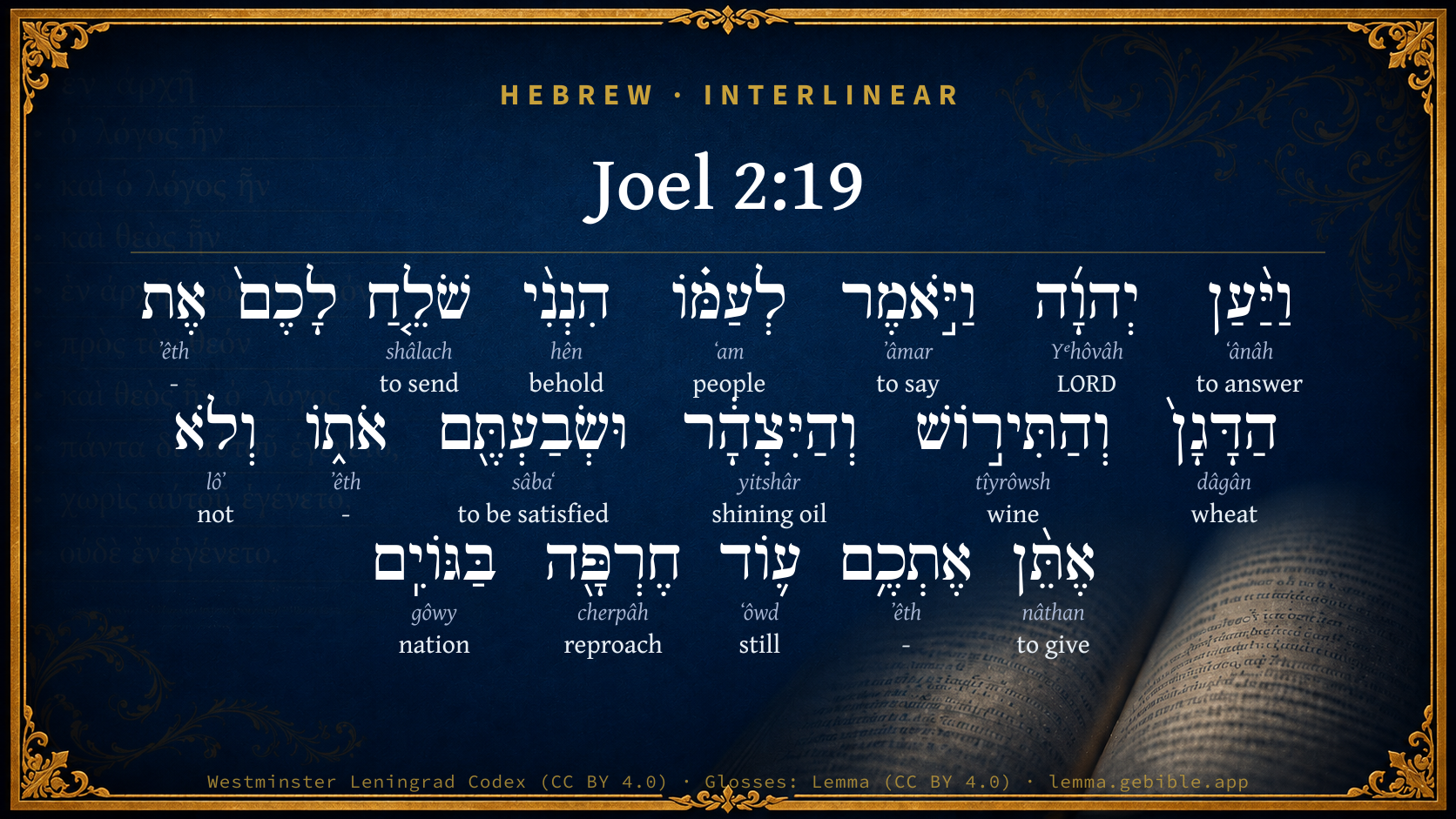
Hebrew (Westminster Leningrad Codex) Joel 2:19 appears in the Hebrew Old Testament. The text above is from the Westminster Leningrad Codex. Each word links to its Strong’s number, a concise gloss, and parsing drawn from the Open Scriptures Hebrew Bible morphology. Click any word for its full Brown-Driver-Briggs (BDB) entry.
Download image
Cite this verse

Joel 2:19 (World English Bible). Public Domain. Lemma interlinear Bible study tool, https://lemma.gebible.app/v/joel/2/19.

Show BibTeX & RIS
BibTeX
RIS
English Translation
Yahweh answered his people, "Behold, I will send you grain, new wine, and oil, And you will be satisfied with them; And I will no more make you a reproach among the nations.
World English Bible · Public Domain
Download a study sheet

One document with this verse’s original text, its word-by-word gloss line, the meaning frame, cross-references with their text, attributed commentary, and full source and license credits — printable, and it pastes into notes with its structure intact.

This verse Autodidact and up

Study sheet (.html) Plain text (.txt)

A passage Seminary Student

Up to 50 verses in one chapter. A passage sheet keeps up to 6 commentary sources and 12 cross-references per verse, in the order this page ranks them, and says so on the sheet whenever that leaves anything out. Ask for a single verse and you get the Autodidact verse sheet above.

Everything on this page stays free to read, with no account — the sheet is a download of what is already on screen, not access to it.

Want to remove ads? Support Godless Engineer
Compare translations 3

The same verse in 3 English versions, stacked beneath the original-language interlinear above. Click any original word for its lexicon entry.

Each is an independent rendering of the whole verse — the interlinear is not word-aligned to these translations.

Highlighted words mark where these versions differ — a whole-verse word diff, not a word-by-word alignment.

  • World English Bible Public Domain
    Yahweh answered his people, "Behold, I will send you grain, new wine, and oil, And you will be satisfied with them; And I will no more make you a reproach among the nations.
  • King James Version Public Domain
    Yea, the LORD will answer and say unto his people, Behold, I will send you corn, and wine, and oil, and ye shall be satisfied therewith: and I will no more make you a reproach among the heathen:
  • unfoldingWord Literal Text CC BY-SA 4.0
    And Yahweh answered and said to his people, “Behold me, sending to you grain and new wine and oil, and you will have enough with it, and I will no longer make you a reproach among the nations.

unfoldingWord Literal Text — © unfoldingWord, licensed CC BY-SA 4.0. Word-aligned USFM3 via Door43 (git.door43.org/unfoldingWord/en_ult).

Versions to compare (up to 4)

3 of 4 selected

Show all 18 translations

Every available English version of this verse, each an independent rendering of the whole verse.

  • World English Bible Public Domain
    Yahweh answered his people, "Behold, I will send you grain, new wine, and oil, And you will be satisfied with them; And I will no more make you a reproach among the nations.
  • Berean Standard Bible Public Domain
    And the LORD answered His people: “Behold, I will send you grain, new wine, and oil, and by them you will be satisfied. I will never again make you a reproach among the nations.
  • Majority Standard Bible Public Domain
    And the LORD answered His people: “Behold, I will send you grain, new wine, and oil, and by them you will be satisfied. I will never again make you a reproach among the nations.
  • King James Version Public Domain
    Yea, the LORD will answer and say unto his people, Behold, I will send you corn, and wine, and oil, and ye shall be satisfied therewith: and I will no more make you a reproach among the heathen:
  • American Standard Version (1901) Public Domain
    And Jehovah answered and said unto his people, Behold, I will send you grain, and new wine, and oil, and ye shall be satisfied therewith; and I will no more make you a reproach among the nations;
  • Revised Version (1885) Public Domain
    And the LORD answered and said unto his people, Behold, I will send you corn, and wine, and oil, and ye shall be satisfied therewith: and I will no more make you a reproach among the nations:
  • Geneva Bible (1599) Public Domain
    Yea, the Lord wil answere and say vnto his people, Beholde, I will send you corne, and wine, and oyle, and you shalbe satisfied therewith: and I will no more make you a reproche among the heathen,
  • Douay-Rheims (1899) Public Domain
    And the Lord answered and said to his people: Behold I will send you corn, and wine, and oil, and you shall be filled with them: and I will no more make you a reproach among the nations.
  • Young's Literal Translation Public Domain
    Let Jehovah answer and say to His people, `Lo, I am sending to you the corn, And the new wine, and the oil, And ye have been satisfied with it, And I make you no more a reproach among nations,
  • Literal Standard Version CC BY-SA 4.0
    Let YHWH answer and say to His people, || “Behold, I am sending to you the grain, || And the new wine, and the oil, || And you have been satisfied with it, || And I make you no longer a reproach among nations,
  • Unlocked Literal Bible CC BY-SA 4.0
    Yahweh answered his people, “Look, I will send you grain, new wine, and oil. You will be satisfied with them, and I will no longer make you a disgrace among the nations.
  • unfoldingWord Literal Text CC BY-SA 4.0
    And Yahweh answered and said to his people, “Behold me, sending to you grain and new wine and oil, and you will have enough with it, and I will no longer make you a reproach among the nations.
  • Darby Bible Public Domain
    And Jehovah will answer and say unto his people, Behold, I send you corn, and new wine, and oil, and ye shall be satisfied therewith; and I will no more make you a reproach among the nations.
  • World Messianic Bible Public Domain
    The LORD answered his people, “Behold, I will send you grain, new wine, and oil, and you will be satisfied with them; and I will no more make you a reproach among the nations.
  • Webster's Bible Public Domain
    And the LORD will answer and say to his people, Behold, I will send you corn, and wine, and oil, and ye shall be satisfied with it; and I will no more make you a reproach among the heathen:
  • Free Bible Version CC BY-SA 4.0
    The Lord will reply, saying to his people, “Look! I am sending you grain and new wine and olive oil, and you will be satisfied. You will no longer be a disgrace among the foreign nations.
  • Bible in Basic English Public Domain
    And the Lord made answer and said to his people, See, I will send you grain and wine and oil in full measure: and I will no longer let you be shamed among the nations:
  • JPS Tanakh (1917) Public Domain
    And the LORD answered and said unto His people: 'Behold, I will send you corn, and wine, and oil, and ye shall be satisfied therewith; and I will no more make you a reproach among the nations;

Literal Standard Version (2020), Covenant Press — licensed CC BY-SA 4.0. Text via the HelloAO Bible API (eBible.org). Unlocked Literal Bible (unfoldingWord) — licensed CC BY-SA 4.0. Text via the HelloAO Bible API (eBible.org). unfoldingWord Literal Text — © unfoldingWord, licensed CC BY-SA 4.0. Word-aligned USFM3 via Door43 (git.door43.org/unfoldingWord/en_ult). Free Bible Version, Dr. Jonathan Gallagher — licensed CC BY-SA 4.0. Text via the HelloAO Bible API (eBible.org).

Word by word

More ways to search: Search by grammar → Find every occurrence → Compare this word →

Practice this passage: Drill this verse → Learn its vocabulary →

וְהַיִּצְהָ֔ר
yitshâr
H3323
“and · the · shining oil”
Conjunction + Particle, Definite Article + Noun, Common, Masculine, Singular, Absolute
Part of Speech
Conjunction + Particle + Noun
Type
Common
Gender
Masculine
Number
Singular
State
Absolute
Full BDB Definition

Origin: from H6671

TWOT: 1883c

fresh oil, shining (pure) oil
  1. וַיַּ֨עַן ʻânâh H6030 “and · to answer” Conjunction + Verb, Qal, Sequential Imperfect, 3rd Person, Masculine, Singular
  2. יְהוָ֜ה Yᵉhôvâh H3068 “LORD” Noun, Proper
  3. וַיֹּ֣אמֶר ʼâmar H559 “and · to say” Conjunction + Verb, Qal, Sequential Imperfect, 3rd Person, Masculine, Singular
  4. לְעַמּ֗וֹ ʻam H5971 “to/for · people · his” Preposition + Noun, Common, Masculine, Singular, Construct + Suffix, Personal, 3rd Person, Masculine, Singular
  5. הִנְנִ֨י hên H2005 “behold · me” Particle, Demonstrative + Suffix, Personal, 1st Person, Common, Singular
  6. שֹׁלֵ֤חַ shâlach H7971 “sending” Verb, Qal, Participle Active, Masculine, Singular, Absolute
  7. אֶת ʼêth H853 “-” Particle, Direct Object
  8. הַדָּגָן֙ dâgân H1715 “the · wheat” Particle, Definite Article + Noun, Common, Masculine, Singular, Absolute
  9. וְהַתִּיר֣וֹשׁ tîyrôwsh H8492 “and · the · wine” Conjunction + Particle, Definite Article + Noun, Common, Masculine, Singular, Absolute
  10. וּשְׂבַעְתֶּ֖ם sâbaʻ H7646 “and · to be satisfied” Conjunction + Verb, Qal, Sequential Perfect, 2nd Person, Masculine, Plural
  11. אֹת֑וֹ ʼêth H853 “- · him” Particle, Direct Object + Suffix, Personal, 3rd Person, Masculine, Singular
  12. וְלֹא lôʼ H3808 “and · not” Conjunction + Particle, Negative
  13. אֶתֵּ֨ן nâthan H5414 “to give” Verb, Qal, Imperfect, 1st Person, Common, Singular
  14. אֶתְכֶ֥ם ʼêth H853 “- · you” Particle, Direct Object + Suffix, Personal, 2nd Person, Masculine, Plural
  15. ע֛וֹד ʻôwd H5750 “still” Adverb
  16. חֶרְפָּ֖ה cherpâh H2781 “reproach” Noun, Common, Feminine, Singular, Absolute
  17. בַּגּוֹיִֽם gôwy H1471 “in/at the · nations” Preposition, Determined + Noun, Common, Masculine, Plural, Absolute

About this verse

These counts appear in no published source. They are computed here, from the morphology-tagged text and Lemma’s own curated glosses. What Lemma adds →

19
words
16
distinct lemmas
Prophets
section

Notable vocabulary

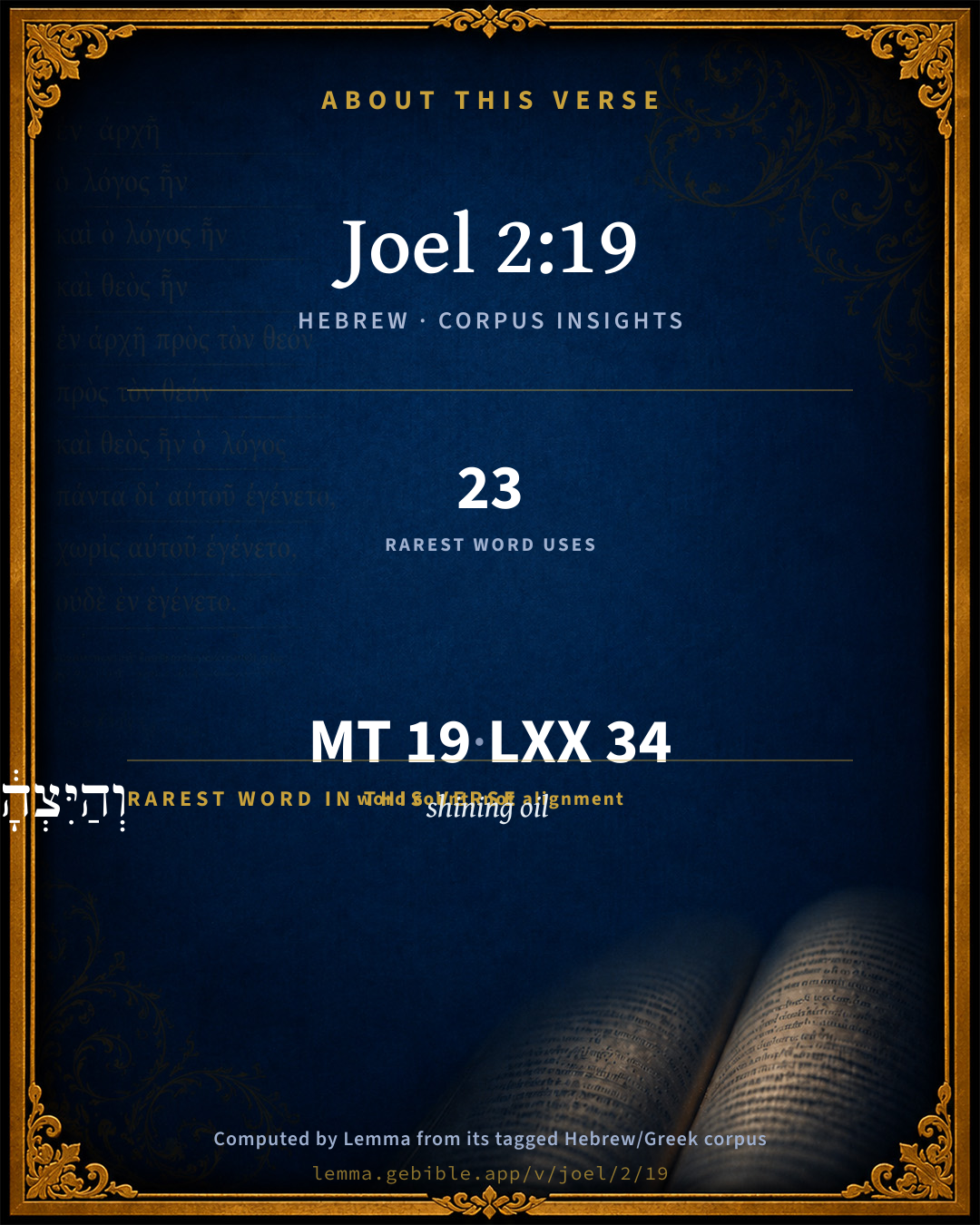
The rarest word here is וְהַיִּצְהָ֔ר shining oil H3323 — appearing just 23 times in the whole Hebrew Bible.

Shared distinctive vocabulary

וְהַיִּצְהָ֔ר shining oil H3323 occurs in 23 verses of the Hebrew Bible. Also found in:

Grammatical profile

  • 5 verbs
  • 7 nouns
  • 1 preposition
  • 1 adverb
  • 5 particles

Verb forms

  • וַיַּ֨עַן Qal · Sequential Imperfect
  • וַיֹּ֣אמֶר Qal · Sequential Imperfect
  • שֹׁלֵ֤חַ Qal · Participle Active
  • וּשְׂבַעְתֶּ֖ם Qal · Sequential Perfect
  • אֶתֵּ֨ן Qal · Imperfect

Hebrew & Septuagint length

In English translation the verse runs 33 words from the Hebrew and 38 from the Septuagint (LXX English) — closely comparable.

A rough comparison of the two English renderings, which tokenize alike — not a word-level alignment.

Word counts can differ between the Hebrew and the Greek without any difference in meaning — e.g. the Hebrew direct-object marker אֵת has no separate Greek word, and Greek often adds the article ὁ.

In the original languages it is 19 Hebrew tokens and 34 Greek tokens — but the two are counted differently (Hebrew bundles its prefixes and suffixes into one token; the Greek is in lemma form), so that isn’t a like-for-like length.

Cross-references

13

Topical passages linked to Joel 2:19 in the Treasury of Scripture Knowledge — connected by theme and wording, ordered by reader-vote popularity; previews shown in the World English Bible.

  • Ezekiel 34:29 I will raise up to them a plantation for renown, and they shall be no more consumed with famine in the land, neither bear the shame of the nations any more.
  • Ezekiel 36:15 neither will I let you hear any more the shame of the nations, neither shall you bear the reproach of the peoples any more, neither shall you cause your nation to stumble any more, says the Lord Yahweh.
  • Isaiah 62:8–9 Yahweh has sworn by his right hand, and by the arm of his strength, Surely I will no more give your grain to be food for your enemies; and foreigners shall not drink your new wine, for which you have labored:
  • Jeremiah 31:12 They shall come and sing in the height of Zion, and shall flow to the goodness of Yahweh, to the grain, and to the new wine, and to the oil, and to the young of the flock and of the herd: and their soul shall be as a watered garden; and they shall not sorrow any more at all.
  • Joel 2:24 The threshing floors will be full of wheat, And the vats will overflow with new wine and oil.
  • Amos 9:13–14 "Behold, the days come," says Yahweh, "That the plowman shall overtake the reaper, And the one treading grapes him who sows seed; And sweet wine will drip from the mountains, And flow from the hills.
  • Isaiah 65:21–24 They shall build houses, and inhabit them; and they shall plant vineyards, and eat the fruit of them.
  • Ezekiel 39:29 neither will I hide my face any more from them; for I have poured out my Spirit on the house of Israel, says the Lord Yahweh.
  • Hosea 2:15 I will give her vineyards from there, And the valley of Achor for a door of hope; And she will respond there, As in the days of her youth, And as in the day when she came up out of the land of Egypt.
  • Haggai 2:16–19 Through all that time, when one came to a heap of twenty measures, there were only ten. When one came to the wine vat to draw out fifty, there were only twenty.
  • Malachi 3:10–12 Bring the whole tithe into the store-house, that there may be food in my house, and test me now in this," says Yahweh of hosts, "if I will not open you the windows of heaven, and pour you out a blessing, that there shall not be room enough for.
  • Matthew 6:33 But seek first God's Kingdom, and his righteousness; and all these things will be given to you as well.
  • Joel 1:10 The field is laid waste. The land mourns, for the grain is destroyed, The new wine has dried up, And the oil languishes.

Cross-references courtesy of OpenBible.info (CC BY 4.0).

Hebrew and Greek witnesses Masoretic Hebrew ↔ Greek Septuagint

The same verse in the two great witnesses to the Old Testament, shown verse-for-verse.

These are two independent witnesses, not word-aligned to each other, and the Septuagint is shown in lemma (dictionary) form.

Hebrew Joel 2:19 Masoretic · Westminster Leningrad Codex

וַיַּ֨עַן יְהוָ֜ה וַיֹּ֣אמֶר לְעַמּ֗וֹ הִנְנִ֨י שֹׁלֵ֤חַ לָכֶם֙ אֶת הַדָּגָן֙ וְהַתִּיר֣וֹשׁ וְהַיִּצְהָ֔ר וּשְׂבַעְתֶּ֖ם אֹת֑וֹ וְלֹא אֶתֵּ֨ן אֶתְכֶ֥ם ע֛וֹד חֶרְפָּ֖ה בַּגּוֹיִֽם

Yahweh answered his people, "Behold, I will send you grain, new wine, and oil, And you will be satisfied with them; And I will no more make you a reproach among the nations.

World English Bible · Public Domain

Greek LXX Joel 2:19 Septuagint · lemma form

καί ἀποκρίνω κύριος καί εἶπον ὁ λαός αὐτός ἰδού ἐγώ ἐκ ἀποστέλλω σύ ὁ σῖτος καί ὁ οἶνος καί ὁ ἔλαιον καί ἐνπίμπλημι αὐτός καί οὐ δίδωμι σύ οὐκέτι εἰς ὀνειδισμός ἐν ὁ ἔθνος

And the Lord answered and said to his people, Behold, I will send you corn, and wine, and oil, and you⌃ shall be satisfied with them: and I will no longer make you a reproach among the Gentiles.

LXX2012 (modern English Septuagint) · Public Domain

Hebrew: Westminster Leningrad Codex (CC BY 4.0). Greek: Septuagint (public domain); English from LXX2012 (modern English Septuagint) (Public Domain). How the Septuagint differs from the Hebrew →

Targum (Aramaic paraphrase)

1

The Targum is the ancient Jewish Aramaic paraphrase of the Hebrew Scriptures — an interpretive translation, not the Hebrew text itself. Onkelos (literal) and Pseudo-Jonathan (expansive) render the Torah, and Jonathan the Prophets. Coverage is partial: where no permissively-licensed English translation exists for a verse, only the Aramaic is shown. This is verse-level text, not a word-by-word alignment to the Hebrew.

  1. Targum Jonathan Prophets (Joshua–Malachi)
    וְאָתֵיב יְיָ וַאֲמַר לְעַמֵיהּ הָא אֲנָא מְבָרַךְ לְכוֹן עִבּוּרָא וְחַמְרָא וּמִשְׁחָא וְתִסְבְעוּן יָתֵיהּ וְלָא אֶתֵּן יַתְכוֹן עוֹד חִיסוּדֵי כַפְנָא בֵּינֵי עַמְמַיָא:

    (no public-domain English translation for this verse)

    Targum Jonathan — Aramaic: “Mikraot Gedolot” (public domain). English: “Sefaria Community Translation” (CC0 1.0 (public-domain dedication)); “London "Chaldee Paraphrase," 1871” (public domain). Text via Sefaria.

Commentary

Notes on Joel 2:19 from classic Christian and Jewish commentators (each source and its license shown beneath its notes). The classic Christian expositions comment on the surrounding passage and are grouped to its opening verse, so a note may address several verses; the Jewish commentaries on the Tanakh (Rashi and others) are per-verse, so they appear only where the commentator wrote on this verse.

Lemma curates 59 commentaries, every one of them public domain or Creative Commons licensed, each selected and text-cleaned for this edition rather than reprinted as found. About our sources →

Trapp's Complete Commentary

John Trapp

Joe 2:19 Yea, the LORD will answer and say unto his people, Behold, I will send you corn, and wine, and oil, and ye shall be satisfied therewith: and I will no more make you a reproach among the heathen:

Ver. 19. Yea, the Lord will answer and say unto his people] He will say it in answer to their prayers (see the note on Joe 2:18). Fear not, my people, that ye shall be a reproach among the heathen:

Behold, I will send you] As a token of my love, and a pledge of better blessings;

Corn, and wine, and oil] All that heart can wish or need require, a sufficiency of outward comforts, and (if not a superfluity, yet) an honest affluence, as Psa 23:5-6, and boldness to conclude from temporals to spirituals, as there David doth; because bestowed in mercy and as an answer to prayer; for God never said to the seed of Jacob, Seek ye me in vain (he scorns that), whether it be for Bona throni or Bona scabelli, as Austin distinguisheth, good things of this life or a better, upper springs or nether springs, though we ask but the one (as here) yet we shall have both. "Nay, take two," saith he, as once Naaman did to Gehazi; take thy back-burden, take even as much as thou canst bring faith to bear away. God deals with his servants as the prophet did with the Shunammite; when he bade her ask what she needed, and she found not what to ask, he sent for her again and makes her a free promise of that she most wanted and desired, a son, 2Ki 4:16. So, often God is pleased to do for his servants exceeding abundantly above all that they ask or think. David asked but life of God, and he gave him "length of days for ever and ever," Psa 21:4. This people prayed that God would not (for that turn) give his heritage a reproach among the heathen; and he graciously promiseth that he will never any more make them a reproach, &c. (so they continue penitent), for עור here signifies perpetuity, as Mercer noteth, and not for a time only, as Lyra would have it.

John Trapp, A Commentary or Exposition upon All the Books of the Old and New Testament (1647–1656) — public domain. Text from a community e-Sword module.

Whedon's Commentary on the Bible

Daniel D. Whedon

19. The jealousy and pity bring about a change in the purpose of God, which change is indicated in the reply to the petitions. The things needed immediately will be restored at once.

I will send — Heb, hinneh with the participle, “I am about to send” (G.-K., 116p.).

Corn [“grain”]… [“new”] wine… oil — The very things that the locusts had destroyed (Joe_1:10); they were needed for the daily sacrifice (Joe_1:9), and for daily life (Joe_1:11-12). These products will be given not in a scant measure but in abundance, so that the people will be satisfied. The new prosperity will remove the reproach (Joe_2:17) that Israel is a poor people whose God is unable or unwilling to assist it; the surrounding nations will recognize once more the presence of Jehovah. The very fact that the removal of the reproach is connected with the new fertility makes it probable that the danger of becoming a reproach was due to the absence of fertility, not to the invasion of a foreign foe.

The contents of the promise do not seem to be enumerated in the chronological order in which they will actually be realized. The blessings of Joe_2:19 follow, they do not precede, the destruction of the locusts announced in Joe_2:20.

From you — Literally, from upon you. Two prepositions in Hebrew; the locusts had been resting upon the land as a burden (Amo_5:23; Exo_10:17).

The northern army — Literally, the northern one (see above, p. 144). The context requires that we regard the expression as an epithet of the swarm of locusts. True, ordinarily they do not come from the north, but it cannot be proved that they never come from there. All that Jerome was willing to say is that “the swarms of locusts are more generally brought by the south wind than by the north.” Niebuhr tells of a tract of land, on the road from Nisibis to Mosul, completely covered with young locusts. Locusts are also found in the Syrian and Palmyrene desert, whence they might easily be carried by a northeast wind into Palestine toward Jerusalem; in such case the designation “the northern” would be perfectly appropriate. While this is a legitimate interpretation, it is more likely (see above, p. 145) that the term is used here not in a literal but in an apocalyptic sense, derived from passages such as Jer_1:14; Eze_38:6; Eze_38:15. A similar change from an historical to an apocalyptic conception may be seen in the corresponding Arabic word (Wellhausen). The army which came from the north will be carried away by a north wind into a land barren and desolate — Not only the desert shores of the Dead Sea (Credner), but the great Arabian Desert south and southeast of Palestine. There the main body will go. The following clause would better be rendered, with R.V., “its forepart into the eastern sea, and its hinder part into the western sea.”

Face — R.V., “forepart”; that which is in front, the van.

East sea — Literally, front sea. The Hebrews and other Oriental nations, in fixing the points of the compass, faced eastward; hence front — east, behind — west.

The “East Sea” is the Dead Sea, which is eastward from Jerusalem (Zec_14:8; Eze_47:18).

Hinder part — Literally, end, the rear; Hebrews soph, an Aramaic word (Dan_4:8; Dan_4:29) found only in late Hebrew writings.

Utmost sea — Literally, hinder sea; R.V., “western sea,” the Mediterranean (Deu_11:24; Num_34:6-7; Zec_14:8). The expressions are not to be understood as signifying that three winds would blow at one and the same time, one from the north, one from the east or northeast, the third from the west or northwest; they present a rhetorical picture of rapid and total destruction “which is founded upon the idea that the wind rises in the northwest, then turns to the north, and finally to the northeast, so that the van of the swarm is driven into the Dead Sea, the great mass into the southern desert, and the rear into the Mediterranean.” The dead locusts will soon decay, their stench will rise (Isa_34:3; Amo_4:10).

Ill savor — The Hebrew word is found only here, but its meaning is determined by the cognate languages and is correctly reproduced by the ancient versions. The Hebrew construction is peculiar. Hence, many commentators think that the two clauses, “and his stink shall come up, and his ill savor shall come up,” are an expansion of one clause. “And his ill savor shall come up” they regard as the original of the two, while they consider the other, “and his stink shall come up,” a later gloss intended to explain the rare word translated “ill savor.” “Even in our own times,” says Jerome, “we have seen the land of Judah covered by swarms of locusts, which as soon as the wind arose were precipitated into the first and the hindermost (Dead and Mediterranean) seas. And when the shores of both seas were filled with heaps of dead locusts, which the waters had thrown up, their corruption and stench became so noxious that even the atmosphere was corrupted, and both man and beast suffered from consequent pestilence.”

Because he hath done great things — Literally, he hath shown greatness to do. Affirmed of Jehovah in Joe_2:21. When used of men or other creatures the idea of haughtiness is implied; they have gone beyond their proper bounds (Lam_1:9; Psa_35:26); like the German “grossthun,” to brag, to glory in one’s strength and success. Here, not only “it has accomplished a great devastation,” but, “it has accomplished it and brags about it.” In a strictly literal sense the expression is inapplicable to irrational creatures, but this does by no means prove that the locusts symbolize hostile armies. The prophet is at liberty, in a poetic description, to endow even irrational creatures with rational and moral powers (Isa_44:23). It is interesting to note that Hebrew legislation holds even animals accountable for acts of violence (Gen_9:5; Exo_21:28-32).

Joe_2:19-20 are placed in the mouth of Jehovah; in 21 the prophet steps in once more as the speaker. In the presence of calamity, joy had vanished from the sons of men (Joe_1:12); the promises of 19, 20 mean a complete transformation. In view of the new prospects he calls upon the land (21), the beasts (22), and the children of Zion (23) to be glad and rejoice.

Daniel D. Whedon (gen. ed.), Commentary on the Old and New Testaments (1874–1909) — public domain. Text from a community e-Sword module.

Keil & Delitzsch

C. F. Keil & F. Delitzsch

The promise runs as follows. Joe 2:19. "Behold, I send you the corn, and the new wine, and the oil, that ye may become satisfied therewith; and will no more make you a reproach among the nations. Joe 2:20. And I will remove the northern one far away from you, and drive him into the land of drought and desert; its van into the front sea, and its rear into the hinder sea: and its stink will ascend, and its corruption ascend, for it has done great things." The Lord promises, first of all, a compensation for the injury done by the devastation, and then the destruction of the devastation itself, so that it may do no further damage. Joe 2:19 stands related to Joe 1:11. Shâlach, to send: the corn is said to be sent instead of given (Hos 2:10), because God sends the rain which causes the corn to grow. Israel shall no longer be a reproach among the nations, "as a poor people, whose God is unable to assist it, or has evidently forsaken it" (Ros.). Marck and Schmieder have already observed that this promise is related to the prayer, that He would not give up His inheritance to the reproach of the scoffings of the heathen (Joe 1:17 : see the comm. on this verse). הצּפוני, the northern one, as an epithet applied to the swarm of locusts, furnishes no decisive argument in favour of the allegorical interpretation of the plague of locusts. For even if locusts generally come to Palestine from the south, out of the Arabian desert, the remark out of the Arabian desert, the remark made by Jerome, to the effect that "the swarms of locusts are more generally brought by the south wind than by the north," shows that the rule is not without its exceptions. "Locusts come and go with all winds" (Oedmann, ii. p. 97). In Arabia, Niebuhr (Beschreib. p. 169) saw swarms of locusts come from south, west, north, and east. Their home is not confined to the desert of Arabia, but they are found in all the sandy deserts, which form the southern boundaries of the lands that were, and to some extent still are, the seat of cultivation, viz., in the Sahara, the Libyan desert, Arabia, and Irak (Credner, p. 285); and Niebuhr (l.c.) saw a large tract of land, on the road from Mosul to Nisibis, completely covered with young locusts. They are also met with in the Syrian desert, from which swarms could easily be driven to Palestine by a north-east wind, without having to fly across the mountains of Lebanon. Such a swarm as this might be called the tsephōnı̄, i.e., the northern one, or northerner, even if the north was not its true home. For it cannot be philologically proved that tsephōnı̄ can only denote one whose home is in the north. Such explanations as the Typhonian, the barbarian, and others, which we meet with in Hitzig, Ewald, and Meier, and which are obtained by alterations of the text or far-fetched etymologies, must be rejected as arbitrary. That which came from the north shall also be driven away by the north wind, viz., the great mass into the dry and desert land, i.e., the desert of Arabia, the van into the front (or eastern) sea, i.e., the Dead Sea (Eze 47:18; Zac 14:8), the rear into the hinder (or western) sea, i.e., the Mediterranean (cf. Deu 11:24). This is, of course, not to be understood as signifying that the dispersion was to take place in all these three directions at one and the same moment, in which case three different winds would blow at the same time; but it is a rhetorical picture of rapid and total destruction, which is founded upon the idea that the wind rises in the north-west, then turns to the north, and finally to the north-east, so that the van of the swarm is driven into the eastern sea, the great mass into the southern desert, and the rear into the western sea. The explanation given by Hitzig and others - namely, that pânı̄m signifies the eastern border, and sōph the western border of the swarm, which covered the entire breadth of the land, and was driven from north to south - cannot be sustained. Joel mentions both the van and the rear after the main body, simply because they both meet with the same fate, both falling into the sea and perishing there; whereupon the dead bodies are thrown up by the waves upon the shore, where their putrefaction fills the air with stench. The perishing of locusts in seas and lakes is attested by many authorities.

(Note: Even Pliny says (h. n. xi. 29), Gregatim sublato vento in maria aut stagna decidunt; and Jerome has the following remarks on this verse: "Even in our own times we have seen the land of Judaea covered by swarms of locusts, which, as soon as the wind rose, were precipitated into the first and latest seas, i.e., the Dead Sea and the Mediterranean. And when the shores of both seas were filled with heaps of dead locusts, which the waters had thrown up, their corruption and stench became so noxious, that even the atmosphere was corrupted, and both man and beasts suffered from the consequent pestilence.")

For עלה באשׁו, compare Isa 34:3 and Amo 4:10. צחנה is ἁπ. λεγ.; but the meaning corruption is sustained partly by the parallelism, and partly by the Syriac verb, which means to be dirty. The army of locusts had deserved this destruction, because it had done great things. הגדּיל לעשׂות, to do great things, is affirmed of men or other creatures, with the subordinate idea of haughtiness; so that it not only means he has done a mighty thing, accomplished a mighty devastation, but is used in the same sense as the German grosstun, via. to brag or be proud of one strength. It does not follow from this, however, that the locusts are simply figurative, and represent hostile nations. For however true it may be that sin and punishment presuppose accountability (Hengst., Hvernick), and conclusion drawn from this - namely, that they cannot be imputed to irrational creatures - is incorrect. The very opposite is taught by the Mosaic law, according to which God will punish every act of violence done by beasts upon man (Gen 9:5), whilst the ox which killed a man was commanded to be stoned (Exo 21:28-32).

Keil & Delitzsch — Biblical Commentary on the Old Testament (1861–1891) — public domain (CC PDM 1.0). Text via the HelloAO Bible API. (Old Testament only.)

The Expositor's Bible

1. THE RETURN OF PROSPERITY

Joe_2:19-27

"And Jehovah answered and said to His people: Lo, I will send you corn and wine and oil, And your fill shall ye have of them; And I will not again make you a reproach among the heathen. And the Northern Foe: will I remove far from you; And I will push him into a land barren and waste, His van to the eastern sea and his rear to the western, Till the stench of him rises, Because he hath done greatly."

Locusts disappear with the same suddenness as they arrive. A wind springs up and they are gone. {Nah_3:17 Exo_10:19} Dead Sea and Mediterranean are at the extremes of the compass, but there is no reason to suppose that the prophet has abandoned the realism which has hitherto distinguished his treatment of the locusts. The plague covered the whole land, on whose high watershed the winds suddenly veer and change. The dispersion of the locusts upon the deserts and the opposite seas was therefore possible at one and the same time. Jerome vouches for an instance in his own day. The other detail is also true to life. Jerome says that the beaches of the two seas were strewn with putrefying locusts, and Augustine quotes heathen writers in evidence of large masses of locusts, driven from Africa upon the sea, and then cast up on the shore, which gave rise to a pestilence. "The south and east winds," says Volney of Syria, "drive the clouds of locusts with violence into the Mediterranean, and drown them in such quantities that when their dead are cast on the shore they infect the air to a great distance." The prophet continues, celebrating this destruction of the locusts as if it were already realized-"the Lord hath done greatly," Joe_2:21. That among the blessings he mentions a full supply of rain proves that we were right in interpreting him to have spoken of drought as accompanying the locusts.

"Fear not, O Land! Rejoice and he glad, For Jehovah hath done greatly. Fear not, O beasts of the field! For the pastures of the steppes are springing with new grass, The trees bear their fruit, Fig-tree and vine yield their substance. O sons of Zion, be glad, And rejoice in Jehovah your God: For He hath given you the early rain in normal measure, And poured on you winter rain and latter rain as before. And the threshing-floors shall be full of wheat, And the vats stream over with new wine and oil. And I will restore to you the years which the Swarmer has eaten, The Lapper, the Devourer and the Shearer, My great army whom I sent among you. And ye shall eat your food and be full, And praise the Name of Jehovah your God, Who hath dealt so wondrously with you; And My people shall be abashed nevermore. Ye shall know I am in the midst of Israel, That I am Jehovah your God and none else; And nevermore shall My people be abashed."

William Robertson Nicoll, ed., The Expositor's Bible (London: Hodder & Stoughton, 1887–1910) — public domain. 65 of 66 books (1 Corinthians is not separately keyed, as that volume carries no machine-parseable verse references); section-level commentary keyed to the opening verse. Introductory and overview sections not keyed to a specific passage are excluded.

Tyndale Open Study Notes

Tyndale Open Resources

2:19-20 grain and new wine and olive oil: God would restore the fruits of the land. This would again make available the elements necessary for sacrifice and worship (see 1:10, 13). God would also eradicate the invading armies from the north.

Tyndale Open Study Notes — © Tyndale Open Resources, licensed CC BY-SA 4.0. Text via the HelloAO Bible API.

Jamieson, Fausset & Brown

Robert Jamieson, A. R. Fausset & David Brown

corn . . . wine . . . oil--rather, as Hebrew, "the corn . . . the wine . . . the oil," namely, which the locusts have destroyed [HENDERSON]. MAURER not so well explains, "the corn, &c., necessary for your sustenance." "The Lord will answer," namely, the prayers of His people, priests, and prophets. Compare in the case of Sennacherib, Kg2 19:20-21.

Jamieson, Fausset & Brown — Commentary Critical and Explanatory on the Whole Bible (1871) — public domain (CC PDM 1.0). Text via the HelloAO Bible API.

Adam Clarke's Commentary

Verse 19. Yea, the Lord will answer] It is not a peradventure; it will surely be done; if ye seek God as commanded, ye will find him as promised.

I will send you corn and wine] He will either prevent the total ravaging of the land, or so bless it with extraordinary vegetable strength, that ye shall have plentiful crops.

Adam Clarke's Commentary on the Bible (1810–1826) — public domain. Text from a community e-Sword/MySword module.

John Calvin's Commentaries

He afterwards says, God has answered and said to his people, Behold, I will send to you corn, wine, and oil. The Prophet does not here recite what had been done, but, on the contrary, declares, that God in future would be reconciled to them; as though he said, “I have hitherto been a herald of war, and bidden all to prepare themselves for the coming evil: but now I am a messenger to proclaim peace to you; if only you are resolved to turn to God, and to turn unfeignedly, I do now testify to you that God will be propitious to you; and as to your prayers know that they are already heard; that is, know that as soon as they were conceived, they were heard by the Lord.” Hence he says, He has answered; that is “If, moved by my exhortation, ye return with sincerity to God, he will meet you, nay, he has already met you; he waits not until ye have done all that ye ought to do; but when he bids you to come to his temple and to weep, he at the same time wipes off your tears, he removes every cause of sorrow and anxiety.” God, then, has answered; that is, “I am to you a certain and sufficient witness, that your prayers have been already accepted before God, though, as I have before reminded you, ye have not offered them.”

And, at the same time, he speaks of the effect, Behold, I will send to you corn, wine, and oil; and ye shall be satisfied. Here, by the effects, he proves that God would be propitious; for want of food was the first evidence of God’s displeasure, to be followed by the destruction which the Prophet had threatened. What does he say now? God will restore to you abundance of corn, wine, and oil; and he says further, I will not give you to the Gentiles for a reproach that they may rule over you

We now then apprehend the meaning of the Prophet; for he not only promises that God would be placable but also declares that he was already placable; and this he confirms by external tokens; for God would immediately remove the sins of his wrath, and turn them into blessings. Hence he says, ‘He will give you abundance of corn, wine, and oil, so as fully to satisfy you.’ As they had perceived that God was angry with them by the sterility of the land, and also by its produce being consumed by chafers, by locusts, and other animals or insects; so now the Lord would testify his love to them by the abounding fruitfulness of every thing. And then he joins another sentence, I will not give you any more for a reproach to the Gentiles. When he says, “any more,” he intimates that they had been before exposed to reproach; and we indeed know that they were then suffering many evils; but there remained that destruction of which we have heard. God does then here promise, that they should no more be subject to the reproaches of the Gentiles provided they repented; for the Prophet ever speaks conditionally. It now follows —

John Calvin's Commentaries (1540-1563) — public domain. Text from the Calvin Translation Society English edition (1840s-50s) via the Christian Classics Ethereal Library (ccel.org). Calvin's coverage is partial (roughly two-thirds of the Bible); uncommented books and verses are honest gaps, never fabricated. The 19th-century editor's footnotes and remarks are omitted so the notes are faithfully Calvin's own voice.

Ellicott's Commentary for English Readers

(19) I will no more make you.—The reply of the Lord is directed to remove the fear that by reason of the destruction of the fruits of the land the people would be at the mercy of the invading nations.

A Bible Commentary for English Readers, edited by Charles John Ellicott (1878–1897) — public domain. Text from a community e-Sword module.

The Cambridge Bible for Schools and Colleges

gen. ed. J. J. S. Perowne

19. Jehovah’s favourable answer: He will no longer suffer His people to be deprived by the locusts of the fruits of the earth, nor give occasion for the heathen to reproach them.

will send] am sending,—the ptcp., as often, of the immediate future. the corn, and the must, and the fresh oil] which they were in need of (Joe_1:10).

and ye shall be satisfied therewith] They should have it in abundance.

a reproach among the nations] Joe_2:17 b.

The Cambridge Bible for Schools and Colleges (gen. ed. J. J. S. Perowne; Cambridge University Press, 1878–1918) — public domain. Text from a community e-Sword module.

John Gill's Exposition

Yea, the Lord will answer and say unto his people,.... By his prophets, as Kimchi: or, "the Lord answered and said" (a); while they were praying and weeping, or as soon as they cried unto him; or, however, praying to him, they might assure themselves that he heard them, and would answer them both by words and deeds:

behold, I will send you corn, and wine, and oil; that is, cause the earth to bring forth corn, as wheat and barley, and the vines and olive trees to bring forth grapes and olives, from which wine and oil might be made: this is, according to some interpreters, to be understood of an abundance of spiritual blessings:

and ye shall be satisfied therewith; or, "with it"; with each and every of the above things, corn, wine, and oil; they should not only have them, but have enough of them, even to satiety:

and I will no more make you a reproach among the Heathen; for want of food, and as if forsaken of God. The Targum is,

"and I will not give you any more the reproaches of famine among the people;''

see Joe 2:17.

(a) "et respondit", Piscator, Drusius, Burkius.

John Gill's Exposition of the Whole Bible (1746–1763) — public domain (CC PDM 1.0). Text via the HelloAO Bible API.

Albert Barnes' Notes on the Bible

I will send you corn ... - This is the beginning of the reversal of the threatened judgments. It is clear from this, and still more from what follows, that the chastisements actually came, so that the repentance described, was the consequence, not of the exhortations to repentance, but of the chastisement. What was removed was the chastisement which had burst upon them, not when it was ready to burst. What was given, was what before had been taken away. So it ever was with the Jews; so it is mostly with the portions of the Christian Church or with individuals now. Seldom do they take warning of coming woe; when it has begun to burst, or has burst, then they repent and God gives them back upon repentance what He had withdrawn or a portion of it. So the prophet seems here to exhibit to us a law and a course of God’s judgments and mercies upon man’s sin. He takes away both temporal and spiritual blessings symbolized here by the grain and wine and oil; upon repentance He restores them. : “Over and against the wasting of the land, he sets its richness; against hunger, fullness; against reproach, unperiled glory; against the cruelty and incursion of enemies, their destruction and putrefaction; against barrenness of fruits and aridity of trees, their fresh shoots and richness; against the hunger of the word and thirst for doctrine, he brings in the fountain of life, and the Teacher of righteousness; against sadness, joy; against confusion, solace; against reproaches, glory; against death, life; against ashes, a crown.”

O fruitful and manly penitence! O noble maiden, most faithful intercessor for sins! A plank after shipwreck! Refuge of the poor, help of the miserable, hope of exiles, cherisher of the weak, light of the blind, solace of the fatherless, scourge of the petulant, axe of vices, garner of virtues. Thou who alone bindest the Judge, pleadest with the Creator, conquerest the Almighty. While overcome, thou overcomest; while tortured, thou torturest; while wounding, thou healest; while healthfully succumbing, thou triumphest gloriously. Thou alone, while others keep silence, mountest boldly the throne of grace. David thou leadest by the hand and reconcilest; Peter thou restorest; Paul thou enlightenest; the Publican, taken from the receipt of custom, thou boldly insertest in the choir of the Apostles; Mary, from a harlot, thou bearest aloft and joinest to Christ; the robber nailed to the cross, yet fresh from blood, thou introducest into Paradise. What more? At thy disposal is the court of heaven.”

And I will no more make you a reproach - All the promises of God are conditional. They presuppose man’s faithfulness. God’s pardon is complete. He will not, He says, for these offences, or for any like offences, give them over to the pagan. So after the captivity He no more made them a reproach unto the pagan, until they finally apostatized, and leaving their Redeemer, owned no king but Caesar. They first gave themselves up; they chose Caesar rather than Christ, and to be servants of Caesar, rather than that He should not be crucified; and so God left them in his hands, whom they had chosen.

Albert Barnes' Notes on the Bible (1834–1885) — public domain. Text from a community e-Sword/MySword module.

Haydock's Catholic Bible Commentary

Nations. This did not take place till after the seventy years captivity, nor then fully. It is verified in true believers, and after death in the glory of the saints. (Worthington)

George Leo Haydock (1774–1849), Haydock's Catholic Family Bible and Commentary, 1859 edition — public domain. Excludes Psalms (Douay-Rheims chapter numbering differs from Protestant) and Deuterocanonical books (Catholic canon only).

Matthew Poole's English Annotations

Yea, or And, Heb.

The Lord will answer; before it was he would pity, Joe 2:18; not as men many times pity and profess to have compassion for the miserable who cry to them, yet do nothing; but God will pity their case and hear their request, nay, grant their request and relieve them.

And say; speak to and work for his people.

Unto his people; his covenant, praying, repenting, and reforming people.

Behold; what he doth for such a people shall be visible, remarkable, and such as they may observe.

I will send you corn, and wine, and oil: fruitful seasons shall come when God sends them, his command to the heavens to pour down their sweet and fruitful influences shall certainly be obeyed; these must hear God, and then the earth shall hear the corn, and wine, and oil, as Hos 2:21,22.

Ye shall be satisfied therewith; you shall have abundance to fill and satisfy you, that you may rejoice in your habitations and know no want.

I will no more make you a reproach among the heathen; your heathen neighbours shall no more insult over you ny people, nor over The your God. Obey my prophet, turn from your sins, and I will do you all this good I promise, or you need and ask.

Matthew Poole's English Annotations on the Holy Bible (1683–1685) — public domain. Text from a community e-Sword/MySword module.

The Pulpit Commentary

Yea, the Lord will answer and say unto his people, Behold, I will send you corn, and wine, and oil, and ye shall be satisfied therewith. The Lord"s answer comes in the shape of a promise of relief of which man and beast were so sorely in need. The promise, with deliverance from distress, couples ample abundance. The corn and the wine and the oil the three great temporal blessings, equivalent to food, refreshment, and ornament which the locusts had destroyed, as we read in ver. 10, God hero promises to restore, and to restore not merely to the extent that was barely necessary, but in full and abundant measure, so that they would be satisfied therewith.

(1) The verbs of fulness or want, clothing and unclothing, going or coming and dwelling, govern an accusative; hence bc has the accusative here; sometimes it is constructed with b or m.

(2) There are two constructions of a participle with a pronoun as subject that in which the pronoun is written in its separate form in immediate connection with the participle, and that in which it is appended as a suffix.

(3) The words dagan from dagah, to multiply; yitshar from tsahar, to shine; and tirosh from yarash, to take possession of the brain, have each the article prefixed, to emphasize the products restored by the Divine mercy. The article, no doubt, is prefixed to the names of classes of objects generally known. And I will no more make you a reproach among the heathen. No more would they be a reproach or byword among the heathen, sneered at, as though God had abandoned them in his sore displeasure, or through sheer impotence had been unable to help them. All this God promised to do in answer to the prayers of his people. Such was the result of penitence, and such the power of prayer. Cherpath is a second accusative, or, more correctly, an appositional accusative to ethkem. The construction with le frequently takes the place of the second accusative, as in the seventeenth verse of the same chapter.

The Pulpit Commentary (1880–1919), ed. H.D.M. Spence-Jones & Joseph S. Exell — public domain. Text from a community e-Sword module.

Rashi

Rabbi Shlomo Yitzchaki (Rashi)

derision Heb. חֶרְפָּה, a derision, that they will call you ill-provided.

Rashi on the Tanakh — English translations: “The Judaica Press complete Tanach with Rashi, translated by A. J. Rosenberg” (CC BY 4.0); “Pentateuch with Rashi's commentary by M. Rosenbaum and A.M. Silbermann, 1929-1934” (public domain); “The Metsudah Tanach series, Lakewood, N.J” (CC BY 4.0); and “The Book of Joshua, Metsudah Publications, 1997” (CC BY 4.0). Text via Sefaria.

Lesson kit

Teaching starters — assembled from the data on this page, not authored interpretation. Every prompt links to the verse data it draws on. Edit before teaching.

Joel, in the Prophets, opens this verse with 19 words (16 distinct Hebrew lemmas). Its most distinctive word is yitshâr (“shining oil”). A historical commentator’s framing appears above. Read the whole chapter for the surrounding context.

Discussion questions

  1. How does “shining oil” (yitshâr) shape what this verse is saying?
  2. Numbers 18:12 shares the word «shining oil» with this verse. How do the two illuminate each other?
  3. These translations render this verse differently. What is at stake in choosing one wording over another?
  4. The verb «וַיַּ֨עַן» is Qal Sequential Imperfect. How does its form color the action?
  5. Reading how Trapp's Complete Commentary and Whedon's Commentary on the Bible read this verse, where do the two commentators agree and where do they part?

Things to notice

Reading settings

Reading text

Shown beneath each verse's original-language words.

Old Testament
Old Testament edition

Read the OT as the Masoretic Hebrew (MT) or the Greek Septuagint (LXX).

English shown for the Greek Septuagint (in the Hebrew ↔ Greek comparison).

Comparing translations? Open the Compare panel on any verse page to stack up to four side by side.