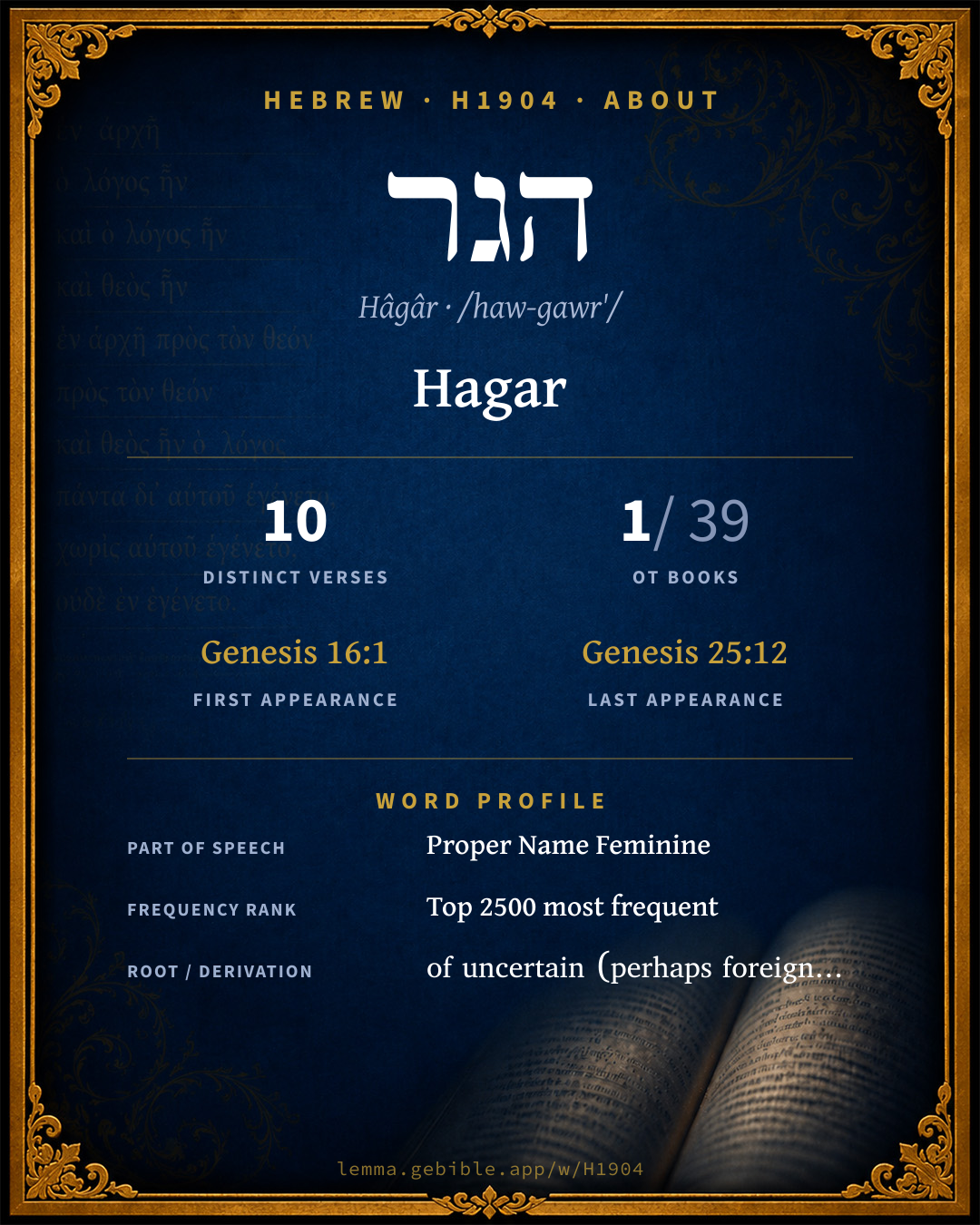
הָגָר
Hagar
BDB lists 2 entries for ‘Hagar’ fuller range ↓
Full lexicon entry — Brown-Driver-Briggs (BDB)
From Brown-Driver-Briggs (BDB)
Where this word appears
Grammar key — what these labels mean
Part of speech
- Noun
- A naming word — a person, place, thing, or idea.
Noun type
- Proper
- A name of a specific person, place, or people (e.g. Abraham, Zion, Israel).
Every verse where H1904 appears — 10 distinct verses across 1 book. Click any verse to open its interlinear word-by-word view. Verse text shown in the World English Bible for context — . Each verse’s Hebrew form is shown with its reference; the English is not keyword-highlighted, since the data carries no word-level English alignment. Use “Compare translations” on any verse to read it across multiple English versions. This concordance covers the Hebrew Bible; Septuagint (Greek Old Testament) occurrences are not indexed here.
Genesis 10 verses
- Genesis 16:1 הָגָֽר n Proper Now Sarai, Abram's wife, bore him no children. She had a handmaid, an Egyptian, whose name was Hagar.
- Genesis 16:3 הָגָ֤ר n Proper Sarai, Abram's wife, took Hagar the Egyptian, her handmaid, after Abram had lived ten years in the land of Canaan, and gave her to Abram her husband to be his wife.
- Genesis 16:4 הָגָ֖ר n Proper He went in to Hagar, and she conceived. When she saw that she had conceived, her mistress was despised in her eyes.
- Genesis 16:8 הָגָ֞ר n Proper He said, "Hagar, Sarai's handmaid, where did you come from? Where are you going?" She said, "I am fleeing from the face of my mistress Sarai."
- Genesis 16:15 הָגָ֛ר הָגָ֖ר n Proper n Proper Hagar bore a son for Abram. Abram called the name of his son, whom Hagar bore, Ishmael.
- Genesis 16:16 הָגָ֥ר n Proper Abram was eighty-six years old, when Hagar bore Ishmael to Abram.
- Genesis 21:9 הָגָ֧ר n Proper Sarah saw the son of Hagar the Egyptian, whom she had borne to Abraham, mocking.
- Genesis 21:14 הָ֠גָר n Proper Abraham rose up early in the morning, and took bread and a bottle of water, and gave it to Hagar, putting it on her shoulder, and gave her the child, and sent her away. She departed, and wandered in the wilderness of Beersheba.
- Genesis 21:17 הָגָר֙ הָגָ֑ר n Proper n Proper God heard the voice of the boy. The angel of God called to Hagar out of the sky, and said to her, "What ails you, Hagar? Don't be afraid. For God has heard the voice of the boy where he is.
- Genesis 25:12 הָגָ֧ר n Proper Now this is the history of the generations of Ishmael, Abraham's son, whom Hagar the Egyptian, Sarah's handmaid, bore to Abraham.
About this entry
At a glance — auto-summarized from this page’s data, not written by a person. Every figure links to its source below. This summary describes the numbers; it doesn’t interpret them.
At its core, הגר (Hâgâr) means “Hagar.” Its uses cluster heavily in Genesis (100% of all occurrences). Spanning 10 verses in 1 book, it ranks among the uncommon words of the Hebrew Bible. It first appears in Genesis 16:1. Each statement above links to its evidence; the full detail follows below.
Gloss history
Strong's 1890 vs modern scholarship
About this word
Strong's H1904 catalogs a Hebrew word from the Hebrew Old Testament.
These counts are not copied from any lexicon or concordance. They are computed here, from the morphology-tagged Hebrew Old Testament. What Lemma adds →
- 10
- distinct verses
- The word appears in 10 distinct verses.
- 1 / 39
- OT books
- The word appears in 1 of 39 Old Testament books.
- #2,101
- by frequency
- Top 2500 most frequent Hebrew words (rank 2,101 of 8,640 Hebrew words by occurrence).
View all 10 occurrences in the concordance →
Most concentrated in
- Genesis 10 verses 100%
By section of the Old Testament
By traditional corpus
Conventional, traditional groupings — biblical authorship is debated, so this is a traditional corpus grouping, not an authorship claim. Each share is this word’s portion of its verses in that division of the Hebrew canon. Each figure is a share of the word’s 10 distinct verses.
- Torah (Pentateuch) 10 verses · 100%
How translations render this word
Counts come from each version’s own published word-to-Strong’s tagging or interlinear alignment — an approximate guide to how each version renders this word, not a word-level alignment the data otherwise carries. Because each total is that version’s own tagged count, the per-version totals vary from one another and need not match the appearance or distinct-verse counts above. These counts may also differ from a printed concordance because Lemma counts each distinctly tagged rendering and does not collapse phrase taggings into a single head-word total. This is a fixed set of word-tagged versions (KJV, ASV, BSB, ULT) and does not change with the reading translation you choose elsewhere. Each version’s license is shown beside its name below (and on Sources).
- King James Version: Hagar 10×
- American Standard Version: Hagar 10×
- Berean Standard Bible: Hagar 10×
- unfoldingWord Literal Text: Hagar 11×
King James Version Public Domain
Renders H1904 across 12 tagged occurrences — most commonly:
Plus 2 renderings that appear only once — usually multi-word phrases or single function words the recovered tagging swept in, not distinct renderings.
American Standard Version Public Domain
Renders H1904 across 12 tagged occurrences — most commonly:
Plus 2 renderings that appear only once — usually multi-word phrases or single function words the recovered tagging swept in, not distinct renderings.
Berean Standard Bible Public Domain
Renders H1904 across 11 tagged occurrences — most commonly:
Plus 1 rendering that appears only once — usually multi-word phrases or single function words the recovered tagging swept in, not distinct renderings. Not rendered by a distinct English word in 1 further occurrence.
unfoldingWord Literal Text CC BY-SA 4.0
Renders H1904 across 12 tagged occurrences — most commonly:
Plus 1 rendering that appears only once — usually multi-word phrases or single function words the recovered tagging swept in, not distinct renderings.
Senses in BDB
The 2 senses BDB distinguishes for this word, in lexicon order (not ranked by frequency or importance). The full entry — with sub-senses — is in the Lexicon Entry tab.
- Hagar = "flight"
- Sarah's Egyptian slave girl, Abraham's concubine, Ishmael's mother
Word origin
n.pr.f. Hagar, Sarah’s Egyptian maid, mother of Ishmael, Gn 16:1, 4, 8 (all J), v 3, 15(×2), 16; 25:12 (all P), 21:9, 14, 17(×2) (all E).
— Brown-Driver-Briggs (Oxford 1906, public domain), digitized via Sefaria, supplemented by the OpenScriptures HebrewLexicon (CC BY 4.0). See Sources.
Origin: of uncertain (perhaps foreign) derivation
Jastrow Dictionary
A second Hebrew/Aramaic lexicon for comparison, covering Aramaic and post-biblical (Talmudic, Targumic, Midrashic) usage that the biblical-Hebrew BDB does not. Matched by lemma rather than by Strong’s number, so a lemma may carry more than one Jastrow headword (shown separately below), and the entries cover usage well beyond the Bible.
גֵּר
- 1. a dweller. Sabb. 104ᵃ, v. preced.
- 2. a stranger. Tanḥ. Vayigg. 4 גרא שנעשה ג׳ he is named Gera, because he (Joseph) became a stranger, v. גּוּר.—Esp. a proselyte, convert to Judaism. Yeb. 46ᵇ; Ber. 47ᵇ לעולם אינו ג׳ וכ׳ one is not a proselyte until he has been &c. Yeb. l. c.; Kidd. 62ᵇ ג׳ צריך שלשה a proselyte requires a court of three for making declaration and immersion. Kerith. II, 1 ג׳ מחוסר כפרה a proselyte who has not yet offered a sacrifice in the Temple; a. v. fr.—ג׳ צֶדֶק a full, true proselyte, ג׳ תֹּושָׁב one who, for the sake of acquiring limited citizenship in Palestine, renounces idolatry. Snh. 96ᵇ; Gitt. 57ᵇ; a. fr.—ג׳ שקר an insincere proselyte (from impure motives). Y. B. Mets. V, 10ᶜ.—Pl. גֵּרִים, constr. גֵּרֵי, גֵּירֵי.—ג׳ גרורים self-made converts, not formally admitted. Ab. Zar. 3ᵇ; 24ᵃ; a. e.—גרי אריות lion-proselytes, i.e. proselytes from mere fear (with ref. to II Kings XVII, 25 sq.). Ḥull. 3ᵇ, opp. גרי אמת. Kidd. 75ᵇ; Snh. 85ᵇ; a. fr.—גרי חלומות proselytes converted by the advice of a dreamer or an interpreter of dreams; גרי מרדכי ואסתר such as joined the Jewish ranks from motives like those prevalent in the days of Mordecai and Esther (Esth. VIII, 17). Yeb. 24ᵇ.—Nidd. VII, 3 (56ᵇ) גרים טועין Ar. (ed. וטועין) proselytes not living in accordance with the Jewish usages.—בן גרים a descendant of proselytes. B. Mets. IV, 10 (58ᵇ).—Sabb. 33ᵇ יהודה בן ג׳. [Mode of admission, v. Yeb. 47ᵃ.—Views about converts, v. Num. R. s. 8; Nidd. 13ᵇ; Pes. 87ᵇ; a. fr.]. Fem. גֵּרָה. Gen. R. s. 88, end.—Usu. גִּיֹּורֶת. Keth. IV, 3; a. fr. e.g. 2 Kings 17:25
הָגַר
- , Ned. 49ᵇ והוגרני Ar., v. חָגַר
הָגָר
- (b. h.) pr. n. f. Hagar, hand-maid of Sarah. Gen. R. s. 45, beg.; a. fr.
A Dictionary of the Targumim, the Talmud Babli and Yerushalmi, and the Midrashic Literature (Marcus Jastrow; London, Luzac, 1903) — Public Domain. Digitized via Sefaria. Digitized via Sefaria. Full attribution on Sources.
Forms in the corpus
The 10 distinct written forms H1904 takes in the Hebrew Bible, most frequent first — each parse links to that state’s occurrences in the concordance. Hebrew forms include their vowel points and cantillation, so a single lemma takes many written forms.
| Form | Parsing | Example | Uses |
|---|---|---|---|
| הָגָ֖ר | Noun, Proper | Genesis 16:4 | 2 |
| הָגָ֧ר | Noun, Proper | Genesis 21:9 | 2 |
| הָ֠גָר | Noun, Proper | Genesis 21:14 | 1 |
| הָגָ֑ר | Noun, Proper | Genesis 21:17 | 1 |
| הָגָ֛ר | Noun, Proper | Genesis 16:15 | 1 |
| הָגָ֞ר | Noun, Proper | Genesis 16:8 | 1 |
| הָגָ֤ר | Noun, Proper | Genesis 16:3 | 1 |
| הָגָ֥ר | Noun, Proper | Genesis 16:16 | 1 |
| הָגָֽר | Noun, Proper | Genesis 16:1 | 1 |
| הָגָר֙ | Noun, Proper | Genesis 21:17 | 1 |
Same root — word family
Other BDB entries built from the same root as H1904, grouped by Strong’s listed origin. These share a root / origin per the lexicon — not necessarily a shared meaning. Each links to that word’s own entry.
Proper names from this root
People and places named from this root — a name, not an additional meaning of the word.
Compare all same-root words → 2 of the same-root words are proper names (people or places). They share a root, not necessarily a meaning.
Bible dictionary
Public-domain dictionary articles matched to this entry by name (Hagar). A biblical name can be shared by more than one person or place, so an article may treat several.
Easton's Bible Dictionary · M. G. Easton, 1897
Flight, or, according to others, stranger, an Egyptian, Sarah's handmaid (Gen. 16:1; 21:9, 10), whom she gave to Abraham (q.v.) as a secondary wife (16:2). When she was about to become a mother she fled from the cruelty of her mistress, intending apparently to return to her relatives in Egypt, through the desert of Shur, which lay between. Wearied and worn she had reached the place she distinguished by the name of Beer-lahai-roi ("the well of the visible God"), where the angel of the Lord appeared to her. In obedience to the heavenly visitor she returned to the tent of Abraham, where her son Ishmael was born, and where she remained (16) till after the birth of Isaac, the space of fourteen years. Sarah after this began to vent her dissatisfaction both on Hagar and her child. Ishmael's conduct was insulting to Sarah, and she insisted that he and his mother should be dismissed. This was accordingly done, although with reluctance on the part of Abraham (Gen. 21:14). They wandered out into the wilderness, where Ishmael, exhausted with his journey and faint from thirst, seemed about to die. Hagar "lifted up her voice and wept," and the angel of the Lord, as before, appeared unto her, and she was comforted and delivered out of her distresses (Gen. 21:18, 19).
Ishmael afterwards established himself in the wilderness of Paran, where he married an Egyptian (Gen. 21:20, 21).
"Hagar" allegorically represents the Jewish church (Gal. 4:24), in bondage to the ceremonial law; while "Sarah" represents the Christian church, which is free.
Smith's Bible Dictionary · William Smith, 1863
(flight), an Egyptian woman, the handmaid or slave of Sarah, (Genesis 16:1) whom the latter gave as a concubine to Abraham, after he had dwelt ten years in the land of Canaan and had no children by Sarah. ch (Genesis 16:2,3) (B.C. 1912.) When Hagar saw that she had conceived, "her mistress was despised in her eyes," v. 4, and Sarah, with the anger, we may suppose, of a free woman rather than of a wife, reproached Abraham for the results of her own act. Hagar fled, turning her steps toward her native land through the great wilderness traversed by the Egyptian road. By the fountain in the way to Shur the angel of the Lord found her, charged her to return and submit herself under the hands of her mistress, and delivered the remarkable prophecy respecting her unborn child recorded in vs. 10-12. On her return she gave birth to Ishmael, and Abraham was then eighty-six years old. When Ishmael was about sixteen years old, he was caught by Sarah making sport of her young son Isaac at the festival of his weaning, and Sarah demanded the expulsion of Hagar and her son. She again fled toward Egypt, and when in despair at the want of water, an angel again appeared to her, pointed out a fountain close by, and renewed the former promises to her. (Genesis 21:9-21) St. Paul, (Galatians 4:25) refers to her as the type of the old covenant of the law.
Hitchcock's Bible Names Dictionary · Roswell D. Hitchcock, 1869
a stranger; one that fears
Classic public-domain reference works; full attribution on Sources.
Septuagint verse parallels
This word appears in 10 verses that also exist in the Greek Old Testament (Septuagint), out of the 10 Hebrew verses it occurs in. You can read those verses in Greek by switching the Old Testament edition to the Septuagint.
Read these verses in the Septuagint
This is a verse-level parallel only — the same verses exist in both the Hebrew and Greek Old Testaments. No word-level Hebrew↔Greek correspondence is claimed: the data carries no such alignment, so no Greek word is shown as this Hebrew word’s translation. Coverage is not total — the Septuagint omits the deuterocanon and renumbers the Psalms, so some Hebrew verses have no direct Greek parallel.