
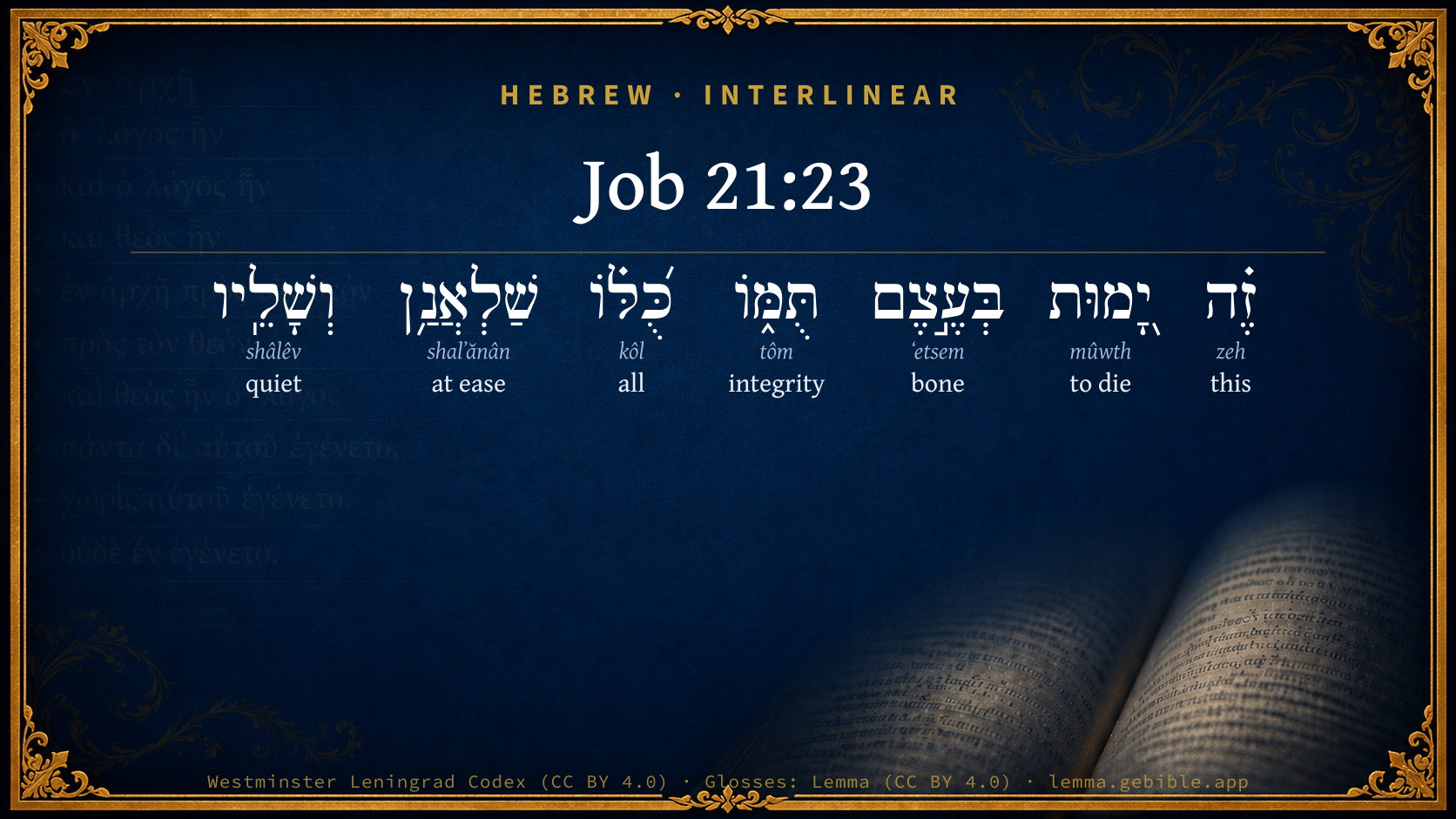
Job 21:23

Hebrew (Westminster Leningrad Codex) Job 21:23 appears in the Hebrew Old Testament. The text above is from the Westminster Leningrad Codex. Each word links to its Strong’s number, a concise gloss, and parsing drawn from the Open Scriptures Hebrew Bible morphology. Click any word for its full Brown-Driver-Briggs (BDB) entry.
Download image
Cite this verse

Job 21:23 (World English Bible). Public Domain. Lemma interlinear Bible study tool, https://lemma.gebible.app/v/job/21/23.

Show BibTeX & RIS
BibTeX
RIS
English Translation
One dies in his full strength, Being wholly at ease and quiet.
World English Bible · Public Domain
Highlights
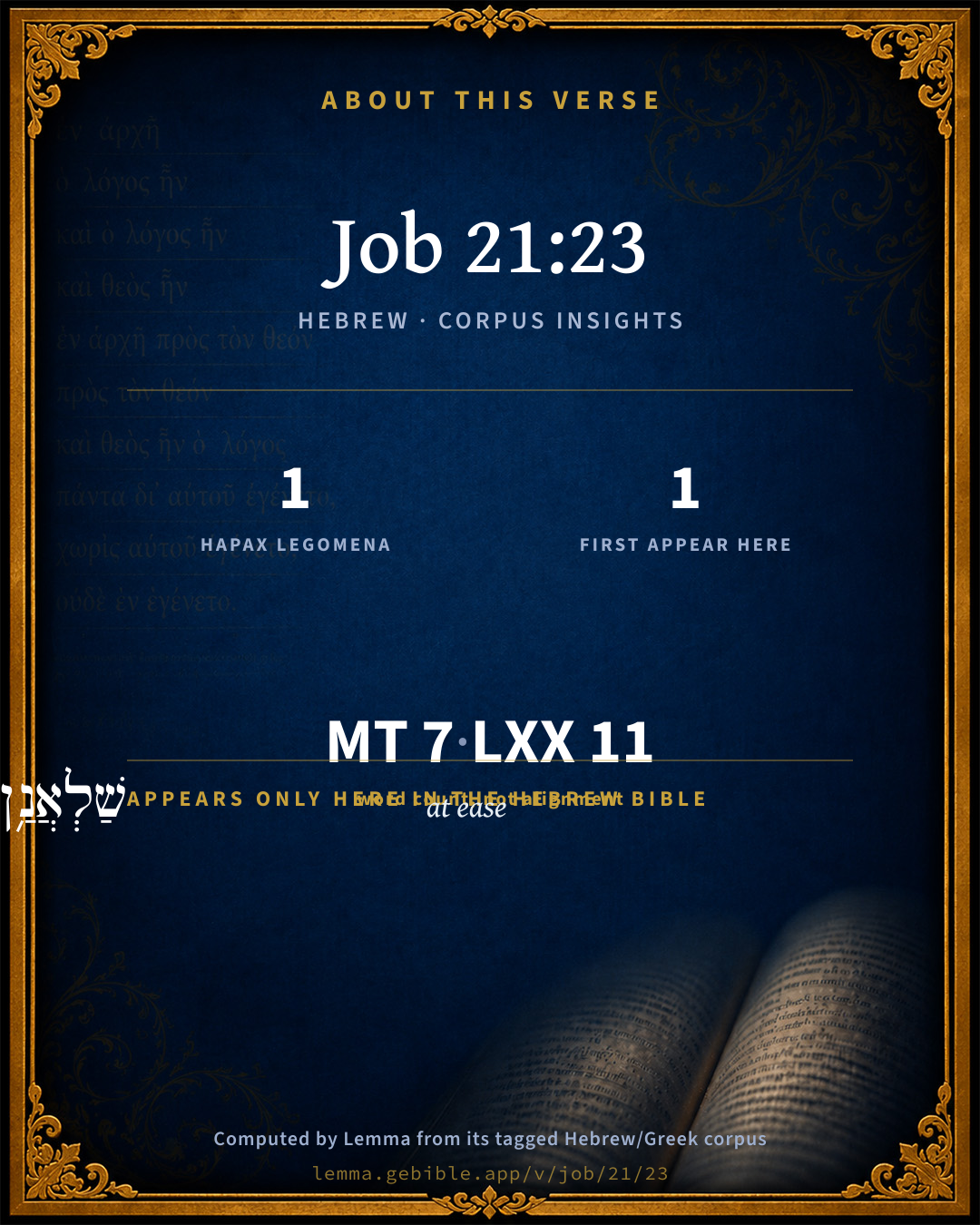
  • 1 hapax legomenon — only here in the Hebrew Bible
  • 1 first appearance in the Hebrew Bible
Full analysis ↓
Download a study sheet

One document with this verse’s original text, its word-by-word gloss line, the meaning frame, cross-references with their text, attributed commentary, and full source and license credits — printable, and it pastes into notes with its structure intact.

This verse Autodidact and up

Study sheet (.html) Plain text (.txt)

A passage Seminary Student

Up to 50 verses in one chapter. A passage sheet keeps up to 6 commentary sources and 12 cross-references per verse, in the order this page ranks them, and says so on the sheet whenever that leaves anything out. Ask for a single verse and you get the Autodidact verse sheet above.

Everything on this page stays free to read, with no account — the sheet is a download of what is already on screen, not access to it.

Want to remove ads? Support Godless Engineer
Compare translations 3

The same verse in 3 English versions, stacked beneath the original-language interlinear above. Click any original word for its lexicon entry.

Each is an independent rendering of the whole verse — the interlinear is not word-aligned to these translations.

Highlighted words mark where these versions differ — a whole-verse word diff, not a word-by-word alignment.

  • World English Bible Public Domain
    One dies in his full strength, Being wholly at ease and quiet.
  • King James Version Public Domain
    One dieth in his full strength, being wholly at ease and quiet.
  • unfoldingWord Literal Text CC BY-SA 4.0
    This one dies in the bone of his perfection; all of him tranquil and secure.

unfoldingWord Literal Text — © unfoldingWord, licensed CC BY-SA 4.0. Word-aligned USFM3 via Door43 (git.door43.org/unfoldingWord/en_ult).

Versions to compare (up to 4)

3 of 4 selected

Show all 18 translations

Every available English version of this verse, each an independent rendering of the whole verse.

  • World English Bible Public Domain
    One dies in his full strength, Being wholly at ease and quiet.
  • Berean Standard Bible Public Domain
    One man dies full of vigor, completely secure and at ease.
  • Majority Standard Bible Public Domain
    One man dies full of vigor, completely secure and at ease.
  • King James Version Public Domain
    One dieth in his full strength, being wholly at ease and quiet.
  • American Standard Version (1901) Public Domain
    One dieth in his full strength, Being wholly at ease and quiet:
  • Revised Version (1885) Public Domain
    One dieth in his full strength, being wholly at ease and quiet:
  • Geneva Bible (1599) Public Domain
    One dyeth in his full strength, being in all ease and prosperitie.
  • Douay-Rheims (1899) Public Domain
    One man dieth strong, and hale, rich and happy.
  • Young's Literal Translation Public Domain
    This `one' dieth in his perfect strength, Wholly at ease and quiet.
  • Literal Standard Version CC BY-SA 4.0
    This [one] dies in his perfect strength, || Wholly at ease and quiet.
  • Unlocked Literal Bible CC BY-SA 4.0
    One man dies in his full strength, being completely quiet and at ease.
  • unfoldingWord Literal Text CC BY-SA 4.0
    This one dies in the bone of his perfection; all of him tranquil and secure.
  • Darby Bible Public Domain
    One dieth in his full strength, being wholly at ease and quiet;
  • World Messianic Bible Public Domain
    One dies in his full strength, being wholly at ease and quiet.
  • Webster's Bible Public Domain
    One dieth in his full strength, being wholly at ease and quiet.
  • Free Bible Version CC BY-SA 4.0
    One person dies in good health, totally comfortable and secure.
  • Bible in Basic English Public Domain
    One comes to his end in complete well-being, full of peace and quiet:
  • JPS Tanakh (1917) Public Domain
    One dieth in his full strength, being wholly at ease and quiet;

Literal Standard Version (2020), Covenant Press — licensed CC BY-SA 4.0. Text via the HelloAO Bible API (eBible.org). Unlocked Literal Bible (unfoldingWord) — licensed CC BY-SA 4.0. Text via the HelloAO Bible API (eBible.org). unfoldingWord Literal Text — © unfoldingWord, licensed CC BY-SA 4.0. Word-aligned USFM3 via Door43 (git.door43.org/unfoldingWord/en_ult). Free Bible Version, Dr. Jonathan Gallagher — licensed CC BY-SA 4.0. Text via the HelloAO Bible API (eBible.org).

Word by word

More ways to search: Search by grammar → Find every occurrence → Compare this word →

Practice this passage: Drill this verse → Learn its vocabulary →

About this verse

These counts appear in no published source. They are computed here, from the morphology-tagged text and Lemma’s own curated glosses. What Lemma adds →

7
words
7
distinct lemmas
Wisdom
section

Notable vocabulary

1 hapax legomenon — a word that appears only here in the entire Hebrew Bible:

  • שַׁלְאֲנַ֥ן at ease H7946

First appearance in Scripture

This word makes its first canonical appearance in the Hebrew Bible here:

  • שַׁלְאֲנַ֥ן at ease H7946

Shared distinctive vocabulary

וְשָׁלֵֽיו quiet H7961 occurs in 8 verses of the Hebrew Bible. Also found in:

Grammatical profile

  • 1 verb
  • 3 nouns
  • 2 adjectives
  • 1 pronoun

Verb forms

  • יָ֭מוּת Qal · Imperfect

Hebrew & Septuagint length

In English translation the verse runs 12 words from the Hebrew and 13 from the Septuagint (LXX English) — closely comparable.

A rough comparison of the two English renderings, which tokenize alike — not a word-level alignment.

Word counts can differ between the Hebrew and the Greek without any difference in meaning — e.g. the Hebrew direct-object marker אֵת has no separate Greek word, and Greek often adds the article ὁ.

In the original languages it is 7 Hebrew tokens and 11 Greek tokens — but the two are counted differently (Hebrew bundles its prefixes and suffixes into one token; the Greek is in lemma form), so that isn’t a like-for-like length.

Cross-references

4

Topical passages linked to Job 21:23 in the Treasury of Scripture Knowledge — connected by theme and wording, ordered by reader-vote popularity; previews shown in the World English Bible.

  • Job 20:22–23 In the fullness of his sufficiency, distress shall overtake him: The hand of everyone who is in misery shall come on him.
  • Psalms 49:17 For when he dies he shall carry nothing away. His glory shall not descend after him.
  • Luke 12:19–21 I will tell my soul, "Soul, you have many goods laid up for many years. Take your ease, eat, drink, be merry."'
  • Psalms 73:4–5 For there are no struggles in their death, But their strength is firm.

Cross-references courtesy of OpenBible.info (CC BY 4.0).

Hebrew and Greek witnesses Masoretic Hebrew ↔ Greek Septuagint

The same verse in the two great witnesses to the Old Testament, shown verse-for-verse.

These are two independent witnesses, not word-aligned to each other, and the Septuagint is shown in lemma (dictionary) form.

Hebrew Job 21:23 Masoretic · Westminster Leningrad Codex

זֶ֗ה יָ֭מוּת בְּעֶ֣צֶם תֻּמּ֑וֹ כֻּ֝לּ֗וֹ שַׁלְאֲנַ֥ן וְשָׁלֵֽיו

One dies in his full strength, Being wholly at ease and quiet.

World English Bible · Public Domain

Greek LXX Job 21:23 Septuagint · lemma form

οὗτος ἀποθνήσκω ἐν κράτος ἁπλοσύνη αὐτός ὅλος δέ εὐπαθέω καί εὐθηνέω

One shall die in his perfect strength, and wholly at ease and prosperous;

LXX2012 (modern English Septuagint) · Public Domain

On this verse, John Gill's Exposition discusses the Septuagint’s reading. Read the note in Commentary ↓

Hebrew: Westminster Leningrad Codex (CC BY 4.0). Greek: Septuagint (public domain); English from LXX2012 (modern English Septuagint) (Public Domain). How the Septuagint differs from the Hebrew →

Commentary

Notes on Job 21:23 from classic Christian and Jewish commentators (each source and its license shown beneath its notes). The classic Christian expositions comment on the surrounding passage and are grouped to its opening verse, so a note may address several verses; the Jewish commentaries on the Tanakh (Rashi and others) are per-verse, so they appear only where the commentator wrote on this verse.

Lemma curates 59 commentaries, every one of them public domain or Creative Commons licensed, each selected and text-cleaned for this edition rather than reprinted as found. About our sources →

Trapp's Complete Commentary

John Trapp

Job 21:23 One dieth in his full strength, being wholly at ease and quiet.

Ver. 23. One dieth in his full strength] Iste moritur, There is one dieth in his very perfections; or, in the strength of his perfection, when he is in the zenith, in the highest degree, of earthly felicity; and he seemeth to point at some one eminent wicked person, well known to them all. Confer Ecc 9:2. God is pleased to do wonderful contradictory things in man’s reason; so that we must needs confess an unsearchableness in his ways. In hoc opere, ratio humana talpa magis caeca est, saith Brentius; In this work of his, human reason is blinder than a mole. Averroes turned atheist upon it, and Aristotle was little better, as being accused at Athens and banished into Chalcis, quod de divinitate male sentiret. because he was thinking poorly about the gods.

Being wholly at ease and quiet] At ease in body and quiet in mind. The common sort ask, What should ail such a man? The Irish, What such a one meaneth to die?

John Trapp, A Commentary or Exposition upon All the Books of the Old and New Testament (1647–1656) — public domain. Text from a community e-Sword module.

The Biblical Illustrator

Joseph S. Exell

Job_21:23; Job_21:25-26

One dieth in his full strength . . . Another dieth in the bitterness of his soul.

Providence vindicated against the superficial observer

That which hampers men most in understanding providence is its tremendous extent. It is like a great poem, and all that one life or one observer can read is a few words, or at most, a few lines. God does not always show His hand. Sometimes He does, and when it suits Him better, He hides it. It is expedient that some mystery hang over the dispensations of this life. Whatever is unsatisfactory, therefore, at present plainly suggests that the scheme is yet unfinished. The unsatisfactory nature of the present suggests a future. Revelation steps in to tell us that this life is but the vestibule of existence. One or two considerations will modify our hasty conclusions in regard to the real fortunes of those who live and die around us, whether their circumstances be apparently prosperous or depressed.

1. Happiness and misery are by no means always according to appearance. They depend more upon the inner state of the soul than its outward surroundings, and are therefore put, to some extent, within the power of everyone.

2. Men make their judgments too much from the outside. It is the outside look of providence that puzzles us, and makes understanding difficult.

We arrive at the following conclusions--

1. God is no indifferent spectator of human fortunes, but manages them on a perfectly righteous plan.

2. The deceptive character of appearances makes it necessary to subtract a good deal from the apparent happiness and misery of the world at the outset of our investigations.

3. Physical disadvantages, and deprivation of the members and senses are capable of compensation in the other world.

4. The difficulty in understanding aright the providence of God, arises from the complex nature of many of His acts, which may have various distinct branches or departments, as penal, disciplinary, merciful, and even remunerative, all in a single stroke.

5. We can understand enough of the Divine doings to enable us to trust for the remainder.

6. The root of all happiness is a good conscience, and this is put within the reach of all.

7. A good conscience can only be had and maintained by seeking the kingdom of God and His righteousness with all the means in our power.

8. And for all the purposes of practical piety, it is rather necessary we should remember the superintending arm of the great Worker, than that we should understand what He is doing. (William Isaac Keay.)

The Biblical Illustrator, edited by Joseph S. Exell (c. 1880s–1900s) — public domain. Text from a community e-Sword module.

Joseph Benson's Commentary

Job 21:23-24. One dieth in his full strength — In a state of perfect health, and strength, and prosperity; all which this phrase implies. His breasts are full of milk — The Hebrew word, עשׂין, gnatin, here rendered breasts, is not elsewhere used in Scripture, and therefore is translated different ways. Houbigant renders the clause, When his bowels are loaden with fatness. Others, When his milk-pails are full of milk; or, his oil-vessels are full of fatness. And his bones are moistened with marrow — Which is opposed to that dryness of the bones (Job 30:30; Psa 102:3;) which is caused by old age or grievous distempers and calamities.

Joseph Benson's Commentary on the Old and New Testaments (1811–1818) — public domain. Text from a community e-Sword module.

Geneva Bible (1599)

Geneva Bible translators

Meaning, the wicked.

Geneva Bible (1599) marginal notes — public domain. Text via Bolls.life.

Jamieson, Fausset & Brown

Robert Jamieson, A. R. Fausset & David Brown

Literally, "in the bone of his perfection," that is, the full strength of unimpaired prosperity [UMBREIT].

Jamieson, Fausset & Brown — Commentary Critical and Explanatory on the Whole Bible (1871) — public domain (CC PDM 1.0). Text via the HelloAO Bible API.

Adam Clarke's Commentary

Verse 23. One dieth in his full strength] In this and the three following verses Job shows that the inequality of fortune, goods, health, strength, c., decides nothing either for or against persons in reference to the approbation or disapprobation of God, as these various lots are no indications of their wickedness or innocence. One has a sudden, another a lingering death but by none of these can their eternal states be determined.

Adam Clarke's Commentary on the Bible (1810–1826) — public domain. Text from a community e-Sword/MySword module.

Ellicott's Commentary for English Readers

(23) One dieth.—Job enlarges on the inequality of human fate, showing that death is the only equaliser.

A Bible Commentary for English Readers, edited by Charles John Ellicott (1878–1897) — public domain. Text from a community e-Sword module.

The Cambridge Bible for Schools and Colleges

gen. ed. J. J. S. Perowne

23. in his full strength] lit. in his very perfection, or completeness, meaning, in the full enjoyment of all that made his lot complete, wanting nothing—as the second clause explains.

The Cambridge Bible for Schools and Colleges (gen. ed. J. J. S. Perowne; Cambridge University Press, 1878–1918) — public domain. Text from a community e-Sword module.

John Gill's Exposition

His breasts are full of milk,.... As this is not literally true of men, some versions read the words otherwise; his bowels or intestines are full of fat, as the Vulgate Latin and Septuagint; and others, his sides or ribs are full of fat, as the Syriac and Arabic; the words for "side" and "fat" being near in sound to those here used; and so it describes a man fit and plump, and fleshy, when death lays hold upon him, and not wasted with consumptions and pining sickness, as in the case of some, Job 33:21; the word for breasts is observed by some (h) to signify, in the Arabic language, "vessels", in which liquors are contained, and in the Misnic language such as they put oil in, out of which oil is squeezed; and so are thought here to intend such vessels as are milked into; and therefore render it by milk pails; so Mr. Broughton, "his pails are full of milk" (i); which may denote the abundance of good things enjoyed by such persons, as rivers of honey and butter; contrary to Zophar's notion, Job 20:17; and a large increase of oil and wine, and all temporal worldly good; amidst the plenty of which such die:

and his bones are moistened with marrow; not dried up through a broken spirit, or with grief and trouble, and through the decays of old age; but, being full of marrow, are moist, and firm and strong; and so it intimates, that such, at the time when death seizes them, are of an hale, healthful, robust, and strong constitution; see Psa 73:4.

(h) See Kimchi, Sepher Shorash. rad. and Jarchi and Ben Melech in loc. (i) "muletralia ejus", Montanus, Beza, Junius & Tremellius, Piscator, Mercerus, Bolducius, Drusius, Cocceius, Schmidt.

John Gill's Exposition of the Whole Bible (1746–1763) — public domain (CC PDM 1.0). Text via the HelloAO Bible API.

Albert Barnes' Notes on the Bible

One dieth in his full strength - Margin, “very perfection,” or, “in the strength of his perfection.” The meaning is, that he dies in the very prime and vigor of life, surrounded with everything that can contribute to comfort. Of the truth of this position, no one can doubt; and the wonder is, that the friends of Job had not seen or admitted it.

Being wholly at ease and quiet - That is, having everything to make them happy, so far as external circumstances are concerned. He is borne down by no calamities; he is overwhelmed by no sudden and heavy judgments. The phrase in this verse rendered “full strength” (תמו בעצם be‛etsem tômô), is literally, “in the bone of his perfection.” It means full prosperity.

Albert Barnes' Notes on the Bible (1834–1885) — public domain. Text from a community e-Sword/MySword module.

Haydock's Catholic Bible Commentary

Hale, or healthy. Hebrew, "in perfect strength." (Haydock) --- Septuagint, "simplicity, or folly." St. Augustine reads with the old Vulgate, "in the strength of his simplicity, (Calmet) or innocence. (Haydock) --- These outward appearances prove nothing for interior piety or wickedness. (Calmet)

George Leo Haydock (1774–1849), Haydock's Catholic Family Bible and Commentary, 1859 edition — public domain. Excludes Psalms (Douay-Rheims chapter numbering differs from Protestant) and Deuterocanonical books (Catholic canon only).

Matthew Poole's English Annotations

One, to wit, either,

1. One of these wicked men, of whose condition he is here speaking. Or,

2. Any one man, whether good or bad. In his full strength; in a state of perfect health, and strength, and prosperity; all which this phrase implies.

Matthew Poole's English Annotations on the Holy Bible (1683–1685) — public domain. Text from a community e-Sword/MySword module.

Whedon's Commentary on the Bible

Daniel D. Whedon

23. One dieth — The wicked man whose life of uninterrupted prosperity he proceeds to describe.

Daniel D. Whedon (gen. ed.), Commentary on the Old and New Testaments (1874–1909) — public domain. Text from a community e-Sword module.

The Pulpit Commentary

One dieth in his full strength, being wholly at ease and quiet. Some continue healthy and vigorous in body, peaceful and satisfied in mind, up to the very moment of their departure (comp. ver. 13, "They spend their days in wealth, and in a moment go down to the grave").

Vers. 23-26. The common fate.

Job has pointed out that the wicked are not always punished in this life with external trouble; on the contrary, they often flourish to the end in unbroken prosperity (ver. 7, etc.). He next proceeds to show that the end of the happy and the sorrowful is the same. The prosperous had man does not meet with a reverse of fortune at last, nor does the afflicted righteous man find an earthly reward in his later days. Both go down to death without a sign of the reversal of their condition which justice would seem to demand.

I DEATH HAPPENS ALIKE TO ALL. As Shakespeare puts it, this may be said of all of us"Nothing can we call our own, but death: And that small model of the barren earth, That serves as paste and cover to our bones.

The "great leveller" should not only humble pride, but also teach us more bureau brotherhood. If we are brothers" in death, should we not he brothers also in life? The deepest facts of life are common to all men. Our differences of state and rank only affect what is superficial.

II DEATH IS NOT FELT TO BE THE SAME BY ALL. Our feelings are affected by contrasts and changes, not by our absolute condition at any moment. The candle-light that looks brilliant to the prisoner in a dungeon, is most gloomy to a man who has just come from the sunshine. Death is all loss and darkness to one who is suddenly snatched away from earthly enjoyment, but it is a haven of rest to the storm-tossed soul. The same death has very different meanings according to our spiritual condition. In sin and worldliness and heathenish ignorance, death is a going out into the darkness. To the Christian it is falling asleep in Christ.

III THESE IS NO EARTHLY ADJUSTMENT OF LOTS. Job is quite right. It is vain to expect it. If it has not come yet, we have no reason to believe that it will come later on, even at the last. There is nothing in experience to warrant us in the hope that it will come at all. In many respects, no doubts moral causes work out visible effects on earth. But this is by no means universal, nor are the effects always adequate to the requirements of justice.

IV THERE MUST BE A FUTURE LIFE. The story is not complete on earth. It breaks off suddenly without any kind of finish. This abruptness of the visible ending of life points to a continuance beyond the grave. Justice requires that the unfinished life should have its appropriate conclusion. Not from necessity of nature, but from moral considerations, we conclude that the broken threads must be picked up and drawn together again to make the perfect pattern.

V THE SPIRITUAL LIFE IS INFINITELY SUPERIOR TO THE MATERIAL. It looks as though the differences of external fortune could be treated with contempt. The good have misfortune, the bad have prosperity. These are slight matters in the eyes of Providence, because real prosperity, is spiritual prosperity, and that is only possible to those who live a right life. W.F.A.

The Pulpit Commentary (1880–1919), ed. H.D.M. Spence-Jones & Joseph S. Exell — public domain. Text from a community e-Sword module.

Rashi

Rabbi Shlomo Yitzchaki (Rashi)

This one The wicked man.

dies (Is punished.) in his full strength in the appearance of his perfection, lacking nothing.

tranquil Heb. שַׁלְאֲנָן, like שַׁאֲנָן.

Rashi on the Tanakh — English translations: “The Judaica Press complete Tanach with Rashi, translated by A. J. Rosenberg” (CC BY 4.0); “Pentateuch with Rashi's commentary by M. Rosenbaum and A.M. Silbermann, 1929-1934” (public domain); “The Metsudah Tanach series, Lakewood, N.J” (CC BY 4.0); and “The Book of Joshua, Metsudah Publications, 1997” (CC BY 4.0). Text via Sefaria.

Lesson kit

Teaching starters — assembled from the data on this page, not authored interpretation. Every prompt links to the verse data it draws on. Edit before teaching.

Job, in the Wisdom, opens this verse with 7 words (7 distinct Hebrew lemmas). Its most distinctive word is shalʼănân (“at ease”). A historical commentator’s framing appears above. Read the whole chapter for the surrounding context.

Discussion questions

  1. How does “at ease” (shalʼănân) shape what this verse is saying?
  2. 1 word here appears nowhere else in the Hebrew Bible. Why might the author reach for such rare wording?
  3. This is the first place “at ease” appears in Scripture (first appears here). What does its debut here establish?
  4. How does 1 Chronicles 4:40, which shares the word «quiet», read alongside this verse?
  5. These translations render this verse differently; the difference is in the English rendering, not the original. What questions does that raise?
  6. «יָ֭מוּת» is a Qal Imperfect verb. How does that grammatical form shape the action described?
  7. Compare how Trapp's Complete Commentary and The Biblical Illustrator read this verse. Where do they agree or differ?

Things to notice

Reading settings

Reading text

Shown beneath each verse's original-language words.

Old Testament
Old Testament edition

Read the OT as the Masoretic Hebrew (MT) or the Greek Septuagint (LXX).

English shown for the Greek Septuagint (in the Hebrew ↔ Greek comparison).

Comparing translations? Open the Compare panel on any verse page to stack up to four side by side.