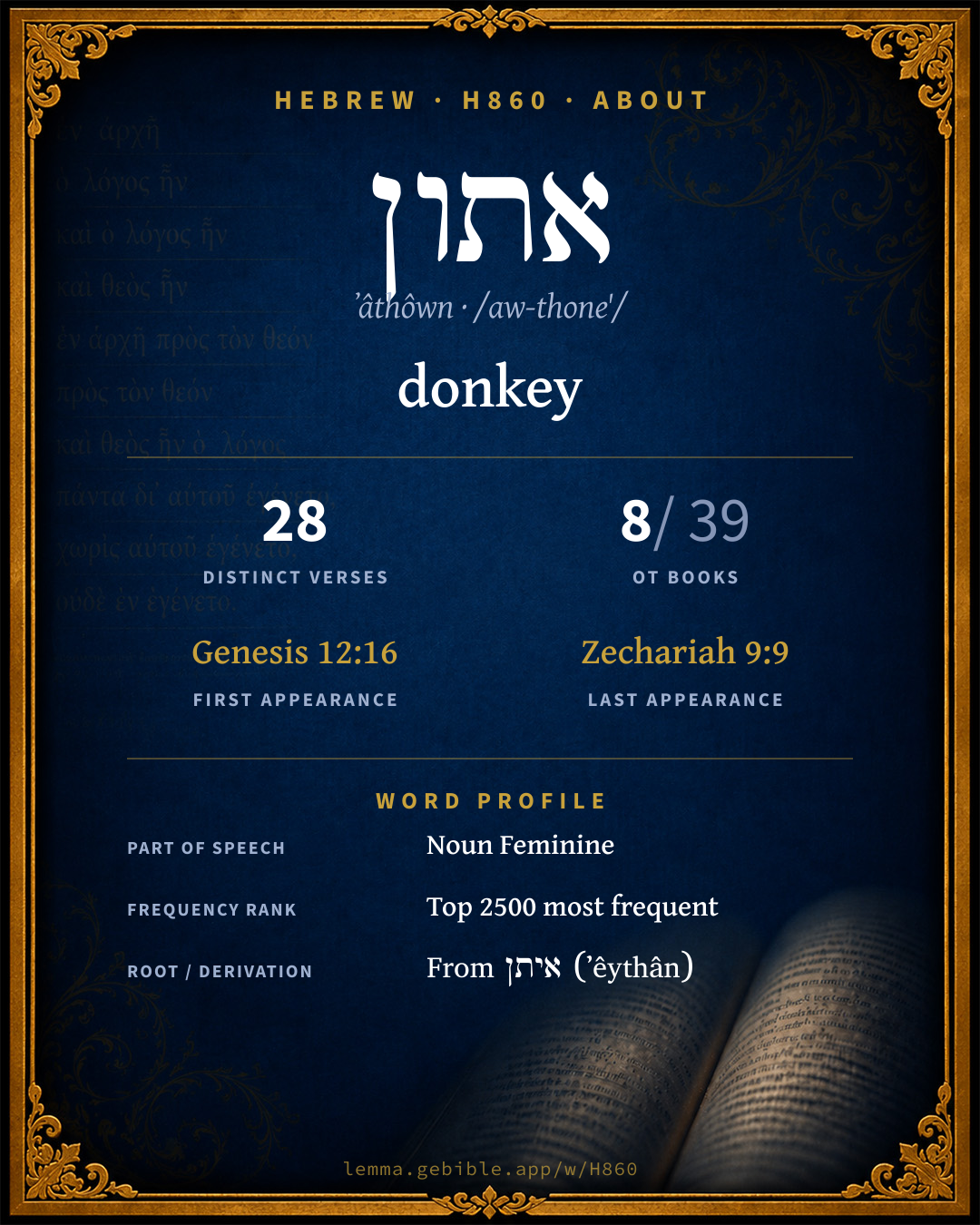
אָתוֹן
donkey
Full lexicon entry — Brown-Driver-Briggs (BDB)
From Brown-Driver-Briggs (BDB)
Where this word appears
See every Absolute-state word in the Hebrew Bible →
Grammar key — what these labels mean
Part of speech
- Noun
- A naming word — a person, place, thing, or idea.
Noun type
- Common
- A common noun — a general class of person, place, or thing (“king,” “city,” “water”), not a specific name.
State
- Absolute
- The independent form of a noun, not bound to a following word.
- Construct
- A noun bound to a following noun in a possessive / “of” relationship (the construct chain).
Gender
- Feminine
- Grammatically feminine.
Number
- Singular
- One.
- Plural
- More than one (in Hebrew, generally three or more).
Grammatical forms
- Noun, Common, Feminine, Plural, Absolute 18 times (53%)
- Noun, Common, Feminine, Singular, Absolute 11 times (32%)
- Noun, Common, Feminine, Singular, Construct 5 times (15%)
Parsed forms decoded from the imported morphology (morphhb / Westminster Leningrad Codex — WLC text public domain, morphhb tagging CC BY 4.0), counted across 34 parsed occurrences — not distinct verses.
Every verse where H860 appears — 28 distinct verses across 8 books. Click any verse to open its interlinear word-by-word view. Verse text shown in the World English Bible for context — . Each verse’s Hebrew form is shown with its reference; the English is not keyword-highlighted, since the data carries no word-level English alignment. Use “Compare translations” on any verse to read it across multiple English versions. This concordance covers the Hebrew Bible; Septuagint (Greek Old Testament) occurrences are not indexed here.
Genesis 4 verses
- Genesis 12:16 וַ/אֲתֹנֹ֖ת conj + n c fp He dealt well with Abram for her sake. He had sheep, and oxen, and male donkeys, and men-servants, and maid-servants, and female donkeys, and camels.
- Genesis 32:15 אֲתֹנֹ֣ת n c fp thirty milk camels and their colts, forty cows, ten bulls, twenty she-donkeys and ten foals.
- Genesis 45:23 אֲתֹנֹ֡ת n c fp To his father, he sent after this manner: ten donkeys loaded with the good things of Egypt, and ten female donkeys loaded with grain and bread and provision for his father by the way.
- Genesis 49:11 אֲתֹנ֑/וֹ n c fs cs + sfx pers 3ms Binding his foal to the vine, His donkey's colt to the choice vine; He has washed his garments in wine, His robes in the blood of grapes:
Numbers 10 verses
- Numbers 22:21 אֲתֹנ֑/וֹ n c fs cs + sfx pers 3ms Balaam rose up in the morning, and saddled his donkey, and went with the princes of Moab.
- Numbers 22:22 אֲתֹנ֔/וֹ n c fs cs + sfx pers 3ms God's anger was kindled because he went; and the angel of Yahweh placed himself in the way for an adversary against him. Now he was riding on his donkey, and his two servants were with him.
- Numbers 22:23 הָ/אָתוֹן֩ הָֽ/אָתוֹן֙ הָ֣/אָת֔וֹן ptcl def.art + n c fs ptcl def.art + n c fs ptcl def.art + n c fs The donkey saw the angel of Yahweh standing in the way, with his sword drawn in his hand; and the donkey turned aside out of the way, and went into the field: and Balaam struck the donkey, to turn her into the way.
- Numbers 22:25 הָ/אָת֜וֹן ptcl def.art + n c fs The donkey saw the angel of Yahweh, and she thrust herself to the wall, and crushed Balaam's foot against the wall: and he struck her again.
- Numbers 22:27 הָֽ/אָתוֹן֙ הָ/אָת֖וֹן ptcl def.art + n c fs ptcl def.art + n c fs The donkey saw the angel of Yahweh, and she lay down under Balaam: and Balaam's anger was kindled, and he struck the donkey with his staff.
- Numbers 22:28 הָ/אָת֑וֹן ptcl def.art + n c fs Yahweh opened the mouth of the donkey, and she said to Balaam, What have I done to you, that you have struck me these three times?
- Numbers 22:29 לָֽ/אָת֔וֹן prep det + n c fs Balaam said to the donkey, Because you have mocked me, I would there were a sword in my hand, for now I had killed you.
- Numbers 22:30 הָ/אָת֜וֹן אֲתֹֽנְ/ךָ֜ ptcl def.art + n c fs n c fs cs + sfx pers 2ms The donkey said to Balaam, Am I not your donkey, on which you have ridden all your life long to this day? was I ever wont to do so to you? and he said, No.
- Numbers 22:32 אֲתֹ֣נְ/ךָ֔ n c fs cs + sfx pers 2ms The angel of Yahweh said to him, Why have you struck your donkey these three times? behold, I am come forth for an adversary, because your way is perverse before me:
- Numbers 22:33 הָֽ/אָת֔וֹן ptcl def.art + n c fs and the donkey saw me, and turned aside before me these three times: unless she had turned aside from me, surely now I had even slain you, and saved her alive.
Judges 1 verse
1 Samuel 6 verses
- 1 Samuel 9:3 הָ/אֲתֹנ֔וֹת הָ/אֲתֹנֹֽת ptcl def.art + n c fp ptcl def.art + n c fp The donkeys of Kish, Saul's father, were lost. Kish said to Saul his son, Take now one of the servants with you, and arise, go seek the donkeys.
- 1 Samuel 9:5 הָ/אֲתֹנ֖וֹת ptcl def.art + n c fp When they had come to the land of Zuph, Saul said to his servant who was with him, Come, and let us return, lest my father leave off caring for the donkeys, and be anxious for us.
- 1 Samuel 9:20 וְ/לָ/אֲתֹנ֞וֹת conj + prep det + n c fp As for your donkeys who were lost three days ago, don't set your mind on them; for they are found. For whom is all that is desirable in Israel? Is it not for you, and for all your father's house?
- 1 Samuel 10:2 הָ/אֲתֹנוֹת֙ הָ/אֲתֹנ֔וֹת ptcl def.art + n c fp ptcl def.art + n c fp When you are departed from me today, then you shall find two men by Rachel's tomb, in the border of Benjamin at Zelzah; and they will tell you, The donkeys which you went to seek are found; and, behold, your father has left off caring for the donkeys, and is anxious for you, saying, What shall I do for my son?
- 1 Samuel 10:14 הָ֣/אֲתֹנ֔וֹת ptcl def.art + n c fp Saul's uncle said to him and to his servant, Where went you? He said, To seek the donkeys; and when we saw that they were not found, we came to Samuel.
- 1 Samuel 10:16 הָ/אֲתֹנ֑וֹת ptcl def.art + n c fp Saul said to his uncle, He told us plainly that the donkeys were found. But concerning the matter of the kingdom, of which Samuel spoke, he didn't tell him.
2 Kings 2 verses
- 2 Kings 4:22 הָ/אֲתֹנ֑וֹת ptcl def.art + n c fp She called to her husband, and said, Please send me one of the servants, and one of the donkeys, that I may run to the man of God, and come again.
- 2 Kings 4:24 הָֽ/אָת֔וֹן ptcl def.art + n c fs Then she saddled a donkey, and said to her servant, Drive, and go forward; don't slacken me the riding, except I bid you.
1 Chronicles 1 verse
Job 3 verses
- Job 1:3 אֲתוֹנ֔וֹת n c fp His possessions also were seven thousand sheep, three thousand camels, five hundred yoke of oxen, five hundred she-donkeys, and a very great household; so that this man was the greatest of all the children of the east.
- Job 1:14 וְ/הָ/אֲתֹנ֖וֹת conj + ptcl def.art + n c fp that there came a messenger to Job, and said, "The oxen were plowing, and the donkeys feeding beside them,
- Job 42:12 אֲתוֹנֽוֹת n c fp So Yahweh blessed the latter end of Job more than his beginning. He had fourteen thousand sheep, six thousand camels, one thousand yoke of oxen, and a thousand female donkeys.
Zechariah 1 verse
About this entry
At a glance — auto-summarized from this page’s data, not written by a person. Every figure links to its source below. This summary describes the numbers; it doesn’t interpret them.
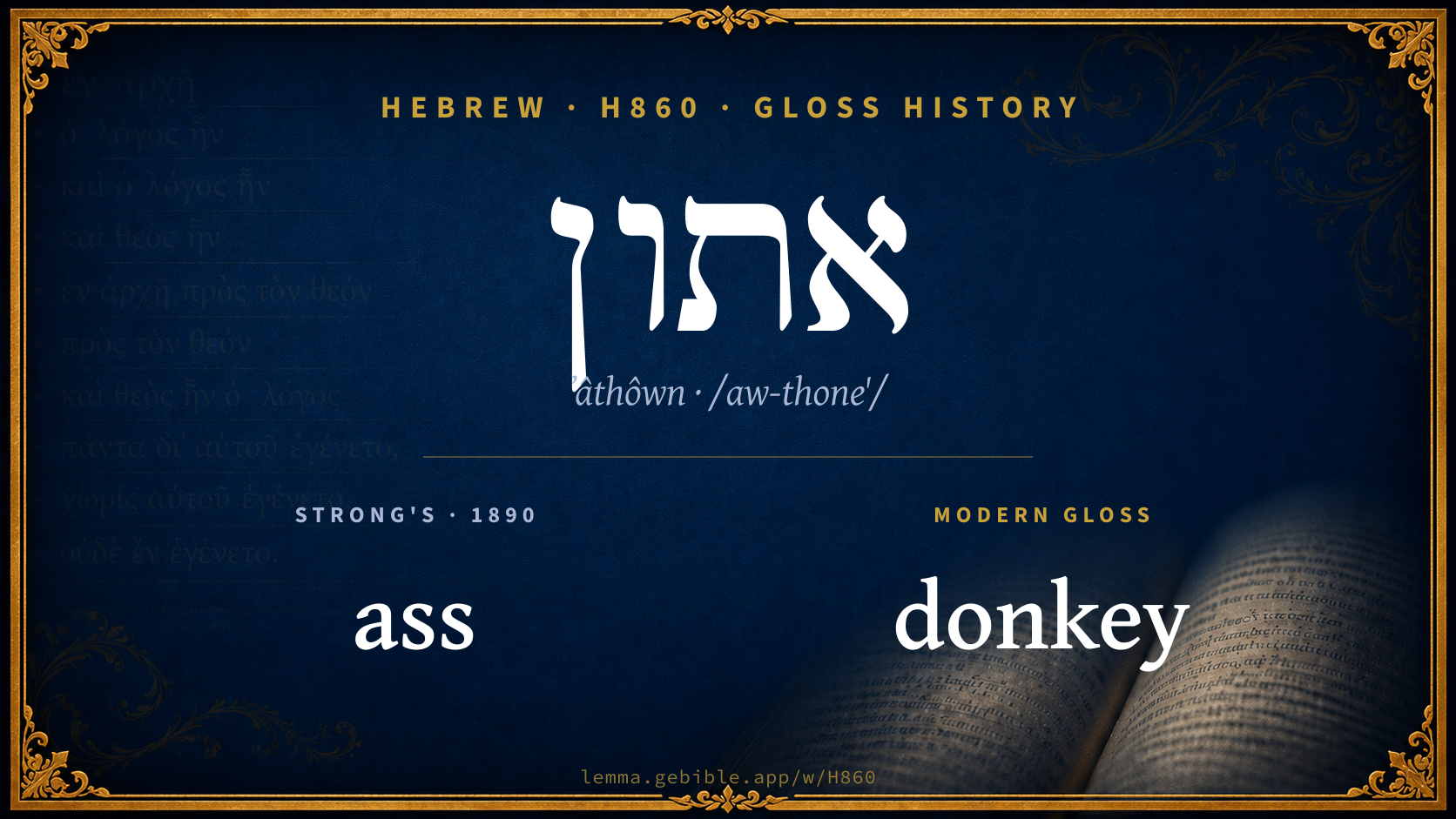
אתון — transliterated ʼâthôwn — is a Hebrew noun carrying the sense “donkey.” The King James Version usually renders it “ass,” while modern versions prefer “donkey” (Berean Standard Bible) and “female donkey” (unfoldingWord Literal Text) — see the renderings breakdown. Spanning 28 verses in 8 books, it ranks among the moderately common words of the Hebrew Bible. Its uses concentrate in Numbers (36% of all occurrences). Debuting at Genesis 12:16, it then recurs through the corpus. See the sense tree, 28-verse concordance, and the renderings breakdown below.
Gloss history
Strong's 1890 vs modern scholarship
About this word
Strong's H860 catalogs a Hebrew word from the Hebrew Old Testament.
These counts are not copied from any lexicon or concordance. They are computed here, from the morphology-tagged Hebrew Old Testament. What Lemma adds →
- 28
- distinct verses
- The word appears in 28 distinct verses.
- 8 / 39
- OT books
- The word appears in 8 of 39 Old Testament books.
- #1,041
- by frequency
- Top 2500 most frequent Hebrew words (rank 1,041 of 8,640 Hebrew words by occurrence).
View all 28 occurrences in the concordance →
By section of the Old Testament
By traditional corpus
Conventional, traditional groupings — biblical authorship is debated, so this is a traditional corpus grouping, not an authorship claim. Each share is this word’s portion of its verses in that division of the Hebrew canon. Each figure is a share of the word’s 28 distinct verses.
- Torah (Pentateuch) 14 verses · 50%
- Prophets (Nevi'im) 10 verses · 36%
- Writings (Ketuvim) 4 verses · 14%
How translations render this word
Counts come from each version’s own published word-to-Strong’s tagging or interlinear alignment — an approximate guide to how each version renders this word, not a word-level alignment the data otherwise carries. Because each total is that version’s own tagged count, the per-version totals vary from one another and need not match the appearance or distinct-verse counts above. These counts may also differ from a printed concordance because Lemma counts each distinctly tagged rendering and does not collapse phrase taggings into a single head-word total. This is a fixed set of word-tagged versions (KJV, ASV, BSB, ULT) and does not change with the reading translation you choose elsewhere. Each version’s license is shown beside its name below (and on Sources).
- King James Version: Ass 15×, Asses 10×, She asses 4×
- American Standard Version: Ass 14×, Asses 9×, She-asses 4×
- Berean Standard Bible: Donkey 12×, Donkeys 11×, Female donkeys 4×
- unfoldingWord Literal Text: Female donkey 14×, Female donkeys 11×, Donkeys 4×
King James Version Public Domain
Renders H860 across 34 tagged occurrences — most commonly:
Plus 5 renderings that appear only once — usually multi-word phrases or single function words the recovered tagging swept in, not distinct renderings.
American Standard Version Public Domain
Renders H860 across 34 tagged occurrences — most commonly:
Plus 7 renderings that appear only once — usually multi-word phrases or single function words the recovered tagging swept in, not distinct renderings.
Berean Standard Bible Public Domain
Renders H860 across 31 tagged occurrences — most commonly:
Plus 4 renderings that appear only once — usually multi-word phrases or single function words the recovered tagging swept in, not distinct renderings. Not rendered by a distinct English word in 3 further occurrences.
unfoldingWord Literal Text CC BY-SA 4.0
Renders H860 across 34 tagged occurrences — most commonly:
Plus 2 renderings that appear only once — usually multi-word phrases or single function words the recovered tagging swept in, not distinct renderings.
Senses in BDB
The 1 sense BDB distinguishes for this word, in lexicon order (not ranked by frequency or importance). The full entry — with sub-senses — is in the Lexicon Entry tab.
- she-ass, she-donkey
Word origin
אָתוֹן n.f. she-ass
— Brown-Driver-Briggs (Oxford 1906, public domain), digitized via Sefaria, supplemented by the OpenScriptures HebrewLexicon (CC BY 4.0). See Sources.
Derived from איתן (ʼêythân) (H386) — perpetual.
Jastrow Dictionary
A second Hebrew/Aramaic lexicon for comparison, covering Aramaic and post-biblical (Talmudic, Targumic, Midrashic) usage that the biblical-Hebrew BDB does not. Matched by lemma rather than by Strong’s number, so a lemma may carry more than one Jastrow headword (shown separately below), and the entries cover usage well beyond the Bible.
אַתּוּן
- , v. אַתּוּנָא II. Dan. III, 6; a. e. e.g. Daniel 3:6
A Dictionary of the Targumim, the Talmud Babli and Yerushalmi, and the Midrashic Literature (Marcus Jastrow; London, Luzac, 1903) — Public Domain. Digitized via Sefaria. Digitized via Sefaria. Full attribution on Sources.
Forms in the corpus
The 27 distinct written forms H860 takes in the Hebrew Bible, most frequent first — each parse links to that state’s occurrences in the concordance. Hebrew forms include their vowel points and cantillation, so a single lemma takes many written forms.
Same root — word family
Other BDB entries built from the same root as H860, grouped by Strong’s listed origin. These share a root / origin per the lexicon — not necessarily a shared meaning. Each links to that word’s own entry.
Derives from
Proper names from this root
People and places named from this root — a name, not an additional meaning of the word.
Compare all same-root words → 2 of the same-root words are proper names (people or places). They share a root, not necessarily a meaning.
Septuagint verse parallels
This word appears in 28 verses that also exist in the Greek Old Testament (Septuagint), out of the 28 Hebrew verses it occurs in. You can read those verses in Greek by switching the Old Testament edition to the Septuagint.
Read these verses in the Septuagint
- Genesis 12:16
- Numbers 22:21
- Judges 5:10
- 1 Samuel 9:3
- 2 Kings 4:22
- 1 Chronicles 27:30
- Job 1:3
- Zechariah 9:9
This is a verse-level parallel only — the same verses exist in both the Hebrew and Greek Old Testaments. No word-level Hebrew↔Greek correspondence is claimed: the data carries no such alignment, so no Greek word is shown as this Hebrew word’s translation. Coverage is not total — the Septuagint omits the deuterocanon and renumbers the Psalms, so some Hebrew verses have no direct Greek parallel.