
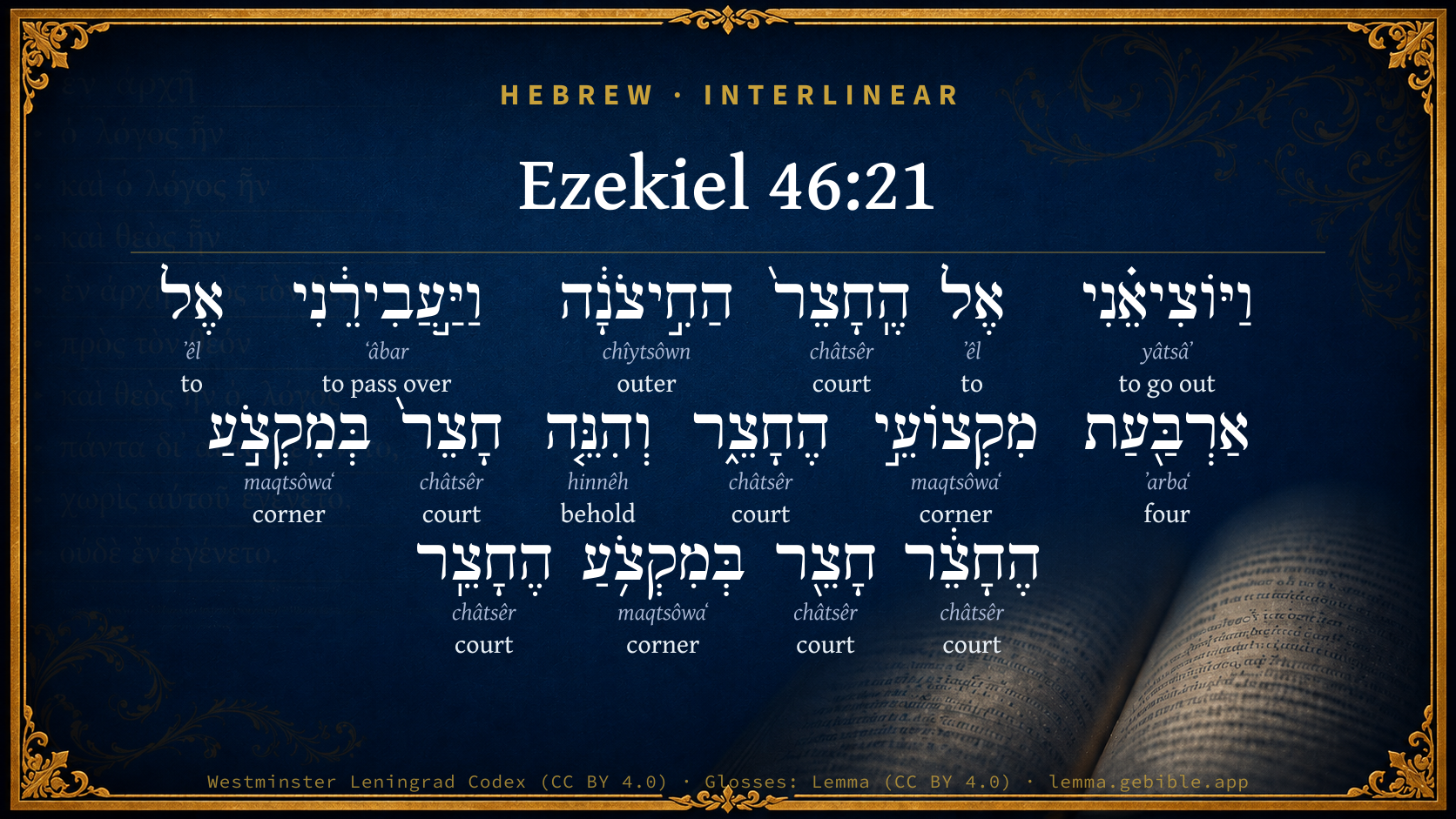
Ezekiel 46:21

Hebrew (Westminster Leningrad Codex) Ezekiel 46:21 appears in the Hebrew Old Testament. The text above is from the Westminster Leningrad Codex. Each word links to its Strong’s number, a concise gloss, and parsing drawn from the Open Scriptures Hebrew Bible morphology. Click any word for its full Brown-Driver-Briggs (BDB) entry.
Download image
Cite this verse

Ezekiel 46:21 (World English Bible). Public Domain. Lemma interlinear Bible study tool, https://lemma.gebible.app/v/ezekiel/46/21.

Show BibTeX & RIS
BibTeX
RIS
English Translation
Then he brought me forth into the outer court, and caused me to pass by the four corners of the court; and, behold, in every corner of the court there was a court.
World English Bible · Public Domain
Download a study sheet

One document with this verse’s original text, its word-by-word gloss line, the meaning frame, cross-references with their text, attributed commentary, and full source and license credits — printable, and it pastes into notes with its structure intact.

This verse Autodidact and up

Study sheet (.html) Plain text (.txt)

A passage Seminary Student

Up to 50 verses in one chapter. A passage sheet keeps up to 6 commentary sources and 12 cross-references per verse, in the order this page ranks them, and says so on the sheet whenever that leaves anything out. Ask for a single verse and you get the Autodidact verse sheet above.

Everything on this page stays free to read, with no account — the sheet is a download of what is already on screen, not access to it.

Want to remove ads? Support Godless Engineer
Compare translations 3

The same verse in 3 English versions, stacked beneath the original-language interlinear above. Click any original word for its lexicon entry.

Each is an independent rendering of the whole verse — the interlinear is not word-aligned to these translations.

Highlighted words mark where these versions differ — a whole-verse word diff, not a word-by-word alignment.

  • World English Bible Public Domain
    Then he brought me forth into the outer court, and caused me to pass by the four corners of the court; and, behold, in every corner of the court there was a court.
  • King James Version Public Domain
    Then he brought me forth into the utter court, and caused me to pass by the four corners of the court; and, behold, in every corner of the court there was a court.
  • unfoldingWord Literal Text CC BY-SA 4.0
    Then he brought me to the outer courtyard and he led me past the four corners of that courtyard, and I saw that in every corner of the courtyard there was a another court.

unfoldingWord Literal Text — © unfoldingWord, licensed CC BY-SA 4.0. Word-aligned USFM3 via Door43 (git.door43.org/unfoldingWord/en_ult).

Versions to compare (up to 4)

3 of 4 selected

Show all 18 translations

Every available English version of this verse, each an independent rendering of the whole verse.

  • World English Bible Public Domain
    Then he brought me forth into the outer court, and caused me to pass by the four corners of the court; and, behold, in every corner of the court there was a court.
  • Berean Standard Bible Public Domain
    Then he brought me into the outer court and led me around to its four corners, and I saw a separate court in each of its corners.
  • Majority Standard Bible Public Domain
    Then he brought me into the outer court and led me around to its four corners, and I saw a separate court in each of its corners.
  • King James Version Public Domain
    Then he brought me forth into the utter court, and caused me to pass by the four corners of the court; and, behold, in every corner of the court there was a court.
  • American Standard Version (1901) Public Domain
    Then he brought me forth into the outer court, and caused me to pass by the four corners of the court; and, behold, in every corner of the court there was a court.
  • Revised Version (1885) Public Domain
    Then he brought me forth into the outer court, and caused me to pass by the four corners of the court; and behold, in every corner of the court there was a court.
  • Geneva Bible (1599) Public Domain
    Then he brought me foorth into the vtter court, and caused me to goe by the foure corners of the court: and beholde, in euery corner of the court, there was a court.
  • Douay-Rheims (1899) Public Domain
    And he brought me into the outward court, and he led me about by the four corners of the court: and behold there was a little court in the corner of the court, to every corner of the court there was a little court.
  • Young's Literal Translation Public Domain
    And he bringeth me out unto the outer court, and causeth me to pass over unto the four corners of the court, and lo, a court in a corner of the court, a court in a corner of the corner.
  • Literal Standard Version CC BY-SA 4.0
    And he brings me out to the outer court, and causes me to pass over to the four corners of the court, and behold, a court in a corner of the court, [moreover] a court in [every] corner of the corner.
  • Unlocked Literal Bible CC BY-SA 4.0
    Then he brought me to the outer courtyard and he led me past the four corners of that courtyard, and I saw that in at every corner of the courtyard there was a another court.
  • unfoldingWord Literal Text CC BY-SA 4.0
    Then he brought me to the outer courtyard and he led me past the four corners of that courtyard, and I saw that in every corner of the courtyard there was a another court.
  • Darby Bible Public Domain
    And he brought me forth into the outer court, and caused me to pass by the four corners of the court; and behold, in every corner of the court there was a court.
  • World Messianic Bible Public Domain
    Then he brought me out into the outer court and caused me to pass by the four corners of the court; and behold, in every corner of the court there was a court.
  • Webster's Bible Public Domain
    Then he brought me forth into the outer court, and caused me to pass by the four corners of the court; and behold, in every corner of the court there was a court.
  • Free Bible Version CC BY-SA 4.0
    He took me into the outer courtyard and led me to each of its four corners. I saw a separate courtyard in each corner.
  • Bible in Basic English Public Domain
    And he took me out into the outer square and made me go by the four angles of the square; and I saw that in every angle of the open square there was a space shut in.
  • JPS Tanakh (1917) Public Domain
    Then he brought me forth into the outer court, and caused me to pass by the four corners of the court; and, behold, in every corner of the court there was a court.

Literal Standard Version (2020), Covenant Press — licensed CC BY-SA 4.0. Text via the HelloAO Bible API (eBible.org). Unlocked Literal Bible (unfoldingWord) — licensed CC BY-SA 4.0. Text via the HelloAO Bible API (eBible.org). unfoldingWord Literal Text — © unfoldingWord, licensed CC BY-SA 4.0. Word-aligned USFM3 via Door43 (git.door43.org/unfoldingWord/en_ult). Free Bible Version, Dr. Jonathan Gallagher — licensed CC BY-SA 4.0. Text via the HelloAO Bible API (eBible.org).

Word by word

More ways to search: Search by grammar → Find every occurrence → Compare this word →

Practice this passage: Drill this verse → Learn its vocabulary →

מִקְצוֹעֵ֣י
maqtsôwaʻ
H4740
“corners of”
Noun, Common, Masculine, Plural, Construct
Part of Speech
Noun
Type
Common
Gender
Masculine
Number
Plural
State
Construct
Full BDB Definition

Origin: from H7106 in the denominative sense of bending

TWOT: 2057a

place of corner structure, corner buttress, inner corner-buttress - corner post, buttress-place, buttress
  1. וַיּוֹצִיאֵ֗נִי yâtsâʼ H3318 “and · to go out · me” Conjunction + Verb, Hiphil, Sequential Imperfect, 3rd Person, Masculine, Singular + Suffix, Personal, 1st Person, Common, Singular
  2. אֶל ʼêl H413 “to” Preposition
  3. הֶֽחָצֵר֙ châtsêr H2691 “the · court” Particle, Definite Article + Noun, Common, Both, Singular, Absolute
  4. הַחִ֣יצֹנָ֔ה chîytsôwn H2435 “the · outer” Particle, Definite Article + Adjective, Adjective, Feminine, Singular, Absolute
  5. וַיַּ֣עֲבִירֵ֔נִי ʻâbar H5674 “and · to pass over · me” Conjunction + Verb, Hiphil, Sequential Imperfect, 3rd Person, Masculine, Singular + Suffix, Personal, 1st Person, Common, Singular
  6. אֶל ʼêl H413 “to” Preposition
  7. אַרְבַּ֖עַת ʼarbaʻ H702 “four” Adjective, Cardinal number, Masculine, Singular, Construct
  8. הֶחָצֵ֑ר châtsêr H2691 “the · court” Particle, Definite Article + Noun, Common, Both, Singular, Absolute
  9. וְהִנֵּ֤ה hinnêh H2009 “and · behold” Conjunction + Particle, Demonstrative
  10. חָצֵר֙ châtsêr H2691 “court” Noun, Common, Both, Singular, Absolute
  11. בְּמִקְצֹ֣עַ maqtsôwaʻ H4740 “in/at · corner of” Preposition + Noun, Common, Masculine, Singular, Construct
  12. הֶחָצֵ֔ר châtsêr H2691 “the · court” Particle, Definite Article + Noun, Common, Both, Singular, Absolute
  13. חָצֵ֖ר châtsêr H2691 “court” Noun, Common, Both, Singular, Absolute
  14. בְּמִקְצֹ֥עַ maqtsôwaʻ H4740 “in/at · corner of” Preposition + Noun, Common, Masculine, Singular, Construct
  15. הֶחָצֵֽר châtsêr H2691 “the · court” Particle, Definite Article + Noun, Common, Both, Singular, Absolute

About this verse

These counts appear in no published source. They are computed here, from the morphology-tagged text and Lemma’s own curated glosses. What Lemma adds →

16
words
8
distinct lemmas
Prophets
section

Notable vocabulary

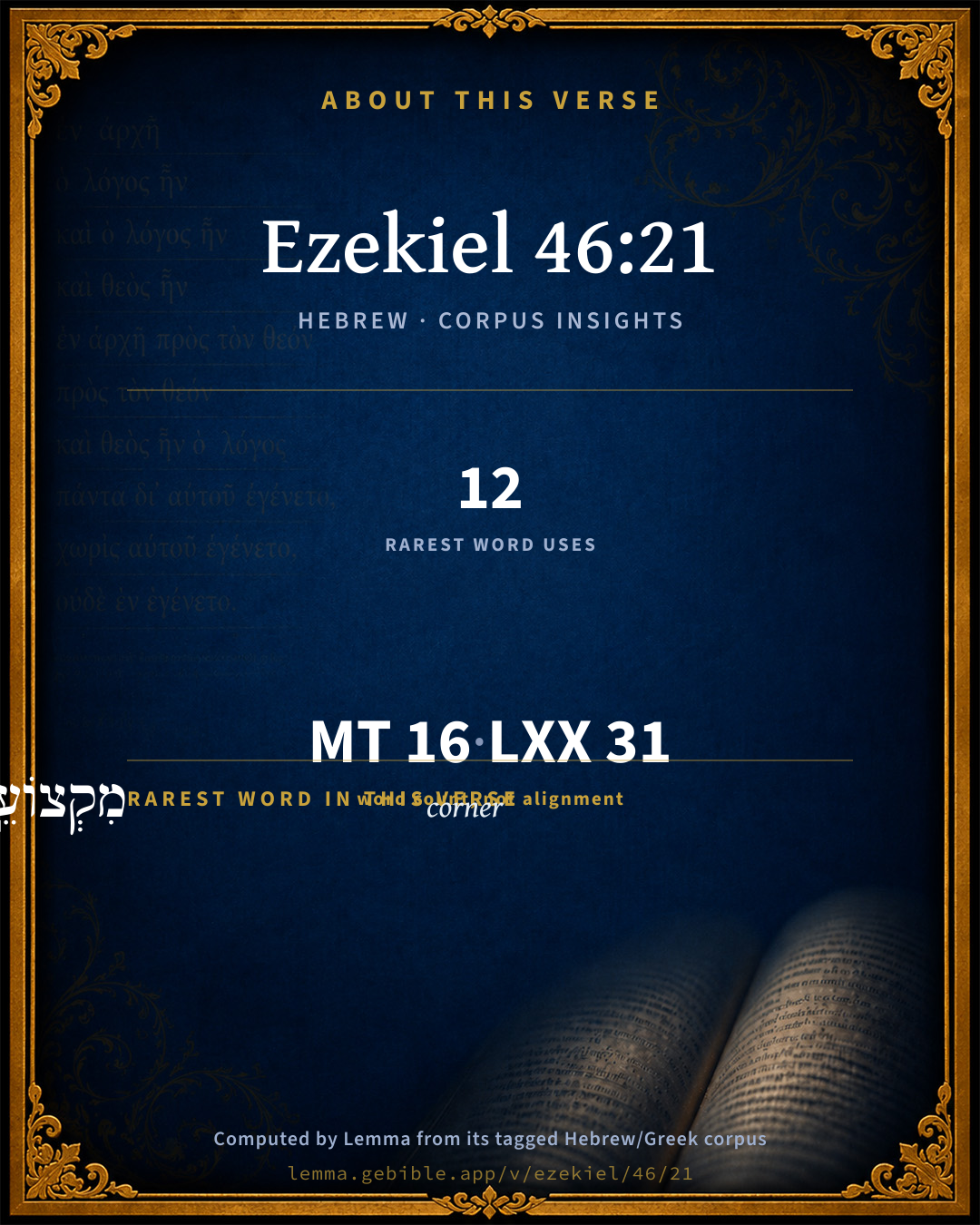
The rarest word here is מִקְצוֹעֵ֣י corner H4740 — appearing just 12 times in the whole Hebrew Bible.

Shared distinctive vocabulary

מִקְצוֹעֵ֣י corner H4740 occurs in 10 verses of the Hebrew Bible. Also found in:

Grammatical profile

  • 2 verbs
  • 9 nouns
  • 2 adjectives
  • 2 prepositions
  • 1 particle

Verb forms

  • וַיּוֹצִיאֵ֗נִי Hiphil · Sequential Imperfect
  • וַיַּ֣עֲבִירֵ֔נִי Hiphil · Sequential Imperfect

Repetition

Words recur within this verse — often emphatic in Hebrew:

  • הֶֽחָצֵר֙ court H2691 ×6
  • מִקְצוֹעֵ֣י corner H4740 ×3
  • אֶל to H413 ×2

Hebrew & Septuagint length

In English translation the verse runs 33 words from the Hebrew and 33 from the Septuagint (LXX English) — the same length.

A rough comparison of the two English renderings, which tokenize alike — not a word-level alignment.

Word counts can differ between the Hebrew and the Greek without any difference in meaning — e.g. the Hebrew direct-object marker אֵת has no separate Greek word, and Greek often adds the article ὁ.

In the original languages it is 16 Hebrew tokens and 31 Greek tokens — but the two are counted differently (Hebrew bundles its prefixes and suffixes into one token; the Greek is in lemma form), so that isn’t a like-for-like length.

Hebrew and Greek witnesses Masoretic Hebrew ↔ Greek Septuagint

The same verse in the two great witnesses to the Old Testament, shown verse-for-verse.

These are two independent witnesses, not word-aligned to each other, and the Septuagint is shown in lemma (dictionary) form.

Hebrew Ezekiel 46:21 Masoretic · Westminster Leningrad Codex

וַיּוֹצִיאֵ֗נִי אֶל הֶֽחָצֵר֙ הַחִ֣יצֹנָ֔ה וַיַּ֣עֲבִירֵ֔נִי אֶל אַרְבַּ֖עַת מִקְצוֹעֵ֣י הֶחָצֵ֑ר וְהִנֵּ֤ה חָצֵר֙ בְּמִקְצֹ֣עַ הֶחָצֵ֔ר חָצֵ֖ר בְּמִקְצֹ֥עַ הֶחָצֵֽר

Then he brought me forth into the outer court, and caused me to pass by the four corners of the court; and, behold, in every corner of the court there was a court.

World English Bible · Public Domain

Greek LXX Ezekiel 46:21 Septuagint · lemma form

καί ἐκἄγω ἐγώ εἰς ὁ αὐλή ὁ ἐξώτερος καί περιἄγω ἐγώ ἐπί ὁ τέσσαρες μέρος ὁ αὐλή καί ἰδού αὐλή κατά ὁ κλίτος ὁ αὐλή αὐλή κατά ὁ κλίτος ὁ αὐλή

And he brought me into the outer court, and led me round upon the four sides of the court; and, behold, there was a court on each of the sides of the court,

LXX2012 (modern English Septuagint) · Public Domain

On this verse, The Pulpit Commentary discusses the Septuagint’s reading. Read the note in Commentary ↓

Hebrew: Westminster Leningrad Codex (CC BY 4.0). Greek: Septuagint (public domain); English from LXX2012 (modern English Septuagint) (Public Domain). How the Septuagint differs from the Hebrew →

Targum (Aramaic paraphrase)

1

The Targum is the ancient Jewish Aramaic paraphrase of the Hebrew Scriptures — an interpretive translation, not the Hebrew text itself. Onkelos (literal) and Pseudo-Jonathan (expansive) render the Torah, and Jonathan the Prophets. Coverage is partial: where no permissively-licensed English translation exists for a verse, only the Aramaic is shown. This is verse-level text, not a word-by-word alignment to the Hebrew.

  1. Targum Jonathan Prophets (Joshua–Malachi)
    וְאַפְקַנִי לְדַרְתָּא בָרַיְתָא וְאַעְבְּרַנִי עַל אַרְבַּע זִוְיַת דַרְתָּא וְהָא דַרְתָּא בְּזִוְיַת דַרְתָּא:

    (no public-domain English translation for this verse)

    Targum Jonathan — Aramaic: “Mikraot Gedolot” (public domain). English: “Sefaria Community Translation” (CC0 1.0 (public-domain dedication)); “London "Chaldee Paraphrase," 1871” (public domain). Text via Sefaria.

Commentary

Notes on Ezekiel 46:21 from classic Christian and Jewish commentators (each source and its license shown beneath its notes). The classic Christian expositions comment on the surrounding passage and are grouped to its opening verse, so a note may address several verses; the Jewish commentaries on the Tanakh (Rashi and others) are per-verse, so they appear only where the commentator wrote on this verse.

Lemma curates 59 commentaries, every one of them public domain or Creative Commons licensed, each selected and text-cleaned for this edition rather than reprinted as found. About our sources →

The Cambridge Bible for Schools and Colleges

gen. ed. J. J. S. Perowne

21–24. The kitchens for cooking the sacrificial meals of the people. These were situated in the four corners of the outer court. In each of the four corners was a small enclosure or court 40 cubits long and 30 broad (Eze_46:21-22); and in these were situated the kitchens, where the “ministers of the house,” the subordinate officials (Eze_44:10-14), boiled the people’s offering for their sacrificial meal (Eze_46:23-24), Fig. 3 M.

The Cambridge Bible for Schools and Colleges (gen. ed. J. J. S. Perowne; Cambridge University Press, 1878–1918) — public domain. Text from a community e-Sword module.

Trapp's Complete Commentary

John Trapp

Eze 46:21 Then he brought me forth into the utter court, and caused me to pass by the four corners of the court; and, behold, in every corner of the court [there was] a court.

Ver. 21. In every corner of the court there was a court.] And buildings in every of them for the same purpose round about. {Eze 46:22} These served, saith Jerome, to set forth the four parts of the world, out of all which the Church is gathered by ministers, &c. It served also, saith another, to show that in God’s house, which is his Church, there shall always be provision both for his ministers and people. Those that have but from hand to mouth have their bread hot, as it were, from God’s hand, which is best of all.

John Trapp, A Commentary or Exposition upon All the Books of the Old and New Testament (1647–1656) — public domain. Text from a community e-Sword module.

Joseph Benson's Commentary

Eze 46:21-24. Behold, in every corner of the court there was a court — At every corner, where the side walls met in right angles, there was another little court. There were courts joined of forty cubits long, &c. — These little courts were in the shape of an oblong square, joined with inner walls to the outside walls of the greater court. The marginal reading, made with chimneys, gives a sense which very well agrees with the uses for which the courts were designed. There was a row of buildings round about in them — Namely, on the inside of these courts. Then said he, These are the places, &c. — As there was a place in the inner court for boiling the trespass and sin-offering, Eze 46:19-20; so these boiling-places might be appointed for boiling the peace-offerings, which were esteemed inferior in holiness to those above mentioned, and therefore, perhaps, were dressed by the Levites, or inferior ministers; whereas the former were boiled by the priests in the court properly belonging to them.

Joseph Benson's Commentary on the Old and New Testaments (1811–1818) — public domain. Text from a community e-Sword module.

Ellicott's Commentary for English Readers

(21) The utter court.—The prophet had just been in those chambers which, although they stood within the area of the outer court, were considered as belonging to the inner. He is now brought into the outer court, properly so called.

In every corner of the court there was a court.—In each of the angles of the outer court a place was set apart for the boiling of the flesh of the peace offerings. These were of considerable size—40 cubits by 30 (Eze_46:22), and appear to have been enclosed by a wall but not covered above. The word translated joined is of very uncertain meaning, but its most probable sense is enclosed. These courts are marked E on Plan II.

A Bible Commentary for English Readers, edited by Charles John Ellicott (1878–1897) — public domain. Text from a community e-Sword module.

John Gill's Exposition

In the four corners of the court there were courts joined,.... To the side walls of the outward court, which met in right angles: or, "were made with chimneys" (r), as some render it; that the smoke of the fire of the kitchens in them, and the steam of the boiled flesh, might ascend through them. So the Jewish writers, as Jarchi and Kimchi, from the Misnah (s), generally interpret the word, that these courts were made so as to let out the smoke, and were not roofed or floored over (t); and in which treatise and also by Maimonides (u); the uses of them in the second temple are observed: for in answer to the question, what do they serve for? it is said, at the southeast was the chamber of the Nazarites, where they boiled their peace offerings, and shaved their hair, and put them under the pot; at the northeast was the wood chamber, where the priests that had blemishes wormed the wood; and any wood, in which a worm was found, was rejected from the altar: at the northwest was the chamber of the lepers: of that which was at the southwest, saith R. Eliezer Ben Jacob, I have forgot (some render it found) of what use it is; but Abba Saul says, there they put the wine and oil, wherefore it was called the oil chamber. These four chambers, according to the same treatise, were in the four corners of the court of the women, and consisted of forty cubits long, but were not roofed; and so, they say, they will be in future time, according to this passage of Scripture. These places, as Dr. Lightfoot (w) observes, are called by the prophet "courts", and in everyone of them places to boil the sacrifices in; and yet they are allotted to other uses in the Misnah, and which seem to require that they should be roofed; all which may consist together, he says: for, grant everyone of these spaces to be built within, with chambers round about, there might be very fair chambers, and yet a good handsome open court in the middle; at either end chambers of ten cubits broad, and yet an open space of twenty cubits between; and on either side chambers of seven or eight cubits broad, and yet an open space of fourteen or sixteen cubits between: thus therefore, adds he, it seems to be, that there were fair chambers round about, which were roofed over as other buildings; and in the middle was an open court, round about which were boiling ranges, whose chimneys went up in the inner walls of the chambers, or the walls to the open place: thus the inner court served for boiling places, and the rooms round about for other uses; see the two following verses. The measure of the courts were,

of forty cubits long, and thirty broad; an oblong quadrangle:

these four corners were of one measure; the courts that were in these four corners were, of the same measure, as to length and breadth; denoting the equality of Gospel churches, being of the same faith, order and discipline, power and authority.

(r) "atria caminata", Junius & Tremellius, Polanus, Cocceius; "fumosa", Tigurine version, Castalio; "fumigata", Starckius. (s) Middot, c. 2. sect. 5. (t) Maimon. & Bartenora in ib. (u) Hilchot Beth Habechira, c. 5. sect. 8. (w) Prospect of the Temple, c. 18. p. 1092, 1093.

John Gill's Exposition of the Whole Bible (1746–1763) — public domain (CC PDM 1.0). Text via the HelloAO Bible API.

Matthew Poole's English Annotations

The utter court; either the court of the people, or more likely the court of the priests or Levites, called here utter court, because it was more outward than the court of the temple.

To pass by the four corners, to go about the whole square of the court.

In every corner, where the side walls did meet in right angles.

A court; a smaller court made up on the outer sides with the walls of the greater square, and on the inside made with two walls, the one forty cubits long, the other thirty cubits broad.

Matthew Poole's English Annotations on the Holy Bible (1683–1685) — public domain. Text from a community e-Sword/MySword module.

The Pulpit Commentary

Vers. 21, 22 The prophet next observed, as his guide led him round the outer area, that in every corner of the court there was a court literally, a court in a corner of the court, a court in a corner of the court and hat these were courts joined of forty cubits long and thirty broad. The word "joined" twOrfuq) has been variously translated: by Gesenins (see "Hebrews Lex.," sub voce), as "vaulted" or "roofed," with which Hitzig seems to agree; by the LXX, whom Bottcher and Ewald follow, mikra, equal to contracts; by Kliefoth, "uncovered;" by Havernick, "firm," "strongly built;" by Smend," separated;" by Hengstenberg and Schroder, after the Talmudists (fumum exhalantia), "smoking" or "made with chimneys" (Authorized Version margin); but is probably best rendered by the Revised Version, Keil, Currey, after Gesenius ("Thesaurus," p. 1213), "enclosed," meaning muris cineta et januis elausa. According to the last clause of ver. 22, these four corners were of one measure; or, one measure was to the four cut-away places, i.e. corners, twOxqhum being the hoph. participle of xq "to cut off." This last word is omitted in the LXX and the Vulgate, Hitzig, and Smend, the puncta extraordinaria showing that the Massorites regarded it as suspicious.

The Pulpit Commentary (1880–1919), ed. H.D.M. Spence-Jones & Joseph S. Exell — public domain. Text from a community e-Sword module.

John Wesley's Explanatory Notes

A court - A smaller court made up on the outer sides with the walls of the greater square, and on the inside made with two walls, the one forty cubits long, the other thirty cubits broad.

John Wesley, Explanatory Notes Upon the Whole Bible (1754–1765) — public domain. Text via the GEBible commentary corpus.

unfoldingWord translationNotes

Door43 World Missions Community

outer courtyard

See how you translated this in Ezekiel 10:5.

forty cubits ... thirty

Each long cubit was about 54 centimeters. See how you translated this in Ezekiel 40:5. AT: "40 cubits ... 30 cubits" or "about 21.6 meters ... about 16.2 meters" (See: Biblical Distance)

cooking hearths

places where people can build fire and cook food

translationWords

court

temple

sacrifice

unfoldingWord translationNotes — © Distant Shores Media and the Door43 World Missions Community, licensed CC BY-SA 4.0. Source: git.door43.org/Door43/en_tn.

Rashi

Rabbi Shlomo Yitzchaki (Rashi)

corners [Heb. מִקְצוֹעֵי,] angles in French, corners.

Rashi on the Tanakh — English translations: “The Judaica Press complete Tanach with Rashi, translated by A. J. Rosenberg” (CC BY 4.0); “Pentateuch with Rashi's commentary by M. Rosenbaum and A.M. Silbermann, 1929-1934” (public domain); “The Metsudah Tanach series, Lakewood, N.J” (CC BY 4.0); and “The Book of Joshua, Metsudah Publications, 1997” (CC BY 4.0). Text via Sefaria.

Lesson kit

Teaching starters — assembled from the data on this page, not authored interpretation. Every prompt links to the verse data it draws on. Edit before teaching.

Ezekiel, in the Prophets, opens this verse with 16 words (8 distinct Hebrew lemmas). Its most distinctive word is maqtsôwaʻ (“corner”). A historical commentator’s framing appears above. Read the whole chapter for the surrounding context.

Discussion questions

  1. The word maqtsôwaʻ carries the sense “corner.” How does it shape the verse?
  2. Exodus 26:24 shares the word «corner» with this verse. How do the two illuminate each other?
  3. “court” occurs 6× in this one verse. What is the effect of the repetition?
  4. These translations render this verse differently. What is at stake in choosing one wording over another?
  5. The verb «וַיּוֹצִיאֵ֗נִי» is Hiphil Sequential Imperfect. How does its form color the action?
  6. Reading how The Cambridge Bible for Schools and Colleges and Trapp's Complete Commentary read this verse, where do the two commentators agree and where do they part?

Things to notice

Reading settings

Reading text

Shown beneath each verse's original-language words.

Old Testament
Old Testament edition

Read the OT as the Masoretic Hebrew (MT) or the Greek Septuagint (LXX).

English shown for the Greek Septuagint (in the Hebrew ↔ Greek comparison).

Comparing translations? Open the Compare panel on any verse page to stack up to four side by side.