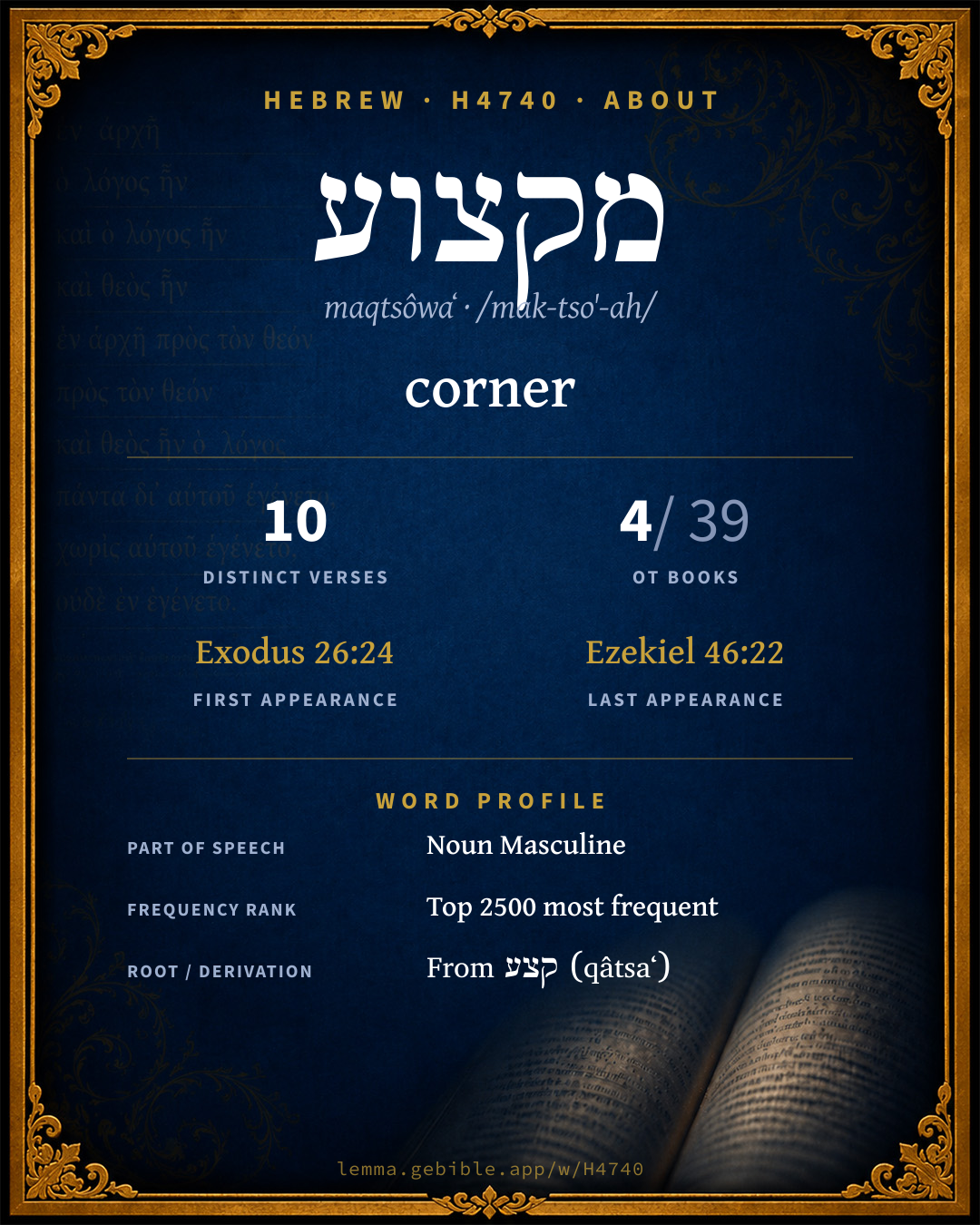
מִקְצֹעַ
corner
‘corner’ is one of 2 main senses fuller range ↓
Full lexicon entry — Brown-Driver-Briggs (BDB)
From Brown-Driver-Briggs (BDB)
Where this word appears
See every Absolute-state word in the Hebrew Bible →
Grammar key — what these labels mean
Part of speech
- Noun
- A naming word — a person, place, thing, or idea.
Noun type
- Common
- A common noun — a general class of person, place, or thing (“king,” “city,” “water”), not a specific name.
State
- Absolute
- The independent form of a noun, not bound to a following word.
- Construct
- A noun bound to a following noun in a possessive / “of” relationship (the construct chain).
Gender
- Masculine
- Grammatically masculine.
Number
- Singular
- One.
- Plural
- More than one (in Hebrew, generally three or more).
Grammatical forms
- Noun, Common, Masculine, Singular, Absolute 5 times (42%)
- Noun, Common, Masculine, Plural, Construct 3 times (25%)
- Noun, Common, Masculine, Singular, Construct 2 times (17%)
- Noun, Common, Masculine, Plural, Absolute 2 times (17%)
Parsed forms decoded from the imported morphology (morphhb / Westminster Leningrad Codex — WLC text public domain, morphhb tagging CC BY 4.0), counted across 12 parsed occurrences — not distinct verses.
Every verse where H4740 appears — 10 distinct verses across 4 books. Click any verse to open its interlinear word-by-word view. Verse text shown in the World English Bible for context — . Each verse’s Hebrew form is shown with its reference; the English is not keyword-highlighted, since the data carries no word-level English alignment. Use “Compare translations” on any verse to read it across multiple English versions. This concordance covers the Hebrew Bible; Septuagint (Greek Old Testament) occurrences are not indexed here.
Exodus 2 verses
- Exodus 26:24 הַ/מִּקְצֹעֹ֖ת ptcl def.art + n c mp They shall be double beneath, and in like manner they shall be entire to the top of it to one ring: thus shall it be for them both; they shall be for the two corners.
- Exodus 36:29 הַ/מִּקְצֹעֹֽת ptcl def.art + n c mp They were double beneath, and in like manner they were all the way to the top of it to one ring. He did thus to both of them in the two corners.
2 Chronicles 1 verse
Nehemiah 4 verses
- Nehemiah 3:19 הַ/מִּקְצֹֽעַ ptcl def.art + n c ms Next to him repaired Ezer the son of Jeshua, the ruler of Mizpah, another portion, over against the ascent to the armory at the turning [of the wall].
- Nehemiah 3:20 הַ֨/מִּקְצ֔וֹעַ ptcl def.art + n c ms After him Baruch the son of Zabbai earnestly repaired another portion, from the turning [of the wall] to the door of the house of Eliashib the high priest.
- Nehemiah 3:24 הַ/מִּקְצ֖וֹעַ ptcl def.art + n c ms After him repaired Binnui the son of Henadad another portion, from the house of Azariah to the turning [of the wall], and to the corner.
- Nehemiah 3:25 הַ/מִּקְצוֹעַ֒ ptcl def.art + n c ms Palal the son of Uzai [repaired] over against the turning [of the wall], and the tower that stands out from the upper house of the king, which is by the court of the guard. After him Pedaiah the son of Parosh [repaired].
Ezekiel 3 verses
- Ezekiel 41:22 וּ/מִקְצֹֽעוֹתָי/ו֙ conj + n c mp cs + sfx pers 3ms The altar was of wood, three cubits high, and the length of it two cubits; and the corners of it, and the length of it, and the walls of it, were of wood: and he said to me, This is the table that is before Yahweh.
- Ezekiel 46:21 מִקְצוֹעֵ֣י בְּ/מִקְצֹ֣עַ בְּ/מִקְצֹ֥עַ n c mp cs prep + n c ms cs prep + n c ms cs Then he brought me forth into the outer court, and caused me to pass by the four corners of the court; and, behold, in every corner of the court there was a court.
- Ezekiel 46:22 מִקְצֹע֤וֹת n c mp cs In the four corners of the court there were courts enclosed, forty [cubits] long and thirty broad: these four in the corners were of one measure.
About this entry
At a glance — auto-summarized from this page’s data, not written by a person. Every figure links to its source below. This summary describes the numbers; it doesn’t interpret them.
מקצוע — transliterated maqtsôwaʻ — is a Hebrew noun carrying the sense “corner.” Where the King James Version says “corners,” newer translations reach for “angle” (unfoldingWord Literal Text); the renderings breakdown has the detail. The Hebrew Bible uses it across 10 verses — uncommon. More than a third of its appearances fall in Nehemiah. BDB distinguishes 2 senses for it. See the sense tree, 10-verse concordance, and the renderings breakdown below.
Gloss history
Strong's 1890 vs modern scholarship
About this word
Strong's H4740 catalogs a Hebrew word from the Hebrew Old Testament.
These counts are not copied from any lexicon or concordance. They are computed here, from the morphology-tagged Hebrew Old Testament. What Lemma adds →
- 10
- distinct verses
- The word appears in 10 distinct verses.
- 4 / 39
- OT books
- The word appears in 4 of 39 Old Testament books.
- #2,101
- by frequency
- Top 2500 most frequent Hebrew words (rank 2,101 of 8,640 Hebrew words by occurrence).
View all 10 occurrences in the concordance →
By section of the Old Testament
By traditional corpus
Conventional, traditional groupings — biblical authorship is debated, so this is a traditional corpus grouping, not an authorship claim. Each share is this word’s portion of its verses in that division of the Hebrew canon. Each figure is a share of the word’s 10 distinct verses.
- Writings (Ketuvim) 5 verses · 50%
- Prophets (Nevi'im) 3 verses · 30%
- Torah (Pentateuch) 2 verses · 20%
How translations render this word
Counts come from each version’s own published word-to-Strong’s tagging or interlinear alignment — an approximate guide to how each version renders this word, not a word-level alignment the data otherwise carries. Because each total is that version’s own tagged count, the per-version totals vary from one another and need not match the appearance or distinct-verse counts above. These counts may also differ from a printed concordance because Lemma counts each distinctly tagged rendering and does not collapse phrase taggings into a single head-word total. This is a fixed set of word-tagged versions (KJV, ASV, BSB, ULT) and does not change with the reading translation you choose elsewhere. Each version’s license is shown beside its name below (and on Sources).
- King James Version: Corners 5×, Turning 4×
- American Standard Version: Corners 5×, Turning 3×
- Berean Standard Bible: Corners 6×, Angle 3×
- unfoldingWord Literal Text: Angle 5×, Corners 4×
King James Version Public Domain
Renders H4740 across 12 tagged occurrences — most commonly:
Plus 3 renderings that appear only once — usually multi-word phrases or single function words the recovered tagging swept in, not distinct renderings.
American Standard Version Public Domain
Renders H4740 across 12 tagged occurrences — most commonly:
Plus 4 renderings that appear only once — usually multi-word phrases or single function words the recovered tagging swept in, not distinct renderings.
Berean Standard Bible Public Domain
Renders H4740 across 11 tagged occurrences — most commonly:
Plus 2 renderings that appear only once — usually multi-word phrases or single function words the recovered tagging swept in, not distinct renderings. Not rendered by a distinct English word in 1 further occurrence.
unfoldingWord Literal Text CC BY-SA 4.0
Renders H4740 across 12 tagged occurrences — most commonly:
Plus 3 renderings that appear only once — usually multi-word phrases or single function words the recovered tagging swept in, not distinct renderings.
Senses in BDB
The 2 senses BDB distinguishes for this word, in lexicon order (not ranked by frequency or importance). The full entry — with sub-senses — is in the Lexicon Entry tab.
- place of corner structure, corner buttress, inner corner-buttress
- corner post, buttress-place, buttress
Word origin
Derived from קצע (qâtsaʻ) (H7106) — to scrape.
Jastrow Dictionary
A second Hebrew/Aramaic lexicon for comparison, covering Aramaic and post-biblical (Talmudic, Targumic, Midrashic) usage that the biblical-Hebrew BDB does not. Matched by lemma rather than by Strong’s number, so a lemma may carry more than one Jastrow headword (shown separately below), and the entries cover usage well beyond the Bible.
מִקְצוֹעַ
- 1. corner, angle. Tam. III, 3; Yoma 15ᵇ מ׳ צפונית מערבית the corner of the north-western side of the Temple.
- 2. = מוּקְצֶה, store. Men. 54ᵇ; 55ᵃ, v. מוּקְצֶה.—B. Bath. X, 8 (175ᵇ) שאין מ׳ בכל התורה כולה גדול מהן Ms. M. (v. Rabb. D. S. a. l. note) for there is no store (of wisdom) in the entire Law richer than these (civil laws); Ber. 63ᵇ.—Pl. מִקְצוֹעִין. Tosef. Ḥag. I, 9 מִקְצוֹעֵי תורה גופי וכ׳ stores of the law, bodies of Halakhoth; Tosef. Erub. XI (VIII), 24 מוקצעי ed. Zuck. (Var. מקצועי).
מַקְצוּעַ
- מ׳ של דבילה a tool for cutting fig-cakes, knife or saw. Tosef. Sabb. XIV (XV), 1 (ed. Zuck. מִקְצוֹעַ); Sabb. 123ᵇ; Y. ib. XVII, beg. 16ᵃ.—Pl. מַקְצוּעוֹת, v. next w.
A Dictionary of the Targumim, the Talmud Babli and Yerushalmi, and the Midrashic Literature (Marcus Jastrow; London, Luzac, 1903) — Public Domain. Digitized via Sefaria. Digitized via Sefaria. Full attribution on Sources.
Forms in the corpus
The 12 distinct written forms H4740 takes in the Hebrew Bible, most frequent first — each parse links to that state’s occurrences in the concordance. Hebrew forms include their vowel points and cantillation, so a single lemma takes many written forms.
| Form | Parsing | Example | Uses |
|---|---|---|---|
| בְּ/מִקְצֹ֣עַ | Noun, Common, Masculine, Singular, Construct | Ezekiel 46:21 | 1 |
| בְּ/מִקְצֹ֥עַ | Noun, Common, Masculine, Singular, Construct | Ezekiel 46:21 | 1 |
| הַ/מִּקְצ֑וֹעַ | Noun, Common, Masculine, Singular, Absolute | 2 Chronicles 26:9 | 1 |
| הַ/מִּקְצ֖וֹעַ | Noun, Common, Masculine, Singular, Absolute | Nehemiah 3:24 | 1 |
| הַ/מִּקְצֹֽעַ | Noun, Common, Masculine, Singular, Absolute | Nehemiah 3:19 | 1 |
| הַ/מִּקְצֹעֹ֖ת | Noun, Common, Masculine, Plural, Absolute | Exodus 26:24 | 1 |
| הַ/מִּקְצֹעֹֽת | Noun, Common, Masculine, Plural, Absolute | Exodus 36:29 | 1 |
| הַ/מִּקְצוֹעַ֒ | Noun, Common, Masculine, Singular, Absolute | Nehemiah 3:25 | 1 |
| הַ֨/מִּקְצ֔וֹעַ | Noun, Common, Masculine, Singular, Absolute | Nehemiah 3:20 | 1 |
| וּ/מִקְצֹֽעוֹתָי/ו֙ | Noun, Common, Masculine, Plural, Construct | Ezekiel 41:22 | 1 |
| מִקְצֹע֤וֹת | Noun, Common, Masculine, Plural, Construct | Ezekiel 46:22 | 1 |
| מִקְצוֹעֵ֣י | Noun, Common, Masculine, Plural, Construct | Ezekiel 46:21 | 1 |
Same root — word family
Other BDB entries built from the same root as H4740, grouped by Strong’s listed origin. These share a root / origin per the lexicon — not necessarily a shared meaning. Each links to that word’s own entry.
Derives from
Shares the same root
Compare all same-root words → Showing 4 of 5 — not the complete family. They share a root, not necessarily a meaning.
Septuagint verse parallels
This word appears in 6 verses that also exist in the Greek Old Testament (Septuagint), out of the 10 Hebrew verses it occurs in. You can read those verses in Greek by switching the Old Testament edition to the Septuagint.
Read these verses in the Septuagint
This is a verse-level parallel only — the same verses exist in both the Hebrew and Greek Old Testaments. No word-level Hebrew↔Greek correspondence is claimed: the data carries no such alignment, so no Greek word is shown as this Hebrew word’s translation. Coverage is not total — the Septuagint omits the deuterocanon and renumbers the Psalms, so some Hebrew verses have no direct Greek parallel.