
Proverbs 1:15

Hebrew (Westminster Leningrad Codex) Proverbs 1:15 appears in the Hebrew Old Testament. The text above is from the Westminster Leningrad Codex. Each word links to its Strong’s number, a concise gloss, and parsing drawn from the Open Scriptures Hebrew Bible morphology. Click any word for its full Brown-Driver-Briggs (BDB) entry.
Download image
Cite this verse

Proverbs 1:15 (World English Bible). Public Domain. Lemma interlinear Bible study tool, https://lemma.gebible.app/v/proverbs/1/15.

Show BibTeX & RIS
BibTeX
RIS
English Translation
My son, don't walk in the way with them. Keep your foot from their path,
World English Bible · Public Domain
Download a study sheet

One document with this verse’s original text, its word-by-word gloss line, the meaning frame, cross-references with their text, attributed commentary, and full source and license credits — printable, and it pastes into notes with its structure intact.

This verse Autodidact and up

Study sheet (.html) Plain text (.txt)

A passage Seminary Student

Up to 50 verses in one chapter. A passage sheet keeps up to 6 commentary sources and 12 cross-references per verse, in the order this page ranks them, and says so on the sheet whenever that leaves anything out. Ask for a single verse and you get the Autodidact verse sheet above.

Everything on this page stays free to read, with no account — the sheet is a download of what is already on screen, not access to it.

Want to remove ads? Support Godless Engineer
Compare translations 3

The same verse in 3 English versions, stacked beneath the original-language interlinear above. Click any original word for its lexicon entry.

Each is an independent rendering of the whole verse — the interlinear is not word-aligned to these translations.

Highlighted words mark where these versions differ — a whole-verse word diff, not a word-by-word alignment.

  • World English Bible Public Domain
    My son, don't walk in the way with them. Keep your foot from their path,
  • King James Version Public Domain
    My son, walk not thou in the way with them; refrain thy foot from their path:
  • unfoldingWord Literal Text CC BY-SA 4.0
    My son, do not walk on the road with them; restrain your foot from their path,

unfoldingWord Literal Text — © unfoldingWord, licensed CC BY-SA 4.0. Word-aligned USFM3 via Door43 (git.door43.org/unfoldingWord/en_ult).

Versions to compare (up to 4)

3 of 4 selected

Show all 18 translations

Every available English version of this verse, each an independent rendering of the whole verse.

  • World English Bible Public Domain
    My son, don't walk in the way with them. Keep your foot from their path,
  • Berean Standard Bible Public Domain
    my son, do not walk the road with them or set foot upon their path.
  • Majority Standard Bible Public Domain
    my son, do not walk the road with them or set foot upon their path.
  • King James Version Public Domain
    My son, walk not thou in the way with them; refrain thy foot from their path:
  • American Standard Version (1901) Public Domain
    My son, walk not thou in the way with them; Refrain thy foot from their path:
  • Revised Version (1885) Public Domain
    My son, walk not thou in the way with them; refrain thy foot from their path:
  • Geneva Bible (1599) Public Domain
    My sonne, walke not thou in the way with them: refraine thy foote from their path.
  • Douay-Rheims (1899) Public Domain
    My son, walk not thou with them, restrain thy foot from their paths.
  • Young's Literal Translation Public Domain
    My son! go not in the way with them, Withhold thy foot from their path,
  • Literal Standard Version CC BY-SA 4.0
    My son! Do not go in the way with them, || Withhold your foot from their path,
  • Unlocked Literal Bible CC BY-SA 4.0
    My son, do not walk down that road with them; do not let your foot touch where they walk;
  • unfoldingWord Literal Text CC BY-SA 4.0
    My son, do not walk on the road with them; restrain your foot from their path,
  • Darby Bible Public Domain
    -- my son, walk not in the way with them, keep back thy foot from their path;
  • World Messianic Bible Public Domain
    my son, don’t walk on the path with them. Keep your foot from their path,
  • Webster's Bible Public Domain
    My son, walk not thou in the way with them; refrain thy foot from their path:
  • Free Bible Version CC BY-SA 4.0
    My son, don't follow their ways. Don't go in that direction with them.
  • Bible in Basic English Public Domain
    My son, do not go with them; keep your feet from their ways:
  • JPS Tanakh (1917) Public Domain
    My son, walk not thou in the way with them, restrain thy foot from their path;

Literal Standard Version (2020), Covenant Press — licensed CC BY-SA 4.0. Text via the HelloAO Bible API (eBible.org). Unlocked Literal Bible (unfoldingWord) — licensed CC BY-SA 4.0. Text via the HelloAO Bible API (eBible.org). unfoldingWord Literal Text — © unfoldingWord, licensed CC BY-SA 4.0. Word-aligned USFM3 via Door43 (git.door43.org/unfoldingWord/en_ult). Free Bible Version, Dr. Jonathan Gallagher — licensed CC BY-SA 4.0. Text via the HelloAO Bible API (eBible.org).

Word by word

More ways to search: Search by grammar → Find every occurrence → Compare this word →

Practice this passage: Drill this verse → Learn its vocabulary →

מִנְּתִיבָתָֽם
nâthîyb
H5410
“from · path · their”
Preposition + Noun, Common, Both, Singular, Construct + Suffix, Personal, 3rd Person, Masculine, Plural
Part of Speech
Preposition + Noun
Type
Common
Gender
Both
Number
Singular
State
Construct
Full BDB Definition

Origin: from an unused root meaning to tramp

TWOT: 1440a , 1440b

trodden with the feet, path, pathway - path, pathway, traveller
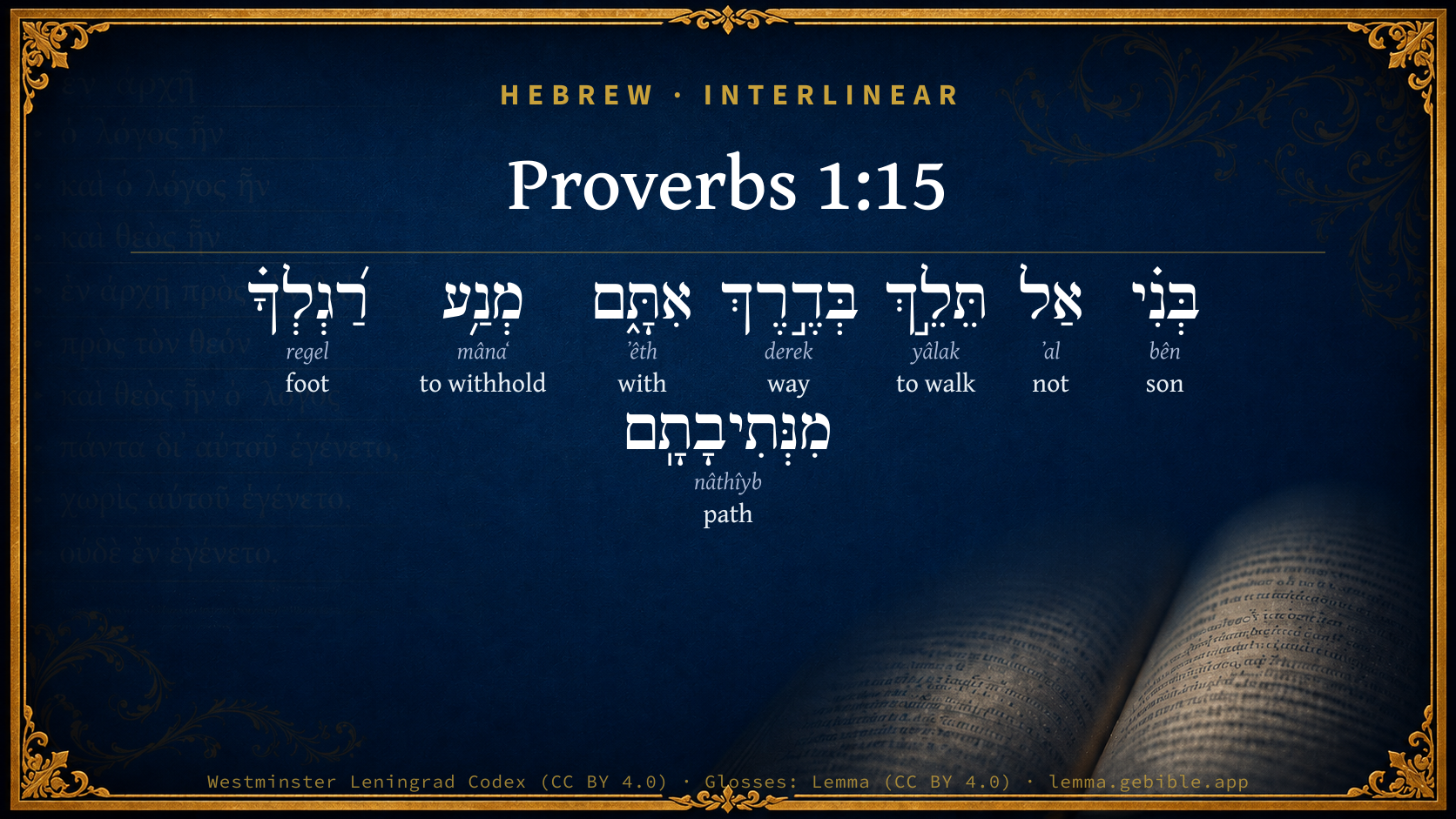
  1. בְּנִ֗י bên H1121 “son · my” Noun, Common, Masculine, Singular, Construct + Suffix, Personal, 1st Person, Common, Singular
  2. אַל ʼal H408 “not” Particle, Negative
  3. תֵּלֵ֣ךְ yâlak H3212 “to walk” Verb, Qal, Jussive, 2nd Person, Masculine, Singular
  4. בְּדֶ֣רֶךְ derek H1870 “in/at · way” Preposition + Noun, Common, Both, Singular, Absolute
  5. אִתָּ֑ם ʼêth H854 “with · them” Preposition + Suffix, Personal, 3rd Person, Masculine, Plural
  6. מְנַ֥ע mânaʻ H4513 “withhold” Verb, Qal, Imperative, 2nd Person, Masculine, Singular
  7. רַ֝גְלְךָ֗ regel H7272 “foot · your” Noun, Common, Feminine, Singular, Construct + Suffix, Personal, 2nd Person, Masculine, Singular

About this verse

These counts appear in no published source. They are computed here, from the morphology-tagged text and Lemma’s own curated glosses. What Lemma adds →

8
words
8
distinct lemmas
Wisdom
section

Shared distinctive vocabulary

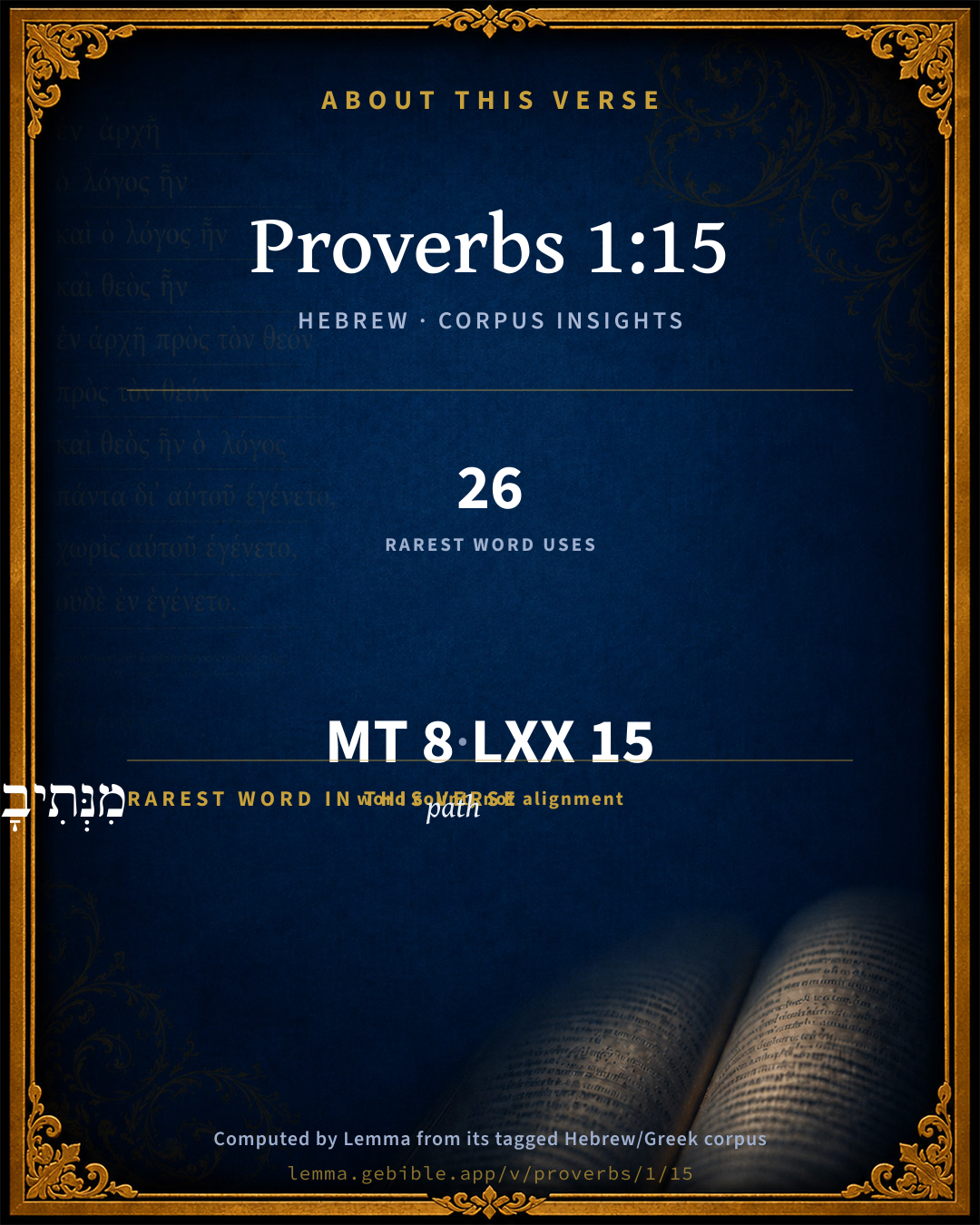
מִנְּתִיבָתָֽם path H5410 occurs in 26 verses of the Hebrew Bible. Also found in:

Grammatical profile

  • 2 verbs
  • 4 nouns
  • 1 preposition
  • 1 particle

Verb forms

  • תֵּלֵ֣ךְ Qal · Jussive
  • מְנַ֥ע Qal · Imperative

Hebrew & Septuagint length

In English translation the verse runs 15 words from the Hebrew and 15 from the Septuagint (LXX English) — the same length.

A rough comparison of the two English renderings, which tokenize alike — not a word-level alignment.

Word counts can differ between the Hebrew and the Greek without any difference in meaning — e.g. the Hebrew direct-object marker אֵת has no separate Greek word, and Greek often adds the article ὁ.

In the original languages it is 8 Hebrew tokens and 15 Greek tokens — but the two are counted differently (Hebrew bundles its prefixes and suffixes into one token; the Greek is in lemma form), so that isn’t a like-for-like length.

Cross-references

10

Topical passages linked to Proverbs 1:15 in the Treasury of Scripture Knowledge — connected by theme and wording, ordered by reader-vote popularity; previews shown in the World English Bible.

  • Psalms 119:101 I have kept my feet from every evil way, That I might observe your word.
  • Psalms 1:1 Blessed is the man who doesn't walk in the counsel of the wicked, Nor stand in the way of sinners, Nor sit in the seat of scoffers;
  • Proverbs 4:14–15 Don't enter into the path of the wicked. Don't walk in the way of evil men.
  • Proverbs 4:27 Don't turn to the right hand nor to the left. Remove your foot from evil.
  • Psalms 26:4–5 I have not sat with deceitful men, Neither will I go in with hypocrites.
  • 2 Corinthians 6:17 Therefore, "'Come out from among them, And be separate,' says the Lord, 'Touch no unclean thing. I will receive you.
  • Proverbs 9:6 Leave your simple ways, and live. Walk in the way of understanding."
  • Proverbs 13:20 One who walks with wise men grows wise, But a companion of fools suffers harm.
  • Proverbs 5:8 Remove your way far from her. Don't come near the door of her house,
  • Jeremiah 14:10 Thus says Yahweh to this people, Even so have they loved to wander; they have not refrained their feet: therefore Yahweh does not accept them; now will he remember their iniquity, and visit their sins.

Cross-references courtesy of OpenBible.info (CC BY 4.0).

Hebrew and Greek witnesses Masoretic Hebrew ↔ Greek Septuagint

The same verse in the two great witnesses to the Old Testament, shown verse-for-verse.

These are two independent witnesses, not word-aligned to each other, and the Septuagint is shown in lemma (dictionary) form.

Hebrew Proverbs 1:15 Masoretic · Westminster Leningrad Codex

בְּנִ֗י אַל תֵּלֵ֣ךְ בְּדֶ֣רֶךְ אִתָּ֑ם מְנַ֥ע רַ֝גְלְךָ֗ מִנְּתִיבָתָֽם

My son, don't walk in the way with them. Keep your foot from their path,

World English Bible · Public Domain

Greek LXX Proverbs 1:15 Septuagint · lemma form

μή πορεύομαι ἐν ὁδός μετά αὐτός ἐκκλίνω δέ ὁ πούς σύ ἐκ ὁ τρίβος αὐτός

go not in the way with them, but turn aside your foot from their paths:

LXX2012 (modern English Septuagint) · Public Domain

On this verse, The Pulpit Commentary discusses the Septuagint’s reading. Read the note in Commentary ↓

Hebrew: Westminster Leningrad Codex (CC BY 4.0). Greek: Septuagint (public domain); English from LXX2012 (modern English Septuagint) (Public Domain). How the Septuagint differs from the Hebrew →

Commentary

Notes on Proverbs 1:15 from classic Christian and Jewish commentators (each source and its license shown beneath its notes). The classic Christian expositions comment on the surrounding passage and are grouped to its opening verse, so a note may address several verses; the Jewish commentaries on the Tanakh (Rashi and others) are per-verse, so they appear only where the commentator wrote on this verse.

Lemma curates 59 commentaries, every one of them public domain or Creative Commons licensed, each selected and text-cleaned for this edition rather than reprinted as found. About our sources →

Trapp's Complete Commentary

John Trapp

Pro 1:15 My son, walk not thou in the way with them; refrain thy foot from their path:

Ver. 15. Walk not thou in the way with them.] "God will not take the wicked by the hand." {Job 8:20} Why then should we? "Gather not my soul with sinners," saith David. {Psa 26:9} "O Lord, let me not go to hell where the wicked are: for Lord, thou knowest I never loved their company here," said a good gentlewoman, when she was to die, being in much trouble of conscience.

John Trapp, A Commentary or Exposition upon All the Books of the Old and New Testament (1647–1656) — public domain. Text from a community e-Sword module.

Joseph Benson's Commentary

Pro 1:15-16. Walk not thou in the way with them — Avoid their courses, their conversation, and company. Refrain thy foot from their path — If thou shouldst have any thought, inclination, or temptation to hearken to their counsels, or to follow their examples, suppress it, and restrain thyself, as it were, by force and violence, as the word מנע, implies. For their feet run to evil — Without considering what they are doing, and shutting their eyes against the consequences, they make haste, not only to do evil to others, but also to bring evil upon themselves; to make haste to shed blood — Innocent blood, which is an inhuman practice, and a practice always followed by dreadful punishment, if not from man, yet certainly from God.

Joseph Benson's Commentary on the Old and New Testaments (1811–1818) — public domain. Text from a community e-Sword module.

Geneva Bible (1599)

Geneva Bible translators

That is, have nothing at all to do with them.

Geneva Bible (1599) marginal notes — public domain. Text via Bolls.life.

Jamieson, Fausset & Brown

Robert Jamieson, A. R. Fausset & David Brown

The society of the wicked (way or path) is dangerous. Avoid the beginnings of sin (Pro 4:14; Psa 1:1; Psa 119:101).

Jamieson, Fausset & Brown — Commentary Critical and Explanatory on the Whole Bible (1871) — public domain (CC PDM 1.0). Text via the HelloAO Bible API.

John Gill's Exposition

My son, walk not thou in the way with them,.... In the same way as they do, which is the broad way that leads unto destruction; set not one foot in it; make no trial of it, whether it will be pleasant and profitable walking in it; the experiment will be dangerous;

refrain thy foot from their path; their manner and course of life; do not follow it, nor join them in it; when there is an inclination or a temptation to it, withstand it; stop in time, do not proceed, but draw back, and go on in the way thou hast been trained up in, and remember the instructions of thy parents.

John Gill's Exposition of the Whole Bible (1746–1763) — public domain (CC PDM 1.0). Text via the HelloAO Bible API.

Matthew Poole's English Annotations

Walk not thou in the way with them; avoid their courses and their conversation, and company.

Refrain thy foot from their path; when thou hast any thought, or inclination, or temptation to follow their counsels or examples, suppress it, and restrain thyself as it were by force and violence, as the word implies.

Matthew Poole's English Annotations on the Holy Bible (1683–1685) — public domain. Text from a community e-Sword/MySword module.

Whedon's Commentary on the Bible

Daniel D. Whedon

15. Refrain — Have nothing to do with them; hold back thy foot from walking in their pathways.

Daniel D. Whedon (gen. ed.), Commentary on the Old and New Testaments (1874–1909) — public domain. Text from a community e-Sword module.

The Pulpit Commentary

My son, walk not thou in the way with them. The admonitory strain of ver. 10 is again resumed, and in vers. 16-19 the teacher states the reasons which should dissuade youth from listening to the temptations of sinners. My son. The recurrence of these words for the third time in this address marks the affectionate interest, the loving solicitude, in which the admonition is addressed. Walk not thou. Immediate and entire abandonment is counselled. The warning is practically a repetition of ver. 10, and is given again in Pro_4:14, "Enter not into the path of the wicked, and go not in the way of evil men." Way; (derek) means, figuratively, the way of living and acting (Gesenius). "Mores et consuetudines" (Bayne); cf. Pro_12:15, "the fool"s way;" Pro_22:25; and Psa_1:1. The meaning is "associate not with them, have no dealings whatever with them." Refrain thy foot from their path; i.e. keep back thy foot, or make not one step in compliance, resist the very first solicitations to evil. Compare the legal maxim, Initiis obsta. Refrain; gm (m"na) is from nm (mana), "to keep back, restrain;" LXX, ekkinon Psa_119:101, "I have refrained my feet from every evil way;" Jer_14:10, "Thus have they loved to wander, they have not refrained their feet"). Restraining the foot carries with it indirectly the natural inclination or propensity of the heart, even of the good, towards evil (Cartwright). Foot (lgr, regel) is, of course, used metaphorically, and means less the member of the body than the idea suggested by it; hence the use of the singular (Gejerus, Delitzsch). Bayne remarks that the Hebrews understood this passage as meaning "neither in public nor private life have any dealings with sinners." Path (bytin, nathiv) is a beaten path, a pathway, a byway; from the unused root btn (nathav), "to tread, trample;" and hence, while "way" may mean the great public high road, "path" may stand for the bypath, less frequented or public. The same distinction probably occurs in Psa_25:4, "Show me thy ways, O Lord; and teach me thy paths."

The Pulpit Commentary (1880–1919), ed. H.D.M. Spence-Jones & Joseph S. Exell — public domain. Text from a community e-Sword module.

Keil & Delitzsch

C. F. Keil & F. Delitzsch

After the men are described against whose enticements a warning is given forth, the warning is emphatically repeated, and is confirmed by a threefold reason:

My son! go not in the way with them.

Keep back thy foot from their path.

If בּדרך (in the way), taken alone, cannot be equivalent to בדרך אחד (in one way), so is אתּם (with them) to be regarded as its determination.

(Note: The Arab. grammarians regard this as half determination, and call it takhsys; that אתּם has with them the force of a virtually coordinated attributive; while, according to the Arab. gram., it is also possible that בּדרך, "in one way," is equivalent to on the common way, for in the indetermination sometimes there lies the conception not merely of âhad, but of weahad.)

Foot (not feet), as eye, hand, etc., is used where the members come less under consideration than what they unitedly bring about (Pro 4:26.). נתיבה, from נתב, signifies properly that which is raised, especially the (raised) footstep.

Keil & Delitzsch — Biblical Commentary on the Old Testament (1861–1891) — public domain (CC PDM 1.0). Text via the HelloAO Bible API. (Old Testament only.)

unfoldingWord translationNotes

Door43 World Missions Community

do not walk down that road with them; do not let your foot touch where they walk

To avoid behaving the same way as the sinners do is spoken of as if the son were to avoid walking on or even touching the roads that sinners walk on. AT: "do not go with the sinners or do what they do" (See: Metaphor)

their feet run to evil

The sinners having an eager interest in doing evil things is spoken of as if they were running to evil. AT: "they are eager to do wicked things" (See: Metaphor)

their feet run

Here "feet" represents the whole person. AT: "they run" (See: Synecdoche)

to shed blood

Here "blood" represents a person's life. To "shed blood" means to murder someone. (See: Metonymy)

For it is useless to spread the net in the sight of any bird

This metaphor compares the wisdom of birds who avoid traps that they see to the foolishness of sinners who get caught in traps they make for themselves.

translationWords

walk

run

evil

blood

unfoldingWord translationNotes — © Distant Shores Media and the Door43 World Missions Community, licensed CC BY-SA 4.0. Source: git.door43.org/Door43/en_tn.

Lesson kit

Teaching starters — assembled from the data on this page, not authored interpretation. Every prompt links to the verse data it draws on. Edit before teaching.

Proverbs, in the Wisdom, opens this verse with 8 words (8 distinct Hebrew lemmas). Its most distinctive word is nâthîyb (“path”). A historical commentator’s framing appears above. Read the whole chapter for the surrounding context.

Discussion questions

  1. How does “path” (nâthîyb) shape what this verse is saying?
  2. Judges 5:6 shares the word «path» with this verse. How do the two illuminate each other?
  3. The translations on this page render this verse differently — a whole-verse word diff, not a word-by-word alignment. What might account for the different wordings?
  4. The verb «תֵּלֵ֣ךְ» is Qal Jussive. How does its form color the action?
  5. Reading how Trapp's Complete Commentary and Joseph Benson's Commentary read this verse, where do the two commentators agree and where do they part?

Things to notice

Reading settings

Reading text

Shown beneath each verse's original-language words.

Old Testament
Old Testament edition

Read the OT as the Masoretic Hebrew (MT) or the Greek Septuagint (LXX).

English shown for the Greek Septuagint (in the Hebrew ↔ Greek comparison).

Comparing translations? Open the Compare panel on any verse page to stack up to four side by side.