John 7:50

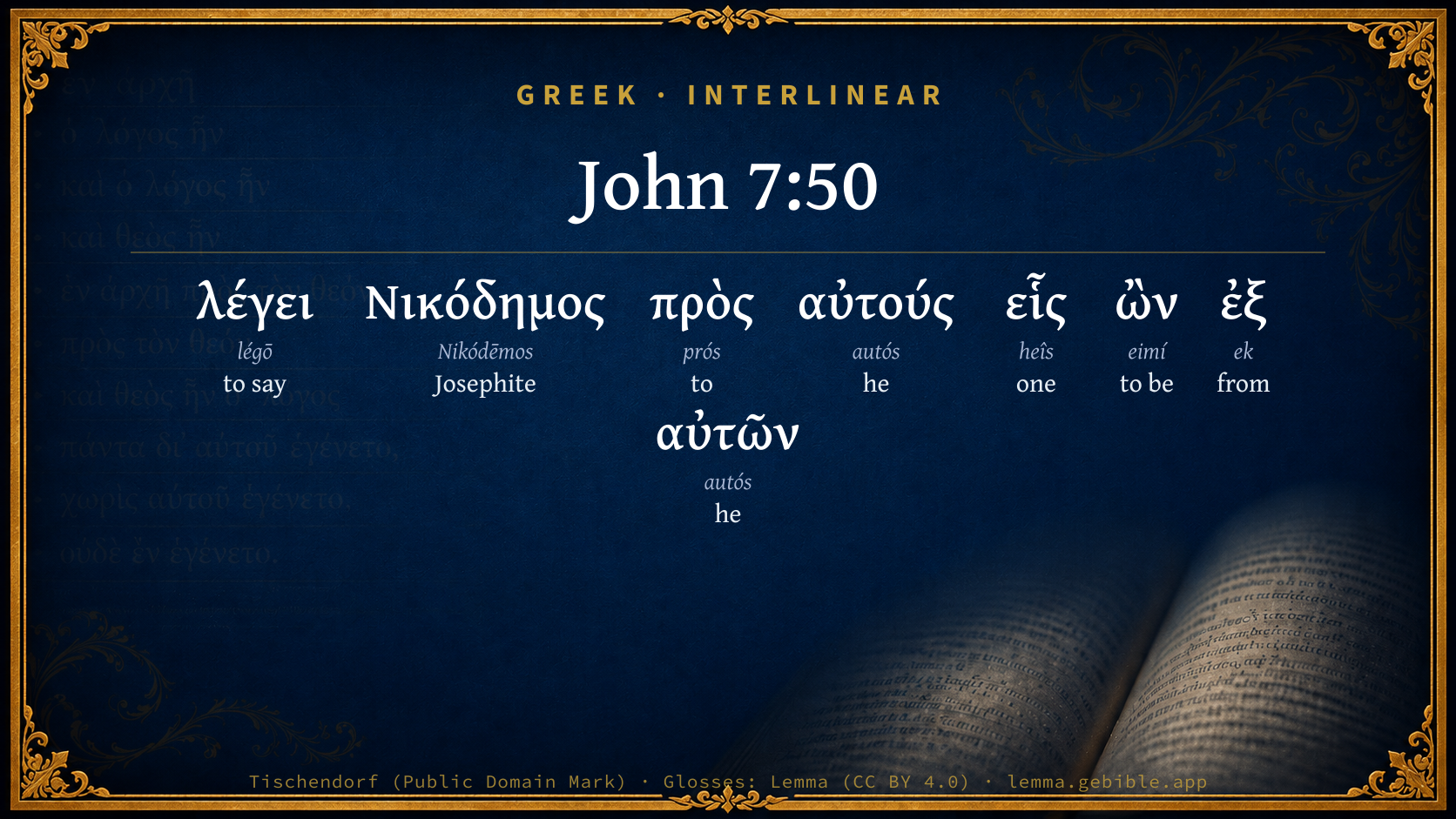
Greek (Tischendorf 8th ed.) John 7:50 appears in the Greek New Testament. The text above is from the Tischendorf 8th edition. Each word links to its Strong’s number and a concise gloss. Click any word for its full Thayer’s Greek Lexicon entry.
Download image
Cite this verse

John 7:50 (World English Bible). Public Domain. Lemma interlinear Bible study tool, https://lemma.gebible.app/v/john/7/50.

Show BibTeX & RIS
BibTeX
RIS
English Translation
Nicodemus (he who came to him by night, being one of them) said to them,
World English Bible · Public Domain
Download a study sheet

One document with this verse’s original text, its word-by-word gloss line, the meaning frame, cross-references with their text, attributed commentary, and full source and license credits — printable, and it pastes into notes with its structure intact.

This verse Autodidact and up

Study sheet (.html) Plain text (.txt)

A passage Seminary Student

Up to 50 verses in one chapter. A passage sheet keeps up to 6 commentary sources and 12 cross-references per verse, in the order this page ranks them, and says so on the sheet whenever that leaves anything out. Ask for a single verse and you get the Autodidact verse sheet above.

Everything on this page stays free to read, with no account — the sheet is a download of what is already on screen, not access to it.

Want to remove ads? Support Godless Engineer
Compare translations 3

The same verse in 3 English versions, stacked beneath the original-language interlinear above. Click any original word for its lexicon entry.

Each is an independent rendering of the whole verse — the interlinear is not word-aligned to these translations.

Highlighted words mark where these versions differ — a whole-verse word diff, not a word-by-word alignment.

  • World English Bible Public Domain
    Nicodemus (he who came to him by night, being one of them) said to them,
  • King James Version Public Domain
    Nicodemus saith unto them, (he that came to Jesus by night, being one of them,)
  • unfoldingWord Literal Text CC BY-SA 4.0
    Nicodemus (the one having come to him earlier, being one from them) says to them,

unfoldingWord Literal Text — © unfoldingWord, licensed CC BY-SA 4.0. Word-aligned USFM3 via Door43 (git.door43.org/unfoldingWord/en_ult).

Versions to compare (up to 4)

3 of 4 selected

Show all 19 translations

Every available English version of this verse, each an independent rendering of the whole verse.

  • World English Bible Public Domain
    Nicodemus (he who came to him by night, being one of them) said to them,
  • Berean Standard Bible Public Domain
    Nicodemus, who had gone to Jesus earlier and who himself was one of them, asked,
  • Majority Standard Bible Public Domain
    Nicodemus, who had gone to Jesus by night and who himself was one of them, asked,
  • King James Version Public Domain
    Nicodemus saith unto them, (he that came to Jesus by night, being one of them,)
  • American Standard Version (1901) Public Domain
    Nicodemus saith unto them (he that came to him before, being one of them),
  • Revised Version (1885) Public Domain
    Nicodemus saith unto them (he that came to him before, being one of them),
  • Geneva Bible (1599) Public Domain
    Nicodemus said vnto them, (he that came to Iesus by night, and was one of them.)
  • Douay-Rheims (1899) Public Domain
    Nicodemus said to them, (he that came to him by night, who was one of them:)
  • Young's Literal Translation Public Domain
    Nicodemus saith unto them -- he who came by night unto him -- being one of them,
  • Literal Standard Version CC BY-SA 4.0
    Nicodemus says to them—he who came by night to Him—being one of them,
  • Unlocked Literal Bible CC BY-SA 4.0
    Nicodemus (one of the Pharisees, who came to him earlier) said to them,
  • unfoldingWord Literal Text CC BY-SA 4.0
    Nicodemus (the one having come to him earlier, being one from them) says to them,
  • Darby Bible Public Domain
    Nicodemus says to them (being one of themselves),
  • World Messianic Bible Public Domain
    Nicodemus (he who came to him by night, being one of them) said to them,
  • Webster's Bible Public Domain
    Nicodemus saith to them, (he that came to Jesus by night, being one of them)
  • Free Bible Version CC BY-SA 4.0
    Nicodemus, who had previously gone to meet Jesus, was one of them and asked them,
  • Bible in Basic English Public Domain
    Nicodemus--he who had come to Jesus before, being himself one of them--said to them,
  • Text-Critical English NT CC BY 4.0
    Then Nicodemus, who had gone to Jesus by night and who was one of the rulers, said,
  • Tyndale New Testament (1534) Public Domain
    Nicodemus sayde vnto them: He that came to Iesus by nyght and was one of them.

Literal Standard Version (2020), Covenant Press — licensed CC BY-SA 4.0. Text via the HelloAO Bible API (eBible.org). Unlocked Literal Bible (unfoldingWord) — licensed CC BY-SA 4.0. Text via the HelloAO Bible API (eBible.org). unfoldingWord Literal Text — © unfoldingWord, licensed CC BY-SA 4.0. Word-aligned USFM3 via Door43 (git.door43.org/unfoldingWord/en_ult). Free Bible Version, Dr. Jonathan Gallagher — licensed CC BY-SA 4.0. Text via the HelloAO Bible API (eBible.org).

Word by word

More ways to search: Search by grammar → Find every occurrence → Compare this word →

Practice this passage: Drill this verse → Learn its vocabulary →

About this verse

These counts appear in no published source. They are computed here, from the morphology-tagged text and Lemma’s own curated glosses. What Lemma adds →

8
words
7
distinct lemmas
Gospels
section

Notable vocabulary

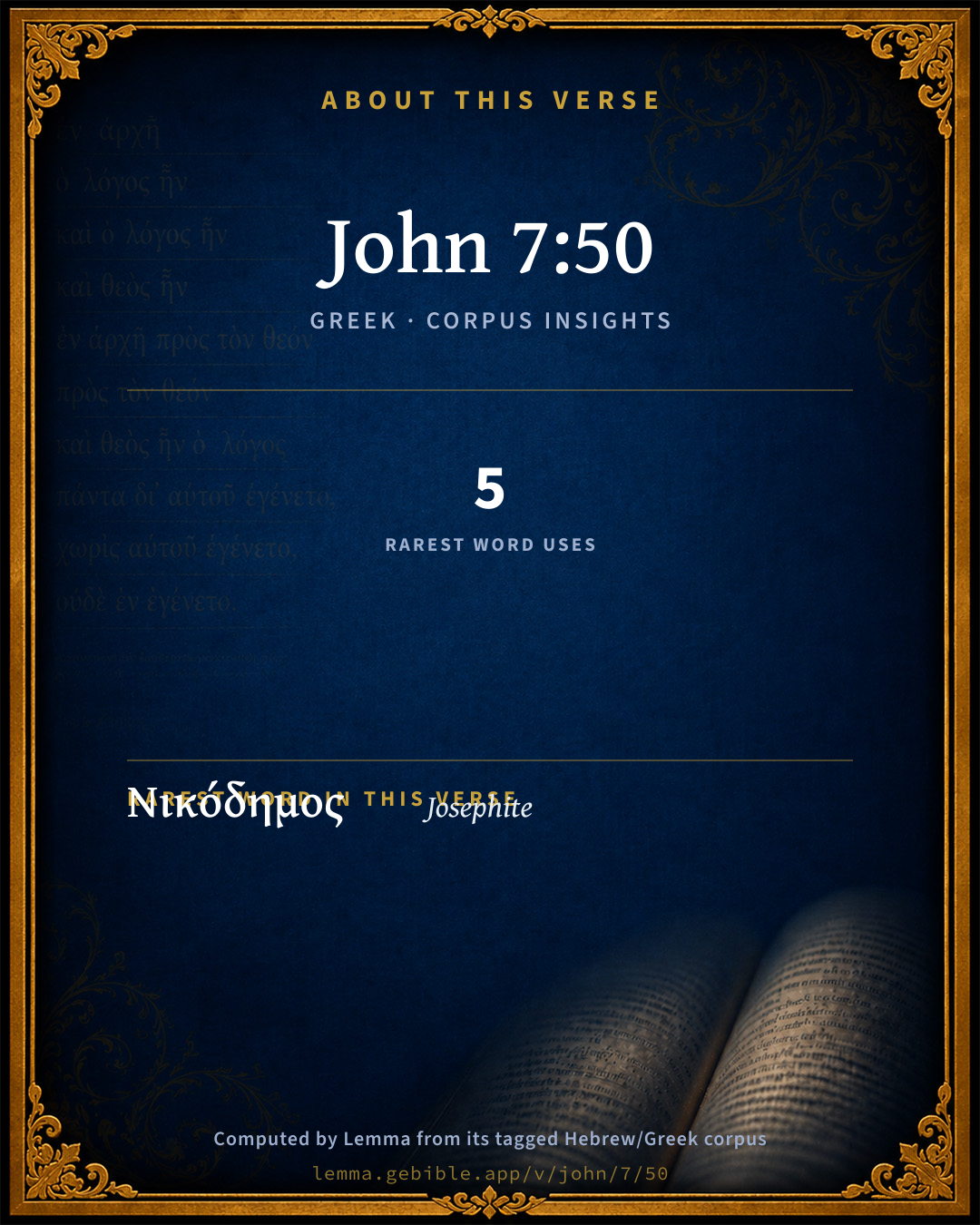
The rarest word here is Νικόδημος Josephite G3530 — appearing just 5 times in the whole Greek New Testament.

Shared distinctive vocabulary

Νικόδημος Josephite G3530 occurs in 5 verses of the Greek New Testament. Also found in:

Repetition

A word recurs within this verse:

  • αὐτούς he G846 ×2

Cross-references

2

Topical passages linked to John 7:50 in the Treasury of Scripture Knowledge — connected by theme and wording, ordered by reader-vote popularity; previews shown in the World English Bible.

  • John 19:39 Nicodemus, who at first came to Jesus by night, also came bringing a mixture of myrrh and aloes, about a hundred pounds.
  • John 3:1–2 Now there was a man of the Pharisees named Nicodemus, a ruler of the Jews.

Cross-references courtesy of OpenBible.info (CC BY 4.0).

Where the printed editions differ

3 variants

Places in this verse where the major printed Greek editions disagree on the wording in a way that affects the translation — a comparison of editions, not a manuscript-by-manuscript collation. The editions are the modern critical texts (Nestlé-Aland 28/27, SBL, Westcott-Hort, Tregelles, Tyndale House) and the traditional texts behind the KJV (the Textus Receptus and the Byzantine/Majority text). It is not a claim about which reading is original.

  1. Extra text
    νυκτὸς

    “at night”

    In TRByz Not in NA28NA27TynSBLWHTreg

    νυκτὸς (nuktos) 'at night' is only in traditional manuscripts (TR+Byz)

  2. Extra text
    τὸ

    “the”

    In NA28NA27 Not in TynSBLWHTregTRByz
  3. Extra text
    πρότερον,

    “former”

    In NA28NA27TynSBLWHTreg Not in TRByz

    τὸ πρότερον, (to proteron) 'the former' is only in older manuscripts (NA28+NA27+Tyn+SBL+WH+Treg)

Textual data: Translators Amalgamated Greek New Testament (STEPBible TAGNT) · CC BY 4.0.

Commentary

Notes on John 7:50 from classic Christian and Jewish commentators (each source and its license shown beneath its notes). The classic Christian expositions comment on the surrounding passage and are grouped to its opening verse, so a note may address several verses; the Jewish commentaries on the Tanakh (Rashi and others) are per-verse, so they appear only where the commentator wrote on this verse.

Lemma curates 59 commentaries, every one of them public domain or Creative Commons licensed, each selected and text-cleaned for this edition rather than reprinted as found. About our sources →

Joseph Benson's Commentary

Joh 7:50-53. Nicodemus, he who came to Jesus by night — Having now got a little more courage; being one of them — Being present, as a member of the great council, saith to them, Doth our law judge (κρινει, condemn) any man before it hear him — Before the magistrate, appointed to execute it, summon him into his presence, that he may hear from him what he has to say in his own defence; and know what he doeth — Namely, from credible witnesses? As if he had said, Do not we ourselves act as if we knew not the law, if we pass sentence on a man before we hear him? They answered — By personal reflection; the argument they could not answer, and therefore did not attempt it. For, notwithstanding that perfect knowledge of the law, and that high reverence for its precepts, which they made such boast of, they were acting directly contrary to the most essential principles of equity established by it. But, being greatly exasperated by Nicodemus’s reproof, which was the more poignant and provoking, because it was well founded; and being in a violent passion with him, for condemning their conduct, and speaking favourably of Jesus, they asked him, with an air of disdain and surprise mixed with fierceness, Art thou also of Galilee — Art thou one of his party? One of the ignorant, low faction, that has leagued to support a Galilean Messiah in opposition to the law, which has determined the Messiah’s nativity to Bethlehem? Search and look; for out of Galilee ariseth (or rather, hath arisen, as ουκ εγηγερται properly signifies) no prophet — They could not but know the contrary. They knew Jonah arose out of Gath-hepher; and Nahum from another village in Galilee. Yea, and Thisbe, the town of Elijah the Tishbite, was in Galilee also. They might, likewise, have known that Jesus was not born in Galilee, but at Bethlehem, even from the public register there, and from the genealogies of the family of David. Add to this, that many of the people had heard the shepherds declare, on the testimony of the angel, that he was born at Bethlehem, and had wondered at the words which had been told them by the shepherds, Luk 2:15-18. Nay, and the chief priests and Pharisees were not ignorant that the wise men from the East went to Bethlehem to worship him soon after he was born, as king of the Jews: the memory of which facts could not be lost in the space of thirty years. Here, then, we have a striking instance of the power of prejudice to shut men’s eyes against the clearest truth. Dr. Campbell, however, thinks they did not mean all that they expressed; because, when men’s passions are inflamed, they are not wont to be accurate in their words, or distinct in recollecting, on the sudden, things which make against them; and that therefore this expression of the Pharisees, whom prejudice, pride, and envy had concurred in blinding, need not appear surprising to us. And every man went unto his own house — The council separated immediately: for, being conscious that their poor answer would not bear examination, they took care, by rising up and dispersing, to prevent a reply. So that short, plain question of Nicodemus, spoiled all their measures, and for the present frustrated their designs. A word spoken in season, how good is it! especially when God gives it his blessing.

Joseph Benson's Commentary on the Old and New Testaments (1811–1818) — public domain. Text from a community e-Sword module.

Godbey's Commentary on the New Testament

William B. Godbey

NICODEMUS VINDICATES HIM

Joh 7:50-52. “Nicodemus says to them, being one of them, Whether does our law condemn a man until it may first have a hearing with him, and know what he doeth? They responded, and said to him, Whether are you also from Galilee? Search and see that no prophet riseth from Galilee.” You see here they are ringing charges of reproach on Galilee, because most remote from Jerusalem, the center of light and knowledge, the home of the hierarchy, the seat of the rabbinical colleges, and the glory of Israel. Consequently they look down with contempt on the poor, ignorant Galileans, and think they have made a point, because the prophecies do not specify a great prophet in that age rising out of Galilee, whereas it was not at all applicable to Jesus, who had simply used it as an evangelistic field. Nicodemus never survived that memorable nocturnal sermon which Jesus preached to him, more than two years ago, on the new birth. As he was an influential member of the Sanhedrin, which was solid against Jesus, how beautiful to see him, true to his convictions, standing alone, and thus daring to vindicate Him! It is a significant fact that Jesus was actually mobbed, being denied a fair trial according to Jewish law, as you here see from the testimony of Nicodemus, which, like the English and American Magna Charta, guaranteed to every accused person a fair trial, bringing the witnesses face to face, and giving them a chance to “implead one another.”

It is equally true in reference to Roman law, as testified by Festus in case of Paul, that every man under accusation had a right to bring the witnesses face to face, prove the guilt or innocence of the accused, and thus bring about a true verdict of acquittal or condemnation in harmony with right and equity. Jonah, one of the first Hebrew prophets, called of God to preach to the Ninevites, was a Galilean, despite all this howl against Jesus on the allegation of no prophet rising from Galilee.

William B. Godbey, Commentary on the New Testament (1896–1900) — public domain. Text from a community e-Sword module.

Bengel's Gnomon

Johann Albrecht Bengel

Joh 7:50. Λέγει, saith) Often those who had been timid where there was no danger, in the very crisis of danger prove to be defenders of the truth. [Comp. ch. Joh 19:39 (after the crucifixion, when others stood aloof), “Then came Nicodemus, which at the first came to Jesus by night, and brought a mixture of myrrh and aloes, about an hundred pound weight.”]—εἷς ὤν, who was one) This clause is connected with saith.

Bengel's Gnomon of the New Testament — English translation (T&T Clark, Edinburgh, 1860) — public domain. Text from a community e-Sword module.

Meyer's Critical & Exegetical Commentary

Heinrich August Wilhelm Meyer

Joh_7:50-51. The Pharisees in the Sanhedrim had expressed themselves as decisively and angrily against Jesus, as if His guilt had already been established. But Nicodemus, who had secretly been inclined towards Jesus since his interview with Him by night, now raises a protest, in which he calmly, plainly, and rightly points the excited doctors to the law itself (see Exo_23:1; Deu_1:16-17; Deu_19:15).

πρὸς αὐτούς] to the Pharisees, Joh_7:47.

ὁ ἐλθὼν … αὐτῶν] who had before come to Jesus, although he was one of them (i.e. of the Pharisees), Joh_3:1.

μὴ ὁ νόμος, κ.τ.λ.] The emphasis is on ὁ νόμος: our law itself does not, eta They had just denied that the people knew the law, and yet they were themselves acting contrary to the law.

τὸν ἄνθρ.] the man; the article denotes the person referred to in any given case; see on Joh_2:25. We are not to supply ὁ κρίτης to ἀκούσῃ (Deu_1:16-17) and γνῷ, for the identity of the subject is essential to the thought; but the law itself is regarded and personified as (through the judge) examining and discerning the facts of the case. For a like personification, see Plato, de Rep. vii p. 538 D. Comp. νόμος πάντων βασιλεύς from Pindar in Herod. iii. 38.

τί ποιεῖ] what he doeth, what the nature of his conduct is.

Meyer — Critical and Exegetical Commentary on the New Testament — English translation by Peter Christie, edited by Frederick Crombie (T&T Clark, 1880) — public domain. Text from a community e-Sword module.

Expositor's Greek Testament

ed. W. Robertson Nicoll

Joh 7:50 . To this strong expression one of their own number (and therefore to their great surprise), Nicodemus, the same person who had visited Jesus under cover of night, takes exception and makes a protest. [Tisch [61] deletes the clause ὁ ἐλθὼν νυκτὸς πρὸς αὐτόν , and no doubt it has quite the appearance of a gloss. At the same time it is John’s manner thus to identify persons named. And at Joh 19:39 the similar clause is not deleted.] This was a bold step. For he must have known it was useless; and he might have persuaded himself to evade all risk by silence. His remonstrance is based on their implied claim to know the law: μὴ ὁ νόμος … ποιεῖ ; their own action is suspiciously like a violation of the law. “Does our law pass judgment on the suspected person before it first hears him and knows what he is guilty of doing?” For the law regarding trials see Deu 1:16 and Stapfer’s Palestine , p. 108, on the administration of justice. The construction is simple; “the law” which the Sanhedrim administered is the nominative throughout.

[61] Tischendorf.

The Expositor's Greek Testament, edited by W. Robertson Nicoll (1897–1910) — public domain. Text from a community e-Sword module.

Jamieson, Fausset & Brown

Robert Jamieson, A. R. Fausset & David Brown

Nicodemus--reappearing to us after nearly three years' absence from the history, as a member of the council, probably then sitting.

Jamieson, Fausset & Brown — Commentary Critical and Explanatory on the Whole Bible (1871) — public domain (CC PDM 1.0). Text via the HelloAO Bible API.

Adam Clarke's Commentary

Verse 50. Nicodemus - being one of them] That is, a Pharisee, and a ruler of the Jews: See Clarke on Joh 3:1.

Adam Clarke's Commentary on the Bible (1810–1826) — public domain. Text from a community e-Sword/MySword module.

John Calvin's Commentaries

50. Nicodemus said to them. The Evangelist describes Nicodemus as a neutral man, who does not venture to undertake in good earnest the defense of sound doctrine, and yet cannot endure to have the truth oppressed.

He who came to Jesus by night. This circumstance is mentioned by the Evangelist, partly to the praise, and partly to the disgrace, of Nicodemus. If he had not loved the doctrine of Christ, he would never have dared to meet the rage of wicked men; for he knew that, if any of them but opened his mouth, he would be immediately exposed to dislike and to danger. When, therefore, he ventures to throw out one word, however feeble it may be, some small spark of godliness shines from his heart; but in not defending Christ openly, he manifests excessive timidity. Thus the Evangelist means that he has still a hankering after the concealment of the night, and is not a true disciple of Christ. He says that he once came to Jesus by night, but remained openly among his enemies, and kept his place in their camp.

This ought to be the more carefully observed, because there are many in the present day who plead that they resemble Nicodemus, and hope that, by assuming this mask, they will mock God with impunity. Granting what they ask, that there is no difference between them and Nicodemus, what assistance, pray, do they derive from such an example? Nicodemus says that Christ ought not to be condemned until he be heard; and the same thing might be said of a robber or an assassin; for it is a well-known and proverbial sentiment, that it is better to acquit the innocent than to condemn the guilty. Besides, in his attempts to release the person of Christ, he leaves and abandons the doctrine. What shall we find here that is worthy of a believer or a Christian? Thus the seed of the gospel, which afterwards bore fruit, was still concealed and choked in him. We shall apply this example far more profitably to another purpose, that the Lord frequently causes the doctrine, which seemed to have perished, gradually to take a concealed root, and, after a long period, to put forth some bud, first like an untimely plant, afterwards lively and vigorous; just as the faith of Nicodemus acquired new and sudden vigor from the death of Christ.

John Calvin's Commentaries (1540-1563) — public domain. Text from the Calvin Translation Society English edition (1840s-50s) via the Christian Classics Ethereal Library (ccel.org). Calvin's coverage is partial (roughly two-thirds of the Bible); uncommented books and verses are honest gaps, never fabricated. The 19th-century editor's footnotes and remarks are omitted so the notes are faithfully Calvin's own voice.

Ellicott's Commentary for English Readers

(50) On the character of Nicodemus, see Notes on John 3. His position here is that of a friend of Jesus, who still does not dare to declare himself His open follower.

He that came to Jesus by night.—Comp. Note on Joh_3:2. The better reading here is, probably, he that came to Him before.

Being one of them contains the answer to their question, “Hath any one (as above) of the rulers or of the Pharisees believed on Him?” (Joh_7:48).

A Bible Commentary for English Readers, edited by Charles John Ellicott (1878–1897) — public domain. Text from a community e-Sword module.

The Cambridge Bible for Schools and Colleges

gen. ed. J. J. S. Perowne

50. he that came to Jesus by night] The better reading seems to be, he that came to Him before. See on Joh_3:1-2. His ‘being one of them’ contradicts what is implied in Joh_7:48, that no member of the Sanhedrin believed on Him.

The Cambridge Bible for Schools and Colleges (gen. ed. J. J. S. Perowne; Cambridge University Press, 1878–1918) — public domain. Text from a community e-Sword module.

John Gill's Exposition

And every man went unto his own house. The officers not bringing Jesus with them, and the sanhedrim being posed with Nicodemus, broke up without doing any business, and every member of it went home: this we may suppose was about the time of the evening sacrifice: for

"the great sanhedrim sat from the time of the morning daily sacrifice, to the time of the evening daily sacrifice (b):''

and it is said (c), that

"after the evening daily sacrifice, the sanhedrim went, "to their own houses";''

as they now did, and not to their booths, the feast of tabernacles being now over.

(b) Maimon. Hilchot Sanhedrin, c. 3. sect. 1. (c) Piske Tosephot Sanhedrin, art. 35.

Next: John Chapter 8

John Gill's Exposition of the Whole Bible (1746–1763) — public domain (CC PDM 1.0). Text via the HelloAO Bible API.

Trapp's Complete Commentary

John Trapp

50 Nicodemus saith unto them, (he that came to Jesus by night, being one of them,)

Ver. 50. Nicodemus saith unto them] Good blood will not belie itself; love, as fire, will not long be hidden. Croesus’s dumb son could not but speak to see his father ready to be slain, {a} Nicodemus, though hitherto a night bird, now shows himself for Christ in a council. How far had Judas outstripped Nicodemus till it came to the upshot! Nicodemus was only a night professor, Judas in the sight of all. Nicodemus a slow scholar, Judas a forward preacher. Yet at last, when Judas betrayed Christ in the night, Nicodemus faithfully professed him in the day, &c.

{a} ανθρωπε, μη κτεινε Κροισον. Herod.

John Trapp, A Commentary or Exposition upon All the Books of the Old and New Testament (1647–1656) — public domain. Text from a community e-Sword module.

Albert Barnes' Notes on the Bible

Nicodemus - See Joh 3:1.

One of them - That is, one of the great council or Sanhedrin. God often places one or more pious men in legislative assemblies to vindicate his honor and his law; and he often gives a man grace on such occasions boldly to defend his cause; to put men upon their proof, and to confound the proud and the domineering. We see in this case, also, that a man, at one time timid and fearful (compare Joh 3:1), may on other occasions be bold, and fearlessly defend the truth as it is in Jesus. This example should lead every man entrusted with authority or office fearlessly to defend the truth of God, and, when the rich and the mighty are pouring contempt on Jesus and his cause, to stand forth as its fearless defender.

Albert Barnes' Notes on the Bible (1834–1885) — public domain. Text from a community e-Sword/MySword module.

Matthew Poole's English Annotations

Of Nicodemus we read, and of his coming by night to Jesus, Joh 3:1,2. He now, being one of this great court, stands up to speak for Christ, yet faintly, or at least very prudently and warily. He saith no more for him than he ought to have spoken for the greatest malefactor, viz.

Matthew Poole's English Annotations on the Holy Bible (1683–1685) — public domain. Text from a community e-Sword/MySword module.

Whedon's Commentary on the Bible

Daniel D. Whedon

50. Nicodemus saith—The words of Nicodemus are a model of caution, but wonderfully to the point. They would have it that no ruler believed on Jesus; but here they are met by one who dares to be his advocate. They curse the people ignorant of the law, and he convicts them of violating the law.

Daniel D. Whedon (gen. ed.), Commentary on the Old and New Testaments (1874–1909) — public domain. Text from a community e-Sword module.

The Pulpit Commentary

Vers. 50, 51. They were hardly prepared for what followed; for one of their own order, one of their "rulers," "the teacher of Israel," a chief among the Pharisees, opens his lips to speak to them, and to call for a halt in their rash proceedings. He did not go far, but he directed attention to a fundamental principle of that very "Law" which the Pharisaic party were ignoring. Nicodemus saith to them (he who came to him formerly, although being one of them). The parenthesis shows the author"s strong recollection of the scene, (Joh_3:1, etc.) when the Lord had opened to his own mind, as well as to Nicodemus, the mystery of the kingdom, and the need of that very Spirit"s power to which (John knew when he wrote that) the Lord was referring in his great discourse. Nicodemus had not proclaimed his own discipleship, but he meant to cover and shield the enthusiastic crowd from the sting of the cruel condemnation of this Pharisaic junta. Doth our Law judge a man except it have first heard from himself, and have come to know what he doeth? (Exo_23:1 margin, "Thou shalt not receive a false report;" Deu_1:16, "Hear the causes between your brethren, and judge righteously between every man and his brother The Law is here personified in the person of the judge. The process is not followed by this hasty ex parte statement. The Law is traversed by this forgetfulness of the first principle of justice as between man and man. They might have rejoined that they did know the teaching and the work of Jesus. They had been following him by their representatives, and were now witnesses of his extraordinary assumptions, and had evidence enough on which to proceed. The retort which they made is sufficient proof of the defective and passion-blinded method of their own procedure. Moreover, it shows that the prophetic rank assigned to the Lord Jesus was the main question in the mind of Nicodemus and his Pharisaic companions. The rules for the judgment of a prophet were stringent, and no attempt had been made to put these prophetic claims to the test. (Deu_18:19-22) Moreover, they ran off upon an utterly false tack, and were not free from inaccuracy in their solemn appeal to Holy Scripture.

The Pulpit Commentary (1880–1919), ed. H.D.M. Spence-Jones & Joseph S. Exell — public domain. Text from a community e-Sword module.

John Wesley's Explanatory Notes

Nicodemus, he that came to him by night - Having now a little more courage, being one of them - Being present as a member of the great council, saith to them - Do not we ourselves act as if we knew not the law, if we pass sentence on a man before we hear him?

John Wesley, Explanatory Notes Upon the Whole Bible (1754–1765) — public domain. Text via the GEBible commentary corpus.

Burkitt's Expository Notes on the New Testament

William Burkitt

Here observe, 1. How God stirs up Nicodemus, though he durst not openly own Christ, yet to plead for him, that he might not be condemned before heard; this was a common rule of justice, and nothing but what might have been said on behalf of the greatest malefactor; he could not well have said less; but God so ordered it, that it was enough to divert the storm from falling upon Christ at this time. One word shall be sufficient to blow over a persecution, when God will have it so.

Observe, 2. They answer Nicodemus with a taunt, a mock, and a scorn, that no prophet ever did rise out of Galilee, nor ever should. Therefore Christ arising out of Galilee, as they thought, could be no prophet.

Observe, lastly, That though they were more and more enraged, yet they dispense without concluding any thing against Christ, for that time every one went to his own home. There is no wisdom, nor understanding, nor counsel against the Lord.

William Burkitt's Expository Notes on the New Testament (1700–1703) — public domain. Text from a community e-Sword module.

The People's New Testament

B. W. Johnson

50–52. Nicodemus. See John 3:1.

Dost our law judge, etc.? Of course it did not, but for him to say a word in defense of justice brought the charge that he was a follower of the Galilean.

Out of Galilee ariseth no prophet. The rulers in their rage make a false statement. Jonah (2 Kings 14:25), Elijah (1 Kings 17:1) and Nahum (Nah. 1:1) were all of Galilee.

B. W. Johnson's The People's New Testament with Notes (1889–1891) — public domain. Electronic text from the Christian Classics Ethereal Library (CCEL) ThML edition.

unfoldingWord translationNotes

Door43 World Missions Community

one of the Pharisees, who came to him earlier

John provides this information to remind us of who Nicodemus is. Your language may have a special way to mark background information. (See: Background Information)

Does our law judge a man ... what he does?

This remark appears in the form of a question to add emphasis. This can be translated as a statement. AT: "Our Jewish law does not allow us to judge a man ... what he does!" (See: Rhetorical Question)

Does our law judge a man

Here Nicodemus speaks of the law as if it were a person. If this is not natural in your language, you may translate it with a personal subject. AT: "Do we judge a man" or "we do not judge a man" (See: Personification)

Are you also from Galilee?

The Jewish leaders know that Nicodemus is not from Galilee. They ask this question as a way of scoffing at him. AT: "You must also be one of those inferior persons from Galilee!" (See: Rhetorical Question and Assumed Knowledge and Implicit Information)

Search and see

This is an ellipsis. You may wish to include the information that does not appear. AT: "Search carefully and read what is written in the Scriptures" (See: Ellipsis)

no prophet comes from Galilee

This probably refers to the belief that Jesus was born in Galilee.

translationWords

judge

unfoldingWord translationNotes — © Distant Shores Media and the Door43 World Missions Community, licensed CC BY-SA 4.0. Source: git.door43.org/Door43/en_tn.

Cambridge Greek Testament for Schools and Colleges

50. πρὀς αὐτὸν πρότερον for νυκτὸς πρὸς αὐτόν. Here also there is much variation in the readings.

50. ὁ ἐλθὼν πρότερον. see on Joh 3:1-2. His being ‘one of them’ answers the challenge in Joh 7:48, ‘Hath any one of the rulers believed on Him?’ But he does not yet declare himself His disciple. Comp. the attitude of Gamaliel, Act 5:34-42.

Cambridge Greek Testament for Schools and Colleges (Cambridge University Press, 1896; 21 vols, various authors incl. Carr, Maclear, Plummer, Farrar, Lumby, Moule, M. R. James, Simcox) — public domain. Text from a community e-Sword module.

Alford’s Greek Testament

Henry Alford

50.] The Jews had, since the sabbath-healing, condemned Jesus, and were seeking to kill him. But in Exo 23:1, Exo 23:2: Deu 1:16, Deu 1:17, justice is commanded to be done in the way here insisted on by Nicodemus. On the consistency, and development, of the character of Nicodemus, Luthardt has some valuable remarks, pp. 125 ff. [see on ch. 19:39].

Henry Alford, The Greek Testament (1849–1861) — public domain. Text from a community e-Sword module.

International Critical Commentary

50. λέγει Ν. πρὸς αὐτούς, sc. to the Pharisees. For this constr., see on 2:3.

εἷς ὢν ἐξ αὐτῶν, sc. being a member of the Sanhedrim, and so taking up the challenge of v. 48. For the constr., see on 1:40.

Most MSS. add ὁ ἐλθὼν πρὸς αὐτὸν πρότερον, thus identifying Nicodemus with the person described in 3:1. א* omits the words; NΓΔ insert νυκτός (from 3:2), omitting πρότερον; D has νυκτὸς τὸ πρῶτον (the true reading at 19:39).

If the story of Nicodemus could be held to belong to the last week of the ministry (see on 3:1), then this passage would be the first mention of him, and the words omitted by א* would be, in that case, a later gloss added by an editor.

International Critical Commentary — older volumes (1896–1929), various authors — public domain. Text from a community e-Sword module.

Vincent's Word Studies in the New Testament

Marvin R. Vincent

He that came to Him by night [ο ελθων νυκτος προς αυτον] . The texts vary, either substituting proteron, before, for nuktov, by night, or omitting the whole clause, and reading, Nicodemus saith unto them, being one of them.

Marvin R. Vincent, Word Studies in the New Testament (1887–1900) — public domain. Text from a community e-Sword/MySword module.

Godet's Commentaries

Frédéric Louis Godet

Vv. 50-52. “Nicodemus, who came to him before by night and who was one of them, says to them, 51. Does our law then condemn a man before hearing from him and taking knowledge of what he does? 52. They answered and said to him, Art thou, then, thyself also, a Galilean? Search and see that out of Galilee arises no prophet.”

The part which Nicodemus plays on this occasion is the proof of the advance which has been made in him since his visit to Jesus. This is noticeably indicated by the apposition, “who came to Jesus before.” The omission of these words in the Sinaitic MS. is probably owing to a confounding of αὐτούς and αὐτόν. Νυκτός, by night, is omitted by the Alexandrian authorities; but we may hold that it has for its aim to bring out the contrast between his present boldness and his former caution. The πρῶτου or πρότερον, before, which the Alexandrian authorities read in place of νυκτός, likewise establishes the contrast between his present conduct and his previous course. The second apposition: who was one of them, ironically recalls their own question, Joh 7:48 : “Has any one of the rulers...”?

The term ὁ νόμος, the law, Joh 7:51, is at the beginning of the sentence; it contains a cutting allusion to the claim of the rulers that they alone have knowledge of the law (Joh 7:49). The subject of the verbs ἀκούσῃ and γνῷ is the law personified in the judge.

We see in Joh 7:52 how passion regards and judges impartiality. It discovers in it the indication of a secret sympathy, and in this it is not always mistaken. The Sanhedrim maliciously assume in their reply that one cannot be an adherent of Jesus without being, like Him, a Galilean: “It must be that thou art His fellow-countryman to give up thyself thus to His imposture.” The last words which the narrative places in the mouth of Jesus’ adversaries seem to contain an assertion which is contrary to the facts of the case; for, it is claimed, several prophets, Elijah, Nahum, Hosea, Jonah, were of Galilean origin. Hence the conclusion has been drawn (Bretschneider, Baur) that the members of the Sanhedrim, who must have known their own sacred history, could not have uttered these words, and that it is the evangelist who has wrongly attributed to them this error. If the perfect ἐγήγερται, has arisen, is read, we might with some writers understand the thought thus: “And see that a prophet has not (really) arisen in Galilee (in the person of this man).” There would thus be an allusion to the title prophet of Galilee, which was frequently given to Jesus. But this does not obviate the difficulty.

For there still remains the phrase ἐρεύνησον καὶ ἴδε, search and see that ..., which implies that the fact has not yet occurred. The more probable reading, the present ἐγείρεται, does not arise, also does not set aside the difficulty; for the proverb: “no prophet arises in Galilee” can only be an axiom resulting, according to them, from Scriptural experience (“search and thou shalt see”). The attempt at a complete justification of this appeal to history must be given up. Undoubtedly, the Galilean origin of three of the four prophets cited (Elijah, Nahum, Hosea) is either false or uncertain; see Hengstenberg. Elijah was of Gilead; Hosea, of Samaria, which cannot be identified with Galilee; Nahum, of El-Kosh, a place whose situation is uncertain. But Jonah remains. His case is an exception which passion might have caused the rulers to forget in a moment of rage and which, if it had been mentioned in the way of objection to the rulers, would have been set aside by them as an exception confirming the rule. Notwithstanding this isolated fact, Galilee was and still continued to be an outcast land in the theocracy. Westcott: “Galilee is not the land of prophets, still less of the Messiah.” The gravest thing which they forget, is not Jonah, it is the prophecy Isa 8:22 to Isa 9:1, where the preaching of the Messiah in Galilee is foretold.

Frédéric Louis Godet — Commentaries on Luke, John, Romans, and 1 Corinthians — English translation (T&T Clark, Edinburgh, 1870s–1890s) — public domain. Text from a community e-Sword module.

Lesson kit

Teaching starters — assembled from the data on this page, not authored interpretation. Every prompt links to the verse data it draws on. Edit before teaching.

John, in the Gospels, opens this verse with 8 words (7 distinct Greek lemmas). Its most distinctive word is Nikódēmos (“Josephite”). A historical commentator’s framing appears above. Read the whole chapter for the surrounding context.

Discussion questions

  1. How does “Josephite” (Nikódēmos) shape what this verse is saying?
  2. How does John 3:1, which shares the word «Josephite», read alongside this verse?
  3. What does the repetition of “he” (2× in this one verse) do in this verse?
  4. The translations on this page render this verse differently — a whole-verse word diff, not a word-by-word alignment. What might account for the different wordings?
  5. Compare how Joseph Benson's Commentary and Godbey's Commentary on the New Testament read this verse. Where do they agree or differ?

Things to notice

Reading settings

Reading text

Shown beneath each verse's original-language words.

Old Testament
Old Testament edition

Read the OT as the Masoretic Hebrew (MT) or the Greek Septuagint (LXX).

English shown for the Greek Septuagint (in the Hebrew ↔ Greek comparison).

Comparing translations? Open the Compare panel on any verse page to stack up to four side by side.