
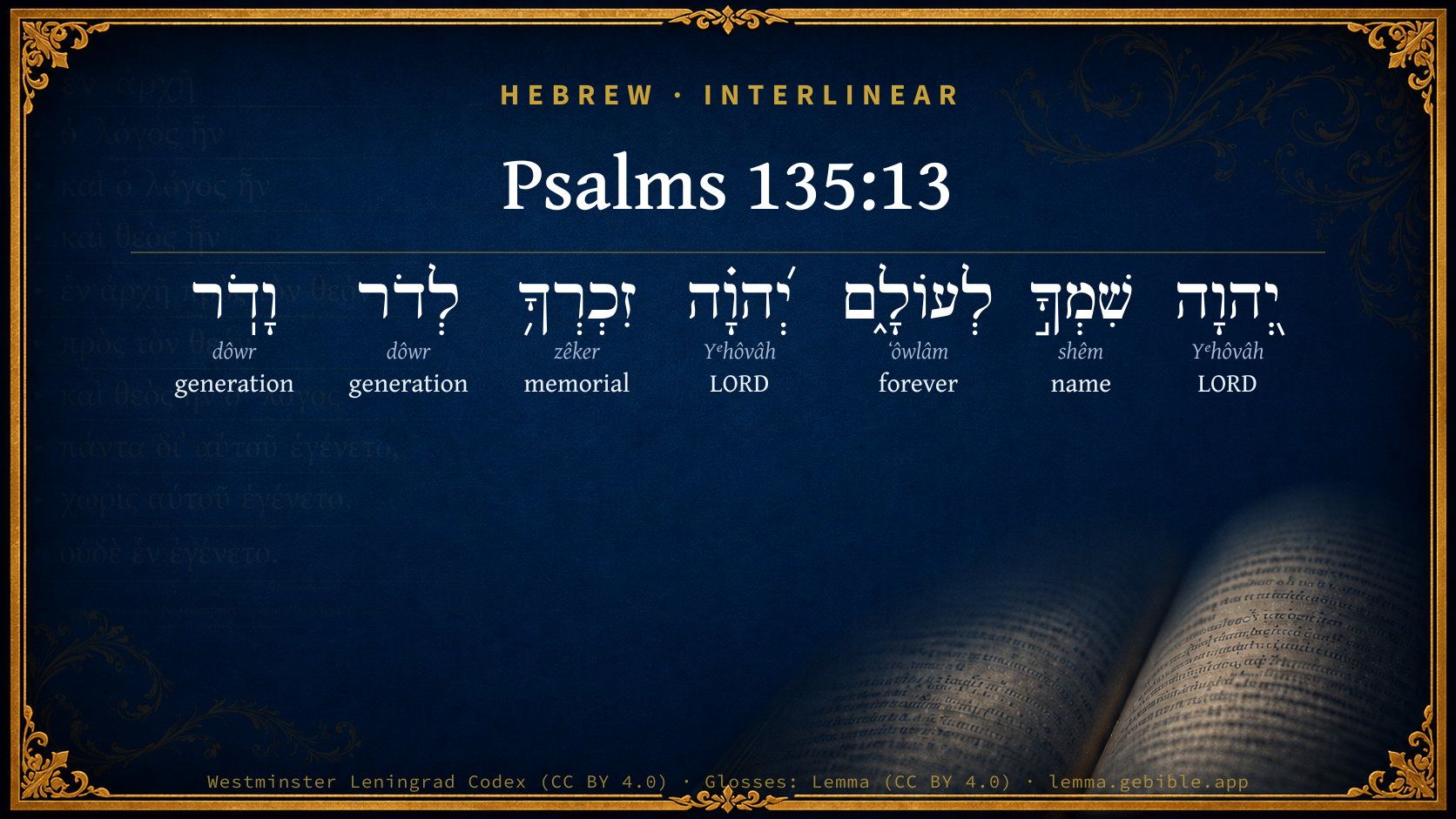
Psalms 135:13

Hebrew (Westminster Leningrad Codex) Psalms 135:13 appears in the Hebrew Old Testament. The text above is from the Westminster Leningrad Codex. Each word links to its Strong’s number, a concise gloss, and parsing drawn from the Open Scriptures Hebrew Bible morphology. Click any word for its full Brown-Driver-Briggs (BDB) entry.
Download image
Cite this verse

Psalms 135:13 (World English Bible). Public Domain. Lemma interlinear Bible study tool, https://lemma.gebible.app/v/psalms/135/13.

Show BibTeX & RIS
BibTeX
RIS
English Translation
Your name, Yahweh, endures forever; Your renown, Yahweh, throughout all generations.
World English Bible · Public Domain
Download a study sheet

One document with this verse’s original text, its word-by-word gloss line, the meaning frame, cross-references with their text, attributed commentary, and full source and license credits — printable, and it pastes into notes with its structure intact.

This verse Autodidact and up

Study sheet (.html) Plain text (.txt)

A passage Seminary Student

Up to 50 verses in one chapter. A passage sheet keeps up to 6 commentary sources and 12 cross-references per verse, in the order this page ranks them, and says so on the sheet whenever that leaves anything out. Ask for a single verse and you get the Autodidact verse sheet above.

Everything on this page stays free to read, with no account — the sheet is a download of what is already on screen, not access to it.

Want to remove ads? Support Godless Engineer
Compare translations 3

The same verse in 3 English versions, stacked beneath the original-language interlinear above. Click any original word for its lexicon entry.

Each is an independent rendering of the whole verse — the interlinear is not word-aligned to these translations.

Highlighted words mark where these versions differ — a whole-verse word diff, not a word-by-word alignment.

  • World English Bible Public Domain
    Your name, Yahweh, endures forever; Your renown, Yahweh, throughout all generations.
  • King James Version Public Domain
    Thy name, O LORD, endureth for ever; and thy memorial, O LORD, throughout all generations.
  • unfoldingWord Literal Text CC BY-SA 4.0
    Yahweh, your name to forever; Yahweh, your remembrance to generation and generation.

unfoldingWord Literal Text — © unfoldingWord, licensed CC BY-SA 4.0. Word-aligned USFM3 via Door43 (git.door43.org/unfoldingWord/en_ult).

Versions to compare (up to 4)

3 of 4 selected

Show all 17 translations

Every available English version of this verse, each an independent rendering of the whole verse.

  • World English Bible Public Domain
    Your name, Yahweh, endures forever; Your renown, Yahweh, throughout all generations.
  • Berean Standard Bible Public Domain
    Your name, O LORD, endures forever, Your renown, O LORD, through all generations.
  • Majority Standard Bible Public Domain
    Your name, O LORD, endures forever, Your renown, O LORD, through all generations.
  • King James Version Public Domain
    Thy name, O LORD, endureth for ever; and thy memorial, O LORD, throughout all generations.
  • American Standard Version (1901) Public Domain
    Thy name, O Jehovah, `endureth' for ever; Thy memorial `name', O Jehovah, throughout all generations.
  • Revised Version (1885) Public Domain
    Thy name, O LORD, endureth for ever; thy memorial, O LORD, throughout all generations.
  • Geneva Bible (1599) Public Domain
    Thy Name, O Lord, endureth for euer: O Lord, thy remembrance is from generation to generation.
  • Young's Literal Translation Public Domain
    O Jehovah, Thy name `is' to the age, O Jehovah, Thy memorial to all generations.
  • Literal Standard Version CC BY-SA 4.0
    O YHWH, Your Name [is] for all time, || O YHWH, Your memorial from generation to generation.
  • Unlocked Literal Bible CC BY-SA 4.0
    Your name, Yahweh, endures forever; your renown, Yahweh, endures throughout all generations.
  • unfoldingWord Literal Text CC BY-SA 4.0
    Yahweh, your name to forever; Yahweh, your remembrance to generation and generation.
  • Darby Bible Public Domain
    Thy name, O Jehovah, is for ever; thy memorial, O Jehovah, from generation to generation.
  • World Messianic Bible Public Domain
    Your name, LORD, endures forever; your renown, LORD, throughout all generations.
  • Webster's Bible Public Domain
    Thy name, O LORD, endureth for ever; and thy memorial, O LORD, throughout all generations.
  • Free Bible Version CC BY-SA 4.0
    Your reputation, Lord, stands forever; you, Lord, are remembered for all generations.
  • Bible in Basic English Public Domain
    O Lord, your name is eternal; and the memory of you will have no end.
  • JPS Tanakh (1917) Public Domain
    O LORD, Thy name endureth for ever; thy memorial, O LORD, throughout all generations.

Literal Standard Version (2020), Covenant Press — licensed CC BY-SA 4.0. Text via the HelloAO Bible API (eBible.org). Unlocked Literal Bible (unfoldingWord) — licensed CC BY-SA 4.0. Text via the HelloAO Bible API (eBible.org). unfoldingWord Literal Text — © unfoldingWord, licensed CC BY-SA 4.0. Word-aligned USFM3 via Door43 (git.door43.org/unfoldingWord/en_ult). Free Bible Version, Dr. Jonathan Gallagher — licensed CC BY-SA 4.0. Text via the HelloAO Bible API (eBible.org).

Word by word

More ways to search: Search by grammar → Find every occurrence → Compare this word →

Practice this passage: Drill this verse → Learn its vocabulary →

About this verse

These counts appear in no published source. They are computed here, from the morphology-tagged text and Lemma’s own curated glosses. What Lemma adds →

7
words
5
distinct lemmas
Wisdom
section

Notable vocabulary

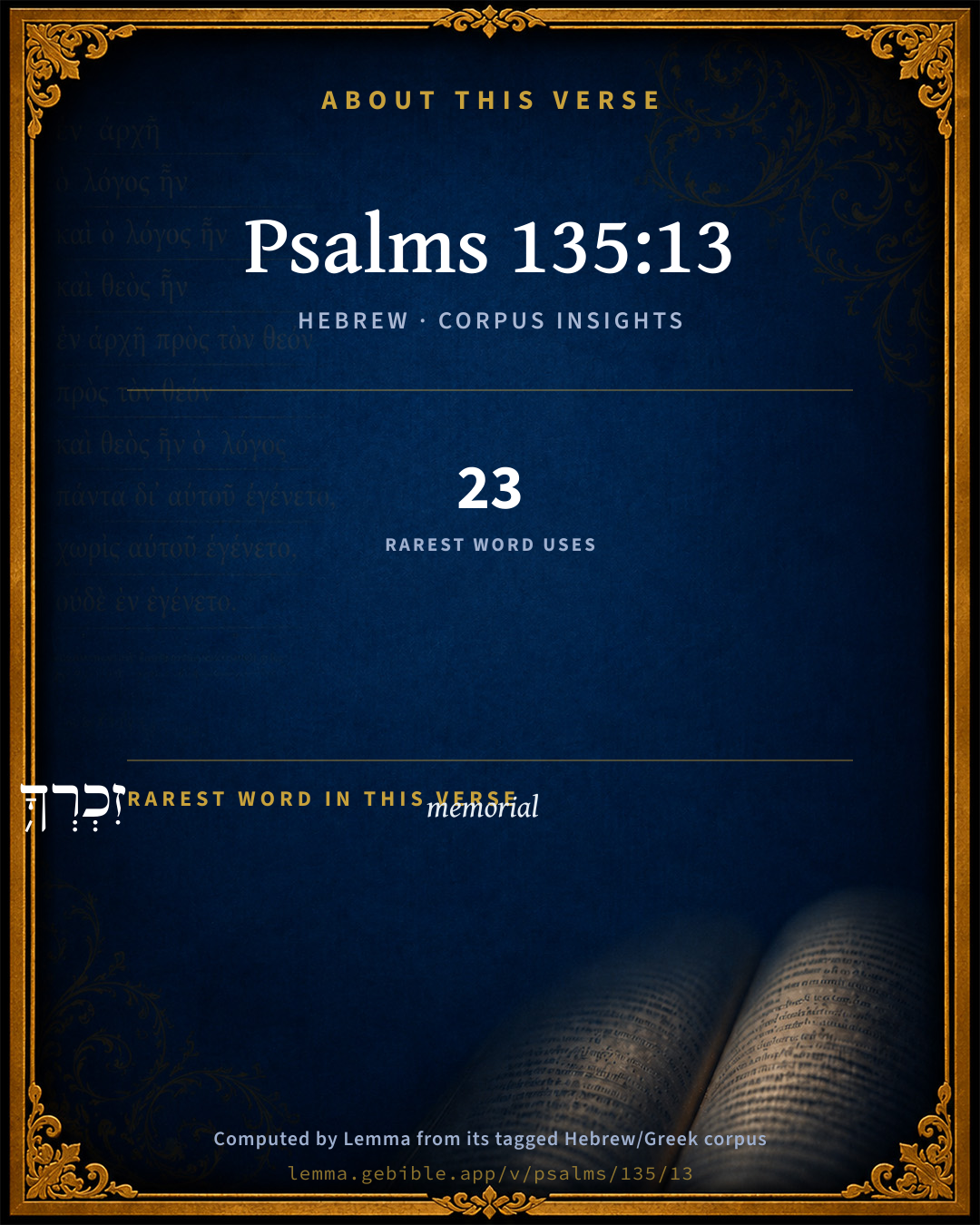
The rarest word here is זִכְרְךָ֥ memorial H2143 — appearing just 23 times in the whole Hebrew Bible.

Shared distinctive vocabulary

זִכְרְךָ֥ memorial H2143 occurs in 23 verses of the Hebrew Bible. Also found in:

Grammatical profile

  • 7 nouns

Repetition

Words recur within this verse — often emphatic in Hebrew:

  • יְ֭הוָה LORD H3068 ×2
  • לְדֹר generation H1755 ×2

Hebrew & Septuagint length

In English translation the verse runs 11 words from the Hebrew and 13 from the Septuagint (LXX English) — closely comparable.

A rough comparison of the two English renderings, which tokenize alike — not a word-level alignment.

Word counts can differ between the Hebrew and the Greek without any difference in meaning — e.g. the Hebrew direct-object marker אֵת has no separate Greek word, and Greek often adds the article ὁ.

Cross-references

10

Topical passages linked to Psalms 135:13 in the Treasury of Scripture Knowledge — connected by theme and wording, ordered by reader-vote popularity; previews shown in the World English Bible.

  • Psalms 102:12 But you, Yahweh, will abide forever; Your renown endures to all generations.
  • Exodus 3:15 God said moreover to Moses, "You shall tell the children of Israel this, 'Yahweh, the God of your fathers, the God of Abraham, the God of Isaac, and the God of Jacob, has sent me to you.' This is my name forever, and this is my memorial to all generations.
  • Psalms 8:1 Yahweh, our Lord, how majestic is your name in all the earth, Who has set your glory above the heavens!
  • Psalms 8:9 Yahweh, our Lord, How majestic is your name in all the earth!
  • Psalms 72:17 His name endures forever. His name continues as long as the sun. Men shall be blessed by him. All nations will call him blessed.
  • Exodus 34:5–7 Yahweh descended in the cloud, and stood with him there, and proclaimed the name of Yahweh.
  • Psalms 89:1 I will sing of the loving kindness of Yahweh forever. With my mouth, I will make known your faithfulness to all generations.
  • Psalms 102:21 That men may declare the name of Yahweh in Zion, And his praise in Jerusalem;
  • Hosea 12:5 Even Yahweh, the God of hosts; Yahweh is his name of renown!
  • Matthew 6:9 Pray like this: 'Our Father in heaven, may your name be kept holy.

Cross-references courtesy of OpenBible.info (CC BY 4.0).

Hebrew and Greek witnesses Masoretic Hebrew ↔ Greek Septuagint

The same verse in the two great witnesses to the Old Testament, shown verse-for-verse.

You’re reading Greek Psalm 134 (Hebrew Psalm 135). The Septuagint counts the superscription, so verse numbers can differ from the Hebrew — chapter-level alignment, not verse-by-verse. Numbering follows Rahlfs.

These are two independent witnesses, not word-aligned to each other, and the Septuagint is shown in lemma (dictionary) form.

Hebrew Psalms 135:13 Masoretic · Westminster Leningrad Codex

יְ֭הוָה שִׁמְךָ֣ לְעוֹלָ֑ם יְ֝הוָ֗ה זִכְרְךָ֥ לְדֹר וָדֹֽר

Your name, Yahweh, endures forever; Your renown, Yahweh, throughout all generations.

World English Bible · Public Domain

Greek LXX Greek Psalm 134:13 Septuagint · lemma form

κύριος ὁ ὄνομα σύ εἰς ὁ αἰών κύριος ὁ μνημόσυνον σύ εἰς γενεά καί γενεά

O Lord, your name endures for ever, and your memorial to all generations.

LXX2012 (modern English Septuagint) · Public Domain

Hebrew: Westminster Leningrad Codex (CC BY 4.0). Greek: Septuagint (public domain); English from LXX2012 (modern English Septuagint) (Public Domain). How the Septuagint differs from the Hebrew →

Commentary

Notes on Psalms 135:13 from classic Christian and Jewish commentators (each source and its license shown beneath its notes). The classic Christian expositions comment on the surrounding passage and are grouped to its opening verse, so a note may address several verses; the Jewish commentaries on the Tanakh (Rashi and others) are per-verse, so they appear only where the commentator wrote on this verse.

Lemma curates 59 commentaries, every one of them public domain or Creative Commons licensed, each selected and text-cleaned for this edition rather than reprinted as found. About our sources →

Trapp's Complete Commentary

John Trapp

Psa 135:13 Thy name, O LORD, [endureth] for ever; [and] thy memorial, O LORD, throughout all generations.

Ver. 13. Thy name, O Lord, &c.] Else, O nos ingratos!

John Trapp, A Commentary or Exposition upon All the Books of the Old and New Testament (1647–1656) — public domain. Text from a community e-Sword module.

Joseph Benson's Commentary

Psa 135:13-14. Thy name, O Lord, endureth for ever — These wonderful works of thine shall never be forgotten. They, together with the land which thou gavest us through them, and which we yet enjoy, are an everlasting monument of thy power and goodness, and an obligation upon, and an encouragement to us, to trust in thee, in all our present or future difficulties. For the Lord will judge his people — Will, in due time, plead the cause of his people, or give judgment for them. And he will repent himself, &c. — He will recall that severe sentence which for their sins he had passed upon them.

Joseph Benson's Commentary on the Old and New Testaments (1811–1818) — public domain. Text from a community e-Sword module.

Keil & Delitzsch

C. F. Keil & F. Delitzsch

This God who rules so praiseworthily in the universe and in the history of Israel is the same yesterday, and to-day, and for ever. Just as Psa 135:13 (cf. Psa 102:13) is taken from Exo 3:15, so Psa 135:14 is taken from Deu 32:36, cf. Psa 90:13, and vid., on Heb 10:30-31.

Keil & Delitzsch — Biblical Commentary on the Old Testament (1861–1891) — public domain (CC PDM 1.0). Text via the HelloAO Bible API. (Old Testament only.)

J. A. Alexander on Psalms

Joseph Addison Alexander

13. (Psa 135:13) Jehovah, thy name (is) to eternity. Jehovah, thy memory is to generation and generation. Name and memory are here equivalent expressions, meaning that by which God is remembered or commemorated, namely, his perfections as exhibited in act. The perpetuity of this implies continued or repeated acts of goodness.

Joseph Addison Alexander, The Psalms Translated and Explained (1850) — public domain. Text from a community e-Sword module.

Tyndale Open Study Notes

Tyndale Open Resources

135:13-18 The Lord’s name and character stand in contrast to idols.

Tyndale Open Study Notes — © Tyndale Open Resources, licensed CC BY-SA 4.0. Text via the HelloAO Bible API.

John Calvin's Commentaries

13. O Jehovah! thy name is for ever There are many reasons why the name of God ought always to be kept up in the world, but here the Psalmist speaks more especially of that everlasting praise which is due to him for preserving his Church and people, the cause being immediately added — that God will judge his people The whole world is a theater for the display of the divine goodness, wisdom, justice, and power, but the Church is the orchestra, as it were — the most conspicuous part of it; and the nearer the approaches are that God makes to us the more intimate and condescending the communication of his benefits, the more attentively are we called to consider them. The term judging in the Hebrew expresses whatever belongs to just and legitimate government, “Le mot de juger selon les Hebrieux,, contient en soy toutes les parties d’un juste et legitime gouvernement. — Fr.

John Calvin's Commentaries (1540-1563) — public domain. Text from the Calvin Translation Society English edition (1840s-50s) via the Christian Classics Ethereal Library (ccel.org). Calvin's coverage is partial (roughly two-thirds of the Bible); uncommented books and verses are honest gaps, never fabricated. The 19th-century editor's footnotes and remarks are omitted so the notes are faithfully Calvin's own voice.

Ellicott's Commentary for English Readers

(13) This verse is from Exo_3:15.

A Bible Commentary for English Readers, edited by Charles John Ellicott (1878–1897) — public domain. Text from a community e-Sword module.

The Cambridge Bible for Schools and Colleges

gen. ed. J. J. S. Perowne

13. Cp. Exo_3:15; Psa_30:4; Psa_102:12. Jehovah’s Name is called His memorial, as bringing to mind all that He is and does. Such as He has once revealed Himself to be He will continue for ever. Cp. Heb_13:8.

13–18. Jehovah is eternally the same, and will not forget His people; whereas the impotent gods of the heathen cannot protect their worshippers.

The Cambridge Bible for Schools and Colleges (gen. ed. J. J. S. Perowne; Cambridge University Press, 1878–1918) — public domain. Text from a community e-Sword module.

John Gill's Exposition

For the Lord will judge his people,.... Rule and govern, protect and defend them; plead their cause, and avenge them of their enemies; judge between them, distinguish them by his care and providence, make them visible, so that others shall see the difference between them; especially at the last day, when he will judge them, and, as the righteous Judge, give them the crown of righteousness. Or "though the Lord judges his people" (m); chastises them in a fatherly way, that they may not be condemned with the world;

and, or "yet" (n);

he will repent himself concerning his servants; of the evil of affliction he has brought upon them; he will change the course of his providential dealings with them, according to his unchangeable will; and turn their adversity into prosperity, and their mourning into joy: some render it, "he will be entreated for his servants" (o); he will hear prayer on their account, and save them out of their afflictions; or, as others, "he will comfort himself concerning his servants" (p); take pleasure in them and their prosperity, comfort them, and take delight in so doing. The Targum of the whole is,

"for the Lord will judge the judgment of his people by his word, and to his righteous servants will return in his mercies.''

(m) "quod si", Junius & Tremellius; "nam etsi", Piscator. (n) "Tamen", Piscator; "mox", Junius & Tremellius. (o) "deprecabitur", V. L. "sinet se deprecari", Tirinus. (p) "Solatium reportabit", Tigurine version.

John Gill's Exposition of the Whole Bible (1746–1763) — public domain (CC PDM 1.0). Text via the HelloAO Bible API.

Albert Barnes' Notes on the Bible

Thy name, O Lord, endureth for ever - Thou art the ever-living, the unchanging God. The generations of people pass away; the kingdoms of the earth change; the idols perish, but thou art the same. The object here seems to be to bring the image or the idea of God before the mind as he was when he performed these great works, as a God interposing in behalf of his people, and as worthy of praise. The idea is that he is the same now that he was then; and as he then impressed the world with a sense of his majesty and power, and as he then interposed in behalf of his people by mighty signs and wonders, we should feel that, being an unchangeable God, he can do it now, and is now equally worthy. of confidence, adoration, and praise.

And thy memorial - Thy remembrance; the memory of thyself. That is, What thou hast done to secure a remembrance among people is of such a nature as to make the same impression to all coming time. The events were such that the memory of them should never pass away from mankind.

Throughout all generations - Margin, as in Hebrew, To generation and generation. There never will be a generation on the earth, in the latest periods, to which the memory of these things should not be transmitted.

Albert Barnes' Notes on the Bible (1834–1885) — public domain. Text from a community e-Sword/MySword module.

Matthew Poole's English Annotations

These wonderful works of thine shall never be forgotten. The land which thou gavest us, Psa 135:12, and which we yet enjoy, is an everlasting monument of thy power and goodness, and an obligation and encouragement to trust in thee in all our present or future difficulties.

Matthew Poole's English Annotations on the Holy Bible (1683–1685) — public domain. Text from a community e-Sword/MySword module.

The Treasury of David

Charles H. Spurgeon

Ver. 13. Thy name, O LORD, endureth for ever. God's name is eternal, and will never be changed. His character is immutable; his fame and honour also shall remain to all eternity. There shall always be life in the name of Jesus, and sweetness and consolation. Those upon whom the Lord's name is named in verity and truth shall be preserved by it, and kept from all evil, world without end. JEHOVAH is a name which shall outlive the ages, and retain the fulness of its glory and might for ever. And thy memorial, O LORD, throughout all generations. Never shall men forget thee, O Lord. The ordinances of thine house shall keep thee in men's memories, and thine everlasting gospel and the grace which goes therewith shall be abiding reminders of thee. Grateful hearts will for ever beat to thy praise, and enlightened minds shall continue to marvel at all thy wondrous works. Men's memorials decay, but the memorial of the Lord abideth evermore. What a comfort to desponding minds, trembling for the ark of the Lord! No, precious Name, thou shalt never perish! Fame of the Eternal, thou shalt never grow dim!

This verse must be construed in its connection, and it teaches us that the honour and glory gained by the Lord in the overthrow of the mighty kings would never die out. Israel for long ages reaped the benefit of the prestige which the divine victories had brought to the nation. Moreover, the Lord in thus keeping his covenant which he made with Abraham, when he promised to give the land to his seed, was making it clear that his memorial contained in promises and covenant would never be out of his sight. His name endures in all its truthfulness, for those who occupied Israel's land were driven out that the true heirs might dwell therein in peace.

Ver. 13. Thy name, O LORD, endureth for ever.

1. As the embodiment of perfection:God's attributes and glory.

2. As the object of veneration:"Holy and reverent is his name."

3. As the cause of salvation:"For my name's sake", etc.

4. As the centre of attraction:"In his name shall the Gentiles trust." "Our desire is to the remembrance of thy name." "Where two or three are gathered in my name", etc.

5. As a plea in supplication:"For thy name's sake, pardon", etc. "Hitherto ye have asked nothing in my name."

6. As a warrant for action:"Whatsoever ye do, do all in the name", etc.

7. As a refuge in tribulation:"The name of the Lord is a strong tower: the righteous runneth into it, and is safe." "I have kept them in thy name."

8. As a mark of glorification:"I will write upon him the name of my God."

9. As a terror to transgressors:"My name is dreadful among the heathen." W. J.

Psalms 135:14*

Charles H. Spurgeon's The Treasury of David (1869–1885) — public domain. Psalms only. Text from a community e-Sword/MySword module.

The Pulpit Commentary

Thy Name, O Lord, endureth forever. The result of God"s marvelous doings (vers. 6-12) is that "his Name endureth forever can never be forgotten attracts to itself eternal praise and honor. And thy memorial (or, "thy remembrance") throughout all generations. (comp. Psa_102:12)

Authoritative records of the Divine ways.

"Thy memorial, O Lord, from one generation to another." The "memorial" may be but another word for the "Name;" but from one point of view the "Name" is but gathering into a single term the records of the Divine dealings; and it does but express that conception of God himself which his Divine dealings have produced on us. So we may say that the memorial of his doings fills with meaning the Divine Name, and assures us that what God has ever been to his people, he ever will be. Once on a time learned men were sorely puzzled by certain irregular holes on the front of an ancient temple. One, more sagacious than the rest, suggested that these indentations might be the marks of nails used to fasten Greek characters to the stone. Lines were drawn from one point to the next, when they were found to form letters, and the name of the Deity unexpectedly stood disclosed. What is known as a "zikr," or memorial service, is repeated by Mohammedans, at stated intervals, at the graves of those long dead, if they have left a reputation for holiness. The word "zikr" is closely connected with the Hebrew word for "a memorial," or "remembrance," indeed, one may say identical with it. The subject suggested is the Divine arrangement that the Divine dealings should be held in men"s memory through all the generations, and be a permanent moral force in every age. The Bible is the memorial.

I THE BIBLE IS A BOOK OF HISTORY. It is more than this, but it is this; and this to a very great extent. It is a collection of records of events that have happened. Take history out of the Pentateuch (or Hexateuch), out of the so-called historical books, out of the prophets, and take the references to history out of the Psalms, and what would be left? The fact is not sufficiently considered. The records in the book are memorials, reminders, of actual events.

II THE SUBJECT OF THE BIBLE IS GOD IN HISTORY. This brings to view the contrast between ordinary history and Biblical history. Scripture everywhere brings to view the direct relation of God to events. And so the records become memorials of God to every generation. Suggestive memorials, showing that history never is read aright unless God is seen in it. R.T.

The Pulpit Commentary (1880–1919), ed. H.D.M. Spence-Jones & Joseph S. Exell — public domain. Text from a community e-Sword module.

Rashi

Rabbi Shlomo Yitzchaki (Rashi)

O Lord, Your name is eternal Like Your greatness and Your authority then, so is it also now, and You have the power to judge and to avenge us.

Rashi on the Tanakh — English translations: “The Judaica Press complete Tanach with Rashi, translated by A. J. Rosenberg” (CC BY 4.0); “Pentateuch with Rashi's commentary by M. Rosenbaum and A.M. Silbermann, 1929-1934” (public domain); “The Metsudah Tanach series, Lakewood, N.J” (CC BY 4.0); and “The Book of Joshua, Metsudah Publications, 1997” (CC BY 4.0). Text via Sefaria.

Lesson kit

Teaching starters — assembled from the data on this page, not authored interpretation. Every prompt links to the verse data it draws on. Edit before teaching.

Psalms, in the Wisdom, opens this verse with 7 words (5 distinct Hebrew lemmas). Its most distinctive word is zêker (“memorial”). A historical commentator’s framing appears above. Read the whole chapter for the surrounding context.

Discussion questions

  1. How does “memorial” (zêker) shape what this verse is saying?
  2. How does Exodus 3:15, which shares the word «memorial», read alongside this verse?
  3. What does the repetition of “LORD” (2× in this one verse) do in this verse?
  4. These translations render this verse differently. What is at stake in choosing one wording over another?
  5. Compare how Trapp's Complete Commentary and Joseph Benson's Commentary read this verse. Where do they agree or differ?

Things to notice

Reading settings

Reading text

Shown beneath each verse's original-language words.

Old Testament
Old Testament edition

Read the OT as the Masoretic Hebrew (MT) or the Greek Septuagint (LXX).

English shown for the Greek Septuagint (in the Hebrew ↔ Greek comparison).

Comparing translations? Open the Compare panel on any verse page to stack up to four side by side.