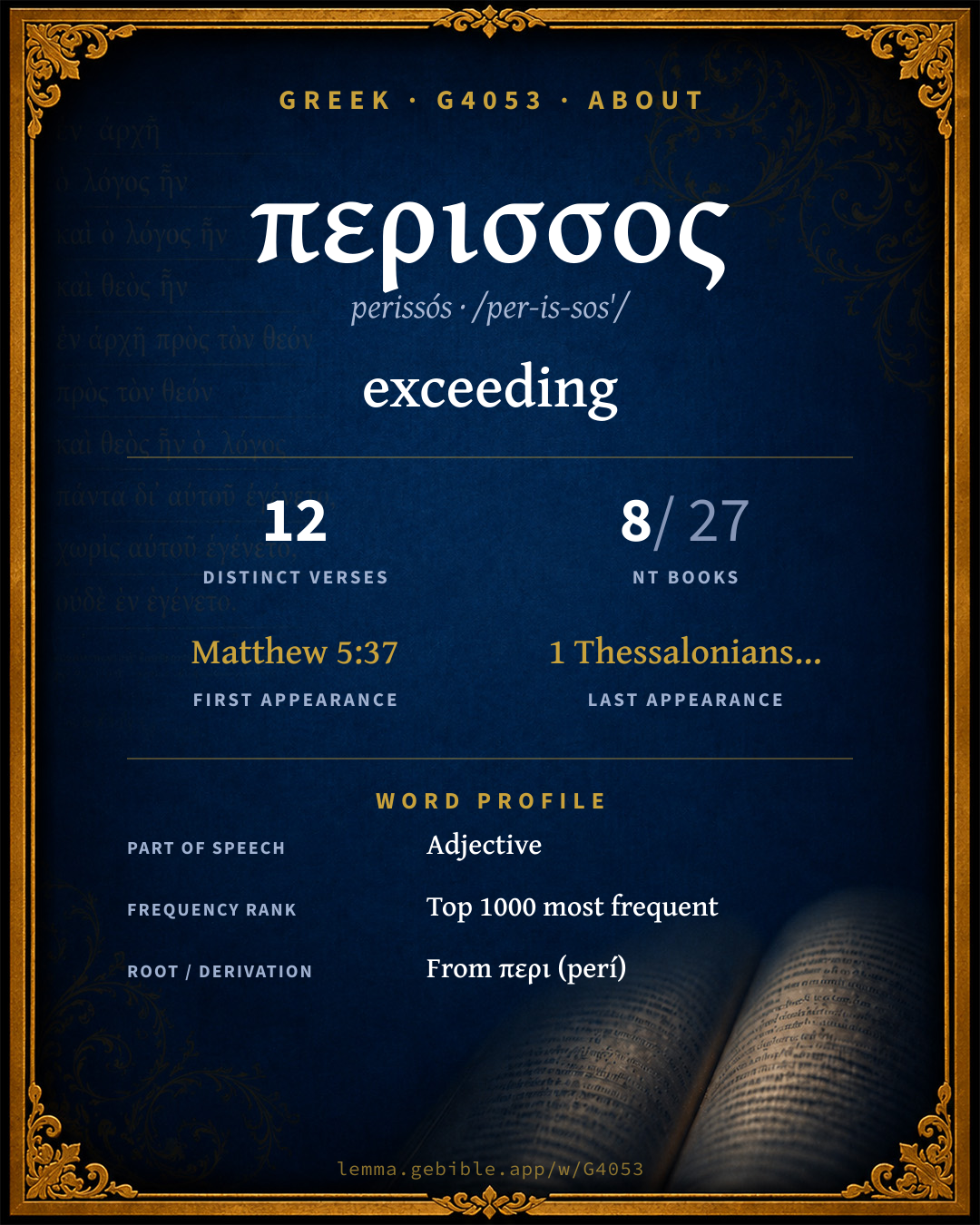
περισσός
exceeding
Full lexicon entry — Thayer's Greek Lexicon
From Thayer's Greek Lexicon
Where this word appears
See every Accusative-case word in the Greek New Testament →
Grammar key — what these labels mean
Part of speech
- Adverb
- A word that modifies a verb, adjective, or other adverb.
- Adjective
- A word that describes or qualifies a noun.
Case
- Accusative
- The case of the direct object and of extent.
- Nominative
- The case of the subject (and the predicate nominative).
- Dative
- The case of the indirect object, means, or location — “to / for / with / in.”
- Genitive
- The case of source, possession, or “of” — answers “whose / from what.”
Gender
- Feminine
- Grammatically feminine.
- Neuter
- Grammatically neuter.
Number
- Singular
- One.
Degree
- Comparative
- Expresses a greater degree (“greater,” “more”).
Grammatical forms
- Adverb 4 times (31%)
- Adjective, Accusative, Singular, Feminine, Comparative 3 times (23%)
- Adjective, Nominative, Singular, Neuter 3 times (23%)
- Adjective, Accusative, Singular, Neuter 1 time (8%)
- Adjective, Dative, Singular, Feminine, Comparative 1 time (8%)
- Adjective, Genitive, Singular, Neuter 1 time (8%)
Parsed forms decoded from the imported morphology (Robinson–Tischendorf, public domain), counted across 13 parsed occurrences — not distinct verses.
Every verse where G4053 appears — 12 distinct verses across 8 books. Click any verse to open its interlinear word-by-word view. Verse text shown in the World English Bible for context — . Each verse’s Greek form is shown with its reference; the English is not keyword-highlighted, since the data carries no word-level English alignment. Use “Compare translations” on any verse to read it across multiple English versions. This concordance covers the Greek New Testament; Septuagint (Greek Old Testament) occurrences of this word are not indexed here.
Matthew 2 verses
Mark 1 verse
John 1 verse
Romans 1 verse
1 Corinthians 2 verses
- 1 Corinthians 12:23 περισσοτέραν περισσοτέραν adj acc sg fem comp adj acc sg fem comp Those parts of the body which we think to be less honorable, on those we bestow more abundant honor; and our unpresentable parts have more abundant propriety;
- 1 Corinthians 12:24 περισσοτέραν adj acc sg fem comp whereas our presentable parts have no such need. But God composed the body together, giving more abundant honor to the inferior part,
2 Corinthians 2 verses
- 2 Corinthians 2:7 περισσοτέρᾳ adj dat sg fem comp so that on the contrary you should rather forgive him and comfort him, lest by any means such a one should be swallowed up with his excessive sorrow.
- 2 Corinthians 9:1 περισσόν adj nom sg neut It is indeed unnecessary for me to write to you concerning the service to the saints,
Ephesians 1 verse
1 Thessalonians 2 verses
About this entry
At a glance — auto-summarized from this page’s data, not written by a person. Every figure links to its source below. This summary describes the numbers; it doesn’t interpret them.
περισσος (perissós) is a Greek adjective most often rendered “exceeding.” Scripture first uses it in Matthew 5:37. Spanning 12 verses in 8 books, it ranks among the uncommon words of the Greek New Testament. Sharing its root, it stands alongside περι, περιαγω and περιαιρεω. For the data behind this summary, explore the sense tree and the renderings breakdown below.
Gloss history
Strong's 1890 vs modern scholarship
About this word
Strong's G4053 catalogs a Greek word from the Greek New Testament.
These counts are not copied from any lexicon or concordance. They are computed here, from the morphology-tagged Greek New Testament. What Lemma adds →
- 12
- distinct verses
- The word appears in 12 distinct verses.
- 8 / 27
- NT books
- The word appears in 8 of 27 New Testament books.
- #863
- by frequency
- Top 1000 most frequent Greek words (rank 863 of 5,347 Greek words by occurrence).
View all 12 occurrences in the concordance →
Most concentrated in
- Matthew 2 verses 17%
- 1 Corinthians 2 verses 17%
- 2 Corinthians 2 verses 17%
By section of the New Testament
By traditional corpus
Conventional, traditional groupings — biblical authorship is debated, so this is a traditional corpus grouping, not an authorship claim. Some books belong to more than one corpus (Luke is in both the Gospels and the Lukan corpus, and so on), so these shares overlap and need not total 100%. Each figure is a share of the word’s 12 distinct verses.
- Pauline corpus 8 verses · 67%
- Gospels 4 verses · 33%
- Johannine 1 verse · 8%
How translations render this word
Counts come from each version’s own published word-to-Strong’s tagging or interlinear alignment — an approximate guide to how each version renders this word, not a word-level alignment the data otherwise carries. Because each total is that version’s own tagged count, the per-version totals vary from one another and need not match the appearance or distinct-verse counts above. These counts may also differ from a printed concordance because Lemma counts each distinctly tagged rendering and does not collapse phrase taggings into a single head-word total. This is a fixed set of word-tagged versions (KJV, ASV, BSB, ULT) and does not change with the reading translation you choose elsewhere. Each version’s license is shown beside its name below (and on Sources).
- King James Version: Advantage 1×, Measure 1×, More abundantly 1×
- American Standard Version: More abundant 3×, Abundantly 2×, Greater 2×
- Berean Standard Bible: More 6×, Greater 4×
- unfoldingWord Literal Text: Advantage 1×, Excessive 1×, Greater than 1×
King James Version Public Domain
Renders G4053 across 6 tagged occurrences — most commonly:
Not rendered by a distinct English word in 4 further occurrences.
American Standard Version Public Domain
Renders G4053 across 18 tagged occurrences — most commonly:
Plus 7 renderings that appear only once — usually multi-word phrases or single function words the recovered tagging swept in, not distinct renderings.
Berean Standard Bible Public Domain
Renders G4053 across 21 tagged occurrences — most commonly:
Plus 11 renderings that appear only once — usually multi-word phrases or single function words the recovered tagging swept in, not distinct renderings. Not rendered by a distinct English word in 1 further occurrence.
unfoldingWord Literal Text CC BY-SA 4.0
Renders G4053 across 4 tagged occurrences — most commonly:
Senses in Thayer's
The 1 sense Thayer's distinguishes for this word, in lexicon order (not ranked by frequency or importance). The full entry — with sub-senses — is in the Lexicon Entry tab.
- exceeding some number or measure or rank or need
Word origin
Derived from περι (perí) (G4012) — about.
From G4012 (in the sense of beyond ); superabundant (in quantity) or superior (in quality); by implication excessive ; adverb (with G1537 ) violently ; neuter (as noun) preeminence : - exceeding abundantly above more abundantly advantage exceedingly very highly beyond measure more superfluous vehement [-ly].
— Strong’s Exhaustive Concordance (1890), public domain.
Forms in the corpus
The 6 distinct written forms G4053 takes in the Greek New Testament, most frequent first — each parse links to that case’s occurrences in the concordance.
| Form | Parsing | Example | Uses |
|---|---|---|---|
| περισσὸν perissòn | Adjective, Nominative, Singular, Neuter | Matthew 5:37 | 4 |
| περισσοτέραν perissotéran | Adjective, Accusative, Singular, Feminine, Comparative | 1 Corinthians 12:23 | 3 |
| ὑπερεκπερισσοῦ hyperekperissoû | Adverb | Ephesians 3:20 | 3 |
| περισσοτέρᾳ perissotéra | Adjective, Dative, Singular, Feminine, Comparative | 2 Corinthians 2:7 | 1 |
| περισσοῦ perissoû | Adjective, Genitive, Singular, Neuter | Mark 6:51 | 1 |
| περισσόν perissón | Adjective, Nominative, Singular, Neuter | 2 Corinthians 9:1 | 1 |
Same root — word family
Other Thayer's entries built from the same root as G4053, grouped by Strong’s listed origin. These share a root / origin per the lexicon — not necessarily a shared meaning. Each links to that word’s own entry.
Derives from
Shares the same root
- περιαγω periágō G4013 to lead around
- περιαιρεω periairéō G4014 to take away
- περιαστραπτω periastráptō G4015 to shine around
- περιβαλλω peribállō G4016 to throw around
- περιβλεπω periblépō G4017 to look around
- περιδεω peridéō G4019 to bind around
- περιεργαζομαι periergázomai G4020 to bustle about
- περιεργος períergos G4021 busybody
- περιερχομαι periérchomai G4022 to go about
- περιεχω periéchō G4023 to surround
- περιζωννυμι perizṓnnymi G4024 to gird
- περιΐστημι periḯstēmi G4026 to stand around
- περικαθαρμα perikátharma G4027 scum
- περικαλυπτω perikalýptō G4028 to cover up
- περικειμαι períkeimai G4029 to lie around
- περικεφαλαια perikephalaía G4030 helmet
- περικρατης perikratḗs G4031 to have power over
- περικρυπτω perikrýptō G4032 to hide
- περικυκλοω perikyklóō G4033 to encircle
- περιλαμπω perilámpō G4034 to shine around
- περιλειπω perileípō G4035 to remain over
- περιλυπος perílypos G4036 deeply sorrowful
- περιμενω periménō G4037 to wait for
- περιξ périx G4038 round about
+17 more words share this root (not shown).
Derived from this word
- περισσευω perisseúō G4052 to abound
- περισσοτερος perissóteros G4055 exceeding
- περισσως perissōs G4057 exceedingly
Compare all same-root words → Showing 4 of 46 — not the complete family. They share a root, not necessarily a meaning.
Septuagint usage
The same Greek word περισσος appears 13 times in the Greek Old Testament (Septuagint), across 13 verses in 8 books.
- 13
- LXX occurrences
- Tagged occurrences of this Greek word in the Septuagint.
- 13
- verses
- Distinct Septuagint verses containing this word.
- 8 / 39
- OT books
- The word appears in 8 of the 39 Old Testament books.
Sample Septuagint occurrences
- Exodus 10:5 περισσός
- Numbers 4:26 περισσός
- Judges 21:7 περισσός
- 1 Samuel 30:9 περισσός
- 2 Kings 25:11 περισσός
- Proverbs 14:23 περισσός
- Ecclesiastes 2:15 περισσός
- Ezekiel 48:15 περισσός
Septuagint occurrences (same lexeme)
Every verse where the same Strong’s number (G4053) appears in the Greek Septuagint. Verse text shown in the World English Bible for context; the Greek form is the matched word — the English is not keyword-highlighted.
- Exodus 10:5 περισσός and they shall cover the surface of the earth, so that one won't be able to see the earth. They shall eat the residue of that which has escaped, which remains to you from the hail, and shall eat every tree which grows for you out of the field.
- Numbers 4:26 περισσός and the hangings of the court, and the screen for the door of the gate of the court, which is by the tabernacle and around the altar, and their cords, and all the instruments of their service, and whatever shall be done with them. Therein shall they serve.
- Judges 21:7 περισσός How shall we do for wives for those who remain, seeing we have sworn by Yahweh that we will not give them of our daughters to wives?
- Judges 21:16 περισσός Then the elders of the congregation said, How shall we do for wives for those who remain, seeing the women are destroyed out of Benjamin?
- 1 Samuel 30:9 περισσός So David went, he and the six hundred men who were with him, and came to the brook Besor, where those who were left behind stayed.
- 2 Kings 25:11 περισσός The residue of the people who were left in the city, and those who fell away, who fell to the king of Babylon, and the residue of the multitude, did Nebuzaradan the captain of the guard carry away captive.
- Proverbs 14:23 περισσός In all hard work there is profit, But the talk of the lips leads only to poverty.
- Ecclesiastes 2:15 περισσός Then said I in my heart, "As it happens to the fool, so will it happen even to me; and why was I then more wise?" Then said I in my heart that this also is vanity.
- Ecclesiastes 7:16 περισσός Don't be overly righteous, neither make yourself overly wise. Why should you destroy yourself?
- Ezekiel 48:15 περισσός The five thousand that are left in the breadth, in front of the twenty-five thousand, shall be for common use, for the city, for dwelling and for suburbs; and the city shall be in the midst of it.
- Ezekiel 48:18 περισσός The remainder in the length, answerable to the holy offering, shall be ten thousand eastward, and ten thousand westward; and it shall be answerable to the holy offering; and the increase of it shall be for food to those who labor in the city.
- Ezekiel 48:21 περισσός The residue shall be for the prince, on the one side and on the other of the holy offering and of the possession of the city; in front of the twenty-five thousand of the offering toward the east border, and westward in front of the twenty-five thousand toward the west border, answerable to the portions, it shall be for the prince: and the holy offering and the sanctuary of the house shall be in the midst of it.
- Ezekiel 48:23 περισσός As for the rest of the tribes: from the east side to the west side, Benjamin, one [portion].
These are occurrences of the same Greek lexeme (G4053) in the Septuagint — not a translation of any one Hebrew word. The store carries no word-level Hebrew↔Greek alignment, so no Hebrew original is asserted here. Counts come from the recovered LXX Strong's tagging — high-frequency vocabulary is well covered, while rare or late forms may be untagged — so they reflect tagged occurrences and may slightly undercount.