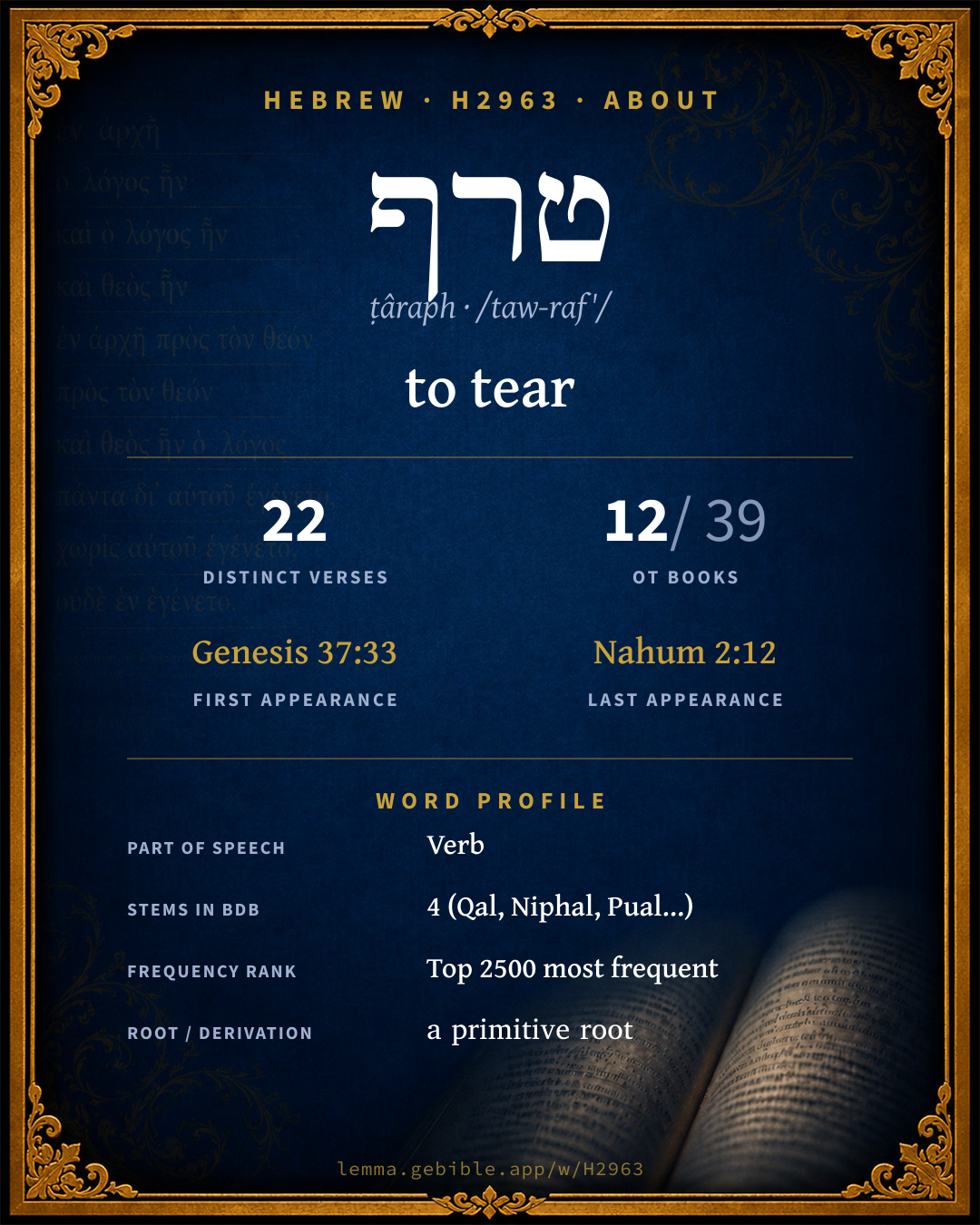
טָרַף
to tear
also: rend, pluck fuller range ↓
Full lexicon entry — Brown-Driver-Briggs (BDB)
From Brown-Driver-Briggs (BDB)
Where this word appears
See every Qal verb in the Hebrew Bible →
Grammar key — what these labels mean
Part of speech
- Verb
- An action or state-of-being word.
Stem
- Qal
- The basic, simple active stem — the plain form of the verb (“he wrote”).
- Niphal
- Usually the simple passive or reflexive of the Qal (“he was written”).
- Pual
- The passive counterpart of the Piel.
- Qal Passive
- An archaic passive of the Qal, preserved in a few forms.
- Hiphil
- The causative active stem (“he caused / brought about”).
Form
- Participle Active
- A verbal adjective expressing ongoing or characteristic action (“writing / one who writes”).
- Infinitive Construct
- A bound verbal noun, frequently with prepositions (“to write / in writing”).
- Infinitive Absolute
- An unbound verbal noun, often intensifying or standing in for a finite verb.
- Sequential Perfect
- A perfect with prefixed waw continuing a preceding imperfect or command (waw-consecutive perfect).
- Imperfect
- An incomplete, ongoing, or future action (“he will / would write”).
- Perfect
- A completed action or state — Hebrew marks aspect (completeness) more than strict tense (“he wrote”).
- Sequential Imperfect
- An imperfect with prefixed waw — the standard past-narrative form (waw-consecutive imperfect).
- Imperative
- A direct command (“write!”).
State
- Absolute
- The independent form of a noun, not bound to a following word.
- Construct
- A noun bound to a following noun in a possessive / “of” relationship (the construct chain).
Person
- 3rd Person
- The one spoken about (“he / she / it / they”).
- 1st Person
- The speaker (“I / we”).
- 2nd Person
- The one addressed (“you”).
Gender
- Masculine
- Grammatically masculine.
- Common
- Either gender — not distinguished for this form.
Number
- Singular
- One.
- Plural
- More than one (in Hebrew, generally three or more).
Grammatical forms 13 distinct
- Verb, Qal, Participle Active, Masculine, Singular, Absolute 4 times (16%)
- Verb, Qal, Infinitive Construct 3 times (12%)
- Verb, Qal, Infinitive Absolute 3 times (12%)
- Verb, Qal, Sequential Perfect, 3rd Person, Masculine, Singular 2 times (8%)
- Verb, Niphal, Imperfect, 3rd Person, Masculine, Singular 2 times (8%)
- Verb, Qal, Imperfect, 1st Person, Common, Singular 2 times (8%)
- Verb, Qal, Imperfect, 3rd Person, Masculine, Singular 2 times (8%)
- Verb, Qal, Perfect, 3rd Person, Masculine, Singular 2 times (8%)
+5 more forms (5 occurrences)
Parsed forms decoded from the imported morphology (morphhb / Westminster Leningrad Codex — WLC text public domain, morphhb tagging CC BY 4.0), counted across 25 parsed occurrences — not distinct verses.
Every verse where H2963 appears — 22 distinct verses across 12 books. Click any verse to open its interlinear word-by-word view. Verse text shown in the World English Bible for context — . Each verse’s Hebrew form is shown with its reference; the English is not keyword-highlighted, since the data carries no word-level English alignment. Use “Compare translations” on any verse to read it across multiple English versions. This concordance covers the Hebrew Bible; Septuagint (Greek Old Testament) occurrences are not indexed here.
Genesis 3 verses
- Genesis 37:33 טָרֹ֥ף טֹרַ֖ף Qal inf.abs Pual pf 3ms He recognized it, and said, "It is my son's coat. An evil animal has devoured him. Joseph is without doubt torn in pieces."
- Genesis 44:28 טָרֹ֣ף טֹרָ֑ף Qal inf.abs Qal Passive pf 3ms and the one went out from me, and I said, "Surely he is torn in pieces;" and I haven't seen him since.
- Genesis 49:27 יִטְרָ֔ף Qal impf 3ms "Benjamin is a ravenous wolf. In the morning he will devour the prey. At evening he will divide the spoil."
Exodus 1 verse
Deuteronomy 1 verse
Job 2 verses
- Job 16:9 טָרַ֨ף Qal pf 3ms He has torn me in his wrath, and persecuted me; He has gnashed on me with his teeth: My adversary sharpens his eyes on me.
- Job 18:4 טֹֽרֵ֥ף Qal ptcp.act ms You who tear yourself in your anger, Shall the earth be forsaken for you? Or shall the rock be removed out of its place?
Psalms 4 verses
- Psalms 7:2 יִטְרֹ֣ף Qal impf 3ms Lest they tear apart my soul like a lion, Ripping it in pieces, while there is none to deliver.
- Psalms 17:12 לִ/טְר֑וֹף prep + Qal inf.cs He is like a lion that is greedy of his prey, As it were a young lion lurking in secret places.
- Psalms 22:13 טֹרֵ֥ף Qal ptcp.act ms They open their mouths wide against me, Lions tearing prey and roaring.
- Psalms 50:22 אֶ֝טְרֹ֗ף Qal impf 1cs "Now consider this, you who forget God, Lest I tear you into pieces, and there be none to deliver.
Proverbs 1 verse
Jeremiah 1 verse
Ezekiel 4 verses
- Ezekiel 19:3 לִ/טְרָף prep + Qal inf.cs She brought up one of her cubs: he became a young lion, and he learned to catch the prey; he devoured men.
- Ezekiel 19:6 לִ/טְרָף prep + Qal inf.cs He went up and down among the lions; he became a young lion, and he learned to catch the prey; he devoured men.
- Ezekiel 22:25 טֹ֣רֵֽף Qal ptcp.act ms There is a conspiracy of her prophets in the midst of it, like a roaring lion ravening the prey: they have devoured souls; they take treasure and precious things; they have made her widows many in the midst of it.
- Ezekiel 22:27 טֹ֣רְפֵי Qal ptcp.act mp cs Her princes in the midst of it are like wolves ravening the prey, to shed blood, [and] to destroy souls, that they may get dishonest gain.
Hosea 2 verses
- Hosea 5:14 אֶטְרֹף֙ Qal impf 1cs For I will be to Ephraim like a lion, And like a young lion to the house of Judah. I myself will tear in pieces and go away. I will carry off, and there will be no one to deliver.
- Hosea 6:1 טָרָ֖ף Qal pf 3ms "Come, and let us return to Yahweh; For he has torn us to pieces, And he will heal us; He has injured us, And he will bind up our wounds.
Amos 1 verse
Micah 1 verse
Nahum 1 verse
About this entry
At a glance — auto-summarized from this page’s data, not written by a person. Every figure links to its source below. This summary describes the numbers; it doesn’t interpret them.
The Hebrew verb טרף centers on the idea of “to tear.” Different stems carry different senses — BDB groups them under 4 stems, among them Qal and Niphal. It turns up in 22 verses across 12 books, an uncommon footprint. First canonically at Genesis 37:33, it enters the text early. It clusters with טרף and טרף under a shared root. For the data behind this summary, explore the sense tree and the renderings breakdown below.
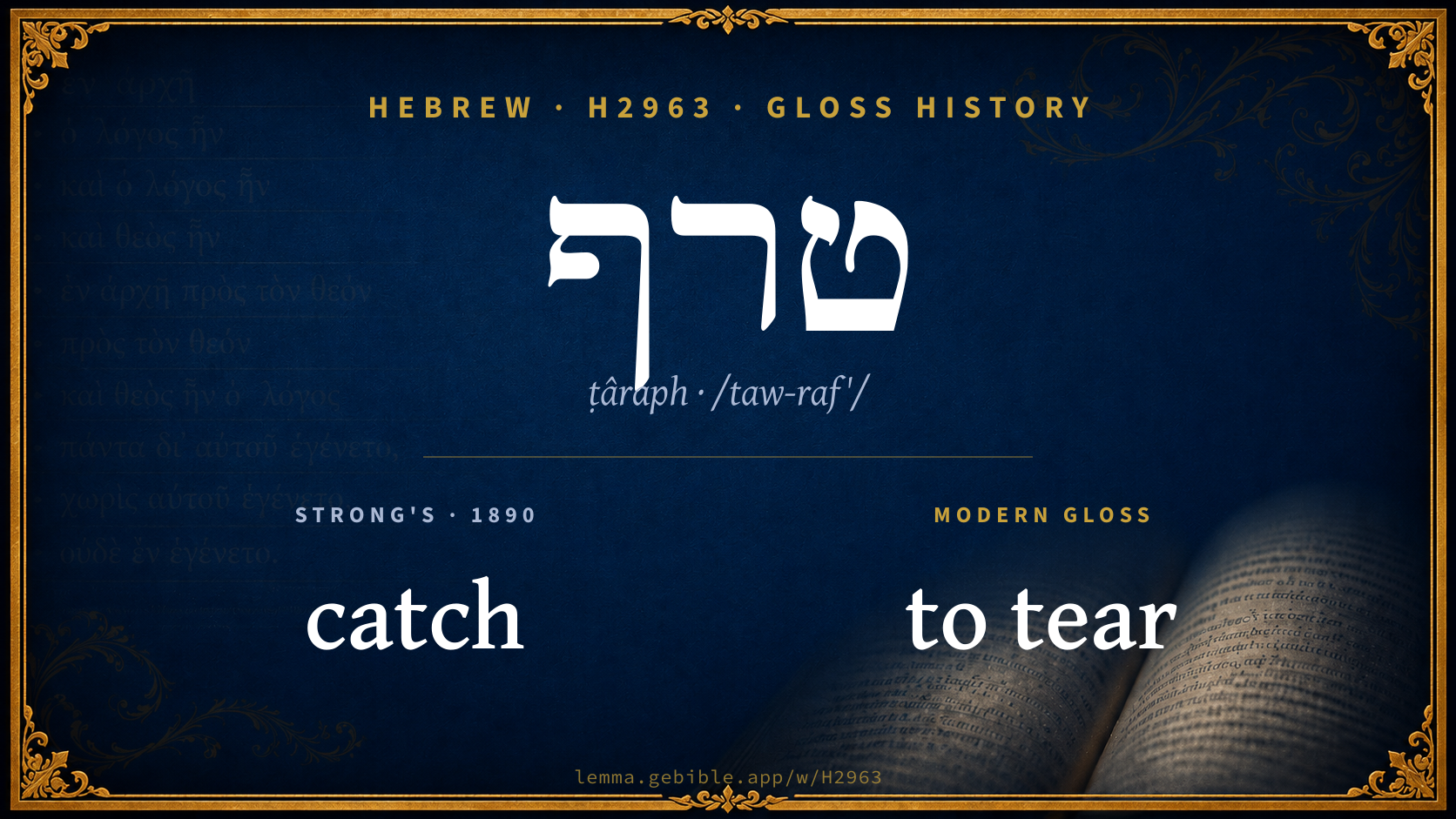
Gloss history
Strong's 1890 vs modern scholarship
About this word
Strong's H2963 catalogs a Hebrew word from the Hebrew Old Testament.
These counts are not copied from any lexicon or concordance. They are computed here, from the morphology-tagged Hebrew Old Testament. What Lemma adds →
- 22
- distinct verses
- The word appears in 22 distinct verses.
- 12 / 39
- OT books
- The word appears in 12 of 39 Old Testament books.
- #1,282
- by frequency
- Top 2500 most frequent Hebrew words (rank 1,282 of 8,640 Hebrew words by occurrence).
View all 22 occurrences in the concordance →
By section of the Old Testament
By traditional corpus
Conventional, traditional groupings — biblical authorship is debated, so this is a traditional corpus grouping, not an authorship claim. Each share is this word’s portion of its verses in that division of the Hebrew canon. Each figure is a share of the word’s 22 distinct verses.
- Prophets (Nevi'im) 10 verses · 45%
- Writings (Ketuvim) 7 verses · 32%
- Torah (Pentateuch) 5 verses · 23%
How translations render this word
Counts come from each version’s own published word-to-Strong’s tagging or interlinear alignment — an approximate guide to how each version renders this word, not a word-level alignment the data otherwise carries. Because each total is that version’s own tagged count, the per-version totals vary from one another and need not match the appearance or distinct-verse counts above. These counts may also differ from a printed concordance because Lemma counts each distinctly tagged rendering and does not collapse phrase taggings into a single head-word total. This is a fixed set of word-tagged versions (KJV, ASV, BSB, ULT) and does not change with the reading translation you choose elsewhere. Each version’s license is shown beside its name below (and on Sources).
- King James Version: Ravening 3×, Be torn in pieces 2×, Catch 2×
- American Standard Version: Ravening 3×, Be torn in pieces 2×, Catch 2×
- Berean Standard Bible: Tear 2×, Tearing 2×
- unfoldingWord Literal Text: He has torn 2×, Tear 2×, Tearing 2×
King James Version Public Domain
Renders H2963 across 24 tagged occurrences — most commonly:
Plus 15 renderings that appear only once — usually multi-word phrases or single function words the recovered tagging swept in, not distinct renderings. Not rendered by a distinct English word in 1 further occurrence.
American Standard Version Public Domain
Renders H2963 across 24 tagged occurrences — most commonly:
Plus 15 renderings that appear only once — usually multi-word phrases or single function words the recovered tagging swept in, not distinct renderings.
Berean Standard Bible Public Domain
Renders H2963 across 21 tagged occurrences — most commonly:
Plus 17 renderings that appear only once — usually multi-word phrases or single function words the recovered tagging swept in, not distinct renderings. Not rendered by a distinct English word in 4 further occurrences.
unfoldingWord Literal Text CC BY-SA 4.0
Renders H2963 across 29 tagged occurrences — most commonly:
Plus 19 renderings that appear only once — usually multi-word phrases or single function words the recovered tagging swept in, not distinct renderings.
Senses in the full BDB
Hebrew verbs can shift meaning by stem (binyan): Qal is the basic action, Niphal is often passive or reflexive, Piel often intensifies or makes it factitive, and Hiphil is typically causative. The senses below are grouped under the stem BDB assigns to each. This entry also uses Pual (the passive of Piel).
What do BDB’s symbols mean?
BDB uses these scholarly abbreviations:
| Symbol | Meaning |
|---|---|
| 𝔊 | the Septuagint (the ancient Greek translation, LXX) |
| 𝔙 | the Vulgate (the Latin translation) |
| 𝔖 | the Syriac version (the Peshitta) |
| 𝔗 | the Targum (the Aramaic translation) |
| ψ | the Psalms |
| √ | root (the underlying root or stem) |
| ‖ | parallel passage (a synonymous or contrasted parallel) |
| † | the dagger: every passage where the word occurs is cited |
The 4 senses and sub-senses the full Brown-Driver-Briggs lexicon distinguishes for this word, in lexicon order (not ranked by frequency), with BDB’s own verbatim wording and sub-sense lettering. Shown in Hebrew script with BDB’s own scholarly abbreviations. The condensed entry is in the Lexicon Entry tab. See also the Forms in the corpus table below.
Qal
- Pf. טָרַף Jb 16:9; טָרָ֑ף Ho 6:1, etc.; Impf. יִטְרֹף ψ 7:3; וַיִּטְרֹף Am 1:11 (but v. infr.); יִטְרָ֑ף Gn 49:27; אֶטְרֹף Ho 5:14 ψ 50:22; Inf. לִטְרֹף ψ 17:12; Pt. act. טֹרֵף Jb 18:4, etc.;—tear rend, of wild beasts, Gn 37:33 (J), 44:28 (J; inf. abs. c. Pu. q.v.), Ex 22:12 (JE; inf. abs. c. Niph. q.v.) Elsewhere only in sim. and metaph.; sim. of Gad’s fierceness Dt 33:20 (like a lioness, poem); so of Benjamin Gn 49:27 (as a wolf, poem); of the remnant of Jacob, like a young lion among sheep, רָמַם וְטָרַף Mi 5:7; of the wicked, ψ 17:12 (lion), 7:3 obj. נַפְשִׁי (like a lion); 22:14 psalmist’s foes like lion (‖ שֹׁאֵג); Ez 22:25 (טֹרֵף טָ֑רֶף), princes like wolves v 27 (id.); metaph. of Israel’s princes, like young lion 19:3, 6 (c. טֶרֶף acc. cogn.); of Nineveh’s king Na 2:13 (as lion); of God’s treatment of the wicked Ho 5:14 (like a lion), ψ 50:22; subj. wrath of God (אַף) conceived as assailing Job, Jb 16:9 his wrath teareth and persecuteth me; cf. טָרָ֖ף וְיִרְפָּאֵנוּ Ho 6:1 subj. י׳ (‖ יַךְ וְיַחְבְּשֵׁנוּ; on tenses v. Dr§ 84 β; 171, 174 n. 1); subj. anger of Edom (abs.) Am 1:11, but read perhaps וַיִּטֹּר for וַיִּטְרֹף and he kept his anger perpetually, so Ol on ψ 103:9 We; טֹרֵף נַפְשׁוֹ בְּאַפּוֹ, said of Job by Bildad Jb 18:4. e.g. Job 16:9
Niphal
- Impf. of animal torn (by wild beasts) טָרֹף יִטָּרֵף Ex 22:12 (JE); יִטָּרֵף also in prediction of judgment on people of Jerusalem Je 5:6. e.g. Exodus 22:12
Pual
- Pf. טָרֹף טֹרַף יוֹסֵף Gn 37:33 (J) Joseph has certainly been torn in pieces; cf. ט׳ טֹרָ֑ף 44:28 (J). e.g. Genesis 37:33
Hiphil
- Imv. ms. sf., note especially 2nd acc. לֶחֶם, הַטְרִיפֵנִי לֶחֶם חֻקִּי Pr 30:8 let me devour my appointed bread (of men, late; cf. טֶרֶף 31:15, and ψ 111:5 Mal 3:10). e.g. Proverbs 30:8
Senses from the full Brown-Driver-Briggs lexicon (Brown, Driver, Briggs; Oxford 1906 — public domain), digitized via Sefaria, supplemented by the OpenScriptures HebrewLexicon (CC BY 4.0). Full attribution on Sources.
Word origin
vb. tear, rend, pluck (NH id., especially of wild beasts; Aramaic טְרַף tear, seize, especially of creditors; טְרֵיפָא torn flesh or animal; Arabic طَرَفَ depasture, said of camel)—
— Brown-Driver-Briggs (Oxford 1906, public domain), digitized via Sefaria, supplemented by the OpenScriptures HebrewLexicon (CC BY 4.0). See Sources.
Origin: a primitive root
Jastrow Dictionary
A second Hebrew/Aramaic lexicon for comparison, covering Aramaic and post-biblical (Talmudic, Targumic, Midrashic) usage that the biblical-Hebrew BDB does not. Matched by lemma rather than by Strong’s number, so a lemma may carry more than one Jastrow headword (shown separately below), and the entries cover usage well beyond the Bible.
טָרַף
- [to move with vehemence,]
- 1. to tear, prey. Lev. R. s. 26 טוֹרֵף ואוכל tears in order to satisfy his appetite. Koh. R. to X, 11 הארי ט׳ the lion goes out for prey. Sot. 47ᵇ טוֹרְפֵי טֶרֶף those robbing (the poor). Zeb. 53ᵇ חלקו של טוֹרֵף the territory of the tearer (wolf = Benjamin, Gen. XLIX, 27). B. Kam. 116ᵇ לטוֹרְפָהּ to plunder it; a. fr. e.g. Genesis 49:27
- 2. to cast with force, knock, strike against; to throw away, reject, eject. Ḥull. III, 3 טְרָפָהּ בכותל he cast or knocked the bird against the wall. Pesik. R. s. 11; Num. R. s. 2 מגרשה אני טוֹרְפָהּ אני I will divorce her, I will cast her out (cmp. טָרַד).—Ber. 5ᵇ טוֹרְפִין לו וכ׳ his prayer is thrown in his face (refused). Y. Yeb. XVI, 15ᵈ top טְרָפַנִי, v. טָרַד.
- 3. to seize forcibly. Yoma IV, 1 ט׳ בקלפי he took the ballot out with haste.—Esp. to seize for a debt. B. Mets. 15ᵃ ובא ב"ח וטְרָפָהּ and a creditor of the previous owner came and seized it, v. טִירְפָּא.
- 4. to chop, hash, to beat, mix. Sabb. XIX, 2 ט׳ יין ושמן beat wine and oil; a. e.—Part. pass. טָרוּף, f. טְרוּפָה. Ib. 38ᵃ בשר ט׳ chopped meat. Ab. Zar. II, 6, v. טָרִית. Y. Nidd. IV, 51ᵃ (of a foetus). Sabb. VIII, 5 (80ᵇ) ביצה ט׳ an egg beaten and mixed with oil; a. fr. V. טָרוּף.
- 5. to hackle, comb (flax or wool). Kil. IX, 1. Y. Orl. III, 63ᵃ; Y. Keth. VI, end, 31ᵃ צמר בכור שטְרָפוֹ wool of a first-born that has been hackled (and mixed up with, other wool).
- 6. to scrape, scour, to plane. Makhsh. II, 4 הטוֹרֵף את גגו (Var. המטהר) if one scrubs his roof; Tosef. ib. I, 8.
- 7. to make טְרֵפָה, to inflict an organic defect. Ḥull. 85ᵇ, sq. צא טְרוֹף go and maim the animal (before slaughtering it).
- 1. to become t’refah. Ib. 9ᵃ, a. e. במה נִטְרְפָה from what cause it became t’refah
- 2. to be in disorder, a) (with דעה, or לב) to be confused, bewildered, not fully conscious. Y. Sabb. II, 5ᵇ bot. נִטְרְפָה דעתו של אבא my father’s mind is unclear; Snh. 68ᵃ. Ib. 43ᵃ כדי שתִּטָּרֵף דעתו (not שתטרוף) that his (the culprit’s) consciousness may be benumbed; Num. R. s. 10.—Ib. נ׳ לבו his mind becomes confused (from drinking); a. fr.—b) (with שעה, of political disturbances) to be troubled. Snh. 11ᵃ; Sot. 48ᵇ; Tosef. ib. XIII, 5 נטרפה (ה)שעה the political condition was too much troubled (persecutions prevailing). Y. Dem. V, 24ᵈ bot.; a. e.
- 1. to shake vehemently, constantly. Succ. III, 9 כל העם מטָרְפִין בלולביהן ed. Y. (Mish. ed. Pes. מט׳את לול׳; ed. מנעועין) all the people shook their branches constantly (during the recitation at Hallel, contrad. to נענע).
- 2. to unbalance (the mind, cmp. טִלְטֵל).—Part. pass. מְטוֹרָף. Num. R. s. 10 לבו מ׳ וכ׳ his mind is disturbed and he talks improper things, v. supra.
- 3. to reject one’s petition, to refuse. Part. pass. מְטוֹרָף. Ber. V, 5 שהוא מ׳ that he (the patient for whom prayer is said) is rejected (bound to die), opp. מקובל accepted.
- 4. to disfigure, to make ungainly by spots, incisions &c., v. טָרוּף). Part. pass. as ab. Koh. R. to X, 11 the serpent is asked מפני מה גופך מט׳ why has thy body been disfigured (v. Gen. III, 14)? e.g. Genesis 3:14
- 5. to cast about (a ship on high sea), v. Hithpa.—Part. pass. as ab.; pl. מְטוֹרָפִים, מְטוֹרָפִין. Yeb. 47ᵃ, v. סָחַף.
- 1. to become t’refah, to be afflicted with a fatal organic disease. Num. R. s. 12, end; Cant. R. to VI, 4; Pesik. Vayhi p. 10ᵃ, a. e. לא הִטְרִיפוּ the animals were found to be free from an organic disease.—[
- 2. (in later liter.) to declare t’refah.]
- 3. (denom. of טֶרֶף) a) to cover with foliage. Yalk. Gen. 119, v. רָטַב.—b) to sprout with moisture, be sappy. Gen. R. s. 69 ה׳ מצות וכ׳ (Yalk. Jud. 38 הפריח) sprouted with good deeds &c., v. רָטַב.—[
- 4. to distribute food, v. טָרָף.]
- , Nithpa. נִיטָּרֵף to be tossed about, to be in a storm near the shore. Taan. III, 7 (19ᵃ) על הספינה המִיטָּרֶפֶת וכ׳ for a ship which is seen from the coast to be tossed about; Taan. 14ᵃ המְטוֹרֶפֶת (v. supra; Ar. ed. Koh. נִטְרֶפֶת Nif.). Tosef. Sabb. XIII (XIV), 11 נִיטָּרְפָה ספינה וכ׳ the ship has been thrown back several times (was prevented from landing by the breakers).
טְרַף I
- 1. to take by force, seize. B. Mets. 14ᵃ אתי … וטַרְפָהּ מיניה (not וטרפא) the creditor came and took it from him (by legal seizure); ib. וקא טָרֵיף ליה מיניה (Ms. H. וטַרְפָהּ מיניה).—ט׳ לקוחות to seize property sold by the debtor, v. לְקוּחוֹת. Ib. 19ᵃ; a. fr.
- 2. to throw, strike, knock down. Y. Snh. X, 29ᵃ וטָרֵיף לון לארעא and let them fall down. Lam. R. to I, 5 ויִטְרוֹף גרמיה and let him throw himself down. Ib. to IV, 2 טְרוֹף קולתיך וכ׳ cast down thy pitcher before me; a. fr.
- 3. to knock at, shake, rap. Ber. 28ᵃ ט׳ אבבא knocked at the door. Snh. 97ᵃ.—Ib. 67ᵇ ט׳ ליה בטבלא he struck the tabla before him; a. v. fr.—Trnsf. to carp at, to contest the validity of a decision. Y. Snh. I, beg. 18ᵃ בעי מִיטְרוֹף wanted to protest (against R. Isaac’s decision because he acted as a single judge).—5) to declare t’refah. Ḥull. 10ᵇ. Ib. 48ᵇ סבר … למִיטְרְפָהּ Mar … wanted to declare it t’refah; a. fr.—Part. pass. טָרִיף a) struck down (in the agony of death). Targ. Jud. III, 25; IV, 22 (h. text נֹפֵל). Lam. R. to IV, 5 טְרִיפִין בקיקלא (not טריפון) lying on dunghills.—b) thrown away. Y. Snh. X, 29ᵃ top הא טריפין לך they are thrown down before thee (cmp. טְרוּן).—c) (denom. of טרפא, v. טָרוּף) spotted, full of incisions; planed. Ned. 25ᵃ; Shebu. 29ᵇ, v. טָרוּף.—[Y. Shebi. I, end, 33ᶜ א"ר יודן כד טריפן לעוביה, read with R. S. to Shebi. I, 8: א"ר יודן בר טרפון or טריפון, לעוביה being a corrupt tautography of ליעז׳ ב"י = ליעזר בן יעקב.]
- 1. to knock, strike, dash. Targ. II Kings VIII, 12 (h. text רטש). Targ. Nah. II, 8 (h. text תפף).
- 2. to prey, wait for prey. Targ. Prov. XXIII, 28 מְטָרֵף.
- 3. to drive about. Part. pass. מְטַרַף. Targ. Y. I Ex. XIV, 3 (ed. Amst. מִטַּ׳ Ithpa.). Targ. Y. II, Num. XII, 12 מְטַרָפָא.—Trnsf. to agitate, trouble, v. infra.
- 1. to be knocked about, dashed; to be tossed about; to be in spasms. Targ. Is. XIII, 16. Ib. LI, 20; a. e.—Lev. R. s. 12 beg. כהד׳ אילפא דמִיטָּרְפָא וכ׳ like the ship that is tossed about in the breakers &c. Snh. 95ᵃ אתו יונה אי׳ קמיה a dove came down and rolled before him in spasms.—Trnsf. to be agitated, troubled. Targ. Gen. XLI, 8 (some ed. מְטַר׳ Part. pass. Pa., v. supra). Targ. Ps. LXXVII, 5; a. fr.—Y. Taan. I, 64ᵇ bot. למה אִיטָּרְפוּן … להכא why did the rabbis (you) take the trouble of coming hither.
- 2. to be spotted, full, of incisions &c., v. supra a. טָרוּף.
- 3. to become, or be t’refah. Ḥull. 57ᵇ במידי דמִיטָּרְפָה בה in the same limb through the mutilation of which the animal became t’refah. Ib. 48ᵃ דלאו מיניה מיטָּרְפָא where the cause of its being t’refah lies not in the mutilated limb itself.
טְרַף II
- m., v. טַרְפָא
טֶרֶף
- preced.)
- 1. prey. Sot. 47ᵇ, v. טָרַף.—Gen. R. s. 99 (ref. to מטרף, Gen. XLIX, 9) מטַרְפּוֹ של יוסף from making Joseph a prey, i.e. saving Joseph; מטַרְפָּהּ של תמר saving Tamar. Yalk. Ps. 637; Midr. Till. to Ps. VII, ed. Bub. יושב על טַרְפּוֹ (oth. ed. טְרֵפָתוֹ) sits over his prey. e.g. Genesis 49:9
- 2. food. Snh. 108ᵇ, v. next w.
- 3. (v. next w.) foliage, green. Sifra Metsora, beg. ובראשה ט׳ with green foliage on its top, v. next w.; Y. Sot. II, 18ᵃ top וראשה ט׳ (corr. acc., or read as Tosef. Neg. VIII, 2 טרוף).
טָרָף
- preced.) plucked, fresh; (homilet., v. preced.) nourishment. Snh. 108ᵇ (ref. to Gen. VIII, 11) מאי משמע דהאי ט׳ לישנא דמזוני הוא what evidence is there that taraf has the meaning of food? Answ. ref. to הטריפני (Prov. XXX, 8); Erub. 18ᵇ (v. Rabb. D. S. a. l. note). e.g. Genesis 8:11
A Dictionary of the Targumim, the Talmud Babli and Yerushalmi, and the Midrashic Literature (Marcus Jastrow; London, Luzac, 1903) — Public Domain. Digitized via Sefaria. Digitized via Sefaria. Full attribution on Sources.
Forms in the corpus
The 23 distinct written forms H2963 takes in the Hebrew Bible, most frequent first — each parse links to that stem’s occurrences in the concordance. Hebrew forms include their vowel points and cantillation, so a single lemma takes many written forms.
Same root — word family
Other BDB entries built from the same root as H2963, grouped by Strong’s listed origin. These share a root / origin per the lexicon — not necessarily a shared meaning. Each links to that word’s own entry.
Derived from this word
Compare all same-root words → They share a root, not necessarily a meaning.
Septuagint verse parallels
This word appears in 20 verses that also exist in the Greek Old Testament (Septuagint), out of the 22 Hebrew verses it occurs in. You can read those verses in Greek by switching the Old Testament edition to the Septuagint.
Read these verses in the Septuagint
- Genesis 37:33
- Exodus 22:13
- Deuteronomy 33:20
- Job 16:9
- Psalms 7:2
- Proverbs 30:8
- Jeremiah 5:6
- Ezekiel 19:3
- Hosea 5:14
- Amos 1:11
- Micah 5:8
- Nahum 2:12
This is a verse-level parallel only — the same verses exist in both the Hebrew and Greek Old Testaments. No word-level Hebrew↔Greek correspondence is claimed: the data carries no such alignment, so no Greek word is shown as this Hebrew word’s translation. Coverage is not total — the Septuagint omits the deuterocanon and renumbers the Psalms, so some Hebrew verses have no direct Greek parallel.