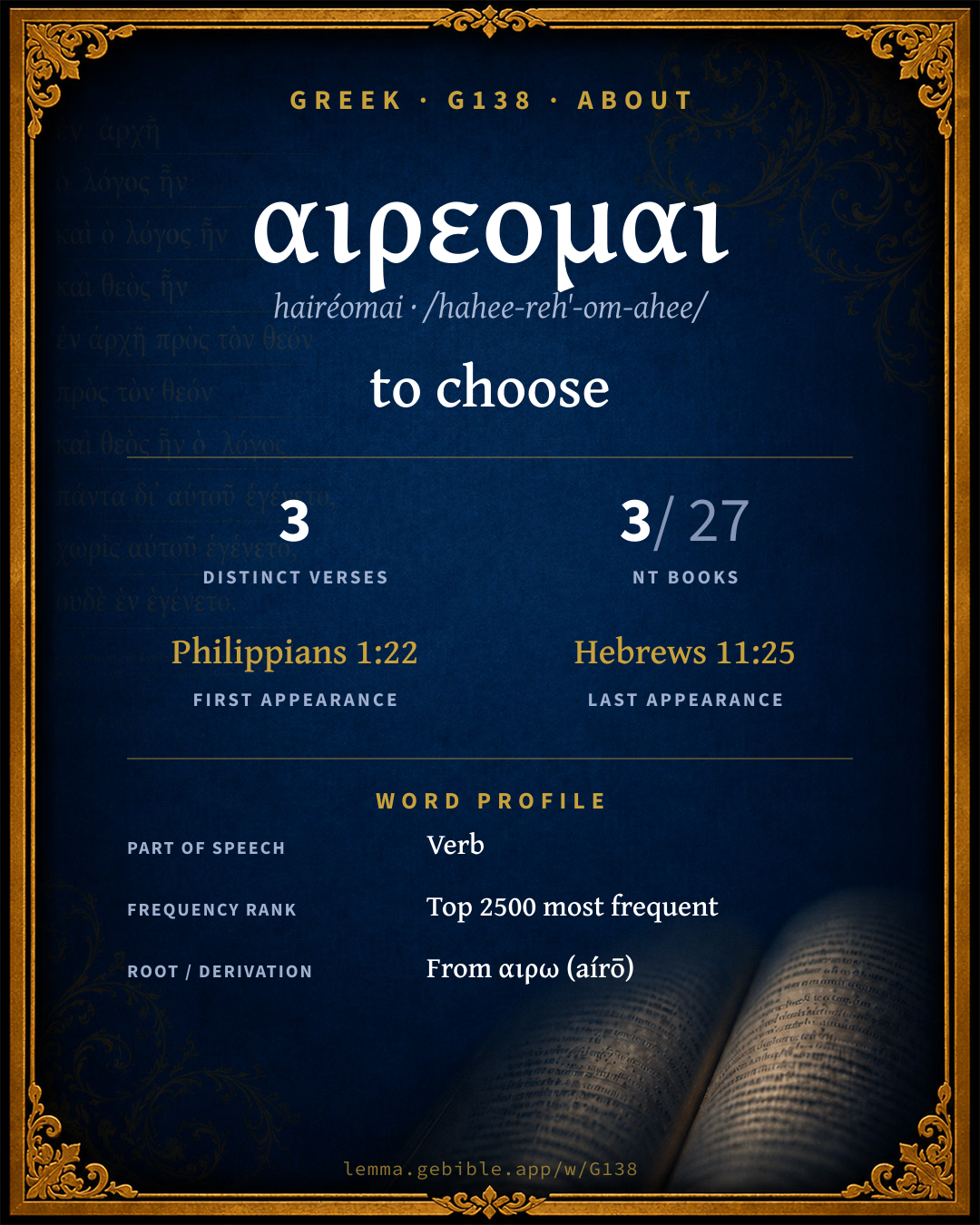
αἱρέομαι
to choose
‘to choose’ is one of 2 main senses fuller range ↓
Full lexicon entry — Thayer's Greek Lexicon
From Thayer's Greek Lexicon
Where this word appears
See every Aorist-tense verb in the Greek New Testament →
Grammar key — what these labels mean
Part of speech
- Verb
- An action or state-of-being word.
Tense
- Aorist
- Action viewed as a simple whole, without regard to duration — often past (perfective aspect).
- Future
- Action expected in future time.
Voice
- Middle
- The subject acts on or for itself, or with special interest in the action.
Mood
- Participle
- A verbal adjective (“writing,” “having written”).
- Indicative
- States a fact or asks a factual question (the mood of reality).
Case
- Nominative
- The case of the subject (and the predicate nominative).
Person
- 3rd person
- The one spoken about (“he / she / it / they”).
- 1st person
- The speaker (“I / we”).
Gender
- Masculine
- Grammatically masculine.
Number
- Singular
- One.
Grammatical forms
- Verb, Aorist, Middle, Participle, Nominative, Singular, Masculine 1 time (33%)
- Verb, Aorist, Middle, Indicative, 3rd person, Singular 1 time (33%)
- Verb, Future, Middle, Indicative, 1st person, Singular 1 time (33%)
Parsed forms decoded from the imported morphology (Robinson–Tischendorf, public domain), counted across 3 parsed occurrences — not distinct verses.
Every verse where G138 appears — 3 distinct verses across 3 books. Click any verse to open its interlinear word-by-word view. Verse text shown in the World English Bible for context — . Each verse’s Greek form is shown with its reference; the English is not keyword-highlighted, since the data carries no word-level English alignment. Use “Compare translations” on any verse to read it across multiple English versions. This concordance covers the Greek New Testament; Septuagint (Greek Old Testament) occurrences of this word are not indexed here.
Philippians 1 verse
2 Thessalonians 1 verse
Hebrews 1 verse
About this entry
At a glance — auto-summarized from this page’s data, not written by a person. Every figure links to its source below. This summary describes the numbers; it doesn’t interpret them.
The Greek verb αιρεομαι centers on the idea of “to choose.” The Greek New Testament uses it only 3 verses. The word gravitates to Philippians (33%), then 2 Thessalonians and Hebrews. Its earliest occurrence is Philippians 1:22. Lexicons map it across 2 senses. Dig into 3-verse concordance and the renderings breakdown below.
Gloss history
Strong's 1890 vs modern scholarship
About this word
Strong's G138 catalogs a Greek word from the Greek New Testament.
These counts are not copied from any lexicon or concordance. They are computed here, from the morphology-tagged Greek New Testament. What Lemma adds →
- 3
- distinct verses
- The word appears in 3 distinct verses.
- 3 / 27
- NT books
- The word appears in 3 of 27 New Testament books.
- #2,203
- by frequency
- Top 2500 most frequent Greek words (rank 2,203 of 5,347 Greek words by occurrence).
View all 3 occurrences in the concordance →
Most concentrated in
- Philippians 1 verse 33%
- 2 Thessalonians 1 verse 33%
- Hebrews 1 verse 33%
By section of the New Testament
By traditional corpus
Conventional, traditional groupings — biblical authorship is debated, so this is a traditional corpus grouping, not an authorship claim. Some books belong to more than one corpus (Luke is in both the Gospels and the Lukan corpus, and so on), so these shares overlap and need not total 100%. Each figure is a share of the word’s 3 distinct verses.
- Pauline corpus 2 verses · 67%
- Hebrews 1 verse · 33%
How translations render this word
Counts come from each version’s own published word-to-Strong’s tagging or interlinear alignment — an approximate guide to how each version renders this word, not a word-level alignment the data otherwise carries. Because each total is that version’s own tagged count, the per-version totals vary from one another and need not match the appearance or distinct-verse counts above. These counts may also differ from a printed concordance because Lemma counts each distinctly tagged rendering and does not collapse phrase taggings into a single head-word total. This is a fixed set of word-tagged versions (KJV, ASV, BSB, ULT) and does not change with the reading translation you choose elsewhere. Each version’s license is shown beside its name below (and on Sources).
- King James Version: Choosing 1×, Chosen 1×, Hath 1×
- American Standard Version: Choosing 1×, God chose 1×, I shall choose 1×
- Berean Standard Bible: Chose 1×, He chose 1×, Shall i choose 1×
- unfoldingWord Literal Text: Chose 1×, He chose 1×, I will choose 1×
King James Version Public Domain
Renders G138 across 4 tagged occurrences — most commonly:
American Standard Version Public Domain
Renders G138 across 3 tagged occurrences — most commonly:
Berean Standard Bible Public Domain
Renders G138 across 3 tagged occurrences — most commonly:
unfoldingWord Literal Text CC BY-SA 4.0
Renders G138 across 3 tagged occurrences — most commonly:
Senses in Thayer's
The 2 senses Thayer's distinguishes for this word, in lexicon order (not ranked by frequency or importance). The full entry — with sub-senses — is in the Lexicon Entry tab.
- to take for oneself, to prefer, choose
- to choose by vote, elect to office
Word origin
Derived from αιρω (aírō) (G142) — to raise up.
Probably akin to G142 ; to take for oneself that is to prefer . Some of the forms are borrowed from a cognate ( ἕλλομαι hellomai) which is otherwise obsolete : - choose. Some of the forms are borrowed from a cognate hellomai hel-lom-ahee; which is otherwise obsolete.
— Strong’s Exhaustive Concordance (1890), public domain.
Forms in the corpus
The 3 distinct written forms G138 takes in the Greek New Testament, most frequent first — each parse links to that tense’s occurrences in the concordance.
| Form | Parsing | Example | Uses |
|---|---|---|---|
| αἱρήσομαι hairḗsomai | Verb, Future, Middle, Indicative, 1st person, Singular | Philippians 1:22 | 1 |
| εἵλατο heílato | Verb, Aorist, Middle, Indicative, 3rd person, Singular | 2 Thessalonians 2:13 | 1 |
| ἑλόμενος helómenos | Verb, Aorist, Middle, Participle, Nominative, Singular, Masculine | Hebrews 11:25 | 1 |
Same root — word family
Other Thayer's entries built from the same root as G138, grouped by Strong’s listed origin. These share a root / origin per the lexicon — not necessarily a shared meaning. Each links to that word’s own entry.
Derives from
Shares the same root
- αρα ará G685 curse
- αρα ára G686 therefore
- αρεσκω aréskō G700 to please
- αριθμος arithmós G706 number
- αρκεω arkéō G714 to ward off
- αρρην árrhēn G730 male
- αρτι árti G737 now
- αρτος ártos G740 bread
- αρτυω artýō G741 to season
- αρωμα árōma G759 spice
- ορος óros G3735 mountain
Derived from this word
- αιρεσις haíresis G139 choice
- αιρετιζω hairetízō G140 to choose
- αλωσις hálōsis G259 capture
- αρπαζω harpázō G726 to seize
- ελκυω helkýō G1670 to draw
- ηλιος hḗlios G2246 sun
- θελω thélō G2309 to will
- ιλεως híleōs G2436 merciful
- σεληνη selḗnē G4582 moon
- σπειρα speîra G4686 cohort
- συλαω syláō G4813 to rob
- συρω sýrō G4951 to drag
- τιλλω tíllō G5089 to pluck
Compare all same-root words → Showing 4 of 26 — not the complete family. They share a root, not necessarily a meaning.
Septuagint usage
The same Greek word αιρεομαι appears 9 times in the Greek Old Testament (Septuagint), across 9 verses in 7 books.
- 9
- LXX occurrences
- Tagged occurrences of this Greek word in the Septuagint.
- 9
- verses
- Distinct Septuagint verses containing this word.
- 7 / 39
- OT books
- The word appears in 7 of the 39 Old Testament books.
Sample Septuagint occurrences
- Deuteronomy 26:17 αἱρέω
- Joshua 24:15 αἱρέω
- 1 Samuel 19:1 αἱρέω
- 2 Samuel 15:15 αἱρέω
- Job 34:4 αἱρέω
- Isaiah 38:17 αἱρέω
- Jeremiah 8:3 αἱρέω
Septuagint occurrences (same lexeme)
Every verse where the same Strong’s number (G138) appears in the Greek Septuagint. Verse text shown in the World English Bible for context; the Greek form is the matched word — the English is not keyword-highlighted.
- Deuteronomy 26:17 αἱρέω You have declared Yahweh this day to be your God, and that you would walk in his ways, and keep his statutes, and his commandments, and his ordinances, and listen to his voice:
- Deuteronomy 26:18 αἱρέω and Yahweh has declared you this day to be a people for his own possession, as he has promised you, and that you should keep all his commandments;
- Joshua 24:15 αἱρέω If it seem evil to you to serve Yahweh, choose you this day whom you will serve; whether the gods which your fathers served that were beyond the River, or the gods of the Amorites, in whose land you dwell: but as for me and my house, we will serve Yahweh.
- 1 Samuel 19:1 αἱρέω Saul spoke to Jonathan his son, and to all his servants, that they should kill David. But Jonathan, Saul's son, delighted much in David.
- 2 Samuel 15:15 αἱρέω The king's servants said to the king, Behold, your servants are ready to do whatever my lord the king shall choose.
- 2 Samuel 19:10 αἱρέω Absalom, whom we anointed over us, is dead in battle. Now therefore why don't you speak a word of bringing the king back?
- Job 34:4 αἱρέω Let us choose for us that which is right. Let us know among ourselves what is good.
- Isaiah 38:17 αἱρέω Behold, [it was] for [my] peace [that] I had great bitterness: But you have in love to my soul delivered it from the pit of corruption; For you have cast all my sins behind your back.
- Jeremiah 8:3 αἱρέω Death shall be chosen rather than life by all the residue that remain of this evil family, that remain in all the places where I have driven them, says Yahweh of Hosts.
These are occurrences of the same Greek lexeme (G138) in the Septuagint — not a translation of any one Hebrew word. The store carries no word-level Hebrew↔Greek alignment, so no Hebrew original is asserted here. Counts come from the recovered LXX Strong's tagging — high-frequency vocabulary is well covered, while rare or late forms may be untagged — so they reflect tagged occurrences and may slightly undercount.