
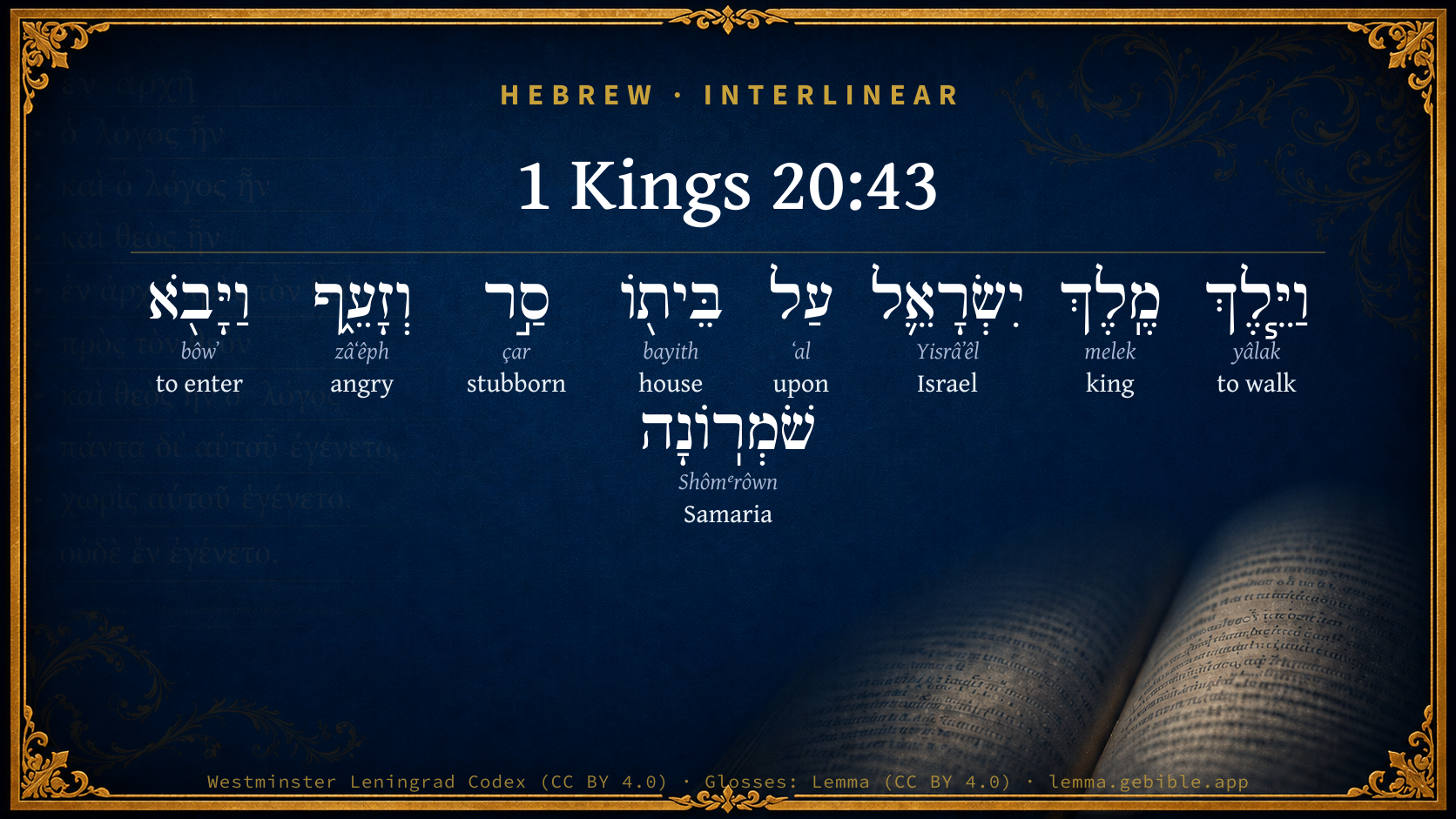
1 Kings 20:43

Hebrew (Westminster Leningrad Codex) 1 Kings 20:43 appears in the Hebrew Old Testament. The text above is from the Westminster Leningrad Codex. Each word links to its Strong’s number, a concise gloss, and parsing drawn from the Open Scriptures Hebrew Bible morphology. Click any word for its full Brown-Driver-Briggs (BDB) entry.
Download image
Cite this verse

1 Kings 20:43 (World English Bible). Public Domain. Lemma interlinear Bible study tool, https://lemma.gebible.app/v/1-kings/20/43.

Show BibTeX & RIS
BibTeX
RIS
English Translation
The king of Israel went to his house sullen and angry, and came to Samaria.
World English Bible · Public Domain
Highlights
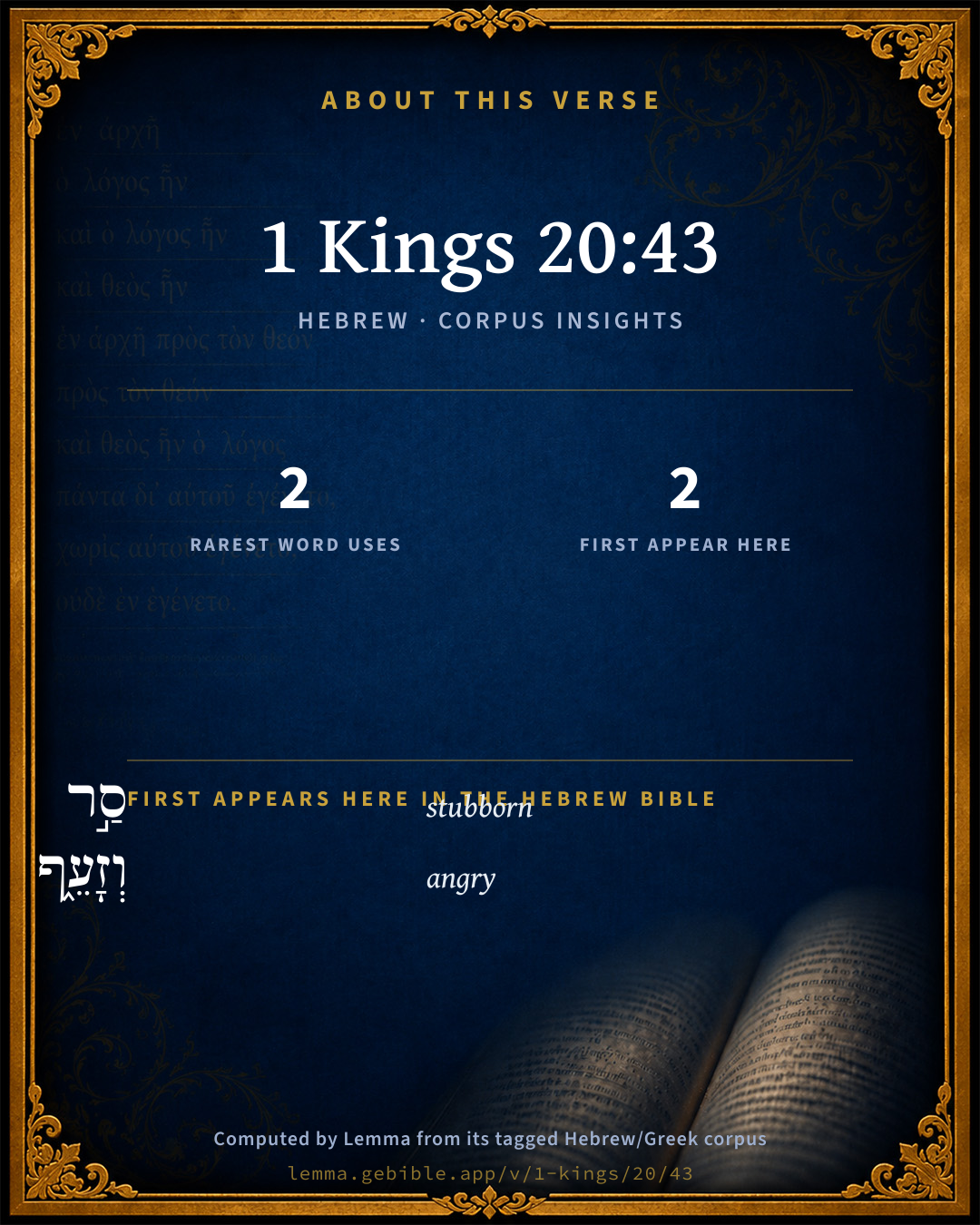
  • 2 first appearances in the Hebrew Bible
Full analysis ↓
Download a study sheet

One document with this verse’s original text, its word-by-word gloss line, the meaning frame, cross-references with their text, attributed commentary, and full source and license credits — printable, and it pastes into notes with its structure intact.

This verse Autodidact and up

Study sheet (.html) Plain text (.txt)

A passage Seminary Student

Up to 50 verses in one chapter. A passage sheet keeps up to 6 commentary sources and 12 cross-references per verse, in the order this page ranks them, and says so on the sheet whenever that leaves anything out. Ask for a single verse and you get the Autodidact verse sheet above.

Everything on this page stays free to read, with no account — the sheet is a download of what is already on screen, not access to it.

Want to remove ads? Support Godless Engineer
Compare translations 3

The same verse in 3 English versions, stacked beneath the original-language interlinear above. Click any original word for its lexicon entry.

Each is an independent rendering of the whole verse — the interlinear is not word-aligned to these translations.

Highlighted words mark where these versions differ — a whole-verse word diff, not a word-by-word alignment.

  • World English Bible Public Domain
    The king of Israel went to his house sullen and angry, and came to Samaria.
  • King James Version Public Domain
    And the king of Israel went to his house heavy and displeased, and came to Samaria.
  • unfoldingWord Literal Text CC BY-SA 4.0
    And the king of Israel went to his house sullen and angry, and he came to Samaria.

unfoldingWord Literal Text — © unfoldingWord, licensed CC BY-SA 4.0. Word-aligned USFM3 via Door43 (git.door43.org/unfoldingWord/en_ult).

Versions to compare (up to 4)

3 of 4 selected

Show all 18 translations

Every available English version of this verse, each an independent rendering of the whole verse.

  • World English Bible Public Domain
    The king of Israel went to his house sullen and angry, and came to Samaria.
  • Berean Standard Bible Public Domain
    Sullen and angry, the king of Israel went home to Samaria.
  • Majority Standard Bible Public Domain
    Sullen and angry, the king of Israel went home to Samaria.
  • King James Version Public Domain
    And the king of Israel went to his house heavy and displeased, and came to Samaria.
  • American Standard Version (1901) Public Domain
    And the king of Israel went to his house heavy and displeased, and came to Samaria.
  • Revised Version (1885) Public Domain
    And the king of Israel went to his house heavy and displeased, and came to Samaria.
  • Geneva Bible (1599) Public Domain
    And the King of Israel went to his house heauie and in displeasure, and came to Samaria.
  • Douay-Rheims (1899) Public Domain
    And the king of Israel returned to his house, slighting to hear, and raging came into Samaria.
  • Young's Literal Translation Public Domain
    and the king of Israel goeth unto his house, sulky and wroth, and cometh in to Samaria.
  • Literal Standard Version CC BY-SA 4.0
    and the king of Israel goes to his house, sulky and angry, and comes to Samaria.
  • Unlocked Literal Bible CC BY-SA 4.0
    So the king of Israel went to his house resentful and angry, and arrived in Samaria.
  • unfoldingWord Literal Text CC BY-SA 4.0
    And the king of Israel went to his house sullen and angry, and he came to Samaria.
  • Darby Bible Public Domain
    And the king of Israel went to his house sullen and vexed, and came to Samaria.
  • World Messianic Bible Public Domain
    The king of Israel went to his house sullen and angry, and came to Samaria.
  • Webster's Bible Public Domain
    And the king of Israel went to his house heavy and displeased, and came to Samaria.
  • Free Bible Version CC BY-SA 4.0
    The king of Israel went home to Samaria, sulking and infuriated.
  • Bible in Basic English Public Domain
    Then the king of Israel went back to his house, bitter and angry, and came to Samaria.
  • JPS Tanakh (1917) Public Domain
    And the king of Israel went to his house sullen and displeased, and came to Samaria.

Literal Standard Version (2020), Covenant Press — licensed CC BY-SA 4.0. Text via the HelloAO Bible API (eBible.org). Unlocked Literal Bible (unfoldingWord) — licensed CC BY-SA 4.0. Text via the HelloAO Bible API (eBible.org). unfoldingWord Literal Text — © unfoldingWord, licensed CC BY-SA 4.0. Word-aligned USFM3 via Door43 (git.door43.org/unfoldingWord/en_ult). Free Bible Version, Dr. Jonathan Gallagher — licensed CC BY-SA 4.0. Text via the HelloAO Bible API (eBible.org).

Word by word

More ways to search: Search by grammar → Find every occurrence → Compare this word →

Practice this passage: Drill this verse → Learn its vocabulary →

About this verse

These counts appear in no published source. They are computed here, from the morphology-tagged text and Lemma’s own curated glosses. What Lemma adds →

9
words
9
distinct lemmas
Historical
section

Notable vocabulary

The rarest word here is וְזָעֵ֑ף angry H2198 — appearing just 2 times in the whole Hebrew Bible.

First appearance in Scripture

These words make their first canonical appearance in the Hebrew Bible here:

  • סַ֣ר stubborn H5620
  • וְזָעֵ֑ף angry H2198

Shared distinctive vocabulary

וְזָעֵ֑ף angry H2198 occurs in 2 verses of the Hebrew Bible. Also found in:

Grammatical profile

  • 2 verbs
  • 4 nouns
  • 2 adjectives
  • 1 preposition

Verb forms

  • וַיֵּ֧לֶךְ Qal · Sequential Imperfect
  • וַיָּבֹ֖א Qal · Sequential Imperfect

Cross-references

6

Topical passages linked to 1 Kings 20:43 in the Treasury of Scripture Knowledge — connected by theme and wording, ordered by reader-vote popularity; previews shown in the World English Bible.

  • 1 Kings 21:4 Ahab came into his house sullen and angry because of the word which Naboth the Jezreelite had spoken to him; for he had said, I will not give you the inheritance of my fathers. He laid him down on his bed, and turned away his face, and would eat no bread.
  • 1 Kings 22:8 The king of Israel said to Jehoshaphat, there is yet one man by whom we may inquire of Yahweh, Micaiah the son of Imlah: but I hate him; for he does not prophesy good concerning me, but evil. Jehoshaphat said, "Don't let the king say so."
  • Esther 5:13 Yet all this avails me nothing, so long as I see Mordecai the Jew sitting at the king's gate.
  • Esther 6:12–13 Mordecai came again to the king's gate. But Haman hurried to his house, mourning and having his head covered.
  • Job 5:2 For resentment kills the foolish man, And jealousy kills the simple.
  • Proverbs 19:3 The foolishness of man subverts his way; His heart rages against Yahweh.

Cross-references courtesy of OpenBible.info (CC BY 4.0).

Hebrew and Greek witnesses Masoretic Hebrew ↔ Greek Septuagint

The same verse in the two great witnesses to the Old Testament, shown verse-for-verse.

These are two independent witnesses, not word-aligned to each other, and the Septuagint is shown in lemma (dictionary) form.

Hebrew 1 Kings 20:43 Masoretic · Westminster Leningrad Codex

וַיֵּ֧לֶךְ מֶֽלֶךְ יִשְׂרָאֵ֛ל עַל בֵּית֖וֹ סַ֣ר וְזָעֵ֑ף וַיָּבֹ֖א שֹׁמְרֽוֹנָה

The king of Israel went to his house sullen and angry, and came to Samaria.

World English Bible · Public Domain

On this verse, Adam Clarke's Commentary discusses the Septuagint’s reading. Read the note in Commentary ↓

Hebrew: Westminster Leningrad Codex (CC BY 4.0). Greek: Septuagint (public domain); English from a public-domain English Septuagint. How the Septuagint differs from the Hebrew →

Targum (Aramaic paraphrase)

1

The Targum is the ancient Jewish Aramaic paraphrase of the Hebrew Scriptures — an interpretive translation, not the Hebrew text itself. Onkelos (literal) and Pseudo-Jonathan (expansive) render the Torah, and Jonathan the Prophets. Coverage is partial: where no permissively-licensed English translation exists for a verse, only the Aramaic is shown. This is verse-level text, not a word-by-word alignment to the Hebrew.

  1. Targum Jonathan Prophets (Joshua–Malachi)
    וַאֲזַל מַלְכָּא דְיִשְׂרָאֵל לְבֵיתֵיהּ נְסִיס וְדַוָי וַאֲתָא לְשֹׁמְרוֹן:

    (no public-domain English translation for this verse)

    Targum Jonathan — Aramaic: “Mikraot Gedolot” (public domain). English: “Sefaria Community Translation” (CC0 1.0 (public-domain dedication)); “London "Chaldee Paraphrase," 1871” (public domain). Text via Sefaria.

Commentary

Notes on 1 Kings 20:43 from classic Christian and Jewish commentators (each source and its license shown beneath its notes). The classic Christian expositions comment on the surrounding passage and are grouped to its opening verse, so a note may address several verses; the Jewish commentaries on the Tanakh (Rashi and others) are per-verse, so they appear only where the commentator wrote on this verse.

Lemma curates 59 commentaries, every one of them public domain or Creative Commons licensed, each selected and text-cleaned for this edition rather than reprinted as found. About our sources →

Trapp's Complete Commentary

John Trapp

1Ki 20:43 And the king of Israel went to his house heavy and displeased, and came to Samaria.

Ver. 43. Heavy and displeased.] Not with a "sorrow according to God," but such as arose from a slavish fear: this heavy message in the midst of his triumph, being worse than the whip and bell hung up usually in the chariot of the Roman triumpher, to show him what he might one day come to, viz., to be whipped as a slave, yea, to lose his head as an offender.

John Trapp, A Commentary or Exposition upon All the Books of the Old and New Testament (1647–1656) — public domain. Text from a community e-Sword module.

Joseph Benson's Commentary

1Ki 20:43. The king of Israel went to his house heavy and displeased — This distressing sentence turned all their joy, for their late victory, into mourning; Ahab being much troubled for what he had done, and for what, it seems, he now believed he must suffer.

Joseph Benson's Commentary on the Old and New Testaments (1811–1818) — public domain. Text from a community e-Sword module.

Geneva Bible (1599)

Geneva Bible translators

Or, Shomeron.

Geneva Bible (1599) marginal notes — public domain. Text via Bolls.life.

Adam Clarke's Commentary

Verse 43. Heavy and displeased] Heavy or afflicted, because of these dreadful tidings; and displeased with the prophet for having announced them. Had he been displeased with himself, and humbled his soul before God, even those judgments, so circumstantially foretold, might have been averted.

1. WE have already seen, in 1Kg 20:30, that according to our text, twenty-seven thousand men were slain by the falling of a wall. Serious doubts are entertained concerning the legitimacy of this rendering. I have, in the note, given the conjecture concerning sapping the foundation of the wall, and thus overthrowing them that were upon it. If instead of חומה chomah, a wall, we read חומה confusion or disorder, then the destruction of the twenty-seven thousand men may appear to have been occasioned by the disorganized state into which they fell; of which their enemies taking advantage, they might destroy the whole with ease.

But חומה chomah, a wall, becomes, as Dr. Kennicott has observed, a very different word when written without the ו vau, חמה which signifies heat; sometimes the sun, vehement heat, or the heat of the noon-day sun; and also the name of a wind, from its suffocating, parching quality.

The same noun, from יחם yacham, Dr. Castel explains by excandescentia, furor, venenum; burning, rage, poison. These renderings, says Dr. Kennicott, all concur to establish the sense of a burning wind, eminently blasting and destructive. I shall give a few instances from the Scripture: -

We read in Job 27:21: The east wind carrieth him away; where the word קדים kadim is καυσων, burning, in the Septuagint; and in the Vulgate, ventus urens, a burning wind. In Eze 19:12: She was plucked up בחמה she was cast down to the ground, and the east wind dried up her fruit; her strong rods were withered, and the fire consumed them. Hosea (Ho 13:15) mentions the desolation brought by an east wind, the wind of the Lord. What in Am 4:9 is, I have smitten you with blasting, in the Vulgate is, in vento vehemente, "with a vehement wind;" and in the Syriac, with a hot wind.

Let us apply these to the history: when Ben-hadad, king of Syria, was besieging Samaria the second time, the Israelites slew of the Syrians one hundred thousand footmen in one day; and it follows, that when the rest of the army fled to Aphek, twenty-seven thousand of the men that were left were suddenly destroyed by החומה hachomah, or החמה hachamah, a burning wind. That such is the true interpretation, will appear more clearly if we compare the destruction of Ben-hadad's army with that of Sennacherib, whose sentence is that God would send upon him a BLAST, רוח ruach, a wind; doubtless such a wind as would be suddenly destructive. The event is said to be that in the night one hundred and eighty-five thousand Assyrians were smitten by the angel of the Lord, 2Kg 19:7; 2Kg 19:35. The connection of this sentence with the execution of it is given by the psalmist, who says, Ps 104:4: God maketh his angels רחות ruchoth, winds; or, maketh the winds his angels, i.e., messengers for the performance of his will. In a note on Ps 11:6, Professor Michaelis has these words: Ventus Zilgaphoth, pestilens eurus est, orientalibus notissimus, qui obvia quaevis necat; "The wind Zilgaphoth is a pestilent east wind, well known to the Asiastics, which suddenly kills those who are exposed to it." Thevenot mentions such a wind in 1658, that in one night suffocated twenty thousand men. And the Samiel he mentions as having, in 1665, suffocated four thousand persons. "Upon the whole, I conclude," says the doctor, 'that as Thevenot has mentioned two great multitudes destroyed by this burning wind, so has holy Scripture recorded the destruction of two much greater multitudes by a similar cause; and therefore we should translate the words thus: But the rest fled to Aphek, into the city; and THE BURNING WIND fell upon the twenty and seven thousand of the men that were left."

2. On the case of Ben-hadad and his servants coming out to Ahab with sackcloth on their loins and ropes about their necks, 1Kg 20:31, I have referred to that of the six citizens of Calais, in the time of Edward III. I shall give this affecting account from Sir John Froissart, who lived in that time, and relates the story circumstantially, and with that simplicity and detail that give it every appearence of truth. He is the only writer, of all his contemporaries, who gives the relation; and as it is not only illustrative of the text in question, but also very curious and affecting, I will give it in his own words; only observing that, King Edward having closely invested the city in 1346, and the king of France having made many useless attempts to raise the siege, at last withdrew his army, and left it to its fate. "Then," says Froissart, chap. cxliv., "after the departure of the king of France with his army, the Calesians saw clearly that all hopes of succour were at an end; which occasioned them so much sorrow and distress that the hardiest could scarcely support it. They entreated therefore, most earnestly, the lord Johns de Vienne, their governor, to mount upon the battlements, and make a sign that he wished to hold a parley.

"The king of England, upon hearing this, sent to him Sir Walter Manny and Lord Basset. When they were come near, the lord de Vienne said to them: 'Dear gentlemen, you, who are very valiant knights, know that the king of France, whose subjects we are, has sent us hither to defend this town and castle from all harm and damage. This we have done to the best of our abilities; all hopes of help have now left us, so that we are most exceedingly straitened; and if the gallant king, your lord, have not pity upon us, we must perish with hunger. I therefore entreat that you would beg of him to have compassion upon us, and to have the goodness to allow us to depart in the state we are in; and that he will be satisfied with having possession of the town and castle, with all that is within them, as he will find therein riches enough to content him.' To this Sir Walter Manny replied: 'John, we are not ignorant of what the king our lord's intentions are, for he has told them to us; know then, that it is not his pleasure that you should get off so, for he is resolved that you surrender yourselves wholly to his will, to allow those whom he pleases their ransom, or to be put to death; for the Calesians have done him so much mischief, and have, by their obstinate defense, cost him so many lives, and so much money, that he is mightily enraged.'

"The lord de Vienne answered: 'These conditions are too hard for us; we are but a small number of knights and squires, who have loyally served our lord and master, as you would have done, and have suffered much ill and disquiet: but we will endure more than any men ever did in a similar situation, before we consent that the smallest boy in the town should fare worse than the best. I therefore once more entreat you, out of compassion, to return to the king of England, and beg of him to have pity on us; he will, I trust, grant you this favour; for I have such an opinion of his gallantry as to hope that, through God's mercy, he will alter his mind.'

"The two lords returned to the king and related what had passed. The king said: 'He had no intention of complying with the request, but should insist that they surrendered themselves unconditionally to his will.' Sir Walter replied: 'My lord, ye may be to blame in this, as you will set us a very bad example; for if you order us to go to any of your castles, we shall not obey you so cheerfully if you put these people to death, for they will retaliate upon us in a similar case.'

"Many barons who were present supported this opinion; upon which the king replied: 'Gentlemen, I am not so obstinate as to hold my opinion alone against you all. Sir Walter, you will inform the governor of Calais, that the only grace he is to expect from me is, that six of the principal citizens of Calais march out of the town with bare heads and feet, with ropes round their necks, and the keys of the town and castle in their hands. These six persons shall be at my absolute disposal, and the remainder of the inhabitants pardoned.'

"Sir Walter returned to the lord de Vienne, who was waiting for him on the battlements, and told him all that he had been able to gain from the king. 'I beg of you,' replied the governor, 'that you would be so good as to remain here a little, whilst I go and relate all that has passed to the townsmen; for, as they have desired me to undertake this it is but proper that they should know the result of it.'

"He went to the market place, and caused the bell to be rung; upon which all the inhabitants, men and women, assembled in the town-hall. He then related to them what he had said, and the answers he had received, and that he could not obtain any conditions more favourable; to which they must give a short and immediate answer.

"This information caused the greatest lamentations and despair, so that the hardest heart would have had compassion on them; even the lord de Vienne wept bitterly.

"After a short time the most wealthy citizen of the town, by name Eustace de St. Pierre, rose up and said: 'Gentlemen, both high and low, it would be a very great pity to suffer so many people to die through famine, if any means could be found to prevent it; and it would be highly meritorious in the eyes of our Saviour, if such misery could be averted. I have such faith and trust in finding grace before God, if I die to save my townsmen, that I name myself as first of the six.'

"When Eustace had done speaking, they all rose up and almost worshipped him: many cast themselves at his feet with tears and groans. Another citizen, very rich and respected, rose up and said, 'He would be the second to his companion Eustace;' his name was John Daire. After him James Wisant, who was very rich in merchandise and lands, offered himself as companion to his two cousins, as did Peter Wisant, his brother. Two others then named themselves, which completed the number demanded by the king of England. The lord John de Vienne then mounted a small hackney, for it was with difficulty he could walk, (he had been wounded in the siege,) and conducted them to the gate. There was the greatest sorrow and lamentation over all the town; and in such manner were they attended to the gate, which the governor ordered to be opened and then shut upon him and the six citizens, whom he led to the barriers, and said to Sir Walter Manny, who was there waiting for him, 'I deliver up to you, as governor of Calais, with the consent of the inhabitants, these six citizens; and I swear to you that they were, and are at this day, the most wealthy and respectable inhabitants of Calais. I beg of you, gentle sir, that you would have the goodness to beseech the king that they may not be put to death.' 'I cannot answer for what the king will do with them,' replied Sir Walter; 'but you may depend that I will do all in my power to save them.'

"The barriers were opened, when these six citizens advanced towards the pavilion of the king, and the lord de Vienne re-entered the town.

"When Sir Walter Manny had presented these six citizens to the king, they fell upon their knees, and with uplifted hands said: 'Most gallant king, see before you six citizens of Calais, who have been capital merchants, and who bring you the keys of the castle and of the town. We surrender ourselves to your absolute will and pleasure, in order to save the remainder of the inhabitants of Calais, who have suffered much distress and misery. Condescend, therefore, out of your nobleness of mind, to have mercy and compassion upon us.' All the barons knights, and squires, that were assembled there in great numbers, wept at this sight.

"The king eyed them with angry looks, (for he hated much the people of Calais, for the great losses he had formerly suffered from them at sea,) and ordered their heads to be stricken off. All present entreated the king that he would be more merciful to them, but he would not listen to them. Then Sir Walter Manny said: 'Ah, gentle king, let me beseech you to restrain your anger; you have the reputation of great nobleness of soul, do not therefore tarnish it by such an act as this, nor allow any one to speak in a disgraceful manner of you. In this instance all the world will say you have acted cruelly, if you put to death six such respectable persons, who of their own free will have surrendered themselves to your mercy, in order to save their fellow citizens.' Upon this the king gave a wink, saying, Be it so, and ordered the headsman to be sent for; for that the Calesians had done him so much damage, it was proper they should suffer for it.

"The queen of England, who was at that time very big with child, fell on her knees, and with tears said: 'Ah, gentle sir, since I have crossed the sea with great danger to see you, I have never asked you one favour; now I most humbly ask as a gift, for the sake of the Son of the blessed Mary, and for your love to me, that you will be merciful to these six men.' The king looked at her for some time in silence, and then said: 'Ah, lady, I wish you had been any where else than here; you have entreated in such a manner that I cannot refuse you; I therefore give them to you, to do as you please with them.'

"The queen conducted the six citizens to her apartments, and had the halters taken from round their necks, new clothed, and served them with a plentiful dinner; she then presented each with nobles, and had them escorted out of the camp in safety."

This is the whole of this affecting account, which is mentioned by no other writer, and has been thought a proper subject for the pen of the poet, the pencil of the painter, and the burin of the engraver; and which has seldom been fairly represented in the accounts we have of it from our historians. The translation I have borrowed from the accurate edition of Froissart, by Mr. Johns, of Hafod; and to his work, vol. i., p. 367, I must refer for objections to the authenticity of some of the facts stated by the French historian. We see in Eustace de St. Pierre and his five companions the portrait of genuine patriotism. - a principle, almost as rare in the world as the Egyptian phoenix, which leads its possessors to devote their property and consecrate their lives to the public weal; widely different from that spurious birth which is deep in the cry of My country! while it has nothing in view but its places, pensions, and profits. Away with it!

Adam Clarke's Commentary on the Bible (1810–1826) — public domain. Text from a community e-Sword/MySword module.

The Cambridge Bible for Schools and Colleges

gen. ed. J. J. S. Perowne

43. heavy and displeased] Said again of Ahab in the next chapter (1Ki_20:4) when he could not prevail upon Naboth to part with his vineyard. The first of these words is used in 1Ki_21:5 to signify sadness of spirit, the second indicates anger arising from disappointment. It describes the sort of rage which Asa exhibited (2Ch_16:10) when he put Hanani in prison for telling him that he had done wrong in relying on the help of the Syrians instead of trusting in the Lord.

The Cambridge Bible for Schools and Colleges (gen. ed. J. J. S. Perowne; Cambridge University Press, 1878–1918) — public domain. Text from a community e-Sword module.

John Gill's Exposition

And the king of Israel went to his house heavy and displeased,.... With the prophet for what he had said, and with himself for what he had done in letting Benhadad go; the Targum is, he was

"troubled and grieved,''

not so much for the sin he had committed, as for the punishment of it on him and his people:

and came to Samaria; with a heavy heart, for the message of the prophet had spoiled the joy of his victory.

Next: 1 Kings Chapter 21

John Gill's Exposition of the Whole Bible (1746–1763) — public domain (CC PDM 1.0). Text via the HelloAO Bible API.

Albert Barnes' Notes on the Bible

Heavy and displeased - Rather, “sullen and angry” (and so marginal reference), not repentant, as after Elijah’s warning 1Ki 21:27 - not acknowledging the justice of his sentence - but full of sullenness and suppressed anger.

Albert Barnes' Notes on the Bible (1834–1885) — public domain. Text from a community e-Sword/MySword module.

Haydock's Catholic Bible Commentary

Raging, (furibundus) full of indignation. Hebrew, "went to his house heavy and displeased." Septuagint, "confounded and fainting," through rage; Greek: eklelumenos. (Haydock) --- "Vexed at the prophet, he ordered him to be kept in prison; and confounded at what Micheas had said, he went to his own house." (Josephus, [Antiquities?] viii. 14.)

George Leo Haydock (1774–1849), Haydock's Catholic Family Bible and Commentary, 1859 edition — public domain. Excludes Psalms (Douay-Rheims chapter numbering differs from Protestant) and Deuterocanonical books (Catholic canon only).

Matthew Poole's English Annotations

Heavy and displeased; not for his sin, but for the sad effects of it upon himself and people; which he might confidently expect, having had many experiences that God did not suffer the words of his prophets to fall to the ground.

Matthew Poole's English Annotations on the Holy Bible (1683–1685) — public domain. Text from a community e-Sword/MySword module.

Whedon's Commentary on the Bible

Daniel D. Whedon

43. Heavy and displeased — He was vexed, troubled, and felt the burden of a sense of Divine wrath upon him; but he was still refractory and rebellious. He went home sulky and sour.

Daniel D. Whedon (gen. ed.), Commentary on the Old and New Testaments (1874–1909) — public domain. Text from a community e-Sword module.

The Pulpit Commentary

And the king of Israel went to his house heavy and displeased Heb. sullen and angry; same words, (1Ki_21:4) and came to Samaria. The order of verse suggests that the house was one in or near Aphek, in which the king was lodged after the battle on which this interview, therefore, followed closely and that shortly afterwards he left it for his capital.

Heavy and displeased." Cf. Psa_16:4 Psa_32:10. "Uneasy lies the head that wears a crown." Life out of God brings only disappointment. The most magnificent of kings found it vanity and vexation of spirit. The things of earth cannot satisfy the soul of man, the soul made for God. History has preserved for us a striking testimony to this truth in the confession of Abdalrahman, caliph of Spain. "I have now reigned," he wrote, "fifty years in victory or peace; beloved by my subjects, dreaded by my enemies, and respected by my allies. Riches and honours, power and pleasures, have waited on my call, nor does any earthly blessing appear to have been wanting to my felicity. In this situation I have numbered the days of pure and genuine happiness which have fallen to my lot: they amount to fourteen! O man, place not thy confidence in this present world."

The Pulpit Commentary (1880–1919), ed. H.D.M. Spence-Jones & Joseph S. Exell — public domain. Text from a community e-Sword module.

Keil & Delitzsch

C. F. Keil & F. Delitzsch

The king therefore went home, and returned sullen (סר, from סרר) and morose to Samaria.

Keil & Delitzsch — Biblical Commentary on the Old Testament (1861–1891) — public domain (CC PDM 1.0). Text via the HelloAO Bible API. (Old Testament only.)

Rashi

Rabbi Shlomo Yitzchaki (Rashi)

Dejected and angry. [Targum Yonoson rendered,] “aggrieved and sad.” His spirit turned [סר] away from him.

Rashi on the Tanakh — English translations: “The Judaica Press complete Tanach with Rashi, translated by A. J. Rosenberg” (CC BY 4.0); “Pentateuch with Rashi's commentary by M. Rosenbaum and A.M. Silbermann, 1929-1934” (public domain); “The Metsudah Tanach series, Lakewood, N.J” (CC BY 4.0); and “The Book of Joshua, Metsudah Publications, 1997” (CC BY 4.0). Text via Sefaria.

Lesson kit

Teaching starters — assembled from the data on this page, not authored interpretation. Every prompt links to the verse data it draws on. Edit before teaching.

1 Kings, in the Historical, opens this verse with 9 words (9 distinct Hebrew lemmas). Its most distinctive word is zâʻêph (“angry”). A historical commentator’s framing appears above. Read the whole chapter for the surrounding context.

Discussion questions

  1. How does “angry” (zâʻêph) shape what this verse is saying?
  2. 2 words here appear for the first time in Scripture. What is being introduced at this debut?
  3. 1 Kings 21:4 shares the word «angry» with this verse. How do the two illuminate each other?
  4. The translations on this page render this verse differently — a whole-verse word diff, not a word-by-word alignment. What might account for the different wordings?
  5. The verb «וַיֵּ֧לֶךְ» is Qal Sequential Imperfect. How does its form color the action?
  6. Reading how Trapp's Complete Commentary and Joseph Benson's Commentary read this verse, where do the two commentators agree and where do they part?

Things to notice

  • 2 words make their first canonical appearance in Scripture here.
  • These translations choose different wording for 4 words in this verse.
  • 9 distinct Hebrew lemmas span 9 words in this verse.

Reading settings

Reading text

Shown beneath each verse's original-language words.

Old Testament
Old Testament edition

Read the OT as the Masoretic Hebrew (MT) or the Greek Septuagint (LXX).

English shown for the Greek Septuagint (in the Hebrew ↔ Greek comparison).

Comparing translations? Open the Compare panel on any verse page to stack up to four side by side.